
欧委会2026年8月第二版FAQ明确:已投放、已生产未投放、8月12日后新生产,是三种完全不同的库存状态。本文用六个真实场景,拆清装船、到港、自由流通、交付与随附文件的边界。
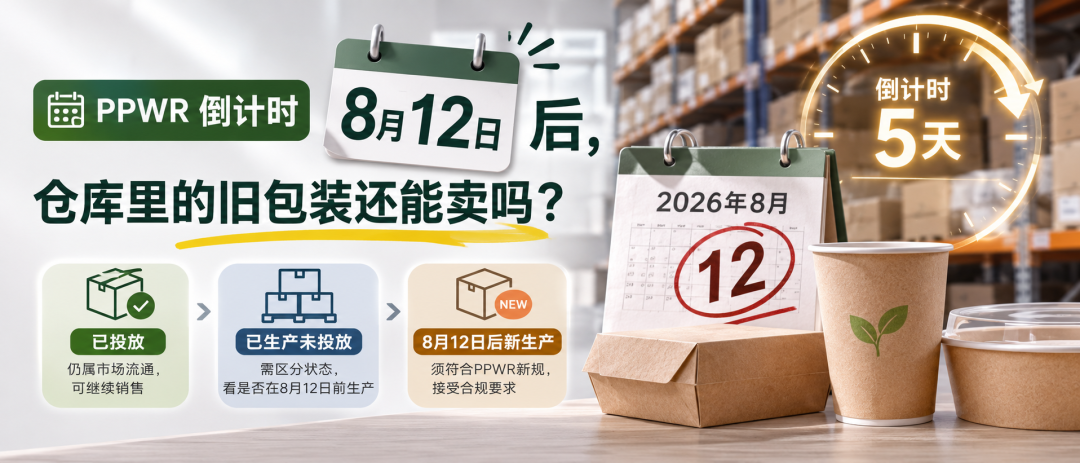
博碳包装|PPWR供应链观察
不看“哪天生产”,先看“何时首次进入欧盟市场”
欧委会2026年8月第二版FAQ明确:已投放、已生产未投放、8月12日后新生产,是三种完全不同的库存状态。本文用六个真实场景,拆清装船、到港、自由流通、交付与随附文件的边界。
三类库存|先分状态,再做决定
已投放|留证并排查特殊要求
已生产未投放|补齐投放时适用合规
8月12日后新生产|进入常态合规流程
PPWR · 2026 / 08 / 12
距离PPWR一般适用日,只剩 4 天
一批纸杯在中国仓库,一批纸盒正在海运,一批餐盒已经进入欧盟经销商仓库,还有一批装好食品后正在零售渠道。
它们都可能被企业统称为“旧库存”,但在PPWR下,答案并不相同。
先说结论:PPWR没有要求所有旧库存一律销毁,也没有允许所有旧库存一律继续销售。
真正的判断顺序只有三步:
这批包装是否已经首次投放欧盟市场;
在实际投放时点,哪些PPWR要求已经适用;
企业能否用同一SKU、批次和交易链证明前两件事。
旧,是物理时间;已投放,是法律状态。生产日期不能替代市场事实。
这正是欧委会2026年8月第二版FAQ给产业链最重要的提醒。
一先拆清两个词:提供,不等于首次投放
PPWR把“在市场提供”定义为:在商业活动中,为欧盟市场的分销、消费或使用而供应包装;包装可以是空的,也可以已经装入产品,可以有偿,也可以免费。
“投放市场”则是包装第一次在欧盟市场提供。
两个定义看似简单,真正进入供应链后却会出现多个时间节点:生产完成、签约或下单、开票、装船、到港、海关自由流通、交付、填装、上架销售。
这些日期都可能是证据,但没有一个日期能够脱离包装类型和真实交易安排,自动成为所有业务的“首次投放日”。
四个时钟必须分开记录
生产时钟: 包装何时制造完成,成为可交易的具体产品。
商业时钟: 何时出现关于所有权、占有或其他财产权利转移的要约或协议。
进口时钟: 第三国货物何时完成“进入自由流通”的进口程序。
成品时钟: 对销售包装或组合包装,何时完成填装、封合等可能影响最终合规的工序。
欧委会正式指引进一步说明:销售包装和组合食品包装通常在完成填装、封合等最终工序后投放,因为这些工序可能影响包装合规;运输包装和最终形态的服务包装则通常可以在空包装状态投放。
这意味着,“空包装已经卖出”和“装好产品才算投放”都不是可以套用到所有包装上的万能答案。
还要区分另一个容易混淆的概念:PPWR产品合规中的“首次投放欧盟市场”,与EPR语境下“首次在某成员国境内提供”不是同一个时钟。前者判断包装何时第一次进入欧盟商业流通,后者主要判断谁在具体成员国承担生产者责任。
二三类库存,必须用三套处理逻辑
INVENTORY 01
8月12日前已经首次投放欧盟市场
核心动作是:保存证据,而不是机械重做。
欧委会2026年8月第二版FAQ明确说明,8月12日前已经投放市场的包装可以继续留在市场,即使它不符合PPWR随后适用的要求。
但企业不能只用“货已经在欧洲”证明这一点。普通经销库存、寄售仓、平台履约仓、保税仓和仅为物流保管的仓库,背后的权利、占有和供应安排可能完全不同。
真正有用的是一组能够相互印证的记录:要约或合同、订单、发票、交付或收货、海关自由流通、仓库占有、SKU、批次与数量。
这里还有两道边界:
这项结论不能外推为食品接触、化学品、客户合同或成员国其他规则的全面豁免;
PPWR内部若某项要求有更早的特殊起算日期,仍要按该条款单独判断。可重复使用包装就是典型例外,其第11条判断涉及2025年2月11日这个更早分界。
所以,这一类库存的安全结论不是“旧货都能卖”,而是:
已经投放且能够证明的包装,原则上可以继续留在市场;但必须排除更早起算的特殊要求和其他并行法规。
INVENTORY 02
8月12日前已经生产,但尚未首次投放
核心动作是:补齐适用合规,而不是恐慌报废,也不是抢跑清仓。
新版FAQ明确,这类包装不需要因为8月12日到来就一律销毁、重新制造或重新贴标。对于PPWR第15(5)、15(6)条涉及的包装识别,以及制造商名称和地址,可以通过随附文件提供。
但这一安排只解决特定的识别与联系信息问题。它不替代:
投放时已经适用的实质要求;
适用的合格评定、技术文件与欧盟符合性声明;
制造商、供应商和欧盟进口商各自的责任;
文件与真实包装结构、SKU和批次的关联。
食品接触包装的PFAS限制就是最直接的例子。欧委会正式指引明确:PPWR没有为PFAS库存设置消化期。即使食品接触包装在8月12日前已经生产,只要在8月12日后首次投放,就必须满足届时生效的PFAS限值。
所以,这一类库存的安全结论是:
提前生产不等于自动豁免;无需机械报废,也不能只靠生产日期继续销售。
INVENTORY 03
8月12日后生产并首次投放
核心动作是:把合规嵌入正常生产、放行和交付流程。
包装的类型、型号、批次或等效识别,制造商信息,适用技术文件以及交易证据,应在出货前形成对应关系。
对于8月12日后生产的包装,随附文件不是默认替代路径。只有包装尺寸或性质确实不允许直接提供有关识别和制造商信息时,才可按法规允许的方式使用随附文件,并应逐案考虑包装的尺寸、形状和功能。
还有一个常见误解需要纠正:
“唯一识别”不等于每一只纸杯、每一个纸盒都必须拥有独立序列号。
欧委会FAQ说明,识别可以是类型、型号、生产批次、序列号或其他等效要素;关键是监管者能够用它连接到对应技术文件和欧盟符合性声明。
三六个真实场景,答案分别是什么?
SCENARIO 01
中国工厂仓库里的成品纸盒
初步判断:通常尚不能证明已经投放欧盟市场。
生产完成、装箱待运,甚至已经开具内部出库单,都不能单独证明包装第一次进入欧盟商业流通。要继续查看是否已有针对具体可发货产品的供应要约或协议、交易对象是谁,以及权利或占有是否已经转移。
企业不能把“生产日期早”当作8月12日后的通行证。
SCENARIO 02
8月10日离港,8月20日进入欧盟自由流通
初步判断:离港日不自动等于首次投放日。
欧委会FAQ指出,对进口包装或包装产品,投放通常被认为发生在申报进入自由流通时;但远程销售等场景可能在自由流通之前已经发生投放。
因此,不能简单写成“装船前赶上了,所以属于旧库存”,也不能机械地说“所有进口货物永远只看清关日”。应同时核对进口商、销售安排、Incoterms、订单对象、报关状态和实际权利转移。
SCENARIO 03
货物已经到欧盟,但仍在海关监管或保税状态
初步判断:地理位置本身不够。
如果货物尚未进入自由流通,也没有在欧盟市场发生供应,它通常不能仅凭“已经在欧盟境内”被认定为已投放。
新版FAQ还说明:仅在欧盟过境、未申报进入自由流通、也未投放欧盟市场的货物,原则上不要求满足PPWR。
所以,欧盟仓库、港口或保税区只是物理位置,不是自动形成的法律结论。
SCENARIO 04
8月12日前已交给欧盟经销商,现仍在经销仓库
初步判断:可能已经投放,关键在证据是否闭环。
如果存在真实的供应安排,所有权、占有或其他相关权利已经转移,且交付、收货、发票、批次和数量能够相互对应,这批包装更可能属于已经投放的后续库存。
但寄售、平台履约、第三方仓储或尚未自由流通的库存,不能只看仓库名称作结论。
SCENARIO 05
已经填装食品并进入欧盟零售渠道
初步判断:通常更接近已经投放,但仍须锁定具体批次和日期。
销售包装和组合食品包装通常在填装、封合等最终工序完成后投放。如果包装产品在8月12日前已经被供应到欧盟市场,且证据指向同一批次,FAQ的一般库存说明可能适用。
如果只是包装材料提前生产、食品产品在8月12日后才完成填装并首次供应,则不能只引用包装材料的生产日期。
SCENARIO 06
空纸杯、纸餐盒或折叠纸盒卖给欧盟填装商
初步判断:先判断包装功能和谁完成最终工序。
对销售包装和组合包装,完成最终切割、填装、封合并以自己的产品投放市场的主体,通常可能是PPWR意义上的制造商;转换加工企业则向其提供必要技术信息。
但运输包装、最终形态服务包装和部分空包装可以在空包装状态被首次投放。企业不能把所有纸杯、纸盒厂一律认定为最终制造商,也不能认为空包装永远没有投放。
六个场景共同说明:仓库位置、生产日期和单张发票只能提供线索;真正结论来自包装类型、交易事实、责任角色和证据链的组合。
四五个日期,不能互相替代
01生产日期
证明何时制造完成,不单独证明何时进入欧盟市场。
02订单或合同日期
可能证明供应安排,但要看是否针对已经制造完成、可明确识别的产品,以及协议具体转移什么权利。
03发票或装船日期
可以支撑交易和物流事实,但不在所有交易中自动决定首次投放。
04进入自由流通日期
是第三国进口包装的重要投放节点;远程销售等特定场景可能更早。
05首次供应或交付日期
需要与包装功能、所有权或占有安排、进口状态、SKU和批次一起判断。
Incoterms也一样。FOB、CIF、DAP或DDP能够帮助解释费用、风险和交付安排,却不会脱离实际合同、进口角色与货物流,自动替企业作出PPWR结论。
五随附文件能解决什么,不能解决什么?
对8月12日前已经生产但尚未投放的库存,新版FAQ允许用随附文件满足第15(5)、15(6)条的特定信息要求。这是一个重要的减损安排,但不是“随货放一张声明就合规”。
它可以解决
包装的类型、型号、批次、序列号或其他等效识别;
制造商名称、注册商号或商标、邮政地址,以及可用时的电子联系方式;
在包装尺寸或性质不允许直接提供信息时,建立与包装之间的可追溯连接。
它不能替代
已经适用的材料、物质、可持续性或其他实质要求;
适用的合格评定、技术文件和欧盟符合性声明;
欧盟进口商投放前的核验责任;
食品接触、化学品和目标成员国的其他并行要求;
对具体SKU、结构、用途和批次的真实证明。
企业内部至少应让随附资料能够关联:文件编号与版本、包装名称与结构、型号或批次、数量、制造商信息、适用声明或技术文件、对应订单或运输记录以及责任联系人。
以上是一套证据管理建议,不是欧盟规定的统一文件模板。
六24小时内,把库存从“数量账”升级为“法律状态账”
0—4 HOURS
冻结口径
把所有欧盟相关库存按SKU和批次拉出,不要只按品名或总吨位汇总。区分销售包装、组合包装、运输包装、服务包装,以及空包装与已填装包装产品。
4—10 HOURS
重建事件链
为每一行记录生产、订单、开票、装船、到港、自由流通、交付、填装和首次供应日期。任何结论都要标出依据,不允许只写“业务认为已经卖出”。
10—16 HOURS
画清责任链
确认谁是PPWR制造商、供应商、欧盟进口商和分销商;不要把EPR生产者与产品合规制造商混为一个角色,也不要默认纸盒厂承担最终包装的全部责任。
16—20 HOURS
核对适用要求
逐条标记实际投放时已经生效的要求、需要的技术文件和声明。对于食品接触包装,优先核查PFAS、食品接触与供应链材料证据;不要因为“可回收等级主要在2030年以后”就误判8月12日没有任何实际义务。
20—24 HOURS
只保留三个结论
绿色|已投放且证据一致:保存事件链和批次证据,作为后续流通库存管理;同时排查特殊更早要求和其他并行法规。
黄色|可能已投放但证据不闭环:暂缓确定性对外承诺,补齐交易、进口、收货或批次关联,并由欧盟责任主体确认。
红色|尚未投放或适用要求未关闭:HOLD,完成届时适用要求、技术资料和责任核验后再投放。
真正要清的不是库存,而是库存的法律状态和证据状态。
七造纸与包装产业链,分别要交付什么?
原纸、涂层、油墨、胶黏剂供应商
提供与具体材料、批次、用途和测试条件绑定的证据输入,包括材料身份、组成或受控物质信息、适用声明、测试方法与版本、变更记录。不要把单一材料报告扩张为最终包装或所有旧库存合规。
印刷、涂布、制杯、制盒与纸浆模塑企业
建立结构BOM、工艺版本、生产批次和交付记录之间的连接,明确自己在具体包装功能下是制造商还是供应商,并向下游提供足以完成最终评估的技术资料。
食品、餐饮和消费品牌
不要只问供应商“有没有证书”。应确认具体包装结构、填装与封合条件、投放日期、制造商身份,以及欧盟符合性声明和技术文件是否覆盖这一SKU。
欧盟进口商、经销商与跨境卖家
进口商在投放前承担核验责任。应把交易安排、自由流通、远程销售、批次文件和自身联系信息放进同一证据链,而不是只依赖中国供应商的一页声明。
八监管强调“先纠正”,不等于可以“先卖后补”
新版FAQ表示,8月12日后新规则的执行不应扰乱贸易流、供应链或消费者获取商品;对于第62条列明的不合规,成员国应先要求相关经营者终止不合规,并给予纠正机会,问题持续时再采取禁止、撤回或召回等进一步措施。
但这个表述不能被翻译成“企业可以先出货、以后再补文件”。
PPWR对可能给环境或健康带来风险的包装另有评估和纠正机制;制造商或进口商自己发现已投放包装不合规时,也可能负有立即纠正、撤回或召回并通知主管机关的责任。
因此,企业不能对客户承诺“欧盟一定先提醒、不会扣货或处罚”,更不能把监管的比例原则当作自己的宽限期。
纠正优先,是监管处置路径;投放前合规,是企业自身责任。
结结语:倒计时要做的,不是抢着清仓
8月12日真正改变的,不只是法规日期,而是企业管理库存的方式。
过去,库存表记录数量、库龄和金额;现在,还必须记录包装功能、首次投放状态、适用条款、责任主体和证据完整度。
同一天、同一个仓库、同一款纸盒,因为交易状态和证据不同,可能得到完全不同的答案。
所以,最后请记住三句话:
旧,不等于已投放。
在库,不等于未投放。
一张单据,不等于事实闭环。
企业现在最该做的,不是用生产日期制造安全感,而是把每一批欧盟相关包装归入“已投放、未投放、状态不清”三个桶,并让结论经得起合同、物流、海关、技术文件和批次记录的交叉验证。
据本文依据与口径说明
Regulation (EU) 2025/40(PPWR)正式文本,重点参考序言(14),第3、5、11、15、16、18、19、58、61、62、71条及附件VII、VIII;
欧委会PPWR正式实施指引 C/2026/3084,重点参考制造商、进口商、PFAS库存与首次投放、可重复使用包装等章节;
欧委会PPWR FAQ发布页,2026年8月3日,第二版FAQ重点参考“制造商义务”“包装合格评定”和“新规则执行”三部分;
欧委会Packaging waste专题页,用于核对一般适用日期与官方实施资源;
欧盟产品规则《Blue Guide》2022版,用于理解欧盟产品规则中“投放市场”、进口与远程销售的一般背景。
欧委会FAQ和实施指引用于协助理解与实施,不能替代PPWR法规文本,也不构成针对具体交易的约束性法律意见。真实订单还应结合包装功能、合同、Incoterms、进口方式、目标成员国要求和责任主体逐案判断。
留言讨论: 你的库存现在卡在中国仓库、海运在途、欧盟保税仓,还是经销商渠道?最难证明的是首次投放日期、批次对应、进口角色,还是技术文件?欢迎留言,我们将继续拆解。
The European Commission’s August 2026 second-edition FAQ makes clear that packaging already placed on the market, packaging produced but not yet placed on the market, and packaging newly produced after August 12 are three entirely different inventory statuses. Using six real-world scenarios, this article clarifies the boundaries among shipment, arrival, release for free circulation, delivery, and accompanying documents.
BIOTEN Packaging | PPWR Supply Chain Watch
Do Not Start with “When Was It Produced?” Start with “When Was It First Placed on the EU Market?”
The European Commission’s August 2026 second-edition FAQ makes clear that packaging already placed on the market, packaging produced but not yet placed on the market, and packaging newly produced after August 12 are three entirely different inventory statuses. Using six real-world scenarios, this article clarifies the boundaries among shipment, arrival, release for free circulation, delivery, and accompanying documents.
Three Inventory Categories | Determine Status First, Then Decide
Already Placed on the Market | Preserve Evidence and Check Special Requirements
Produced but Not Yet Placed on the Market | Complete the Compliance Requirements Applicable at Placement
Newly Produced After August 12 | Enter the Standard Compliance Process
PPWR · 2026 / 08 / 12
Only 4 Days Until the PPWR’s General Date of Application
One batch of paper cups is in a warehouse in China, one batch of paper boxes is in ocean transit, one batch of food containers has already entered an EU distributor’s warehouse, and another batch, filled with food, is already in retail channels.
A company may call all of them “old inventory,” but under the PPWR, the answers are not the same.
Bottom line first: the PPWR does not require all old inventory to be destroyed, nor does it allow all old inventory to continue to be sold without distinction.
The correct decision sequence has only three steps:
Has this batch of packaging already been placed on the EU market for the first time;
Which PPWR requirements were already applicable at the actual time of placement;
Can the company prove the first two points through records tied to the same SKU, batch, and transaction chain.
“Old” is a matter of physical time; “placed on the market” is a legal status. The production date cannot substitute for market facts.
This is precisely the most important reminder the European Commission’s August 2026 second-edition FAQ gives the value chain.
I. First Clarify Two Terms: Making Available Is Not the Same as First Placement on the Market
The PPWR defines “making available on the market” as supplying packaging, whether empty or containing a product, for distribution, consumption, or use on the EU market in the course of a commercial activity, whether in return for payment or free of charge.
“Placing on the market” means the first making available of packaging on the EU market.
These two definitions appear simple, but once applied to the supply chain they involve multiple time points: completion of production, contract execution or ordering, invoicing, shipment, arrival, customs release for free circulation, delivery, filling, and retail sale.
Any of these dates may serve as evidence, but no single date can automatically become the “first placement date” for every business model independently of the packaging type and actual transaction arrangements.
Four Clocks Must Be Recorded Separately
Production clock: When the packaging is completed and becomes a specific tradable product.
Commercial clock: When an offer or agreement arises concerning the transfer of ownership, possession, or other property rights.
Import clock: When goods from a third country complete the import procedure for “release for free circulation.”
Finished-product clock: For sales packaging or grouped packaging, when filling, sealing, or other operations that may affect final compliance are completed.
The European Commission’s formal guidance further explains that sales packaging and grouped food packaging are generally placed on the market after final operations such as filling and sealing are completed, because these operations may affect packaging compliance; transport packaging and service packaging in its final form, by contrast, can generally be placed on the market while empty.
This means neither “empty packaging has already been sold” nor “placement occurs only after the product is filled” is a universal answer applicable to all packaging.
Another easily confused concept must also be distinguished: “first placement on the EU market” for PPWR product compliance is not the same clock as “first making available within a particular Member State” in the EPR context. The former determines when packaging first enters EU commercial circulation, while the latter primarily determines who bears producer-responsibility obligations in a specific Member State.
II. Three Inventory Categories Require Three Different Handling Approaches
INVENTORY 01
First Placed on the EU Market Before August 12
Core action: preserve evidence rather than mechanically reworking the packaging.
The European Commission’s August 2026 second-edition FAQ expressly states that packaging placed on the market before August 12 may remain on the market even if it does not comply with PPWR requirements that become applicable afterward.
However, a company cannot prove this merely by saying “the goods are already in Europe.” Ordinary distributor inventory, consignment warehouses, platform fulfillment warehouses, bonded warehouses, and warehouses used solely for logistics custody may involve entirely different arrangements regarding rights, possession, and supply.
What is truly useful is a mutually corroborating set of records: offer or contract, order, invoice, delivery or receipt, customs release for free circulation, warehouse possession, SKU, batch, and quantity.
There are two further boundaries:
This conclusion cannot be extended into a blanket exemption from food-contact, chemical, customer-contract, or other Member State requirements;
If a PPWR requirement has an earlier specific start date, it must still be assessed separately under that provision. Reusable packaging is a typical exception, with the Article 11 assessment involving the earlier cutoff date of February 11, 2025.
Therefore, the safe conclusion for this inventory category is not “all old goods can be sold,” but:
Packaging that has already been placed on the market and can be proven as such may, in principle, remain on the market; however, special requirements with earlier start dates and other parallel legislation must still be excluded from that conclusion.
INVENTORY 02
Produced Before August 12 but Not Yet First Placed on the Market
Core action: complete applicable compliance requirements rather than panic-scrapping inventory or rushing to clear stock.
The new FAQ makes clear that this packaging does not need to be uniformly destroyed, remanufactured, or relabeled merely because August 12 arrives. For packaging identification under Articles 15(5) and 15(6), as well as the manufacturer’s name and address, the information may be provided in accompanying documents.
But this arrangement addresses only specific identification and contact-information issues. It does not replace:
Substantive requirements already applicable at the time of placement;
Applicable conformity assessment, technical documentation, and EU declaration of conformity;
The respective responsibilities of manufacturers, suppliers, and EU importers;
The linkage between documents and the actual packaging structure, SKU, and batch.
The PFAS restriction for food-contact packaging is the most direct example. The European Commission’s formal guidance makes clear that the PPWR provides no sell-through period for PFAS inventory. Even if food-contact packaging was produced before August 12, if it is first placed on the market after August 12, it must comply with the PFAS limits in force at that time.
Therefore, the safe conclusion for this inventory category is:
Early production does not equal an automatic exemption; mechanical scrapping is unnecessary, but continued sales cannot rely on the production date alone.
INVENTORY 03
Produced and First Placed on the Market After August 12
Core action: embed compliance into normal production, release, and delivery processes.
The packaging type, model, batch or equivalent identification, manufacturer information, applicable technical documentation, and transaction evidence should be linked before shipment.
For packaging produced after August 12, accompanying documents are not the default substitute. Only where the size or nature of the packaging genuinely does not allow the relevant identification and manufacturer information to be provided directly may accompanying documents be used in the manner permitted by the Regulation, with the packaging’s size, shape, and function considered case by case.
Another common misconception also needs to be corrected:
“Unique identification” does not mean that every paper cup or every paper box must have its own individual serial number.
The European Commission FAQ explains that identification may consist of the type, model, production batch, serial number, or another equivalent element; the key is that regulators can use it to link the packaging to the corresponding technical documentation and EU declaration of conformity.
III. Six Real-World Scenarios: What Is the Answer in Each Case?
SCENARIO 01
Finished Paper Boxes in a Chinese Factory Warehouse
Preliminary assessment: generally insufficient to prove that they have already been placed on the EU market.
Completion of production, packing for shipment, or even issuance of an internal warehouse-release document cannot alone prove that the packaging first entered EU commercial circulation. It remains necessary to determine whether there is already a supply offer or agreement covering specific products ready for shipment, who the transaction counterparty is, and whether rights or possession have already transferred.
Companies cannot treat an “early production date” as a pass for the period after August 12.
SCENARIO 02
Departed Port on August 10, Released for Free Circulation in the EU on August 20
Preliminary assessment: the departure date does not automatically equal the first placement date.
The European Commission FAQ states that, for imported packaging or packaged products, placement is generally considered to occur when they are declared for release for free circulation; however, in scenarios such as distance sales, placement may already have occurred before release for free circulation.
Therefore, it is incorrect simply to say “it shipped in time, so it is old inventory,” and equally incorrect to mechanically state that “all imported goods are always determined solely by the customs-clearance date.” The importer, sales arrangements, Incoterms, order counterparty, customs status, and actual transfer of rights should all be reviewed together.
SCENARIO 03
Goods Have Arrived in the EU but Remain Under Customs Supervision or in Bonded Status
Preliminary assessment: geographic location alone is insufficient.
If the goods have not yet been released for free circulation and no supply has occurred on the EU market, they generally cannot be deemed placed on the market merely because they are “already within EU territory.”
The new FAQ also explains that goods merely transiting through the EU, not declared for release for free circulation, and not placed on the EU market are, in principle, not required to comply with the PPWR.
Therefore, an EU warehouse, port, or bonded zone is only a physical location, not an automatically established legal conclusion.
SCENARIO 04
Delivered to an EU Distributor Before August 12 and Still in the Distributor’s Warehouse
Preliminary assessment: they may already have been placed on the market; the key is whether the evidence forms a closed loop.
If there is a genuine supply arrangement, ownership, possession, or other relevant rights have transferred, and delivery, receipt, invoice, batch, and quantity can be matched to one another, the packaging is more likely to qualify as downstream inventory that has already been placed on the market.
However, no conclusion should be drawn solely from the warehouse name for consignment inventory, platform fulfillment inventory, third-party warehousing, or inventory not yet released for free circulation.
SCENARIO 05
Already Filled with Food and Entered EU Retail Channels
Preliminary assessment: generally closer to having already been placed on the market, but the specific batch and date must still be established.
Sales packaging and grouped food packaging are generally placed on the market after final operations such as filling and sealing are completed. If the packaged product was supplied to the EU market before August 12 and the evidence points to the same batch, the FAQ’s general inventory explanation may apply.
If only the packaging material was produced early, while the food product was not filled and first supplied until after August 12, the packaging material’s production date alone cannot be relied upon.
SCENARIO 06
Empty Paper Cups, Paper Food Containers, or Folding Cartons Sold to an EU Filler
Preliminary assessment: first determine the packaging function and who completes the final operations.
For sales packaging and grouped packaging, the entity that completes final cutting, filling, and sealing and places the packaging on the market with its own product may generally be the manufacturer within the meaning of the PPWR; the converting company then provides it with the necessary technical information.
However, transport packaging, service packaging in its final form, and some empty packaging can be first placed on the market while empty. Companies cannot uniformly treat every paper-cup or paper-box manufacturer as the final manufacturer, nor assume that empty packaging can never have been placed on the market.
The six scenarios demonstrate the same point: warehouse location, production date, and a single invoice provide only clues; the actual conclusion comes from the combination of packaging type, transaction facts, responsibility roles, and the evidence chain.
IV. Five Dates Cannot Substitute for One Another
01 Production Date
Proves when manufacturing was completed; it does not independently prove when the packaging entered the EU market.
02 Order or Contract Date
May prove a supply arrangement, but it is necessary to determine whether it covers products that have already been manufactured and can be specifically identified, and exactly which rights the agreement transfers.
03 Invoice or Shipment Date
Can support transaction and logistics facts, but does not automatically determine first placement in every transaction.
04 Date of Release for Free Circulation
An important placement point for packaging imported from third countries; specific scenarios such as distance sales may occur earlier.
05 Date of First Supply or Delivery
Must be assessed together with packaging function, ownership or possession arrangements, import status, SKU, and batch.
The same applies to Incoterms. FOB, CIF, DAP, or DDP can help explain cost, risk, and delivery arrangements, but cannot, independently of the actual contract, import role, and flow of goods, automatically determine the PPWR conclusion for a company.
V. What Can Accompanying Documents Solve, and What Can They Not Solve?
For inventory produced before August 12 but not yet placed on the market, the new FAQ allows accompanying documents to satisfy the specific information requirements of Articles 15(5) and 15(6). This is an important loss-mitigation arrangement, but it does not mean that “placing one declaration with the shipment makes it compliant.”
They Can Address
The packaging type, model, batch, serial number, or other equivalent identification;
The manufacturer’s name, registered trade name or trademark, postal address, and, where available, electronic means of contact;
Where the size or nature of the packaging does not permit information to be provided directly, establishing a traceable link to the packaging.
They Cannot Replace
Applicable material, substance, sustainability, or other substantive requirements;
Applicable conformity assessment, technical documentation, and EU declaration of conformity;
The EU importer’s verification responsibilities before placement on the market;
Food-contact, chemical, and other parallel requirements of the destination Member State;
Genuine evidence for the specific SKU, structure, intended use, and batch.
At minimum, internal accompanying documentation should be able to link: document number and version, packaging name and structure, model or batch, quantity, manufacturer information, applicable declaration or technical documentation, corresponding order or transport record, and responsible contact person.
The above is an evidence-management recommendation, not a uniform document template prescribed by the EU.
VI. Within 24 Hours, Upgrade Inventory from a “Quantity Ledger” to a “Legal-Status Ledger”
0—4 HOURS
Freeze the Classification Basis
Extract all EU-related inventory by SKU and batch; do not aggregate only by product name or total tonnage. Distinguish sales packaging, grouped packaging, transport packaging, and service packaging, as well as empty packaging and filled packaged products.
4—10 HOURS
Reconstruct the Event Chain
For each line item, record the dates of production, order, invoicing, shipment, arrival, release for free circulation, delivery, filling, and first supply. Every conclusion must identify its basis; “the business team believes it has already been sold” is not sufficient.
10—16 HOURS
Map the Responsibility Chain Clearly
Confirm who is the PPWR manufacturer, supplier, EU importer, and distributor; do not conflate the EPR producer with the product-compliance manufacturer, and do not assume that the paper-box manufacturer bears all responsibility for the final package.
16—20 HOURS
Verify Applicable Requirements
Mark, provision by provision, the requirements already in force at the actual time of placement, together with the required technical documentation and declarations. For food-contact packaging, prioritize review of PFAS, food-contact requirements, and supply-chain material evidence; do not mistakenly conclude that August 12 carries no practical obligations simply because “recyclability grades mainly apply after 2030.”
20—24 HOURS
Retain Only Three Conclusions
Green | Already placed on the market with consistent evidence: preserve the event chain and batch evidence for subsequent management of inventory remaining in circulation; also screen for special earlier requirements and other parallel legislation.
Yellow | Possibly already placed on the market, but the evidence does not form a closed loop: suspend definitive external commitments, complete transaction, import, receipt, or batch-linkage evidence, and obtain confirmation from the responsible EU entity.
Red | Not yet placed on the market or applicable requirements remain unresolved: HOLD until the requirements applicable at that time, technical documentation, and responsibility verification have been completed.
What truly needs to be cleared is not the inventory itself, but the inventory’s legal status and evidentiary status.
VII. What Must Each Part of the Papermaking and Packaging Value Chain Deliver?
Base Paper, Coating, Ink, and Adhesive Suppliers
Provide evidentiary inputs tied to specific materials, batches, intended uses, and test conditions, including material identity, composition or controlled-substance information, applicable declarations, test methods and versions, and change records. Do not expand a single material report into a compliance conclusion for the final package or all old inventory.
Printing, Coating, Cup-Making, Carton-Making, and Molded-Pulp Companies
Establish links among structural BOMs, process versions, production batches, and delivery records; clarify whether the company is a manufacturer or supplier for the specific packaging function; and provide downstream parties with sufficient technical information to complete the final assessment.
Food, Foodservice, and Consumer Brands
Do not merely ask suppliers whether they “have a certificate.” Confirm the specific packaging structure, filling and sealing conditions, placement date, manufacturer identity, and whether the EU declaration of conformity and technical documentation cover that SKU.
EU Importers, Distributors, and Cross-Border Sellers
Importers bear verification responsibilities before placement on the market. Transaction arrangements, release for free circulation, distance sales, batch documentation, and the importer’s own contact information should be incorporated into the same evidence chain rather than relying only on a one-page declaration from a Chinese supplier.
VIII. Regulatory Emphasis on “Correction First” Does Not Mean Companies Can “Sell First and Fix Later”
The new FAQ states that enforcement of the new rules after August 12 should not disrupt trade flows, supply chains, or consumer access to goods; for non-compliance listed in Article 62, Member States should first require the relevant economic operator to bring the non-compliance to an end and provide an opportunity for correction, with further measures such as prohibition, withdrawal, or recall if the problem persists.
But this statement cannot be translated as “companies may ship first and supplement documents later.”
The PPWR has separate assessment and corrective mechanisms for packaging that may pose risks to the environment or health; manufacturers or importers that themselves discover non-compliance in packaging already placed on the market may also be required to take immediate corrective action, withdraw or recall the packaging, and notify the competent authorities.
Therefore, companies cannot promise customers that “the EU will definitely issue a warning first and will not detain goods or impose penalties,” nor can they treat regulatory proportionality as their own grace period.
Correction first is an enforcement pathway; compliance before placement on the market is the company’s own responsibility.
Conclusion: The Countdown Is Not About Rushing to Clear Inventory
What August 12 truly changes is not merely a regulatory date, but how companies manage inventory.
In the past, inventory records tracked quantity, age, and value; now they must also record packaging function, first-placement status, applicable provisions, responsible entity, and completeness of evidence.
On the same day, in the same warehouse, the same paper box may receive entirely different answers because its transaction status and evidence differ.
Therefore, remember three statements:
Old does not mean already placed on the market.
In inventory does not mean not yet placed on the market.
One document does not equal a closed loop of facts.
What companies should do now is not use production dates to create a false sense of security, but classify every batch of EU-related packaging into three buckets—“placed on the market,” “not placed on the market,” and “status unclear”—and ensure that each conclusion can withstand cross-verification against contracts, logistics, customs, technical documentation, and batch records.
Sources and Scope Notes
Official text of Regulation (EU) 2025/40 (PPWR), with particular reference to Recital (14), Articles 3, 5, 11, 15, 16, 18, 19, 58, 61, 62, and 71, and Annexes VII and VIII;
European Commission formal PPWR implementation guidance C/2026/3084, with particular reference to the sections on manufacturers, importers, PFAS inventory and first placement on the market, reusable packaging, and related matters;
European Commission PPWR FAQ publication page, August 3, 2026, with particular reference in the second-edition FAQ to the three sections “Manufacturer Obligations,” “Packaging Conformity Assessment,” and “Enforcement of the New Rules”;
European Commission Packaging Waste topic page, used to verify the general date of application and official implementation resources;
The EU “Blue Guide” on product rules, 2022 edition, used to understand the general background of “placing on the market,” imports, and distance sales under EU product rules.
The European Commission FAQ and implementation guidance are intended to assist understanding and implementation; they do not replace the PPWR regulatory text and do not constitute binding legal advice for a specific transaction. Actual orders should still be assessed case by case based on packaging function, contract, Incoterms, import method, destination Member State requirements, and responsible entities.
Join the Discussion: Is your inventory currently held in a warehouse in China, in ocean transit, in an EU bonded warehouse, or in distributor channels? What is hardest to prove—the first-placement date, batch matching, importer role, or technical documentation? Leave a comment; we will continue to break it down.