真正被重新定义的,不是纸塑胜负,而是每种材料与功能层的应用边界。
绿色包装与材料观察 / MATERIAL SYSTEMS
博碳包装 · 产业洞察
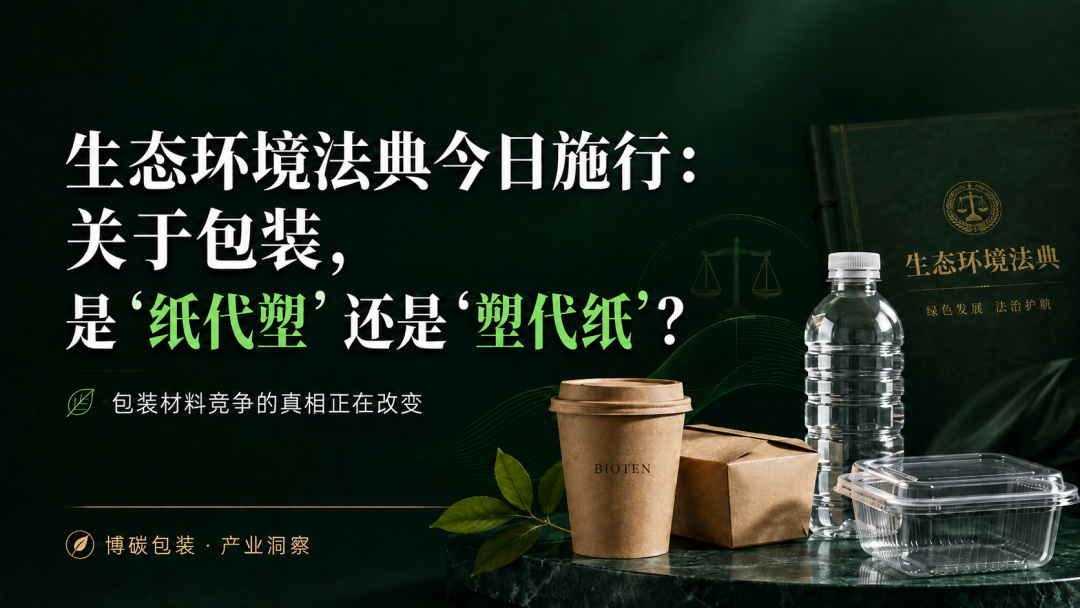
生态环境法典今日施行:关于包装,是“纸代塑”还是“塑代纸”?
法典没有宣布某一种包装材料胜出。本文沿着场景、功能层、材料效率、现实回收与合规证据,解释PE淋膜为何成就纸代塑1.0时代,水性丙烯酸、PLA、PBAT、PEF和博碳PHA水性阻隔创新路线又将怎样推动下一轮重新分工。
场景 · 功能层 · 制造 · 终端路径 · 证据
核心判断 / CORE JUDGEMENT
法规真正推动的,不是“纸赢塑料”或“塑料翻盘”,而是包装从材料竞争走向系统竞争。
00 · THE QUESTION
冲突是真的,二选一是假的
2026年8月15日,《中华人民共和国生态环境法典》正式施行。包装行业最容易被点燃的争论是:这是不是纸替代塑料的新一轮利好?或者,当塑料完成轻量化、单一材料化和循环设计后,又会不会反过来替代纸包装?
这种冲突有传播力,却不足以指导企业做材料、设备和订单决策。法典要求的是绿色设计、减量包装、反对过度包装、循环利用、清洁生产和逐步完善的碳足迹管理;它没有按材料名称直接宣布胜负。
真正值得研究的,是纸、传统塑料、生物基聚合物、功能涂层和复用系统,怎样在不同场景中重新分工。同一只包装要同时回答:能不能保护产品,能否以尽可能少的材料完成任务,能否稳定制造,使用后能否进入现实存在的回收或适配处置路径,总成本与环境主张能否被证据支持。
应用场景 → 必要性能 → 基材与功能层组合 → 制造效率 → 现实终端路径 → 总成本与法规证据
01 · FIVE GATES
法典没有为材料站队,它为包装设了五道门
第九百七十三条鼓励绿色包装、减量包装,要求遵守限制商品过度包装的强制性标准,并明确包装的材质、结构和成本应当与内装产品相适应。第九百七十四条要求电商、快递、外卖等行业减少包装物使用,优先采用可重复使用、易回收利用的包装物。第九百九十八条针对依法禁止和限制的不可降解塑料袋等一次性塑料制品,同时鼓励可循环、易回收、可降解且无害的替代产品。
01|功能门 先完成保护、卫生、运输和使用任务,避免破损、泄漏与内容物浪费。
02|减量门 以更少的完整结构材料,稳定实现必要功能。
03|制造门 把VOCs、化学物质、清洁生产和工艺稳定一起纳入方案。
04|循环门 从“理论可回收”走向真实收集、分选、再生或适配处置。
05|证据门 用测试边界、方法、数据、认证范围和适用地区支撑环境主张。
法典第二百一十三条至第二百一十五条对含挥发性有机物的原辅材料、低挥发性产品和相关标识提出制度要求;第六百四十四条至第六百四十九条建立化学物质和新污染物风险管控逻辑。油墨、胶黏剂、涂层和清洗过程不再只是采购参数,也是环境管理对象。
第九百四十四条还把造纸列入传统行业绿色低碳转型范围,指向节能低碳、清洁生产和工艺装备升级;第九百七十七条的强制回收责任须与依法制定的名录及管理办法对应;第一千零三十六条则建立产品碳足迹制度方向。它们都不能被提前扩大成已经覆盖所有包装的统一细则。
法规依据:《中华人民共和国生态环境法典》正式文本
重要边界:生态环境部已明确同步推进文件清理、配套制度完善和标准制修订。8月15日是统一法律框架开始适用的重要节点,不代表所有目录、标准和技术细则同日完成。
法规真正淘汰的,不是某一种材料;而是无法解释功能、减量、制造、回收与证据的包装。
02 · PAPER BOUNDARY
纸会继续增长,但“纸”本身不是免检标签
纸基包装的优势很清楚:挺度与印刷表现好,适合餐饮具、箱盒、运输外包装和大量干燥商品;成熟的纤维回收体系,也让结构清晰、污染较少的纸包装具备较好的循环基础。电商物流、品牌展示、干燥食品和部分餐饮场景,仍会给纸基方案留下扩展空间。
但纤维网络多孔、亲水,单独承担防水、防油、阻湿、阻氧和热封时能力有限。进入湿热、油脂或长货架期场景,通常需要涂层、淋膜、胶黏剂或多层复合结构。功能层一旦过厚、难分离,或者为了补强而显著增加克重,纸包装原本的回收和减量优势就可能被削弱。
积极案例|BASF × DBC × APP × Lido
2023年,四家产业链企业协同披露纸杯及食品卡纸与水性高性能阻隔树脂的协同方案,用于提升防水、防油、防潮、热封等性能。它说明纸的新增长机会来自基材与功能层共同进步,而不是纸张本身天然完成所有阻隔任务。2025年初发布,全球首个大型造纸在线水性涂布纸量产。
证据边界:相关纸张和阻隔材料分别已有回收适配证据和市场广泛应用。
因此,纸基产业真正的机会不是机械删除“塑料”两个字,而是提高单位功能对应的材料效率:用更薄、更稳定、更适配目标回收体系的功能层,让纤维主体进入过去够不到、但又不需要极端阻隔的场景。
资料来源:都佰城与巴斯夫联合技术披露
03 · FUNCTIONAL LAYER
PE淋膜不是原罪,它完成了“纸代塑1.0”
PE淋膜的工程贡献需要被公平看见。纸板提供挺度、成型与印刷,薄薄的聚乙烯层则补上耐湿、液体保持和热封能力,使纸杯、餐饮容器以及部分液体和油脂包装能够高速、稳定、规模化生产。没有这层功能协作,很多看上去“以纸为主”的包装,过去并不能真正替代全塑结构。
阶段判断|FROM 1.0 TO NEXT
纸代塑1.0:先解决“纸能不能完成包装任务”。PE凭成熟的淋膜、制杯、热封、成本与供应链窗口,成为长期基准。
下一阶段:在功能不倒退的前提下,让功能层更薄、更易分离、更适配回收,或者转向更合适的碳源与终端路径。
欧洲纸业联合会的设计指南明确承认,纸包装为满足阻隔和食品接触等功能有时需要涂布或复合;关键是组合方式不能妨碍回收,并应按目标市场的收集和再生条件验证。
PPWR也没有用一句“禁PE淋膜”概括全部纸塑复合包装。其附件把带聚烯烃淋膜的纸杯、液体包装纸板和塑料覆膜纸板单列为纸/纸板占主体的复合包装类别,同时要求所有包装逐步满足材料回收设计与规模化回收条件。法规提高的是整包门槛,而不是用一个材料名替代工程判断。
“去PE”只有在替代路线同时守住阻隔、热封、线速、良率、食品接触、成本和现实终端路径时,才是有效升级;否则只是把一个可见的塑料层,换成一个证据更不清楚的新层。
资料来源:CEPI纸基包装可回收设计指南;PPWR正式文本
04 · MATERIAL PASSPORTS
新材料不是替代清单,而是五本不同的“材料护照”
生物新材料的进步,不是让包装失去塑料般的成膜、触感、透明、韧性、热封和阻隔能力;恰恰相反,它们在努力保留这些高效性能,同时重写碳源、材料用量或使用后的路径。但“生物基、可降解、可堆肥”不是同义词,更不能只看树脂名称。
概念校准|THREE DIFFERENT CLAIMS
生物基只说明原料全部或部分来自生物资源,不必然可降解或可堆肥;可降解必须写明环境与条件;可堆肥过去指进入特定工业堆肥设施,今后,可堆肥泛指要满足家庭堆肥,并且首先需要符合可回收条件。欧盟目前也没有通用的海洋生物降解标准。
01 / PLA · 聚乳酸
成熟度较高,但终端路径必须说清。PLA具备透明、刚性和热塑加工基础,可用于薄膜、杯、盒与纸张淋膜阻隔;短板集中在耐热、韧性、部分阻隔与稳定加工窗口,常需结晶调控、共混PBAT、PBS或结构设计。它可在符合标准的特定工业堆肥条件下形成价值,但不等于任意PLA包装都能在家庭、土壤或海洋中快速消失。
02 / PHA · 聚羟基脂肪酸酯
不是一个牌号,而是一族材料。不同单体组成会带来从高结晶、较硬脆到更柔韧的性能。PHA淋膜在多种环境中具有生物降解潜力,但速度仍受材料组成、结晶度、厚度、添加剂、温湿度和微生物条件影响。博碳PHA水性分散复合涂层以较低涂布量形成纸面功能层,有水性生物基属性、可回收高再浆率、易堆肥,但分散稳定、干燥成膜、热封、阻隔性、可堆肥性、有待市场与目标市场验证。
03 / PBS · 聚丁二酸丁二醇酯
优势在加工与柔韧平衡,碳源不能想当然。PBS可通过不同原料路径生产,并非所有PBS天然都是生物基。其机械、热性能和加工性使其适合薄膜、涂层以及与PLA等材料共混调韧;但结晶、配方、阻隔和降解表现需要逐体系确认。
04 / PEF · 聚呋喃二甲酸乙二醇酯
主战场更接近高阻隔与循环,而不是堆肥。PEF面向瓶、膜和阻隔层,研究显示其气体阻隔潜力突出;但韧性、规模化成本、分选和回收体系兼容仍需推进,现有研究也不支持把它直接归为已经明确可家庭堆肥的材料。生物基材料同样可以走“高性能+回收”的路线。
05 / 水性丙烯酸及其他分散涂层
水是载体,不是材料终点。水性技术可以减少对有机溶剂的依赖,并通过低涂布量、成膜和热封设计扩大纸的使用范围;丙烯酸/EAA等树脂种类繁多、鱼龙混杂,需识别非食品接触的丙烯酸涂层,且在液体产品中的VOC含量、苯系物、甲醛等重金属含量易超标,需要加强液体待用前的第三方检测监管。水性不自动等于无塑、可堆肥,仍须核对组合物身份、涂布量、残余物、再制浆筛除、废水影响、食品接触和目标市场判定。
五本材料护照没有谁天然高人一等。好的设计不是把所有优点写在一个标签上,而是承认权衡,再把权衡做成可验证的产品。
研究来源:欧盟委员会概念说明;PLA综述;PHA降解综述;博碳PHA水性分散复合涂层纸研究;PBS综述;PEF综述;水性聚合物纸板涂层研究
05 · PLASTICS BOUNDARY
塑料不会自动出局,它必须从“性能优势”走向“循环证明”
塑料在包装中具有一定的不可替代性。薄膜可以用较低重量获得耐湿、韧性、热封和一定阻隔;在酱料、液体、冷冻食品、肉类、医疗卫生和长货架期产品中,包装失效的代价往往远高于包装材料本身。只看材料名称,而不看泄漏、破袋和食品损耗,容易得出错误答案。
积极案例|AMCOR
Amcor在2026年披露的Liquiflex AmPrima,以单一材料、轻量软包装服务酱料、汤品、冷冻蔬菜和蛋白类等大包装场景。它展示的不是“塑料回到旧路线”,而是用减层、减重和单一材料设计保留高功能价值。
证据边界:公司把“可回收设计”明确限定在已建立柔性聚乙烯回收流的欧洲市场。可回收性既是产品属性,也是地区基础设施属性;设计可回收不等于实际已回收。
资料来源:UNEP生命周期评价综述;Amcor企业披露
06 · SCENARIO MAP
为什么纸包装和塑料包装仍可能同时增长?
因为包装不是一个固定总量、单一功能的零和市场。消费形态、渠道、保质需求、自动化灌装、外卖、电商、冷链和循环体系都在变化,不同材料增长的可能是不同场景、不同价值层和不同地区。
干燥商品、运输外包装、礼盒与零售展示|看重挺度、印刷、堆码和成熟纤维回收,瓦楞、卡纸和模塑纤维通常更有发挥空间。塑料若持续攻击已经能由轻量纸结构稳定完成的场景,容易遭遇减量和回收逻辑的共同压力。
湿润、含油、高阻隔或高泄漏风险产品|看重耐湿、封口、穿刺和货架期,塑料薄膜、单一聚合物结构或必要复合方案仍可能更高效。纸若靠堆高克重和难分离功能层硬打,可能同时失去成本和循环优势。
烘焙、快餐和短货架期食品|处于纸塑与新材料的交界。PE减薄、PLA淋膜、水性丙烯酸、PHA分散涂层及其他生物基或可回收设计,都可能参与竞争;最后比的是涂布量、阻隔、热封、线速、良率、食品接触和目标地区终端路径。
闭环运输与重复使用|耐用塑料箱、托盘等只有在回程、清洗、破损和实际复用次数成立时才有系统优势;纸质运输包装可能凭成熟回收路径占优。
高价值、易腐或卫生敏感产品|先控制内容物损失,再优化包装。减量不能以增加食物、药品或产品报废为代价。
纸与塑料可以同时增长,因为增长发生在不同场景、不同功能和不同循环系统里。
07 · WRONG BATTLES
真正危险的,不是竞争,而是无边界替代
纸企最需要避免的,是把所有“以纸代塑”机会都当成同一种机会。一个样品能防油,不等于能经受冷凝、运输摩擦、长时间阻湿和高速热封;一项组件测试通过,也不等于整包、整机、整条回收路径已经闭环。纸基企业越尊重边界,越能把资源集中到真正可量产、可复购的市场。
塑料企业最需要避免的,是只强调材料性能,不回答一次性使用、回收经济性和环境泄漏问题。在干燥、低风险、易纤维化的场景中,继续依赖复杂多层结构,可能把技术优势变成合规和回收负担。越主动做减量、单一材料化、再生料兼容和新聚合物创新,越有机会守住真正擅长的高功能场景。
新材料企业最需要避免的,是把纯原料来源或一项降解测试,当作整包可持续性的全部答案。新材料只有同时进入稳定供应、加工窗口、客户产线、产品安全和目标终端路径,才从“材料可能性”变成“包装解决方案”。
国际对照|PPWR
欧盟《包装和包装废弃物法规》自2026年8月12日起一般适用,覆盖所有材料和来源的包装,目标包括减少包装与原生资源使用、提高可回收性,并安全提高塑料包装中的再生塑料使用。
其可堆肥要求只针对特定类别和条件,其他生物可降解包装原则上仍要走材料回收设计。PPWR不是“纸的通行证”,也不是“可堆肥材料的万能通行证”;不同义务具有不同适用时点,欧盟规则也不等同于中国法定义务。
资料来源:欧盟委员会PPWR官方说明
08 · DECISION TOOL
给产业链的一张“材料选择五问”
今后评估一个替代项目,建议先问五个问题,而不是先问“纸还是塑料”。
一问|包装失败的代价是什么? 先列泄漏、破损、受潮、氧化、污染、保质期和停线风险。
二问|整包用了什么、用了多少? 合并基材、涂层、胶黏剂、标签、油墨、封口和二次包装,并写清材料身份。
三问|它能否稳定制造? 验证涂布、淋膜、印刷、成型、热封、灌装、运输和批次一致性。
四问|使用后究竟去哪里? 核对真实收集、分选、再生或适配处置与经济价值。
五问|谁来证明它更好? 明确方法、边界、样品结构、认证范围、年份和适用地区。
造纸与纸基材料企业:把挺度、强度、涂布适配、低克重和纤维回收表现一起定义,不追求无边界替代。
塑料树脂与薄膜企业:把轻量化、单一材料化、再生料兼容、易分选和高功能性能一起兑现。
生物材料与功能涂层企业:把碳源、配方、涂布量、成膜、热封、食品接触和经济性与终端路径做成一张完整材料护照。
包装加工与设备企业:把材料性能转化为线速、良率、密封、稳定交付和可复制工艺窗口。
品牌、渠道与回收企业:共享真实使用、损耗、收集和再生数据,让材料选择不再停留在会议室里。
09 · BIOTEN VIEW
博碳包装:不替材料站队,替科学边界站台
生态环境法典施行,对纸基包装是机会,对塑料包装也是倒逼创新的机会;对PLA、PHA、PBS、PEF、PBAT、水性阻隔材料、再生材料、油墨胶黏剂、检测认证和回收企业,则是共同扩大的系统创新市场。
博碳包装所坚持的科学性创新,不是先选一种材料,再为它寻找所有场景;而是先把场景的性能、成本、法规和终端路径说清楚,再把一款好材料送到它真正擅长、能够长期成立的位置。该用纸的地方,让纸更轻、更强、更易回收、有真降解潜力;该用塑料的地方,让塑料更少、更单一、更可循环;适合生物材料的地方,则把材料身份、经济性、功能表现和适配处置一起验证。
这种克制不是保守,而是更高质量的进攻。纸基功能层的升级,会推动传统塑料重新证明自己的效率;塑料的高性能基准,也会推动纸、涂层和生物聚合物持续突破。竞争不是互相否定,而是通过技术压力测试共同抬高绿色包装的标准。
绿色包装的终点,不是某一种材料胜出,而是材料各归其位、价值持续升级。
CONCLUSION
停止材料攻击,通过技术竞争,开始画自己的场景边界图
“纸代塑”与“塑代纸”都只能描述局部市场动作,无法概括包装产业的整体方向。法典带来的更深变化,是把材料选择从宣传偏好拉回真实系统:功能必须成立,包装必须适度,制造必须更清洁,循环路径必须真实,环境主张必须有证据。
PE淋膜让纸基包装完成了从“纸张”到“功能包装”的重要跨越;今天的PLA、PHA、PBS、PEF、水性丙烯酸和其他阻隔路线,则在推动第二次升级。第二次升级不是为了在材料名单里换一个名字,而是同时重写功能层用量、碳源、加工窗口、回收或适配处置以及法规证据和可持续性。
对企业最有价值的行动,是建立自己的场景边界图和材料护照:哪些订单应该用纸打,哪些应该用塑料打,哪些适合生物材料、复用或必要复合方案,哪些暂时应当放弃。边界越清楚,创新越集中,客户越容易相信,投入也越不容易浪费。
用科学创新和可核验证据,推动中国包装产业链从材料概念,走向定义应用边界、交付全球方案。
博碳包装·产业洞察·研究说明
本文为产业研究与材料选择框架,不构成法律意见、认证结论或特定产品推荐。法规条款以正式文本及有权机关后续解释、标准、目录和配套文件为准;中国法典与欧盟PPWR属于不同法域,文中仅作治理逻辑对照。
材料性能按“树脂/配方 → 涂层或膜 → 涂布纸/复合结构 → 最终包装”分层处理。生物基、可降解、可堆肥、可回收、无塑、水性和食品接触属于不同主张,不得相互替代。实验室研究、企业设计目标和组件测试不外推为量产表现、整包认证或目标地区的实际回收/堆肥结果。
博碳包装关注并参与PHA基水性阻隔材料及纸基包装应用研究。本文对PHA路线的表述因此只采用公开研究支持的材料与工艺边界,并明确把具体配方、性能、食品接触、再制浆、堆肥和商业化状态留给独立测试与项目级证据,不以品牌立场替代验证。
博碳观察:数据与核验来源
1. 《中华人民共和国生态环境法典》正式文本|生态环境部
2. 生态环境法典立法专题|中国人大网
3. 生态环境法典实施准备工作说明|生态环境部
4. PPWR官方说明|European Commission
5. Regulation (EU) 2025/40|EUR-Lex
6. 生物基、可降解与可堆肥塑料说明|European Commission
7. 纸基包装可回收设计指南|CEPI
8. Recyclability Test Method Version 3|CEPI
9. 食品包装生命周期评价综述|UNEP Life Cycle Initiative
10. UPM与BASF纤维基阻隔包装披露|BASF
11. Liquiflex AmPrima食品服务包装|Amcor
12. 纸杯PE涂层与热封研究|BioResources
13. PLA结构、性能与降解综述|PubMed
14. 水性PLA纸张涂层研究|Progress in Organic Coatings
15. PHA生物降解研究综述|PubMed
16. 博碳PHA分散复合纸张阻隔涂层研究|Progress in Organic Coatings
17. PBS性能与降解综述|PubMed
18. PEF性能、回收与产业化综述|ACS Polymers Au
19. 水性聚合物纸板阻隔与回收研究|Coatings
What is really redefined is not paper-based winners, but the application boundaries of each material and functional layer.
Green packaging and material observation / MATERIAL SYSTEMS
BIOTEN Packaging:: Industry insight
Eco-Environment Code is in effect today: with regard to packaging, is it “paper plastic” or “sculpture paper”?
The Code does not declare a package to be successful. This explains why the PE lymphs are made in paper form along the scene, functional layers, material efficiency, real recovery and compliance evidence. 1.0 Ages, Aquatic Acid, PLA, PBAT, PEF andBIOTENHow would the new PHA water barrier route facilitate a re-distribution of labour in the next round?
The scenes, the functional layers, the manufacturing, the terminal path, the evidence.
Core Judgement / CORE JUDGEMENT
The regulation does not really promote “paper-win plastic” or “plastic roller”, but rather the packaging moving from material to system competition.
00. THE QUESTION
The conflict is real. The alternative is fake.
15 August 2026 The most controversial argument that the packaging industry is prone to lightening is whether it is a new round of paper-substitution benefits or, if plastics are designed for light quantification, single materialization and recycling, will they then be replaced by paper packaging?
The code requires green design, less packaging, anti-overpacking, recycling, cleaner production and step-by-step carbon footprint management; it does not declare a victory by material name.
What really deserves to be studied is how paper, traditional plastics, bio-based polymers, functional coatings and reuse systems can be redistributed in different settings. The same packaging should answer: Can products be protected, can produce with the least possible material, can manufacture stabilize, can use them into a realistic recovery or fitting disposal path, and whether total costs and environmental claims are supported by evidence.
The application scene.. Needs to combine the building blocks with the functional layers..
01 • FIVE GATES
The code doesn't have a material station. It has five doors for packaging.
Article 973 Encourage green packaging, less packaging, require compliance with mandatory standards that limit overpacking of goods and specify the types of packagings to be used in order to achieve a greater degree of compliance Material, structure and cost should be appropriate for the contents I'm sorry. Article 974 The electric power suppliers, couriers and take-out industries are required to reduce the use of packagings by prioritizing reuseable and recyclable packagings. Article 998 OF THE LAWnot biodegradableOne-time plastic products such as plastic bags, while encouraging recycling, recovery and recoverybiodegradableAnd not-so-hazardous alternative products.
01 The X-ray door. The tasks of protection, hygiene, transportation and use are accomplished first to avoid damage, leakage and waste of content.
02 The X-ray door. To stabilize the necessary functionality with fewer complete structural materials.
03 The door to the mill. Include VOCs, chemical substances, cleaner production and process stabilization in programmes.
04 The door to the rim. From "Theory"recyclable“To be collected, sorted, regenerated or adapted to disposal.”
05 The evidence door. Environmental claims are supported by testing boundaries, methods, data, authentication scope and areas of application.
Articles 213 to 215 of the Code require that primary materials containing volatile organic matter, low-volatile products and associated markings be regulated; articles 644 to 649, which establish a logic for managing risks from chemical substances and new pollutants. Ink, glue, coating and cleaning processes are no longer mere procurement parameters but also environmental management targets.
Article 944 also places paper in the context of a green low-carbon transformation in traditional industries , for low-carbon energy conservation, cleaner production and upgrading of process equipment; Compulsory recovery liability under article 977 must correspond to legally established lists and management practices Article 13 sets out the direction of a carbon footprint system for products. They cannot be expanded in advance to uniform rules covering all packagings.
The basis of the legislation is: Official text of the Environmental Code of the People ' s Republic of China
Important boundaries: The Ministry of Ecology has clearly and simultaneously promoted document cleansing, the improvement of the supporting system and standard amendments. 8 months 15 is an important node for the commencement of the application of a uniform legal framework, and does not represent all catalogues, standards and technical rules completed on the same day.
The regulation does not actually phase out a material; it is packaging that cannot explain functionality, reduction, manufacture, recovery and evidence.
02. Papar Boundary
Paper will continue to grow, but "paper" is not a de-checkable label.
Fiber-based packagingThe advantages are clear: good performance and printing, suitable for catering devices, boxes, transport overpacks and large quantities of dry commodities; mature fibre recovery systems that also provide a better circulation base for well-structured, less polluting paper packaging. Electric logistics, branding, dry food, and part of the restaurant scene still leave room for expansion of paper-based schemes.
But fibre networks are porous, water-friendly and have limited capacity to undertake waterproofing, oilproofing and damping, resistance to oxygen and heat seals alone. Entering the wet heat, fat or long shelf stage usually requires coating, a lymphine, glue or multilayered structures. Once the functional layer is too thick, difficult to separate, or when there is a significant increase in gram weight for the purpose of filling it, the original recovery and reduction advantage of paper packaging may be weakened.
Positive casesBASF X DBC x APP X Lido
2023 Four industry chain companies have co-existed the disclosure of paper cups and food cards with water high performance barrier-free resin programs to improve waterproofing, oilproofing and heatproofing. It suggests that new opportunities for paper growth come from building blocks and functional layers working together instead of paper itself doing all the barriers naturally. 2025 The first release was a series of events. World's firstLarge paper online water-painted paper volume.
Evidence boundary: Relevant paper and barrier materials are available for recovery, evidence of suitability and extensive market use.
So the real opportunity for the paper-based industry is not to mechanically delete "plastic" but to improve it. Material efficiency for unit function : Use a thinner, more stable and better-suited functional layer of the target recovery system to allow fibre subjects into previously unavailable but not in need of extreme barrier.
Source: DBCandBASFJoint technical disclosure
03 • FUNCTIONAL LAYER
PE is not a sin. It's finished with the paper. 1.0 The blogger says:
The engineering contribution of the PE lymphs needs to be seen fairly. Paperboards provide a high degree of strength, shape and printing, while thin polyethylene layers are refilled with wet, liquid maintenance and heat sealing that allow for high-speed, stable, and scalding production of cups, catering containers, and parts of liquid and fat packagings. Without this functional collaboration, many packages that appear “paper-based” have not been really replaced by full plastic structures in the past.
The stage judgement is a "FROM". 1.0 TO NEXT
Paper Shape1.0: The first is to address whether paper can perform the packing tasks. PE serves as a long-term benchmark with mature permers, cups, hot seals, costs and supply chain windows.
Next stage: Make the function layer thinner, more easily separated, better suited for recycling or move to a more appropriate source and terminal path without retrogression.
The design guide of the EU ropean Paper Federation explicitly recognizes that paper packaging is designed to meet barriers and constraintsfood contactAt times, such functions need to be painted or compounded; it is critical that the combination approach does not impede recovery and should be validated according to the collection and regeneration conditions of the target market.
PPWR also did not use the phrase “no permeable permime” to summarize all paper-based composite packagings. The annex lists paper cups, liquid packaging cardboard and plastic coating sheeting as composite packing categories with polyolefin film in the main paper/paper board, while requiring all packaging to meet progressively the conditions for material recovery design and scalability. Packet threshold Instead of replacing engineering with a material name.
Go to the PE only if alternative routes are secured simultaneously, with a heat seal, speed of wire, good rate, food contactThe effective upgrade is when costs and real end paths are involved; otherwise, only a visible plastic layer will be replaced by a new layer where evidence is less clear.
Source: CEPIfiber-based packagingrecyclabledesign guidelines; official PPWR text
04 • MATERIAL PASSPORTS
The new material is not a substitute list, but five different "material passports"
The advances in new biological materials are not to lose plastic-like membrane, touch, transparency, resilience, heat seals and barriers; on the contrary, they are trying to retain these efficiency features while rewrite carbon sources, material use or subsequent pathways. BiodegradableI'm not sure. Compostable) is not synonymous, let alone the name of a resin.
Conceptual calibration of THREE DIFERENT CLAIMS
Biobases only indicate that the feedstock is derived wholly or partly from biological resources, and it is not inevitable thatbiodegradableorcompostable (a) The following: biodegradableThe environment and conditions must be specified; compostableThe past means entering a specific area. Industrially compostableFacilities, in the future. CompostableIt's a general reference to satisfying. Home compostableAnd first, it needs to be matched. RecyclableThe conditions. There is no common ocean in the EU. BiodegradationStandard.
01 / PLA Polylectic acid
High maturity, but terminal path must be clear. PLA has a transparent, rigid and thermal processing base that can be used to block film, cups, boxes and paper lymphine; short panels are concentrated in heat-resistant, resilient, partially blocked and stable process windows, often with crystallized management, mixing PBAT, PBS or structural design. Industrially compostableValues are formed under conditions that do not amount to any arbitrary PLA packaging disappearing rapidly in the home, soil or ocean.
02 I'm not sure. PHA • The media polyhydroxyalkanoates (PHA)
It's not a card number, it's a family material. Different monolithic formations bring performance from high crystallization to more rigidity. PHAThe lymphine has been in many environments. BiodegradationPotential, but velocity is still influenced by material composition, crystallization, thickness, additives, temperature humidity and microbiological conditions. BIOTENPHA water-dispersive composite coatings form paper functional layers with a low volume of coating, having hydrobiogenic properties, recyclableHigh replastic rate, composting but spread stable, dry membrane, heat seals, barrierability, compostableSex, to be validated by the market and target markets.
03 / PBS Polybutyltinate butyl diol
The advantage is that the process is balanced with flexibility, and carbon sources cannot be taken for granted. PBS can be produced through different feedstock pathways, not all of which are naturally biological. Mechanical, thermal and process properties make it suitable for film thins, coatings, and materials such as PLA that are co-resilient; but crystallization, formulation, barrier partition and degradation performance needs to be system-by-system confirmation.
04 / PEF polyfurans dimethylate
The main battlefield is closer to high barriers and cycles than composting. PEF is directed towards bottles, films and barriers, and studies show a significant potential for gas containment; however, resilience, scalability costs, sorting and recovery system compatibility still need to be advanced and current research does not support its direct classification as already clearhome compostableMaterials. Bio-based materialsThe same is true of the high performance plus recycling route.
05 / Aquatic acrylic acid and other dispersed coatings
Water is a carrier, not the end of materials. Water technologies can reduce reliance on organic solvents and expand paper use through low-painting, membrane and thermal design; acrylic acid/EAA is a heterogeneous range of resins and fish complexes that need to be identified as non-requiredfood contactThe Acid coatings, and the VOC content in liquid products, benzene and other heavy metals such as formaldehyde are easily overstretched, require enhanced third-party monitoring before the fluid is ready for use. Compostable, still have to check the combination identity, coating volume, residues, re-slurries, wastewater effects, food contactAnd target market determination.
The five-material passport does not have any natural superiority. A good design is not to write all the advantages on a label, but rather to recognize the trade-off and then make it a proven product.
Research sources: European CommissionConcept note; overview of PLAsPHA (a) Overview of degradation; BIOTENPHA Waterless Distributed Polycrete Paper Study; PBS Overview; PEF General; Water polymer Paper Paint coating Study
05.. PLASTICS BoUNDARY
Plastics do not automatically exit, and they must move from “performance advantage” to “cycle certification”.
Plastics have some non-alternative content in packaging. The film can be wet-resistant, resilient, hot envelopes and a certain barrier with lower weight; in sauce, liquids, frozen foods, meat, health care and long shelf life products, the cost of packing is often much higher than that of packaging material itself. It is easy to get wrong answers by looking at the name of the material without looking at leaks, broken bags and food losses.
Positive case AMCOR
Amcor's in. 2026 Disclosures of Liquiflex AmPrima, a large packaging scene with single materials, light soft packaging service sauce, soup, frozen vegetables and protein. It shows not “plastic back to the old route”, but rather high functional values by decomposition, weight reduction and single material design.
Evidence boundary: the company put "recyclableDesign is clearly limited to EU ropean markets where flexible polyethylene recycling streams have been established. Recyclability (a) As product attributes and as regional infrastructure attributes; recyclableNot equal to actual recovery.
Source: UNEP life cycle evaluation synthesis; Amcor corporate disclosure
06 SCENARIO MAP
Why is it still possible to grow paper and plastic packaging at the same time?
For packaging is not a fixed sum, single function zero market. Consumption patterns, channels, preservation needs, automated fillings, take-out, power suppliers, cold chains and circulation systems are changing, with different material growth likely to be from different scenarios, value layers and different regions.
Dry goods, overpacking of transport, gift boxes and retail displays The heavy lifting, printing, stacking and mature fibre recycling usually allows more room for tiles, cardboard, and plastic fibers. A continuous attack on a scene that can be stabilized by light paper structures is liable to the combined pressure of both reduction and recovery logic.
Wet, oily, high-blocking or high risk of leakage The plastic film, a single polymer structure or the necessary compounding options may still be more efficient when looking at wet-resistant, shutter, piercing and shelf periods.
Breading, fast food and short shelf racks It's in the intersection of paper and new materials. PHADispersed coatings and other biological bases orrecyclableDesign, all of which may compete; lastly, the amount of cloth, blockage, heat seals, wire speed, good ratefood contactand target area terminal path.
Closed loop transport and reuse of platinum The durable plastic boxes, pallets and so on have a systemic advantage only when return, cleaning, breakage and actual reuse are established; paper transport packaging may be superior to mature recovery pathways.
High-value, perishable or health-sensitive products Controls the loss of content before optimizing packaging.
Paper and plastics can grow at the same time, as growth occurs in different scenarios, functions and cycles.
07. WRONG BATTLES
It's not competition, it's no border substitution.
The paper company needs to avoid it most. A sample that is resistant to oil does not mean being able to withstand condensation, transport friction, prolonged wet resistance and high-speed heat sealing; a component test does not pass, nor does it amount to a complete package, whole machine, entire recovery path being closed. The more paper-based companies respect borders, the more they can concentrate resources on a real, affordable market.
The plastic industry needs to be avoided. The more active the reduction, single materialization, regenerative compatibility, and innovation of new polymers, the more likely they will be to hold high-capacity scenes that are really good at doing so.
The most important thing to avoid is new materials. The new material is changed from “material possibilities” to “packaging solutions” only if it enters a stable supply, processing window, customer line, product safety and target end path simultaneously.
International PPWR
EU Code on Packaging and Packing Waste12 August 2026 Packaging, generally applicable, covering all materials and sources with objectives including reduction of packaging and use of primary resources, improvementrecyclabilityand safely improve the use of recycled plastics in plastic packaging.
OthercompostableRequirement for specific categories and conditions, other organismsbiodegradablePackaging is still in principle designed for material recovery. PPWR is not a "paper pass" or "compostable (b) A " passable for materials "; different obligations have different points of application and the EU rules are not equivalent to China's legal obligations.
Source: European CommissionPPWR Official Note
08 • DECISION TOOL
"Technology Five Questions" for the industrial chain.
A replacement project will be evaluated in the future and five questions proposed instead of “paper or plastic”.
Asking what the cost of failure is. First list of leakage, breakage, tide exposure, oxidation, pollution, preservation period and stoppage risks.
Two questions. What's the whole bag used, how much? (B) Merge base materials, coatings, glues, labels, ink, seals and secondary packagings and write the identity of the material.
Three questions. Can it be made stable? Validation of coating, film, printing, formation, heat sealing, filling, transport and batch consistency.
Four questions: Where exactly did you go after the use? Check for true collection, selection, regeneration or suitability of disposal and economic values.
Five questions: Who will prove it better? (C) Clear methodology, boundaries, sample structure, range of certifications, year and area of application.
Paper and paper-based materials enterprises: Defines strength, intensity, cloth fit, low-g weight and fibre recovery performance together , do not seek to replace without borders.
Plastic resin and film industry: (B) The combination of light quantification, single materialization, regenerative compatibility, easy-to-selection and high functionality.
Biomaterials and functional coating enterprises: Carbon source, formula, coatings, membrane, heat seal, food contactThe economic and terminal routes are made as a complete material passport.
Packaging processing and equipment enterprises: Convert material performance into linear, good rates, seals, stable delivery and replicable process windows.
Brands, channels and recycling enterprises: Sharing of real use, wear and tear, collection and regeneration data so that material selection is no longer available in the conference room.
09 • The media BIOTEN VIEW
BIOTEN Packaging: no material station, for the scientific boundary
The Code of Eco-Environment is in effect. Fiber-based packagingIt's an opportunity, and it's a chance to create innovation with plastic packaging; for PLA, PHAThe joint expanded market for system innovation is the PBS, PEF, PBAT, water barrier materials, recycled materials, ink-coated glues, testing certification and recycling facilities.
BIOTEN PackagingThe scientific innovation that is maintained is not to select a material before looking for all the scenes; rather, it is to clarify the features, costs, regulations and end paths of the scene and then send a good material to a place where it is truly good at and can be built over time. This paper site will make it lighter, stronger, more recyclable, and with real degradation potential; this plastic will make the plastic less, more monolithic and more recycled; and where it suits biological materials, the material identity, economics, functional performance and suitability disposal will be tested together.
This restraint is not conservative, but a higher-quality attack. The upgrading of paper-based functional layers will drive traditional plastics to reprove their efficiency; the high performance benchmark for plastics will also push paper, coatings and biopolymeric materials to break down. Competition is not negative to each other, but it is by testing the criteria for jointly raising green packagings through technical pressure tests.
The end point for green packaging is not that one material wins, but rather that the material is located and its value continuously uplifts.
CONCLUSION
Stop the material attacks, start to draw their own scene boundary maps through a technical competition.
Neither “paper-making” nor “sculpture-based” can describe local market movements and cannot outline the overall direction of the packaging industry. The legal code has brought about a deeper change in the choice of materials from propaganda preferences to real systems: functions must be built, packaging must be moderate, manufacturing must be cleaner, circulation routes must be authentic, and environmental claims must be supported by evidence.
PE lymphinefiber-based packagingSignificant crosses from "paper" to "functional packaging" were completed; today's PLA, PHAThe second upgrade is not intended to replace a name on the material list, but also to rewrite functional layer usage, carbon sources, processing windows, recycling or fitting disposals and regulatory evidence and sustainability.
The most valuable action for businesses is to build their own landscape border maps and materials passports: which orders should be paper-based, which plastics should be used, which options are suitable for biological material, reuse or necessary compounding, and which should be abandoned. The clearer the boundaries, the more focused innovation, the easier it becomes for clients to believe that inputs are not too easy to waste.
Using scientific innovation and verifiable evidence, China ' s packaging industry chain moved from material concepts to defining application boundaries and delivering global programmes.
BIOTEN PackagingIndustry Insight Research Note
The text provides a framework for industrial research and material selection, which does not constitute legal opinions, certification findings or product-specific recommendations.
Material performance is treated in a layered manner according to "Lip/formulation coating or membrane clothing/complex structure § final packaging". BiodegradableI'm not sure. CompostableI'm not sure. RecyclableStyrofoam, hydrotropics andfood contactLaboratory research, enterprise design objectives and component testing are not extrapolated to mass production performance, whole package certification or actual recovery/compost results in the target area.
BIOTEN PackagingConcern and participationPHAWater-based barrier materials andfiber-based packagingApplied research. PHAThe route is thus presented using only the publicly researched material and process boundary, with specific formulations, performance, etc. food contact. The state of re-sulpting, composting and commercialization is left to independent testing and project level evidence and does not replace certification with brand positions.
BIOTEN Observation: data and sources of verification
1. The official text of the Environmental Code of the People ' s Republic of China, which is part of the Ministry of Eco-Environmental Environment
2. The issue of legislation in the Code on Eco-Environmental Law is a Chinese-language network.
3. Preparations for the implementation of the Code on Eco-Environment
4. PPWR Official Note by EU ropaan Commission
5. Regulation 2025/40EUR-Lex
6. Biobases, biodegradableandcompostablePlastics for EU ropaan Commission
7. Fiber-based packagingrecyclableDesign Guide — CEPI
8. Reciclability Test Method Version 3CEPI
9. Food packagingSynthesis of the life cycle evaluation
10. UPM withBASFFibre-based blocker package disclosureBASF
11. Liquiflex AmPrima Food Services Packing Amcor
12. Cup Pe coating and hot sealing |BioResources
13. PLA Structure, Performance and Degradation Overview
14. Water PLA paper coating study |press in Organic Coatings
15. PHAbiodegradationThe study is a synthesis of the research by PubMed
16. BIOTENPHA Dispersed Paper Blocking coating study |Progress in Organic Coatings
17. PBS Summary of Performance and Degradation
18. PEF Summary of Performance, Recovery and Industrialization
19. Water polymer cardboard blockage and recycling study |Coatings