
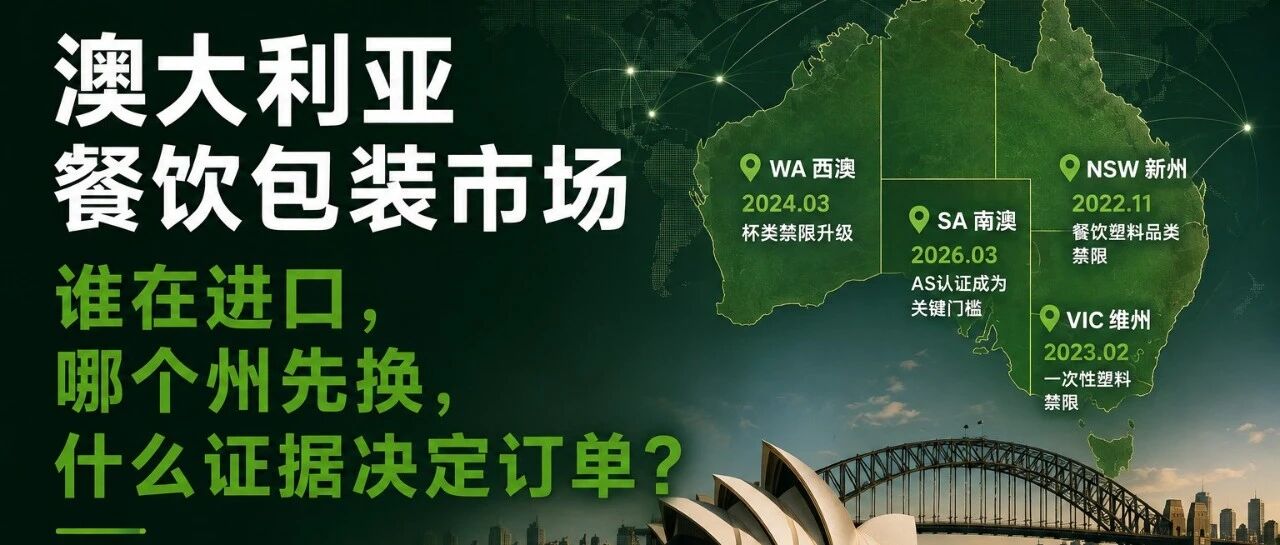
澳大利亚不是统一市场,而是一组由州级规则、最终制品证书与地方末端共同决定的订单市场。
全球餐饮包装政策与市场地图 / AUSTRALIA MARKET
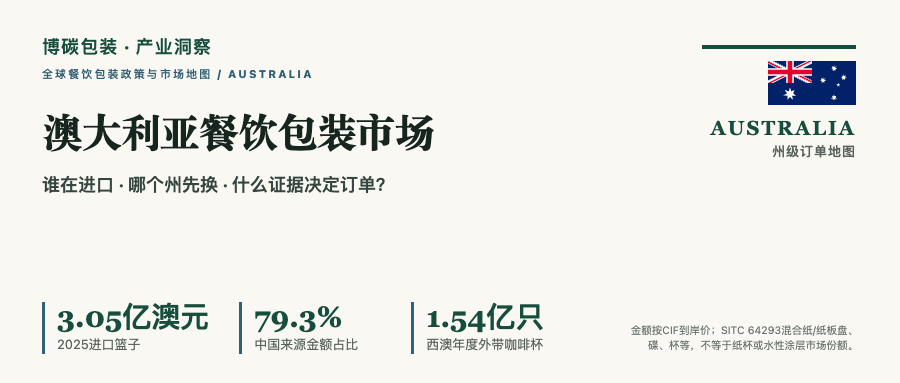
澳大利亚餐饮包装市场谁在进口,哪个州先换什么证据决定订单?
从官方进口明细、州级禁限、AS与ABA认证、FOGO末端和采购责任链,判断中国材料商、涂布纸厂与杯盒厂如何进入澳大利亚餐饮包装市场。
3.05亿澳元 2025进口篮子 · 79.3% 中国来源金额占比 · 1.54亿只 西澳年度外带咖啡杯
金额按CIF到岸价;SITC 64293为混合篮子,来源占比不等于纸杯或水性涂层市场份额。
01 · EDITORIAL QUESTION
澳洲是进口机会,还是认证迷宫?
澳大利亚的吸引力,首先体现在已经存在的进口链。2025年,SITC 64293项下的纸或纸板盘、碟、杯等产品进口约3.05亿澳元,其中来自中国约2.42亿澳元,占79.3%。这个品目同时包含盘、碟、杯等多种制品,数据只能说明进口来源,不能代表纸杯或水性涂层市场份额。
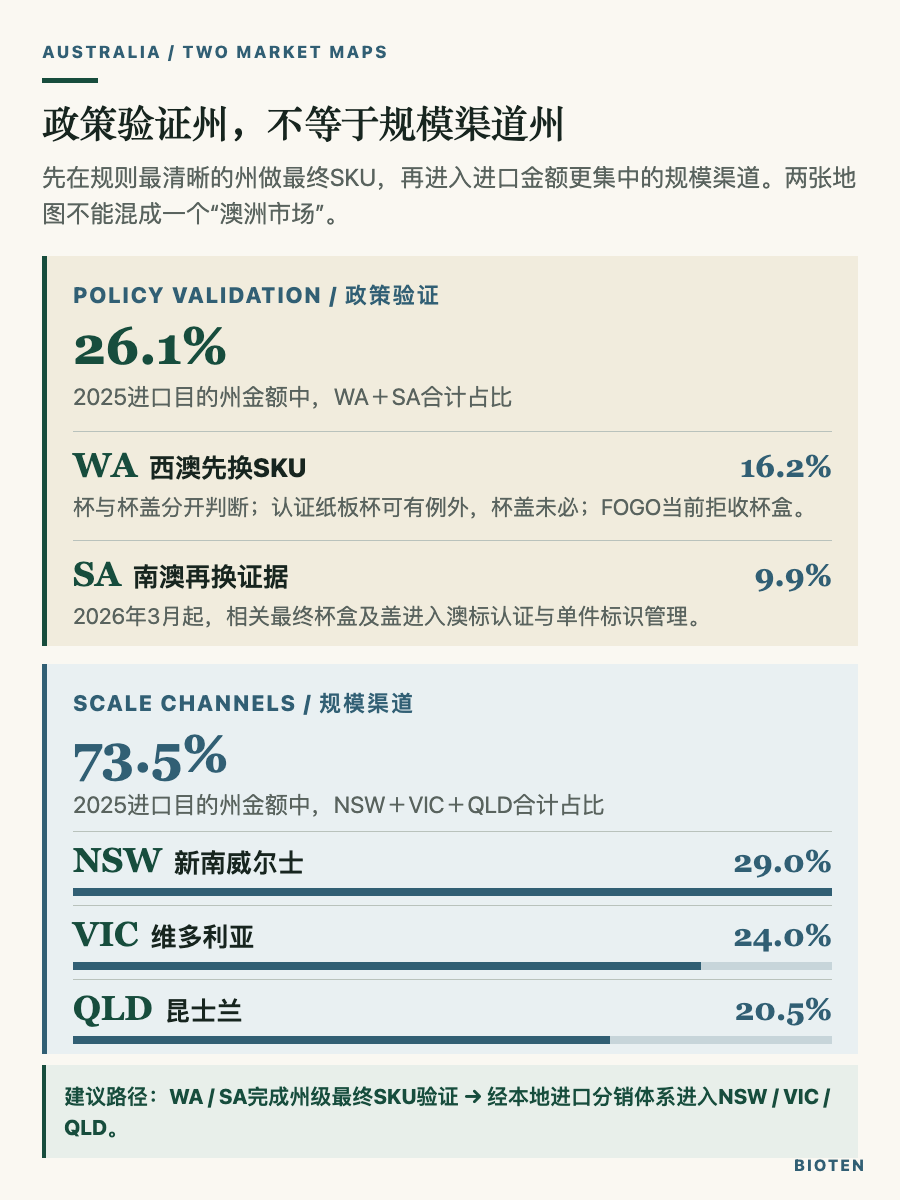
但货量和政策不在同一张地图上。西澳、南澳正在用州级规则改变杯、盖和餐盒的结构、证书与标签;2025年进口目的州中,新南威尔士、维多利亚和昆士兰合计承接73.5%的进口金额。西澳、南澳适合先做合规验证,销量放大则要面向新州、维州和昆州的渠道,两步不能倒过来。
西澳还给出一个必须拆开的信号:特定经澳标认证的纸板杯可以进入供货例外,但2026年FOGO指引仍要求可堆肥杯、容器和托盘进入一般垃圾。认证回答“能否按例外供应”,末端系统回答“使用后去哪里”。一张证书不能同时替代两套判断。
核心判断
澳大利亚已经不是从零开发的市场。中国是相关进口篮子的主要来源,接下来比拼的是规格重选:西澳、南澳先验证州级合规和最终制品,新州、维州、昆州再承接规模渠道。能够同时交付结构、食品接触、证书、标签和真实去向的供应商,才有机会进入下一轮名单。
研究边界
本文核验至2026年8月17日。进口数据采用澳大利亚政府发布的ABS海关明细中SITC 64293,金额按CIF到岸价统计;该分类覆盖HS 482361与482369的纸/纸板盘、碟、杯等,不含HS 482370模塑纸浆制品,也不包含以4811等品目进口后在澳洲制杯的全部涂布纸。金额、重量和来源占比均不是纸杯、水性涂层或澳洲总市场份额。法规重点完整核验联邦、南澳与西澳;其他州只作已获证范围内的比较,不凭印象补齐。
02 · MARKET DATA
这不是一个等待中国企业进入的空白市场
2025年SITC 64293进口约3.05亿澳元,重量字段合计约8.51万吨;其中中国约2.42亿澳元、重量字段约6.65万吨,占金额79.3%、重量78.1%。2024年同口径约3.16亿澳元,中国金额占77.1%;到2025年,总金额下降3.3%、重量下降1.1%,中国金额下降0.5%、重量增长3.7%。数据呈现的是成熟市场中的价格、产品组合和供应份额调整,并不足以支持“禁塑带来需求爆发”。
从来源结构看,中国金额占比一年提高约2.2个百分点。2025年其余主要来源为印尼7.3%、台湾6.5%、越南4.7%。中国供货优势明显,但买方仍有多个亚洲替代产地;结构合规、稳定交付和本地库存直接关系到现有份额能否守住,也会直接进入采购谈判,成为续单条件。
2026年1—4月,该篮子进口约8,815万澳元,重量字段约2.59万吨,同比金额下降17.3%、重量下降3.4%。金额跌幅明显大于重量,值得继续观察买方价格压力和产品组合变化;但四个月数据不能外推全年,也不能据此判断澳洲餐饮包装需求萎缩。
海运占2025年进口金额的99.7%。因此,订单不只比出厂价,还要看本地进口商的海运计划、库存、州际分销和版本管理。进口目的州中,新州占29.0%、维州24.0%、昆州20.5%、西澳16.2%、南澳9.9%。新州和维州合计53.0%,是主要规模入口;西澳和南澳合计26.1%,也足以支撑州级合规验证。
餐饮端同样有可核验的使用场景。ABS记录,2025年6月澳大利亚咖啡馆、餐厅和外带餐饮服务经季调营业额约55.82亿澳元;西澳政府披露,当地每年使用超过1.54亿只外带咖啡杯。前者是单月餐饮营业额,后者是州级杯量,都不能当作包装市场规模,但能分别说明渠道体量和杯类SKU暴露。
澳洲也有本地制造。Detmold Group总部位于南澳,在澳大利亚及亚洲多地生产纸和纸板食品包装;Huhtamaki Australia公开披露了本地纸杯、纸容器和纸盘制造能力。这个市场由本土制造、跨国工厂和进口分销共同组成。中国企业既要与国内同行竞争,也要面对印尼、台湾、越南等亚洲来源以及澳洲本地转换能力。
主要依据:ABS国际商品贸易明细(2024—2026);ABS《Retail Trade, Australia, June 2025》;西澳咖啡杯事实表;Detpak与Huhtamaki官方资料。
03 · FEDERAL LAYER
联邦定责任,州政府决定杯盒能不能卖
截至2026年3月,澳大利亚新的全国包装制度仍在开发。DCCEEW明确表示,新规开始前,现有共同监管安排继续有效。联邦层面先管包装责任,具体杯盒能不能卖,仍要看州和领地的产品规则以及当地末端体系。
现行全国底座由《National Environment Protection (Used Packaging Materials) Measure 2011》和Australian Packaging Covenant共同构成。
DCCEEW当前说明,在澳大利亚制造或销售包装且年营业额达到500万澳元的企业,需加入APCO、按州或领地NEPM实施安排报告,或参加达到同等结果的获批计划。中国工厂可能生产产品,但本地进口商、品牌所有者或首个销售者需要判断自身责任,由此会把结构、来源、环境声明和年度数据要求传回供应商。
澳大利亚政府披露,2023—24年度约684万吨包装投放市场,其中41%最终进入填埋。这是全部包装口径,只用于说明全国包装废弃物流向。减量、复用、可回收设计和化学品管理是联邦改革方向,但还不能当作已经生效的全国统一产品规则。出口报价首先要确认最终收货州。
主要依据:DCCEEW《Taking responsibility for our packaging》《Reforming packaging regulation》《A circular economy for packaging in Australia》;NEPM;APCO。
04 · WESTERN AUSTRALIA
西澳先换SKU:杯可以例外,杯盖未必可以
西澳适合成为杯盒厂的首个验证市场,因为产品范围和时间节点都较清楚。
《Environmental Protection (Prohibited Plastics and Balloons) Regulations 2018》及Plan for Plastics规定:冷饮一次性塑料杯自2022年10月1日起执行;热饮杯及全部一次性塑料杯盖自2024年3月1日起执行;带盖外带或堂食容器、碗、托盘及相关塑料盖自2024年9月1日起执行;模塑或切割扩展塑料包装自2025年7月1日起执行。
西澳看的是产品组成,不是材料名称。全部或部分含塑料的产品都可能进入规则,包括内衬、涂层和层压结构;植物基、可降解或水性也不能仅凭商品名排除。法规还把供应行为连接到西澳境内的接收人,境外工厂不能只以合同签署地或供应商所在地排除风险。
杯和杯盖必须拆开核对。作为完整产品取得当前有效AS 4736或AS 5810证书的纸板杯,可以进入特定法定例外;杯盖没有同一套普遍例外。西澳现行条文对经认证纸板盖的例外只列食品容器、托盘和碗的盖,不包括杯盖(cup lid);官方说明也要求咖啡杯盖完全无塑料。杯体证书不能顺带覆盖杯盖,一个附件就可能否决整套SKU。
截至2026年8月17日,西澳对装盛超过60 ℃、可倾倒汤类或液态食品的特定外带容器和盖仍有临时类别豁免(class exemption),官方列示于2026年8月31日到期,距核验日14天。汤碗、咖喱、叻沙等项目必须在报价和发货前重新核对,不能把临时豁免写进长期产品手册。
主要依据:西澳现行Regulations;Plan for Plastics;咖啡杯与杯盖事实表;SUP0003/2024/2临时豁免。
05 · SOUTH AUSTRALIA
南澳再换证据:2026年以后,单件标签也进入合规
南澳的重点在证据和标签。2024年9月1日起,冷热饮杯、杯盖和用于即食食品的相关食品容器进入新阶段;塑料淋膜、aqueous-coated(水性涂层)或通过水性施工形成防水层的纸基杯盒,都不能因为“水性”或“纤维主体”自动被视为无塑。
自2026年3月1日起,相关AS认证可堆肥食品和饮料容器要获得禁限规则下的例外,必须具备当前有效的AS 4736或AS 5810路径,并在单件上清楚标明家庭可堆肥、工业可堆肥或二者。只在外箱印标识不够。容量小于60 mL的容器和直径小于70 mm的盖存在标识条件例外,但不等于整条产品线免认证、免留档。
南澳还为特定透明PP/PET可分离盖容器和高温汤类容器保留限定过渡例外,市场不会只剩一种材料。西澳先改变杯和盖的SKU,南澳再把证书、标签和版本管理压到最终单件。
新州、维州、昆州同样有一次性塑料禁限,但范围并不等同。新州当前禁用项目包括特定盘、碗、餐具和EPS食品服务具,且塑料内衬或涂层可进入判断;带防漏盖的碗等存在范围差异。维州直接列入塑料盘——包括塑料内衬纸盘——及EPS食品饮料容器;昆州重点覆盖塑料盘、无盖碗、餐具和EPS杯盒。它们是更大的渠道州,却不能照搬南澳和西澳的杯盒认证规则。
主要依据:南澳Act与现行Regulations;Replace the Waste标签指南;NSW EPA、Victoria EPA及Business Queensland官方指导。
06 · CERTIFICATION
AS与ABA:上一层证据,不能自动替代下一层
AS 4736—2006对应商业或工业堆肥及其他受控微生物处理,AS 5810—2010对应家庭堆肥,两套标准不能互相替代。标准本身通常是自愿文件;州法规把它写进例外条件后,才在相应产品和州的范围内成为门槛。Standards Australia负责制定标准但不签发产品证书,ABA是认证机构和行业组织,不是立法机关。
ABA公开FAQ列出了容易忽略的边界:供应商的认证不会自动让客户的最终产品获得认证;标识使用不能自动转让,可能需要商标转授权(sublicense);同一配方系列是否由最厚产品覆盖,由独立审核决定,而且申请范围需要包括实际油墨、色料和添加剂。州级例外核对的是证书持有人、产品名称、标准、厚度、配方、印刷、附件、有效期和授权使用范围。
证据应分成三层。材料级可以证明某一树脂或涂层配方;涂布纸级可以证明原纸、涂布量和阻隔结构;最终制品级才把杯底、侧封、卷口、油墨、胶、标签、杯盖和实际厚度纳入同一SKU。上一层可以支持下一层,却不能替代下一层。
食品接触需要单独验证。FSANZ Standard 3.2.2第9条要求食品经营者只使用适合预期用途、不太可能污染食品的包装。食品类型、酸油性、接触时间、温度、加热或微波、冷冻和重复使用都会改变证据要求。AS或ABA不能替代食品接触;食品接触资料也不证明堆肥、纸纤维回收或州级例外。
PFAS也要避免过度表述。联邦正在研究未来的包装化学品限制,APCO的纤维基食品接触包装PFAS路线目前仍是行业行动和2026年讨论更新,不是覆盖所有食品包装的全国统一禁令。ABA流程会核查总氟和非故意添加声明,但“通过ABA流程”不能直接写成“零PFAS”。
主要依据:Standards Australia;ABA FAQ及sublicensing规则;FSANZ食品包装指南与Standard 3.2.2;DCCEEW/APCO PFAS资料。
07 · END OF LIFE
认证通过,为什么西澳仍进不了FOGO?
西澳2026年最新FOGO指引只接收食物、园林有机物和带AS 4736标识的认证厨余袋。食品包装不在接收范围内;包括可堆肥杯、容器和托盘在内的非可回收包装,当前应进入一般垃圾。官方给出的原因不是“认证造假”,而是路边系统无法可靠区分认证与非认证包装,并需控制塑料、涂层和化学品污染。
认证和末端各管一件事。认证可能决定特定纸板杯能否按州级例外供应;地方政府、处理厂、许可证和收运合同决定使用后能否进入FOGO。南澳部分提供绿色有机物服务的地方议会可能接受带适用澳标标识的认证包装。同一张证书,在不同州和地方系统中会得到不同结果。
环境宣传因此也是订单门槛。ACCC要求环境主张真实、有证据并清楚说明成立条件;其官方指南甚至以外带咖啡杯为例指出,若杯子只能通过专门回收点处理,却让消费者理解为可进入普通回收,可能构成误导。澳洲市场不只验产品,还验标签、图示和销售话术。
认证回答“能否按例外供应”,末端系统回答“使用后去哪里”;订单要同时回答两件事。
主要依据:WA Waste Authority《Towards cleaner compost》;Which Bin SA;ACCC环境主张指南;ABA FAQ。
08 · ORDER CHAIN
谁在进口、谁付款、谁能否决SKU?
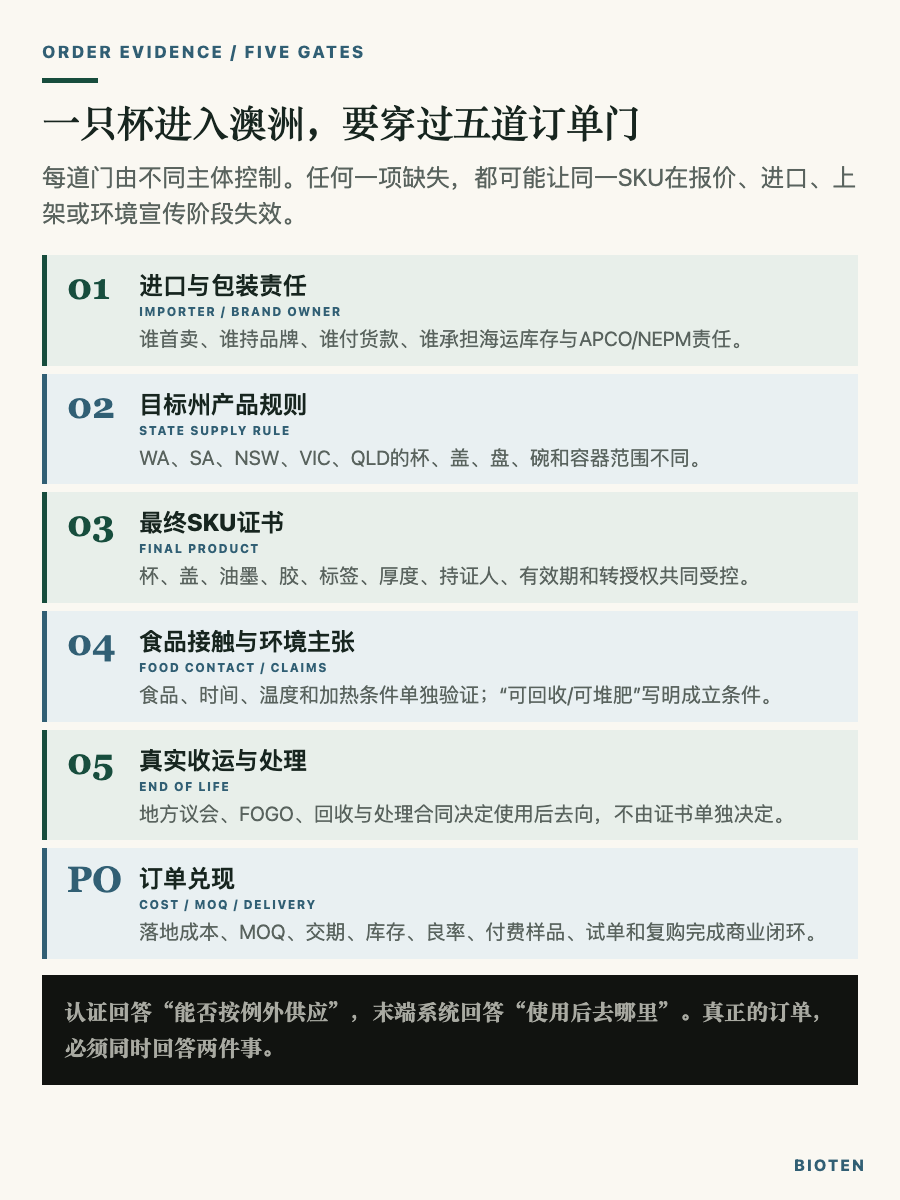
ABS海关明细能看到来源国、金额、重量、运输方式和目的州,但不公开企业级进口商排名。公开文章最多能识别角色,不能给出进口商Top 10。澳大利亚包装品牌、进口商和分销商通常把餐饮品牌的功能、印刷、成本和环境目标转换为SKU,选择产地并承担海运、库存和州际交付;本地转换厂则采购材料或涂布纸并完成最终杯盒。
常见订单有两条路线。成品路线是:中国杯盒厂→澳洲包装品牌或进口商→分销商→咖啡馆、快餐连锁(QSR)、酒店、商超或机构客户。材料路线是:中国材料商或涂布纸厂→澳洲或海外转换厂→包装品牌/进口商→餐饮渠道。进口商未必是品牌所有者,订单付款方也未必是联邦包装责任主体,合同和品牌归属必须单独确认。
规格提出者通常是餐饮连锁、咖啡品牌、包装品牌或机构采购;对中国供应商付款的常见主体是澳洲进口商、包装分销商或转换厂;州监管者判断产品能否供应;ABA和实验室判断证书与测试范围;食品经营者控制使用安全;地方政府和处理设施决定末端。任何一个角色都可能否决SKU,但否决理由不同。
报价前应问清:最终收货州、进口或首卖主体、品牌和付款人、杯与盖的完整结构、食品和温度、证书持有人、单件标签、目标末端、海运最小起订量(MOQ)、交期、库存和变更责任。法规只有进入正式规格、付费样品、第三方测试、试单或复购,才转化成商业证据。
主要依据:ABS海关明细;DCCEEW/APCO包装责任;FSANZ;SA/WA实施指南;企业公开供应链资料。
09 · CHINA ENTRY
中国三类企业,怎样进入下一轮供应商名单?
材料商要交“受控组成+用途窗口”。 文件应写明干膜聚合物身份、固含、涂布量、残留单体、交联剂与助剂、受限物质、PFAS/总氟边界、食品介质、温度和接触时间。对外表述应落在“为最终SKU验证提供材料与技术支持”,不能用“水性”“生物基”直接承诺无塑、可堆肥、可回收或州级准入。
涂布纸厂要交“功能+成型+末端三本账”。 固定原纸、克重、涂层配方、干膜质量、厚度和卷批次;提供Cobb/KIT、热封、折痕、边缘吸液、印刷和制杯参数;如果主张纸纤维循环,再单列总筛选得率、筛渣、DCS/COD、黏着物和成纸结果。再浆证据不能替代SA/WA的AS路线,也不能证明澳洲地方系统已经接受。
纸杯/纸餐盒厂要交“按实际售出状态的最终SKU责任包”。 杯、盒、盖、油墨、胶、标签、贴纸、尺寸、最厚处和运输包装都要受控;证书持有人、编号、标准、有效期和授权标识保持一致;南澳准备单件标识稿,西澳把杯与杯盖分别判断;食品接触资料覆盖真实食品和温度;工厂、配方、厚度或附件变化后重新判定。
商业进入不宜从“全澳通用杯”开始。可执行的顺序是:先用西澳或南澳完成一个州、一个进口责任方、一个最终SKU和一条真实去向的验证;再借助本地进口分销体系进入新州、维州和昆州的规模渠道。对成品厂,海运最小起订量(MOQ)、每千只落地成本、库存和补货能力与认证同样重要;对材料和涂布纸企业,本地转换伙伴与杯厂良率是更早的控制点。
10 · CONCLUSION
澳洲真正购买的是低风险SKU
对中国供应链来说,澳洲市场的门槛已经从“能做纸杯”转向“能按州交付最终SKU”。2025年官方进口明细显示,中国是相关纸制餐饮具进口篮子的主要来源;州级规则正在把竞争从单价推向结构、证书、食品接触、标签、库存和末端说明。
西澳一年超过1.54亿只外带咖啡杯,并不等于同等数量的替代订单。更实际的目标,是先完成一只证据闭环的杯:目标州和进口责任人明确,杯与盖分别合规,最终制品可制造,食品用途可验证,环境说明与当地垃圾桶一致。这样的SKU才有机会进入澳洲成熟供应链的下一轮筛选。
博碳包装·产业洞察·研究说明
本文依据截至2026年8月17日可核验的澳大利亚法规、政府统计、标准与认证机构及企业正式资料整理;动态豁免、证书和地方接受在实际报价与发货前须按目标州和最终SKU复核。本文用于产业研究与市场判断,不构成法律、认证、产品性能或订单承诺。
数据与核验来源
联邦包装责任:DCCEEW《Taking responsibility for our packaging》、包装监管改革状态、澳大利亚包装循环经济、NEPM 2011、APCO Covenant。
市场与贸易:ABS国际商品贸易数据集、ABS进口明细资源、ABS《Retail Trade, Australia, June 2025》、UN SITC Rev.4、Detpak企业资料、Huhtamaki Australia。
西澳:现行Regulations入口、Plan for Plastics、外带咖啡杯事实表、杯盖事实表、完整制品认证指导、临时豁免、FOGO最新指导。
南澳:2020 Act、2021 Regulations现行版、饮料容器指南、食品容器指南、2026标签要求、Which Bin SA。
其他州比较:NSW EPA一次性塑料FAQ、Victoria EPA、Business Queensland。
认证、食品接触与环境主张:Standards Australia AS 4736、ABA FAQ、ABA Sublicensing、FSANZ食品包装指南、Standard 3.2.2、DCCEEW可持续包装与PFAS、APCO PFAS更新、ACCC环境主张指南。
Australia is not a single, uniform market, but a collection of state-level markets in which orders are shaped by state regulations, final-product certification and local end-of-life systems.
GLOBAL FOODSERVICE PACKAGING POLICY AND MARKET MAP / AUSTRALIA MARKET
Australia's Foodservice Packaging Market
Who Imports, Which State Moves First
What Evidence Wins the Order?
Official import records, state-level restrictions, AS and ABA certification, FOGO end-of-life requirements and the procurement chain together determine how Chinese materials suppliers, coated-paper producers and cup-and-container manufacturers can enter Australia's foodservice packaging market.
AUD 305 million 2025 import basket · 79.3% value share sourced from China · 154 million takeaway coffee cups used annually in Western Australia
Values are reported on a CIF basis. SITC 64293 is a mixed basket; source-country shares do not represent market shares for paper cups or water-based coatings.
01 · EDITORIAL QUESTION
Is Australia an Import Opportunity or a Certification Maze?
Australia's appeal begins with an import chain that already exists. In 2025, imports of paper or paperboard trays, dishes, cups and related articles under SITC 64293 were approximately AUD 305 million. About AUD 242 million came from China, representing 79.3% of the total value. Because the category covers several kinds of articles, including trays, dishes and cups, these figures indicate sourcing patterns rather than the size of the paper-cup or water-based-coating market.
Volume and policy, however, sit on different maps. Western Australia and South Australia are using state-level rules to reshape the construction, certification and labelling of cups, lids and food containers. Meanwhile, New South Wales, Victoria and Queensland together accounted for 73.5% of import value by destination state in 2025. Western Australia and South Australia are logical markets for initial compliance validation; scaling sales requires access to channels in New South Wales, Victoria and Queensland. The sequence matters.
Western Australia also illustrates why supply eligibility and end-of-life acceptance must be assessed separately. Certain paperboard cups certified to an applicable Australian Standard may qualify for a supply exemption, yet the state's 2026 FOGO guidance still directs compostable cups, containers and trays to general waste. Certification answers whether a product may be supplied under an exemption; the local waste system determines where it goes after use. One certificate cannot replace both assessments.
CORE ASSESSMENT
Australia is not a greenfield market. China is already the principal source within the relevant import basket; the next contest is over specification redesign. Western Australia and South Australia are suited to validating state compliance and final-product evidence, while New South Wales, Victoria and Queensland provide the larger sales channels. Suppliers that can deliver verified construction, food-contact compliance, certification, labelling and a credible end-of-life route are the ones most likely to reach the next round of procurement.
SCOPE OF THE REVIEW
This article was verified through 17 August 2026. Import data are drawn from Australian Bureau of Statistics customs records for SITC 64293 and reported on a CIF basis. The category covers paper or paperboard trays, dishes, cups and similar articles under HS 482361 and HS 482369. It excludes moulded-pulp articles under HS 482370 and does not capture all coated paper imported under headings such as HS 4811 and subsequently converted into cups in Australia. Import value, weight and source-country shares are not market-share measures for paper cups, water-based coatings or the Australian packaging market as a whole. The federal framework and the rules in South Australia and Western Australia were reviewed in full; other states are compared only to the extent supported by verified official sources.
02 · MARKET DATA
This Is Not an Empty Market Waiting for Chinese Entrants
In 2025, imports under SITC 64293 totalled approximately AUD 305 million and 85,100 tonnes. China accounted for about AUD 242 million and 66,500 tonnes, equal to 79.3% of import value and 78.1% of recorded weight. In 2024, imports under the same classification were approximately AUD 316 million, with China representing 77.1% of value. By 2025, total value had fallen 3.3% and weight 1.1%; imports from China declined 0.5% in value but increased 3.7% in weight. The data point to adjustments in price, product mix and sourcing within a mature market, not to a demand surge created simply by plastic restrictions.
China's share of import value increased by about 2.2 percentage points in one year. Other leading sources in 2025 were Indonesia at 7.3%, Taiwan at 6.5% and Vietnam at 4.7%. China has a clear supply advantage, but buyers retain several Asian alternatives. Structural compliance, dependable delivery and local inventory therefore affect both procurement negotiations and the ability to retain repeat business.
From January through April 2026, imports in the basket were approximately AUD 88.15 million and 25,900 tonnes, down 17.3% in value and 3.4% in weight year on year. The sharper decline in value warrants continued monitoring of pricing pressure and product-mix changes, but four months of data cannot be extrapolated to the full year or used to conclude that Australian foodservice-packaging demand is contracting.
Sea freight accounted for 99.7% of 2025 import value. Orders are therefore judged not only on ex-works price, but also on an importer's shipping plan, inventory position, interstate distribution and version control. Destination-state shares were New South Wales 29.0%, Victoria 24.0%, Queensland 20.5%, Western Australia 16.2% and South Australia 9.9%. New South Wales and Victoria together represented 53.0%, making them the principal scale channels. Western Australia and South Australia together represented 26.1%, enough to support state-specific compliance validation.
Demand-side use cases are also verifiable. The ABS recorded seasonally adjusted turnover of approximately AUD 5.582 billion for Australian cafés, restaurants and takeaway food services in June 2025. The Western Australian Government reports that the state uses more than 154 million takeaway coffee cups each year. The first figure is one month's foodservice turnover and the second is a state-level cup count; neither is the size of the packaging market. They do, however, indicate the scale of the channel and the exposure of cup-related SKUs.
Australia also has domestic production. Detmold Group is headquartered in South Australia and manufactures paper and paperboard food packaging in Australia and across Asia. Huhtamaki Australia publicly describes local capacity for paper cups, containers and plates. The market combines domestic manufacturing, multinational operations and import distribution. Chinese suppliers compete not only with one another, but also with sources in Indonesia, Taiwan and Vietnam and with Australian converting capacity.
Principal sources: ABS international merchandise-trade records, 2024–2026; ABS, Retail Trade, Australia, June 2025; Western Australian coffee-cup fact sheet; official information from Detpak and Huhtamaki.
03 · FEDERAL LAYER
The Federal Framework Assigns Responsibility; States Decide Whether a Cup or Container May Be Supplied
As of March 2026, Australia's proposed national packaging regime remained under development. The Department of Climate Change, Energy, the Environment and Water (DCCEEW) states that existing co-regulatory arrangements will continue until the new regulations commence. The federal layer establishes packaging responsibilities; whether a particular cup or container may be supplied still depends on state or territory product rules and the relevant local end-of-life system.
The current national foundation consists of the National Environment Protection (Used Packaging Materials) Measure 2011 and the Australian Packaging Covenant.
DCCEEW currently explains that businesses manufacturing or selling packaging in Australia with annual turnover of AUD 5 million or more must join APCO, report under state or territory arrangements implementing the NEPM, or participate in an approved program delivering equivalent outcomes. A factory in China may manufacture the product, but the Australian importer, brand owner or first seller must determine its own obligations. Those obligations flow upstream as requirements for construction, origin data, environmental claims and annual reporting.
The Australian Government reports that about 6.84 million tonnes of packaging were placed on the market in 2023–24, of which 41% ultimately went to landfill. This is an all-packaging figure used only to describe national material flows. Reduction, reuse, design for recycling and chemicals management are directions of federal reform, but they should not be presented as an already operative, nationally uniform product rule. Export quotations must first identify the final state of receipt.
Principal sources: DCCEEW, Taking Responsibility for Our Packaging, Reforming Packaging Regulation and A Circular Economy for Packaging in Australia; NEPM; APCO.
04 · WESTERN AUSTRALIA
Western Australia Changes the SKU First: A Cup May Qualify, but Its Lid May Not
Western Australia is a practical first validation market for cup-and-container manufacturers because product scope and implementation dates are comparatively clear.
Under the Environmental Protection (Prohibited Plastics and Balloons) Regulations 2018 and the state's Plan for Plastics, single-use plastic cold-drink cups were covered from 1 October 2022; hot-drink cups and all single-use plastic cup lids from 1 March 2024; lidded takeaway or dine-in containers, bowls, trays and related plastic lids from 1 September 2024; and moulded or cut expanded-plastic packaging from 1 July 2025.
Western Australia assesses product composition rather than marketing terminology. Products made wholly or partly of plastic may fall within scope, including lined, coated and laminated structures. A product is not excluded simply because it is described as plant-based, biodegradable or water-based. The regulations also connect supply to the recipient in Western Australia; an overseas factory cannot avoid the rules merely by pointing to the place of contract or the supplier's location.
Cups and lids must be assessed separately. A paperboard cup certified as a complete product to a current AS 4736 or AS 5810 scheme may qualify for a specific statutory exemption. Cup lids do not enjoy the same general exemption. The current Western Australian provision for certified paperboard lids applies to lids for food containers, trays and bowls, but not to cup lids; official guidance also requires coffee-cup lids to be entirely plastic-free. Certification of the cup body does not automatically cover its lid, and one non-compliant accessory can disqualify the complete SKU.
As of 17 August 2026, Western Australia retained a temporary class exemption for certain takeaway containers and lids used for pourable soup or other liquid food served above 60°C. The official listing showed an expiry date of 31 August 2026, only 14 days after the verification date. Products for soup, curry, laksa and similar applications must therefore be rechecked before quotation and shipment. A temporary exemption should never be embedded in a long-term product manual.
Principal sources: current Western Australian Regulations; Plan for Plastics; coffee-cup and cup-lid fact sheets; temporary exemption SUP0003/2024/2.
05 · SOUTH AUSTRALIA
South Australia Changes the Evidence Next: From 2026, Item-Level Labelling Also Matters
South Australia's focus is evidence and labelling. From 1 September 2024, hot- and cold-drink cups, cup lids and relevant containers for ready-to-eat food entered a new regulatory phase. A paper-based cup or container with plastic extrusion coating, an aqueous coating or a water-applied barrier layer is not automatically plastic-free merely because it is described as water-based or predominantly fibre.
From 1 March 2026, relevant certified-compostable food and beverage containers seeking an exemption must follow a current AS 4736 or AS 5810 certification route and clearly identify, on each individual item, whether the product is home compostable, industrially compostable, or both. Marking only the outer carton is insufficient. Containers below 60 mL and lids below 70 mm in diameter may qualify for limited marking-condition exceptions, but the exceptions do not remove certification or record-keeping obligations from the entire product line.
South Australia also retains narrowly defined transitional exceptions for certain clear, separable PP or PET lids and high-temperature soup containers. The market will not converge on a single material. Western Australia first alters the cup-and-lid SKU; South Australia then pushes certification, labelling and version control down to the individual item.
New South Wales, Victoria and Queensland also restrict selected single-use plastic products, but their scopes are not identical. New South Wales covers specified plates, bowls, cutlery and expanded-polystyrene foodservice articles, and plastic linings or coatings may be relevant to classification; some lidded bowls fall outside particular categories. Victoria expressly covers plastic plates, including paper plates with plastic linings, as well as EPS food and beverage containers. Queensland focuses on plastic plates, open bowls, cutlery and EPS cups and containers. These states provide larger channels, but South Australian and Western Australian certification logic cannot simply be copied into them.
Principal sources: South Australian Act and current Regulations; Replace the Waste labelling guidance; official guidance from NSW EPA, EPA Victoria and Business Queensland.
06 · CERTIFICATION
AS and ABA: Evidence at One Level Does Not Automatically Replace Evidence at the Next
AS 4736—2006 covers commercial or industrial composting and other controlled microbial treatment, while AS 5810—2010 covers home composting. The two standards are not interchangeable. Standards are generally voluntary until a state regulation incorporates one as a condition of an exemption for a defined product. Standards Australia develops standards but does not issue product certificates. The Australasian Bioplastics Association (ABA) is a certification body and industry organisation, not a legislature.
ABA's public FAQ highlights several easily overlooked boundaries. A supplier's certification does not automatically certify its customer's finished product. Use of a certification mark is not automatically transferable and may require a trademark sublicense. Whether the thickest product represents an entire formulation family is subject to independent review, and the application must include the inks, colourants and additives actually used. State exemptions look at the certificate holder, product name, standard, thickness, formulation, printing, accessories, validity period and authorised scope of mark use.
Evidence should be separated into three levels. Material-level evidence can establish the properties of a resin or coating formulation. Coated-paper evidence can define the base paper, coat weight and barrier construction. Only final-product evidence captures the cup bottom, side seam, rim, ink, adhesive, label, lid and actual maximum thickness within the same SKU. Evidence at one level can support, but cannot replace, evidence at the next.
Food-contact compliance must be assessed independently. Clause 9 of FSANZ Standard 3.2.2 requires a food business to use packaging that is fit for its intended use and unlikely to contaminate food. Food type, acidity or fat content, contact time, temperature, heating or microwave use, freezing and reuse can all change the evidence required. AS or ABA certification does not substitute for food-contact compliance, and food-contact documentation does not establish compostability, fibre recyclability or eligibility for a state exemption.
PFAS claims also require restraint. The federal government is considering future restrictions on packaging chemicals, and APCO's work on PFAS in fibre-based food-contact packaging remains an industry initiative and a subject of 2026 consultation, not a nationally uniform prohibition covering all food packaging. ABA processes may review total fluorine and declarations concerning intentionally added fluorinated substances, but participation in an ABA process should not be marketed as proof of “zero PFAS”.
Principal sources: Standards Australia; ABA FAQ and sublicensing rules; FSANZ food-packaging guidance and Standard 3.2.2; DCCEEW and APCO PFAS materials.
07 · END OF LIFE
Certified, Yet Still Excluded from Western Australia's FOGO System—Why?
Western Australia's 2026 FOGO guidance accepts food, garden organics and certified kitchen caddy liners bearing the AS 4736 mark. Food packaging is outside the accepted stream. Non-recyclable packaging—including compostable cups, containers and trays—is currently directed to general waste. The official rationale is not that certification is invalid, but that kerbside systems cannot reliably distinguish certified packaging from non-certified packaging and must control contamination from plastics, coatings and chemicals.
Certification and end-of-life systems answer different questions. Certification may determine whether a particular paperboard cup can be supplied under a state exemption. Local governments, treatment facilities, licence conditions and collection contracts determine whether the used product may enter FOGO. Some South Australian councils offering green-organics services may accept certified packaging bearing an applicable Australian Standard mark. The same certificate can therefore lead to different outcomes in different states and local systems.
Environmental marketing is consequently part of the order threshold. The Australian Competition and Consumer Commission (ACCC) requires environmental claims to be truthful, evidence-based and clear about the conditions under which they apply. Its official guidance uses takeaway coffee cups to show that a claim may mislead consumers if a cup can be handled only through a dedicated collection point but is presented as suitable for ordinary recycling. The Australian market assesses the product, the label, the disposal graphic and the sales language.
Certification answers, “May this product be supplied under an exemption?” The end-of-life system answers, “Where does it go after use?” A commercially viable order must answer both.
Principal sources: WA Waste Authority, Towards Cleaner Compost; Which Bin SA; ACCC environmental-claims guidance; ABA FAQ.
08 · ORDER CHAIN
Who Imports, Who Pays, and Who Can Reject the SKU?
ABS customs records disclose source country, value, weight, transport mode and destination state, but not a company-level ranking of importers. Public evidence can identify roles; it cannot support a credible “Top 10 importers” list. Australian packaging brands, importers and distributors typically convert a foodservice brand's functional, printing, cost and environmental objectives into an SKU, select the source country and manage ocean freight, inventory and interstate delivery. Local converters purchase materials or coated paper and manufacture the finished cups and containers.
Two order routes are common. The finished-product route runs from a Chinese cup or container manufacturer to an Australian packaging brand or importer, then through a distributor to cafés, quick-service restaurants, hotels, supermarkets or institutional customers. The material route runs from a Chinese materials supplier or coated-paper producer to an Australian or offshore converter, then to a packaging brand or importer and finally to the foodservice channel. The importer may not be the brand owner, and the party paying for the order may not be the entity responsible under the federal packaging framework. Contract terms and brand ownership must be checked separately.
Specifications are usually set by foodservice chains, coffee brands, packaging brands or institutional procurement teams. Chinese suppliers are commonly paid by Australian importers, packaging distributors or converters. State regulators determine whether the product may be supplied; ABA and laboratories determine the scope of certificates and tests; food businesses control safe use; local governments and treatment facilities determine the end-of-life route. Any of these parties can reject an SKU, but for different reasons.
Before quoting, suppliers should identify the final state of receipt; the importer or first seller; the brand owner and payer; the full construction of cup and lid; food type and temperature; certificate holder; item-level labelling; intended end-of-life route; sea-freight minimum order quantity; delivery lead time; inventory arrangements; and responsibility for changes. Regulation becomes commercial evidence only when it is reflected in a formal specification, paid sampling, third-party testing, a trial order or repeat purchasing.
Principal sources: ABS customs records; DCCEEW and APCO packaging-responsibility materials; FSANZ; South Australian and Western Australian implementation guidance; publicly available corporate supply-chain information.
09 · CHINA ENTRY
How Can Three Types of Chinese Suppliers Reach the Next Round?
Materials suppliers: deliver a controlled-composition and use-window dossier. It should identify the dry-film polymer, solids content, coat weight, residual monomers, crosslinkers and additives, restricted substances, PFAS and total-fluorine boundaries, food simulants, temperature and contact time. External claims should state that the material and technical package supports validation of the final SKU. “Water-based” or “bio-based” alone cannot substantiate claims of plastic-free status, compostability, recyclability or state-level market access.
Coated-paper producers: deliver three evidence sets—performance, converting and end of life. Fix the base paper, basis weight, coating formulation, dry-film mass, thickness and roll batch. Provide Cobb and KIT results, heat-seal performance, crease resistance, edge-wicking data and printing and cup-forming parameters. Where fibre circularity is claimed, report total screening yield, rejects, DCS or COD, stickies and resulting paper quality separately. Repulpability evidence does not replace the AS pathway required in South Australia or Western Australia, nor does it prove acceptance by a local Australian waste system.
Cup and paper-container manufacturers: deliver a final-SKU responsibility package in the condition actually sold. Control the cup or container, lid, ink, adhesive, label, sticker, dimensions, maximum thickness and transport packaging. Keep the certificate holder, certificate number, standard, validity period and authorised mark use consistent. Prepare item-level marking for South Australia and assess the cup and its lid separately for Western Australia. Food-contact evidence must cover the actual food and temperature. Any change in factory, formulation, thickness or accessory requires reassessment.
Commercial entry should not begin with the idea of a single “all-Australia cup”. A practical sequence is to validate one state, one accountable importer, one final SKU and one real end-of-life route in Western Australia or South Australia, then use local import and distribution systems to reach the larger channels in New South Wales, Victoria and Queensland. For finished-product manufacturers, sea-freight MOQ, landed cost per thousand units, inventory and replenishment capacity matter as much as certification. For materials and coated-paper suppliers, local converting partners and cup-forming yields are earlier control points.
10 · CONCLUSION
What Australia Actually Buys Is a Low-Risk SKU
For Chinese supply chains, the threshold for the Australian market has shifted from “we can make a paper cup” to “we can deliver a compliant final SKU state by state”. Official 2025 import records show that China is the principal source within the relevant basket of paper-based foodservice articles. State rules are moving competition beyond unit price toward construction, certification, food-contact compliance, labelling, inventory and end-of-life instructions.
Western Australia's annual use of more than 154 million takeaway coffee cups does not translate into the same number of substitution orders. A more realistic objective is to complete one evidence-closed-loop cup: the target state and accountable importer are identified; cup and lid are assessed separately; the finished product can be manufactured consistently; food use is substantiated; and environmental instructions match the local bin system. An SKU that meets those conditions has a credible chance of entering the next round of Australia's mature supply chain.
BIOTEN PACKAGING · INDUSTRY INSIGHT · RESEARCH NOTE
This article is based on Australian legislation, government statistics, standards, certification-body materials and official corporate information verifiable through 17 August 2026. Dynamic exemptions, certificate status and local acceptance must be rechecked for the target state and final SKU before quotation or shipment. The article is intended for industry research and market assessment and does not constitute legal, certification, product-performance or order advice.
Data and verification sources
Federal packaging responsibility: DCCEEW, Taking Responsibility for Our Packaging; status of packaging-regulation reform; circular-economy materials; NEPM 2011; APCO Covenant.
Market and trade: ABS international merchandise-trade datasets and import-detail resources; ABS, Retail Trade, Australia, June 2025; UN SITC Rev. 4; official information from Detpak and Huhtamaki Australia.
Western Australia: current Regulations, Plan for Plastics, takeaway-coffee-cup and cup-lid fact sheets, final-product certification guidance, temporary exemptions and current FOGO guidance.
South Australia: 2020 Act, current 2021 Regulations, beverage-container and food-container guidance, 2026 labelling requirements and Which Bin SA.
Other states: NSW EPA single-use-plastics FAQ, EPA Victoria and Business Queensland.
Certification, food contact and environmental claims: Standards Australia AS 4736; ABA FAQ and sublicensing rules; FSANZ food-packaging guidance and Standard 3.2.2; DCCEEW sustainable-packaging and PFAS materials; APCO PFAS updates; ACCC environmental-claims guidance.