
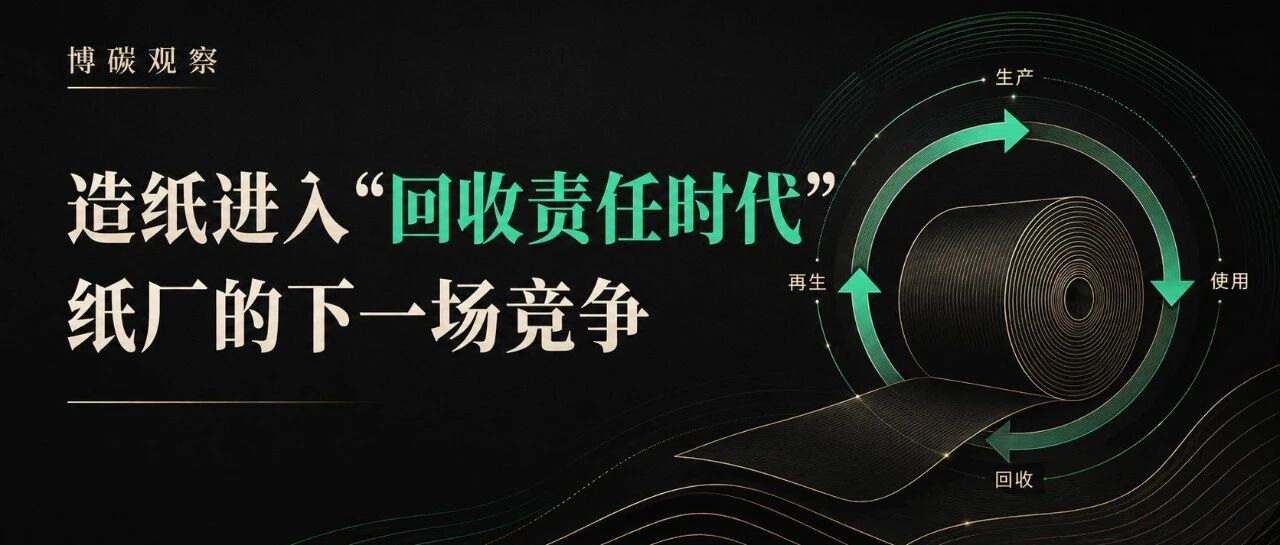
产能决定规模;回收适配与证据,决定订单能走多远。
中国造纸产业观察 / CHINA PAPER INDUSTRY
造纸进入“回收责任时代”纸厂的下一场竞争不只看产能
法典与PPWR把减量、复用、回收和证明推到订单前台;纸厂交付的不只是吨纸,更是客户能生产、能验证、能进入回收系统的能力。
DATA COORDINATES / 2026经营坐标
行业 H1 机制纸及纸板产量 +6.0%
行业 H1 规上造纸和纸制品业利润 +27.5%
中欧 法典 8.15 / PPWR 8.12
研究资料:国家统计局产量;工业效益
RESEARCH QUESTION / 研究问题
产量利润双增,为什么竞争表还要重写?
生态环境法典第九百七十四条要求电商、快递、外卖减少包装,优先复用、易回收并积极回收。直接对象不是纸厂,但品牌会把要求写进采购与加工合同。
PPWR自8月12日起一般适用,覆盖欧盟市场所有包装,涉及制造、组成、复用/回收和废物管理;具体义务仍有后续节点。两套制度不同,却都要求包装回答性能、减量、回收和证据。法律未把全部责任交给纸厂,订单会把适配要求向上游传导。
资料:生态环境法典;欧盟PPWR;实施指导
法律责任边界没有消失,商业能力边界正在向回收端延长。
产能决定规模,验证能力决定订单寿命。
01 FIVE CAPABILITIES
纸厂不只卖纸,开始交付回收适配能力
纤维效率|杂质、灰分、含水率、强度和波动,最终都要落到每吨投入能产出多少合格纸。
纸机稳定|低克重不自动等于先进;定量波动、断纸、换产、损纸率、能耗和交付偏差要一起管理。
功能留出口|产品标准不替代最终SKU的食品接触、封口、结构与回收实测。
功能、减量、制造、循环与证据属于同一评价链;这是本文框架,并非法规原文。
PE淋膜凭借薄、低成本、阻隔和热封,支撑了纸代塑1.0;PLA淋膜、PBAT淋膜、水性丙烯酸涂层、PHA水性复合涂层符合中长期发展的路线则需在完整SKU与目标设施中比较。
证据可交付|纸种、克重、功能层、油墨、胶黏剂、测试条件、批次和回收边界要组成资料链。
网络能接回|没有收集、分选、再浆或再生料去向,“可回收”只能停留在材料描述。
资料:GB/T 44834-2024;GB/T 36392-2025
02 RECYCLABILITY TEST
“可回收”不是把样品放进水里搅一搅
Cepi Version 3模拟常规回收纸厂的碎浆、筛选和再成页,评价粗细筛渣、纸页黏连、宏观黏性物等,滤液可选测COD/BOD。4evergreen 2026指南再连接设计、收集和分选,并区分常规、浮选脱墨和专门回收三类路径。
纸厂真正要问的五个问题
纤维得率 / 筛渣与黏性物 / 滤液负荷 / 纸厂路径 / 再造纸页
这是行业方法,不是PPWR法定及格线,也不能替代完整包装在目标系统中的实测。
方法:Cepi Version 3;4evergreen V4
03 ORDER CONVERSION
回收责任,怎样兑现成订单?
产能表要增加四列:单位合格吨纤维效率、最终SKU性能、证据完整度、客户验证周期与复购。
浆和废纸看质量追溯;化学品/涂层看纸机适配与回收负荷;设备看断纸、换产、能耗;加工端看原纸与成型良率。
客户最终验证六件事:方案、量产、协同、交付、质量与复购。
百胜中国披露2025年总包装减量约3.5万吨,其中纸包装约1.7万吨;截至年末,约99%的纸包装获FSC或等效认证。这提示纸厂:品牌买的不是标签,而是减量、认证、良率、稳定和回收路径。
企业披露:百胜中国2025可持续发展报告;品牌数据不外推行业总量。
CONCLUSION / 博碳观察
造纸进入“回收责任时代”,不意味着纸厂独自承担从收集到再生的全部责任,而是纸厂不能再把包装离厂视为价值终点。
下一场竞争,看谁能把纤维效率、纸机稳定、功能结构、客户文件和回收网络连成可验证的交付链。纸厂最需警惕的,不是材料口号,而是只用吨产能回答客户用完整SKU、证据和回收适配提出的问题。
产能给出规模,责任交付决定订单寿命。
博碳包装·产业洞察·研究说明
“回收责任时代”为本文产业判断,不是法定制度名称,不作为事实证据;生态环境法典、PPWR、标准、行业方法和品牌披露分别处理。核验日期:2026年8月21日。
数据与核验来源
1. 国家统计局:纸及纸板产量
2. 国家统计局:工业利润
3. 生态环境法典
4. 欧盟委员会:PPWR
5. PPWR实施指导
6. GB/T 44834-2024
7. GB/T 36392-2025
8. 百胜中国2025报告
9. Cepi回收测试V3
10. 4evergreen循环设计V4
下一步 要思考的 要认知的多维角度
Capacity determines scale; recycling compatibility and evidence determine how far customer orders can go.
China Paper Industry Watch / CHINA PAPER INDUSTRY
Papermaking Enters the “Recycling-Responsibility Era”The Next Competition Among Paper MillsIs About More Than Capacity
China’s Ecological and Environmental Code and the PPWR are bringing reduction, reuse, recycling and proof to the front end of procurement. Paper mills are no longer delivering tonnes of paper alone; they are also delivering the ability for customers to manufacture, verify and route packaging into recycling systems.
DATA COORDINATES / 2026 OPERATING METRICS
Industry | H1 2026 Machine-made paper and paperboard output +6.0%
Industry | H1 2026 Profits of above-designated-size paper and paper products enterprises +27.5%
China / EU Code: 15 August / PPWR: 12 August
Sources:National Bureau of Statistics output data; industrial enterprise performance data
RESEARCH QUESTION / THE QUESTION
If Output and Profits Are Both Rising, Why Must the Competitive Scorecard Be Rewritten?
Article 974 of China’s Ecological and Environmental Code requires e-commerce, express-delivery and food-delivery operators to reduce packaging, give priority to reusable and readily recyclable options, and actively support recovery. Paper mills are not the direct regulated parties, but brands will incorporate these requirements into procurement and converting contracts.
The PPWR has been generally applicable since 12 August 2026, covering all packaging placed on the EU market and addressing manufacturing, composition, reuse and recycling, and waste management; some specific obligations take effect at later milestones. The two regimes differ, but both require packaging to demonstrate performance, reduction, recycling and supporting evidence. The law does not assign all responsibility to paper mills, yet customer orders will transmit compatibility requirements upstream.
Sources:China’s Ecological and Environmental Code; EU PPWR; implementation guidance
The boundary of legal responsibility has not disappeared; the boundary of commercial capability is extending toward recovery and recycling.
Capacity determines scale; verification capability determines the longevity of customer orders.
01 FIVE CAPABILITIES
Paper Mills Are Beginning to Deliver Recycling Compatibility, Not Just Paper
Fibre efficiency |Contaminants, ash, moisture, strength and variability must ultimately be measured by how much on-specification paper each tonne of input can produce.
Paper-machine stability |Lightweighting is not automatically advanced. Basis-weight variation, sheet breaks, grade changes, broke rate, energy consumption and delivery deviations must be managed together.
Functional headroom |A product standard does not replace testing of the final SKU for food contact, sealing, structural performance and recyclability.
Functionality, reduction, manufacturability, circularity and evidence form a single assessment chain. This is the analytical framework used in this article, not language taken from the regulations.
PE extrusion coating, with its thin gauge, low cost, barrier performance and heat-sealability, underpinned paper-for-plastic substitution 1.0. PLA- and PBAT-based extrusion coatings, water-based acrylic coatings and PHA-based waterborne composite coatings are medium- to long-term pathways that must be compared at the level of the complete SKU and within the intended processing and recycling facilities.
Evidence as a deliverable |Paper grade, basis weight, functional layer, inks, adhesives, test conditions, batch information and recycling boundaries must form a coherent documentation chain.
Recycling-network connectivity |Without collection, sorting, repulping or a defined outlet for recovered material, “recyclable” remains only a material description.
Sources:GB/T 44834-2024; GB/T 36392-2025
02 | RECYCLABILITY TEST
Calling Something “Recyclable” Requires More Than Stirring a Sample in Water
Cepi Version 3 simulates pulping, screening and handsheet formation in a conventional recovered-paper mill. It assesses coarse and fine screening rejects, sheet adhesion and macrostickies, with optional COD/BOD testing of the filtrate. The 4evergreen 2026 guidance further connects design, collection and sorting, and distinguishes conventional, flotation-deinking and specialized recycling routes.
Five Questions Paper Mills Should Actually Ask
Fibre yield / screening rejects and stickies / filtrate load / mill route / resulting handsheet
This is an industry methodology, not a statutory PPWR pass/fail threshold, and it cannot replace testing of the complete package in the intended system.
Methods:Cepi Version 3; 4evergreen Version 4
03 ORDER CONVERSION
How Does Recycling Responsibility Translate into Orders?
Add four columns to the capacity table:Fibre efficiency per on-spec tonne, final-SKU performance, evidence completeness, and customer validation cycle plus repeat orders.
For pulp and recovered paper, track quality and traceability; for chemicals and coatings, paper-machine compatibility and recycling-system load; for equipment, sheet breaks, grade-change time and energy use; and for converters, base-paper performance and forming yield.
Customers ultimately validate six things: the solution, mass production, collaboration, delivery, quality and repeat orders.
Yum China reported a total packaging reduction of approximately 35,000 tonnes in 2025, including about 17,000 tonnes of paper packaging. By year-end, approximately 99% of its paper packaging was FSC-certified or carried equivalent certification. The implication for paper mills is clear: brands are not buying a label; they are buying reduction, certification, yield, consistency and a credible recycling route.
Company disclosure:Yum China 2025 Sustainability Report; brand-level data should not be extrapolated to the industry as a whole.
CONCLUSION / BIOTEN OBSERVER
Papermaking entering the “recycling-responsibility era” does not mean paper mills alone assume every responsibility from collection through reprocessing. It means mills can no longer treat the moment packaging leaves the factory as the end of value creation.
The next competitive battleground is the ability to connect fibre efficiency, paper-machine stability, functional structures, customer documentation and recycling networks into a verifiable delivery chain. What paper mills should fear most is not material rhetoric, but answering customers’ questions about complete SKUs, evidence and recycling compatibility with capacity figures alone.
Capacity creates scale; responsible delivery determines the longevity of customer orders.
BIOTEN Packaging · Industry Insight · Research Note
“Recycling-responsibility era” is an industry interpretation used in this article, not the name of a statutory regime and not itself presented as factual evidence. China’s Ecological and Environmental Code, the PPWR, standards, industry methodologies and brand disclosures are treated separately. Information verified as of 21 August 2026.
Data and Verification Sources
1. National Bureau of Statistics: paper and paperboard output
2. National Bureau of Statistics: industrial profits
3. China’s Ecological and Environmental Code
4. European Commission: PPWR
5. PPWR implementation guidance
6. GB/T 44834-2024
7. GB/T 36392-2025
8. Yum China 2025 Sustainability Report
9. Cepi Recyclability Test Method, Version 3
10. 4evergreen Circularity by Design Guideline, Version 4
Further Questions and Perspectives