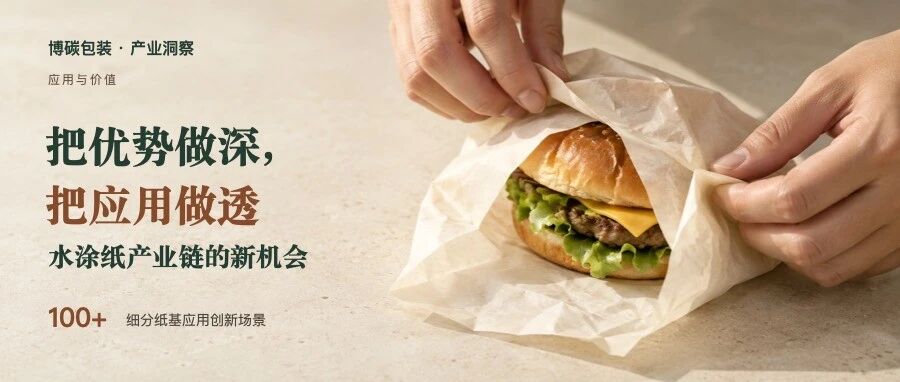

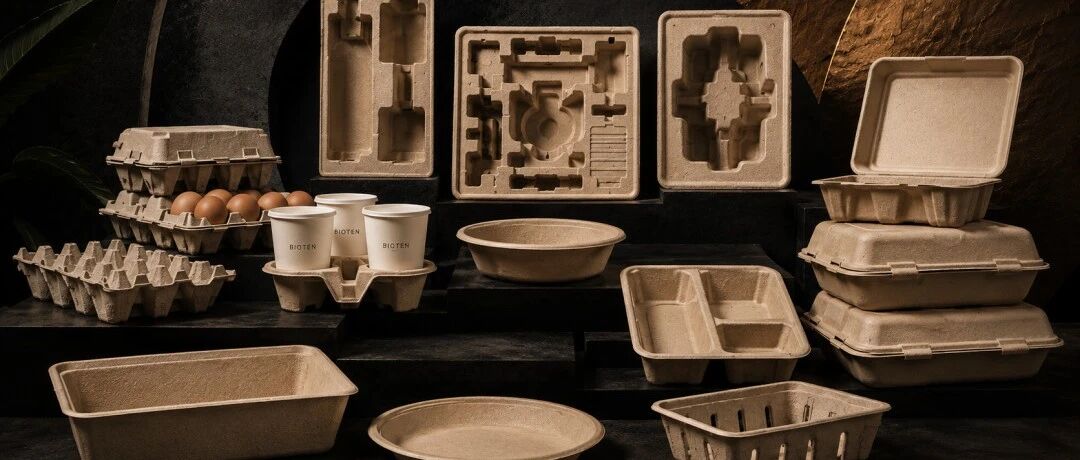
纸浆模塑正在扩展产能,但增产不会自动变成增值;近79%的受访纸浆模塑制造商预计2026年增产。可产量增加,不等于利润和现金同步增长:从蛋托、果托等规模型产品走向高性能精密器件内衬、高要求食品包装与餐饮具,企业必须同时跨过食品接触、真实工况、完整BOM和稳定交付四道门。
产量增加,不等于利润和现金同步增长:从蛋托、果托等规模型产品走向高性能、高要求食品包装,企业必须跨过食品接触、真实工况、完整BOM和稳定交付四道门。
2026 · THREE EVIDENCE COORDINATES
IMFA|参与首轮基准调查的制造商
近79% 预计2026年产量增加
Huhtamaki Fiber Packaging|2026年上半年分部口径
+6% 可比销售 +28% 调整后EBIT
众鑫股份|2026年上半年单家公司口径,报告未经审计
+33.70% 营业收入
+66.61% 归母净利润
1.63亿元 经营活动现金流净额同比-34.44%,但仍为正
同属纸浆模塑,规模供给、客户认证和高性能食品包装并不共享一套利润模型;越接近食品接触,责任越集中到涂层和完整制品。
IMFA数据是参与制造商预期,Huhtamaki是分部口径,众鑫是单家公司财务;概念验证、设备订单和量产分级表达,不混算为行业增长率。
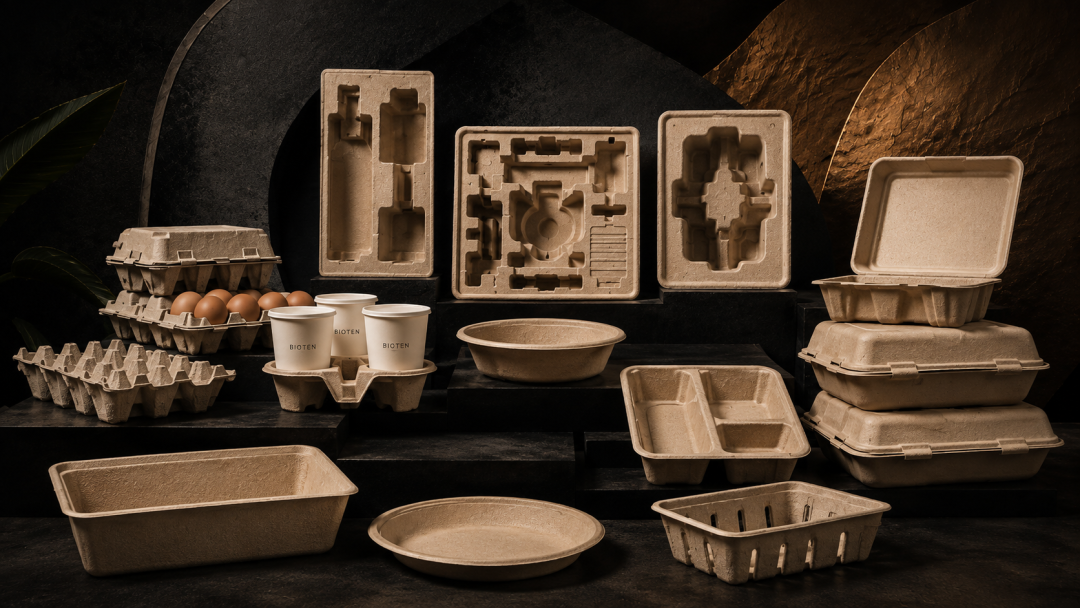
三类数据不能相加成一个行业增长率,却共同说明:制造端增产预期、全球企业分部改善和中国企业销量增长已经出现,利润与现金能否同步兑现仍是另一道题。
应用端也不是同一条跑道:中国餐饮具处于规模供给,马来西亚干法杯盖已有商业生产,瑞典鼻烟罐进入设备投入,纤维瓶盖仍在开发,澳大利亚鲜肉托盘还在概念验证。
第一轮增长已经把应用做宽;第二轮增长要回答的是,食品包装怎样把性能、合规与稳定交付变成利润和现金。
研究资料:IMFA全球基准报告;Huhtamaki 2026年半年度报告;众鑫股份2026年半年度报告;博碳开发者。
01 · APPLICATION STAGES
第一轮增长:四级应用坐标,把行业带出蛋托
蛋托、果托和饮料托盘仍是规模底盘。工业缓冲、电子内衬和美妆精品把行业带向结构、尺寸、表面和客户认证;餐盒、汤碗、生鲜托盘、膨化食品包装内衬与冷链包装,又把食品接触和真实工况压到同一件制品上。
概念验证|澳大利亚Zipform鲜肉托盘完成首轮测试,下一步仍是更广市场验证和产业化。
开发测试|PulPac纤维瓶盖已做早期现实环境测试,但仍明确处于开发阶段。
产业化投入|Future Materials Sweden订购两台设备,新基地初期聚焦纤维鼻烟罐。
商业生产|HZ Green Pulp于2025年披露马来西亚干法咖啡杯盖进入全规模商业生产。
第一轮增长由不同工艺共同完成。传统厚壁/转移湿法覆盖托盘、餐具和成本敏感保护件;精品湿压/热压追求薄壁、精度与表面;干法纤维成型试图缩短湿坯脱水和干燥链条。三条路线的含水、模具、节拍、能耗、精度和良率不能横向套用。
研究资料:鲜肉托盘项目;博碳开发者;纤维瓶盖开发;瑞典设备订单;咖啡杯盖商业生产。
02 · PROFIT MODELS
增长后的现实:同一行业,至少三种利润模型
众鑫股份2025年审计年报显示,餐饮具营业收入下降4.97%;由新增精品工业包装销售带动的“其他环保包装”增长64.14%。但后者全年收入只有1679.90万元,餐饮具则为14.42亿元。
规模型餐饮具|依靠连续生产、采购规模和区域供货,利润容易受到单价、能源、贸易和物流挤压。
认证型工业与精品包装|靠结构、模具、表面和客户认证获得项目价值,代价是开发周期、换型和批量一致性。
高性能食品包装|同时承担食品接触、阻隔、密封、配送和末端责任,溢价也可能被涂层、干燥、良率和认证周期吃掉。
同年,公司餐饮具及其他产品产量下降19.76%、销量下降1.40%,内销增长8.21%、外销下降4.62%。年报将产量下降主要联系到美国贸易措施和泰国产能爬坡。
名义产能不是稳定输出,设备订单不是客户订单,展会样品也不是复购。应用扩张只回答“有没有活干”;单位合格品成本与现金回款,才回答“有没有增值”。
研究资料:众鑫股份2025年年度报告;美国商务部终裁;加拿大CBSA终裁。
03 · SECOND GROWTH
第二轮增长:食品包装为什么更难,也更值得做
电子精密内衬和美妆精品同样可以创造高价值。食品包装之所以值得单独讨论,是因为它高频、体量广、工况复杂,最能同时检验材料、结构、法规、制造和末端能力。
餐盒、汤碗、生鲜托盘、冷冻复热、预制食品和超市即食包装,购买的不是“植物纤维含量高”,而是热汤不渗、油脂不外迁、冷凝不软塌、边角不先失效、盖合不脱开等确定结果。
食品接触门|浆料、助剂、涂层、油墨、胶黏剂、迁移和感官。
真实工况门|内容物、温度、时间、油水热液、冷冻复热、边角、密封和配送。
法规与客户门|目标市场归类、检测文件、客户审核和最终SKU认证。
末端与经济门|减量、可分离、再浆或堆肥,以及干燥、良率和单位合格品成本。
2026年8月15日起施行的《生态环境法典》要求合理、减量包装,并把绿色采购和绿色供应链写入企业责任。北京《餐饮外卖商户绿色包装使用指南》将于9月1日实施,把餐品温度、包装尺寸、层数、封口和易分离结构翻译成商户动作。
法律和推荐性地方标准效力不同,也没有指定纸浆模塑、水性涂层或PHA、PLA。它们改变的是采购问题:结构有没有减量,BOM能否追溯,食品工况是否通过,食品接触安全、可回收再浆、可堆肥,用后路径是否真实。无塑成分是否能被计算满足SUPD要求。
研究资料:中华人民共和国生态环境法典;北京外卖绿色包装指南;博碳开发者;SUPD指南。
04 · BOM & COATING
增质的关键:完整BOM与那层涂层
纤维决定纸浆模塑能不能成型;完整BOM与涂层决定它能进入什么食品工况、承担什么法规责任,以及最终走向哪条用后路径。
木浆、再生浆、竹浆、甘蔗浆和秸秆回答“纤维从哪里来”。竹浆已经属于纸浆模塑原料边界,却不能自动证明最终制品食品接触合规、可回收、可堆肥或低碳。
高性能纸浆模塑必然涉及配方和助剂,以及阻隔涂层生物基材料的涵盖的高端市场。专业判断要落到每种成分是否必要、可追溯、适用于目标食品和温度,能否跨批次稳定,并与声明的末端路径相容。
“水性”只描述分散或施工介质。水挥发后留下的成膜聚合物、配方组成、涂布量和连续结构,才决定阻油、阻水、热液、热封、法规归类和末端行为。
PE淋膜|性能、热封与供应链成熟;纸塑复合、再浆分离和非堆肥末端需要处理。
EAA、丙烯酸、PU等水性/分散体系|配方灵活、产线经验较成熟;“水性”不会改变成膜聚合物身份。
天然聚合物、蜡/树脂和矿物协同|可承担部分阻隔,但湿度、热稳定、折曲开裂和粘结相仍是约束。
PHA水性阻隔路线|把食品阻隔开发与经验证生物处理路径放到同一条工程路线上,仍需按材料、厚度、配方和最终制品范围建立证据。
中国|GB 4806.10—2025将于2026年9月2日实施。
美国|FDA确认35项纸和纸板防油PFAS相关食品接触通知已因用途放弃而不再有效。
欧盟|SUPD没有最低塑料含量豁免;PPWR的95%/5%规则不是通用“无塑线”。
认证|材料或组件获证,不等于每一只餐盒自动获证。
研究资料:GB 4806.10—2025发布公告;FDA纸包装PFAS用途状态;博碳开发者;SUPD指南;PPWR欧盟包装法规。
05 · BIOTEN INTERFACES
博碳观察:三个材料接口,分别卡在三种失效上
以下为博碳包装关联材料的开发观察,不是三张产品卡。
内表面PHA水性阻隔涂层|对应热汤、油脂、酱汁、生鲜冷凝和冷冻复热。DIN CERTCO和BPI列有Bioten™ PHA Barrier Coating材料或组件/涂层记录;这些证据不等于推荐涂布量,也不能替代最终餐盒认证。采购还要看最低有效干涂布量、边角连续性、干燥窗口和目标食品条件能否在同一SKU成立。
纤维增效共聚物|作用在浆料、湿坯和纤维网络内部,方向是强度、成型稳定、减量与纤维利用效率。它也可以用于表面喷涂,如浆内添加量在千分之几即可实现全方位增强或减重。
外表面PHA水性光油|用于有外观、触感、耐磨和表面保护要求的精品湿压、美妆、电子或高端餐饮。只有品牌体验足以支付额外工序时才有商业意义;可清洗复用仍是博碳开发者纸浆模塑系统开发方向。
三个接口分别进入纤维网络、食品接触内表面和品牌体验外表面。共同门槛不是材料名称,而是准确SKU、完整制品、重复数据和单位合格品成本。
研究资料:DIN CERTCO记录;BPI目录;ABA认证说明;博碳开发者。
06 · STABLE DELIVERY
利润兑现:从最低有效涂布量,到现金有没有回来
涂层路线选定后,商业验证才开始。高性能纸浆模塑食品容器至少要锁定纤维与助剂配方、涂层SKU、施工方式、湿/干涂布量、干燥窗口、边角覆盖、内容物、温度、密封、堆叠和配送。
01|最低有效湿涂布量和干涂布量
02|干燥负荷、线速、换型和停机
03|首件通过率、跨批次合格率和稳定可售产量
04|单位合格品成本,而不是每公斤材料单价
05|食品接触、目标市场与客户认证的一次通过率
06|复购、客诉、库存、应收和现金回款
当前没有可公开、跨SKU通用的BIOTEN最低喷涂量或最低干涂布量。它必须由DOE回答:在同一制品、同一工况和同一合格标准下,比较涂布量、干燥、阻隔、良率和成本,找出最低有效窗口。
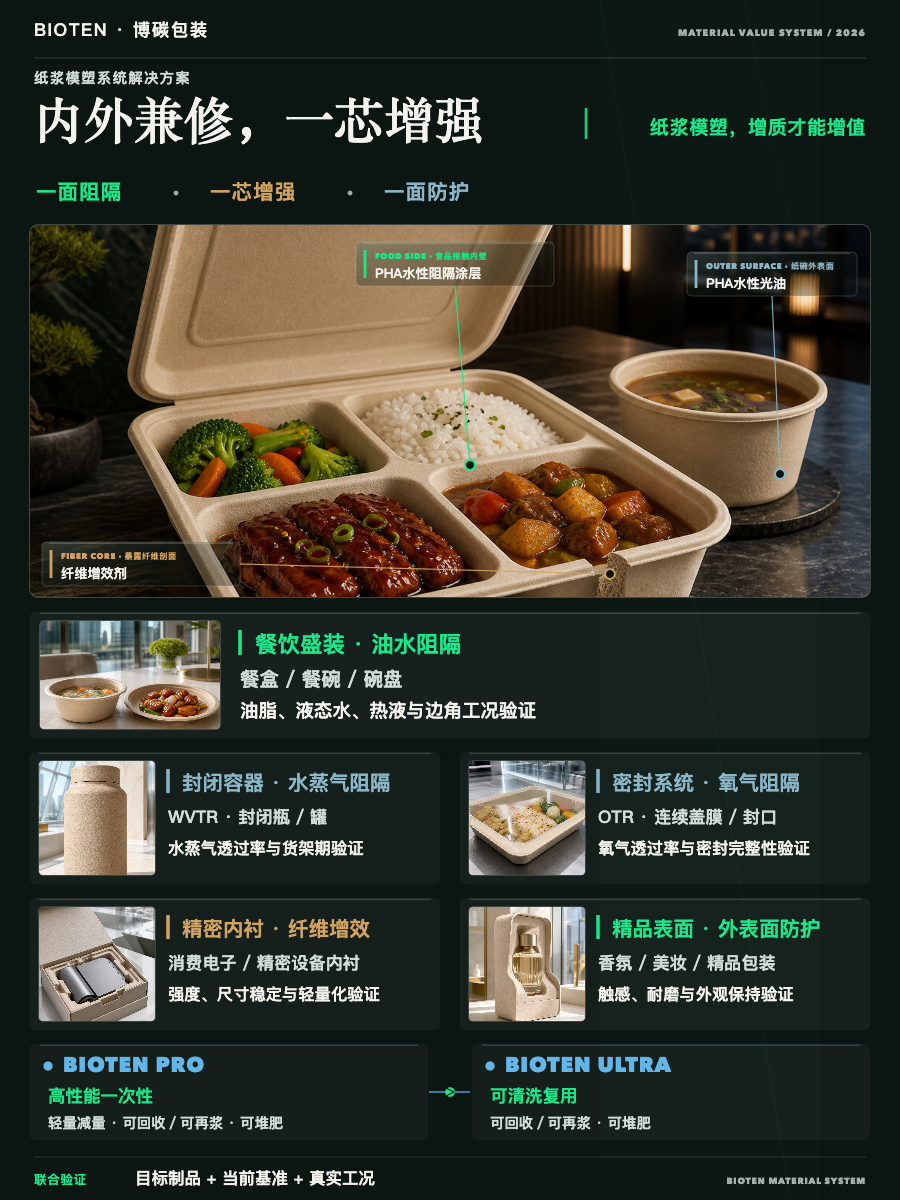
浆料企业要交付纤维一致性;材料企业要交付配方身份、施工窗口和末端证据;设备模具企业要把涂布、干燥和在线检测纳入整线;制品厂要把良率、认证、客诉、成本和回款放进同一张经营表。
纸上谈兵·数说本质
真正值得期待的“爆发”,不是样品更多,而是准确SKU跨批次合格、持续复购,并把利润变成现金。
第二轮增长,不是再讲一个纤维故事
第一轮增长已经把纸浆模塑带到工业内衬、电子、美妆、生鲜和复杂部件。第二轮增长要让食品包装同时经得住食品接触、真实工况、法规归类、末端路径和量产经济性的检验。
增量来自更多应用;增质来自完整BOM、功能层和证据包;增值只能由良率、单位合格品成本、客户认证、复购、客诉和现金回款兑现。
博碳包装·产业洞察·研究说明
本文优先采用协会基准报告、上市公司定期报告、监管与标准机构、认证数据库和企业项目原始披露,由博碳包装独立研究整理,核验至2026年8月26日。BIOTEN为博碳开发者关联材料,相关内容仅按公开证据与待验证开发接口呈现。本文仅供产业链研究学习,不构成采购、合规、投资或其他具体决策依据;如对内容、数据或权益有异议,可联系申请修改、说明或删除,我们将在收到后24小时内核查处理。
博碳观察数据与核验来源
01|IMFA|首份全球模塑纤维基准报告发布说明
02|Huhtamaki|2026年半年度报告
03|众鑫股份|2026年半年度报告;2025年年度报告
04|PulPac|鲜肉托盘概念验证;纤维瓶盖开发;瑞典设备订单
05|生态环境部|中华人民共和国生态环境法典
06|北京市市场监督管理局|餐饮外卖商户绿色包装使用指南
07|国家卫生健康委员会|GB 4806.10—2025发布公告
08|美国FDA|纸和纸板食品包装PFAS用途状态
09|欧盟委员会|SUPD解释指南;PPWR法规
10|DIN CERTCO|DBC/BIOTEN认证记录
11|BPI|DBC/BIOTEN组件与涂层目录
12|Australasian Bioplastics Association|认证说明与目录入口
Molded fiber capacity is expanding, but higher output does not automatically create more value. Nearly 79% of manufacturers participating in IMFA’s global benchmarking survey expect production to increase in 2026. Yet more volume does not mean that profit and cash flow will rise in step. Moving from high-volume products such as egg and fruit trays into precision protective inserts, demanding food packaging, and foodservice items requires manufacturers to pass four gates at once: food-contact compliance, real-use performance, a complete bill of materials (BOM), and reliable delivery.
Higher output does not mean that profit and cash flow will rise in step. Moving from egg and fruit trays into high-performance food packaging requires manufacturers to pass four gates: food-contact compliance, real-use performance, a complete bill of materials, and reliable delivery.
2026 · THREE EVIDENCE COORDINATES
IMFA | Manufacturers participating in the inaugural benchmarking survey
Nearly 79% Expect production to increase in 2026
Huhtamaki Fiber Packaging | H1 2026 segment figures
+6% Comparable net sales growth +28% Adjusted EBIT
ZX Packing Group | H1 2026 company figures; report unaudited
+33.70% Operating revenue
+66.61% Net profit attributable to shareholders of the listed company
RMB 163 million Net cash generated from operating activitiesDown 34.44% year on year, but still positive
Although all three operate in molded fiber, high-volume supply, customer-certified industrial packaging, and high-performance food packaging do not share the same profit model. The closer an application comes to food contact, the more responsibility shifts to the coating and the finished article.
The IMFA figure reflects expectations among participating manufacturers; Huhtamaki reports segment data; and ZX Packing Group reports company-level financials. Concept validation, equipment orders, and commercial production are presented as separate stages and are not combined into an industry growth rate.
These three datasets cannot be added together to produce a single industry growth rate. Together, however, they show that manufacturers expect higher output, a global company’s segment performance is improving, and a Chinese producer’s sales are growing. Whether profit and cash flow improve at the same pace remains a separate question.
Applications are also on different tracks. Chinese foodservice items are already supplied at scale; dry-molded-fiber coffee lids are in commercial production in Malaysia; Sweden is investing in equipment for fiber-based snus cans; fiber bottle caps remain under development; and an Australian fresh-meat tray is still at the concept-validation stage.
The first growth phase broadened the range of applications. The second must answer how food packaging can convert performance, compliance, and reliable delivery into profit and cash flow.
Sources:IMFA global benchmarking report; Huhtamaki Half-yearly Report 2026; ZX Packing Group Half-year Report 2026; BIOTEN Developer.
01 · APPLICATION STAGES
The first growth phase: four application stages beyond egg trays
Egg trays, fruit trays, and beverage carriers remain the volume base. Industrial cushioning, electronics inserts, and premium cosmetic packaging move the industry toward tighter requirements for structure, dimensions, surface quality, and customer approval. Meal boxes, soup bowls, fresh-food trays, puffed-food inserts, and cold-chain packaging bring food contact and real-use conditions together in a single finished article.
Concept validation |Zipform’s fresh-meat tray in Australia has completed initial testing; broader market validation and industrialization are still required.
Development testing |PulPac’s fiber bottle cap has undergone early real-world testing but remains explicitly in development.
Industrial investment |Future Materials Sweden has ordered two production units, with its new facility initially focused on fiber-based snus cans.
Commercial production |HZ Green Pulp disclosed in 2025 that its Dry Molded Fiber coffee lids in Malaysia had entered full-scale commercial production.
The first growth phase has been enabled by several processes. Conventional thick-wall or transfer-molded wet fiber serves trays, foodservice items, and cost-sensitive protective packaging. Premium wet pressing and thermoforming target thinner walls, tighter tolerances, and better surfaces. Dry Molded Fiber seeks to shorten the dewatering and drying chain associated with wet preforms. Moisture content, tooling, cycle time, energy use, precision, and yield cannot be compared across these three routes without a consistent basis.
Sources:Fresh-meat tray project; BIOTEN Developer; fiber bottle-cap development; Swedish equipment order; commercial production of coffee lids.
02 · PROFIT MODELS
The post-growth reality: one industry, at least three profit models
ZX Packing Group’s audited 2025 annual report shows that revenue from foodservice items declined by 4.97%, while “other environmentally friendly packaging,” driven by sales of new premium industrial-packaging products, grew by 64.14%. The latter generated only RMB 16.799 million in annual revenue, compared with RMB 1.442 billion from foodservice items.
High-volume foodservice items |Continuous production, purchasing scale, and regional supply underpin this model, but margins are readily squeezed by unit prices, energy, trade measures, and logistics.
Customer-certified industrial and premium packaging |Structure, tooling, surface quality, and customer approval create project value, at the cost of development lead times, changeovers, and batch-to-batch consistency requirements.
High-performance food packaging |These products must simultaneously manage food contact, barrier performance, sealing, distribution, and end-of-life responsibilities. Any premium can still be absorbed by coating, drying, yield losses, and certification lead times.
In the same year, the company’s output of foodservice items and other products declined by 19.76%, while sales volume fell by 1.40%. Domestic sales rose by 8.21%, but export sales declined by 4.62%. The annual report primarily associates the production decline with U.S. trade measures and the ramp-up of capacity in Thailand.
Nominal capacity is not stable output, an equipment order is not a customer order, and an exhibition sample is not a repeat purchase. Application expansion answers whether there is work to be done; unit cost per conforming product and cash collection answer whether value is being created.
Sources:ZX Packing Group Annual Report 2025; final determination by the U.S. Department of Commerce; final determination by the Canada Border Services Agency.
03 · THE SECOND GROWTH PHASE
Why food packaging is harder—and more valuable—in the second growth phase
Precision electronics inserts and premium cosmetic packaging can also create high value. Food packaging warrants separate discussion because it combines high frequency, broad volume, and complex service conditions, testing materials, structures, regulation, manufacturing, and end-of-life performance at the same time.
Meal boxes, soup bowls, fresh-food trays, frozen and reheated foods, prepared foods, and supermarket ready-to-eat packaging are not purchased merely for “high plant-fiber content.” Customers buy defined outcomes: no leakage with hot soup, no migration of oils and fats, no loss of stiffness under condensation, no premature edge failure, and no lid disengagement.
Food-contact gate |Pulp, additives, coatings, inks, adhesives, migration, and organoleptic performance.
Real-use gate |Contents, temperature, time, hot aqueous and oily foods, freeze–reheat cycles, edges, sealing, and distribution.
Regulatory and customer gate |Target-market classification, testing documentation, customer audits, and final SKU approval.
End-of-life and economics gate |Material reduction, separability, repulpability or compostability, together with drying, yield, and unit cost per conforming product.
China’s Environmental Code, effective from 15 August 2026, requires packaging to be reasonable and reduced and incorporates green procurement and green supply chains into corporate responsibilities. Beijing’s Guidelines for the Use of Green Packaging by Food-Delivery Merchants, effective from 1 September 2026, translate food temperature, package dimensions, layer count, sealing, and readily separable structures into merchant actions.
Laws and recommended local standards have different legal force, and neither specifies molded fiber, waterborne coatings, PHA, or PLA. Instead, they change the procurement questions: Has the structure been reduced? Is the bill of materials traceable? Does the product pass its intended food-use conditions? Are the food-contact safety, repulpability, compostability, and claimed post-use pathway credible? Can the plastic content be calculated to determine whether the product falls within the scope of the Single-Use Plastics Directive (SUPD)?
Sources:Environmental Code of the People’s Republic of China; Beijing green food-delivery packaging guidelines; BIOTEN Developer; SUPD guidance.
04 · BILL OF MATERIALS AND COATING
The key to better quality: a complete bill of materials and the functional coating
Fiber determines whether molded pulp can be formed. The complete bill of materials and the coating determine which food-use conditions the article can enter, which regulatory responsibilities it assumes, and which post-use pathway it can credibly follow.
Wood pulp, recovered pulp, bamboo pulp, bagasse pulp, and straw pulp answer the question, “Where does the fiber come from?” Bamboo pulp is already within the raw-material boundary for molded fiber, but it does not automatically prove that the finished article is food-contact compliant, recyclable, compostable, or low carbon.
High-performance molded fiber necessarily involves formulations and additives as well as barrier coatings; bio-based materials are part of this higher-value market. Professional assessment must determine whether each component is necessary, traceable, suitable for the target food and temperature, stable across batches, and compatible with the declared end-of-life pathway.
“Waterborne” describes only the dispersion or application medium. After the water evaporates, the film-forming polymer, formulation, coat weight, and film continuity determine grease resistance, water resistance, resistance to hot liquids, heat sealability, regulatory classification, and end-of-life behavior.
PE lamination |Mature performance, heat sealing, and supply chains; paper–plastic separation, repulping, and non-compostable end-of-life routes still require management.
Waterborne or dispersion systems such as EAA, acrylics, and PU |Flexible formulations and relatively mature production experience; being “waterborne” does not change the identity of the film-forming polymer.
Natural polymers, wax/resin systems, and mineral combinations |Can provide part of the barrier function, but humidity, thermal stability, cracking on flexing, and the bonding phase remain constraints.
PHA waterborne barrier route |Places food-barrier development and a verified biological-treatment pathway on the same engineering route. Evidence must still be established for the specific material, thickness, formulation, and finished-article scope.
China |GB 4806.10—2025 takes effect on 2 September 2026.
United States |The U.S. Food and Drug Administration has confirmed that 35 food contact notifications involving grease-proofing PFAS for paper and paperboard are no longer effective because the relevant uses were abandoned.
European Union |The SUPD provides no minimum plastic-content exemption. The PPWR’s 95%/5% rule is not a general-purpose “plastic-free threshold.”
Certification |Certification of a material or component does not automatically certify every finished meal box.
Sources:Announcement of GB 4806.10—2025; U.S. FDA status of PFAS uses in paper food packaging; BIOTEN Developer; SUPD guidance; EU Packaging and Packaging Waste Regulation (PPWR).
05 · BIOTEN MATERIAL INTERFACES
BIOTEN Observer: three material interfaces, each addressing a different failure mode
The following observations concern material-development interfaces associated with BIOTEN Packaging; they are not three product cards.
PHA waterborne barrier coating for the food-contact surface |Designed for hot soup, oils and fats, sauces, fresh-food condensation, and freeze–reheat conditions. DIN CERTCO and BPI list records for Bioten™ PHA Barrier Coating materials, components, or coatings. These records do not prescribe a coat weight and do not replace certification of the finished food container. Procurement must still establish the minimum effective dry coat weight, edge continuity, drying window, and target food conditions within the same SKU.
Fiber-performance copolymer |Acts within the pulp, wet preform, and fiber network to improve strength, forming stability, lightweighting, and fiber-use efficiency. It may also be applied by surface spraying; addition rates of only a few parts per thousand in the furnish can provide broad reinforcement or enable weight reduction.
PHA waterborne overprint varnish for the exterior surface |Intended for premium wet-pressed, cosmetic, electronics, or high-end foodservice applications requiring appearance, tactile quality, abrasion resistance, and surface protection. It is commercially meaningful only when the brand experience can support the added process cost. Washable reuse remains a development direction within the BIOTEN Developer molded-fiber system.
The three interfaces act respectively within the fiber network, on the food-contact inner surface, and on the brand-facing outer surface. Their common threshold is not the material name, but a precisely defined SKU, a complete finished article, repeatable data, and unit cost per conforming product.
Sources:DIN CERTCO records; BPI directory; Australasian Bioplastics Association certification information; BIOTEN Developer.
06 · RELIABLE DELIVERY
Converting profit potential into cash: from minimum effective coat weight to cash collection
Commercial validation only begins after the coating route is selected. A high-performance molded-fiber food container must, at minimum, lock down the fiber and additive formulation, coating SKU, application method, wet and dry coat weights, drying window, edge coverage, contents, temperature, sealing, stacking, and distribution conditions.
01 |Minimum effective wet and dry coat weights
02 |Drying load, line speed, changeovers, and downtime
03 |First-piece pass rate, cross-batch conformance rate, and stable saleable output
04 |Unit cost per conforming product—not material price per kilogram
05 |First-pass approval rate for food contact, the target market, and customer certification
06 |Repeat purchases, customer complaints, inventory, receivables, and cash collection
There is currently no publicly available minimum BIOTEN spray application or dry coat weight that applies across SKUs. It must be determined through design of experiments (DOE): under the same article, service conditions, and acceptance criteria, compare coat weight, drying, barrier performance, yield, and cost to identify the minimum effective operating window.
Pulp suppliers must deliver fiber consistency. Material suppliers must deliver formulation identity, application windows, and end-of-life evidence. Equipment and tooling suppliers must integrate coating, drying, and in-line inspection into the production line. Finished-article manufacturers must place yield, certification, customer complaints, cost, and cash collection on the same operating dashboard.
PAPER PERSPECTIVES · THE NUMBERS BEHIND THE STORY
The real breakthrough worth expecting is not more samples, but precisely defined SKUs that conform across batches, win repeat orders, and convert profit into cash.
The second growth phase is not another fiber story
The first growth phase has already taken molded fiber into industrial inserts, electronics, cosmetics, fresh foods, and complex components. The second must make food packaging withstand simultaneous tests of food contact, real-use performance, regulatory classification, end-of-life pathways, and mass-production economics.
Incremental volume comes from more applications. Better quality comes from a complete bill of materials, functional layers, and an evidence package. Value creation can be realized only through yield, unit cost per conforming product, customer approval, repeat purchases, complaint performance, and cash collection.
BIOTEN Packaging · Industry Insights · Research Notes
This article prioritizes benchmarking reports from industry associations, periodic reports of listed companies, regulatory and standards bodies, certification databases, and original company project disclosures. It was independently researched and compiled by BIOTEN Packaging, with information verified through 26 August 2026. BIOTEN materials are associated with BIOTEN Developer; related content is presented only on the basis of public evidence and development interfaces still requiring validation. This article is provided solely for value-chain research and learning and does not constitute procurement, compliance, investment, or other specific decision-making advice. If you have concerns regarding the content, data, or rights, please contact us to request correction, clarification, or removal; we will review the request within 24 hours of receipt.
BIOTEN Observer · Data and Verification Sources
01 | IMFA | Announcement of the inaugural global molded-fiber benchmarking reports
02 | Huhtamaki | Half-yearly Report 2026
03 | ZX Packing Group | Half-year Report 2026; Annual Report 2025
04 | PulPac | Fresh-meat tray concept validation; fiber bottle-cap development; Swedish equipment order
05 | Ministry of Ecology and Environment of the People’s Republic of China | Environmental Code of the People’s Republic of China
06 | Beijing Municipal Administration for Market Regulation | Guidelines for the Use of Green Packaging by Food-Delivery Merchants
07 | National Health Commission of the People’s Republic of China | Announcement of GB 4806.10—2025
08 | U.S. Food and Drug Administration | Status of PFAS uses in paper and paperboard food packaging
09 | European Commission | SUPD interpretive guidance; PPWR
10 | DIN CERTCO | DBC/BIOTEN certification records
11 | BPI | DBC/BIOTEN component and coating directory
12 | Australasian Bioplastics Association | Certification information and directory entry