
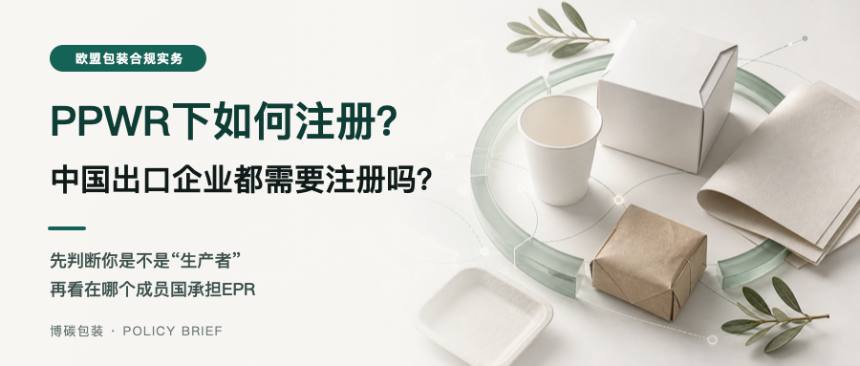
先判断你是不是“生产者”,再看在哪个成员国承担EPR。
欧盟《包装和包装废弃物法规》(PPWR,Regulation (EU) 2025/40)将于2026年8月12日起通常适用。
临近适用日期,不少中国出口企业开始问:PPWR到底在哪里注册?中国企业是不是都要注册?有欧盟进口商,是否就与自己无关?
先给结论:
不是所有中国出口企业都需要亲自注册;但也不能一概认为注册一定由欧盟进口商承担。
真正要判断的,不是“包装是不是在中国生产”,而是:在某一个欧盟成员国,谁首次提供了包装或包装商品,交易对象是不是最终用户,以及该主体是否属于PPWR所说的“生产者”。
一、先分清三件事:“注册”不是一个笼统概念
谈PPWR时,至少要把以下三件事分开。
1. 产品合规
这是包装本身进入欧盟市场需要满足的要求,包括材料与设计、可回收性、标签,以及符合性声明和技术文件等。承担这些责任的主体,可能涉及制造商、进口商和分销商。
2. 生产者/EPR注册
这是本文讨论的“注册”。它对应包装废弃物的延伸生产者责任,也就是登记、申报、缴费以及组织回收处理等义务。
PPWR第44条要求各成员国建立生产者登记制度。生产者原则上需要在每一个首次提供包装或包装商品的成员国登记。
因此,PPWR不是申请一个覆盖全欧盟的统一证书,也不是取得一个号码就能通行所有成员国。
3. 第三方认证
可堆肥、再生含量、可回收性等第三方认证,可以为特定环境声明提供证据,但不等同于PPWR生产者注册,也不能替代产品合规文件。
这三件事可以互相支持,却不能互相替代。
二、PPWR中的“制造商”和“生产者”,为什么不是一回事?
中文语境里,“生产者”很容易被理解为实际生产包装的工厂,但PPWR中的producer是一个与EPR责任相关的法律角色。
欧盟委员会2026年实施指引进一步说明:
manufacturer(制造商)**主要对应包装产品合规责任;
producer(生产者)**主要用于确定在哪个成员国承担EPR;
同一条供应链中,两者可能是同一企业,也可能完全不同。
换句话说,一家中国工厂即使实际制造了包装,也不当然就是每个成员国的EPR生产者;一家并不生产包装的进口商、分销商或跨境卖家,也可能因为首次在当地提供包装或包装商品而成为生产者。
三、中国出口企业,先看这四种常见场景
场景一:销售给欧盟进口商或分销商,再由对方在当地销售
如果欧盟客户买入后,再首次向当地市场提供包装或包装商品,欧盟客户通常更可能成为该成员国的生产者。
但中国出口企业仍应在合同中明确:谁负责目的国登记、申报、缴费和数据留存;同时向客户提供准确的包装材料、重量、类别和技术文件。
不能只凭“我们有欧盟进口商”就结束判断。
场景二:中国品牌通过欧盟子公司或当地进口主体销售
此时需要分别判断品牌方、欧盟子公司和进口主体在产品合规与EPR中的角色。
欧盟实体可能是制造商、进口商,也可能是在当地首次提供包装商品的生产者。企业内部应避免把“品牌所有者”“进口商”和“EPR生产者”自动画上等号。
场景三:中国企业通过独立站、平台或直邮,直接销售给欧盟最终用户
这是最容易被忽视的高风险场景。
如果中国企业直接把包装或包装商品销售给某成员国的消费者或专业最终用户,中国卖家可能成为该国的生产者,需要在目的国完成登记并履行EPR义务。
对于第三国生产者,PPWR允许成员国要求其委任当地EPR授权代表。因此,授权代表要求必须逐国核查,不能简单理解为一项完全统一的欧盟规则。
例如,德国官方已明确:自2026年8月12日起,在德国无分支机构、但直接向德国最终用户销售空包装或包装商品的境外企业,需要委任授权代表,并在LUCID包装登记系统完成相应登记。
场景四:只向欧盟企业供应空包装或包装材料
纸张、阻隔材料、空杯、空盒等供应商,不一定就是最终承担EPR的生产者。
关键仍然是:销售对象是否为最终用户,谁把包装首次提供到该成员国市场,以及包装在交易时属于空包装、运输包装还是包装商品的一部分。
即使不承担EPR注册,材料与空包装供应商仍可能承担产品信息、文件传递和供应链配合责任。
四、不要先找“注册入口”,先走完这七步
面对任何一条欧盟出口业务,可以按以下顺序判断:
第一步:确定包装对象。
是空包装、包装材料、运输包装,还是已经装入商品的销售包装?
第二步:列出目的成员国。
不是只写“出口欧盟”,而是明确德国、法国、意大利等实际销售国家。
第三步:识别交易对象。
对方会继续转售,还是消费者、工厂、餐饮企业等最终用户?
第四步:确认谁在当地首次提供。
结合合同、订单、物流、所有权转移和实际销售路径,判断谁把包装或包装商品第一次提供到该成员国市场。
第五步:分别确定产品合规角色和EPR生产者。
不要用一个“责任方”概括所有义务。
第六步:核查该国具体制度。
确认主管机构、登记平台、生产者责任组织(PRO)、授权代表、申报周期和费用规则。
第七步:完成登记后持续履责。
注册不是终点。企业还需要按当地要求申报包装数量、材料和类别,缴纳相关费用,并保存可以追溯的数据。
五、现在可以提前准备哪些资料?
企业至少可以先建立一份“国家—交易—包装”台账,整理:
企业名称、地址、联系方式、税号及商业登记信息;
品牌和销售主体;
目的成员国、客户类型和交易路径;
合同、订单及物流安排;
包装结构、材料类别、单件重量和年度投放量;
符合性声明、技术文件及供应商证明;
当地PRO或EPR授权代表的委托信息,如适用;
各成员国注册号、申报记录和费用凭证。
PPWR给出了登记信息的共同框架,但成员国仍可能依据本国制度要求补充资料。实际操作应回到目标国主管机构和登记平台逐项确认。
六、五个常见误区
误区一:申请一个“PPWR证书”,就完成了合规。PPWR不是一张统一证书;产品合规、EPR登记和第三方认证应分别处理。
误区二:在一个欧盟国家注册,就覆盖全欧盟。生产者登记原则上按实际首次提供包装的成员国判断。
误区三:有欧盟进口商,中国企业就一定不用管。要看进口商是否真正承担首次提供角色,以及合同和实际交易是否一致。
误区四:所有中国出口企业都必须委任欧盟授权代表。对第三国EPR生产者,PPWR允许成员国提出这一要求,具体仍需逐国核查。
误区五:完成注册,就代表包装产品已经符合PPWR。EPR注册不能替代材料、设计、标签、符合性声明和技术文件等产品合规义务。
结语:先定角色,再谈注册
PPWR带来的真正变化,不只是多一个登记动作,而是要求企业把包装材料、交易链和成员国责任连接起来。
对中国出口企业而言,最稳妥的起点不是先购买一项所谓“PPWR注册服务”,而是先回答四个问题:销售到哪个国家、卖给谁、是什么包装、谁首次在当地提供。
把这四项厘清,才有可能判断谁注册、在哪里注册、是否需要PRO或授权代表,以及还要准备哪些产品合规证据。
如需判断具体业务,可先整理“目标国家—交易对象—包装类型—首次提供主体”四项信息,与当地主管机构或专业顾问逐国确认。
博碳包装 阻隔系统
主要依据
Regulation (EU) 2025/40,第3、44、45条及附件IX;
欧盟委员会《Regulation (EU) 2025/40实施指引》C(2026)3702;
欧盟委员会Packaging waste与PPWR implementation官方页面;
德国中央包装登记机构ZSVR关于境外企业与授权代表的官方说明。
First determine whether you are a “producer,” and then identify the Member State in which you bear extended producer responsibility (EPR).
The EU Packaging and Packaging Waste Regulation (PPWR, Regulation (EU) 2025/40) will generally apply from August 12, 2026.
As that date approaches, many Chinese exporters are asking: where should PPWR registration be completed? Must every Chinese company register? If there is an EU importer, does that remove the exporter’s responsibility?
In brief:
Not every Chinese exporter must register in its own name, but registration cannot automatically be assumed to fall to the EU importer.
The decisive questions are not whether the packaging was made in China, but who first makes the packaging or packaged product available in a particular EU Member State, whether the customer is an end user, and whether that party is a “producer” within the meaning of the PPWR.
1. Separate Three Different Concepts: “Registration” Is Not a Single Requirement
At least three distinct matters must be separated when discussing the PPWR.
1.1 Product compliance
These are the requirements the packaging itself must meet before entering the EU market, including materials and design, recyclability, labelling, the declaration of conformity, and technical documentation. Manufacturers, importers, and distributors may each have responsibilities in this area.
1.2 Producer and EPR registration
This is the “registration” discussed in this article. It concerns extended producer responsibility for packaging waste, including registration, reporting, fee payment, and the organisation of collection and treatment.
Article 44 of the PPWR requires every Member State to establish a register of producers. In principle, a producer must register in each Member State in which it first makes packaging or packaged products available.
The PPWR is therefore not a single EU-wide certificate, nor does one registration number provide access to every Member State.
1.3 Third-party certification
Third-party certifications for compostability, recycled content, recyclability, and similar attributes may support specific environmental claims, but they are not PPWR producer registration and do not replace product-compliance documentation.
These three areas may support one another, but none substitutes for another.
2. Why “Manufacturer” and “Producer” Are Not the Same Under the PPWR
In everyday Chinese usage, “producer” is easily understood as the factory that physically makes the packaging. Under the PPWR, however, producer is a legal role connected to EPR obligations.
The European Commission’s 2026 implementation guidance further distinguishes the roles:
Manufacturer primarily relates to product-compliance responsibilities for packaging.
Producer primarily determines the Member State in which EPR must be fulfilled.
Within the same supply chain, the two roles may be held by the same company or by entirely different companies.
Accordingly, a Chinese factory that physically makes packaging is not automatically the EPR producer in every Member State. Conversely, an importer, distributor, or cross-border seller that does not manufacture packaging may become the producer because it is the first party to make the packaging or packaged product available locally.
3. Four Common Scenarios for Chinese Exporters
Scenario 1: selling to an EU importer or distributor that resells locally
If the EU customer purchases the goods and is then the first party to make the packaging or packaged product available on the local market, that customer is generally more likely to be the producer in that Member State.
The Chinese exporter should nevertheless state clearly in the contract who is responsible for destination-country registration, reporting, fees, and data retention, and should provide accurate information about packaging materials, weight, category, and technical documentation.
The analysis should not end simply because an EU importer is involved.
Scenario 2: a Chinese brand sells through an EU subsidiary or local importing entity
The respective product-compliance and EPR roles of the brand owner, EU subsidiary, and importing entity must be assessed separately.
The EU entity may be a manufacturer or importer, and it may also be the producer that first makes the packaged product available locally. Companies should avoid treating “brand owner,” “importer,” and “EPR producer” as automatically identical.
Scenario 3: a Chinese company sells directly to EU end users through its own website, a platform, or direct shipping
This is a frequently overlooked, higher-risk scenario.
If a Chinese company sells packaging or packaged products directly to consumers or professional end users in a Member State, the Chinese seller may be the producer in that country and may need to register and fulfil EPR obligations there.
For producers established in a third country, the PPWR allows Member States to require the appointment of a local EPR authorised representative. The requirement must therefore be checked country by country and should not be treated as a completely uniform EU rule.
Germany, for example, has stated that from August 12, 2026, a foreign company with no branch in Germany that sells empty packaging or packaged products directly to German end users must appoint an authorised representative and complete the applicable registration in the LUCID Packaging Register.
Scenario 4: supplying only empty packaging or packaging materials to EU businesses
Suppliers of paper, barrier materials, empty cups, empty cartons, and similar products are not necessarily the parties that ultimately bear EPR.
The key questions remain whether the customer is an end user, who first makes the packaging available in the Member State, and whether the packaging is empty packaging, transport packaging, or part of a packaged product at the time of the transaction.
Even when they do not bear the EPR registration obligation, suppliers of materials and empty packaging may still be responsible for product information, document transfer, and supply-chain cooperation.
4. Complete These Seven Steps Before Looking for a Registration Portal
For any export transaction involving the EU, the assessment can follow this sequence:
Step 1: identify the packaging object.
Is it empty packaging, packaging material, transport packaging, or sales packaging already containing a product?
Step 2: list the destination Member States.
Do not write only “EU export”; identify the actual countries of sale, such as Germany, France, and Italy.
Step 3: identify the customer.
Will the customer resell the goods, or is it an end user such as a consumer, factory, or food-service business?
Step 4: confirm who first makes the packaging available locally.
Use the contract, order, logistics arrangements, transfer of title, and actual sales route to determine who first makes the packaging or packaged product available in the Member State.
Step 5: determine the product-compliance roles and the EPR producer separately.
Do not use a single “responsible party” label to cover every obligation.
Step 6: check the national system.
Confirm the competent authority, registration platform, producer responsibility organisation (PRO), authorised-representative rules, reporting periods, and fee arrangements.
Step 7: continue fulfilling obligations after registration.
Registration is not the end. Companies must report packaging quantities, materials, and categories as required locally, pay the relevant fees, and retain traceable records.
5. What Information Can Be Prepared Now?
Companies can begin by establishing a “country–transaction–packaging” register containing at least:
- company name, address, contact details, tax number, and commercial-registration information;
- brands and selling entities;
- destination Member States, customer types, and transaction routes;
- contracts, orders, and logistics arrangements;
- packaging structure, material categories, unit weight, and annual quantities placed on the market;
- declarations of conformity, technical documents, and supplier evidence;
- appointment details for a local PRO or EPR authorised representative, where applicable; and
- Member State registration numbers, reporting records, and proof of fee payment.
The PPWR provides a common framework for registration information, but Member States may require additional information under their national systems. Actual implementation should be checked item by item with the competent authority and registration platform in each target country.
6. Five Common Misunderstandings
Misunderstanding 1: obtaining a “PPWR certificate” completes compliance. The PPWR is not a single certificate; product compliance, EPR registration, and third-party certification must be handled separately.
Misunderstanding 2: registration in one EU country covers the entire EU. Producer registration is generally determined by each Member State in which packaging is first made available.
Misunderstanding 3: having an EU importer means the Chinese company has nothing further to consider. The analysis depends on whether the importer actually performs the first making-available role and whether the contract matches the real transaction.
Misunderstanding 4: every Chinese exporter must appoint an EU authorised representative. For third-country EPR producers, the PPWR permits Member States to impose this requirement; the position must be checked country by country.
Misunderstanding 5: registration proves that the packaging product complies with the PPWR. EPR registration does not replace requirements relating to materials, design, labelling, declarations of conformity, or technical documentation.
Conclusion: determine the role before discussing registration
The PPWR introduces more than an additional registration step. It requires companies to connect packaging materials, the transaction chain, and Member State responsibilities.
For Chinese exporters, the most reliable starting point is not purchasing a generic “PPWR registration service,” but answering four questions: which country is the product sold into, who buys it, what type of packaging is involved, and who first makes it available locally?
Only after those four points are clear can a company determine who must register, where registration is required, whether a PRO or authorised representative is needed, and what further product-compliance evidence must be prepared.
For a specific business model, first document the target country, customer, packaging type, and party making it available for the first time, and then confirm the position country by country with the competent authority or a qualified adviser.
BIOTEN Packaging Barrier Systems
Principal references
- Regulation (EU) 2025/40, Articles 3, 44 and 45, and Annex IX;
- European Commission implementation guidance for Regulation (EU) 2025/40, C(2026) 3702;
- the European Commission’s official Packaging Waste and PPWR implementation pages; and
- official guidance from Germany’s Central Agency Packaging Register (ZSVR) on foreign companies and authorised representatives.