
BIOTEN PACKAGING · POLICY BRIEF
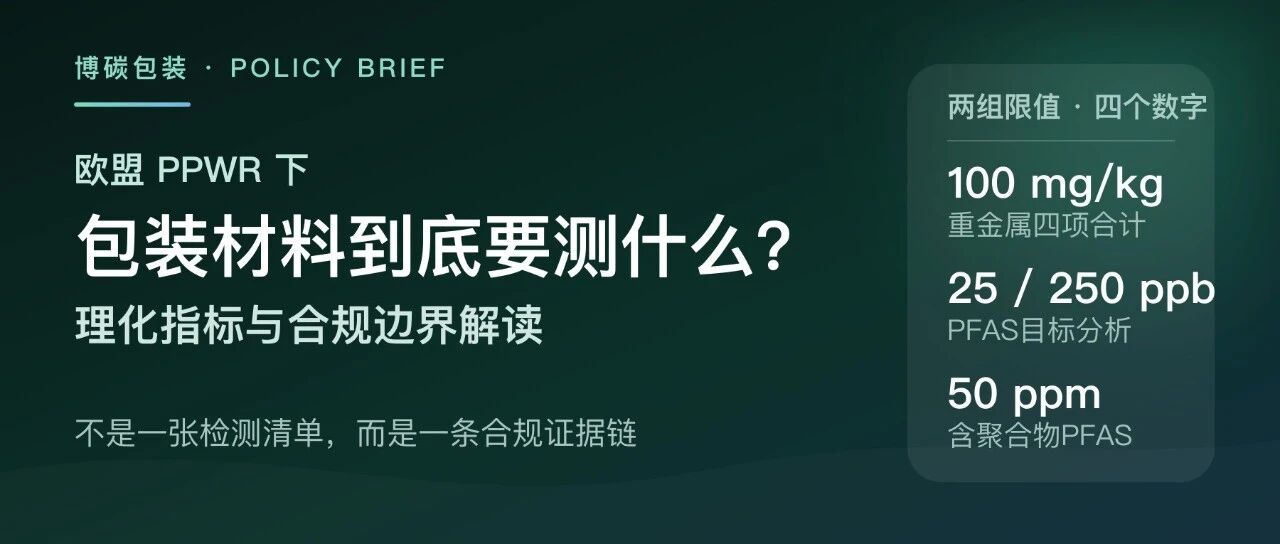
100 mg/kg是四项重金属合计;25 ppb、250 ppb和50 ppm是食品接触包装的PFAS禁止线。比背下数字更重要的,是分清检测对象、证明方法和责任主体。
先说答案:PPWR没有一张适用于所有包装的“统一检测清单”。
• 所有包装或包装组件,要证明铅、镉、汞和六价铬四项浓度合计不超过100 mg/kg;
• 食品接触包装,还要核对三条PFAS限值;
• 技术文件、欧盟符合性声明(DoC)和EPR都不是检测项目。
欧盟《包装和包装废弃物法规》(PPWR,Regulation (EU) 2025/40)已于2025年2月11日生效,并将从2026年8月12日起通常适用。临近实施,市场上出现了不少“PPWR检测套餐”和“一张证书解决全部合规”的说法。企业真正要解决的,却是:测哪一个对象、用什么证据证明、最终由谁承担责任。
01一只食品纸杯,为什么不能只看四张原料报告?
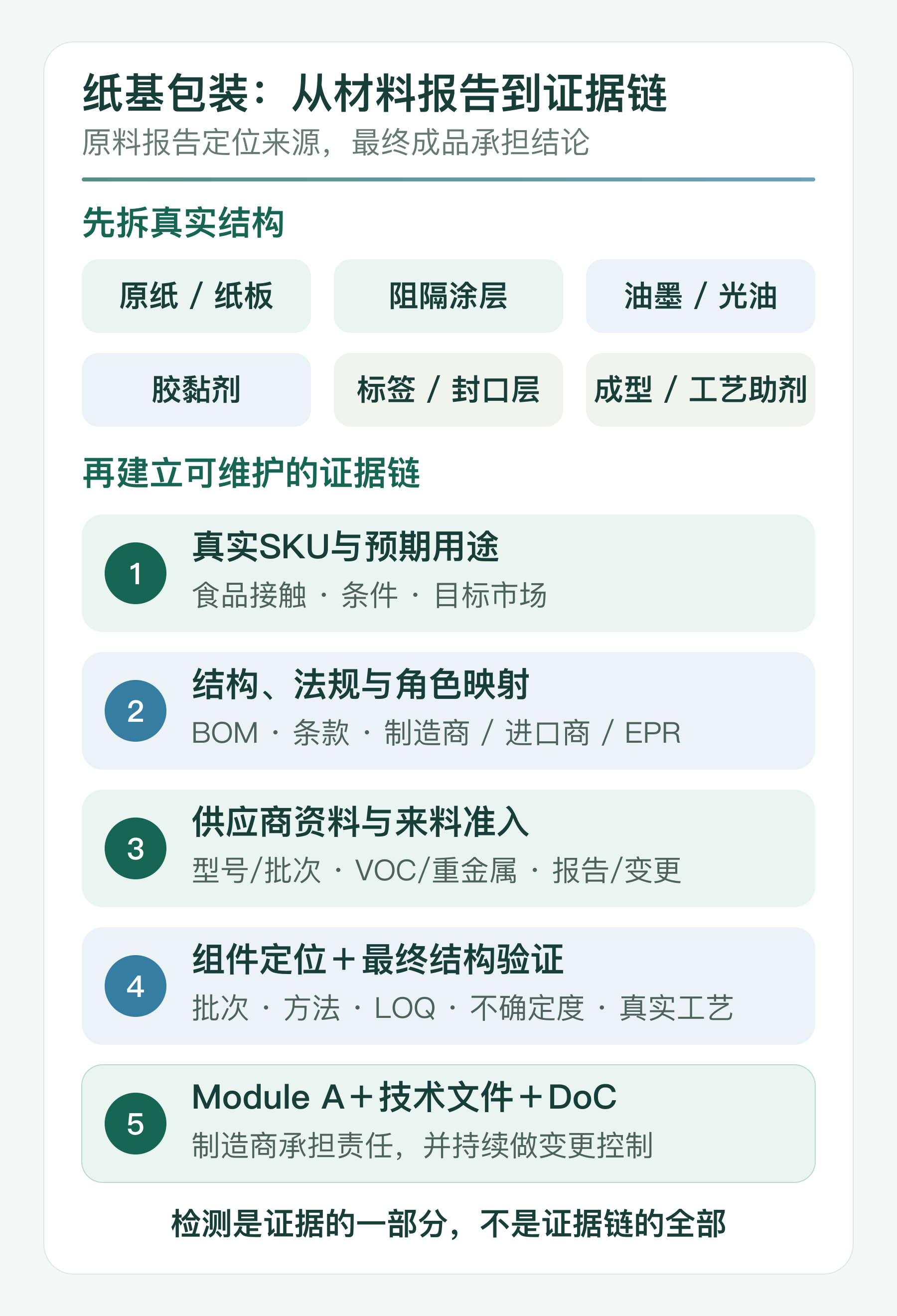
以一只食品纸杯为例,它可能由原纸、阻隔涂层、油墨、光油、胶黏剂和封口材料共同构成,还经历涂布、印刷、熟化、成型和封合。即使每家供应商都提供了一份报告,也不能直接推出“整只纸杯符合PPWR”。
原因很简单:材料报告证明的是特定样品和方法下的结果;组件证据用于定位风险;最终包装证据还要覆盖真实结构、加工状态和预期用途。把所有材料一起粉碎取得一个平均数,也可能掩盖低质量占比、高浓度的油墨、标签或胶黏剂风险。
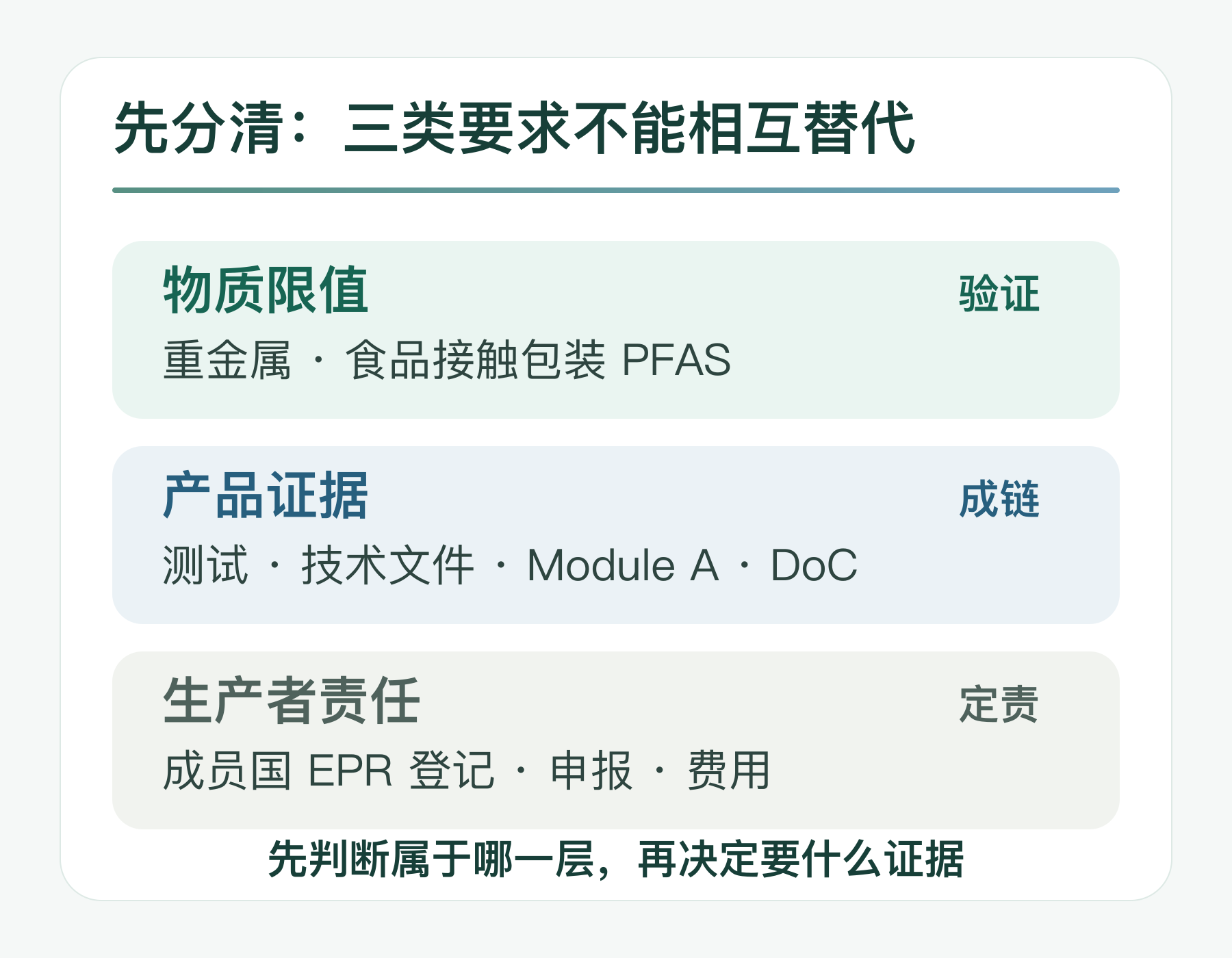
因此,PPWR相关工作至少要分成三层:
1. 物质限值:重金属和食品接触包装PFAS,回答规定对象达到什么结果;
2. 产品证据:测试、技术文件、合格评定和DoC,回答证据如何成链;
3. 生产者责任:EPR登记、申报和费用,回答谁承担包装废弃物责任。
三者有关联,但不能相互替代。
02重金属100 mg/kg:是四项合计,不是每项各100
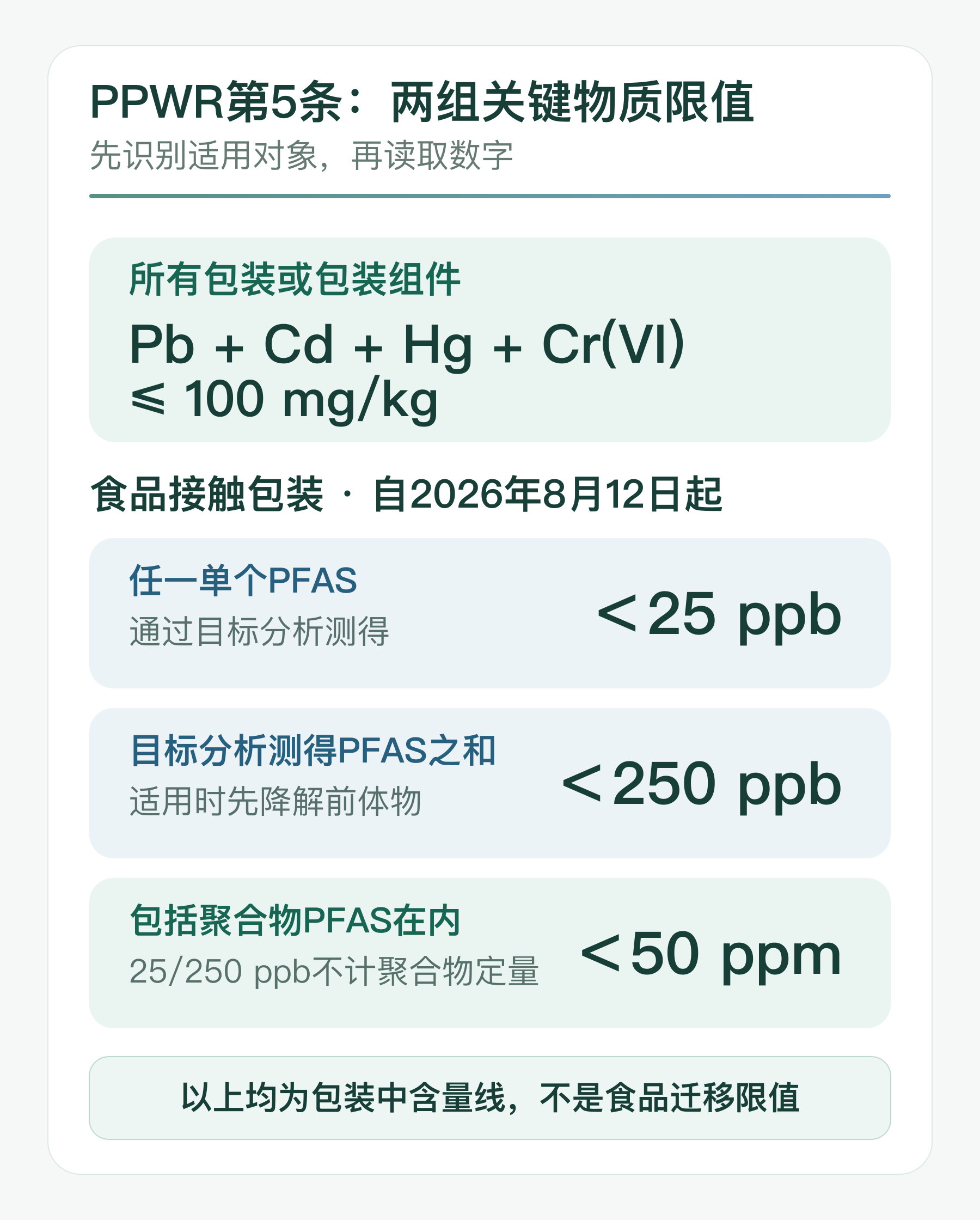
PPWR第5(4)条规定,包装或包装组件中由所含物质产生的铅、镉、汞和六价铬浓度总和不得超过100 mg/kg:
Pb+Cd+Hg+Cr(VI) ≤ 100 mg/kg
这里要抓住三个边界。
第一,这是包装中的含量要求,不是向食品中的迁移限值。重金属总含量报告不能自动替代食品接触迁移评价;迁移合格报告也不能反向证明PPWR重金属总量要求已经满足。
第二,总铬不等于六价铬。
实验室报告中的“Cr”或“总铬”,不能直接改写成六价铬的实测结果。若Pb+Cd+Hg+总铬在考虑测量不确定度后仍不超过100 mg/kg,可作为保守筛查证据;若保守总和超过100 mg/kg,只能说明需要进一步进行适合该材料基体的Cr(VI)形态分析,不能据此直接判定不合格。
第三,原纸合格不等于整只包装合格。企业应根据真实BOM识别高风险材料层、部件和施加物,并让组件定位与最终结构验证相互补充。报告必须说清分析的是整件、可分离组件、局部区域还是单一材料层。
100 mg/kg要求存在严格限定的现行例外。根据PPWR第70(3)条,符合条件的再生玻璃包装(Decision 2001/171/EC),以及封闭、受控循环中的塑料箱和塑料托盘(Decision 2009/292/EC),在相关决定被废止前继续适用例外。是否使用再生材料本身,并不构成自动豁免。
03PFAS三条禁止线:只适用于食品接触包装
PPWR第5(5)条规定,自2026年8月12日起,食品接触包装中的PFAS浓度达到或超过以下限值时,不得投放欧盟市场:
1. 任一单个PFAS(通过目标PFAS分析测得):25 ppb,聚合物PFAS不计入该项定量;
2. 目标PFAS分析测得PFAS之和:250 ppb,适用时先降解前体物,聚合物PFAS不计入该项定量;
3. 包括聚合物PFAS在内的PFAS:50 ppm。
因此,对外表达“通过条件”时应写成:低于25 ppb、低于250 ppb、低于50 ppm,而不是机械写成“≤”。因为法条规定的是“达到或超过”即触及禁止线。
这三条都是包装中的含量线,不是食品迁移限值。质量分数口径下,ppb可对应µg/kg、ppm可对应mg/kg;若实验室按µg/dm²、干基或单位面积报告,就必须说明克重、样品质量、含水状态和换算过程,不能直接比较数字。
另一个常见误区是把某个实验室的20项、30项或40项套餐当成法规固定清单。PPWR并未给出一张固定目标物清单,也没有锁定一套适用于所有包装基体的统一实验室方法。报告写“未检出”,只证明在该目标清单、该方法、该检出能力范围内的结果。若某项目的定量限高于25 ppb,“未检出”并不能证明低于25 ppb。
委托检测时,至少要确认目标物清单、前体处理、样品与组件边界、LOD、LOQ、空白、回收率、测量不确定度和符合性判定规则。
还有一条直接影响出货安排的时间边界:欧委会指引确认,2026年8月12日前已经投放市场的包装可以继续流通;即使此前已经生产,只要在8月12日后才首次投放市场,就必须满足PFAS限值。PFAS条款也没有针对含再生材料包装的例外。
04总氟不是PFAS,但欧委会已经给出三步筛查路径
PPWR法条规定:如果总氟超过50 mg/kg,REACH意义上的制造商、进口商或下游用户,应PPWR意义上的制造商或进口商请求,提供所测氟分别来自PFAS或非PFAS的证据,以支持附件VII技术文件。
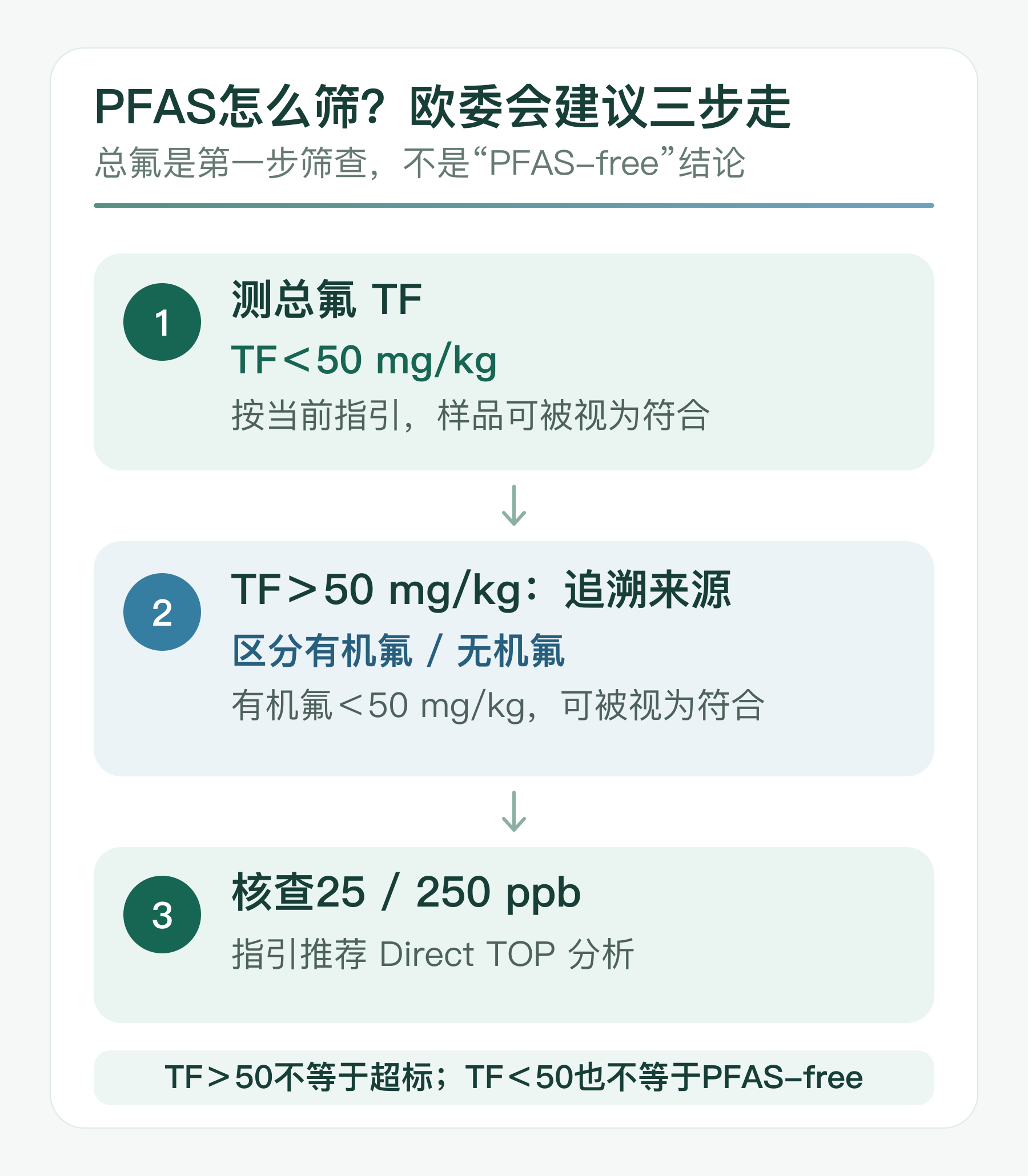
总氟测的是元素氟,PFAS限值约束的是PFAS;二者不是同一个分析量。但欧委会2026年实施指引已经给出当前建议的执法筛查路径:
1. 总氟TF<50 mg/kg:样品可被视为符合;欧委会同时说明,按现有证据,通过第一步的样品也通过后续两步测试;
2. TF>50 mg/kg:可使用热裂解GC/MS等方法区分有机氟与无机氟;有机氟<50 mg/kg时,样品可被视为符合;
3. 继续核查25/250 ppb:指引推荐Direct TOP分析,检查25 µg/kg和250 µg/kg两条限值。
总氟是筛查指标,不是宣传口号
这套路径解决的是当前执法筛查问题,不能把“TF<50 mg/kg”写成“PFAS-free”。反过来,TF>50 mg/kg也不等于PFAS已经超标,而是进入氟来源追溯和进一步分析。
还要理解方法边界:Direct TOP用于扩大对可氧化前体物的覆盖,并不是“全部PFAS总量仪”;包括聚合物PFAS在内的50 ppm判断,通常还需要供应商成分与身份信息、总氟/有机氟筛查、必要的质量平衡及针对性分析共同支持。
05五个“不能替代”,决定文章会不会被误用
1. 含量不能替代迁移。PPWR的100 mg/kg和三条PFAS数字都是包装中含量;食品接触迁移、NIAS和感官安全仍要按Regulation (EC) No 1935/2004及适用的欧盟或成员国规则判断。
2. PPWR DoC不能替代食品接触DoC。二者法律依据和内容要求不同。适当时可以形成一份列明各项欧盟法规的综合声明或文件包,但不能用一句“符合PPWR”替代食品接触法规项下的证明。BPA,以及具有特定危害属性并有协调分类的其他危险双酚和危险双酚衍生物,还要核对Regulation (EU) 2024/3190及Regulation (EU) 2026/250的更正规则。
3. 水性不是零VOC,也不是食品接触合格结论。水性只是体系或工艺路线,不等于零VOC、零残留溶剂、无气味或低迁移。湿料VOC含量、涂布与干燥过程中的逸散和排放、成品残留挥发物、包装气味和食品异味迁移,是五个不同对象;PPWR没有为所有包装规定一个通用VOC限值。
趋势观察|把控制点前移到涂布之前
为什么现在讨论:国务院《空气质量持续改善行动计划》已经明确提出,加大包装印刷行业低(无)VOCs含量原辅材料替代力度。随着水性阻隔涂层进入更多食品包装应用,控制逻辑也应从“水性标签”转向“液态来料—涂布与干燥—最终包装”的三端证据。
2.0 g/L控制什么:一个值得行业进一步验证的主动加严方向,是对完成全部必要组分配制、处于涂布待用状态的每一种独立水性阻隔涂料,探索将扣除水后的VOC含量控制在≤2.0 g/L。基础乳液还需加入交联剂、助剂或其他必需组分的,应按受控配方形成完整待用体系;不得只测基础乳液,也不得靠临时加水改变结论。GB/T 23986.2—2023可提供气相色谱检测与计算路径;属于GB 30981.2—2025适用范围的水性涂料,还应满足其强制性国家标准底线。但这两个标准都不是2.0 g/L数值的来源;2.0 g/L也不是PPWR或欧盟食品接触法规的法定限值,而是企业或团体标准可以探索的前端源控值。
怎么执行:底涂、面涂及其他独立功能涂料应分别判定,不作层间加权;报告应写清样品状态、组分配比、水分、密度、报告限和判定规则。“未检出”不是零,报告限高于2.0 g/L时,不能支持符合性判断。
边界在哪里:对湿态乳液建立重金属等来料准入同样有源头筛查价值;但PPWR的100 mg/kg法定对象仍是包装或包装组件。低VOC或湿料重金属报告,都不能替代涂布与干燥过程排放控制,以及最终包装的残留、气味、迁移和整体合规验证。
4. 原材料合格不能替代最终包装合格。组件测试用于定位来源,最终结构验证还要覆盖涂布、印刷、粘合、熟化、成型和封合等影响。
5. 物质限值不能替代可回收或可堆肥结论。“纸基”“水性”“生物基”“可降解”和“可回收”各有自己的结构、测试和处理体系边界,不能互相推导。
此外,PPWR第5条还有“尽量减少关注物质”的一般要求。四项重金属和PFAS是最明确的两组数值限值,却不是检查完几个数字就完成全部物质管理;REACH、POPs、食品接触规则、供应链信息和风险评估仍然适用。
06技术文件、DoC和EPR,究竟分别解决什么?
PPWR附件VII采用的是Module A内部生产控制。也就是说,制造商建立技术文件、实施内部生产控制,并对包装符合适用要求承担责任。实验室或第三方报告可以支持判断,但PPWR并没有把所有包装都变成一张通用的强制第三方“PPWR证书”。
正式合格评定和欧盟DoC面向整个包装单元,并应覆盖全部集成组件和分离组件;组件报告是输入证据,不是多份报告的机械相加。
正确顺序是:
用途与结构 → 适用条款 → 供应商资料 → 风险测试与计算 → 技术判断 → 技术文件+Module A内部生产控制 → 欧盟DoC
技术文件至少应能说明包装用途和可追溯标识、结构与材料、适用要求、采用的标准或技术规范、测量和计算、风险评估、测试报告及其与真实包装的对应关系。供应商应向制造商提供证明合规所需的信息和文件,但原纸、涂层、油墨或胶黏剂供应商的资料,不自动等于最终包装制造商的PPWR DoC。
一次性包装的技术文件和DoC自包装投放市场之日起保存5年,可重复使用包装自投放市场之日起保存10年。制造商收到国家主管机关说明理由的要求后,必须提供证明包装符合第5至12条要求所需的信息和文件;相关文件必须在收到要求后10日内提供。
EPR则是另一条责任链:它涉及生产者在相关成员国的登记、申报和费用,不是产品理化检测,也不能由一份DoC替代。
07纸基包装企业可以直接照着做的六步核对表
第一步:锁定一个真实SKU和预期用途
明确包装类型,是否属于食品接触包装,是否存在直接、间接接触或可预见转移,以及食品类型、时间、温度、使用条件和目标成员国。
第二步:拆解完整结构与最终工艺
列出原纸、内外涂层、油墨、光油、胶黏剂、标签、封口层和工艺助剂,并记录涂布量、印刷覆盖、胶量、批次、成型与封合状态。
第三步:建立法规和角色矩阵
区分PPWR、食品接触、REACH/POPs、BPA、可回收或可堆肥、目标国和客户要求,同时确认制造商、进口商、供应商和EPR生产者角色。
第四步:先审文件,再定检测
索取准确型号、配方版本、供应商声明、既有报告、食品接触资料和变更通知;对水性阻隔涂料按风险建立待用VOC、重金属等来料准入。把“未有意添加”视为源头管理证据,而不是浓度合格证明。
第五步:让检测对应真实风险
高风险组件用于定位来源,完成印刷、粘合、熟化、成型和封合的最终结构用于验证真实状态;报告写清样品、批次、质量基准、方法、目标范围、LOD/LOQ、不确定度与判定规则。
第六步:形成可维护的证据链
将BOM、供应商输入、测试、计算、评估、Module A内部控制、DoC和变更管理放入同一技术文件体系。材料、配方、涂布量、色组、胶黏剂或工艺变化后,重新判断证据是否仍然适用。
08结语:不要再问“买哪一套检测”,先问“我要证明什么”
PPWR真正要求企业建立的,不是多一张孤立证书,而是让每项数据都能回到真实包装、真实组件、预期用途和责任主体。
唯一行动
把本文收藏为核对表。下一次准备欧盟订单时,拿一款真实包装按“用途—结构—适用法规—资料缺口—风险测试—技术文件/DoC”六步逐项打勾;任何一步回答不清,就先补证据,再决定检测。
主要依据
1. Regulation (EU) 2025/40(PPWR),重点核对第5、15、16、38、39条及附件VII、VIII;
2. 欧盟委员会PPWR实施指引 C/2026/3084,重点核对食品接触包装PFAS三步筛查路径;
3. 欧盟委员会PPWR FAQ及Packaging waste专题页;
4. Regulation (EC) No 1935/2004和Regulation (EC) No 2023/2006,食品接触材料与GMP;
5. Regulation (EU) 2024/3190现行合并文本及Regulation (EU) 2026/250,BPA及特定危险双酚专项要求;
6. Decision 2001/171/EC与Decision 2009/292/EC,重金属100 mg/kg要求的严格限定例外;
7. 国务院《空气质量持续改善行动计划》,包装印刷行业低(无)VOCs原辅材料源头替代方向;
8. GB 30981.2—2025《涂料中有害物质限量 第2部分:工业涂料》,适用工业涂料的强制性国家标准底线;
9. GB/T 23986.2—2023《色漆和清漆 VOC和/或SVOC含量的测定 第2部分:气相色谱法》等。
博碳包装 阻隔系统——
赋能纸基包装产业链可持续高质量发展。
BIOTEN PACKAGING POLICY BRIF
100 mg/kgis the sum of four heavy metals;25 ppbI'm not sure.250 ppband50 ppmYes.food contactPackaging.PFASBan line. More important than the number below is the separation of subjects, methods of proof and subject of responsibility.
First answer: PPWR does not have a “harmonized list” applicable to all packagings.
• All packaging or packing components, showing that the combined concentrations of lead, cadmium, mercury and hexavalent chromium do not exceed four100 mg/kg(a) The following:
• The following: food contactPacking. Check three more.PFAS(a) Limit values;
• Technical papers, EU conformity declarations (DoC) and EPR are not testing projects.
EU Packaging and Packaging Waste Regulations (PPWR, Regulation (EU)) 2025I'm not sure.40already2025Year2Month11and will enter into force from2026Year8Month12The market is close to implementation, and there are many references to the PPR test package and a certificate that solves all compliance.
One food paper cup. Why can't we just look at four raw material reports?
For example, a food paper cup may consist of original paper, blockage coatings, ink, light oil, glue and sealing materials. It also undergoes fabrication, printing, clinking, formatting, and seals. Even if each supplier provides a report, it cannot be directly introduced as “the whole cup matches the PPP.”
The reasons are simple: the material report proves results under a particular sample and method; component evidence is used to locate risks; final packaging evidence also covers real structures, processing state and intended uses. Taking all materials together takes an average may mask low-quality ratios, high-concentration ink, labels or glue risk.
The PPWR-related work is therefore to be divided into at least three layers:
1. Material limit value: heavy metals andfood contactPackagingPFASThe answer specifies what the target achieves;
2. (a) Evidence of products: testing, technical documentation, qualification and DoC to answer how the evidence is chained;
3. Producer responsibility: EPR registration, declaration and fees, answer who bears the liability for packaging waste.
The three are relevant but cannot be substituted for each other.
02 Heavy Metal100 mg/kg: Four totals, not 100 each
PPWR No.5(SINGING)4The sum of lead, cadmium, mercury and hexavalent chromium in packaging or packaging assemblies shall not exceed the total concentration of lead from the substance contained. ]100 mg/kg:
Pb+Cd+Hg+Cr(VI) 100 mg/kg
Here are three boundaries to be captured.
First, this is the content requirement in packaging and not the transport limit value to food.food contactRelocation evaluation; migration eligibility reports do not provide a reverse proof that the requirement for PPWR heavy metals has been met.
Second, total chromium is not equivalent to hexavalent chrome.
The results of the test for chromium 6 cannot be directly recast into " Cr" or "total chrome" in the laboratory report. If Pb+Cd+Hg+ total chromers are considered to have no more than uncertainty after measuring them,100 mg/kg, as conservative screening evidence; if conservative totals exceed100 mg/kgThe need for further Cr (VI) morphological analysis appropriate to the material matrix can only be explained and cannot be directly determined as ineligible.
The report must state whether the whole package, separated components, local areas or single material layers are analysed.
100 mg/kgThe current exceptions are strictly limited.70(SINGING)3) Article, qualifying for regenerative glass packaging (Decision) 2001I'm not sure.171and plastic boxes and plastic pallets in closed, controlled cycles (decision) 2009I'm not sure.292/EC) the exception continues until the relevant decision is annulled.
03PFAS three barring lines: only forfood contactPackaging
PPWR No.5(SINGING)5Article 2, paragraph 1, of the Constitution2026Year8Month12The government has been trying to protect the country.food contactIn packagingPFASThe EU market shall not be placed at concentrations that have reached or exceeded the following limits:
1. Any individualPFAS(Approves objective)PFASAnalysis measured:25 ppbPolymericsPFAS(b) Does not include this amount;
2. ObjectivePFASAnalysis and detectionPFASThe sum of:250 ppb, degrading precursors first when applicable, polymersPFAS(b) Does not include this amount;
3. Including polymers.PFASIncludingPFAS:50 ppmI'm sorry.
Thus, the expression “accession requirement” should be read as follows:25 ppbLess than250 ppbLess than50 ppmThe law provides that “attaining or exceeding” is the line of prohibition.
These three are content lines in packaging, not food migration limits. At mass fractions, ppb corresponds to μg/kg and ppm to mg/ kg; if the laboratory reports on μ g/dm2, dry base or unit area, it is necessary to describe the gram weight, sample quality, water-bearing state and conversion process, which cannot be directly compared.
Another common error area is to take a laboratory.20Item30entry or40The PPWR does not provide a list of fixed targets or a single laboratory method applicable to all packaging matrices.25 ppb, "not detected" does not prove to be below25 ppbI'm sorry.
At least the target list, precursor handling, sample and component boundary, LOD, LOQ, blanks, recovery rates, measurement uncertainty and conformity determination rules are confirmed when commissioning tests.
There is also a time boundary that has a direct impact on the delivery schedule: the EC Guidelines confirm that the price of goods is not enough to cover the supply of goods.2026Year8Month12Packagings that have been placed on the market before now can continue to circulate; even if previously produced, provided they are in place8Month12It's only a day before the market is opened.PFASlimit value.PFASNor is there an exception to packaging containing recycled materials.
Total 04 is notPFASBut the EC has given three steps of screening.
The PPWR Act provides that if total fluorine exceeds50 mg/kg, the manufacturer, importer or downstream user in the meaning of REACH, at the request of the manufacturer or importer in the sense of PPPWR, provided the controlled fluorinated fromPFASor notPFASii. Evidence in support of Annex VII technical paper.
The total fluorinated is the elemental fluorine.PFASThe limit value is bound byPFAS; they're not the same amount of analysis. But EC2026The current recommended law enforcement screening path has been given in the annual implementation guidelines:
1. Total SF<50 mg/kg: Samples may be considered to be compatible; EC also stated that, based on the available evidence, samples passed through the first step were tested in subsequent steps;
2. TF >50 mg/kg: Organofluorofonyl fluoride can be distinguished from inorganic fluorine by, for example, thermal fission GC/MS; organic fluorinated <50 mg/kg(b) The sample may be considered to have met;
3. Continuing verification25I'm not sure.250 ppb: Guidance recommends Direct TOOP analysis, inspection25 μg/kg and250 μg/kg two limit values.
Total fluorine is a screening indicator, not an advocacy slogan.
This is a solution to the current law enforcement screening problem.50 mg/kg"Created as a "PFAS-Free." Conversely, TF.50 mg/kgIt doesn't mean it.PFASOverstepped, but entered the source of fluorinated emissions retroactively and further analysed.
Understanding the methodological boundary: Direct TOP is used to expand coverage of oxidable precursors, not “all”PFASmass meters; including polymersPFASIncluding50 ppmThe vendor component is usually supported by identification information, total fluorinated/organic fluoro screening, necessary quality balance and targeted analysis.
055 "No substitute", deciding whether articles will be misused
1. The content is not a substitute for the migration.100 mg/kgAnd three.PFASThe numbers are all in packaging;food contactMigration, NAS and sensory security still have to be as Regulement (EC) No 1935I'm not sure.2004and applicable EU or Member State rules.
2. PPR DoC cannot replacefood contactDoC. The legal basis and content requirements are different.food contactCertificates under the regulations. BPA, and other hazard binary and hazardous biphenol derivatives with specific hazard properties and harmonized classification, also check Reguation (EU) 2024I'm not sure.3190And Regulation 2026I'm not sure.250and Corr.1.
3. Not aquatic.zero VOCNot really.food contactAqueousity is only a system or process route and not equal tozero VOCThe wet material content, the fugitive and discharge during coatings and drying, the volatile product residues, the odour of packaging and food affluence transport are five different objects; the PPPWR does not provide for a generic VOC limit value for all packagings.
The trend observation pips move the control point forward to pre-painting.
Why now? The State Council Action Plan for the Continuous Improvement of Air Quality has clearly proposed that there be greater substitution of low (none) VOCs content in packaging printing.waterborne barrier coatingEnter morefood packagingApplying, the control logic should also be changed from a “water label” to a three-tier evidence of a “liquid material—paint and dry—final packaging”.
2.0 g/L control what: a proactive and stringent direction worthy of further industry validation is to complete all necessary group allocation systems, each stand-alone water barrier coating in the state of paint ready for use, exploring the containment of VOC content after deduction of water2.0 g/L. Where the basic emulsion is also required to be added to a mixture, assistive or other necessary components, a complete ready-to-use system shall be formed by controlled formulations; no primary emulse shall be measured alone and no temporary water-added changes in conclusion.GB/T 23986.2I'm not sure.2023(a) Provides gas chromatography detection and computational pathways; OfGB 30981.2I'm not sure.2025Water paints in the scope of application should also meet their mandatory national standard thresholds.2.0 gSource of values /L;2.0 g/L's not a PPPWR or EUfood contactThe statutory limit values are the front end control values that can be explored by enterprise or group standards.
How to do this: Bottom, surface and other stand-alone coatings should be determined separately and not weighted between layers; the report should state the sample status, group distribution ratio, moisture, density, reporting limits and determination rules. “Undetected” is not zero, reporting limit is higher2.0 gConformity judgement cannot be supported at the time of/L.
Where is the boundary: creating heavy metals for wet milk etc. access has an equally source-based screening value; but PPWR100 mg/kgThe mandatory target is still packaging or packing components.
4. The raw material is not a substitute for the final packaging.
5. The substance limit value cannot be replacedrecyclableorcompostableConclusion. "Paper-based" "Water-based", "Bio-based".biodegradableandrecyclable“The boundaries of each with its own structure, test and process system cannot be inferred from one another.
Besides, PPWR No.5There is also a general requirement for “minimizing substances of concern”.PFASThe two most explicit values limit, but complete the whole substance management without checking several numbers; REACH, POPs,food contactRules, supply chain information and risk assessment remain applicable.
Technical paper 06, DoC and EPR respectively, what does it solve?
Annex VII to the PPWR uses internal production control of Module A. That is, manufacturers establish technical documents, implement in-house production controls and are responsible for packaging compliance with applicable requirements. Laboratory or third party reports can support judgement, but PPWR does not convert all packaging into a generic mandatory third-party “PPPWR certificate”.
Formal conformity and EU DOC are directed towards the entire packaging unit, which should cover all integrated and separated components; component reports are input evidence and not a multi-reporting mechanical sum.
The correct order is:
Use and structure Applicable provisions Vendor information Risk testing and calculation Technical judgement Technical paper + Module A Internal Production Control EU DOC
The technical paper should at least be able to describe the packaging use and traceable marking, structure and material, applicable requirements, standards or technical specifications used, measurements and calculations, risk assessment, test reports and their correspondence with true packaging.
Technical documents for one-time packaging and DoC ' s preservation from the day of the market placement of the package5Year, when the packaging may be used again and held from the date of its placement on the market10year. Once the manufacturer has received a request from the competent national authority to provide justification, it must provide proof that the packaging meets paragraph5to12Information and documentation required for requirements; relevant documents must be available upon receipt of the request10Daytime available.
The EPR is another chain of responsibility: it involves the registration, declaration and cost of producers in the member country concerned, not product-based testing, nor can it be replaced by a DoC.
07fiber-based packagingThe company can just follow the six-step checklist.
Step 1: Lock a real SKU and intended use
Specify type of packaging, if anyfood contactPackaging, whether there is direct, indirect or foreseeable movement, and the type of food, time, temperature, conditions for use and target member State.
Step 2: Dismantling complete structures and final processes
List original paper, ink and oils, photo-oil, glue, labels, sealing and process aids, and record the amount of coating, print cover, glue volume, batch size, formation and encapsulation.
Step 3: Establishment of a regulatory and role matrix
PPWR,food contactREEACH/POPS, BPA,recyclableorcompostable(b) Target countries and customers ' requirements, while recognizing the roles of manufacturers, importers, suppliers and EPR producers.
Step 4: Document review first, then testing
Request accurate models, formulation version, supplier statement, available reports,food contactInformation and change notifications; risk-based establishment of pending VOC, heavy metals etc. for water barrier paints. “not intentionally added” is considered source management evidence rather than a concentration certificate.
Step 5: Let testing match real risk
High-risk components are used to locate sources and complete the final structure of printing, glued, clinker, formatting and sealing for authentic state; reports write samples, batches, quality benchmarks, methods, target ranges, LOD/LOQ, uncertainty and determination rules.
Step 6: Forming a sustainable evidence chain
Re-judges whether the evidence is still applicable after changes in materials, formulations, coatings, colour groups, glues or processes.
No more questions, no more tests.
PPWR really requires that enterprises be established, not by an additional isolated certificate but by allowing each data to return to the real packaging, true components, intended use and responsible subject.
The only action
The collection is a checklist. When preparing the EU order, take a true package and check it in six steps according to "Use - Structure - Applicable Regulations - Information Gaps - Risk Tests" Technical Paper/DoC " ; any step that is unclear will be followed by proof before the decision is made.
Main basis
1. Regulation 2025I'm not sure.40(PPWR), Focus Check Number5I'm not sure.15I'm not sure.16I'm not sure.38I'm not sure.39Article and annexes VII and VIII;
2. European Commission PPWR Implementation Guidelines C/2026I'm not sure.3084Focus Checkfood contactPackagingPFASThree-step screening path;
3. PPWR FAQ and Packaging intte, European Commission;
4. Regulation (EC) No 1935I'm not sure.2004And Regulement (EC) No 2023I'm not sure.2006I'm not sure.food-contact materialsWith GMP;
5. Regulation 2024I'm not sure.3190Current consolidated text and Regulement 2026I'm not sure.250BPA and specific hazard biphenol requirements;
6. Decision 2001I'm not sure.171The government is not in a position to do so. 2009I'm not sure.292/EC, heavy metals100 mg/kg(b) The strict exceptions required;
7. (b) The State Council ' s Action Plan for the Continuous Improvement of Air Quality, which replaces the source direction of the original VOCs auxiliary material in the packaging industry;
8. GbH 30981.2I'm not sure.2025"Limits of Hazardous Substances in Paints"2Part: Industrial Paints, applying the mandatory national standard floor for industrial paints;
9. GB/T 23986.2I'm not sure.2023"Colour and varnish VOC and/or SVOC content measurement "2Part: Gas Chromatography Act, etc.
BIOTENPackaging, containment system -
Empowermentfiber-based packagingSustainable quality development of industrial chains.