
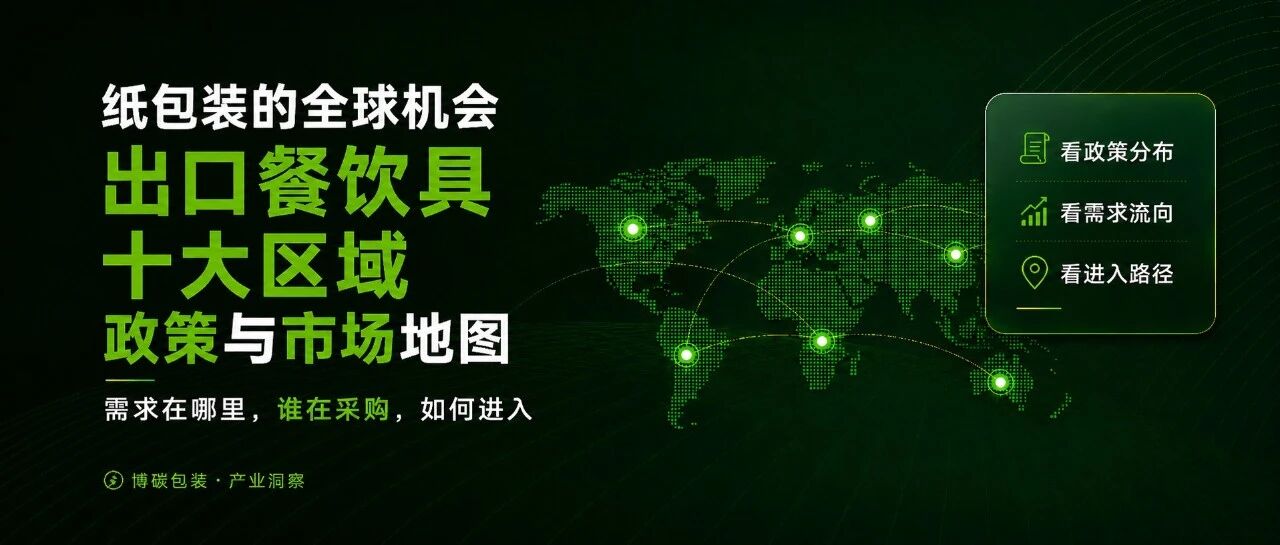
纸包装的全球机会,正在从“替代一种材料”升级为“交付一套可验证的餐饮包装解决方案”。
海外餐饮包装政策与市场地图 / GLOBAL PACKAGING MAP
出口餐饮包装十大区域政策与市场地图需求在哪里,谁在采购,如何进入
从欧盟、法国、德国、英国、加州、澳大利亚、印度、加拿大、新西兰到海湾市场,逐区回答需求为何形成、谁在采购、什么证据决定SKU,以及中国供应链如何进入。
19 候选 · 10 区域 · 7 角色
01 · EDITORIAL QUESTION
同样限塑,为何形成不同机会
“限塑”三个字,正在制造至少四种完全不同的市场。法国把可同时接待至少20人的餐饮场所堂食导向可洗、可重复使用餐具;英国把纸卡、纤维基复合和塑料分开收费;澳大利亚允许某些经认证的可堆肥制品进入州级豁免,但当地厨余与园林有机物收集(FOGO)仍可能拒收;印度的禁令、生产者延伸责任(EPR)和水性涂层询盘线索同时出现。
值得追踪的不是哪个市场“限塑最严”,而是法规如何变成采购:谁提规格,谁进口付款,谁承担EPR与测试,谁能让SKU进入或退出。本轮十区从19个候选中筛出,代表研究与进入优先级,不是“全球市场规模前十”。
核心判断
同样限塑没有形成全球通用产品,却共同推动采购升级:买方不再只比杯盒单价,还要核对功能、食品接触、EPR、终端去向和供应稳定性。纸包装凭借规模制造、成型印刷和纤维循环基础,正成为承接需求的重要平台;更接近订单的,是能按区域交付可验证最终SKU的供应链。
研究边界
十区由19个候选单元筛出,代表首批研究与进入优先级,不是市场规模、增速或订单概率排名;贸易数据只作进口通道代理。纸基包装可回收再浆”实验室可回收、纸厂可回收和当地可回收”是三个层级,实验室得率不等于现实回收率。
02 · CIRCULAR FIBRE VALUE
从材料替换走向纤维循环
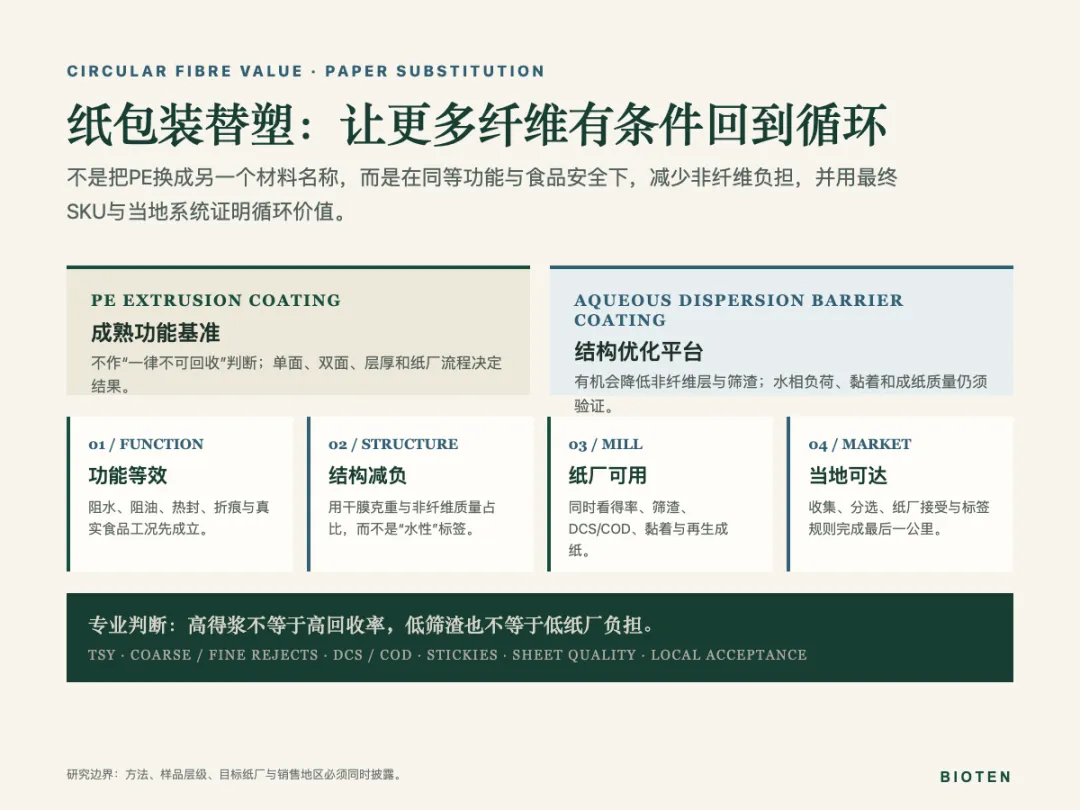
纸杯和纸餐盒的商业起点,是稳定完成盛装、加工和规模交付。PE挤出淋膜提供成熟的阻水、热封和加工方案,不能简单写成“不可回收”。欧洲产业联盟4evergreen的非强制指南把仅包装内侧单面施涂的热塑性挤出层暂列为对常规纸回收“完全兼容或有限兼容”,双面结构通常转向专门纸厂;指南部分判断仍基于专家意见,并要求最终结构测试。改进对象是非纤维质量、纤维分离、筛渣和纸厂负担,不是PE名称。
水性分散涂层的积极价值在这里出现。该指南列出典型湿法施涂量约5—20克/平方米,成膜可薄至1—2微米,相比膜复合更易与纤维分离;但用量、结合强度和填料都会改变结果。水性只描述施涂体系,干膜仍可能是塑料;“更薄、更少”只有在相同原纸和同等功能下才是有效比较。
03 · TEN REGION MAP
十大区域速览
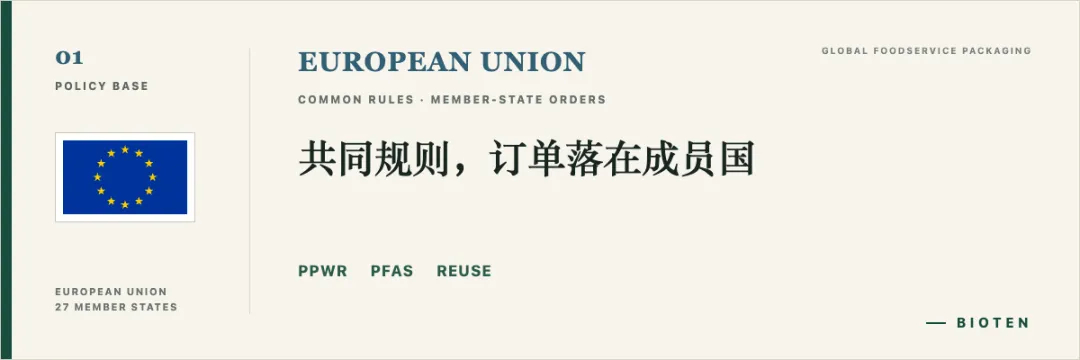
欧盟共同规则:先定产品底座,订单落在成员国
政策与数据。 欧洲议会和理事会《包装和包装废弃物条例》Regulation (EU) 2025/40(PPWR)于2025年2月11日生效,2026年8月12日起一般适用,覆盖所有包装,并把减量、复用、可回收设计、生产者责任及食品接触包装PFAS限值放进共同底座。外带餐饮最迟自2027年2月12日起接受顾客自带容器,2028年2月12日起提供复用选择,后者对微型企业有豁免。Eurostat统计,欧盟2023年产生7,970万吨包装废弃物,人均177.8千克;纸和纸板约3,230万吨、占40.4%。这不是餐饮包装市场规模。
需求、采购与进入。 需求信号属于“法规直接驱动+品牌采购”,但PPWR没有指定水性涂层;含聚合物的阻隔层仍可能被识别为塑料或复合组件。品牌/包装生产者提出设计和PFAS规格,成员国进口商或首次投放者承担登记与EPR,涂布纸厂和制品厂实际采购,合规机构、PRO及回收体系可以否决SKU。中国企业应先选一个成员国、一个杯盒结构和一个责任主体,以完整BOM、食品接触、受限物质、涂层质量占比和可回收/复用证据切入,而不是拿“欧盟通用水涂证书”推遍27国。
主要依据:EUR-Lex PPWR;Eurostat《Packaging waste statistics》(2023数据,2025发布)。
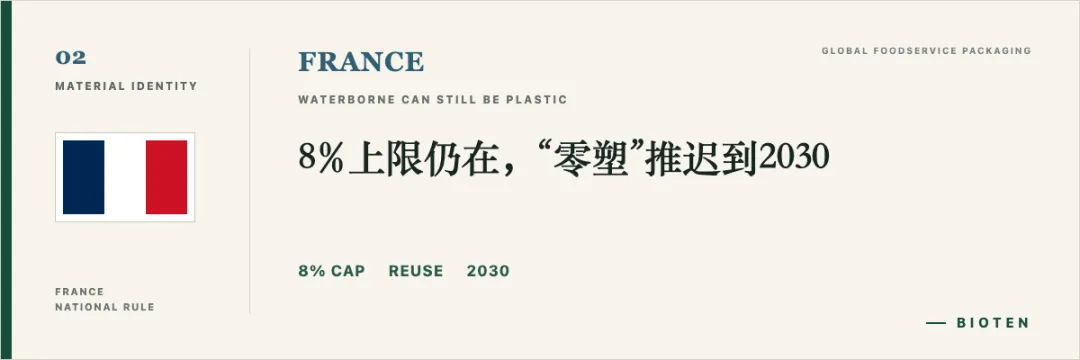
法国:8%上限仍在,纸杯“零塑”推迟到2030
政策与数据。 法国生态转型部与经济财政部门联署的《2021年9月24日一次性塑料杯最大允许塑料含量法令》规定,自2024年1月1日起相关一次性杯塑料含量不超过杯重的8%。2025年12月28日修订法令把原定2026年的“无塑或仅痕量”节点推至2030年,2028年再评估;节点前合规制造或进口的库存可再消化12个月。其2025年技术评估明确:承担阻隔功能且含化学改性聚合物的水性分散体仍属于塑料。《AGEC法》及环境法典D.541-342要求,自2023年起,可接待至少20人的场所用复用杯、盘、容器和餐具供应堂食;外带另核杯体含塑上限。ADEME统计,法国2024年投放约27.5亿件各类复用包装,整体复用率1.82%;这是全包装口径,不是餐饮杯盒专属。
需求、采购与进入。 需求信号是“减塑+复用”,不是“水涂直接增长”。连锁餐饮定堂食和外带规格;专业包装EPR缴费主体仍须以法国政府承诺最迟2026年9月公布的界定为准,生态组织、食品接触审核和门店运营都可卡住SKU。材料商应证明干膜组成和塑料占比;水性价值是在同等功能下控制聚合物质量。EPR运营已由2026年7月1日后移至2027年1月1日。
主要依据:Legifrance杯规与环境法典;法国生态转型部;ADEME《Réemploi des emballages:données 2024》。
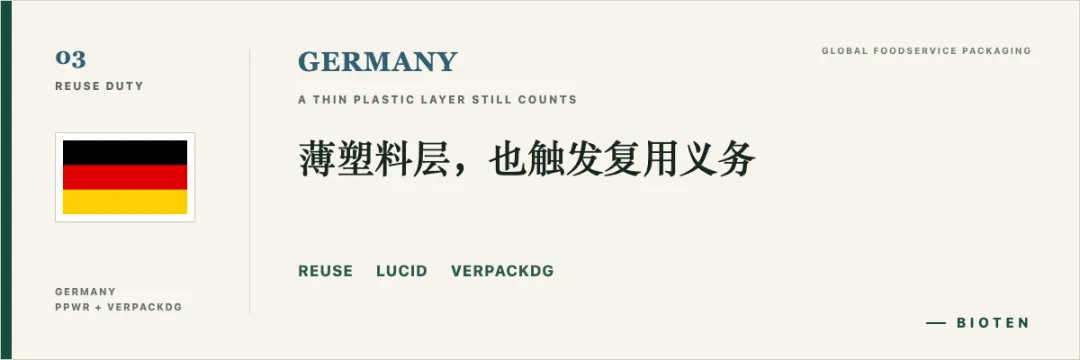
德国:薄塑料层也触发复用义务
政策与数据。 德国《Verpackungsrecht-Durchführungsgesetz》(VerpackDG)于2026年8月12日生效并取代旧VerpackG;第60、61条承接自2023年以来的复用义务:由最终销售者灌装——包括其厨房、准备间或其他经营设施——的一次性塑料食品容器,以及所有材质的一次性饮料杯,都须提供不更贵、条件不更差的复用选择。食品容器全部或部分由塑料构成即可进入定义;不超过5名员工且销售面积不超过80平方米的小店可用顾客自带容器履责,并非完全免责。UBA统计,德国2023年产生约1,792万吨包装废弃物,整体回收率69.4%,纸和纸板大类为86.6%;大类率不证明具体纸杯可回收。
需求、采购与进入。 直接需求首先是复用。自2026年8月12日起,PPWR与VerpackDG把manufacturer的符合性责任和producer的EPR责任分开;品牌、德国境内供应链位置和是否境外直供最终用户都会改变责任人。餐饮品牌定规格,manufacturer准备技术文件,producer承担LUCID、系统参与和EPR。服务包装须按品牌、供应商所在地和采购路径重新识别,不能沿用旧“预参与系统”口径。中国供应商应先锁定角色,再交含塑、复用、再浆和食品接触证据。
主要依据:德国联邦公报VerpackDG;UBA《Verpackungsabfälle》(2023数据,2026更新);ZSVR。
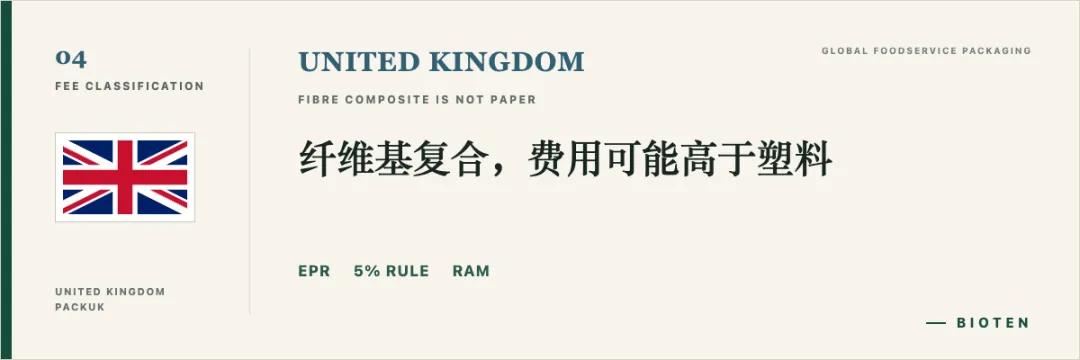
英国:“纸基”不一定按纸卡付费
政策与数据。 英国四地共同适用的《Producer Responsibility Obligations (Packaging and Packaging Waste) Regulations 2024》SI 2024/1332自2025年1月1日起生效,品牌所有者、灌装者和进口商等按活动与门槛识别责任。对承担废弃物处置费义务的适用包装,PackUK公布的2025—2026年度第一年基础费为:纸卡196英镑/吨、塑料423英镑/吨、纤维基复合461英镑/吨;不含全部注册、PRN/PERN等成本。自2026年1月1日起,不可手工分离的纸纤维—塑料组件,塑料质量占比超过5%按纤维基复合申报,5%及以下且能举证才归纸卡;可分离组件分别报告。
需求、采购与进入。 需求信号属于“EPR费用直接驱动+品牌可回收性采购”,不是禁塑自动推动水涂。水性聚合物若形成不可分离塑料层,仍进入5%质量计算和可回收性评估方法(RAM);降低干膜克重和不可分离塑料占比由此进入EPR分类、费用与采购核算。品牌/零售商提规格,英国进口商或达到门槛的producer申报付款,转换厂采购纸材,PackUK、监管机构和回收商控制分类与末端。切入包至少应包含层结构、干膜克重、塑料占比、食品接触和再浆测试。
主要依据:SI 2024/1332;PackUK《2025 base fees》;英国政府EPR材料分类指南。
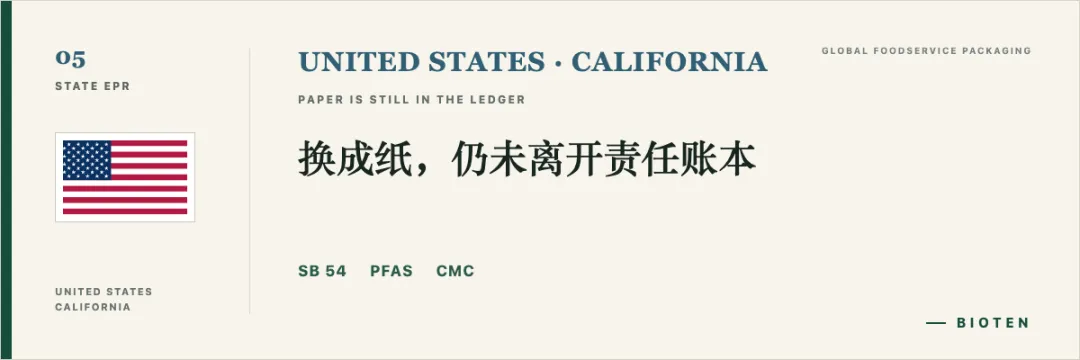
美国加州:从塑料换成纸,仍未离开责任账本
政策与数据。 加州州长于2022年6月30日签署SB 54《Plastic Pollution Prevention and Packaging Producer Responsibility Act》;CalRecycle永久实施规章于2026年5月1日生效。制度覆盖一次性包装和一次性塑料餐饮具,并设EPR、源头减量及2032年目标;部分医疗、处方药和特定食品农业包装有排除。AB 1200又自2023年1月1日起禁止植物纤维食品包装含有意添加且发挥功能或技术作用的PFAS,或总有机氟达到100 ppm。CalRecycle估算,2024年填埋的SB 54覆盖材料约845.7万短吨,占全州填埋处置量21.1%;纸和纤维约392.9万短吨,占覆盖材料46.5%。2026覆盖材料类别(CMC)还把“带塑料涂层/内衬的纸板”单列,组别估算回收率低于6%且当期未列为可回收;这不是具体SKU认证。
需求、采购与进入。 需求信号是“法规直接+品牌采购+末端体系”,但不等于水性体系获豁免。品牌所有者、制造商或州内主体按法定层级可能成为producer;Circular Action Alliance已获批为首个PRO并于2026年6月提交计划,计划、预算和年度报告由CalRecycle审批,费用以获批安排为准。餐饮/零售买方提SKU,分选、回收或堆肥体系控制末端。中国供应商应先锁定producer、组件分类、PFAS、CMC和真实去向;进入州属设施还要另看SB 1335最终产品清单。
主要依据:CalRecycle SB 54永久规章、2024材料处置研究和2026 CMC清单;AB 1200。
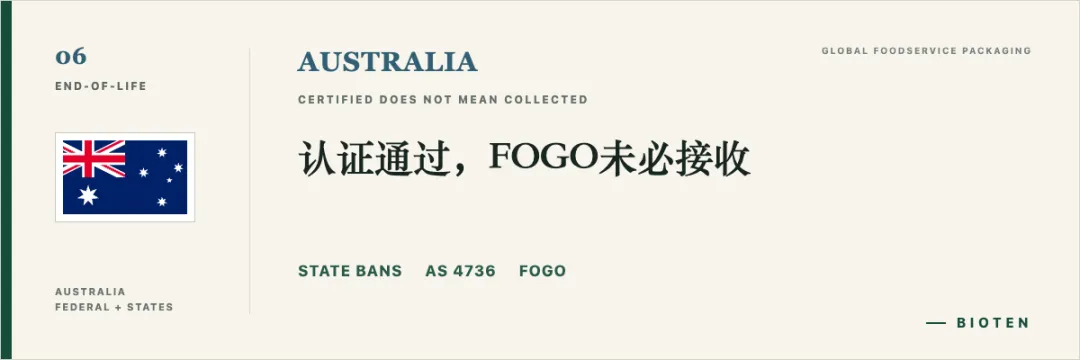
澳洲:认证通过,FOGO未必接收
政策与数据。 联邦现行底座仍是《National Environment Protection (Used Packaging Materials) Measure 2011》与Australian Packaging Covenant,新包装改革尚在开发。南澳《Act 2020》及《Regulations 2021》自2024年9月1日起把一次性塑料饮料杯、杯盖及即食外带容器等纳入禁限;自2026年3月1日起,经AS 4736或AS 5810豁免的杯盒还须按适用堆肥路径清晰标识。西澳《Regulations 2018》下,咖啡杯、杯盖和外带托盘自2024年3月1日起实施,部分盖件和带盖容器自9月1日起实施;场外预包装、航空服务和州外供应等是西澳特定例外。水性聚合物层不自动退出塑料判断。AS 4736和AS 5810不能相互推定,上游证书不自动覆盖成杯,也不保证FOGO接受。
需求、采购与进入。 UN Comtrade Preview API对2024年HS 482369的估计值为:澳大利亚自全球约2.065亿美元、自中国约1.587亿美元,计算占比约76.9%;两行均标记isReported=false,只能作为混合盘、碟、杯等进口通道代理。西澳每年使用超过1.54亿只外带咖啡杯;其2026年FOGO沟通指南把可堆肥杯、容器和托盘列入一般垃圾,地方议会正分阶段采用。进口商/分销商采购付款,连锁品牌定规格,州监管、证书范围与地方末端控制SKU。中国企业应按“一个州+一个SKU+一种末端”验证。
主要依据:DCCEEW联邦包装框架;南澳/西澳法规与Waste Authority;UN Comtrade 2024。
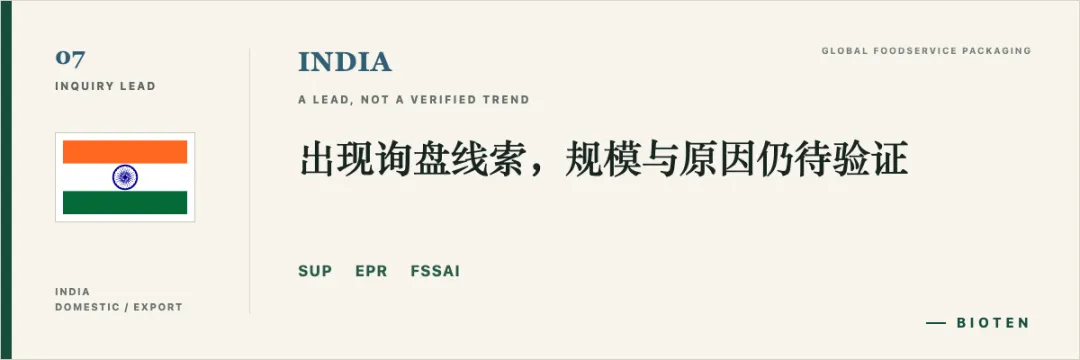
印度:出现询盘线索,规模与原因仍待验证
政策与数据。 印度《Plastic Waste Management Amendment Rules, 2021》规定,自2022年7月1日起禁生产、进口、储存、分销、销售和使用清单内一次性塑料盘、杯、餐具、吸管和托盘等;没有直接禁止所有纸杯。2022年修订规则建立塑料包装EPR,至少一层塑料加一层非塑料的包装进入Category III判断。FSSAI《Packaging Regulations, 2018》要求食品经营者取得NABL认可实验室的食品接触符合性证据。本轮在BIS公开资料中仅检得2024年10月CHD 16 (22358) WC征求意见稿,未检得同题最终IS发布记录,不能当作现行认证。2022年7月至2025年7月累计检查861,740次、查扣1,985吨禁用SUP,处罚₹19.82 crore(约1.982亿卢比)。
需求、采购与进入。 本轮只确认用户提供了询盘线索,未取得完整时间序列、客户和项目阶段。若构成塑料包装,生产者、进口商、品牌所有者(PIBO)按身份履行CPCB EPR;NABL认可实验室提供证据,FSSAI、州食品部门及CPCB/SPCB/PCC实施监管。中国供应商应先问最终销售地,再联合打样。
主要依据:MoEFCC/CPCB塑料规则;FSSAI包装法规;印度议会SUP执行答复;TNPL 2024—25年报。
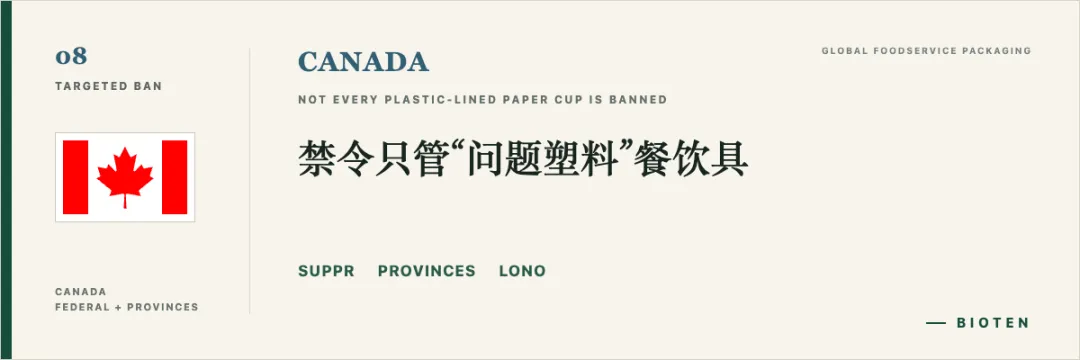
加拿大:禁令只管“问题塑料”餐饮具
政策与数据。 加拿大环境与气候变化部《Single-use Plastics Prohibition Regulations》(SUPPR)于2022年6月22日发布;指定餐饮具制造和进口禁令自2022年12月20日、销售禁令自2023年12月20日、出口相关禁令自2025年12月20日起实施。2026年1月30日联邦上诉法院裁判后,SUPPR继续有效。它针对含EPS、XPS、PVC、炭黑或氧化降解塑料的杯、盘、碗、盒。官方指南还把不含这些问题塑料的普通塑料内衬纸咖啡杯和PLA餐饮具列作不因该条款自动被禁的示例;但PLA、PHA仍可属于塑料。加拿大统计局记录,2025年餐饮及饮酒场所销售1,014亿加元,其中有限服务餐饮473亿、占46.6%;这是使用场景代理,不是包装市场规模。
需求、采购与进入。 信号来自“特定树脂禁限+品牌/省级EPR”,不是联邦规则指定水涂。水性聚合物仍可能是塑料,只是未含五类问题塑料时不因SUPPR自动被禁。品牌定规格,进口商、品牌所有者或省级producer承担采购与EPR;省级PRO和地方回收系统控制末端。Health Canada的无异议函(LONO)是自愿化学安全意见,不是法律批准,也不转移食品卖方责任。中国企业应按目标省份核对主体、配方和用途。
主要依据:SUPPR及官方技术指南;Statistics Canada 2025餐饮销售;Health Canada食品包装指南。
新西兰:市政体系里,“可堆肥”仍可能进一般垃圾
政策与数据。 新西兰《Waste Minimisation (Plastic and Related Products) Regulations 2022》自2022年10月起禁部分PVC食品托盘、PS外带食品饮料包装等;2023年7月起,主要由塑料制成的盘、碗、托盘等餐桌用品被禁,叉、匙、刀、筷只要含塑即纳入,塑料定义包括生物基和可堆肥塑料。实施指南明确:塑料内衬的纸/竹/甘蔗浆餐桌用品、非EPS一次性杯及普通带盖塑料容器不在这一阶段。原计划2025年的第三阶段期限已取消。自2024年2月起,地方政府路边厨余/FOGO标准不收纸、纸板和可堆肥包装;专门商业收集另行核验。
需求、采购与进入。 UN Comtrade Preview API对2024年HS 482369的世界合计估计约3,110万美元;中国伙伴行约2,389万美元、毛重约782.9万千克且isReported=true,按金额计算占76.8%,但品目不能识别水涂。水性聚合物干膜不自动“无塑”;即使产品未被禁,复合层仍可能被标准路边纸回收排除。进口商/分销商付款,品牌定规格;食品企业与供应商证明包装安全,MPI/New Zealand Food Safety实施法规,市政和设施决定末端。纸回收路线须有最终结构测试与当地接受,堆肥路线须有设施确认。
主要依据:新西兰环境部塑料淘汰与路边收集指南;MPI食品包装规则;UN Comtrade 2024。

海湾市场:迪拜是规则锚,沙特是另一套准入
政策与数据。 UAE气候变化与环境部《Ministerial Decision No. 380 of 2022》形成联邦底座:自2026年1月1日起,第二阶段禁止进口、生产或交易塑料饮料杯及杯盖、盘、餐具、吸管、搅拌棒和泡沫塑料食品容器;出口/再出口及主管部门规定的再生材料产品有特定例外。迪拜《Executive Council Resolution No. 124 of 2023》另行适用于迪拜全境及自由区:2025年覆盖Styrofoam杯和食品容器等,2026年覆盖塑料盘、食品容器、餐具、饮料杯和杯盖;标识后的出口/再出口产品不得在UAE内销。迪拜2025年上半年约新开2,336家食品机构,只是渠道活动代理。
需求、采购与进入。 需求信号是“UAE/迪拜法规直接+酒店餐饮渠道活跃”;区域转口仍须逐单验证。公开规则尚未统一分类水性聚合物涂层纸杯,报价前应由本地进口商就配方和最终SKU取得书面意见。沙特不是UAE禁令的延伸:SASO可降解塑料法规针对附件列明的PE/PP及氧化—生物降解产品,不是覆盖所有纸杯的堆肥路线;《Technical Regulation for Food Safety in Tools and Appliances Used in the Kitchen》另管食品接触。沙特进口商须在Saber完成产品符合性证书和逐批Shipment Certificate。中国企业应拆成迪拜内销、转口、沙特内销三张SKU卡。
主要依据:UAE 380/2022;Dubai 124/2023及Dubai Municipality 2025;SASO/Saber。
04 · ORDER CHAIN
谁在采购:真实订单不是从法规直接跳到工厂
七个订单角色|规格提出者 → 材料采购者 → 进口/投放者 → PO付款者 → EPR承担者 → 证据控制者 → 末端接受者
十区反复出现的不是一张“客户名单”,而是七个需要拆开的订单角色。
第一,规格提出者通常是餐饮品牌、商超、机构客户或包装品牌。第二,材料采购者是涂布纸厂、转换厂或杯盒厂。第三,进口或市场投放者处理跨境、库存和登记。第四,实际PO付款者可能是进口商、分销商、品牌指定供应链或转换厂;合同和Incoterms会改变货款、测试费与库存风险。
第五,EPR责任与费用承担者可能与PO付款者不同,各市场producer或PIBO走不同体系。第六,证据门槛控制者包括食品接触审核、实验室、认证机构、PRO和监管部门;它们控制报告、标签、上架或履责能否成立,并非都属产品许可机关。第七,末端接受者是收运、分选、纸厂、堆肥设施和门店系统;“有证书”与“当地桶里能收”可以同时一真一假。
有效询盘至少要问清:最终销售国家/州、客户角色、SKU结构、食品工况、替代理由、法规/标准、谁进口、谁付测试费、谁承担EPR、目标末端、预计年量和下一节点。只有买方规格、责任主体、付费样品、第三方测试、试单或复购逐级出现,政策热度才开始变成商业证据。
05 · CHINA ENTRY PACKAGE
中国产业样本,水性涂层纸杯领域有辨识度的行业样本
纸杯/纸餐盒厂要交“最终SKU责任包”。 材料报告不能覆盖成杯,侧封、卷口、油墨和胶要进入BOM。立乐(Lido)是水性涂层纸杯领域有辨识度的产业样本:国家标准平台列其为GB/T 44834—2024和GB/T 27591—2025主要起草单位;其持续多年联合巴斯夫、博汇纸业、都佰城产业链协同推动水性阻隔涂层纸基餐饮具的规模化应用。对海外买方,这一价值还在持续放大,不止在于“水性涂层纸杯”标签的中国产业链能力,而在食品接触安全可靠、易回收的透明度与可验证性。
06 · CONCLUSION
真正的窗口,是把证据做在订单之前
十区共同指向一种采购变化:餐饮包装正从“材料替代”走向“区域化、可验证的解决方案交付”。在保留一次性需求的外带、配送、机构场景,纸包装凭借成熟制造、成型印刷和纤维循环基础具有升级空间;在复用优先市场,需与复用体系形成场景分工。水性阻隔的价值,是继续优化最终SKU的功能、非纤维负担和回收条件。
中国纸包装供应链的机会,是率先把区域需求、功能对照、结构减塑、再浆证据、食品接触、EPR和当地末端整理成低风险SKU。纸替塑由此成为买方可审核、纸厂可验证、责任方可计量的采购语言。
后续博碳包装将专业研究解读具体区域市场的政策与市场发展逻辑和机会,为中国纸基包装产业链从业者高质量创新发展,提供判断依据和参考。
博碳包装·产业洞察·研究说明
本文依据截至2026年8月17日可核验的法规、监管资料和官方数据整理;政策、费率及设施接受仍会变化,实际项目请按目标市场与最终SKU复核;本文用于产业研究与市场判断,不构成法律、认证或产品性能承诺。
博碳研究数据与核验来源
欧盟:Regulation (EU) 2025/40(PPWR)、欧盟委员会包装政策页、Eurostat 2023包装废弃物数据。
法国与德国:法国纸杯塑料含量现行条文、法国水性聚合物技术评估、ADEME 2024复用包装数据、德国VerpackDG联邦公报、UBA 2023包装数据、ZSVR:2026年8月12日起责任变化。
英国与加州:UK PackUK 2025—2026基础费、英国EPR材料分类、CalRecycle SB 54、CalRecycle 2024材料处置研究。
澳大利亚与印度:澳大利亚联邦包装责任框架、西澳FOGO接收规则、印度SUP执行数据、FSSAI包装法规汇编、TNPL 2024—25年报。
加拿大与新西兰:加拿大SUPPR技术指南、Statistics Canada 2025餐饮销售、新西兰塑料淘汰政策、新西兰FOGO排除清单、MPI食品包装规则。
海湾与贸易口径:UAE Ministerial Decision No. 380 of 2022、迪拜Executive Council Resolution No. 124 of 2023、SASO可降解塑料技术法规、UN Comtrade API方法说明。
迪拜渠道数据:Dubai Municipality 2025食品机构数据。
纸替塑与再浆方法:4evergreen《Circularity by Design Guideline》Version 4(2026)、Cepi《Paper and Board Recyclability Laboratory Test Method》Version 3(2025)、Lyytikäinen等2026年水性木栓质分散涂层再浆研究。
The global opportunity for paper packaging is evolving from “replacing one material” into “delivering a complete, verifiable foodservice-packaging solution”.
Overseas Foodservice-Packaging Policy and Market Map / GLOBAL PACKAGING MAP
Export Foodservice Packaging: A Ten-Region Policy and Market Map — Where Demand Is Forming, Who Buys and How to Enter
From the European Union, France, Germany and the United Kingdom to California, Australia, India, Canada, New Zealand and the Gulf, this report examines—region by region—why demand is emerging, who makes purchasing decisions, which evidence determines whether a SKU is accepted, and how Chinese suppliers can enter the market.
19 candidates ·10 regions ·7 roles
01 · EDITORIAL QUESTION
Why do similar restrictions on plastics create different opportunities?
The phrase “plastic restriction” is producing at least four very different markets. France is directing dine-in service at foodservice establishments with seating for at least 20 people towards washable, reusable tableware. The United Kingdom applies different extended producer responsibility fees to paper and board, fibre-based composites and plastic. Australia allows certain certified-compostable items to qualify for exemptions under some state rules, yet local food-organics and garden-organics (FOGO) collection systems may still reject them. In India, single-use-plastic prohibitions, extended producer responsibility (EPR) and enquiries about water-based coatings are appearing at the same time.
The issue worth tracking is not which market has the “strictest plastic restrictions”, but how regulation becomes procurement: who sets the specification, who imports and pays, who bears EPR and testing obligations, and who can approve or reject a SKU. The ten regions in this report were selected from 19 candidates to represent research and market-entry priorities; they are not a ranking of the world’s ten largest markets.
Core finding
Similar plastic restrictions have not created a single global product specification, but they are driving the same procurement upgrade. Buyers no longer compare only the unit price of cups and containers; they also examine functionality, food-contact compliance, EPR, end-of-life pathways and supply reliability. With its industrial manufacturing scale, forming and printing capabilities, and established fibre-recycling infrastructure, paper packaging is becoming an important platform for meeting this demand. The suppliers closest to winning orders will be those able to deliver a verifiable final SKU for each target region.
Scope and limitations
The ten regions were selected from 19 candidate market units and represent the first group of research and market-entry priorities; they are not ranked by market size, growth rate or likelihood of an order. Trade data are used only as a proxy for import channels. For fibre-based packaging, “repulpable” can refer to three different levels: repulpable in a laboratory, recyclable at a paper mill, and recyclable in the local collection system. Laboratory fibre yield is not the same as real-world recycling performance.
02 · CIRCULAR FIBRE VALUE
From material substitution to fibre circularity
The commercial starting point for paper cups and food containers is their ability to hold their contents, run reliably in conversion and be supplied at scale. Polyethylene (PE) extrusion coating provides mature water-resistance, heat-sealing and processing performance and should not be described simply as “non-recyclable”. The non-binding guidance issued by the European industry alliance 4evergreen provisionally classifies a thermoplastic extrusion layer applied only to the inside of a pack as either fully compatible or compatible under specific conditions with conventional paper recycling; double-sided structures generally require specialised mills. Some conclusions in the guidance still rely on expert judgement, and the final structure must be tested. The optimisation target is the non-fibre mass, fibre separation, screening rejects and burden on the paper mill—not the name “PE”.
This is where the positive value of water-based dispersion coatings becomes apparent. The same guidance cites a typical wet application weight of approximately 5–20 g/m², with films potentially as thin as 1–2 µm, making them easier to separate from the fibre than laminated films. However, coat weight, bond strength and fillers can all change the outcome. “Water-based” describes the application system; the dry film may still be plastic. “Thinner and less” is a valid comparison only when the same base paper and equivalent functionality are being assessed.
03 · TEN-REGION MAP
The ten regions at a glance
European Union common rules: the product baseline is shared, but orders are placed in individual Member States
Policy and data. Regulation (EU) 2025/40 of the European Parliament and of the Council on packaging and packaging waste (PPWR) entered into force on 11 February 2025 and generally applies from 12 August 2026. It covers all packaging and establishes a common baseline for packaging minimisation, reuse, design for recycling, producer responsibility and PFAS limits for food-contact packaging. Takeaway operators must allow customers to bring their own containers by 12 February 2027 at the latest and must offer a reusable option by 12 February 2028; micro-enterprises are exempt from the latter obligation. Eurostat reports that the EU generated 79.70 million tonnes of packaging waste in 2023, equivalent to 177.8 kg per person. Paper and board accounted for approximately 32.30 million tonnes, or 40.4%. These figures are not a measure of the foodservice-packaging market.
Demand, procurement and market entry. The demand signal is “direct regulatory pressure plus brand procurement”, but the PPWR does not prescribe water-based coatings. Barrier layers containing polymers may still be classified as plastic or as composite components. Brands and packaging producers set design and PFAS specifications; the importer or party first placing the product on the market in a Member State handles registration and EPR; coated-paper mills and converters make the actual material purchases; and compliance bodies, producer responsibility organisations (PROs) and recycling systems can reject a SKU. A Chinese supplier should begin with one Member State, one cup or container structure and one clearly identified responsible party, supported by a complete bill of materials (BOM), food-contact evidence, restricted-substance data, the coating’s mass share, and recyclability or reuse evidence—not by promoting a supposed “EU-wide water-based-coating certificate” across all 27 Member States.
Principal sources:EUR-Lex, PPWR; Eurostat, “Packaging waste statistics” (2023 data, published in 2025).
France: the 8% limit remains, while the “plastic-free” paper-cup deadline has moved to 2030
Policy and data. A French decree of 24 September 2021 on the maximum permitted plastic content of certain single-use cups provides that, from 1 January 2024, plastic may account for no more than 8% of the cup’s weight. An amending decree of 28 December 2025 postponed the previous 2026 deadline for “no plastic or trace quantities only” to 2030, with a further review in 2028; compliant products manufactured or imported before the deadline may continue to be sold for 12 months. France’s 2025 technical assessment is explicit that a water-based dispersion containing chemically modified polymers and performing a barrier function still constitutes plastic. Under the AGEC Law and Article D.541-342 of the Environmental Code, establishments able to seat at least 20 people have, since 2023, been required to serve dine-in food and drink using reusable cups, plates, containers and cutlery. Takeaway cups are assessed separately against the plastic-content limit. ADEME reports that approximately 2.75 billion items of reusable packaging of all kinds were placed on the French market in 2024, giving an overall reuse rate of 1.82%; these figures cover all packaging, not only foodservice cups and containers.
Demand, procurement and market entry. The demand signal is “plastic reduction plus reuse”, not “automatic growth in water-based coatings”. Foodservice chains set separate dine-in and takeaway specifications. The party liable for professional-packaging EPR fees still depends on the legal definition that the French government has committed to publish by September 2026 at the latest; producer responsibility organisations, food-contact reviewers and store operations can all prevent a SKU from being adopted. Materials suppliers must substantiate the composition of the dry film and its plastic mass share. The value of a water-based system lies in controlling polymer mass while delivering equivalent performance. The launch of the EPR system has been postponed from 1 July 2026 to 1 January 2027.
Principal sources:Legifrance, the cup-content decree and the Environmental Code; French Ministry for Ecological Transition; ADEME, “Réemploi des emballages: données 2024”.
Germany: even a thin plastic layer can trigger the reusable-option obligation
Policy and data. Germany’s Verpackungsrecht-Durchführungsgesetz (Packaging Law Implementation Act; VerpackDG) entered into force on 12 August 2026 and replaced the former Verpackungsgesetz (Packaging Act). Sections 60 and 61 continue the reusable-option obligations in place since 2023. Single-use plastic food containers filled by the final distributor—including in its kitchen, preparation area or other operating premises—and single-use beverage cups made from any material must be accompanied by a reusable option that is no more expensive and is offered on no less favourable terms. A food container falls within the definition if it is wholly or partly made of plastic. Small establishments with no more than five employees and a sales area of no more than 80 m² may comply by filling customers’ own containers; they are not fully exempt. The German Environment Agency (UBA) reports that Germany generated approximately 17.92 million tonnes of packaging waste in 2023, with an overall recycling rate of 69.4% and a rate of 86.6% for the broad paper-and-board category. A category-wide rate does not prove that a specific paper cup is recyclable.
Demand, procurement and market entry. The most direct demand is for reuse. From 12 August 2026, the PPWR and VerpackDG distinguish between the manufacturer’s conformity obligations and the producer’s EPR obligations. The responsible party changes according to the brand, the position of the German supply-chain entity and whether a foreign seller supplies end users directly. The foodservice brand sets the specification, the manufacturer prepares the technical documentation, and the producer handles LUCID registration, system participation and EPR. Service packaging must therefore be reassessed by brand, supplier location and purchasing route rather than relying on the former “pre-participation in a system” assumption. A Chinese supplier should establish its legal role first, then provide evidence on plastic content, reuse, repulpability and food-contact compliance.
Principal sources:German Federal Law Gazette, VerpackDG; UBA, “Verpackungsabfälle” (2023 data, updated in 2026); ZSVR.
United Kingdom: “fibre-based” does not necessarily attract the paper-and-board fee
Policy and data. The Producer Responsibility Obligations (Packaging and Packaging Waste) Regulations 2024 (SI 2024/1332), which apply across all four nations of the United Kingdom, entered into force on 1 January 2025. Brand owners, packer/fillers, importers and other parties are identified by their activities and the applicable thresholds. For packaging subject to waste-disposal fees, PackUK’s first-year base fees for 2025–2026 are £196 per tonne for paper or board, £423 per tonne for plastic and £461 per tonne for fibre-based composite packaging. These figures do not include every registration charge, PRN/PERN cost or other obligation. From 1 January 2026, a paper-fibre and plastic component that cannot be separated by hand is reported as a fibre-based composite if plastic exceeds 5% of its weight; it may be classified as paper or board only where plastic is 5% or less and supporting evidence is available. Components that can be separated are reported individually.
Demand, procurement and market entry. The signal is “EPR fees directly influencing brand recyclability procurement”, not a plastic restriction automatically favouring water-based coatings. Where a water-based polymer forms an inseparable plastic layer, it still counts towards the 5% plastic threshold and is assessed under the recyclability assessment methodology (RAM). Lower dry-film coat weight and a lower share of inseparable plastic therefore enter directly into EPR classification, fees and purchasing calculations. Brands and retailers set the specification; UK importers or producers above the thresholds report and pay; converters purchase the paper; and PackUK, regulators and recyclers control classification and end-of-life acceptance. The market-entry pack should include, at minimum, the layer structure, dry coat weight, plastic mass share, food-contact evidence and repulpability test results.
Principal sources:SI 2024/1332; PackUK, “2025 base fees”; UK Government guidance on EPR packaging-material classification.
California, United States: switching from plastic to paper does not remove the product from the responsibility ledger
Policy and data. California’s governor signed SB 54, the Plastic Pollution Prevention and Packaging Producer Responsibility Act, on 30 June 2022; CalRecycle’s permanent implementing regulations took effect on 1 May 2026. The system covers single-use packaging and single-use plastic foodservice ware and establishes EPR, source-reduction requirements and 2032 targets. Certain medical, prescription-drug and specified food and agricultural packaging is excluded. Since 1 January 2023, AB 1200 has prohibited plant-fibre-based food packaging containing either intentionally added PFAS that serves a functional or technical purpose or total organic fluorine at or above 100 ppm. CalRecycle estimates that approximately 8.457 million short tons of materials covered by SB 54 were landfilled in 2024, representing 21.1% of statewide landfill disposal. Paper and fibre accounted for approximately 3.929 million short tons, or 46.5% of covered materials. The 2026 covered material category (CMC) list also identifies “paperboard with plastic coating/lining” separately; the category group has an estimated recycling rate below 6% and was not listed as recyclable for that period. This is not a certification decision for any individual SKU.
Demand, procurement and market entry. The demand signal combines direct regulation, brand procurement and end-of-life infrastructure; it does not exempt water-based systems. Under the statute’s hierarchy, the producer may be the brand owner, manufacturer or an in-state entity. Circular Action Alliance has been approved as the first PRO and submitted its plan in June 2026; the plan, budget and annual reports are subject to CalRecycle approval, and fees will follow the approved arrangements. Foodservice and retail buyers set SKU requirements, while sorting, recycling and composting systems determine end-of-life acceptance. Chinese suppliers should first identify the producer, component classification, PFAS status, applicable CMC and actual end-of-life route. Products intended for state facilities must also be checked separately against the SB 1335 approved-products list.
Principal sources:CalRecycle, SB 54 permanent regulations, 2024 material-disposal study and 2026 CMC list; AB 1200.
Australia: certification does not guarantee acceptance in a FOGO system
Policy and data. The current federal baseline remains the National Environment Protection (Used Packaging Materials) Measure 2011 and the Australian Packaging Covenant; broader packaging reform is still under development. Under South Australia’s Single-use and Other Plastic Products (Waste Avoidance) Act 2020 and Regulations 2021, single-use plastic beverage cups, lids and ready-to-eat takeaway containers have been progressively restricted since 1 September 2024. From 1 March 2026, cups and containers exempted on the basis of AS 4736 or AS 5810 certification must also be clearly labelled for the applicable composting pathway. Under Western Australia’s Environmental Protection (Prohibited Plastics and Balloons) Regulations 2018, the rules for coffee cups, lids and takeaway trays took effect on 1 March 2024, with certain lids and lidded containers following on 1 September. Off-site pre-packaging, aviation services and supply outside the state are among Western Australia’s specific exceptions. A water-based polymer layer does not automatically fall outside the definition of plastic. AS 4736 and AS 5810 are not interchangeable, an upstream certificate does not automatically cover the finished cup, and certification does not guarantee acceptance by a FOGO service.
Demand, procurement and market entry. The UN Comtrade Preview API estimates Australia’s 2024 imports under HS 482369 at approximately USD 206.5 million from the world and USD 158.7 million from China, implying a share of about 76.9%; both rows are markedisReported=false, so the figures can be used only as a proxy for an import channel that combines plates, dishes, cups and similar products. Western Australia uses more than 154 million takeaway coffee cups each year. Its 2026 FOGO communications guidance directs compostable cups, containers and trays to general waste, while local councils are adopting FOGO in stages. Importers and distributors place and pay for orders, foodservice chains set specifications, and state regulators, certificate scope and local end-of-life systems control whether a SKU is accepted. A Chinese supplier should validate “one state, one SKU, one end-of-life pathway” at a time.
Principal sources:Australian Department of Climate Change, Energy, the Environment and Water (DCCEEW), federal packaging framework; South Australian and Western Australian legislation and Waste Authority guidance; UN Comtrade 2024.
India: enquiry signals are emerging, but their scale and causes still need to be verified
Policy and data. India’s Plastic Waste Management Amendment Rules, 2021 prohibit, from 1 July 2022, the manufacture, import, stocking, distribution, sale and use of listed single-use plastic items, including plates, cups, cutlery, straws and trays. They do not directly prohibit every paper cup. The 2022 amendment established EPR for plastic packaging; a pack consisting of at least one layer of plastic and one layer of a non-plastic material falls within the Category III assessment. The Food Safety and Standards Authority of India (FSSAI) Packaging Regulations, 2018 require food businesses to obtain food-contact compliance evidence from a laboratory accredited by the National Accreditation Board for Testing and Calibration Laboratories (NABL). In publicly available Bureau of Indian Standards (BIS) material reviewed for this report, only the October 2024 CHD 16 (22358) WC consultation draft was found; no publication record for a final Indian Standard with the same title was identified, so the draft should not be treated as current certification. Between July 2022 and July 2025, authorities conducted 861,740 inspections, seized 1,985 tonnes of prohibited single-use plastics and imposed penalties totalling ₹19.82 crore (approximately ₹198.2 million).
Demand, procurement and market entry. This review confirms only that the user has received enquiry signals; it does not establish a complete time series, customer set or project stage. Where the item constitutes plastic packaging, producers, importers and brand owners (PIBOs) must meet Central Pollution Control Board (CPCB) EPR obligations according to their role. NABL-accredited laboratories provide evidence, while FSSAI, state food authorities and the CPCB, state pollution control boards (SPCBs) and pollution control committees (PCCs) enforce the rules. A Chinese supplier should first establish the final place of sale and then conduct joint sampling and trials with the customer.
Principal sources:Ministry of Environment, Forest and Climate Change (MoEFCC) and CPCB plastic-waste rules; FSSAI packaging regulations; Indian parliamentary response on single-use-plastic enforcement; TNPL Annual Report 2024–25.
Canada: the prohibition targets specified “problematic plastic” foodservice ware
Policy and data. Environment and Climate Change Canada published the Single-use Plastics Prohibition Regulations (SUPPR) on 22 June 2022. For specified foodservice ware, the manufacture and import prohibitions took effect on 20 December 2022, the sale prohibition on 20 December 2023, and the export-related prohibition on 20 December 2025. Following the Federal Court of Appeal’s judgment of 30 January 2026, the SUPPR remain in force. They apply to cups, plates, bowls and containers containing expanded polystyrene (EPS), extruded polystyrene (XPS), polyvinyl chloride (PVC), carbon black or oxo-degradable plastic. Official guidance gives ordinary plastic-lined paper coffee cups that do not contain these problematic plastics, and PLA foodservice ware, as examples that are not automatically prohibited by this provision; PLA and PHA may nevertheless still be plastics. Statistics Canada recorded CAD 101.4 billion in sales by food services and drinking places in 2025, of which limited-service restaurants accounted for CAD 47.3 billion, or 46.6%. These figures are a proxy for the use environment, not the size of the packaging market.
Demand, procurement and market entry. The signal comes from restrictions on specified resins plus brand and provincial EPR requirements, not from a federal rule prescribing water-based coatings. A water-based polymer may still be plastic; if it contains none of the five problematic plastics, it is simply not automatically prohibited by the SUPPR provision. Brands set specifications, while the importer, brand owner or provincial producer may be responsible for purchasing and EPR. Provincial PROs and local recycling systems control end-of-life acceptance. Health Canada’s Letter of No Objection (LONO) is a voluntary opinion on chemical safety, not a legal approval, and it does not transfer responsibility away from the food seller. Chinese suppliers should verify the responsible party, formulation and intended use for the target province.
Principal sources:SUPPR and official technical guidance; Statistics Canada, 2025 foodservice sales; Health Canada food-packaging guidance.
New Zealand: “compostable” packaging may still be directed to general waste by municipal systems
Policy and data. Under New Zealand’s Waste Minimisation (Plastic and Related Products) Regulations 2022, certain PVC food trays and polystyrene takeaway food and beverage packaging have been prohibited since October 2022. Since July 2023, tableware such as plates, bowls and trays made predominantly from plastic has been prohibited, while forks, spoons, knives and chopsticks are covered if they contain any plastic. The definition of plastic includes bio-based and compostable plastics. Implementation guidance clarifies that plastic-lined paper, bamboo or bagasse tableware, non-EPS single-use cups and ordinary lidded plastic containers were not included in that phase. The original deadline for the third phase in 2025 has been removed. Since February 2024, local-authority kerbside food-scraps and FOGO services have excluded paper, board and compostable packaging; dedicated commercial collection must be verified separately.
Demand, procurement and market entry. The UN Comtrade Preview API estimates New Zealand’s 2024 imports under HS 482369 from the world at approximately USD 31.10 million. The China partner row is approximately USD 23.89 million with a gross weight of about 7.829 million kg and is markedisReported=true, implying 76.8% by value; however, the tariff heading cannot identify water-based-coated products. A water-based polymer dry film is not automatically “plastic-free”. Even where a product is not prohibited, a composite layer may still be excluded from standard kerbside paper recycling. Importers and distributors pay for orders and brands set specifications; food businesses and suppliers must demonstrate packaging safety, the Ministry for Primary Industries/New Zealand Food Safety enforces the rules, and municipalities and facilities determine end-of-life acceptance. A paper-recycling route requires final-structure testing and confirmation of local acceptance; a composting route requires confirmation from the receiving facility.
Principal sources:New Zealand Ministry for the Environment guidance on plastic phase-outs and kerbside collection; Ministry for Primary Industries food-packaging rules; UN Comtrade 2024.
Gulf markets: Dubai is the regulatory anchor, while Saudi Arabia has a separate market-access system
Policy and data. UAE Ministry of Climate Change and Environment Ministerial Decision No. 380 of 2022 establishes the federal baseline. From 1 January 2026, its second phase prohibits the import, production or trading of plastic beverage cups and lids, plates, cutlery, straws, stirrers and expanded-foam food containers; specified exceptions apply to export or re-export products and products made from recycled materials as determined by the competent authority. Dubai Executive Council Resolution No. 124 of 2023 applies separately throughout Dubai, including its free zones. It covered Styrofoam cups and food containers from 2025 and covers plastic plates, food containers, cutlery, beverage cups and lids from 2026. Products labelled for export or re-export may not be sold in the UAE. Dubai added approximately 2,336 food establishments in the first half of 2025; this is only a proxy for channel activity.
Demand, procurement and market entry. The demand signal is “direct UAE and Dubai regulation plus an active hotel, restaurant and catering channel”; regional re-export must still be verified order by order. The published rules do not yet provide a single classification for paper cups with water-based polymer coatings, so the local importer should obtain a written determination on the formulation and finished SKU before a quotation is finalised. Saudi Arabia is not an extension of the UAE prohibition. The Saudi Standards, Metrology and Quality Organization (SASO) regulation on degradable plastics covers listed PE/PP and oxo-biodegradable products; it is not a compostability route covering all paper cups. The Technical Regulation for Food Safety in Tools and Appliances Used in the Kitchen separately governs food contact. The Saudi importer must obtain a product certificate of conformity and a shipment certificate through Saber for each consignment. Chinese suppliers should maintain three separate SKU files: Dubai domestic sale, re-export, and Saudi domestic sale.
Principal sources:UAE Ministerial Decision No. 380 of 2022; Dubai Executive Council Resolution No. 124 of 2023 and Dubai Municipality 2025; SASO and Saber.
04 · ORDER CHAIN
Who buys: real orders do not move directly from regulation to the factory
Seven roles in an order |Specification setter → material buyer → importer/placer on the market → purchase-order payer → EPR-obligated party → evidence gatekeeper → end-of-life acceptance operator
What recurs across the ten regions is not a single “customer list”, but seven distinct roles that must be identified separately.
First,the specification setteris usually a foodservice brand, supermarket, institutional customer or packaging brand. Second,the material buyeris the coated-paper mill, converter, or cup and container manufacturer. Third,the importer or party placing the product on the markethandles cross-border movement, inventory and registration. Fourth,the actual purchase-order payermay be the importer, distributor, brand-nominated supplier or converter; the contract and Incoterms determine who bears payment, testing costs and inventory risk.
Fifth,the EPR-obligated party and fee payermay differ from the purchase-order payer because each market assigns the producer or PIBO role differently. Sixth,the evidence gatekeeperincludes food-contact reviewers, laboratories, certification bodies, PROs and regulators. They control whether reports, labels, listings or compliance claims are accepted, although not all of them are product-approval authorities. Seventh,the end-of-life acceptance operatoris the collection service, sorting facility, paper mill, composting facility or store system. It is entirely possible for a certificate to be valid while the relevant local collection bin still rejects the item.
An effective enquiry should establish at least the final country or state of sale, the customer’s role, the SKU structure, food-use conditions, reason for substitution, applicable legislation or standard, who imports, who pays for testing, who bears EPR, the intended end-of-life pathway, expected annual volume and the next decision point. Policy interest begins to become commercial evidence only as buyer specifications, a responsible legal entity, paid samples, third-party testing, trial orders and repeat orders appear in sequence.
05 · CHINA ENTRY PACKAGE
A Chinese industry example:a distinctive case in water-based-coated paper cups
Cup and food-container manufacturers must provide a “finished-SKU responsibility pack”. A materials report cannot cover the finished cup by itself; the side seam, rim, inks and adhesives must all be included in the BOM.Lidois a distinctive industry example in water-based-coated paper cups. China’s national standards platform lists the company as a principal drafting organisation for GB/T 44834—2024 and GB/T 27591—2025. For years it has worked with BASF, Bohui Paper and DBC across the value chain to advance the scaled application of waterborne-barrier-coated paper foodservice ware. For overseas buyers, the value of this work continues to grow. It lies not only in the Chinese value chain’s capability behind the label “water-based-coated paper cup”, but also in the transparency andverifiability of food-contact safety, reliability and recyclability.
06 · CONCLUSION
The real window of opportunity is to prepare the evidence before the order arrives
The ten regions point to the same change in procurement: foodservice packaging is moving from “material substitution” to the delivery of region-specific, verifiable solutions. In takeaway, delivery and institutional settings where single-use formats remain necessary, paper packaging has room to advance because of its mature manufacturing, forming and printing capabilities and established fibre-recycling base. In markets that prioritise reuse, paper must be positioned alongside reusable systems according to the use case. The value of waterborne barriers lies in continuing to optimise the finished SKU’s functionality, non-fibre burden and recycling conditions.
The opportunity for China’s paper-packaging supply chain is to be first in organising regional demand, functional benchmarking, structural plastic reduction, repulpability evidence, food-contact compliance, EPR and local end-of-life acceptance into a lower-risk SKU. In this form, replacing plastic with paper becomes a procurement language that buyers can audit, paper mills can verify and obligated parties can quantify.
In subsequent editions, BIOTEN Packaging will provide professional research and interpretation of the policy, market-development logic and commercial opportunities in specific regional markets, offering evidence and reference points for high-quality innovation across China’s paper-based-packaging value chain.
BIOTEN Packaging · Industry Insights · Research Statement
This article is based on legislation, regulatory materials and official data that could be verified as of 17 August 2026. Policies, fee levels and facility acceptance may change; actual projects must be rechecked for the target market and finished SKU. This article is provided for industry research and market assessment and does not constitute legal advice, certification or a product-performance commitment.
BIOTEN research data and verification sources
European Union: Regulation (EU) 2025/40 (PPWR); European Commission packaging policy page; Eurostat 2023 packaging-waste data.
France and Germany: current French provisions on plastic content in paper cups; French technical assessment of water-based polymers; ADEME 2024 reusable-packaging data; German Federal Law Gazette, VerpackDG; UBA 2023 packaging data; ZSVR guidance on responsibility changes from 12 August 2026.
United Kingdom and California: PackUK 2025–2026 base fees; UK EPR material-classification guidance; CalRecycle SB 54; CalRecycle 2024 material-disposal study.
Australia and India: Australian federal packaging-responsibility framework; Western Australian FOGO acceptance rules; Indian single-use-plastic enforcement data; FSSAI packaging-regulations compilation; TNPL Annual Report 2024–25.
Canada and New Zealand: Canadian SUPPR technical guidance; Statistics Canada 2025 foodservice sales; New Zealand plastic phase-out policy; New Zealand FOGO exclusion list; Ministry for Primary Industries food-packaging rules.
Gulf and trade methodology: UAE Ministerial Decision No. 380 of 2022; Dubai Executive Council Resolution No. 124 of 2023; SASO technical regulation on degradable plastics; UN Comtrade API methodology.
Dubai channel data: Dubai Municipality 2025 food-establishment data.
Paper-for-plastic substitution and repulpability methods: 4evergreen, Circularity by Design Guideline, Version 4 (2026); Cepi, Paper and Board Recyclability Laboratory Test Method, Version 3 (2025); Lyytikäinen et al. (2026), study of repulpability for water-based suberin dispersion coatings.