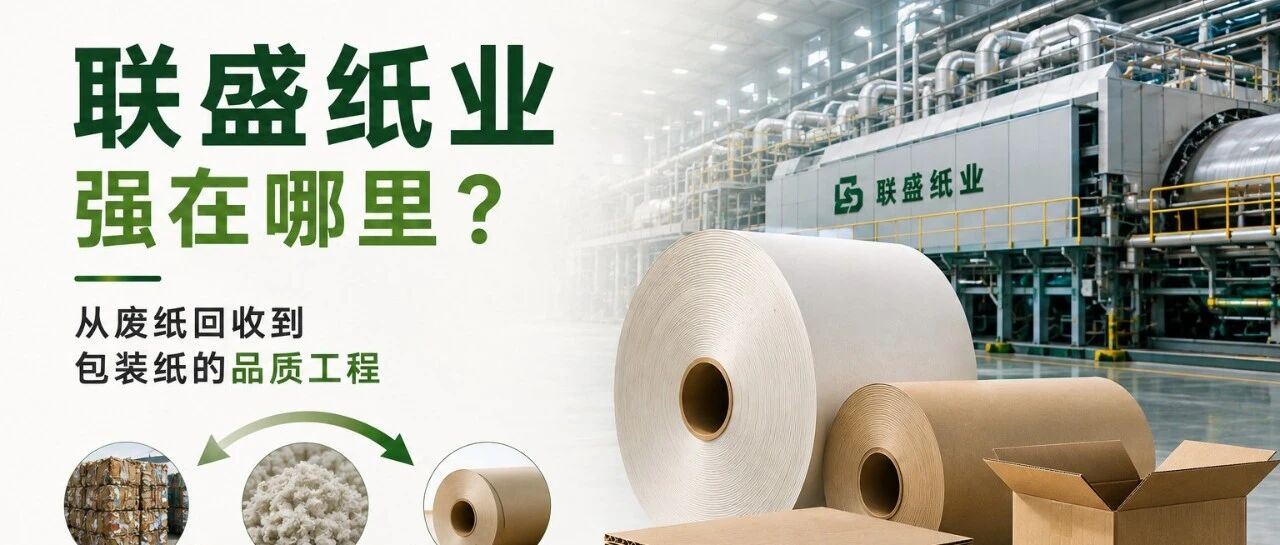
联盛纸业的优势,是把废纸波动转化为包装纸的强度、稳定性与交付能力。
中国造纸二十强 / INDUSTRIAL PAPER STUDY
联盛纸业强在哪里?从废纸回收到包装纸的品质工程
282.40万吨只是协会产量坐标。联盛纸业(龙海)的关键能力,是把再生纤维的波动,依次转化为配浆、纸机、热电与水系统、包装纸应用的稳定表现。
核心判断
联盛纸业的强,不只来自规模化使用废纸,而来自把纤维质量、纸机效率、热电水系统和下游加工要求放到同一张制造账上:原料更稳定,纸张才更稳定;纸张更稳定,包装加工和客户交付才有基础。
一张包装纸的竞争,从废纸分选开始,在配浆、纸机、能源、水和客户加工中完成。
01 · SCALE AND SCOPE
282.40万吨与260万吨同一基地的两种坐标
中国造纸协会《中国造纸工业2025年度报告》列示,联盛纸业(龙海)有限公司2025年纸及纸板产量为282.40万吨,同比增长0.57%,在报告列示的重点企业中位列第十。协会同时注明,排名“按已收集到的数据排列”。
联盛官网公司简介显示,龙海企业以再生资源废纸为主要原料,业务覆盖废纸回收、废纸制浆、造纸、销售与物流,并配套热电联产。2021年项目验收资料则记录六条制浆造纸线的设计与既有工程规模,合计260万吨/年。
三个数据坐标
282.40万吨:协会列示的2025年纸及纸板产量;同比+0.57%,只作为系列规模坐标。
260万吨/年:官网与2021项目验收资料中的包装纸/工程规模,不等于2025实际产量。
六条纸机线:PM5—PM10构成龙海基地的既有制造底盘;各线实时开工率与盈利未在本文推断。
福建省造纸行业2025年上半年运行概况还将联盛纸业(龙海)列入产量同比增长10%以上的规上造纸企业,但该页面没有公开企业绝对量。结合全年协会坐标,可以确认龙海基地已经形成较大规模底盘;下一阶段的观察重点应转向产品结构、原料效率和单位制造成本。
口径边界:协会产量、官网介绍、工程设计和项目验收不是同一统计口径,不能相除计算利用率,也不能据此推断2026年全厂实际产量。
资料来源:中国造纸协会《中国造纸工业2025年度报告》;福建省造纸行业2025年上半年产销运行概况。
02 · FIBER QUALITY ENGINEERING
从OCC到纸页再生纤维是一项品质工程
OCC,即废旧瓦楞箱板纸,是再生包装纸的重要纤维来源。它的纤维长度、杂质、胶黏物、灰分、含水率与批次稳定性,会依次影响筛选净化、配浆、纸页成形、施胶、干燥、环压、耐破和适印性。
联盛公开专利所呈现的,并不是一张“专利清单”,而是一组围绕再生纤维质量的工艺问题:如何分级使用OCC短纤、中纤和长纤,如何控制纸页洁净度,如何通过再生牛卡配浆与施胶提高强度和抗潮表现。
能力路径 A · FIBER SORTING
纤维分级:把OCC短纤、中纤和长纤放入不同纸层,先解决洁净度、成形和强度基础。
能力路径 B · FURNISH DESIGN
配浆设计:在再生纤维与木浆之间寻求强度、成本和稳定性的平衡,避免把原料变化直接传导给客户。
能力路径 C · FORMING AND SIZING
成形与施胶:把纤维体系转化为纸页的强度、表面性能、抗潮表现与可加工性。
能力路径 D · CUSTOMER CONVERTING
加工与交付:让原纸稳定通过印刷、覆合、模切、成型、堆码和运输,完成客户真正感知的包装表现。
CN108824062B公开了以OCC浆替代传统ONP浆生产涂布白板纸的路线;CN113308944B公开再生牛卡的配浆路线;CN112012042B公开用于牛卡和瓦楞纸的施胶剂路径。它们只能证明公开技术布局,不能替代当前所有纸机、所有SKU或所有客户的实际应用证明。
GB/T 43393—2026《再生纸浆》将联盛纸业(龙海)列为主要起草单位之一,标准于2026年3月31日发布、10月1日实施。参与标准工作说明企业对再生纸浆技术议题有投入,但不等于标准实施前全部产品已经符合或拥有标准独占技术。
资料来源:国家标准GB/T 43393—2026《再生纸浆》;CN108824062B;CN113308944B。
03 · PRODUCT AND CONVERTING
七类包装纸的价值在于服务不同加工场景
联盛官网列出的主导产品包括涂布白板纸、涂布牛卡纸、高强瓦楞纸、高档牛卡纸、纱管原纸、灰板纸和T纸。产品覆盖越宽,越需要把纤维等级、配浆、施胶、涂布、压光、分切和库存组织成一套可切换的制造系统。
包装纸的三类加工界面
运输包装:高强瓦楞纸、牛卡纸,面对环压、耐破、堆码和物流损耗。
印刷与彩盒:涂布白板、涂布牛卡和灰板,更接近印刷、彩盒和消费品包装加工。
工业用纸延伸:纱管原纸进入纸管等应用,检验原纸能否适配后加工工艺。
维美德2022年对龙海PM5、PM6和PM10的供应商案例披露,PM10在开机早期主要生产125—230g/m²牛卡纸,采访口径称车速约1150m/min、日产约2200吨,并使用国废原料、自动换卷和复卷等装备。该案例用于解释纸机工程如何缓冲原料波动,不应写成2026年当前运行数据。
从原纸到应用的另一条线索是纸管。2024年公开项目资料显示,龙海基地规划年产600万米纸管;同年11月行业项目汇总记录项目完成首次试生产。这说明企业正在把纱管纸、箱板纸能力延伸到具体加工场景,但首次试生产不等于稳定量产、客户导入或商业收入已经兑现。
产品边界:产品类别、供应商历史访谈和纸管项目阶段,不替代具体SKU的性能、食品接触、可回收性、订单规模或客户复购证明。
资料来源:维美德:深化全方位合作,共创联盛全面发展;纸管项目规划报道;纸管项目首次试生产报道。
04 · ENERGY AND WATER
热电和水是纸机稳定性的制造底座
造纸厂的能源和水系统不是外围配套。它们决定纸机能否连续运行,也影响吨纸成本、补水量、环保责任和客户交付的稳定性。
龙海260万吨项目验收资料记录,动力车间配置2×410t/h循环流化床锅炉、1×60MW抽凝机组和1×70MW背压机组;生产水来自九龙江北溪左干渠,资料同时记录净水站、部分排水回用、灰渣综合利用、污泥与废油处置路径。
外部可核验的两项坐标
2025年度水效资格:联盛纸业(龙海)列入福建省工业用水效率达到国家用水定额先进值纳税人名单。
2026年度碳管理责任:公司列入福建省碳市场既有重点排放单位名录。
水效先进值资格说明水效管理已获得外部部门认定;重点排放单位身份说明能源与碳管理需要进入日常经营系统。两项事实都不能被外推为具体吨纸水耗、碳排强度或当前全厂环保绩效。
工程边界:热电、水处理和固废路径为2021年项目验收/既有工程资料;本文不把它写成2026年全厂实时运行状态,也不写成“所有固废100%资源化”或“当前全面达标”。
资料来源:龙海260万吨项目自备动力车间技改验收资料(2021项目验收口径;原始摘录已在本地来源台账保存);福建省2025年度工业用水先进值名单;福建省碳市场2026年度重点排放单位名录。
05 · NETWORK AND DELIVERY
从回收网络到应用端原纸能力如何走向交付
福建省工信厅2026年循环经济文章点名联盛纸业(龙海)构建“废纸—回收—制浆—造纸”全链条闭环。漳州市工信系统转载的案例还描述了回收站点、回收企业和纸箱厂之间的合作网络。
这支持一个更有用的产业判断:联盛的制造系统同时连接原料端和需求端。回收质量决定纸机能否稳定;纸机质量决定纸箱、纸板和纸管能否稳定加工;下游加工反馈又会回到原纸配方和库存组织。
该案例同时披露了企业产值、废纸回收量和部分技术效果,但这些数字属于案例或企业口径,并非审计财务报表。本文只用它们理解产业链结构,不把它们写成经营业绩结论。对产业链从业者而言,更值得追踪的是回收质量、纸机稳定、下游消化和项目商业化能否形成持续闭环。
产业链的四个合作接口
原料与纤维质量:废纸分选、OCC分级、胶黏物控制、纤维检测与回收站点追踪。
化学品与纸机运行:施胶、淀粉、助留助滤、筛选净化、压榨脱水、涂布和复卷。
水、热电与固废:水效、冷凝水回用、灰渣与污泥处置,最终回到能耗、补水和稳定运行。
纸箱与纸管应用:通过加工良率、稳定产量、订单质量和现金回收检验应用端价值。
兑现观察:循环网络能否持续释放价值,要看废纸成本与质量、纸机车速和断纸率、产品结构、吨纸能耗与水效、下游订单质量及纸管项目从试生产到稳定量产的进展。
资料来源:福建省工信厅循环经济文章;漳州市工信循环经济案例转载。
CONCLUSION
品质工程的终点是稳定加工与稳定交付
联盛纸业(龙海)的强,不只是把废纸变成纸,而是把再生纤维的波动转化为强度、稳定性与可加工性的制造能力。
282.40万吨是规模坐标;六条纸机线、七类包装纸、OCC分级与配浆专利、热电和水循环、再生纸浆标准参与、水效资格和纸管项目,共同构成了更完整的能力图谱。
这条路径已经形成,但仍需用原料质量、纸机稳定、产品结构、吨纸能耗与水效、纸箱合作深度和纸管项目商业化来持续验证。对再生纤维和包装纸企业而言,这比单纯比较产能数字更接近经营竞争的本质。
对博碳包装而言,研究这类企业的价值,是把材料、化学品、设备和应用场景之间的接口说明白:一项创新只有进入适合的纸种、工艺和客户加工条件,并经稳定生产、加工良率和持续订单验证,才会形成长期价值。
当再生纤维能够稳定通过客户的加工与交付,循环制造才从资源利用进入可持续经营。
NEXT COMPANY · NO.11
下一篇|广西金桂浆纸业有限公司
排名只作为系列顺序。下一篇将在独立研究后形成企业判断,不从金桂浆纸业的模式预设结论。
博碳包装·产业洞察·研究说明
本文采用“中国造纸协会确定系列坐标、企业官网确认主体与产品、政府部门核对水效与碳市场身份、国家标准平台核对标准参与、环评验收和专利文件拆解工艺路径、行业与供应商资料补充应用场景”的方法,信息核验截至2026年8月。
282.40万吨属于协会2025年度重点企业产量表;260万吨属于企业官网、项目验收或项目设计口径;75亿元产值、220万吨废纸回收量和技术效果属于案例或企业披露,不能写成审计财务数据。本文未取得联盛纸业(龙海)2025年度或2026年上半年独立审计财务报表,因此不构造企业收入、利润、现金流或毛利率结论。
本文研究对象为统一社会信用代码913506815575947589的联盛纸业(龙海)有限公司。可能存在公司同名没有关联的公司,福建省联盛纸业有限责任公司、联盛浆纸(漳州)有限公司及其他同名或关联主体不纳入龙海企业经营结论。
博碳观察数据与核验来源
01|中国造纸协会《中国造纸工业2025年度报告》
02|联盛纸业官网公司简介
03|福建省造纸行业2025年上半年产销运行概况
04|福建省工业用水先进值名单
05|福建省碳市场2026年度重点排放单位名录
06|国家标准GB/T 43393—2026《再生纸浆》
07|福建省工信厅:让高质量发展的绿色底色更浓
08|工信部第五批绿色工厂名单
09|CN108824062B:OCC浆替代ONP浆生产涂布白板纸
10|CN112012042B:造纸施胶剂及其制备方法
11|CN113308944B:再生牛卡纸及其制备方法
12|龙海纸管项目规划报道
13|龙海纸管项目首次试生产报道
14|维美德:深化全方位合作,共创联盛全面发展
15|东南网:联盛纸业持续降本增效、推动绿色循环发展
16|漳州市工信循环经济案例转载(案例口径)
Liansheng Paper's advantage lies in turning the variability of recovered paper into containerboard strength, consistency and reliable delivery.
CHINA'S TOP 20 PAPER PRODUCERS / INDUSTRIAL PAPER STUDY
What Makes Liansheng Paper Strong? — Quality Engineering from Recovered Paper to Containerboard
2.824 million tonnes is only an industry-association output benchmark. Liansheng Paper (Longhai)'s core capability is to convert variability in recovered fiber into stable performance across furnish preparation, paper-machine operations, combined heat and power, water systems and containerboard applications.
CORE JUDGMENT
Liansheng Paper's strength does not come solely from using recovered paper at scale. It comes from managing fiber quality, paper-machine efficiency, energy and water systems, and downstream converting requirements within one manufacturing equation: more consistent furnish produces more consistent paper, and more consistent paper underpins reliable converting and customer delivery.
The competitiveness of a sheet of containerboard begins with recovered-paper sorting and is completed through furnish preparation, the paper machine, energy, water and customer converting.
01 · SCALE AND SCOPE
2.824 Million Tonnes and 2.6 Million Tonnes: Two Measures of the Same Mill
The China Paper Association's Annual Report on China's Paper Industry 2025 states that Liansheng Paper Industry (Longhai) Co., Ltd. produced 2.824 million tonnes of paper and paperboard in 2025, up 0.57% year on year, ranking tenth among the key enterprises listed in the report. The association also notes that the ranking is based on the data collected.
According to the company profile on Liansheng Paper's website, the Longhai operation primarily uses recovered paper as its raw material and covers recovered-paper collection, recovered-fiber pulping, papermaking, sales and logistics, supported by combined heat and power. Project-acceptance documents from 2021 record six pulping and papermaking lines with a combined designed and existing project scale of 2.6 million tonnes per year.
THREE DATA BENCHMARKS
2.824 million tonnes: Paper and paperboard output for 2025 as reported by the association; the 0.57% year-on-year increase is used only as a scale benchmark for this series.
2.6 million tonnes per year: The containerboard and project scale cited on the company website and in 2021 project-acceptance documents; it is not the same as actual output in 2025.
Six paper-machine lines: PM5 through PM10 form the established manufacturing base at the Longhai mill. This article does not infer the real-time operating rate or profitability of any individual line.
Fujian Province's overview of the paper industry's performance in the first half of 2025 also listed Liansheng Paper (Longhai) among paper enterprises above designated size whose output grew by more than 10% year on year, although the page did not disclose the company's absolute output. Taken together with the association's full-year figure, this confirms that Longhai has established a large-scale production base. The next questions are product mix, raw-material efficiency and unit manufacturing cost.
SCOPE BOUNDARY: Association-reported output, company-profile information, engineering design capacity and project-acceptance figures use different statistical bases. They cannot be divided to calculate a utilization rate, nor can they be used to infer the mill's actual output in 2026.
Sources: China Paper Association, Annual Report on China's Paper Industry 2025; Overview of Production and Sales in Fujian's Paper Industry in the First Half of 2025.
02 · FIBER QUALITY ENGINEERING
From OCC to the Sheet: Recovered Fiber as a Quality-Engineering Discipline
OCC, or old corrugated containers, is a major fiber source for recycled containerboard. Fiber length, contaminants, stickies, ash, moisture and batch-to-batch consistency successively affect screening and cleaning, furnish preparation, sheet formation, sizing, drying, ring crush strength, burst strength and printability.
Liansheng's published patents are not merely a patent list; they reveal a set of process challenges centered on recovered-fiber quality: how to allocate short, medium and long OCC fibers by layer, how to control sheet cleanliness, and how to improve strength and moisture resistance through recycled linerboard furnish design and sizing.
CAPABILITY PATH A · FIBER SORTING
Fiber fractionation: Allocate short, medium and long OCC fibers to different sheet layers to establish the foundations of cleanliness, formation and strength.
CAPABILITY PATH B · FURNISH DESIGN
Furnish design: Balance strength, cost and consistency between recovered fiber and virgin pulp so that raw-material variability is not passed directly to the customer.
CAPABILITY PATH C · FORMING AND SIZING
Forming and sizing: Convert the fiber system into sheet strength, surface properties, moisture resistance and convertibility.
CAPABILITY PATH D · CUSTOMER CONVERTING
Converting and delivery: Ensure that the base paper runs reliably through printing, lamination, die-cutting, forming, stacking and transportation to deliver the packaging performance customers actually experience.
Patent CN108824062B describes a route for using OCC pulp in place of conventional ONP pulp to produce coated white-lined chipboard; CN113308944B describes a furnish route for recycled linerboard; and CN112012042B describes a sizing-agent route for linerboard and corrugating medium. These patents demonstrate a publicly disclosed technology portfolio, but they do not prove current application across every paper machine, every SKU or every customer.
GB/T 43393—2026, Recycled Pulp, lists Liansheng Paper Industry (Longhai) Co., Ltd. as one of the principal drafting organizations. The standard was issued on 31 March 2026 and takes effect on 1 October 2026. Participation in the standards process demonstrates investment in recovered-pulp technology, but it does not mean that every product complied before the effective date or that the company owns exclusive rights to the standard's technologies.
Sources: National Standard GB/T 43393—2026, Recycled Pulp; CN108824062B; CN113308944B.
03 · PRODUCT AND CONVERTING
The Value of Seven Containerboard Grades Lies in Serving Different Converting Applications
The principal products listed on Liansheng Paper's website include coated white-lined chipboard, coated kraft linerboard, high-strength corrugating medium, premium kraft linerboard, coreboard, greyboard and T-paper. The broader the grade portfolio, the greater the need to organize fiber grades, furnish preparation, sizing, coating, calendering, slitting and inventory into a flexible manufacturing system.
THREE CONVERTING INTERFACES FOR PACKAGING PAPER
Transport packaging: High-strength corrugating medium and linerboard must meet requirements for ring crush strength, burst strength, stacking and logistics durability.
Printing and folding cartons: Coated white-lined chipboard, coated kraft linerboard and greyboard are more closely tied to printing, folding-carton production and consumer-goods packaging.
Industrial-paper extensions: Coreboard enters applications such as paper tubes, testing whether the base paper can perform reliably in downstream converting.
A Valmet supplier case published in 2022 states that, during its early operation, PM10 at Longhai primarily produced 125–230 g/m² linerboard. The interview cited a speed of about 1,150 m/min and daily output of about 2,200 tonnes, using domestic recovered paper together with automatic reel change and winding equipment. The case helps explain how paper-machine engineering can buffer raw-material variability; it should not be presented as current operating data for 2026.
Another link from base paper to application is the paper-tube project. Public project information from 2024 indicates that the Longhai mill planned annual capacity of 6 million meters of paper tubes; an industry project roundup in November of that year recorded the project's first trial production. This suggests that the company is extending its coreboard and containerboard capabilities into specific converting applications, but first trial production does not establish stable commercial production, customer qualification or realized revenue.
PRODUCT BOUNDARY: Product categories, historical supplier interviews and the stage of the paper-tube project do not substitute for evidence on a specific SKU's performance, food-contact suitability, recyclability, order volume or repeat purchases.
Sources: Valmet, A 15-year collaboration has made Valmet an all-round developer for Liansheng Paper; reports on the paper-tube project's planned capacity and first trial production.
04 · ENERGY AND WATER
Energy and Water Systems Form the Manufacturing Foundation for Stable Paper-Machine Operation
A paper mill's energy and water systems are not peripheral utilities. They determine whether paper machines can run continuously and influence unit manufacturing cost, freshwater intake, environmental responsibility and the reliability of customer deliveries.
Acceptance documents for the 2.6-million-tonne Longhai project record two 410 t/h circulating fluidized-bed boilers, one 60 MW extraction-condensing turbine generator and one 70 MW back-pressure turbine generator in the power plant. Process water is drawn from the left main canal of the Beixi section of the Jiulong River. The documents also record a water-treatment station, partial wastewater reuse, beneficial use of ash and slag, and disposal routes for sludge and waste oil.
TWO EXTERNALLY VERIFIABLE BENCHMARKS
2025 water-efficiency qualification: Liansheng Paper (Longhai) was included on Fujian Province's list of taxpayers whose industrial water-use efficiency met the advanced values in the national water-use quotas.
2026 carbon-management responsibility: The company was included on Fujian Province's list of existing key emitting entities covered by the provincial carbon market.
The advanced water-efficiency qualification indicates external recognition of the company's water-management practices; designation as a key emitting entity means that energy and carbon management must be embedded in day-to-day operations. Neither fact can be extrapolated into a specific water-consumption figure per tonne, carbon intensity or a conclusion about the mill's current overall environmental performance.
ENGINEERING BOUNDARY: The combined heat and power, water-treatment and solid-waste routes come from 2021 project-acceptance and existing-project documents. This article does not present them as real-time operating conditions for the entire mill in 2026, nor does it claim that all solid waste is fully recovered or that the whole mill is currently compliant in every respect.
Sources: Acceptance documents for the technical upgrade of the captive power plant serving the 2.6-million-tonne Longhai project (2021 project-acceptance basis; original extracts retained in the local source register); Fujian Province's 2025 list for advanced industrial water-use efficiency; Fujian Province's 2026 list of key emitting entities covered by the carbon market.
05 · NETWORK AND DELIVERY
From the Recovery Network to End Use: How Base-Paper Capability Becomes Reliable Delivery
A 2026 circular-economy article from the Fujian Provincial Department of Industry and Information Technology names Liansheng Paper (Longhai) as having built a closed loop spanning recovered paper, collection, pulping and papermaking. A case study republished by Zhangzhou's industry and information authorities also describes a cooperation network linking collection points, recycling companies and corrugated-box plants.
This supports a more useful industry judgment: Liansheng's manufacturing system connects both the raw-material and demand sides. Recovery quality determines paper-machine stability; paper quality determines whether boxes, board and tubes can be converted reliably; and downstream converting feedback, in turn, informs base-paper formulations and inventory planning.
The case study also discloses production value, recovered-paper volume and selected technical outcomes, but these are case-study or company figures rather than audited financial statements. This article uses them only to understand the value-chain structure, not to draw conclusions about operating performance. For industry participants, the more important question is whether recovery quality, paper-machine stability, downstream demand and project commercialization can form a durable closed loop.
FOUR COLLABORATION INTERFACES ACROSS THE VALUE CHAIN
Raw materials and fiber quality: Recovered-paper sorting, OCC fractionation, stickies control, fiber testing and traceability across collection points.
Chemicals and paper-machine operation: Sizing, starch, retention and drainage aids, screening and cleaning, press dewatering, coating and winding.
Water, energy and solid waste: Water efficiency, condensate reuse, and ash, slag and sludge management—ultimately reflected in energy use, freshwater intake and stable operations.
Corrugated-box and paper-tube applications: Application value is tested through converting yield, stable output, order quality and cash collection.
WHAT TO WATCH: Whether the circular network can create sustained value depends on recovered-paper cost and quality, machine speed and web-break rates, product mix, energy use and water efficiency per tonne, downstream order quality, and the paper-tube project's progress from trial production to stable commercial output.
Sources: Fujian Provincial Department of Industry and Information Technology article on the circular economy; circular-economy case study republished by Zhangzhou's industry and information authorities.
CONCLUSION
Quality Engineering Ultimately Means Reliable Converting and Delivery
Liansheng Paper (Longhai)'s strength is not merely its ability to turn recovered paper into new paper, but its manufacturing capability to translate recovered-fiber variability into strength, consistency and convertibility.
The 2.824-million-tonne figure is a scale benchmark. Six paper-machine lines, seven containerboard grades, patents covering OCC fractionation and furnish preparation, energy and water systems, participation in the recycled-pulp standard, the water-efficiency qualification and the paper-tube project together form a more complete map of capability.
This pathway has taken shape, but it still requires continuing validation through raw-material quality, paper-machine stability, product mix, energy use and water efficiency per tonne, the depth of corrugated-box partnerships and commercialization of the paper-tube project. For recovered-fiber and containerboard producers, these factors come closer to the essence of operating competition than a simple comparison of capacity figures.
For BIOTEN Packaging, the value of studying companies like this lies in clarifying the interfaces among materials, chemicals, equipment and applications. An innovation creates long-term value only when it enters the right paper grade, process and customer-converting conditions—and is then validated by stable production, converting yield and sustained orders.
Only when recovered fiber passes reliably through customer converting and delivery does circular manufacturing advance from resource utilization to sustainable operations.
NEXT COMPANY · NO.11
Next: Guangxi Jingui Pulp & Paper Co., Ltd.
The ranking is used only to determine the sequence of this series. The next article will form its view after independent research rather than presupposing a conclusion based on Guangxi Jingui Pulp & Paper's business model.
BIOTEN PACKAGING · INDUSTRY INSIGHTS · RESEARCH NOTES
This article uses the China Paper Association to establish the series benchmark; the company's website to confirm the legal entity and product portfolio; government sources to verify water-efficiency and carbon-market status; the national standards platform to verify participation in standards; environmental and project-acceptance documents and patent filings to analyze process routes; and industry and supplier materials to supplement application context. Information was verified through August 2026.
The 2.824-million-tonne figure comes from the association's 2025 output table for key enterprises. The 2.6-million-tonne figure comes from the company website and project-acceptance or design-capacity documents. The RMB 7.5 billion production-value figure, 2.2 million tonnes of recovered-paper collection and cited technical outcomes are case-study or company disclosures and must not be presented as audited financial data. This article did not obtain independently audited financial statements for Liansheng Paper (Longhai) for 2025 or the first half of 2026 and therefore does not construct conclusions about revenue, profit, cash flow or gross margin.
The subject of this research is Liansheng Paper Industry (Longhai) Co., Ltd., unified social credit code 913506815575947589. Unrelated companies may have similar names. Fujian Liansheng Paper Industry Co., Ltd., Liansheng Pulp & Paper (Zhangzhou) Co., Ltd. and other similarly named or affiliated entities are not included in conclusions about the Longhai company's operations.
BIOTEN OBSERVER · DATA AND VERIFICATION SOURCES
01 | China Paper Association, Annual Report on China's Paper Industry 2025
02 | Company Profile on the Liansheng Paper website
03 | Overview of Production and Sales in Fujian's Paper Industry in the First Half of 2025
04 | Fujian Province list for advanced industrial water-use efficiency
05 | Fujian Province's 2026 list of key emitting entities covered by the carbon market
06 | National Standard GB/T 43393—2026, Recycled Pulp
07 | Fujian Provincial Department of Industry and Information Technology: Strengthening the Green Foundation for High-Quality Development
08 | Ministry of Industry and Information Technology, Fifth List of Green Factories
09 | CN108824062B: Producing coated white-lined chipboard by replacing ONP pulp with OCC pulp
10 | CN112012042B: Papermaking sizing agent and its preparation method
11 | CN113308944B: Recycled linerboard and its preparation method
12 | Report on the planned Longhai paper-tube project
13 | Report on the first trial production of the Longhai paper-tube project
14 | Valmet: A 15-year collaboration has made Valmet an all-round developer for Liansheng Paper
15 | Southeast Net: Liansheng Paper continues to reduce costs, improve efficiency and advance green circular development
16 | Zhangzhou circular-economy case study republished by industry and information authorities (case-study basis)