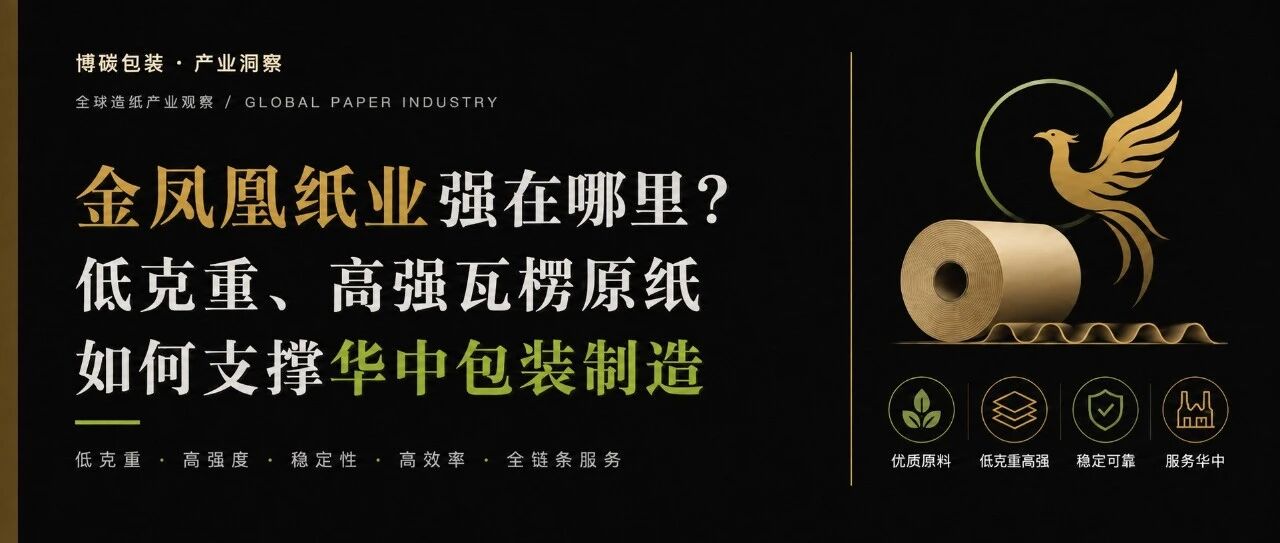
金凤凰的技术命题,不是把纸做得越轻,而是在不同定量窗口内把强度、稳定性和交付做出来。
中国造纸二十强 · 第12位 / CHINA PAPER INDUSTRY
中国造纸协会重点企业产量表第12位。金凤凰的看点不是纸种多,而是在国产回收废纸条件下,把低克重、高强度和稳定交付放进同一条工业包装纸制造路径。
制造命题
在国产回收废纸条件下,把低克重、强度与稳定交付同时做稳,是金凤凰的技术命题。248.10万吨和第12位是规模坐标;成品率、纸页强度与交付稳定性,决定这套规模的含金量。
低克重的含金量,要由单位定量强度、成品率和交付稳定性共同确认。
数据口径
本系列所称“中国造纸二十强”,是博碳包装按照中国造纸协会重点企业产量表前20家依次研究的栏目名称,不是协会另行发布的集团合并排名。本文将协会表中的248.10万吨视为武汉金凤凰纸业有限公司年度产量,将地方媒体披露的约260万吨视为两基地年产能,二者不作利用率计算。武汉金口与孝感孝南对应不同法人,60g/㎡以下、95%以上中水循环及沼气、泥饼数据均为企业/媒体披露;本文不对股权、合并报表、统一排产或财务现金流作超出公开证据的判断。
01 · SCALE & COORDINATES
先看清它做什么:把工业包装纸做深
中国造纸协会《2025年中国造纸工业年度报告》列示,武汉金凤凰纸业有限公司2024年纸及纸板产量220.67万吨,2025年248.10万吨,同比增长12.43%,位列重点造纸企业产量表第12位。协会同时注明,前30名按已收集到的数据排列。
这个坐标说明金凤凰已经进入全国大型纸企样本,但还没有解释它靠什么形成竞争力。金凤凰纸业体系的公开资料显示,武汉江夏金口与孝感孝南形成两大生产基地,两地对应不同法律主体;产品集中在高强度、低定量瓦楞原纸,公开报道给出的产品范围为45—170g/㎡。2026年孝南区融媒体报道将两基地年产能概括为约260万吨;这是一项企业/地方报道口径,不是协会统计的同一指标。
因此,金凤凰不适合用“综合纸业大而全”来概括。更准确的观察方式,是看它是否把工业包装纸的三个问题连续解决:国产回收废纸能不能稳定进线;纸页能不能在更低克重下保持强度;成品能不能按纸箱厂节奏持续交付。
资料来源:中国造纸协会《中国造纸工业2025年度报告》;纸业观察:武汉、孝感两大基地可年产260万吨瓦楞原纸。
02 · LOW-GRAMMAGE / HIGH-STRENGTH
低克重高强:减掉定量,不能减掉强度
低克重不是把定量往下调一个数字。原纸端要同时看定量、紧度、横向环压强度指数、平压或楞后抗压表现、纵向裂断长、吸水性和交货水分;进入瓦楞纸板和纸箱后,还要看楞型适配、CCT/ECT、BCT、粘合与成型。它们属于不同测试层级,不能用“环压、抗压、耐破”一句话概括。
湖北日报客户端2024年报道援引孝感基地相关人士介绍,国内高强瓦楞原纸生产100g/㎡以上产品相对成熟,金凤凰通过技术攻关,在保证性能强度的前提下可以生产60g/㎡以下产品。这个表述是企业人员接受媒体采访时的技术披露,不能替代客户实验室或第三方检测。它把金凤凰的技术命题说得很具体:不是追求纸越薄越好,而是在特定克重窗口内把单位定量强度、纸机运行和加工适性同时稳住。
因此,“60g/㎡以下仍能保持性能强度”只能理解为企业针对特定产品、工艺窗口和客户规格的公开技术表述,不能外推为所有纸种、所有克重和所有箱型都具有相同表现。
真正的判断标准,不是能不能做出一卷低克重原纸,而是能否在不同批次、不同纸机和不同订单条件下,持续保持单位定量强度、成品率和加工适性。同等包装功能下,纸张减重有机会减少原料使用和运输负荷;但具体节省多少,必须以纸箱结构、楞型、箱体尺寸、客户堆码要求和真实物流条件测算,不能把“低克重”直接写成所有客户都能降低10%成本。
供应商与客户共同需要核对的,不只是一个强度数字,还包括横幅定量和水分、断纸率、损纸率、卷筒端面、纸板成型和批次稳定性。低克重的价值,最终要通过单位定量强度、纸机运行和下游纸箱表现共同确认。
资料来源:湖北日报客户端:倾力讲好工业故事——孝感连续6年跻身全国先进制造业百强市;国家标准信息公共服务平台:GB/T 13023—2026《瓦楞芯(原)纸》。
03 · RECYCLED FIBRE LOOP
从废纸到纸页:原料波动如何被工厂消化
公开报道将金凤凰描述为以回收国产废纸为原料的工业包装纸企业。对再生纸厂而言,原料难点不只在“有没有废纸”,还在于不同来源的纤维长度、胶黏物、塑料膜、灰分和含水率如何被分拣、碎浆、筛选、净化和配浆系统消化。
金凤凰孝感基地公开的环保运行案例,呈现出一条比“废纸变成纸”更完整的循环链:投资约2.7亿元建设污水处理中心;湖北日报转述企业人员介绍,中水重复循环利用率超过95%,并披露年节约清水约650万吨;据报道,分离出的废塑料膜被制成塑料颗粒,浆渣和污泥压成泥饼后送往热电锅炉,沼气也被回收利用。报道还提到,上一年度回收利用沼气约2700万立方米、泥饼替代约3000吨煤炭。上述均为地方媒体转述的企业运行数据,不等同于年度环境核查结论;相关处置路径仍应以实际环评、排污许可和固废处置合规文件为准。
原料端的杂质和波动,需要由制浆、污水处理、固废分流和能源环节分别处理、分担和转化。循环制造的价值,不在于把废纸写成环保标签,而在于把每吨纸的原料损耗、清水补充、沼气利用、固废去向和排放数据放在同一张运行账上。其长期效果仍需连续台账、排污许可执行数据或第三方环境数据验证。
资料来源:湖北日报:孝感观察|让废纸获新生;湖北省经济和信息化厅:孝感市纸(卫)塑包装产业发展大会。
04 · TWO BASES / STANDARD
双基地:运输半径之外,还要看设备升级
武汉金口与孝感孝南是公开报道中的两大生产基地。两地布局靠近华中包装产业集群,从地理上具备缩短原纸运输半径的条件,也为不同纸机、不同克重和不同订单节奏的分工留下空间。公开资料尚不足以证明两地已经实现统一排产、统一配方或统一质量体系,这应作为后续观察项。
武汉市经信部门2023年公开的技术改造项目资料显示,金凤凰曾推进制浆部、压榨部设备改造和白水回用装置改造,预计可节约清水2496m³/d,并改善湿部温度、网部脱水和纸页成形稳定性。湖北省2025年面向民间资本项目清单又列出“金凤凰纸业提质增效综合节能降碳改造项目”,拟对纸机及配套透平机、电机、罗茨风机、碎浆机等设备进行升级,新增永磁电机、磁悬浮电机、造纸机等50台套。后者属于项目清单中的建设计划,不能写成已经完成的节能成果。
另一个值得关注的信号,是金凤凰纸业(孝感)有限公司、武汉金凤凰纸业有限公司进入了国家标准GB/T 13023—2026《瓦楞芯(原)纸》的起草单位名单。这是一项推荐性国家标准,已于2026年5月25日发布,将于2026年12月1日实施。两家金凤凰主体参与了该产品标准的制定过程;这体现的是标准参与,不等于企业所有产品已经获得认证,也不能单独证明市场质量表现。后续仍应以具体产品的检验报告、客户验收和批次数据确认。
资料来源:武汉市经济和信息化局:金凤凰纸业提质增效改造项目;湖北省发展和改革委员会2025年第二批民间投资项目清单;全国标准信息公共服务平台。
05 · SUPPLY CHAIN METRICS
真正要看的,是减重之后的可靠性
对产业链从业者,金凤凰提供的是一组可以落到现场的验证问题:
• 回收与分拣企业,看纤维洁净度、含水率、杂质组成和批次波动;
• 制浆、施胶和纸机供应商,看原纸环压、短距压缩或平压、横幅定量、水分、断纸率和成品率;
• 水处理、厌氧、沼气和热电系统,看吨纸清水补充量、能源回收量、固废处置路径和排放监测结果;
• 纸箱客户,看纸箱抗压、成型良率、批次波动、退货或投诉情况和交付周期。
从公开资料看,金凤凰的观察价值不只在纸机规模,还在于原料、制浆、纸机、水处理、能源和交付被放在了同一条工业包装纸链条中。下一步应从单一产能指标转向低克重产品占比、单位原料消耗、损纸率、纸机稳定运行、吨纸清水补充量和客户批次表现。当这些指标能在不同批次、不同基地持续复现,低克重才真正从产品卖点变成客户可以使用的制造能力。
CONCLUSION
从制造规模到经营质量
金凤凰的路径很清楚:不靠纸种铺得多宽,而是把工业包装纸这一条路做深——以国产回收废纸为起点,把低克重高强瓦楞原纸做成稳定产品,再用武汉—孝感双基地、水循环、热电和固废分流提供运行支撑,面向华中及周边纸箱客户交付。
248.10万吨和第12位是规模坐标;低克重产品、循环系统、标准起草参与和提质增效项目,则构成了值得继续跟踪的能力线索。下一步,行业要用客户检测、排污许可执行、项目验收和经营数据,把这些线索逐项转化为稳定克重、成品率、交付周期和客户复购。
对华中包装产业链而言,金凤凰的价值不只是供纸,而是提供一种减重而不降低可靠性、使用再生原料仍能连续制造的专业路径。
下一篇 · 协会重点企业产量表第13位
金东纸业(江苏)股份有限公司
2025年纸及纸板产量227.11万吨 · 同比+2.50%
下一篇将继续研究其文化纸基地与APP中国多基地体系。数据来源:中国造纸协会《中国造纸工业2025年度报告》
博碳包装·产业洞察·研究说明
本文是博碳包装基于公开资料开展的独立产业研究,采用中国造纸协会年度产量表、政府部门公开文件、国家标准信息平台、地方党报/政府媒体和企业/供应商公开材料交叉核验。协会产量、媒体采访、企业披露、政府项目清单和分析判断分别标注,不把企业报道当作审计财务,不把项目计划写成投产成果,不把绿色工厂称号替代当前环境绩效,也不把产品目录替代客户质量、食品接触或法规合规证明。核验日期:2026年8月20日。本文不构成合作背书、产品认证、投资建议或交易依据。
博碳观察数据与核验来源
1. 中国造纸协会《中国造纸工业2025年度报告》
2. 国家标准信息公共服务平台:GB/T 13023—2026《瓦楞芯(原)纸》
3. 湖北日报客户端:倾力讲好工业故事——孝感连续6年跻身全国先进制造业百强市
4. 湖北日报:孝感观察|让废纸获新生
5. 武汉市经济和信息化局:金凤凰纸业提质增效改造项目
6. 湖北省经济和信息化厅:孝感市纸(卫)塑包装产业发展大会
7. 湖北省发展和改革委员会:2025年第二批民间投资项目清单
8. 孝感市融媒体报道:金凤凰纸业两大基地年产260万吨瓦楞原纸
9. 工业和信息化部办公厅:2023年度绿色制造名单附件1
Golden Phoenix Paper’s technical challenge is not simply to make paper lighter, but to deliver strength, stability and reliable supply across different basis-weight ranges.
China’s Top 20 Paper Producers · No. 12 / CHINA PAPER INDUSTRY
Ranked No. 12 in the China Paper Association’s production table of key enterprises. Golden Phoenix Paper stands out not for the breadth of its grades, but for integrating lightweighting, high strength and reliable delivery into one industrial packaging-paper manufacturing route based on domestically recovered paper.
MANUFACTURING PROPOSITION
Under the constraints of domestically recovered paper, Golden Phoenix Paper’s core technical challenge is to stabilise low basis weight, strength and reliable delivery at the same time. Output of 2.481 million tonnes and a No. 12 ranking define scale; finished-product yield, sheet strength and delivery consistency determine the quality of that scale.
The value of lightweight paper must be demonstrated jointly through strength per unit basis weight, finished-product yield and delivery consistency.
DATA SCOPE
In this series, “China’s Top 20 Paper Producers” is BIOTEN Packaging’s editorial label for its sequential study of the top 20 companies in the China Paper Association’s production table of key enterprises; it is not a separate consolidated-group ranking published by the Association. This article treats 2.481 million tonnes in the Association’s table as the annual output of Wuhan Golden Phoenix Paper Co., Ltd., and approximately 2.6 million tonnes reported by local media as the combined annual capacity of the two production bases; the two figures are not used to calculate a utilisation rate. The Wuhan Jinkou and Xiaogan Xiaonan sites correspond to separate legal entities. Claims concerning grades below 60 g/m², reclaimed-water recirculation above 95%, biogas and sludge cake are company or media disclosures. This article does not infer ownership, consolidated financial statements, unified production scheduling or cash flow beyond the available public evidence.
01 · SCALE & POSITION
First, Define the Business: Going Deep in Industrial Packaging Paper
The China Paper Association’s 2025 Annual Report on China’s Paper Industry shows that Wuhan Golden Phoenix Paper Co., Ltd. produced 2.2067 million tonnes of paper and paperboard in 2024 and 2.4810 million tonnes in 2025, up 12.43% year on year, ranking No. 12 in the production table of key paper enterprises. The Association also notes that the top 30 are ranked according to the data collected.
This position places Golden Phoenix Paper among China’s large paper producers, but scale alone does not explain its competitiveness. Public information on the Golden Phoenix Paper system identifies two production bases: Jinkou in Jiangxia District, Wuhan, and Xiaonan District, Xiaogan, each operated by a different legal entity. Production is concentrated on high-strength, low-basis-weight corrugating medium, with a publicly reported product range of 45–170 g/m². In 2026, Xiaonan District media described the two bases as having combined annual capacity of approximately 2.6 million tonnes. That figure comes from company and local-media reporting and is not the same measure as the Association’s production statistic.
Golden Phoenix Paper therefore should not be characterised as a broad, fully diversified paper group. A more precise lens is whether it can solve three linked problems in industrial packaging paper: maintaining a stable furnish supply from domestically recovered paper; preserving sheet strength at lower basis weights; and supplying finished paper consistently in line with corrugated-box plants’ production schedules.
Sources: China Paper Association, 2025 Annual Report on China’s Paper Industry; Paper Industry Observer, “Wuhan and Xiaogan Production Bases Can Produce 2.6 Million Tonnes of Corrugating Medium Annually.”
02 · LOW-GRAMMAGE / HIGH-STRENGTH
Lightweight and High Strength: Reduce Basis Weight, Not Performance
Lightweighting is not a matter of simply lowering the basis-weight number. At the paper stage, performance must be assessed through basis weight, density, cross-direction ring crush strength index, flat crush or post-corrugation compression performance, machine-direction breaking length, water absorptiveness and moisture at delivery. Once converted into corrugated board and boxes, flute-profile compatibility, CCT/ECT, BCT, bonding and forming must also be considered. These belong to different test levels and should not be collapsed into the shorthand of “ring crush, compression and burst strength.”
A 2024 Hubei Daily report cited staff at the Xiaogan plant as saying that domestic producers are relatively mature in making high-strength corrugating medium above 100 g/m², while Golden Phoenix Paper, through technical development, can produce grades below 60 g/m² without compromising specified strength performance. This is a technical claim made by company personnel in a media interview; it is not a substitute for customer laboratory results or third-party testing. It nevertheless defines the technical challenge clearly: the objective is not to make paper as thin as possible, but to stabilise strength per unit basis weight, paper-machine runnability and converting performance within a specified basis-weight window.
Accordingly, the statement that “performance and strength can be maintained below 60 g/m²” should be read only as the company’s public technical claim for particular products, process windows and customer specifications. It should not be generalised to every grade, basis weight or box design.
The real test is not whether a single roll of lightweight corrugating medium can be produced, but whether strength per unit basis weight, yield and converting performance can be maintained across batches, machines and order conditions. For the same packaging function, lightweighting may reduce fibre use and transportation load. The actual saving, however, must be calculated against the corrugated-board structure, flute profile, box dimensions, customer stacking requirements and real logistics conditions. “Lightweighting” cannot be presented as a guaranteed 10% cost reduction for every customer.
Suppliers and customers need to verify more than one strength figure. They should examine cross-machine basis-weight and moisture profiles, sheet-break frequency, broke rate, reel-end quality, board forming and batch consistency. The value of lightweighting is ultimately established by strength per unit basis weight, paper-machine runnability and downstream box performance together.
Sources: Hubei Daily Client, “Telling Industrial Stories Well: Xiaogan Ranks Among China’s Top 100 Advanced Manufacturing Cities for the Sixth Consecutive Year”; National Public Service Platform for Standards Information, GB/T 13023—2026, Corrugating Medium (Base) Paper.
03 · RECYCLED FIBRE LOOP
From Recovered Paper to Sheet: How the Mill Manages Furnish Variability
Public reports describe Golden Phoenix Paper as an industrial packaging-paper producer using domestically recovered paper. For a recycled-paper mill, the raw-material challenge is not simply whether recovered paper is available. It is how variations in fibre length, stickies, plastic film, ash content and moisture from different sources are managed through sorting, pulping, screening, cleaning and stock-preparation systems.
Publicly reported environmental operations at the Xiaogan base describe a loop more complete than the simple phrase “turning recovered paper into new paper”: approximately RMB 270 million was invested in a wastewater-treatment centre; Hubei Daily cited company personnel as reporting a reclaimed-water recirculation rate above 95% and annual freshwater savings of approximately 6.5 million tonnes. According to the report, separated waste plastic film is pelletised, pulp rejects and sludge are dewatered into cake and sent to the combined heat and power boiler, and biogas is recovered for use. The report also states that approximately 27 million cubic metres of biogas were recovered in the preceding year and sludge cake displaced about 3,000 tonnes of coal. These figures are operating data relayed by local media, not the findings of an annual environmental audit. Actual handling routes remain subject to environmental-impact approvals, pollutant-discharge permits and compliant solid-waste disposal documentation.
Contaminants and variability at the fibre input must be managed, absorbed and converted across stock preparation, wastewater treatment, solid-waste segregation and energy systems. The value of circular manufacturing does not come from attaching an environmental label to recovered paper. It comes from putting fibre losses, freshwater make-up, biogas utilisation, solid-waste destinations and emissions data for each tonne of paper on the same operating ledger. Long-term performance still requires verification through continuous operating records, pollutant-discharge permit data or third-party environmental data.
Sources: Hubei Daily, “Xiaogan Observation | Giving Recovered Paper a New Life”; Hubei Provincial Department of Economy and Information Technology, Xiaogan Paper, Hygiene Products and Plastics Packaging Industry Development Conference.
04 · TWO BASES / STANDARD
Two Bases: Beyond Transport Radius, Equipment Upgrades Matter
Wuhan Jinkou and Xiaogan Xiaonan are the two production bases identified in public reports. Their locations near the Central China packaging cluster offer the potential to shorten the transport radius for paper and leave room to allocate different machines, basis weights and order rhythms between sites. Public information is not sufficient to establish that the two sites already operate with unified production scheduling, furnish recipes or a single quality system; this remains an item for further observation.
Public information on a 2023 technical-upgrading project from Wuhan’s industry and information authorities shows that Golden Phoenix Paper planned upgrades to stock-preparation and press-section equipment as well as a white-water reuse system, with projected freshwater savings of 2,496 m³ per day and improvements in wet-end temperature, wire-section drainage and sheet-formation stability. Hubei Province’s second 2025 list of projects for private capital also includes the “Golden Phoenix Paper Integrated Quality, Efficiency, Energy-Saving and Carbon-Reduction Upgrade Project,” which proposes upgrading paper machines and supporting turbines, motors, Roots blowers and pulpers, and adding 50 units including permanent-magnet motors, magnetic-bearing motors and papermaking machines. The latter is a construction plan listed in a project schedule and must not be presented as an energy-saving result already achieved.
A further signal is the inclusion of Golden Phoenix Paper (Xiaogan) Co., Ltd. and Wuhan Golden Phoenix Paper Co., Ltd. among the drafting organisations for GB/T 13023—2026, Corrugating Medium (Base) Paper. This recommended national standard was issued on 25 May 2026 and will take effect on 1 December 2026. The two Golden Phoenix entities participated in drafting the product standard. This signifies participation in standards development; it does not mean that every company product has been certified, nor does it independently prove market quality. Specific inspection reports, customer acceptance records and batch data remain necessary.
Sources: Wuhan Municipal Bureau of Economy and Information Technology, Golden Phoenix Paper Quality and Efficiency Upgrade Project; Hubei Provincial Development and Reform Commission, Second List of Private Investment Projects for 2025; National Public Service Platform for Standards Information.
05 · SUPPLY CHAIN METRICS
What Matters Is Reliability After Lightweighting
For practitioners across the value chain, Golden Phoenix Paper raises a practical set of questions for on-site verification:
• Recovered-paper collectors and sorters should track fibre cleanliness, moisture, contaminant composition and batch variability;
• Stock-preparation, sizing and paper-machine suppliers should track the corrugating medium’s ring crush performance, short-span compression or flat crush, cross-machine basis-weight profile, moisture profile, sheet-break rate and finished-product yield;
• Water-treatment, anaerobic digestion, biogas and combined heat and power systems should track freshwater make-up per tonne of paper, energy recovery, solid-waste handling routes and emissions monitoring;
• Corrugated-box customers should track box compression performance, converting yield, batch variability, returns or complaints, and lead times.
The value of Golden Phoenix Paper as an industry case lies not only in machine scale, but in the fact that fibre, stock preparation, paper machines, water treatment, energy and delivery are integrated within a single industrial packaging-paper chain. The next stage of assessment should move beyond one capacity figure to the share of low-basis-weight grades, raw-material consumption per tonne, broke rate, machine uptime, freshwater make-up per tonne and customer batch performance. Only when these metrics are repeatedly achieved across batches and sites does lightweighting become a manufacturing capability that customers can rely on, rather than merely a product claim.
CONCLUSION
From Manufacturing Scale to Operating Quality
Golden Phoenix Paper’s path is clear. Instead of widening its grade portfolio, it is going deeper in industrial packaging paper: starting with domestically recovered paper, turning lightweight, high-strength corrugating medium into a stable product, and supporting operations through the Wuhan–Xiaogan two-base system, water recirculation, combined heat and power, and solid-waste segregation, while supplying corrugated-box customers across Central China and neighbouring markets.
Output of 2.481 million tonnes and a No. 12 ranking define scale. Lightweight grades, circular systems, participation in standards drafting, and quality-and-efficiency upgrade projects form capability signals worth tracking. The next step is to use customer testing, pollutant-discharge permit implementation, project acceptance and operating data to translate those signals into consistent basis weight, finished-product yield, lead times and repeat orders.
For the Central China packaging value chain, Golden Phoenix Paper’s value lies not only in supplying paper, but in offering a route to lightweighting without sacrificing reliability and to continuous manufacturing based on recovered fibre.
NEXT ARTICLE · No. 13 in the Association’s Production Table of Key Enterprises
Gold East Paper (Jiangsu) Co., Ltd.
2025 paper and paperboard output: 2.2711 million tonnes · Year on year: +2.50%
The next article will examine its fine-paper production base and APP China’s multi-site system. Source: China Paper Association, 2025 Annual Report on China’s Paper Industry.
BIOTEN Packaging · Industry Insight · Research Note
This article is an independent industry study by BIOTEN Packaging based on public sources. It cross-checks the China Paper Association’s annual production table, public documents from government departments, the national standards information platform, local Party newspapers and government media, and public materials from companies and suppliers. Association production data, media interviews, corporate disclosures, government project lists and analytical judgments are identified separately. Company publicity is not treated as audited financial information; project plans are not presented as completed operations; green-factory designations are not used as substitutes for current environmental performance; and product catalogues are not used as substitutes for evidence of customer quality, food-contact compliance or regulatory compliance. Information was verified as of 20 August 2026. This article does not constitute a collaboration endorsement, product certification, investment advice or a basis for transactions.
BIOTEN Observer: Data and Verification Sources
1. China Paper Association, 2025 Annual Report on China’s Paper Industry
2. National Public Service Platform for Standards Information: GB/T 13023—2026, Corrugating Medium (Base) Paper
3. Hubei Daily Client: “Telling Industrial Stories Well: Xiaogan Ranks Among China’s Top 100 Advanced Manufacturing Cities for the Sixth Consecutive Year”
4. Hubei Daily: “Xiaogan Observation | Giving Recovered Paper a New Life”
5. Wuhan Municipal Bureau of Economy and Information Technology: Golden Phoenix Paper Quality and Efficiency Upgrade Project
6. Hubei Provincial Department of Economy and Information Technology: Xiaogan Paper, Hygiene Products and Plastics Packaging Industry Development Conference
7. Hubei Provincial Development and Reform Commission: Second List of Private Investment Projects for 2025
8. Xiaogan Converged Media: Golden Phoenix Paper’s Two Bases Have Annual Corrugating-Medium Capacity of 2.6 Million Tonnes
9. General Office of the Ministry of Industry and Information Technology: Annex 1 to the 2023 Green Manufacturing List