校园纸包装换好一层膜,要让饮品装得稳、热饭送得好,也让制品工厂做得顺。PHA水性阻隔替代PE,应从一款用途明确的制品开始。
校园咖啡店递出的一杯热拿铁、食堂窗口打包的一份热饭,都要靠包装完成最后一段交付。看起来是一只纸杯、一只纸碗,挡住液体、参与封合的,往往还有纸面上的功能层。
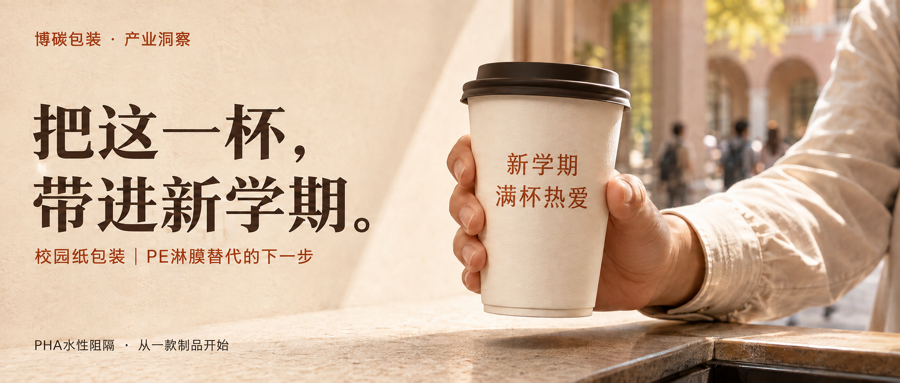
当经营者希望升级纸包装,制品企业开始研究PHA水性阻隔替代PE淋膜,最值得问的是:原来那层膜做了什么,换掉以后,谁把这些功能接住?
9月5—6日是郑州大学官方安排的秋季注册报到时间,各大学正按自己的节奏迎接新学期。对造纸、涂布和制品企业,校园的价值在于:咖啡茶饮、热食外卖、烘焙轻食集中在相对明确的服务区域,可以逐个场景研究包装升级。
需求写在校园公告里
云南师范大学资产经营公司网站7月17日发布的校园综合外卖服务公告,列出约4万名在校师生、80余个风味档口、10余家奶茶店等底商,并要求校内订单40分钟内送达、控制滴漏污染、配置保温配送箱。这是已结束报名的项目要求,不能当成实际配送成绩;但它清楚表明,校园外带是一段需要包装保护的服务过程。
华东师范大学9月1日的后勤报道也显示,开学前食品安全会议覆盖18家餐饮服务单位,包括膳食中心、餐饮企业和咖啡店、便利店、超市。
集中堂食餐具有洗消和周转路径;随学生带走或配送的食品,则要靠杯、碗、盒、袋承接不同的温度、时间和受力。升级机会应从这些实际用途里找。
研究资料:云南师范大学资产经营公司|校园综合外卖服务公告;华东师范大学|学校食品安全工作例会。
那层PE,先接住了什么
PE即聚乙烯。斯道拉恩索的阻隔涂层资料将其列为最常用的阻隔涂层之一,典型用途包括饮用杯、冰淇淋和酸奶等包装,强调其防潮性能。纸板上的聚合物功能层,还可按结构承担耐液、密封等任务。
在常见的PE淋膜纸杯、纸碗结构中,纸提供形状和支撑,淋膜帮助隔开内容物与纤维,并在相应结构中参与热封接合。这套材料与加工配合,是替代时要尊重的基准。
PHA水性阻隔值得研究的,是在保住所需功能的同时,为功能层引入生物基材料路线,并通过水性涂布组织成膜、涂层位置和加工适配。对于已有或可配套水性涂布、干燥能力的企业,这提供了不同于PE挤出淋膜的开发路径。
两种工艺不能直接互换:水需要被有效去除,涂层需要连续成膜,后续还要经得住成型与封合。能否减少材料用量、改善成本或回收表现,要看具体结构;不能仅凭“水性”判定更省能、更便宜。
替代对象可以明确是PE淋膜,替代范围必须具体到一款制品。
研究资料:Stora Enso|Barrier coatings;BIOTEN|纸基阻隔系统工程。
场景一 · 咖啡茶饮
一杯咖啡,接合处见功夫
对校园咖啡店,一杯饮品要方便出杯、拿得稳、喝起来没有异味。对制杯企业,替代PE的难点常常藏在消费者看不到的接合处:杯身搭接、杯底密封和杯口加工,必须与新涂层继续配合。
因此,若现用杯已确认是PE淋膜结构,可以选一个固定容量、固定杯盖和明确饮用时间的单品,比较现用杯与PHA水涂纸制杯。先看实际热饮盛装和封口稳定,再看生产节拍及外观触感,避免为了一个纸感目标牺牲密封。
冰饮又多了一层外侧考验:杯壁冷凝水可能影响杯托和外袋。杯内功能层换了,不会自动解决杯盖扣合或纸袋受潮;外表面防护、纸袋结构和杯托仍要按需配置。
固定一个饮品单品,纸厂、涂布商、制杯厂和门店就能围绕同一个对象比较。优先选择它,是因为使用条件容易说清,技术难度仍由实际结构决定。
场景二 · 热食外带
一份热饭,边角要接住
一只纸碗装清汤、浓酱或含油热食,接触条件不同;窗口自提与叠放配送,也会给盖沿和接缝带来不同压力。平整样片上的阻水阻油表现,到了碗底、折线或切边,才开始接受整件考验。
研究PE替代时,要先确认现用碗盒的完整结构。如果PE层同时承担耐液和封合,新方案就要一起接住这两项任务;若还有独立盖膜或其他阻隔层,也要分别处理,不能假定一层PHA包办全部功能。
对运营方,价值是食品送到时少渗漏、好开启;对制品企业,价值是这种表现能够在稳定线速和良率下重复做出来。样品装得住,生产却频繁粘连或封合不稳,替代的账仍然不成立。
宜从单一菜单、明确温时和固定配送路径的碗盒做起,把高温长时、微波复热或更复杂用途另行开发。校园40分钟送达要求只能帮助理解流程,不能直接当成包装接触时长或食品安全保证。
场景三 · 烘焙轻食
一袋烘焙,挡油也要排湿
校园烘焙既有刚出炉带走的面包,也有需要冷藏或较长保存的产品。并非所有防油纸和面包袋都用了PE,现用结构应以供应规格和实物资料确认。
如果一款包裹纸确实依靠PE层挡油,就可以研究PHA水性功能层能否在折叠和实际含油食品接触后保持保护;如果原本已是满足需求的其他防油纸,则应从真实缺口出发,不必为了替代而增加一层。
酥皮食品还有一个直观矛盾:油要挡住,热气却未必适合全部闷在袋里。涂层的水蒸气传递、装袋时机和开口设计共同影响口感。阻隔更强,并不总是更好吃。
因此,边界明确的短时外带可以先做对照;长货架产品还要回答氧气、水蒸气和密封的组合问题。一个耐油等级,不能替代保鲜期结论。
把PHA路线接到制品上
BIOTEN以PHA水性功能材料推进纸基阻隔应用;其Plus通用平衡型公开路线,将纸杯、纸碗、餐盒与纸袋纳入耐液耐油、涂布成膜、热封成型和回收再浆的项目开发。
这给制品企业的选择依据可以归为三点:现用PE到底承担哪些功能;企业能否组织匹配的涂布干燥与转换加工;终端是否有一个需求明确、可以比较结果的产品。
三点说清后,PHA水性阻隔就有了具体任务:在指定纸张和位置形成所需功能层,接上原有制品的保护与加工要求,再判断哪些PE结构值得替换。材料路线、准确牌号和最终制品是三个层次;最终食品接触符合性仍按完整结构、食品类型和温时条件确认。
无需一次铺开杯、碗、盒、袋。先把一款做好,得到的原纸、涂布与成型经验,才有条件支持下一款。
研究资料:BIOTEN Plus|通用纸基食品包装路线。
用完以后,纤维去哪儿
让纸包装装得好,也为纸纤维留下可利用的路径。这应是替代开发共同追求的结果,而非更换材料名称后自动获得的标签。
研究资料:4evergreen|纸基包装循环设计指南。
从一款制品开始
南京工业大学2024年的校园配送餐用具采购,曾把定制标识、每日两个供货时段和批次证明写入要求。这份历史资料提醒供应链,校园需要的是能持续补货、质量稳定、证据对应的产品。
开学季可以从一款现用PE淋膜纸杯、一只外卖纸碗,或一款已确认结构的烘焙包裹纸开始。把现用制品作为基准,在同样食品和使用条件下,比较保护表现、加工良率、门店操作和总成本,再核对回收接收条件。替代若增加漏损或不必要的包装,应调整方案。
制品企业与校园经营者可向博碳包装提供现用结构、食品与温时、加工设备以及最想改善的问题,共同确定PHA功能层的位置、首轮纸张与工艺选择、对照打样和整件验证项目。样品规格、批次与可用状态按项目确认。双方可以先选最影响使用的一项问题作为试样重点,同时保留密封、食品接触和交付成本这些底线。
从一杯咖啡到一份外卖,校园纸包装升级的机会,就在这些能被说清、做出并比较的产品里。
研究资料:南京工业大学|2024年校园配送餐用具采购邀请。
博碳包装·产业洞察·研究说明
本文由博碳包装依据学校及校属企业公告、企业公开产品资料和行业指南独立研究整理,核验截至2026年9月5日。本文供产业研究学习,不构成采购或性能保证;如需修改、说明或删除,可通过本公众号联系,我们将在收到后24小时内核查处理。
博碳观察数据与核验来源
01|郑州大学|秋季报到和返校提醒
02|云南师范大学资产经营公司|校园综合外卖服务公告
03|华东师范大学|学校食品安全工作例会
04|Stora Enso|Barrier coatings
05|BIOTEN|纸基阻隔系统工程
06|BIOTEN Plus|通用纸基食品包装路线
07|4evergreen|纸基包装循环设计指南
08|南京工业大学|校园配送一次性餐用具采购邀请
原来源限制访问
Getting the barrier layer right in campus paper packaging means keeping drinks secure, delivering hot meals reliably, and ensuring smooth converting on the factory floor. Replacing PE extrusion coating with a PHA waterborne barrier should begin with a clearly defined end product.
A hot latte handed across a campus coffee-shop counter and a hot meal packed at a canteen window both depend on packaging for the final stage of delivery. What looks like a simple paper cup or bowl often also relies on a functional layer on the paper to hold back liquids and enable sealing.
When operators seek to upgrade paper packaging and converters begin assessing PHA waterborne barriers as an alternative to PE extrusion coating, the most useful question is: what functions does the existing layer perform, and what will take over those functions after it is replaced?
Zhengzhou University officially scheduled autumn registration for 5-6 September, while universities across China are welcoming the new academic year on their own timetables. For papermakers, coaters and converters, campuses offer a useful setting: coffee and tea, hot-meal takeaway and light bakery foods are concentrated within relatively well-defined service areas, allowing packaging upgrades to be studied one use case at a time.
Demand is written into campus notices
A campus-wide takeaway service notice published on 17 July by Yunnan Normal University Asset Management Co., Ltd. described approximately 40,000 students and staff, more than 80 food counters and over 10 milk-tea shops and other ground-floor outlets. It also required on-campus orders to be delivered within 40 minutes, leakage and drips to be controlled, and insulated delivery boxes to be used. These were tender requirements for a project whose application period has closed, not evidence of actual delivery performance; nevertheless, they clearly show that campus takeaway is a service process in which packaging must provide protection.
A 1 September logistics report from East China Normal University likewise noted that a pre-semester food-safety meeting covered 18 catering service providers, including dining centres, catering companies, coffee shops, convenience stores and supermarkets.
Reusable tableware for centralised dine-in service has established washing, sanitisation and circulation routes. Food carried away by students or delivered elsewhere, by contrast, relies on cups, bowls, boxes and bags to cope with different temperatures, durations and mechanical stresses. The opportunities for improvement should be identified from these real uses.
Research sources: Yunnan Normal University Asset Management Co., Ltd. | Campus-wide Takeaway Service Notice; East China Normal University | School Food Safety Working Meeting.
What does the PE layer do?
PE stands for polyethylene. Stora Enso's barrier-coating literature identifies it as one of the most widely used barrier materials, with typical applications including packaging for drinking cups, ice cream and yoghurt, and highlights its moisture resistance. Depending on the structure, a polymer functional layer on paperboard may also provide liquid resistance and sealing performance.
In conventional PE extrusion-coated paper cups and bowls, the paper provides shape and structural support, while the coating separates the contents from the fibres and, in the relevant constructions, enables heat-sealed joints. This interaction between material and process is the baseline that any replacement must respect.
PHA waterborne barriers merit investigation because they can introduce a bio-based material route for the functional layer while retaining the required performance, with film formation, coating position and process compatibility engineered through aqueous coating. For companies that already have, or can add, waterborne coating and drying capabilities, this offers a development route distinct from PE extrusion coating.
The two processes are not directly interchangeable: water must be removed effectively, the coating must form a continuous film, and the finished material must withstand subsequent forming and sealing. Whether the new structure can reduce material use, improve cost or enhance recyclability depends on the specific design; a coating is not automatically more energy-efficient or less expensive simply because it is waterborne.
The material being replaced may be clearly identified as PE extrusion coating, but the scope of replacement must be defined at the level of a specific end product.
Research sources: Stora Enso | Barrier Coatings; BIOTEN | Paper-based Barrier Systems Engineering.
Scenario 1 | Coffee and tea
For a cup of coffee, the joint is where performance is proven
For a campus coffee shop, a drink must be quick to serve, secure to hold and free from off-odours. For cup manufacturers, the challenge in replacing PE often lies in the joints consumers do not see: the side seam, bottom seal and rim forming must continue to work with the new coating.
Once the current cup has been confirmed as a PE extrusion-coated structure, a single SKU with a fixed volume, lid and consumption window can be selected to compare the incumbent cup with one made from PHA waterborne barrier-coated paper. First assess hot-drink containment and seal integrity under actual use, then evaluate production speed, appearance and feel, so that seal performance is not sacrificed in pursuit of a more paper-like finish.
Cold drinks introduce an additional external challenge: condensation on the cup wall may affect the cup carrier and outer bag. Replacing the cup's internal functional layer will not automatically resolve lid engagement or paper-bag exposure to moisture; external-surface protection, bag construction and cup carriers must still be specified as needed.
By fixing one beverage SKU, the paper producer, coater, cup manufacturer and outlet can compare the same object under the same conditions. It is a sensible place to start because the use conditions are easy to define, while the technical difficulty remains governed by the actual construction.
Scenario 2 | Hot-food takeaway
For a hot meal, the corners and seams must hold
A paper bowl containing clear soup, thick sauce or oily hot food faces different contact conditions; collection at the counter and stacked delivery also impose different stresses on the lid edge and seams. Water- and oil-resistance measured on a flat specimen face the real package test only at the bowl bottom, score lines and cut edges.
When evaluating alternatives to PE, first confirm the complete construction of the existing bowl or container. If the PE layer provides both liquid resistance and sealing, the replacement must take over both functions. If a separate lidding film or another barrier layer is also present, each must be addressed individually; one PHA layer should not be assumed to perform every function.
For operators, the value lies in less leakage and easier opening when the food arrives. For converters, the value lies in reproducing that performance at stable line speeds and yields. A sample that contains the food but sticks frequently or seals inconsistently in production does not yet support a viable replacement case.
Start with one menu item and a bowl or container with defined time-temperature conditions and a fixed delivery route; develop solutions for extended high-temperature exposure, microwave reheating and more complex uses separately. A campus requirement for delivery within 40 minutes helps describe the service process, but it cannot be treated as the package's contact duration or as a guarantee of food safety.
Scenario 3 | Bakery and light meals
For bakery packaging, grease resistance must be balanced with moisture release
Campus bakery offerings range from bread taken away straight from the oven to products requiring refrigeration or longer storage. Not all greaseproof papers and bread bags use PE; the existing construction should be confirmed from supplier specifications and physical samples.
If a wrapping paper does rely on a PE layer for grease resistance, it is reasonable to investigate whether a PHA waterborne functional layer can maintain protection after folding and contact with actual oily foods. If another greaseproof paper already meets the need, development should begin with a genuine performance gap rather than adding a layer merely for the sake of substitution.
Pastries present an intuitive trade-off: grease must be contained, but heat and moisture should not necessarily be trapped entirely inside the bag. Coating water-vapour transmission, the timing of bagging and the opening design all affect eating quality. A stronger barrier does not always produce a better-tasting product.
Short-duration takeaway uses with clearly defined boundaries can therefore be compared first. Products with longer shelf lives must also address the combined effects of oxygen, water vapour and sealing. A grease-resistance rating cannot substitute for a shelf-life conclusion.
Connect the PHA route to a specific product
BIOTEN advances paper-based barrier applications with PHA waterborne functional materials. Its publicly disclosed BIOTEN Plus universal balanced route applies project-based development to paper cups, bowls, food containers and bags, covering liquid and grease resistance, coating and film formation, heat-seal converting, and recycling and repulping.
For converters, the choice can be reduced to three questions: which functions does the existing PE perform; can the company provide a compatible coating, drying and converting process; and is there a clearly defined end product for which the customer needs comparable results?
Once those three points are clear, a PHA waterborne barrier has a specific assignment: form the required functional layer on the specified paper and in the specified position, meet the protection and processing requirements of the existing product, and then determine which PE structures are worth replacing. The material route, exact grade and finished article are three distinct levels. Food-contact compliance must still be confirmed for the complete construction, food type and time-temperature conditions.
There is no need to roll out cups, bowls, boxes and bags all at once. Perfect one product first; only then can the resulting experience in base paper, coating and forming support the next.
Research source: BIOTEN Plus | Universal Paper-based Food Packaging Route.
Where do the fibres go after use?
Paper packaging should perform its job while preserving a viable pathway for the paper fibres to be recovered and used again.That should be a shared objective of replacement development, not a label acquired automatically by changing the name of the material.
Research source: 4evergreen | Circularity by Design Guideline for Fibre-based Packaging.
Start with one product
A 2024 procurement notice for campus food-delivery tableware from Nanjing Tech University specified customised markings, two daily delivery windows and batch documentation. This historical notice reminds the supply chain that campuses need products that can be replenished continuously, with consistent quality and traceable evidence.
Back-to-school development can begin with one existing PE extrusion-coated paper cup, one takeaway bowl, or one bakery wrap whose construction has been confirmed. Use the incumbent product as the benchmark and, under the same food and use conditions, compare protective performance, converting yield, outlet handling and total cost, then verify acceptance conditions in the recycling stream. If the alternative increases leakage or unnecessary packaging, the design should be revised.
Converters and campus operators can provide BIOTEN Packaging with details of the existing construction, food type and time-temperature conditions, processing equipment, and the issue they most want to improve. Together, the parties can define the position of the PHA functional layer, select the first-round paper and process, produce comparative samples and validate the complete article. Sample specifications, batches and availability are confirmed project by project. The trial may focus first on the issue with the greatest impact on use, while retaining seal integrity, food-contact compliance and delivered cost as non-negotiable requirements.
From a cup of coffee to a takeaway meal, the opportunity to upgrade campus paper packaging lies in products whose requirements can be defined, whose designs can be manufactured and whose performance can be compared.
Research source: Nanjing Tech University | 2024 Invitation to Procure Tableware for Campus Food Delivery.
BIOTEN Packaging | Industry Insight | Research Note
This article was independently researched and compiled by BIOTEN Packaging from notices issued by universities and university-affiliated companies, publicly available corporate product information and industry guidelines. Information was verified through 5 September 2026. It is provided for industry research and learning and does not constitute a procurement recommendation or performance guarantee. For corrections, clarifications or removal requests, please contact us through this WeChat Official Account; we will review the request within 24 hours of receipt.
BIOTEN Observer data and verification sources
01 | Zhengzhou University | Autumn Registration and Return-to-Campus Reminder
02 | Yunnan Normal University Asset Management Co., Ltd. | Campus-wide Takeaway Service Notice
03 | East China Normal University | School Food Safety Working Meeting
04 | Stora Enso | Barrier Coatings
05 | BIOTEN | Paper-based Barrier Systems Engineering
06 | BIOTEN Plus | Universal Paper-based Food Packaging Route
07 | 4evergreen | Circularity by Design Guideline for Fibre-based Packaging
08 | Nanjing Tech University | Invitation to Procure Disposable Tableware for Campus Food Delivery
Original source access restricted