
四小时不是一个保温数字,而是一场食品、包装与门店的联合测试。先分清时间口径,才谈得上包装方案。
THE FOUR-HOUR QUESTION
“最长4小时”,谁共同完成?
9月3日,ProAmpac发布面向热柜场景的新包装组合:Hot Hold Box、Hot HandRap和Hot Hold Carton。企业称这些方案兼顾可视性与温度保持,热持时间最长可达4小时。
它把一个熟悉的门店画面推到了台前——汉堡、卷饼或热三明治做好后,不会立刻被拿走,而是在热柜里等待下一位消费者。真正值得包装行业研究的,不是把“4小时”抄到产品页上,而是看这段等待时间由谁共同完成。
研究资料:ProAmpac 9月3日新品页。
先拆口径
这里有两种“4小时”
第一种是包装企业的产品测试口径。ProAmpac的244HT指定SKU页面写明,该热三明治包装在194°F、约90℃条件下经过4小时热持测试,并使用防雾薄膜;纸板既承担容器作用,也帮助隔开热食与手部。页面没有公开食品中心温度曲线、菜单配方和完整失效判据,因此它只能证明一个具体产品页面上的企业测试范围。
第二种来自食品安全操作。《餐饮服务食品安全操作规范》对餐饮外卖场景写明:烧熟后2小时食品中心温度保持在60℃以上热藏的,食用时限为烧熟后4小时。这里控制的是从烧熟到食用的时间—温度关系,不是纸板或薄膜单独拥有的性能。
两个数字相同,证明对象完全不同。一个验证包装,一个管理食品,不能互相背书。
研究资料:ProAmpac 244HT页面;市场监管总局《餐饮服务食品安全操作规范》。
01 · FOOD SAFETY
安全线|柜温不等于中心温度
热柜显示90℃,不代表每一份食品的中心温度始终相同。出炉温度、食品厚度、含水量、装包速度、柜门开启频率、陈列层位和补货节奏,都会改变温度曲线。包装提供的是局部热环境,不能替代餐饮企业的时间—温度管理。
验证应从一张温度地图开始:记录出炉、装包、入柜和取出时间;在最不利层位测食品中心温度,而非只读柜温;把高峰期开门和补货动作纳入测试;最后按目标市场和门店SOP确定食用时限。60、90、120或240分钟,都可以成为项目目标,但不能从另一个SKU直接复制。
02 · STEAM & TASTE
蒸汽线|留温,更要放水汽
该留住的是温度,该放走的是水汽。
炸物、酥皮和烤面包怕冷凝回落,米饭、肉馅和柔软面包又怕失水;开孔太少,窗口起雾、表皮回软,纸板还可能吸湿;开孔太多,食品变干,热量也可能更快流失。
ProAmpac的HotRap产品族把窗口、通风和防雾列为可选设计。窗口薄膜负责可视,通风孔调节水汽路径,纸板提供承载和隔热;三者必须围绕具体食品一起设定。
口感验证不能只写“包装无破损”。更有用的指标是重量损失、表面含水、酥脆度、窗口雾度和消费者可接受性。包装没有坏,不等于食品还值得卖。
研究资料:ProAmpac HotRap产品页。
03 · BARRIER & STRUCTURE
油脂结构|平面过关不够
汉堡酱汁、香肠油脂和热三明治蒸汽,会沿着纸板孔隙、折痕、切边、搭接与封合处寻找最薄弱的位置。纸板克重增加,不一定能解决渗油;平面样片耐油,也不等于折后、热态和受压条件下仍然完整。
水性与PHA,接住纸板功能层
水性涂层和PHA水性阻隔的合理位置,也由此变得清楚:它们不是去代替窗口、通风孔或封合,而是作为纸板接触面和易失效部位的候选功能层,围绕热油与酱汁渗透、冷凝水引起的吸水软化,以及折线和切边完整性进行筛选。
PHA家族中的PHBV已有水性分散涂布纸的同行评审研究基础。研究者在特定配方和马尼拉纸条件下观察到水蒸气、油脂、吸水和湿态力学表现改善;这说明路线值得验证,不等于任何PHA水性涂层自动适配90℃热柜或4小时窗口。BIOTEN公开路线因此把耐液耐油、成膜、折后、热封和完整制品表现放在同一验证链中。
研究资料:PHBV水性分散纸张涂层研究;BIOTEN纸基阻隔系统工程。
04 · STORE OPERATIONS
门店线|从装包跑到交付
ProAmpac对HotRap和HandRap的积极价值表述很明确:一个包装可贯穿生产端装包、门店加热、热柜陈列和消费者取用;产品平板运输,门店组装,并通过减少包装SKU来改善运营效率。
这些卖点只有进入门店数据才算兑现:单份装包时间、每小时补货量、货架容量、误拿率、烫手投诉、报损率、剩余库存和员工培训时间,都应与食品品质一起记录。若结构太复杂、拆分困难或高峰期装包变慢,材料性能再漂亮,也可能输在交付环节。
使用后路径同样不能跳过。ProAmpac对部分HandRap产品的表述是,薄膜移除后纸板可进入纸类回收流;这是一项有方向价值的设计说明,但不等于整包可回收,也不证明消费者会拆、当地系统会收。水性、生物基、可回收和可堆肥各自需要独立证据。
研究资料:ProAmpac HandRap;4evergreen循环设计指南。
从一份真实菜单开始
把“4小时”写进验证表
先固定食品尺寸、油水特征、出炉与装包温度、热柜参数、开门节奏和目标销售窗口;再比较现用包装、普通水性路线与PHA水性候选路线,逐项记录中心温度、失重、口感、雾度、渗漏、挺度、封合、装包效率和使用后路径。
如果你正在解决热柜食品的回潮、渗油、雾化、烫手或封口失稳,可以提交食品与包装照片、食品尺寸和油水特征、出炉及装包温度、目标热持时间、热柜参数与开门节奏、现用结构和具体失效。
博碳先返回一份失效地图、水性/PHA候选涂布位置、对照打样清单和制品级验证指标,再判断是否值得进入打样。具体材料、规格、批次和可用状态,以项目回执为准。
时间更长,不天然更好
时间拉长可能增加回潮、失水、油脂迁移和报损,也可能让门店误以为“包装还完整,食品就还能卖”。如果食品安全、感官品质、结构完整或门店效率有一项失守,最长4小时就只是一个不适合该菜单的目标。
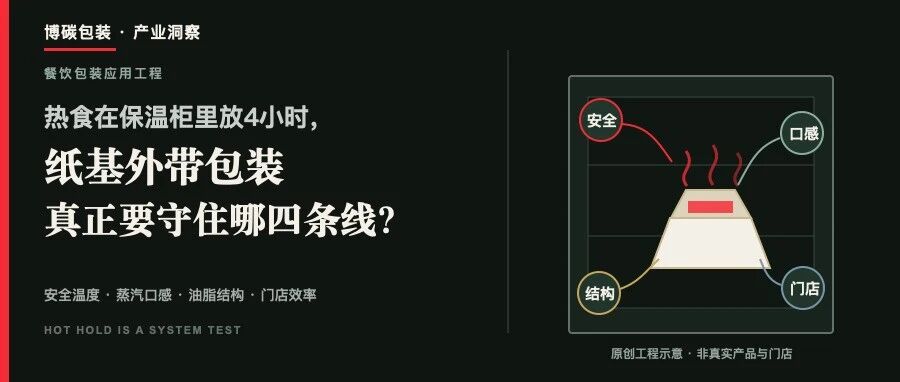
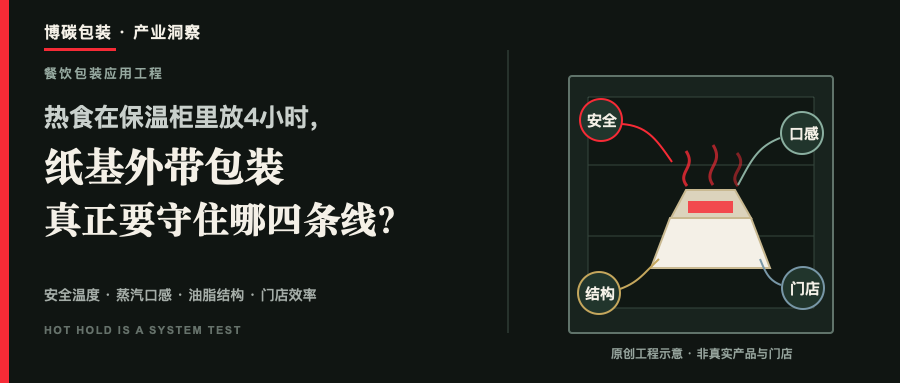
热柜包装守住的不是一个温度,而是安全、口感、结构和门店效率。
纸板、薄膜、窗口、通风、封合与阻隔层各自多做一步,才能把等待时间变成稳定交付。四小时可以是研究钩子,却不能成为统一答案;最终答案永远写在真实菜单、真实热柜和真实门店数据里。
博碳包装·产业洞察·研究说明
本文依据ProAmpac企业公开新品、产品与指定SKU页面,市场监管总局《餐饮服务食品安全操作规范》、同行评审研究及4evergreen指南,由博碳包装独立研究整理,核验截至2026年9月4日。文中最长4小时、194°F与392°F均按各自来源范围呈现,不构成第三方验证或通用性能。本文仅供产业研究学习,不构成采购、合规或性能保证;如有修改、说明或删除要求,我们将在收到后24小时内核查处理。
博碳观察数据与核验来源
01|ProAmpac|A Hot New Lineup for LUNCH! 2026
02|ProAmpac|HotRap
03|ProAmpac|HandRAP 244HT热三明治指定SKU
04|ProAmpac|HandRap
05|市场监管总局|餐饮服务食品安全操作规范
06|Progress in Organic Coatings|PHBV水性分散体系用于纸张阻隔涂层
07|4evergreen|Circularity by Design Guideline
08|BIOTEN博碳包装|纸基阻隔系统工程
原来源限制访问
Four hours is not merely a heat-retention claim; it is a joint test of food, packaging and store operations. Only after the time basis is defined can the packaging solution be assessed.
THE FOUR-HOUR QUESTION
Who makes “up to four hours” possible?
On 3 September, ProAmpac launched a new range for hot-cabinet applications: the Hot Hold Box, Hot HandRap™ and Hot Hold Carton. The company says the solutions combine product visibility with temperature retention, supporting hot-hold times of up to four hours.
The launch brings a familiar retail scene to the fore: once a burger, wrap or hot sandwich is prepared, it may not be collected immediately but instead waits in a hot cabinet for the next customer. The important question for the packaging industry is not whether “four hours” can be copied onto a product page, but which parties and controls must work together throughout that waiting period.
Research sources: ProAmpac product launch, 3 September.
Start by separating the two claims
There are two different “four-hour” claims
The first is a packaging manufacturer's product-test claim. The product page for ProAmpac's specified 244HT SKU states that the hot square-sandwich pack was tested for four hours of hot holding at 194°F (approximately 90°C) and uses fog-resistant film. The paperboard functions as the container while also helping shield the consumer's hands from the hot food. Because the page does not disclose the food's core-temperature curve, menu formulation or full failure criteria, it supports only the test scope stated for that specific product.
The second comes from food-safety operations. For catered meal delivery, China's Code of Practice for Food Safety in Catering Services states that where the food's core temperature is maintained above 60°C by hot holding for the first 2 hours after cooking, the time limit for consumption is four hours from cooking. This requirement governs the time–temperature relationship from cooking to consumption; it is not a performance property of paperboard or film alone.
The numbers are the same, but the subjects of proof are entirely different. One validates packaging; the other manages food safety. Neither can be used to substantiate the other.
Research sources: ProAmpac 244HT product page; State Administration for Market Regulation, Code of Practice for Food Safety in Catering Services.
01 · FOOD SAFETY
Safety: cabinet temperature is not core temperature
A cabinet display of 90°C does not mean that the core temperature of every food item remains the same. Temperature at removal from the oven, food thickness, moisture content, packing speed, frequency of door openings, shelf position and replenishment cadence all change the temperature curve. Packaging creates a local thermal environment; it cannot replace the foodservice operator's time–temperature controls.
Validation should begin with a temperature map: record the times at which the food leaves the oven, is packed, enters the cabinet and is removed; measure core temperature at the least-favourable shelf position rather than relying only on the cabinet display; include peak-period door openings and replenishment in the test; and determine the consumption window from the target market's requirements and the store SOP. Sixty, 90, 120 or 240 minutes may each be a project target, but none can simply be copied from another SKU.
02 · STEAM & TASTE
Steam: retain heat, release moisture
Retain the heat; release the moisture.
Fried foods, pastries and toasted breads lose crispness when condensation returns to the surface, while rice, meat fillings and soft breads are vulnerable to moisture loss. Too little venting can fog the window, soften the surface and allow the paperboard to absorb moisture; too much can dry the food and accelerate heat loss.
The ProAmpac HotRap™ family offers windows, venting and fog resistance as design options. The window film provides visibility, vents control the moisture pathway, and the paperboard provides support and insulation. All three must be specified around the particular food.
Sensory validation cannot stop at “the package remained intact”. More useful indicators include mass loss, surface moisture, crispness, window haze and consumer acceptability.An intact package does not mean the food is still worth selling.
Research sources: ProAmpac HotRap™ product page.
03 · BARRIER & STRUCTURE
Grease and structure: passing a flat-sheet test is not enough
Burger sauces, sausage fat and steam from hot sandwiches will find the weakest points in the paperboard's pores, creases, cut edges, overlaps and seals. Increasing basis weight will not necessarily stop grease penetration; nor does grease resistance in a flat coupon prove integrity after converting, under heat and under load.
Aqueous coatings and PHA as the paperboard's functional layer
This also clarifies the proper role of aqueous coatings and aqueous PHA barriers. They do not replace windows, vents or seals. Instead, they are candidate functional layers for the food-contact surface and failure-prone areas of the paperboard, to be screened for penetration by hot grease and sauces, moisture-induced softening from condensation, and integrity at score lines and cut edges.
For PHBV, a member of the PHA family, peer-reviewed research has already examined aqueous dispersion coatings on paper. Using the study's specific formulation and Manila paper substrate, researchers observed improvements in water-vapour barrier performance, oil resistance, water absorption and wet mechanical properties. The route therefore merits validation, but the findings do not mean that every aqueous PHA coating is automatically suitable for a 90°C hot cabinet or a four-hour holding window. BIOTEN's published approach accordingly places liquid and grease resistance, film formation, performance after creasing, heat sealability and finished-pack integrity in the same validation chain.
Research sources: Research on aqueous PHBV dispersion coatings for paper; BIOTEN paper-based barrier system engineering.
04 · STORE OPERATIONS
Store operations: from packing to handover
ProAmpac's claimed benefits for HotRap™ and HandRap™ are clear: one pack can remain with the food from factory packing through in-store heating and hot-cabinet display to consumer use. The products ship flat, are assembled in store and are intended to improve operational efficiency by reducing the number of packaging SKUs.
Those benefits count only when they show up in store data. Packing time per serving, hourly replenishment throughput, shelf capacity, wrong-item pickup rate, complaints about packs being too hot to handle, waste rate, remaining inventory and staff training time should all be recorded alongside food quality. If the structure is too complex, difficult to separate or slower to pack during peak periods, even excellent material performance can fail at the point of delivery.
The post-use pathway cannot be skipped either. For certain HandRap™ products, ProAmpac states that the paperboard can enter the paper-recycling stream once the film is removed. This is a useful design direction, but it does not mean that the complete pack is recyclable, nor does it prove that consumers will separate the components or that local systems will collect them. Aqueous, bio-based, recyclable and compostable are separate claims, each requiring its own evidence.
Research sources: ProAmpac HandRap™; 4evergreen Circularity by Design Guideline.
Start with a real menu item
Put “four hours” on the validation sheet
First fix the food dimensions, grease and moisture profile, oven-exit and packing temperatures, hot-cabinet settings, door-opening cadence and target sales window. Then compare the current pack, a conventional aqueous-coating route and a candidate aqueous PHA route, recording core temperature, mass loss, sensory quality, haze, leakage, stiffness, seal integrity, packing efficiency and post-use pathway for each.
If you are trying to solve moisture regain, grease leakage, window fogging, packs that are too hot to handle or seal instability in hot-cabinet food, submit photographs of the food and pack; the food's dimensions and grease/moisture profile; oven-exit and packing temperatures; target hot-hold time; cabinet settings and door-opening cadence; the current structure; and the specific failure mode.
BIOTEN will first return a failure map, candidate coating locations for aqueous and PHA systems, a comparative prototyping checklist and pack-level validation metrics, and then assess whether prototyping is warranted. Specific materials, specifications, batches and availability remain subject to project-specific confirmation.
Longer is not inherently better
A longer holding time may increase moisture regain, moisture loss, grease migration and product waste. It may also lead stores to assume that food remains saleable simply because the pack is intact. If food safety, sensory quality, structural integrity or store efficiency fails, an advertised maximum of four hours is merely an unsuitable target for that menu item.
Hot-cabinet packaging must protect more than a temperature: it must protect safety, sensory quality, structural integrity and store efficiency.
Paperboard, film, windows, vents, seals and barrier layers must each do their part to turn waiting time into reliable delivery. Four hours may be a useful research hook, but it cannot be a universal answer. The answer must always come from data generated with the actual menu item, hot cabinet and store operations.
BIOTEN Packaging · Industry Insights · Research Note
This article was independently prepared by BIOTEN Packaging from ProAmpac's public product launch, product and specified-SKU pages; the State Administration for Market Regulation's Code of Practice for Food Safety in Catering Services; peer-reviewed research; and the 4evergreen guideline. Sources were checked through 4 September 2026. The maximum four-hour hold, 194°F and 392°F figures are presented only within the scope stated by their respective sources and do not constitute third-party validation or general performance claims. This article is for industry research and educational purposes only and does not constitute procurement, compliance or performance assurance. Requests for corrections, clarification or removal will be reviewed within 24 hours of receipt.
BIOTEN Observer data and verification sources
01 | ProAmpac | A Hot New Lineup for LUNCH! 2026
02 | ProAmpac | HotRap™
03 | ProAmpac | HandRAP w/fog-resistant film for hot square sandwiches (SKU 244HT)
04 | ProAmpac | HandRap™
05 | State Administration for Market Regulation | Code of Practice for Food Safety in Catering Services
06 | Progress in Organic Coatings | Stable aqueous dispersions of poly(3-hydroxybutyrate-co-3-hydroxyvalerate) (PHBV) polymer for barrier paper coating
07 | 4evergreen | Circularity by Design Guideline
08 | BIOTEN Packaging | Paper-based barrier system engineering
Original source access restricted