
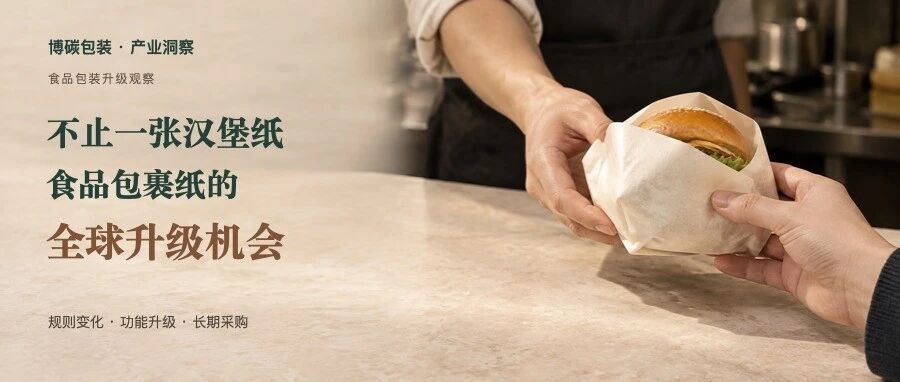
国际食品品牌选择一张包装纸,正在同时追问:能不能保护食物,用了什么材料,使用后如何处理,以及下一轮规则到来时,是否需要重新换材。
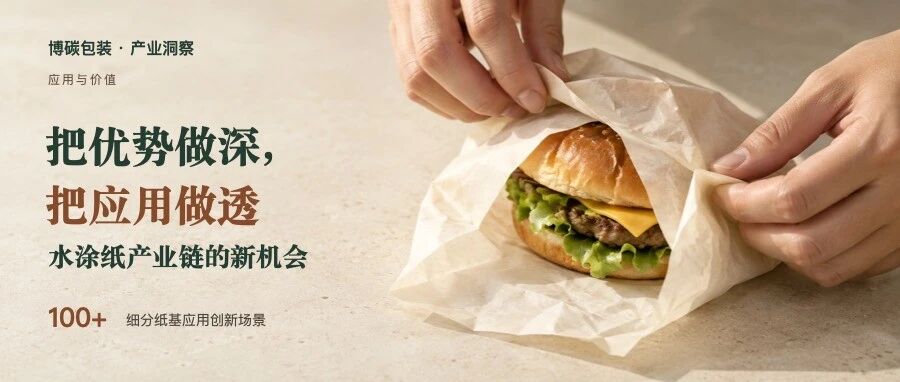
这才是长期采购的起点。汉堡纸只是一个看得见的入口,背后连着三明治、热狗、卷饼、肉类、奶酪与食品隔离纸等更广的应用。
规则变化,
先改变选材的理由
欧盟包装与包装废弃物法规PPWR自2026年8月12日起分阶段适用,其中食品接触包装的PFAS限值要求已经开始执行;可回收等要求自2030年起分阶段推进。
大型品牌也在改变采购条件。麦当劳将材料来源、含氟化合物管理、功能安全及使用后的处理纳入包装政策与供应商管理。品牌需要考虑的,是今天的产品能否承接已经明确的升级方向。
长期采购看重的,不只是一张纸今天能用,更是这条技术路线能否持续适配目标市场。
这给低用量功能涂层、减少PE淋膜依赖及不同末端路径的开发留下空间。回收、家庭堆肥与食品接触安全,应分别形成针对具体市场和成品的依据。
汉堡纸背后,
是百万吨的行业基准
Nordic Paper在2025年报中,将全球各类防油纸需求描述为数百万吨,并指出过去五年需求增长快于整体纸市场,北美和欧洲是主要市场。
这一口径包含天然防油纸及其他防油纸,覆盖包裹、袋类、烘焙等用途,是行业量级参照,并非汉堡纸单品销量。
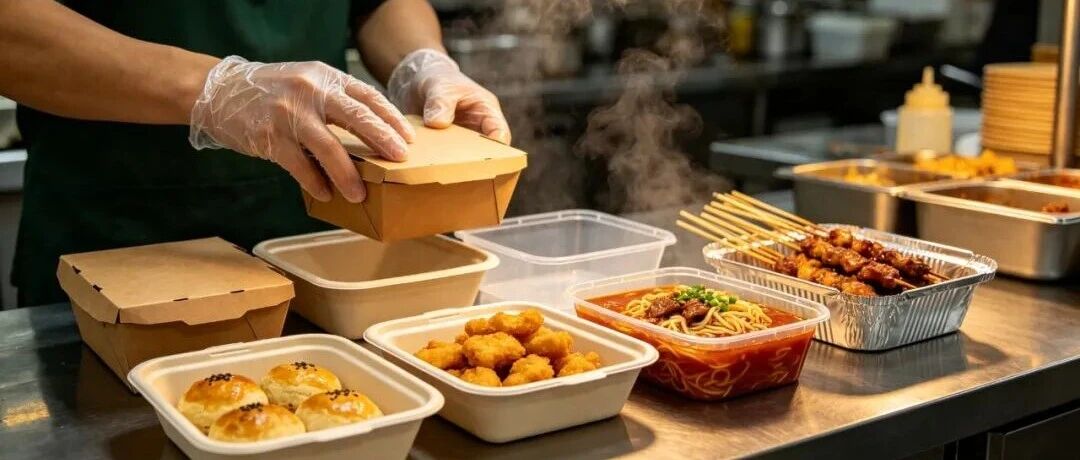
把视野从一种汉堡放大:快餐需要便捷折包,高端现制汉堡需要合适幅面和手感,三明治、热狗与卷饼需要应对油脂、酱汁与水汽;冷鲜肉、鱼类和奶酪,又提出不同的湿态和保存要求。
机会不是给同一张纸换几个名字,而是围绕不同食品,把材料做成不同的产品。
定量与功能,
由使用任务决定
“多少克”通常指每平方米的质量,也就是定量,不是纸张厚度。
例如,delfort公开的快餐包装纸定量范围为25.5—45g/m²;其鱼、肉和奶酪包裹纸有43g/m²、47.3g/m²规格。这些行业规格说明,食品用纸并非都要从80克、100克起步,高端也不等于更厚。
热食包裹纸,要协调耐油、耐水、耐折与水汽传递。控制液态油水渗透,同时管理食品释放的蒸汽,是不同功能之间的配合;透湿并非越高越好,大汉堡还要把幅面、折包手感和承托一起考虑。
冷鲜食品包裹纸,要结合汁液、低温、湿态强度和存放时间研究。热汉堡需要的散汽,与冷鲜肉需要的水分管理,不宜套用同一个指标。
食品隔离纸,则连接火腿、奶酪、肉饼等切片或分层场景。防油之外,还要研究不粘连、剥离干净及接触安全,不能只拿耐油表现代替易剥离能力。
不同食品需要不同的纸基、涂层与加工组合,开发从具体餐品开始。
博碳的价值,
把规则与应用接起来
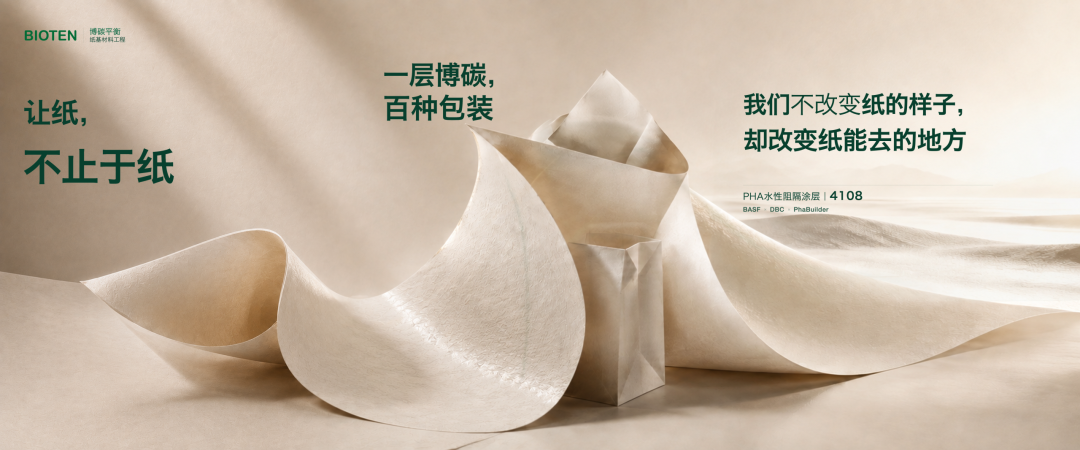
博碳所推进的PHA水性阻隔路线,是在适用包裹场景中,以功能涂层替代传统PE淋膜结构,并围绕不有意添加PFAS、纸纤维回收适配和可堆肥选择组织开发。
关键在纸基、涂层分布、成膜、干燥与印刷加工的协同。看的是折包后的功能、实际食品接触表现和单位合格产品成本,而非单项指标越高越好。
博碳表示,拟推广的特定型号汉堡纸成品已取得BPI家庭堆肥认证,并形成相应测试资料。具体合作将对应产品型号、规格与有效证书范围。
BPI家庭堆肥认证以法国NF T 51-800为基础,并以前置的商业堆肥认证为条件。它的价值,是为提出相应要求的客户提供可核查的第三方依据;再浆回收及目标市场的其他要求,仍按完整纸品结构分别落实。
品牌愿意长期选择的,是功能适用、要求说得清、还能随市场继续升级的产品。
把一个场景做透,
再把市场做深
中国的造纸、涂布、印刷和加工能力,可以与材料创新和目标市场的应用经验结合。
薄纸企业可深耕包裹与隔离,涂布企业可研究功能组合与批次一致性,转换和渠道伙伴则把产品规格、品牌定制与本地服务接起来。
博碳欢迎具备相应能力、尊重创新并愿意长期投入的伙伴,共同开发食品包裹纸。针对特定国家或约定区域,可洽谈独家合作安排,明确产品、渠道、期限及履约责任。
汉堡纸是入口,食品包裹纸的功能升级才是更大的机会。把规则、材料和应用真正做透,才有机会把一张小纸做成全球品牌愿意持续采购的长期生意。
研究说明
本文由博碳包装依据法规、企业公开资料及应用研究整理,核验截至2026年9月23日。市场量级为所引年报的行业估计;所列克重为第三方产品示例。具体产品以对应规格与有效文件为准,供产业研究学习,不构成采购或性能保证。如需修改、说明或删除,请联系本公众号,24小时内核查处理。
博碳观察数据与核验来源
欧盟委员会|包装规则适用与PFAS限制
Nordic Paper|2025年报
delfort|快餐包装纸、鱼肉奶酪包裹纸
BPI|家庭堆肥认证体系
麦当劳|包装与供应商要求
博碳包装|产品与合作信息(企业确认)
When international food brands choose a wrapping paper, they increasingly ask several questions at once: Will it protect the food? What materials does it contain? How should it be managed after use? And will the next round of regulations require another material change?
These questions are the starting point for long-term sourcing. Burger wraps are one visible entry point into a much wider range of applications, including sandwiches, hot dogs, filled wraps, meat, cheese and food interleaving papers.
Changing rules reshape
the reasons for choosing a material
The EU Packaging and Packaging Waste Regulation (PPWR) began applying in phases on 12 August 2026. Its PFAS concentration limits for food-contact packaging are already applicable, while requirements such as recyclability will be phased in from 2030.
Major brands are also changing their sourcing criteria. McDonald's incorporates material sourcing, management of fluorinated compounds, functionality and safety, and post-use handling into its packaging policies and supplier management. Brands must consider whether today's products can support the direction of change already set out.
Long-term sourcing depends not only on whether a paper works today, but also on whether its technology can continue to meet the needs of the target market.
This creates room to develop functional coatings at low coat weights, reduce reliance on polyethylene (PE) extrusion coatings and explore different end-of-life pathways. Recycling, home compostability and food-contact safety each require their own supporting evidence for the specific market and finished product.
Beyond burger wraps:
understanding the industry's scale
Nordic Paper's 2024 Annual and Sustainability Report, published in 2025, estimates global demand for all types of greaseproof paper at just under one million tonnes. North America and Europe are the largest markets.
This estimate includes natural greaseproof paper and other grease-resistant papers for wrapping, bags, baking and other uses. It provides context for the scale of the industry; it does not represent sales of burger wraps alone.
Look beyond a single type of burger: fast food requires convenient folding and wrapping, while premium freshly made burgers call for suitable sheet dimensions and handling. Sandwiches, hot dogs and filled wraps must cope with grease, sauces and water vapor. Chilled meat, fish and cheese introduce different requirements for wet performance and storage.
The opportunity is to develop distinct products around different foods, rather than give the same paper several different names.
Basis weight and functionality
follow the task the paper must perform
A paper's weight in grams usually refers to its mass per square meter, known as basis weight or grammage, rather than its thickness.
For example, delfort lists a basis-weight range of 25.5–45 g/m² for its fast-food packaging papers, and 43 g/m² and 47.3 g/m² grades for fish, meat and cheese wrapping. These examples show that food papers do not all need to start at 80 or 100 g/m², and that a premium product need not be thicker.
Hot-food wrapping papers must balance grease resistance, water resistance, fold resistance and water-vapor transmission. Limiting penetration by liquid oil and water while managing steam released by the food requires several functions to work together. Higher water-vapor transmission is not always better. For large burgers, sheet dimensions, folding and handling, and support for the food must also be considered together.
Chilled-food wrapping papers must be developed with food juices, low temperatures, wet strength and storage time in mind. The steam release needed for a hot burger and the moisture management required for chilled meat should not be assessed using a single common metric.
Food interleaving papers serve applications involving slices or layers of ham, cheese, meat patties and similar foods. Beyond grease resistance, they require evaluation of non-stick performance, clean release and food-contact safety. Grease resistance alone is not a measure of easy release.
Different foods require different combinations of paper substrate, coating and converting processes. Development starts with the specific food.
BIOTEN's role:
connecting regulatory requirements with applications
BIOTEN's PHA waterborne barrier approach uses functional coatings to replace conventional PE extrusion-coated structures in suitable wrapping applications. Development focuses on formulations with no intentionally added PFAS, compatibility with paper-fiber recovery and compostability as an optional end-of-life pathway.
Success depends on coordinating the paper substrate, coating distribution, film formation, drying, printing and converting. What matters is performance after wrapping, behavior in actual food contact and cost per conforming product, rather than maximizing a single test result.
BIOTEN states that a specific finished burger-wrap grade it plans to promote has obtained BPI home compostability certification and is supported by corresponding test documentation. Any collaboration will be tied to the relevant product grade, specifications and scope of a valid certificate.
BPI's home compostability certification is based on the French standard NF T 51-800 and requires commercial compostability certification as a prerequisite. It provides verifiable third-party evidence for customers with those requirements. Repulpability and other target-market requirements must still be addressed separately for the complete paper product construction.
Brands choose products for the long term when they perform the intended function, have clearly documented requirements and can continue to evolve with the market.
Master an application,
then build a stronger market presence
China's capabilities in papermaking, coating, printing and converting can be combined with materials innovation and application experience in target markets.
Lightweight-paper producers can specialize in wrapping and interleaving. Coating companies can develop combinations of functions and improve batch consistency. Converting and distribution partners can connect product specifications, brand customization and local service.
BIOTEN welcomes partners with relevant capabilities, respect for innovation and a commitment to sustained investment to jointly develop food wrapping papers. Exclusive cooperation arrangements may be discussed for specific countries or agreed territories, with products, channels, duration and responsibilities for fulfilling the agreement clearly defined.
Burger wraps are an entry point; improving the functionality of food wrapping papers is the larger opportunity. A thorough understanding of regulations, materials and applications can turn a small sheet of paper into a lasting business that global brands are willing to source from repeatedly.
Research note
Prepared by BIOTEN Packaging using regulatory materials, publicly available company information and application research, with verification current to 23 September 2026. The market scale is the industry estimate in the cited report; basis weights are examples of third-party products. Specific products are subject to their corresponding specifications and valid documentation. This article is for industry research and learning and does not constitute a procurement or performance guarantee. For corrections, clarification or removal requests, please contact the originating WeChat official account; requests will be reviewed and addressed within 24 hours.
BIOTEN Observer: data and verification sources
European Commission | Application of packaging rules and PFAS restrictions
Nordic Paper | 2024 Annual and Sustainability Report (published in 2025)
delfort | Fast-food packaging papers and wrapping papers for fish, meat and cheese
BPI | Home compostability certification scheme
McDonald's | Packaging and supplier requirements
BIOTEN Packaging | Product and partnership information (company confirmation)