

从功能阻隔、表面保护到纤维增效的纸浆模塑整体解决方案发布:纸浆模塑,增质才能增值。
从内表面阻隔、外表面防护到纤维本体减量,看懂纸浆模塑三项工程的价值逻辑。
博碳开发者:纸基功能材料系统工程创新
一件制品,三项工程
从内表面阻隔、外表面防护到纤维本体减量,看懂纸浆模塑三项工程的价值逻辑。
纸浆模塑的增值不只来自成型:内表面要应对内容物,外表面要承受触摸与摩擦,纤维本体则要在功能保持前提下寻找减量空间。
BIOTEN 博碳以一面阻隔、一面防护、一芯减量,把三种材料分别放到内表面、外表面和纤维网络,并按目标制品单独选用或组合验证。
本文只说明材料位置与应用开发方向。食品接触、阻隔、强度、耐磨、减量、降解与末端路径均以准确SKU、最终BOM和完整制品测试为准。
我们的发明|原创技术布局
以下为都佰城多年来连续研发的系统发明专利成果,博碳包装体系相关主体共同申请并已获授权公告的发明专利,分别对应阻隔、纤维增强和表面光油方向的部分相关发明专利。
01|内表面阻隔聚羟基脂肪酸酯PHA水性阻隔涂层组合物及应用授权公告号 CN120925356B
02|纤维增强酸中性纳米PHA纸板增强剂及其制备与应用授权公告号 CN121295549B
03|外表面光油含PHA的低气味低VOC水性触感阻隔上光油组合物及其制备方法与应用授权公告号 CN121496785B
专利证明原创技术布局和权利边界,不替代具体SKU、工艺窗口或完整制品性能验证。
01 · FOOD SIDE
一面阻隔|内容物
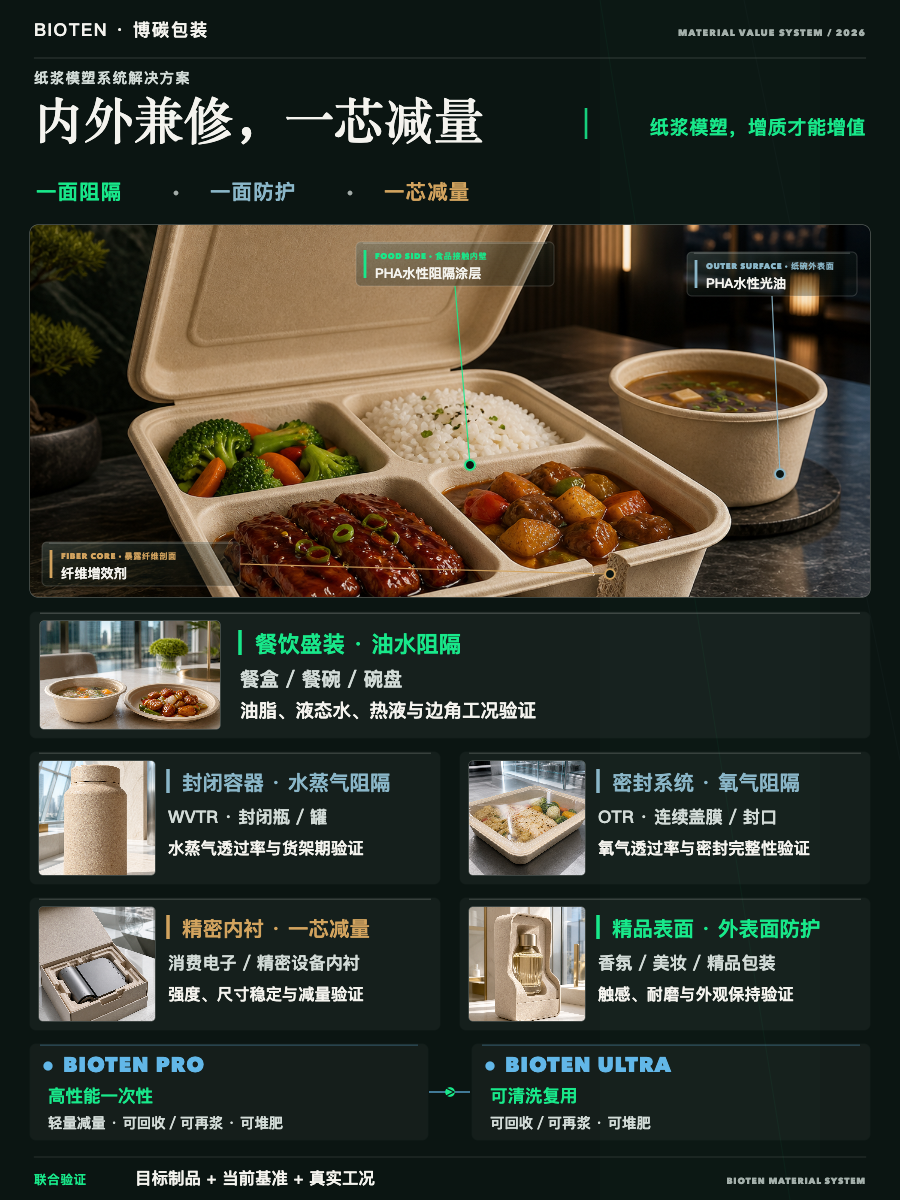
食品接触内表面使用BIOTEN / PHA水性阻隔涂层,面向油脂、液态水、热液与真实盛装工况开展开发。餐饮盛装关注油水和边角;封闭瓶罐关注水蒸气透过率(WVTR);连续盖膜与封口系统还要同时验证氧气透过率(OTR)和密封完整性。不同内容物,需要不同阻隔答案。
02 · OUTER SURFACE
一面防护|外表面
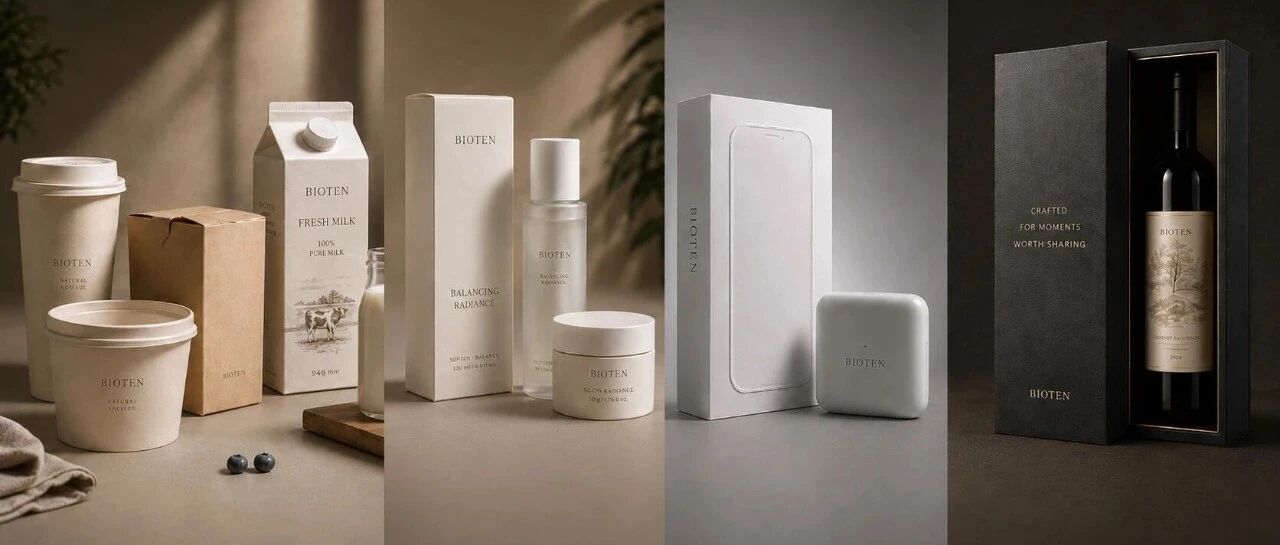
PHA水性光油作用于制品外表面,面向外观、触感、耐磨与表面防护开展适配。它适合香氛、美妆、精品消费品或高端餐饮包装等重视表面体验的场景,是可按需求选择的升级入口,不承担纤维本体的结构减量。
03 · FIBER CORE
一芯减量|纤维网络
纤维增效剂进入浆料、湿坯和纤维网络内部,它能在添加料千分之几的情况下有效实现数倍的纤维增强。它围绕强度、尺寸稳定、成型稳定和单位制品用料建立对照。包装最小化趋势强调的不是单纯做薄,而是将重量和体积降到维持功能所必需的水平;因此,减量必须回到同浆料、同模具、同工况、单位制品干重和三维制品功能对照。
研究资料:Regulation (EU) 2025/40 Article 10与Annex IV;博碳开发者。
按场景选择验证对象
餐饮盛装|油脂、液态水、热液与边角。
封闭瓶罐|WVTR与货架期。
盖膜封口|OTR与密封完整性。
精密内衬|强度、尺寸稳定与减量。
精品表面|触感、耐磨与外观保持。
05 · JOINT VALIDATION
从一个目标制品开始
三项工程可以单独选用,也可以组合验证。项目启动只需要三个输入:一个目标制品、一个当前基准、一种真实工况。减量结果还要增加单位制品干重和功能保持对照。
材料筛选 → 三维打样 → 功能保持 → 减量验证让“一芯减量”成为可比较的工程结果。
都佰城·博碳包装开发者·研究说明
BIOTEN/博碳包装提供产品系统、产品资料、技术TDS联系获取。
博碳开发者数据与核验来源
01|ASTM International|水蒸气透过率测试方法F1249
02|ASTM International|完整包装氧气透过率测试方法F1307
03|ASTM International|柔性阻隔材料封口强度测试方法F88/F88M
04|TAPPI|纸和纸板耐油脂测试方法T 559
05|ISO|纸和纸板内结合强度ISO 16260
06|EUR-Lex|Regulation (EU) 2025/40包装最小化要求
07|专利公开检索|聚羟基脂肪酸酯水性阻隔涂层组合物及应用
08|专利公开检索|酸中性纳米PHA纸板增强剂及其制备与应用
09|专利公开检索|含PHA的低气味低VOC水性触感阻隔上光油组合物

An integrated molded-fiber solution spanning functional barriers, surface protection, and fiber efficiency: value grows only when performance improves.
From an inner-surface barrier and exterior protection to fiber reduction within the structural network, this article explains the value logic of three engineering tracks for molded fiber.
BIOTEN Developer | Systems Engineering Innovation in Functional Paper-Based Materials
One Article, Three Engineering Tracks
From an inner-surface barrier and exterior protection to fiber reduction within the structural network, this article explains the value logic of three engineering tracks for molded fiber.
Value in molded fiber comes from more than the forming process. The inner surface must manage the contents, the exterior must withstand handling and abrasion, and the fiber structure must create room for material reduction without sacrificing function.
BIOTEN organizes its materials system around three functions—barrier performance inside, protection outside, and less fiber at the core—placing the respective materials on the inner surface, exterior surface, and within the fiber network. Each can be selected independently or validated in combination for the target article.
This article describes only material placement and application-development directions. Food-contact safety, barrier performance, strength, abrasion resistance, lightweighting, degradation, and end-of-life pathways must all be verified using the exact SKU, final bill of materials (BOM), and complete finished-article testing.
Our Inventions | An Original Technology Portfolio
The following are selected invention patents arising from DBC’s sustained systems R&D. Jointly filed by entities associated with the BIOTEN Packaging system and now granted and published, they cover selected innovations in barrier coatings, fiber reinforcement, and exterior-surface varnishes.
01 | Inner-Surface BarrierPolyhydroxyalkanoate (PHA) Waterborne Barrier-Coating Composition and Its ApplicationGranted Patent Publication No. CN120925356B
02 | Fiber ReinforcementAcid-Neutral Nano-PHA Paperboard Reinforcing Agent: Preparation and ApplicationsGranted Patent Publication No. CN121295549B
03 | Exterior-Surface VarnishLow-Odor, Low-VOC Waterborne Tactile Barrier Overprint-Varnish Composition Containing PHA, and Its Preparation and ApplicationsGranted Patent Publication No. CN121496785B
Patents demonstrate the originality and boundaries of the technology portfolio; they do not replace validation of the specific SKU, process window, or performance of the complete finished article.
01 · FOOD-CONTACT SURFACE
Barrier Performance Inside | Contents
BIOTEN PHA waterborne barrier coating is applied to the food-contact surface and developed for grease, liquid water, hot liquids, and actual filling and use conditions. Foodservice containers require oil- and water-resistance testing, including at edges and corners; sealed bottles and jars require water vapor transmission rate (WVTR) testing; continuous lidding and sealing systems also require oxygen transmission rate (OTR) and seal-integrity testing. Different contents demand different barrier solutions.
02 · EXTERIOR SURFACE
Protection Outside | Exterior Surface
BIOTEN PHA waterborne overprint varnish is applied to the exterior surface to enhance appearance, haptics, abrasion resistance, and surface protection. It is suited to applications where the surface experience matters, including fragrance, beauty, premium consumer goods, and upscale foodservice packaging. This optional upgrade does not provide structural fiber reduction.
03 · FIBER CORE
Less Fiber at the Core | Fiber Network
The fiber-efficiency additive is introduced into the furnish, wet preform, and internal fiber network. At addition levels of only a few parts per thousand, it can deliver a several-fold improvement in fiber reinforcement. Validation compares strength, dimensional stability, forming stability, and material use per article. The packaging-minimization trend is not simply about making packaging thinner; it is about reducing weight and volume to the minimum necessary to maintain functionality. Lightweighting must therefore be assessed using the same furnish, mold, and operating conditions, with dry weight per article and three-dimensional functional performance compared side by side.
Research references:Regulation (EU) 2025/40, Article 10 and Annex IV; BIOTEN Developer.
Select Validation Targets by Application
Foodservice containers |Grease, liquid water, hot liquids, and edges and corners.
Sealed bottles and jars |WVTR and shelf life.
Lidding and sealing |OTR and seal integrity.
Protective inserts |Strength, dimensional stability, and lightweighting.
Premium exterior surfaces |Haptics, abrasion resistance, and appearance retention.
05 · JOINT VALIDATION
Start with One Target Article
The three engineering tracks can be selected independently or validated in combination. A project requires only three inputs to begin: one target article, one current baseline, and one actual use condition. Lightweighting validation must also compare dry weight per article and retention of functional performance.
Materials screening → 3D prototyping → functional-performance retention → lightweighting validation: a process that turns “less fiber at the core” into a comparable engineering result.
DBC · BIOTEN Packaging Developer | Research Notes
For BIOTEN/BIOTEN Packaging product-system information, product documentation, and technical data sheets (TDS), please contact us.
BIOTEN Developer | Data and Verification Sources
01 | ASTM International | Water Vapor Transmission Rate Test Method F1249
02 | ASTM International | Oxygen Transmission Rate Test Method for Complete Packages, F1307
03 | ASTM International | Seal Strength Test Method for Flexible Barrier Materials, F88/F88M
04 | TAPPI | Grease-Resistance Test Method for Paper and Paperboard, T 559
05 | ISO | Internal Bond Strength of Paper and Paperboard, ISO 16260
06 | EUR-Lex | Packaging-Minimization Requirements Under Regulation (EU) 2025/40
07 | Patent Search | Polyhydroxyalkanoate Waterborne Barrier-Coating Composition and Its Application
08 | Patent Search | Acid-Neutral Nano-PHA Paperboard Reinforcing Agent: Preparation and Applications
09 | Patent Search | Low-Odor, Low-VOC Waterborne Tactile Barrier Overprint-Varnish Composition Containing PHA