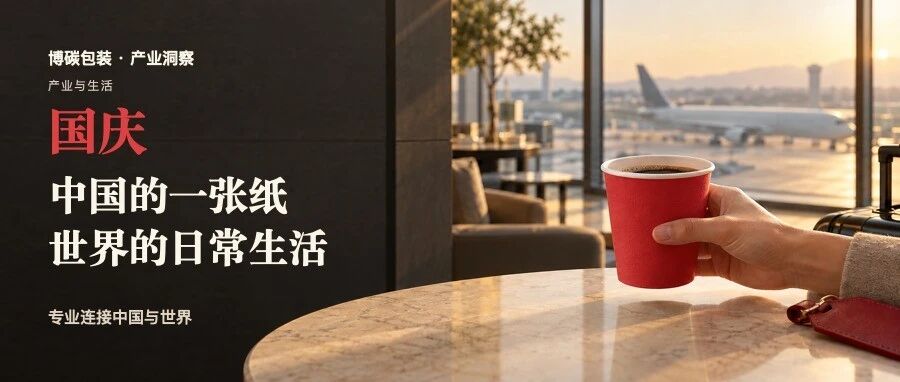
换纸杯是公众看得见的动作;真正难的是让杯纸、阻隔层、杯盖、封合、食品接触、门店操作、供应链交付和末端证据在同一只杯子上同时成立。
先看公开规模
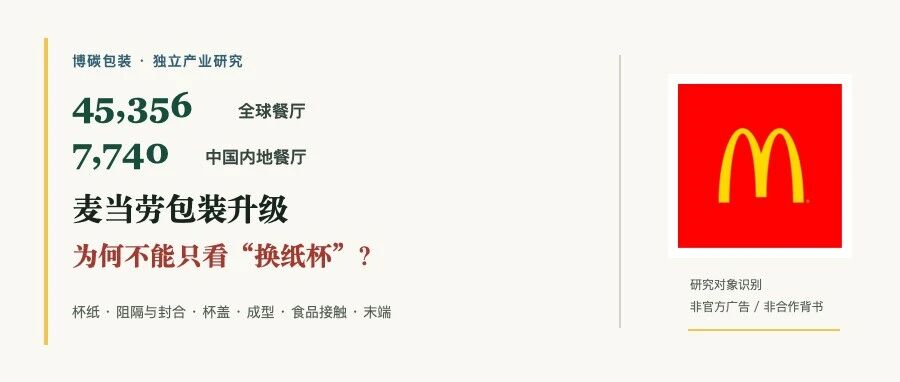
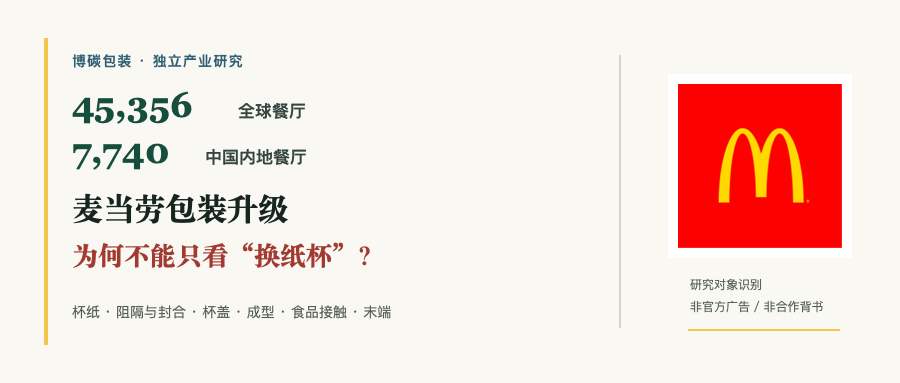
45,356 / 7,740 / 5,800吨
麦当劳2025年末全球系统餐厅45,356家,中国内地7,740家。新包装将陆续覆盖全国超7,500家餐厅;完成切换后,企业预计每年少用超过5,800吨石油基塑料。
研究资料:麦当劳2025年各市场餐厅数量;麦当劳中国包装升级公告
01 · NETWORK SCALE
全球餐厅网络,放大的是哪一种包装难题
麦当劳2025年末全球系统餐厅为45,356家,约95%为特许经营餐厅。中国内地7,740家,较2024年净增920家,按公开数据计算约增13.5%,约占全球系统餐厅17.1%。这不自动产生某种纸杯或杯盖的用量,却意味着一处包装改动要经过不同工厂、仓配、门店和顾客操作的重复验证。
截至2025年11月,公开报道显示麦当劳已进入中国280余个地级市、餐厅超过7,500家;广州市场在2026年1月达到900家。门店广度和密度意味着包装系统必须面对地域温湿度、配送时长、设备差异、补货节奏和异常处置。
研究资料:麦当劳2025年年度报告;新华社门店覆盖报道;广州900店
换纸杯,实际是八个系统字段
材料结构|杯纸、阻隔层、杯盖、封合。
最终验证|食品接触、成型、门店操作、供应链与末端。
重要边界|门店数、方案数和预测减塑量不能推出单SKU件数、BOM、供应商份额、切换完成率或实际回收/堆肥结果。独立数据图随文章包交付。
02 · CUP SYSTEM
纸杯为何不是“只有纸”
麦当劳全球把主要顾客包装定义为交付餐食和饮品的单次使用纤维与塑料包装,范围包括杯、盖、袋、纸盒/贝壳盒、包装纸、杯托、碗和容器、吸管与餐具。中国本轮公告更具体:麦咖啡及饮料、新地、玉米、粥等包装的杯盖将使用PLA;饮料、新地、玉米等部分杯身将转为纸制包材。
这不是“杯身换纸”就结束的事情。冷饮杯盖的防溢结构、热饮杯盖的韧性与耐热性,说明杯身与杯盖共同决定饮用体验和防漏。杯纸、内外阻隔、杯底与侧缝封合、印刷、堆叠和门店拿取,缺任何一个都可能让一只材料看起来更绿的纸杯无法被稳定使用。
研究资料:麦当劳全球包装报告;麦当劳中国包装升级
03 · BARRIER LAYER
纸杯走向规模化,靠的是整套阻隔与封合系统
PE等阻隔与封合体系,和杯纸、杯盖、成型设备一起,完成了纸杯走向规模化工业产品的关键一程。杯纸多孔,单靠纸本身难以承担液体、油脂和热封要求;同行评议研究表明,热饮纸杯的聚合物涂层需要兼顾液体/油脂阻隔、热稳定性和热封性,低密度聚乙烯是常见阻隔层之一,可帮助杯侧缝和杯底形成液密封合。
功能解决后,新的设计难题才出现。PE与纤维紧密结合时,再浆会出现纤维回收和薄膜分离挑战;它需要结构设计、工艺和目标纸厂方法验证。这个挑战不等于PE“有毒”或纸杯“食品不安全”,也不等于纸基结构天然无法回收。
水性阻隔、PLA、其他聚酯、矿物或复合涂层也要接受同一套考题:准确牌号、涂布量、封合温度、基纸、杯型、食品、温度—时间、感官、食品接触、连续成型和真实末端。去掉PE不是结论,完成系统验证才是结论。
研究资料:BioResources纸杯制造研究;PE涂布纸板再浆研究
100种方案、200万次实操,到底在验证什么
它不证明任何单一材料一定更好,却反映连锁餐饮改变顾客可见包装时,要同时筛掉不合格的阻隔、封合、耐热、外观、堆叠、门店操作和供应稳定性组合。大型连锁采购的不是一张检测单,而是材料、结构、工厂和门店能否一起稳定运行。
04 · EVIDENCE BOUNDARY
5,800吨目标,证明什么,又不能证明什么
公司公开的5,800吨不是目前已经实现的减塑量,而是现有包装完成切换后,按2025年11月至2026年10月相关包装预估用量计算的年度预测。它证明的是,中国包装网络已把材料替换放进全国规模的采购与验证议程。
它不能证明每一个纸杯都已切换,不能给出每个杯盖、杯身或纸袋的年件数,也不能证明最终SKU已在所有市场实现食品接触合规、回收、堆肥或更低碳。历史动作也应保持同样口径:2015年部分汉堡改用单层包装纸,相关产品用纸量减少近80%;2020年免吸管杯盖覆盖中国内地所有餐厅,企业预计年减约400吨塑料。
研究资料:麦当劳中国包装升级;麦当劳中国绿色包装
05 · FIVE OPPORTUNITIES
包装产业链的五个真实机会
杯纸与阻隔层|把液体、油脂、热封、印刷和折痕窗口做成可复制规格。
杯盖与封合|把防漏、开口、韧性、耐热、配杯公差和顾客饮用体验一起交付。
成型与转换设备|交出涂布、干燥、卷绕、制杯、热封、换线和废品率的连续记录。
食品接触与采购|把报告映射到最终SKU、工厂、批次和使用条件。
回收与末端|用方法、设施和实际流向证明纸基结构能否进入目标城市的真实路径。
下一代阻隔体系的未来问题
PE等阻隔与封合体系,和杯纸、杯盖、成型设备一起,帮助纸杯完成了规模化的一程。下一程,谁能同时通过食品接触、阻隔、成型、量产与末端验证?这会不会是PHA时刻?
这是待验证的产业问题,不是材料答案。
博碳包装·产业洞察·研究说明
本文基于麦当劳中国、麦当劳全球、同行评议研究及现行法规/方法资料独立研究整理,核验截至2026年8月29日;仅供包装产业链研究学习,不构成任何材料、包装、供应商或餐饮企业的采购、投资、食品接触、环境或法律结论。如对内容、数据或权益有异议,可联系说明或要求修改/删除,我们将在收到后24小时内核查处理。
博碳观察数据与核验来源
01|麦当劳|2025年各市场餐厅数量
02|麦当劳中国|餐食包装绿色再升级
03|麦当劳中国|绿色包装
04|BioResources|纸杯制造研究
05|BioResources|PE涂布纸板再浆研究
06|麦当劳中国|2028年万家餐厅目标
07|欧盟|包装和包装废弃物法规
Switching to paper cups is the visible change. The real challenge is ensuring that cupstock, barrier layers, lids, sealing, food-contact compliance, restaurant operations, supply-chain delivery and end-of-life evidence all work together in the same cup.
Start with the Publicly Disclosed Scale
45,356 / 7,740 / 5,800 tonnes
At the end of 2025, the McDonald’s System had 45,356 restaurants worldwide, including 7,740 in mainland China. The new packaging will be rolled out progressively across more than 7,500 restaurants nationwide. Once the transition is complete, the company estimates that it will reduce its use of petroleum-based plastic by more than 5,800 tonnes each year.
Research sources:McDonald’s Restaurants by Market 2025; McDonald’s China packaging-upgrade announcement
01 · NETWORK SCALE
What Packaging Challenge Does a Global Restaurant Network Magnify?
At year-end 2025, the McDonald’s System had 45,356 restaurants worldwide, approximately 95% of which were franchised. Mainland China had 7,740 restaurants, a net increase of 920 from 2024—about 13.5% based on public data—and accounted for roughly 17.1% of the global System. These figures do not automatically imply demand for any specific cup or lid. They do mean that any packaging change must be repeatedly validated across different factories, distribution networks, restaurants and customer-use conditions.
As of November 2025, public reports indicated that McDonald’s operated in more than 280 prefecture-level cities in China and had over 7,500 restaurants; Guangzhou reached 900 restaurants in January 2026. The network’s breadth and density mean that packaging systems must accommodate regional temperature and humidity, delivery times, equipment differences, replenishment cycles and exception handling.
Research sources:McDonald’s 2025 Annual Report; Xinhua coverage of the restaurant footprint; McDonald’s 900th restaurant in Guangzhou
Switching Cups Actually Means Managing Eight System Variables
Material structure |Cupstock, barrier layer, lid and seals.
Final validation |Food contact, converting, restaurant operations, supply chain and end of life.
Important boundary |Restaurant count, number of solution variants and forecast plastic reduction cannot be used to infer unit volumes for any individual SKU, bill of materials, supplier share, rollout completion rate, or actual recycling or composting outcomes. A separate data graphic is delivered with the article package.
02 · CUP SYSTEM
Why a Paper Cup Is Never “Just Paper”
McDonald’s globally defines primary guest packaging as single-use fiber and plastic packaging used to serve food and beverages, including cups, lids, bags, cartons and clamshells, wraps, cup carriers, bowls and containers, straws and cutlery. The current China announcement is more specific: lids for McCafé and other beverages, sundaes, corn cups and congee bowls will use PLA; selected cups for beverages, sundaes and corn will shift to paper-based formats.
This does not end with replacing the cup body with paper. Spill-resistant geometry for cold-drink lids and toughness and heat resistance for hot-drink lids show that cup and lid jointly determine the drinking experience and leak prevention. Cupstock, internal and external barrier layers, bottom and side-seam seals, printing, stackability and handling in restaurants must all work; a failure in any one can prevent an ostensibly greener cup from performing reliably.
Research sources:McDonald’s Global Packaging Report; McDonald’s China Packaging Upgrade
03 · BARRIER LAYER
Scaling Paper Cups Requires a Complete Barrier-and-Sealing System
Barrier-and-sealing systems such as PE, together with cupstock, lids and forming equipment, were critical in turning paper cups into mass-produced industrial products. Cupstock is porous and cannot, on its own, meet liquid, grease and heat-sealing requirements. Peer-reviewed research shows that polymer coatings for hot-drink cups must balance liquid and grease resistance, thermal stability and heat sealability. Low-density polyethylene is one common barrier layer that helps form liquid-tight seals at the side seam and cup bottom.
Once functionality is solved, new design challenges emerge. When PE is tightly bonded to fiber, repulping faces difficulties in recovering fibers and separating the film; the structure, process and methods used by the target mill must be validated together. That challenge does not mean PE is “toxic” or that paper cups are “unsafe for food contact,” nor does it mean fiber-based structures are inherently unrecyclable.
Water-based barriers, PLA, other polyesters, mineral coatings and composite coatings must answer the same questions: exact grade, coat weight, sealing temperature, base paper, cup geometry, food type, time and temperature, organoleptic performance, food-contact compliance, continuous forming and the actual end-of-life pathway. Removing PE is not the conclusion; completing system-level validation is.
Research sources:BioResources study on paper-cup manufacturing; study on repulping PE-coated paperboard
What Are 100 Candidate Solutions and 2 Million In-Restaurant Tests Actually Validating?
They do not prove that any single material is necessarily superior. They show that when a restaurant chain changes customer-facing packaging, it must simultaneously screen out inadequate combinations of barrier performance, sealing, heat resistance, appearance, stackability, restaurant handling and supply reliability. A large chain is not buying a single test certificate; it is procuring a material, structure, factory and restaurant system that can run reliably together.
04 · EVIDENCE BOUNDARY
What Does the 5,800-Tonne Target Prove—and What Does It Not Prove?
The publicly stated 5,800-tonne figure is not plastic reduction already achieved. It is an annual forecast based on estimated use of the relevant packaging from November 2025 through October 2026, after the transition from existing formats is complete. It shows that McDonald’s China has placed material substitution on a nationwide procurement and validation agenda.
It does not prove that every paper cup has already changed, disclose annual unit volumes for each lid, cup or paper bag, or establish that every final SKU in every market has achieved food-contact compliance, recyclability, compostability or lower carbon emissions. Historical initiatives require the same discipline: in 2015, selected burgers moved to single-layer wrappers, reducing paper use for those products by nearly 80%; in 2020, strawless lids were rolled out across all mainland China restaurants, with the company estimating an annual reduction of about 400 tonnes of plastic.
Research sources:McDonald’s China Packaging Upgrade; McDonald’s China Green Packaging
05 · FIVE OPPORTUNITIES
Five Real Opportunities for the Packaging Value Chain
Cupstock and barrier layers |Convert liquid and grease resistance, heat sealing, printability and creasing windows into repeatable specifications.
Lids and sealing |Deliver leak resistance, drinking aperture, toughness, heat resistance, cup-fit tolerances and customer drinking experience as one system.
Forming and converting equipment |Provide continuous records for coating, drying, winding, cup forming, heat sealing, changeovers and scrap rates.
Food contact and procurement |Map test reports to the final SKU, factory, batch and conditions of use.
Recovery and end of life |Use methods, available infrastructure and actual material flows to demonstrate whether the fiber-based structure has a viable pathway in each target city.
The Next Question for Barrier Systems
Barrier-and-sealing systems such as PE, together with cupstock, lids and forming equipment, helped paper cups achieve mass production. In the next phase, which system can pass food-contact, barrier, forming, scale-up and end-of-life validation at the same time? Could this be a PHA moment?
This is an industry question to be tested, not a predetermined answer about any material.
BIOTEN Packaging · Industry Insight · Research Notes
This article was independently researched and compiled from McDonald’s China and McDonald’s global materials, peer-reviewed research, and current regulations and methods. Information was verified through 29 August 2026. It is provided solely for research and learning across the packaging value chain and does not constitute a procurement, investment, food-contact, environmental or legal conclusion regarding any material, package, supplier or restaurant company. If you have concerns regarding content, data or rights, you may request an explanation, correction or removal. We will review the request within 24 hours of receipt.
BIOTEN Observer Data and Verification Sources
01 | McDonald’s | Restaurants by Market 2025
02 | McDonald’s China | Food Packaging Gets a Greener Upgrade
03 | McDonald’s China | Green Packaging
04 | BioResources | Study on Paper-Cup Manufacturing
05 | BioResources | Study on Repulping PE-Coated Paperboard
06 | McDonald’s China | Target of 10,000 Restaurants by 2028
07 | European Union | Packaging and Packaging Waste Regulation