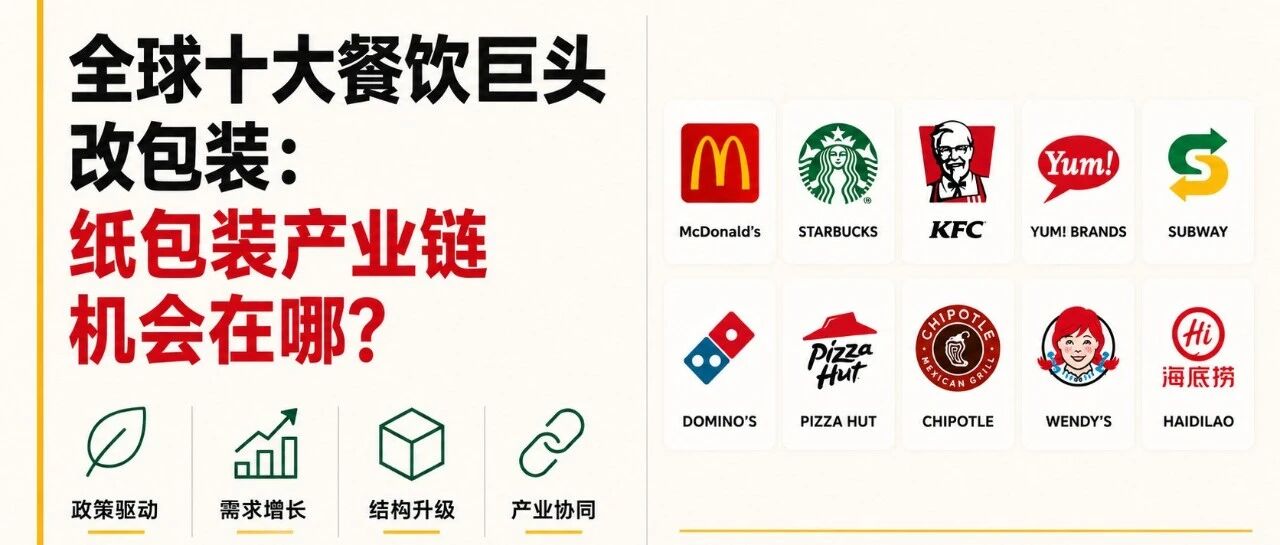
用2025门店榜单找到包装触点,再看2026变化如何传导到杯纸、食品卡、瓦楞、阻隔和供应资格。
前十品牌约31.7万家门店,铺开的是一张包装触点地图。它能不能变成订单,取决于单品规格、材料构成、食品接触、量产、加盟执行和当地末端是否一一接上。
连锁品牌最大的价值,是一个成熟规格可以跨市场复制;最大的难点,是同一品牌常被区域菜单、采购主体、加盟权限和回收设施拆成多套方案。
这是博碳包装按2025年末公开全球在营系统门店数、单一品牌口径编制的独立研究榜单;2026数据只进入动向卡,不参与2025名次。
31.7万 家门店触点 · 10 个品牌 · 2026 变化卡
按本文采用的公开数相加,前十品牌合计约317,220家门店。规模从蜜雪冰城(MIXUE)约48,250家,一直延伸到必胜客(Pizza Hut)单品牌复算19,155家;第11名库迪咖啡(Cotti Coffee)公开称18,000+家,未进入前十。这个量级足以把一次杯型、盒型或包纸切换放大成跨市场工程,但不能直接换算成吨位、订单金额或供应商份额。
2026年的几项变化,已经把机会指向更具体的接口:瑞幸咖啡半年净增5,262家;汉堡王(Burger King)把新翻盖盒(clamshell)用于皇堡(Whopper)核心单品;星巴克(Starbucks)的美国聚丙烯(PP)冷饮杯获得“广泛可回收”(Widely Recyclable)标识;百胜中国(Yum China)完成中国内地必胜客品牌所有权收购。门店榜单画出网络,2026变化则提醒供应商,哪些规格、采购权和末端条件已经开始移动。
2025门店排名
01|2025全球十大:约31.7万家门店触点
第01名
蜜雪冰城(MIXUE)约48,250家
口径|截至2025-12-31;博碳公开公式复算。中国市场43,789家,加上蜜雪集团(MIXUE Group)披露的海外集团门店,再剔除幸运咖(Lucky Cup)少量海外首店。网络与经营|集团以加盟为主,主品牌覆盖中国及海外13个国家。包装触点|饮料杯、杯盖、吸管、杯套、纸袋、冰淇淋包装和运输纸箱。
第02名
麦当劳(McDonald's)45,356家
口径|截至2025-12-31;官方精确。网络与经营|2,039家直营、43,317家特许/关联,约95%为特许经营;2025系统销售1,394亿美元。包装触点|纸杯、杯盖、纸袋、汉堡盒/包纸、薯条盒、餐具、外卖和运输包装。
第03名
星巴克(Starbucks)40,990家
口径|截至2025财年末(2025-09-28);官方精确。网络与经营|21,514家直营、19,476家许可,覆盖89个市场;2025财年收入371.844亿美元。包装触点|冷热饮杯、盖、杯套、吸管、纸袋、食品盒、外卖和重复使用杯。
第04名
赛百味(Subway)近37,000家
口径|2025年品牌正式近似披露;企业未给12月31日精确数。网络与经营|覆盖100多个国家,餐厅由独立加盟商拥有和运营。包装触点|三明治包纸、防油纸、纸袋、碗、杯盖、餐巾、餐具和外卖包装。与肯德基(KFC)的公开差距足以稳定第4名。
第05名
肯德基(KFC)33,897家
口径|截至2025-12-31;官方精确。网络与经营|149个国家和地区、99%加盟/许可;2025系统销售364.34亿美元。包装触点|鸡桶、餐盒、包纸、纸袋、杯盖、餐具、外卖和运输包装。
第06名
瑞幸咖啡(Luckin Coffee)31,048家
口径|截至2025-12-31;官方精确。网络与经营|20,234家直营、10,814家合作店;2025月均交易客户9,420万。包装触点|冷热饮杯、杯盖、杯套、纸袋、杯托、食品袋盒和配送包装。
第07名
达美乐(Domino's)22,142家
口径|截至2025-12-28;官方精确。网络与经营|覆盖90多个市场、约99%加盟;2025全球零售销售201.268亿美元。包装触点|瓦楞披萨盒、蘸料杯、纸袋、餐具、外卖和运输包装。
第08名
汉堡王(Burger King)19,900家
口径|截至2025-12-31;官方精确。网络与经营|覆盖126个国家和地区;2025系统销售293.68亿美元。包装触点|汉堡翻盖盒(clamshell)/包纸、纸袋、薯条盒、杯盖、餐具和外卖包装。
第09名
华莱士(Wallace)19,482家
口径|窄门餐眼2025品牌年终原表,品牌官网“约2万家”交叉确认;可信研究原表。网络与经营|中国31个省市区为主要网络,公开资料未统一拆分直营与加盟。包装触点|汉堡盒/包纸、炸鸡盒桶、薯条盒、杯盖、纸袋和外卖包装。
第10名
必胜客(Pizza Hut)19,155家
口径|截至2025-12-31;博碳单品牌复算。网络与经营|覆盖108个国家,99%+为加盟;事业部口径(Division)系统销售127.94亿美元只作辅助。包装触点|瓦楞披萨盒、鸡翅盒、纸袋、杯盖、餐具、外卖和运输包装。
两条复算边界|蜜雪集团(MIXUE Group)的59,823家不能直接当作蜜雪冰城单品牌数。必胜客(Pizza Hut)采用19,974 −(702 − 16)−(243 − 110)= 19,155:从百胜餐饮集团(Yum! Brands)披露的事业部口径(Division)总数中,剔除西班牙和葡萄牙可识别的Telepizza品牌差额;这是可重复计算的研究值,不是企业官方单品牌精确数。
研究资料:蜜雪集团(MIXUE Group)、麦当劳(McDonald's)、星巴克(Starbucks)、百胜餐饮集团(Yum! Brands)、瑞幸咖啡(Luckin Coffee)、达美乐(Domino's)及Restaurant Brands International(RBI,汉堡王母公司)年报与季度资料;赛百味(Subway)品牌资料;窄门餐眼;Ibersol年报;必胜客西班牙品牌网络数据。
大型连锁放大的不只是材料用量,也会放大换线失败、加盟不执行和末端不接收的成本。
2026观察清单
02|2026纸包装变化观察清单
网络与采购|先看需求有没有发生
01 门店与交易|每季核对期末在营门店、净开店、直营/加盟拆分和交易客户;门店增加而交易不增,包装放量未必同步。02 包装单品(SKU)|从新品、新店型、联名和核心产品公告中确认杯身、盒型、包纸或纸袋是否真的切换,并记录区域和首发日期。03 供应商导入|在采购公告、供应商规范和财报中查入围区域、采购主体、首批量、双供、扩区日期;样品通过不等于系统订单。04 加盟复制|查主特许市场的总部指定、本地采购、例外单品和实际覆盖率;同一品牌不等于同一张订单。
材料与兑现|再看方案能不能稳定交付
05 材料物料清单(BOM)与食品接触|查纸种、定量、再生含量、涂层/内衬、胶黏剂、油墨、接触温度、时间和证书有效期。06 量产良率|在试产、设备验收和30/60/90天爬坡中看线速、换线、漏液、掉粉、压溃、套叠、报废率。07 末端接收|查城市或回收商的接收清单、分选方式、再浆得率、污染率、终端需求和重复使用损耗。08 实际减量|把“预计减塑”“设计可回收”与年度实际用量、捕获率、回收率分开,按报告年份连续比较。
十家品牌变化
03|十张2026变化卡
2026变化
蜜雪冰城|先披露包材总量,品牌拆分仍待补齐
截至日期|2026-06-30。门店/市场|蜜雪集团(MIXUE Group)三品牌共有63,987家门店;蜜雪冰城新进入墨西哥、吉尔吉斯斯坦和巴西。集团数不重排2025单品牌榜单。包装/品牌/材料|2025环境、社会与管治(ESG)报告于2026年公开生产设施包装材料305,264.65吨、再生浆纸板箱占69.13%;超过3,000家蜜雪冰城门店部署全自动咖啡机。相对2025|集团首次把生产设施包材总量讲得更清楚,咖啡单品和设备也进入更多门店,但数据仍未拆到单一品牌和纸塑材料。产业含义|杯纸、杯盖、阻隔、封合和跨区域印刷一致性需求上升;吨位不是蜜雪单品牌门店消费量。下一信号|2026 ESG能否分品牌、分纸塑;咖啡机覆盖和新市场杯型。研究资料:蜜雪集团2026中期业绩;蜜雪集团2025环境、社会与管治报告。
2026变化
麦当劳|门店继续增加,材料来源进度为95.8%
截至日期|2026-06-30。门店/市场|46,028家,较2025年末净增672;约95%加盟。包装/品牌/材料|公司更新称2025年末95.8%主要顾客包装来自可再生、再生或认证材料;中国推进生物基新包装切换。相对2025|门店网络继续扩大,材料来源进度更新为95.8%,距离100%仍有缺口;中国市场已进入具体包装单品切换阶段。产业含义|认证纸源、纸杯/盒涂层和大规模换线有机会;来源属性不等于实际回收。下一信号|剩余4.2%构件,以及中国预计年减塑超过5,800吨对应的实际切换范围。研究资料:麦当劳2026年第二季度10-Q报告;公司包装进展更新;麦当劳中国包装升级公告。
2026变化
星巴克|从设计属性走向回收接入
截至日期|2026-06-28。门店/市场|41,304家,较2025财年末净增314。包装/品牌/材料|美国聚丙烯(PP)冷饮杯获得How2Recycle的“广泛可回收”(Widely Recyclable)标识;该标识对应至少60%美国家庭拥有路边回收或投放点接入。2025财年报告还披露,75%客用包装按可重复使用、可回收或可堆肥(RRC)方向设计,25%使用再生材料。相对2025|美国聚丙烯杯从设计端推进到回收接入门槛,实际捕获率仍未闭合。产业含义|纸杯与塑杯都要同时证明杯体、杯盖、分选接收和终端需求,不能只比材料标签。下一信号|聚丙烯杯实际捕获率、欧洲纸杯/纤维盖放量、重复使用杯占比。研究资料:星巴克2026财年第三季度业绩;2025财年全球影响报告;聚丙烯杯标识公告。
2026变化
赛百味|门店表述下调,包装量化没有跟上
截至日期|2026-08-30。门店/市场|当前品牌页面改称35,000+家;与2025“近37,000”不是同日同口径,不回写排名。包装/品牌/材料|未发现可核验的2026全球材料新增;公开方向仍以可回收、可堆肥和再生料为主。相对2025|品牌把全球门店表述改为35,000+,包装信息仍只有方向,没有新增量化指标。产业含义|防油包纸、纸袋和碗类机会,需要主特许市场SKU、涂层和供应商清单确认。下一信号|全球系统精确店数、主特许包装规范、SKU覆盖率。研究资料:赛百味品牌页面;气候与自然保护页面(Climate and Conservation)。
2026变化
肯德基|半年新增850家,全球包装指标仍缺席
截至日期|2026-06-30。门店/市场|34,747家,较2025年末净增850。包装/品牌/材料|未发现可核验的2026全球品牌级新增;Yum报告主要披露品牌/市场局部项目。相对2025|网络继续扩大,但全球品牌层面的包装量化数据仍没有出现。产业含义|鸡桶、餐盒、防油纸和纸袋有规模,但149个市场、本地法规和加盟采购会拆分订单。下一信号|肯德基品牌包装关键绩效指标(KPI)、新店包装单品、供应商认证和加盟执行率。研究资料:百胜餐饮集团2026年第二季度10-Q报告;2025全球企业公民与可持续发展报告。
2026变化
瑞幸咖啡|半年净增5,262家,杯类触点迅速扩大
截至日期|2026-06-30。门店/市场|36,310家,较2025年末净增5,262;第二季度(Q2)净开2,714家,月均交易客户1.127亿。包装/品牌/材料|未发现可核验的2026纸杯/盖材料切换;财报仅把配送包装材料列入直营店成本定义。相对2025|门店和交易客户同步增加,材料物料清单(BOM)、单杯克重和供应商份额仍未披露。产业含义|杯纸、杯盖、杯套、杯托、纸袋和高速成型检测形成强放量信号,但不能由门店数直接估吨位。下一信号|杯型单品、大杯扩展、供应商导入、单杯克重和量产良率。研究资料:瑞幸咖啡2026年第二季度业绩。
2026变化
达美乐|披萨盒网络继续扩大,材料披露没有更新
截至日期|2026-06-14。门店/市场|22,531家,较2025年末净增389。包装/品牌/材料|未发现可核验的2026全球披萨盒材料新增;公开行动仍主要是美国披萨盒70%+再生含量和历史减量。相对2025|披萨盒网络继续扩大,材料信息仍以美国案例为主。产业含义|高强轻量瓦楞、抗油同时可再浆、数字印刷和地方回收接受是核心接口。下一信号|2026责任报告、箱体克重/再生含量、地方接收率。研究资料:达美乐2026年第二季度业绩;2024责任管理报告;披萨盒回收说明。
2026变化
汉堡王|核心汉堡单品换用新盒
截至日期|2026-06-30。门店/市场|19,933家,较2025年末净增33。包装/品牌/材料|Restaurant Brands International(RBI,汉堡王母公司)宣布升级皇堡(Whopper),并采用新翻盖盒(clamshell);2025报告称,获批准的客用纤维包装中,95%+来自再生或认证来源。相对2025|核心汉堡单品进入结构更新,但材料物料清单(BOM)、上线区域和放量仍未披露。产业含义|食品卡纸、抗油阻隔、挺度、锁扣/封合、印刷一致性和加盟复制成为直接门槛。下一信号|翻盖盒材料物料清单、上线范围、转线良率和加盟覆盖率。研究资料:RBI 2026年第二季度10-Q报告;2025品牌向善报告;投资者日更新。
2026变化
华莱士|网络微降,联名换版仍频繁
截至日期|2026-03-08。门店/市场|监管申报文件披露19,437家,较2025研究原表少45家。包装/品牌/材料|未发现可核验的2026材料物料清单(BOM)升级;品牌持续高频联名。相对2025|网络轻微回落,视觉换版频率仍高,统一包材规范没有公开。产业含义|食品卡纸、汉堡盒、炸鸡盒桶、防油纸和短版印刷有需求,公开资料仍缺全国复制参数。下一信号|2026年末在营数、统一规格、联名批量和报废率。研究资料:北京证券交易所百利食品公开发行申请文件;窄门餐眼2025品牌年终表。
2026变化
必胜客|品牌所有权改变采购治理
截至日期|2026-08-07。门店/市场|2026年第二季度的事业部口径(Division)为19,985家;不用于改写2025单品牌排名。包装/品牌/材料|百胜中国(Yum China)已完成收购中国内地必胜客品牌所有权;境外交易另行推进。相对2025|同一品牌开始对应不同所有者和采购体系,全球统一规范面临新的治理边界。产业含义|披萨盒、鸡翅盒和外卖包装供应商需分别跟踪中国与境外采购权限、规格和认证。下一信号|境外交易完成、新供应商名录、中国与境外包装规范差异。研究资料:百胜餐饮集团2026年第二季度10-Q报告;百胜中国品牌收购完成公告。
包装构件地图
04|包装构件地图:机会沿着使用条件分层
饮品线|蜜雪冰城、星巴克、瑞幸咖啡、麦当劳和肯德基高频使用杯、盖、杯套、杯托、吸管和纸袋。机会集中在杯纸、阻隔、卷筒印刷、封合与高速检测;门槛是热/冷饮、果酸、漏液、杯盖配合和食品接触。
热食线|麦当劳、肯德基、华莱士和汉堡王对应汉堡盒/包纸、炸鸡盒桶和薯条盒。机会在食品卡纸、无氟防油和结构锁扣;门槛是热油、蒸汽回潮、挺度、折叠速度和最终制品迁移。
披萨线|达美乐和必胜客的核心是瓦楞披萨盒。机会在轻量高强瓦楞、抗油同时可再浆、数字印刷和箱型优化;门槛是压溃、保温散湿、油污接收和地区回收规则。
模塑与重复使用|纤维杯盖、杯托、餐具和托盘需要验证湿热强度、套叠、掉粉、成型良率和食品接触;重复使用系统还要看回收点、清洗、周转次数、损耗和参与率。
运输线|集团工厂、配送中心和加盟网络使用再生瓦楞、周转托盘、仓配标签和自动装箱。运输包装与客用包装必须分开统计。
唯一可直接采用的总量披露来自蜜雪集团(MIXUE Group):2025年集团生产设施包装材料305,264.65吨,其中“可持续包装材料”111,602.18吨、其他包装193,662.47吨。该分类包含纸杯、结晶聚乳酸(CPLA)吸管、聚乳酸(PLA)塑杯等,不是纸/塑料拆分,更不是蜜雪冰城单品牌门店消费量。
其余九个品牌没有公开全球、全渠道、全包装单品统一的纸、塑料或总包装吨位。本文不做“门店数×假设单店用量”的情景估算。
供应资格
05|六类机会,都要经过供应资格这一关
造纸企业|机会在杯纸、食品卡、袋纸、防油纸和瓦楞规格分层;入场证据是认证纤维、低克重高强、涂布适配、批次稳定和跨区域供货。
包装加工|机会在全球基础款与短版联名并存;入场证据是模切、成型、套印、封合、掉粉、压溃、换版损耗和30/60/90天爬坡记录。
功能材料|水性、生物基、无氟只是材料属性。供应资格要绑定最终接触面、温度、时间、酸油水环境、成型工艺和末端路径。
设备检测|杯机、糊盒、模切、视觉检测和在线泄漏/封合控制会随包装单品切换放大;关键文件是线速、良率、换线时间、缺陷判定和稳定性报告。
回收再浆|“设计可回收”之后,还要拿出当地接收、收集、分选、再浆得率、污染率和终端需求数据。
品牌采购|门店数只是谈判入口。采购资格表要写清总部规范、主特许市场、本地供应、加盟强制性、双供策略、旧库存切换和版本责任人。
反方校准
06|必须校准:大网络不等于统一订单
瑞幸咖啡半年新增5,262家,确实扩大了杯、盖、袋和杯托触点;没有杯型、克重、交易数和供应商份额,仍不能换算吨位。汉堡王的新翻盖盒进入核心单品,也不等于126个市场同步更换。必胜客品牌所有权拆分后,同一品牌会对应不同采购主体。
纸替塑也不自动成立。纸基结构如果增加复合层、降低线速、提高报废或不被当地设施接收,只是把成本和环境问题换了位置。供应商必须同时回答功能、合规、量产、商业复制和末端五个问题。
博碳数说
2025榜单给出网络坐标:前十约31.7万家门店;2026变化卡则把订单线索落到具体动作:瑞幸咖啡高速开店、星巴克推进回收接入、汉堡王更换核心单品包装、必胜客重构品牌所有权。
对纸包装产业链,更有用的跟踪方式,是把“纸替塑”拆成六个问题:门店净增是否伴随交易增长,包装是否进入明确单品,材料物料清单是否闭合,供应商能否稳定量产,加盟体系是否执行,末端是否接收。只有这些指标连续兑现,全球餐饮网络才会转化为可持续订单。
喝完咖啡,纸杯开始生长,博碳育苗纸杯。
博碳包装·产业洞察·研究说明
本文由博碳包装基于企业年报、监管文件、可持续报告、品牌正式资料和可信研究原表独立研究,核验截至2026年8月30日,仅供产业研究学习,不构成采购、投资或合规决策依据。如对内容、数据或权益有异议,可提出修改、说明或删除请求,我们将在收到后24小时内核查处理。
博碳观察数据与核验来源
蜜雪集团(MIXUE Group)|2025年度报告蜜雪集团(MIXUE Group)|2026中期业绩麦当劳(McDonald's)|2025年度10-K报告星巴克(Starbucks)|2025年度10-K报告赛百味(Subway)|2025品牌资料百胜餐饮集团(Yum! Brands)|2025年度10-K报告百胜餐饮集团(Yum! Brands)|2025全球品牌与市场门店表瑞幸咖啡(Luckin Coffee)|2025财年业绩达美乐(Domino's Pizza)|2025年度报告Restaurant Brands International(RBI,汉堡王母公司)|2025年度10-K报告北京证券交易所|百利食品公开发行申请文件Ibersol|2025年度报告百胜中国(Yum China)|必胜客中国内地品牌收购公告星巴克(Starbucks)|2025财年全球影响报告
Use the 2025 store ranking to locate packaging touchpoints, then examine how 2026 developments are flowing through to cupstock, foodservice board, corrugated packaging, barrier systems and supplier qualification.
The top ten brands represent approximately 317,000 store touchpoints, creating a map of packaging demand. Whether that map converts into orders depends on aligning each SKU's specifications, material construction, food-contact compliance, commercial-scale production, franchisee implementation and local end-of-life infrastructure.
The greatest value of a restaurant chain is that a proven specification can be replicated across markets. The greatest challenge is that regional menus, procurement entities, franchise rights and recycling infrastructure can divide a single brand into multiple packaging programs.
This independent BIOTEN Packaging ranking is based on publicly disclosed global stores in operation at the end of 2025 and uses a single-brand methodology. Data from 2026 appear only in the development cards and do not affect the 2025 ranking.
317,000 store touchpoints · 10 brands · 2026 development cards
Based on the public figures used in this analysis, the top ten brands operated approximately 317,220 stores in total. The ranking extends from approximately 48,250 MIXUE stores to a reconstructed single-brand total of 19,155 Pizza Hut stores. Cotti Coffee, ranked eleventh, reported more than 18,000 stores and therefore did not enter the top ten. This scale can turn a change in cup or box format into a cross-market program, but it cannot be converted directly into tonnage, order value or supplier share.
Several developments in 2026 already point to more specific opportunities: Luckin Coffee added a net 5,262 stores in the first half; Burger King introduced a new clamshell for its core Whopper product; Starbucks' polypropylene cold cup in the United States received a How2Recycle Widely Recyclable designation; and Yum China completed the acquisition of Pizza Hut's brand ownership in mainland China. The store ranking maps the network, while the 2026 developments show suppliers which specifications, procurement rights and end-of-life conditions have begun to change.
2025 Store Ranking
01 | 2025 Global Top 10: Approximately 317,000 Store Touchpoints
No. 01
MIXUEApproximately 48,250 stores
Basis | As of 31 December 2025; reconstructed by BIOTEN from public disclosures. The total combines 43,789 stores in China with MIXUE Group's disclosed overseas network, while excluding the small number of overseas Lucky Cup pilot stores. Network and operations | The group operates primarily through franchising. Its flagship brand is present in China and 13 overseas countries. Packaging touchpoints | Beverage cups, lids, straws, sleeves, paper bags, ice-cream packaging and corrugated transport cases.
No. 02
McDonald's45,356 stores
Basis | As of 31 December 2025; precise figure reported by the company. Network and operations | 2,039 company-operated restaurants and 43,317 franchised or affiliated restaurants; approximately 95% franchised. Systemwide sales were US$139.4 billion in 2025. Packaging touchpoints | Paper cups, lids, paper bags, burger cartons and wraps, fry cartons, cutlery, delivery packaging and transport packaging.
No. 03
Starbucks40,990 stores
Basis | As of the end of fiscal 2025 (28 September 2025); precise figure reported by the company. Network and operations | 21,514 company-operated stores and 19,476 licensed stores across 89 markets. Fiscal 2025 revenue was US$37.1844 billion. Packaging touchpoints | Hot and cold beverage cups, lids, sleeves, straws, paper bags, food cartons, delivery packaging and reusable cups.
No. 04
SubwayNearly 37,000 stores
Basis | An official brand approximation published in 2025; the company did not report an exact figure for 31 December. Network and operations | Present in more than 100 countries, with restaurants owned and operated by independent franchisees. Packaging touchpoints | Sandwich wraps, grease-resistant paper, paper bags, bowls, cup lids, napkins, cutlery and delivery packaging. Its publicly reported lead over KFC is sufficient to support fourth place.
No. 05
KFC33,897 stores
Basis | As of 31 December 2025; precise figure reported by the company. Network and operations | Present in 149 countries and territories, with 99% of stores franchised or licensed. System sales were US$36.434 billion in 2025. Packaging touchpoints | Chicken buckets, meal cartons, wraps, paper bags, cup lids, cutlery, delivery packaging and transport packaging.
No. 06
Luckin Coffee31,048 stores
Basis | As of 31 December 2025; precise figure reported by the company. Network and operations | 20,234 self-operated stores and 10,814 partnership stores. Average monthly transacting customers reached 94.2 million in 2025. Packaging touchpoints | Hot and cold beverage cups, lids, sleeves, paper bags, cup carriers, food bags and cartons, and delivery packaging.
No. 07
Domino's22,142 stores
Basis | As of 28 December 2025; precise figure reported by the company. Network and operations | Present in more than 90 markets, with approximately 99% of stores franchised. Global retail sales were US$20.1268 billion in 2025. Packaging touchpoints | Corrugated pizza boxes, dipping cups, paper bags, cutlery, delivery packaging and transport packaging.
No. 08
Burger King19,900 stores
Basis | As of 31 December 2025; precise figure reported by the company. Network and operations | Present in 126 countries and territories. System sales were US$29.368 billion in 2025. Packaging touchpoints | Burger clamshells and wraps, paper bags, fry cartons, cup lids, cutlery and delivery packaging.
No. 09
Wallace19,482 stores
Basis | Based on the original 2025 year-end brand table from Narrow Door Restaurant Data, cross-checked against the brand website's statement of approximately 20,000 stores; a credible research-table figure. Network and operations | The network is concentrated across China's 31 provincial-level regions. Public disclosures do not provide a consistent breakdown between company-operated and franchised stores. Packaging touchpoints | Burger cartons and wraps, fried-chicken cartons and buckets, fry cartons, cup lids, paper bags and delivery packaging.
No. 10
Pizza Hut19,155 stores
Basis | As of 31 December 2025; single-brand figure reconstructed by BIOTEN. Network and operations | Present in 108 countries, with more than 99% of stores franchised. Division-level system sales of US$12.794 billion are included only as supplementary context. Packaging touchpoints | Corrugated pizza boxes, chicken-wing cartons, paper bags, cup lids, cutlery, delivery packaging and transport packaging.
Two reconstruction boundaries | MIXUE Group's total of 59,823 stores cannot be treated as the store count of the MIXUE brand alone. For Pizza Hut, the reconstructed figure is 19,974 - (702 - 16) - (243 - 110) = 19,155. The calculation starts with the Yum! Brands division total and removes the identifiable Telepizza-brand differences in Spain and Portugal. It is a reproducible research estimate, not an exact single-brand figure reported by the company.
Sources: Annual reports and quarterly disclosures from MIXUE Group, McDonald's, Starbucks, Yum! Brands, Luckin Coffee, Domino's and Restaurant Brands International (RBI, Burger King's parent company); Subway brand materials; Narrow Door Restaurant Data; the Ibersol annual report; and Pizza Hut Spain network data.
Large restaurant chains amplify more than material consumption. They also magnify the cost of failed line changeovers, incomplete franchisee implementation and rejection by local end-of-life systems.
2026 Tracking Checklist
02 | 2026 Paper-Packaging Development Checklist
Network and procurement | First determine whether demand has actually changed
01 Stores and transactions | Each quarter, verify stores in operation at period-end, net openings, the company-operated/franchised split and transacting customers. If store count rises without transaction growth, packaging volume may not increase at the same pace. 02 Packaging SKUs | Use product launches, new store formats, collaborations and core-product announcements to confirm whether the cup body, carton format, wrap or paper bag has actually changed. Record the market and launch date. 03 Supplier onboarding | Review procurement notices, supplier specifications and financial disclosures for the approved region, purchasing entity, initial volume, dual-sourcing arrangement and expansion date. Sample approval is not the same as a systemwide order. 04 Franchise replication | Determine whether headquarters mandates the specification, permits local sourcing or grants SKU-level exceptions in major franchise markets, and verify the actual coverage rate. One brand does not necessarily represent one order.
Materials and execution | Then determine whether the solution can be delivered reliably
05 Bill of materials (BOM) and food contact | Verify the paper grade, basis weight, recycled content, coating or liner, adhesive, ink, contact temperature and duration, and certificate validity. 06 Commercial-scale yield | During trials, equipment acceptance and the 30/60/90-day ramp-up, track line speed, changeovers, leakage, dusting, crush performance, nesting and scrap rate. 07 End-of-life acceptance | Verify municipal or recycler acceptance lists, sorting methods, repulping yield, contamination rate, end-market demand and losses in reusable systems. 08 Actual material reduction | Separate projected plastic reduction and design for recyclability from annual actual material use, capture rate and recycling rate, and compare them consistently across reporting years.
Developments Across Ten Brands
03 | Ten 2026 Development Cards
2026 development
MIXUE | Aggregate packaging volume disclosed; brand-level allocation remains unavailable
As of | 30 June 2026. Stores and markets | MIXUE Group operated 63,987 stores across its three brands. MIXUE entered Mexico, Kyrgyzstan and Brazil. The group total does not alter the 2025 single-brand ranking. Packaging, brand and materials | The 2025 ESG Report, published in 2026, disclosed 305,264.65 tonnes of packaging materials used at production facilities; cardboard boxes made from recycled pulp accounted for 69.13%. More than 3,000 MIXUE stores deployed fully automatic coffee machines. Change from 2025 | The group has provided greater transparency on total packaging materials used at production facilities, while coffee products and equipment have entered more stores. The data, however, are still not split by individual brand or between paper and plastic. Industry implications | Demand is increasing for cupstock, lids, barrier systems, sealing performance and cross-regional print consistency. The disclosed tonnage is not the packaging consumption of MIXUE stores alone. Next signal | Whether the 2026 ESG report provides brand-level and paper/plastic breakdowns, along with coffee-machine coverage and cup formats in new markets. Sources: MIXUE Group 2026 Interim Results; MIXUE Group 2025 Environmental, Social and Governance Report.
2026 development
McDonald's | Store count continues to rise; responsible sourcing reaches 95.8%
As of | 30 June 2026. Stores and markets | 46,028 restaurants, a net increase of 672 from year-end 2025; approximately 95% franchised. Packaging, brand and materials | The company reported that, at year-end 2025, 95.8% of primary guest packaging was sourced from renewable, recycled or certified materials. McDonald's China is advancing a transition to new bio-based packaging. Change from 2025 | The restaurant network continued to expand, and the responsible-sourcing rate rose to 95.8%, still short of 100%. China has moved into SKU-specific packaging changes. Industry implications | Opportunities exist in certified fiber, paper-cup and carton coatings, and large-scale line conversions. Responsible sourcing does not by itself establish actual recyclability. Next signal | The remaining 4.2% of packaging components and the actual scope of changes underlying McDonald's China's projected annual plastic reduction of more than 5,800 tonnes. Sources: McDonald's Q2 2026 Form 10-Q; company packaging-progress update; McDonald's China packaging-upgrade announcement.
2026 development
Starbucks | Moving from design attributes to recycling access
As of | 28 June 2026. Stores and markets | 41,304 stores, a net increase of 314 from the end of fiscal 2025. Packaging, brand and materials | Starbucks' polypropylene (PP) cold cup in the United States received a How2Recycle Widely Recyclable designation, meaning that at least 60% of U.S. households have access through curbside collection or drop-off programs. The fiscal 2025 report also stated that 75% of customer-facing packaging was designed to be reusable, recyclable or compostable (RRC), while 25% incorporated recycled content. Change from 2025 | The U.S. polypropylene cup has advanced from design intent to the threshold for recycling access, but the actual capture rate has not yet been demonstrated. Industry implications | Both paper and plastic cups must demonstrate alignment among the cup body, lid, sorting acceptance and end-market demand; a material label alone is insufficient. Next signal | Actual capture rates for polypropylene cups, scale-up of paper cups and fiber lids in Europe, and the share of beverages served in reusable cups. Sources: Starbucks Q3 Fiscal 2026 Results; Fiscal 2025 Global Impact Report; polypropylene-cup recyclability announcement.
2026 development
Subway | Store-count wording moves lower; quantified packaging data do not follow
As of | 30 August 2026. Stores and markets | The current brand page states more than 35,000 restaurants. Because this is not a same-date, like-for-like figure with the nearly 37,000 reported in 2025, it does not revise the ranking. Packaging, brand and materials | No verifiable new global material metric for 2026 was identified. Public commitments continue to focus on recyclable, compostable and recycled-content materials. Change from 2025 | The brand has revised its global network description to more than 35,000 restaurants, while packaging disclosures still provide direction rather than new quantitative metrics. Industry implications | Opportunities in grease-resistant sandwich wraps, paper bags and bowls require confirmation of SKUs, coatings and approved-supplier lists in major franchise markets. Next signal | A precise global system count, packaging specifications in major franchise markets and SKU coverage rates. Sources: Subway brand page; Climate and Conservation page.
2026 development
KFC | 850 net new stores in the first half; global packaging metrics remain absent
As of | 30 June 2026. Stores and markets | 34,747 restaurants, a net increase of 850 from year-end 2025. Packaging, brand and materials | No verifiable new global brand-level packaging metric for 2026 was identified. Yum's reporting primarily covers individual brand or market initiatives. Change from 2025 | The network continued to expand, but no quantitative global brand-level packaging data have emerged. Industry implications | Chicken buckets, meal cartons, grease-resistant paper and paper bags offer substantial scale, but 149 markets, local regulation and franchise procurement divide the opportunity into multiple orders. Next signal | KFC brand-level packaging KPIs, packaging SKUs for new stores, supplier certification and franchisee implementation rates. Sources: Yum! Brands Q2 2026 Form 10-Q; 2025 Global Citizenship and Sustainability Report.
2026 development
Luckin Coffee | 5,262 net new stores in the first half rapidly expand beverage-packaging touchpoints
As of | 30 June 2026. Stores and markets | 36,310 stores, a net increase of 5,262 from year-end 2025. Luckin opened a net 2,714 stores in Q2, while average monthly transacting customers reached 112.7 million. Packaging, brand and materials | No verifiable 2026 change in paper-cup or lid materials was identified. The financial statements refer only to delivery packaging materials within the cost definition for self-operated stores. Change from 2025 | Stores and transacting customers both increased, but the bill of materials (BOM), material weight per cup and supplier shares remain undisclosed. Industry implications | Cupstock, lids, sleeves, cup carriers, paper bags and high-speed forming and inspection systems all show strong volume potential, but store count cannot be converted directly into tonnage. Next signal | Cup-format SKUs, large-size expansion, supplier onboarding, material weight per cup and commercial-scale yield. Sources: Luckin Coffee Q2 2026 Results.
2026 development
Domino's | The pizza-box network continues to expand; material disclosures have not been updated
As of | 14 June 2026. Stores and markets | 22,531 stores, a net increase of 389 from year-end 2025. Packaging, brand and materials | No verifiable new global pizza-box material development for 2026 was identified. Publicly disclosed actions still center on more than 70% recycled content in U.S. pizza boxes and historical source reduction. Change from 2025 | The pizza-box network continued to expand, while material information remains concentrated on U.S. examples. Industry implications | The principal interfaces are lightweight, high-strength corrugated board; grease resistance with repulpability; digital printing; and acceptance by local recycling systems. Next signal | The 2026 responsibility report, box basis weight and recycled content, and local acceptance rates. Sources: Domino's Q2 2026 Results; 2024 Stewardship Report; pizza-box recycling guidance.
2026 development
Burger King | A new package for its core burger SKU
As of | 30 June 2026. Stores and markets | 19,933 restaurants, a net increase of 33 from year-end 2025. Packaging, brand and materials | Restaurant Brands International (RBI), Burger King's parent company, announced an upgraded Whopper served in a new clamshell. Its 2025 report stated that more than 95% of approved guest-facing fiber packaging was sourced from recycled or certified materials. Change from 2025 | The core burger SKU has entered a structural packaging redesign, but the bill of materials (BOM), launch markets and volume remain undisclosed. Industry implications | Food-grade paperboard, grease barriers, stiffness, locking and sealing performance, print consistency and franchise replication are direct qualification thresholds. Next signal | The clamshell BOM, launch scope, conversion yield and franchisee coverage. Sources: RBI Q2 2026 Form 10-Q; 2025 Restaurant Brands for Good Report; investor-day update.
2026 development
Wallace | A slightly smaller network, with frequent collaboration-driven artwork changes
As of | 8 March 2026. Stores and markets | A regulatory filing reported 19,437 stores, 45 fewer than the 2025 research-table figure. Packaging, brand and materials | No verifiable 2026 bill-of-materials (BOM) upgrade was identified. The brand continues to run frequent collaborations. Change from 2025 | The network edged lower, while visual redesigns remained frequent. No unified packaging specification has been publicly disclosed. Industry implications | Demand exists for food-grade paperboard, burger cartons, fried-chicken cartons and buckets, grease-resistant paper and short-run printing, but public information still lacks parameters for nationwide replication. Next signal | The year-end 2026 store count, unified specifications, collaboration volumes and obsolescence or scrap rates. Sources: Baili Foods public-offering application filed with the Beijing Stock Exchange; Narrow Door Restaurant Data 2025 year-end brand table.
2026 development
Pizza Hut | A change in brand ownership reshapes procurement governance
As of | 7 August 2026. Stores and markets | The division-level store count for Q2 2026 was 19,985. It is not used to revise the 2025 single-brand ranking. Packaging, brand and materials | Yum China completed its acquisition of Pizza Hut's brand ownership in mainland China; the transaction for markets outside mainland China is proceeding separately. Change from 2025 | A single brand is beginning to map to different owners and procurement systems, creating new governance boundaries for global specifications. Industry implications | Suppliers of pizza boxes, chicken-wing cartons and delivery packaging must track procurement authority, specifications and certification separately for China and other markets. Next signal | Completion of the transaction outside mainland China, new approved-supplier lists, and differences between packaging specifications in China and other markets. Sources: Yum! Brands Q2 2026 Form 10-Q; Yum China announcement confirming completion of the mainland China brand acquisition.
Packaging Component Map
04 | Packaging Component Map: Opportunities Differ by Use Conditions
Beverage packaging | MIXUE, Starbucks, Luckin Coffee, McDonald's and KFC use cups, lids, sleeves, cup carriers, straws and paper bags at high frequency. Opportunities center on cupstock, barrier coatings, web printing, sealing and high-speed inspection. Qualification thresholds include hot and cold beverages, fruit acids, leakage, cup-lid fit and food-contact compliance.
Hot-food packaging | McDonald's, KFC, Wallace and Burger King use burger cartons and wraps, fried-chicken cartons and buckets, and fry cartons. Opportunities lie in food-grade paperboard, fluorine-free grease resistance and structural locking. Qualification thresholds include hot oil, steam-induced moisture, stiffness, folding speed and migration testing on the finished article.
Pizza packaging | Corrugated pizza boxes are central to Domino's and Pizza Hut. Opportunities lie in lightweight, high-strength corrugated board, grease resistance with repulpability, digital printing and structural optimization. Qualification thresholds include crush performance, the balance between heat retention and moisture release, acceptance of oil-contaminated fiber and regional recycling rules.
Molded fiber and reuse | Fiber lids, cup carriers, cutlery and trays require validation of wet-heat strength, nesting performance, dusting, forming yield and food-contact compliance. Reusable systems must also demonstrate collection points, washing, number of rotations, loss rates and participation.
Transport packaging | Group factories, distribution centers and franchise networks use recycled-content corrugated packaging, reusable pallets, warehouse and logistics labels, and automated case packing. Transport packaging and customer-facing packaging must be reported separately.
The only directly usable aggregate disclosure comes from MIXUE Group. In 2025, the group's production facilities used305,264.65 tonnesof packaging materials, including 111,602.18 tonnes classified as Sustainable Packaging Material Usage and 193,662.47 tonnes as Other Packaging Material Usage. The classification includes paper cups, crystallized polylactic acid (CPLA) straws and polylactic acid (PLA) plastic cups. It is neither a paper/plastic split nor the packaging consumption of MIXUE stores alone.
The other nine brands do not disclose a unified global, all-channel total for paper, plastic or all packaging SKUs. This analysis therefore does not estimate tonnage by multiplying store count by assumed consumption per store.
Supplier Qualification
05 | Six Opportunity Areas, All Subject to Supplier Qualification
Paper producers | Opportunities lie in differentiated grades of cupstock, foodservice board, bag paper, grease-resistant paper and corrugated medium or linerboard. Entry evidence includes certified fiber, lightweight strength, coating compatibility, batch consistency and cross-regional supply capability.
Packaging converters | Opportunities combine standardized global formats with short-run collaboration designs. Entry evidence includes die-cutting, forming, print registration, sealing, dusting, crush performance, artwork-change waste and 30/60/90-day ramp-up records.
Functional materials | Water-based, bio-based and fluorine-free describe material attributes only. Supplier qualification must be tied to the final food-contact surface, temperature, duration, acid/oil/water environment, converting process and end-of-life pathway.
Equipment and inspection | Changes in packaging SKUs increase demand for cup-forming, folder-gluing, die-cutting, vision inspection, and inline leakage and seal control. The critical records are line speed, yield, changeover time, defect criteria and stability reports.
Recycling and repulping | After establishing design for recyclability, suppliers must still provide data on local acceptance, collection, sorting, repulping yield, contamination and end-market demand.
Brand procurement | Store count is only an entry point for commercial discussions. A supplier-qualification matrix must identify headquarters specifications, major franchise markets, local sourcing, mandatory franchisee compliance, dual-sourcing strategies, legacy-inventory transition and the owner of each specification version.
Necessary Calibration
06 | A Large Network Is Not the Same as a Unified Order
Luckin Coffee's 5,262 net new stores in the first half clearly expanded touchpoints for cups, lids, bags and cup carriers. Without cup formats, basis weights, transaction volumes and supplier shares, however, the increase still cannot be converted into tonnage. Burger King's new clamshell has entered a core product SKU, but that does not mean all 126 markets will change at the same time. After Pizza Hut's brand ownership is divided, the same brand will correspond to different procurement entities.
Paper substitution does not work automatically either. If a paper-based structure adds composite layers, slows production, increases scrap or is not accepted by local infrastructure, it merely shifts the cost and environmental burden. Suppliers must answer five questions at once: functionality, compliance, commercial-scale production, commercial replication and end-of-life performance.
BIOTEN by the Numbers
The 2025 ranking provides network coordinates: approximately 317,000 stores across the top ten brands. The 2026 development cards translate that network into specific order signals: Luckin Coffee's rapid store expansion, Starbucks' progress on recycling access, Burger King's change to core-product packaging and Pizza Hut's restructuring of brand ownership.
For the paper-packaging value chain, a more useful way to track paper substitution is to break it into six questions: Does net store growth come with transaction growth? Has the packaging entered a defined SKU? Is the bill of materials complete? Can the supplier deliver stable commercial-scale production? Will the franchise system implement the change? Will local end-of-life systems accept it? Only sustained progress on these measures can turn a global restaurant network into durable orders.
When the coffee is finished, the paper cup begins to grow: the BIOTEN nursery paper cup.
BIOTEN Packaging | Industry Insight | Research Note
This article is an independent BIOTEN Packaging study based on corporate annual reports, regulatory filings, sustainability reports, official brand materials and credible original research tables. Information was verified through 30 August 2026. It is provided solely for industry research and learning and does not constitute procurement, investment or compliance advice. If you have concerns regarding the content, data or rights involved, you may request a correction, clarification or removal. We will review the request within 24 hours of receipt.
BIOTEN Observer Data and Verification Sources
MIXUE Group | 2025 Annual Report; MIXUE Group | 2026 Interim Results; McDonald's | 2025 Form 10-K; Starbucks | 2025 Form 10-K; Subway | 2025 Brand Materials; Yum! Brands | 2025 Form 10-K; Yum! Brands | 2025 Global Brand and Market Store Table; Luckin Coffee | Fiscal 2025 Results; Domino's Pizza | 2025 Annual Report; Restaurant Brands International (RBI, Burger King's parent company) | 2025 Form 10-K; Beijing Stock Exchange | Baili Foods Public-Offering Application; Ibersol | 2025 Annual Report; Yum China | Announcement on the Acquisition of Pizza Hut's Brand Ownership in Mainland China; Starbucks | Fiscal 2025 Global Impact Report.