

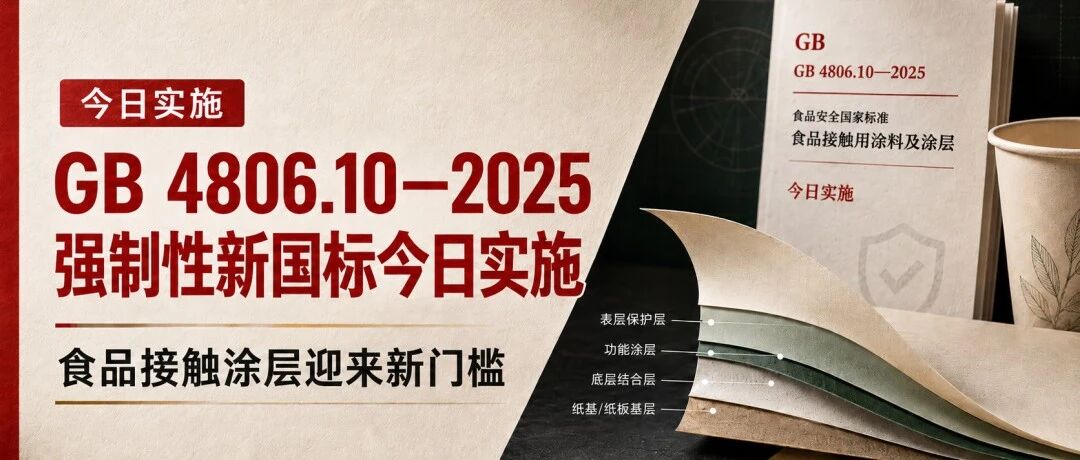
2026年9月2日强制性新国标正式实施
GB 4806.10—2025《食品安全国家标准 食品接触材料及制品用涂料及涂层》正式实施。105→346之后,产业链要更新哪些证据?
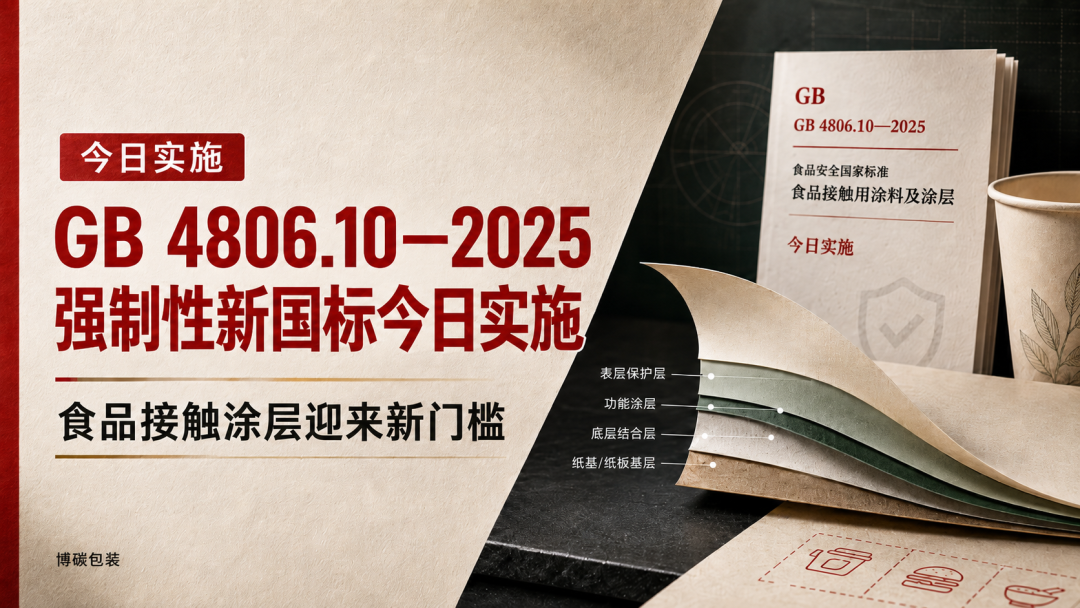
基础原料范围扩大到346种,同时检测与责任链收紧;合规仍要落到具体原料、涂层工艺、最终包装和使用条件。
涂料供应商决定配方与信息,涂布纸厂控制工艺,包装厂把证据落到SKU,品牌采购和检测团队负责场景与验证。
标准适用于食品接触材料及制品用涂料与涂层,不是纸质餐饮具专用标准;旧库存和旧报告仍需按产品与批次判断。
实施日三项锚点
2026.09.02 正式实施
105 → 346 基础原料数量
0.6 → 0.05 mg/kg 涉及相应原料时的双酚A迁移限值
第一层 · 标准对象
标准管什么
2026年9月2日,GB 4806.10—2025《食品安全国家标准 食品接触材料及制品用涂料及涂层》正式实施,代替2016版。食品安全国家标准依法强制执行。
它覆盖食品接触材料及制品所用的涂料与涂层:可以直接接触食品,也包括不直接接触、但成分可能迁移到食品中的涂层。
2016版明确排除纸涂料及涂层,2025版删除了这项排除。纸杯、纸碗、纸餐盒和食品包装纸上的涂层,由此有了更清楚的标准坐标。
对涂层纸包装,纸和纸板主体仍要符合GB 4806.8—2022,涂料及涂层符合GB 4806.10—2025;结构中还有塑料层、黏合剂或油墨时,继续核对相应要求。最终SKU面对的是一组标准,不是一张材料报告。
研究资料:国家卫生健康委2025年第6号公告;食品安全国家标准数据检索平台
第二层 · 新旧变化
关键变化
原料扩容:北京市市场监管局官方解读显示,允许使用的基础原料由105种增至346种;新标准还整合了23项相关公告中涂料及涂层用基础原料的内容。
扩容不等于346种原料可以无条件使用。企业仍要逐项核对原料身份、使用量、迁移或残留限制、适用食品、温度、涂层厚度及特殊人群用途。
双酚A限量收紧:涉及相应原料时,迁移限值由0.6 mg/kg降至0.05 mg/kg。它不能扩写成所有涂层固定必检同一项目,也不是对某类材料的一刀切禁令。
终产品检测加强:对含芳香族异氰酸酯、偶氮类着色剂等可能产生芳香族伯胺的涂层,应在固化后的食品接触材料及制品终产品上检测;一般要求不得检出,检出限为0.01 mg/kg,已有具体迁移限量的按相应规定执行。
责任落到上下游:第3.2条要求涂料生产企业从配方设计、原料选择、生产控制和信息传递控制风险;第3.3条要求使用企业关注接缝与边缘、有效阻隔层、固化过程、涂料使用量和信息传递。
这份标准规定的是食品接触安全,不是统一VOC限值,也没有宣布某种材料全面退出。
研究资料:北京市市场监督管理局新国标解读;2025版与2016版正式文本
第三层 · 责任链
对产业链各方的影响
涂料、乳液和添加剂供应商:对外牌号要能对应内部配方版本,并说明原料限制、适用条件和变更责任。下游需要的不是商业秘密,而是足以完成安全评估的文件。
涂布纸厂:原纸、涂层牌号、涂布量、干燥固化、生产线和接触面要进入产品版本。配方、涂布量、温度或线速变化,都可能改变原报告的适用边界。
包装加工厂:证据要落到最终SKU。杯身、卷口、杯底、搭接缝、盒角和切边经历的材料与工艺不同,不能用一桶涂料或一张平面样片代替成品判断。
品牌采购与供应链:采购规格先写食品、温度、接触时间、热灌装、冷藏、复热和使用次数。报告必须对应实际供应商、牌号、工厂、结构和批次。
检测、质量与法规团队:样品结构、接触面、食品模拟物、时间、温度、面积体积比和固化状态都要进入测试方案。标准名称相同,不代表不同SKU可以共用同一结论。
第四层 · 当天动作
企业今天怎么做
01|清原料。涂料供应商核对基础原料与添加剂的清单位置、最大使用量、特定迁移、迁移总量和残留限制,形成版本化原料限制矩阵。
02|清结构。涂布纸厂和包装厂建立“基材—涂层—工艺—最终SKU—用途”映射,标出食品接触面、接缝、边缘和有效阻隔层。
03|清测试。判断纸涂层、间接接触、双酚A、其他风险项目和固化终产品是否触发,同时核对食品模拟物、时间和温度。
04|清文件。更新符合性声明、供应商证明、测试报告适用范围、批次追溯和变更通知。GB 4806.1要求的信息不能被一句“符合新国标”替代。
05|清过渡。把旧库存、旧报告、在制品、客户在库和未交订单列成清单。标准正文与第6号公告没有给出适用于所有企业的一刀切方式,不能自行宣布全部沿用或全部报废。
一个短边界:GB 4806.10—2025回答的是食品接触安全问题,不自动证明无PFAS、可回收或可堆肥;这些声明仍要使用各自对应的最终结构、方法和地区证据。
新标准扩大了原料选择,也提高了把信息传到最终包装的要求。
今天要更新的不是一张报告,而是原料、工艺、结构、用途和批次组成的证据链。
博碳包装·产业洞察·研究说明
本文依据国家卫生健康委、市场监管总局、食品安全国家标准数据检索平台及监管部门公开资料,由博碳包装独立研究整理,核验截至2026年9月2日,仅供食品接触涂料、纸基包装、制品加工、采购与检测研究学习,不构成法律、合规、检测或采购决策依据。如需修改、说明或删除,将在收到信息后24小时内核查处理。
博碳观察数据与核验来源
01|国家卫生健康委|2025年第6号公告
02|食品安全国家标准数据检索平台|GB 4806.10—2025正式文本
03|食品安全国家标准数据检索平台|GB 4806.10—2016正式文本
04|食品安全国家标准数据检索平台|GB 4806.1—2016通用安全要求
05|食品安全国家标准数据检索平台|GB 4806.8—2022纸和纸板材料及制品
06|北京市市场监督管理局|GB 4806.10—2025新国标解读
07|中国人大网|中华人民共和国食品安全法

China’s Mandatory New Standard Takes Effect on 2 September 2026
GB 4806.10—2025, National Food Safety Standard—Coatings and Coating Layers for Food-Contact Materials and Articles, is now in force. With the list expanding from 105 → 346, what evidence must the supply chain update?
The list of permitted base raw materials has expanded to 346, while testing and supply-chain accountability have tightened. Compliance must still be assessed against the specific raw materials, coating process, finished packaging and conditions of use.
Coating suppliers are responsible for formulation and information disclosure; coated-paper mills control the process; packaging converters must tie the evidence to each SKU; and brand procurement and testing teams are responsible for defining use scenarios and verification.
The standard applies to paints and coatings used in food-contact materials and articles; it is not a standard specifically for paper foodservice ware. Existing inventories and legacy test reports must still be assessed by product and batch.
Three anchors for the effective date
2026.09.02 Effective date
105 → 346 Number of base raw materials
0.6 → 0.05 mg/kg Migration limit for bisphenol A where the relevant raw material is used
LEVEL 1 · SCOPE
What the Standard Covers
On 2 September 2026, GB 4806.10—2025, National Food Safety Standard—Coatings and Coating Layers for Food-Contact Materials and Articles, took effect, replacing the 2016 edition. National food safety standards are mandatory under Chinese law.
It covers paints and coatings used in food-contact materials and articles, including those in direct contact with food and those not in direct contact whose constituents may nevertheless migrate into food.
The 2016 edition expressly excluded paper coatings and coating layers; the 2025 edition removes that exclusion. Coatings on paper cups, bowls, food containers and food-packaging paper therefore now have a clearer regulatory reference.
For coated paper packaging, the paper and paperboard substrate must still comply with GB 4806.8—2022, while the paint or coating must comply with GB 4806.10—2025. Any plastic layer, adhesive or printing ink in the construction remains subject to the relevant requirements. A finished SKU must be assessed against a set of standards, not a single material report.
Research sources:National Health Commission Announcement No. 6 of 2025; National Food Safety Standards Database
LEVEL 2 · WHAT HAS CHANGED
Key Changes
Expanded raw-material list:According to the official interpretation issued by the Beijing Municipal Administration for Market Regulation, the number of permitted base raw materials has increased from 105 to 346. The new standard also consolidates base raw materials for paints and coatings previously covered by 23 related announcements.
Expansion does not mean that all 346 raw materials may be used without conditions. Companies must still verify each material’s identity, maximum use level, migration or residual limits, applicable food types and temperatures, coating thickness, and any restrictions for special populations.
Tighter bisphenol A limit:Where the relevant raw material is used, the migration limit has been reduced from 0.6 mg/kg to 0.05 mg/kg. This should not be misread as requiring the same fixed test for every coating, nor as a blanket ban on an entire class of materials.
Stronger finished-product testing:Coatings containing aromatic isocyanates, azo colorants or other substances that may generate primary aromatic amines must be tested on the cured, finished food-contact material or article. As a general rule, primary aromatic amines must not be detected, at a limit of detection of 0.01 mg/kg; where a specific migration limit already applies, the corresponding requirement governs.
Shared responsibility across the supply chain:Clause 3.2 requires coating manufacturers to control risks through formulation design, raw-material selection, production controls and information transfer. Clause 3.3 requires users to address seams and edges, effective barrier layers, curing conditions, coating use levels and information transfer.
This standard addresses food-contact safety. It does not establish a uniform VOC limit, nor does it mandate the wholesale phase-out of any particular material.
Research sources:Beijing Municipal Administration for Market Regulation interpretation of the new standard; official 2025 and 2016 texts
LEVEL 3 · CHAIN OF RESPONSIBILITY
Implications for Each Link in the Supply Chain
Coating, emulsion and additive suppliers:Each commercial grade must be traceable to the corresponding internal formulation version, with clear disclosure of raw-material restrictions, conditions of use and change-control responsibilities. Downstream users do not need trade secrets; they need enough documented information to complete a safety assessment.
Coated-paper mills:The base paper, coating grade, coat weight, drying and curing conditions, production line and food-contact surface must be incorporated into the product specification. Changes to the formulation, coat weight, temperature or line speed may alter the scope for which an existing report remains valid.
Packaging converters:Evidence must be tied to the finished SKU. A cup wall, rim, base, side seam, box corner and cut edge encounter different materials and processes; a drum of coating or a flat-sheet specimen cannot substitute for an assessment of the finished article.
Brand procurement and supply-chain teams:Specifications should first define the food type, temperature, contact time, hot-fill, refrigeration, reheating and number of use cycles. Reports must correspond to the actual supplier, grade, plant, construction and batch.
Testing, quality and regulatory teams:The test plan must specify sample construction, contact surface, food simulants, time, temperature, surface-area-to-volume ratio and curing state. The same standard designation does not mean that different SKUs can share the same conclusion.
LEVEL 4 · ACTIONS FOR THE EFFECTIVE DATE
What Companies Should Do Now
01 | Verify raw materials.Coating suppliers should check where each base raw material and additive appears in the positive lists, together with maximum use levels, specific migration limits, overall migration limits and residual limits, and build a version-controlled raw-material restrictions matrix.
02 | Map the construction.Coated-paper mills and packaging converters should map “substrate—coating—process—finished SKU—intended use,” identifying food-contact surfaces, seams, edges and effective barrier layers.
03 | Define the test scope.Determine whether paper coatings, indirect-contact scenarios, bisphenol A, other risk parameters and testing of the cured finished article are triggered, and verify the food simulants, time and temperature.
04 | Update documentation.Update declarations of compliance, supplier documentation, the applicability of test reports, batch traceability and change notifications. The information required by GB 4806.1 cannot be replaced by a generic statement that the product “complies with the new national standard.”
05 | Manage the transition.Create an inventory of legacy stock, legacy reports, work in progress, customer-held stock and undelivered orders. Neither the standard itself nor Announcement No. 6 prescribes a one-size-fits-all approach for every company; businesses should not unilaterally declare that everything remains valid or that everything must be scrapped.
One important boundary:GB 4806.10—2025 addresses food-contact safety. It does not, by itself, substantiate claims such as PFAS-free, recyclable or compostable; each claim still requires evidence specific to the final construction, applicable test method and market or jurisdiction.
The new standard broadens raw-material options while raising the bar for information transfer through to the finished package.
What needs updating today is not a single report, but an evidence chain covering raw materials, processes, constructions, intended uses and batches.
BIOTEN Packaging · Industry Insights · Research Note
This article was independently researched and prepared by BIOTEN Packaging using public information from the National Health Commission, the State Administration for Market Regulation, the National Food Safety Standards Database and other regulatory authorities. Information was verified as of 2 September 2026. It is provided solely for research and educational purposes relating to food-contact coatings, fiber-based packaging, article conversion, procurement and testing, and does not constitute legal, compliance, testing or procurement advice. Requests for correction, clarification or removal will be reviewed within 24 hours of receipt.
BIOTEN Observer: Data and Verification Sources
01 | National Health Commission | Announcement No. 6 of 2025
02 | National Food Safety Standards Database | Official text of GB 4806.10—2025
03 | National Food Safety Standards Database | Official text of GB 4806.10—2016
04 | National Food Safety Standards Database | GB 4806.1—2016 General Safety Requirements
05 | National Food Safety Standards Database | GB 4806.8—2022 Paper and Paperboard Materials and Articles
06 | Beijing Municipal Administration for Market Regulation | Interpretation of GB 4806.10—2025
07 | National People’s Congress of the People’s Republic of China | Food Safety Law of the People’s Republic of China