


一包曲奇里,最不起眼的那只内托,正在成为纸包装值得认真研究的生意。
9月4日,亿滋宣布,已完成欧洲旗舰曲奇系列硬质PET塑料内托向纸托的转换。范围覆盖超115款产品、8个品牌、超过25个欧洲市场,包括LU、Milka、Cadbury等品牌的相关产品。
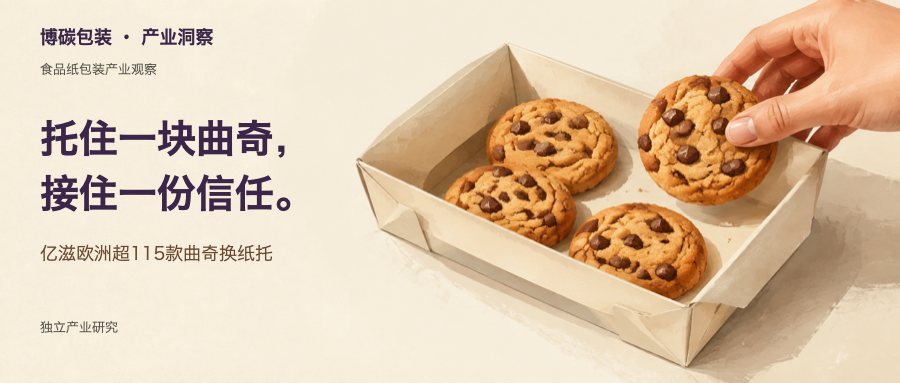
按2026财年预计产量测算,公司预计每年可减少约2200吨原生塑料。
对纸包装企业,更值得追问的是:一只纸托如何同时获得产品、工厂和采购的认可?
纸托的产业价值,要由产品保护、产线适配与稳定交付共同兑现。 原纸的吨价、涂层的性能、模切的精度,最终都要落到同一件事上:让合格的曲奇包装稳定地走出工厂。
研究资料:亿滋|欧洲曲奇纸托转换公告。
先把一包曲奇的功能分清
消费者对曲奇有两个朴素期待:打开时完整,吃起来酥脆。
这两件事,涉及不同的包装任务。对常见的内托加外袋结构,内托承接排列、支撑和机械保护;直接接触食品的纸面需要按油脂与接触时间安排防护;外袋材料与封口共同帮助控制水汽进入,保护货架期内的酥脆。
开发纸托之前,先把这些任务分清,才能知道哪一处适合换纸,哪一项功能需要补上。
亿滋与Saica在2024年推出的LU Véritable Petit Beurre多件装,就是一个清楚的例子:外层采用纸包装,里面仍以小包维持产品的新鲜与酥脆;纸外包采用冷封,并配合包装设备调整。
这个历史项目启发我们:包装升级可以从一个部件开始,但开发要看整包。 做好纸托的机械保护和接触面,并把它接回原有保鲜系统,是一条具体的开发路径。
对纸厂和涂布企业,这也改变了提问方式:客户需要的是支撑、耐油、封合,还是保鲜?各层各司其职,才有机会把材料用在真正需要的位置。
研究资料:亿滋|LU多件装纸外包合作项目;CSIRO|食品货架期与包装。
托得住曲奇,
还要跟得上产线
纸托的第一项任务是保护。托底怎样支撑、侧边怎样约束、内部怎样排列,会影响产品在装包和运输中的稳定性。曲奇容易受碰撞而破损,纸托应与产品形状、装填方式一起设计。
第二项任务藏在工厂里:纸托要一次次顺利进入包装线。
IMA公开的饼干托盘包装整线,将分托、机器人装饼、枕式包装和装盒连续连接。对这样的工厂,一只托盘既是包装件,也是被机器抓取、定位和输送的对象。
因此,尺寸与形状的一致性有了直接经营意义。样品手工装得下,和批量生产中持续装得顺,是两种不同的交付能力。纸托若出现变形、难以分离或定位偏差,影响可能沿着装饼和封包环节向后传递。
纸板企业Holmen的技术指南提供了一个容易忽略的细节:吸湿可能造成纸板翘曲,过干又可能让它变脆,影响进料与压痕。把储运后的平整度和含水状态稳住,是批量加工稳定性的一部分。
供应方式也要提前选。可以交付预成型纸托,也可以采用折叠纸托路线,让平片在装饼前起成立体结构。Syntegon在2022年IBIE参展资料中介绍过后一条路线:先以锁扣方式折成纸托,再进入枕包机完成外包。
两条路线对应不同的运输形态、现场设备和操作安排。制品厂越早与客户讨论这些条件,越容易把设计做成可持续运行的产品。
供应商参与的起点,要前移到客户的包装与产线设计;交付的验收,则要看纸托能否稳定地跑在产线上。
研究资料:IMA|饼干托盘完整包装线;Syntegon|烘焙纸托成型与包装方案;Holmen|纸板储运与加工技术指南。
一只纸托,
为什么需要四类企业
要看清分工,可以看一个独立的行业开发实例。
Walki在2023年公开的Folded Fibre Tray曲奇纸托项目中,Billerud提供纸板,Walki参与防油阻隔,Spiegel Verpackungen负责印刷与模切,Syntegon开发纸托概念及装饼前起托设备。
纸板结构提供机械保护,接触面的阻隔处理应对油渍,印刷模切形成可加工的包装片,设备把它变成立体纸托。四类能力围绕同一个食品对象配合,才形成可交付方案。
研究资料:Walki|纤维基曲奇纸托的开发协作。
对中国制品企业,值得借鉴的是把成型后的纸托作为共同开发对象:纸板提供的支撑是否保留下来,折叠后的接触面是否仍有需要的防护,模切出来的包装片能否顺畅起托、装饼。
材料因此有了更具体的评价方式。纸厂看纸板与结构的配合;涂布商将耐油目标、涂布干燥和折后表现连起来;制品厂与设备方共同确定尺寸、成型方式和批量标准。各环节的指标,最后都在同一只纸托上接受检验。
制品厂可以成为协作的组织者,把各家的材料与设备能力,变成客户能够使用的包装产品。 越早围绕同一款食品协作,越有机会减少后面的反复改样。
大品牌还要算一笔
“合格交付”的账
这种协同为什么重要?因为采购最终要面对的,是持续生产和稳定出货。
亿滋公开的包装供应商要求中,新开发或修改材料需要填写包装供应商问卷。食品用途、材料组成、目标市场和支持文件都在审核内容中,气味与味道转移也是关注项。
对做食品包装的企业,这些要求可以转化为很直接的产品语言:纸托要与指定食品相配,包装不干扰食品风味,样品及批量供货的材料资料能够对应。
研究资料:亿滋|包装供应商要求。
算成本时,也值得把比较单位从“一吨纸”或“一只托盘”,拉到“每千包合格成品的包装相关综合成本”。
建议在同一款食品、同一装量和相同交付要求下,先看相同运行时间能稳定产出多少合格包装,再把材料加工、产线运行、破损报废、相关仓储物流及必要设备改造分摊放进比较。停机造成的产出下降,也会影响这些成本的分摊结果。
纸托单价回答买入时花多少,合格品成本帮助判断用起来是否值得。
如果减了纸张,却增加破损或频繁停机,便要回头调整结构;如果结构和上料配合更顺,供应商就有了单张报价之外的价值。
对制品企业,更有说服力的销售材料,是一组能对应真实工况的结果:装后完整、上机顺畅、交付稳定,以及算得清楚的综合成本。
从一款产品开始,把能力做实
下一次开发,不妨从一款已有内托的曲奇开始,把现用方案留作基准。让食品样品、包装结构和真实产线条件同时进入讨论;先保留已确认有效的外包与封口条件,用运输后完整性、纸面状态和连续上机结果决定先改哪一处,再比较成本。
涉及食品接触面的耐油和纸面防护时,水性阻隔便有了明确的应用位置。博碳围绕PHA水性阻隔开展纸与纸板包装的应用协同,关注的是把所需防护与原纸、涂布、折叠及成型条件一起设计。
有具体产品需求的纸厂、涂布商、制品企业或食品品牌,可以带着一款食品、现有包装和关键生产条件,与博碳讨论纸基结构及功能层的选择,明确首轮打样方向。
研究资料:BIOTEN|纸基阻隔工程与应用协同。
亿滋这次跨品牌转换,让一只小内托的产业价值更容易被看见。对纸包装企业,值得积累的能力,是让纸、功能层、成型设备和食品任务彼此配合,并把这种配合稳定地交付给客户。
研究说明
本文由博碳包装依据企业公开公告、包装供应商要求及材料和设备应用资料独立研究整理,核验截至2026年9月5日。本文供产业研究学习,不构成采购或性能保证;如需修改、说明或删除,可通过本公众号联系,我们将在收到后24小时内核查处理。
博碳观察数据与核验来源
亿滋|欧洲曲奇纸托转换公告
亿滋|LU多件装纸外包合作项目
Walki|纤维基曲奇纸托的开发协作
IMA|饼干托盘完整包装线
Syntegon|烘焙纸托成型与包装方案
Holmen|纸板储运与加工技术指南
CSIRO|食品货架期与包装
亿滋|包装供应商要求
BIOTEN|纸基阻隔工程与应用协同
Inside a pack of biscuits, the least conspicuous component—the inner tray—is becoming a business opportunity that merits serious attention from the paper-packaging industry.
On 4 September, Mondelēz announced that it had completed the conversion of rigid PET inner trays to paper trays across its flagship biscuit portfolio in Europe. The change covers more than 115 products, eight brands and over 25 European markets, including products sold under LU, Milka and Cadbury.
Based on projected output for fiscal 2026, the company expects the change to eliminate approximately 2,200 metric tonnes of virgin plastic each year.
For paper-packaging companies, the more important question is this: How can a paper tray satisfy product, factory and procurement requirements at the same time?
The industrial value of a paper tray must be proven through product protection, line compatibility and reliable delivery. The price of the base paper, the performance of the coating and the precision of die-cutting must ultimately deliver the same result: qualified biscuit packs moving reliably out of the factory.
Research sources: Mondelēz | Announcement on the conversion to paper trays for European biscuit products.
Start by defining the functions within a biscuit pack
Consumers expect two simple things from biscuits: they should be intact when the pack is opened and crisp when eaten.
Those expectations translate into different packaging tasks. In a common inner-tray-and-outer-wrapper format, the tray organizes, supports and mechanically protects the biscuits; paper surfaces in direct food contact need protection suited to the fat exposure and contact duration; and the outer wrapper and seals work together to control moisture ingress and preserve crispness throughout shelf life.
Before developing a paper tray, these tasks must be separated clearly. Only then can a team determine where paper substitution makes sense and which functions must be added.
The LU Véritable Petit Beurre multipack launched by Mondelēz and Saica in 2024 is a clear example: the outer layer uses paper packaging, while the biscuits remain in smaller packs to preserve freshness and crispness. The paper outer wrapper uses cold sealing and required corresponding adjustments to the packaging equipment.
This earlier project offers a useful lesson: A packaging upgrade may begin with one component, but development must consider the complete pack. A practical route is to provide the tray with the required mechanical protection and food-contact surface, then integrate it back into the existing freshness-preservation system.
For papermakers and coating companies, this also changes the question they should ask: Does the customer need support, grease resistance, sealing or freshness preservation? Each layer must perform its own role so that materials are used only where they are truly needed.
Research sources: Mondelēz | LU multipack paper-wrapper collaboration; CSIRO | Food shelf life and packaging.
Protect the biscuits—
and keep pace with the production line
The paper tray's first task is protection. The way its base supports the product, its sides constrain movement and its interior arranges the biscuits all affect stability during packing and transport. Because biscuits are vulnerable to impact damage, the tray should be designed together with the product geometry and loading method.
Its second task is hidden inside the factory: the tray must enter the packaging line smoothly, cycle after cycle.
IMA's published complete biscuit-tray packaging line links tray denesting, robotic biscuit loading, flow wrapping and cartoning in one continuous process. In such a factory, a tray is both a packaging component and an object that machinery must pick, position and convey.
Dimensional and geometric consistency therefore has direct commercial value. A sample that can be packed by hand and a tray that runs smoothly at scale represent two different levels of delivery capability. Deformation, poor denesting or positioning errors can propagate downstream through biscuit loading and wrapping.
A technical guide from paperboard producer Holmen highlights an easily overlooked detail: moisture absorption can warp paperboard, while excessive drying can make it brittle and impair feeding and creasing. Maintaining flatness and moisture condition after storage and transport is part of ensuring stable high-volume conversion.
The supply format must also be selected early. Suppliers can deliver preformed trays, or use a folding-tray route in which flat blanks are erected immediately before biscuit loading. In its 2022 IBIE materials, Syntegon described the latter approach: the blank is folded into a tray using locking tabs before entering a flow wrapper for the outer pack.
The two routes entail different shipping formats, on-site equipment and operating arrangements. The earlier a converter discusses these conditions with the customer, the easier it is to turn a design into a product that can run sustainably.
Supplier involvement should begin upstream, during the customer's packaging and line design; acceptance at delivery should then depend on whether the paper tray runs reliably on the production line.
Research sources: IMA | Complete biscuit-tray packaging line; Syntegon | Forming and packaging solution for bakery paper trays; Holmen | Technical guidance on paperboard storage, transport and conversion.
One paper tray—
why does it require four types of company?
An independent industry development project makes the division of responsibilities clear.
In the Folded Fibre Tray project for biscuit packaging disclosed by Walki in 2023, Billerud supplied the paperboard, Walki contributed the grease-barrier solution, Spiegel Verpackungen handled printing and die-cutting, and Syntegon developed the tray concept and the equipment used to erect it before biscuit loading.
The paperboard structure provides mechanical protection; the barrier treatment on the contact surface manages grease; printing and die-cutting create a processable packaging blank; and the equipment erects that blank into a three-dimensional tray. Only when these four capabilities are coordinated around the same food product does a deliverable solution emerge.
Research sources: Walki | Collaborative development of a fibre-based biscuit tray.
For Chinese converters, the lesson is to treat the formed paper tray as the shared development target: Does the paperboard retain the required support? Does the contact surface still provide the necessary protection after folding? Can the die-cut blank be erected and loaded smoothly?
This gives materials a more concrete basis for evaluation. The papermaker assesses how the paperboard works with the structure; the coater connects grease-resistance targets with coating, drying and post-fold performance; and the converter works with the equipment supplier to define dimensions, forming methods and volume-production standards. The performance of every link is ultimately tested in the same tray.
The converter can serve as the coordinator, turning the material and equipment capabilities of multiple suppliers into a packaging product the customer can use. The earlier all parties collaborate around the same food product, the more likely they are to avoid repeated rounds of sampling and redesign later.
Major brands also calculate the cost of
“qualified delivery”
Why is this collaboration so important? Because procurement ultimately depends on continuous production and reliable shipment.
Mondelēz's published requirements for packaging suppliers call for a packaging-supplier questionnaire whenever a material is newly developed or modified. Intended food use, material composition, target markets and supporting documents are all reviewed, as are potential odour and taste transfer.
For food-packaging suppliers, these requirements translate into direct product criteria: the paper tray must be suitable for the specified food, the packaging must not alter its flavour, and documentation for samples must correspond to the materials supplied at production scale.
Research sources: Mondelēz | Requirements for packaging suppliers.
When calculating cost, it is also worth moving the comparison unit from “one tonne of paper” or “one tray” to the “total packaging-related cost per 1,000 qualified finished packs.”
For the same food product, pack count and delivery requirements, first compare how many qualified packs can be produced reliably in the same operating time. Then allocate the costs of material conversion, line operation, breakage and scrap, associated warehousing and logistics, and any necessary equipment modifications. Lower output caused by downtime also changes how those costs are allocated.
The unit price of a paper tray tells procurement what it costs to buy; cost per qualified pack shows whether it is economical to use.
If reducing paper use increases breakage or frequent downtime, the structure must be reconsidered. If the structure and feeding performance work better together, the supplier creates value beyond the quoted price per tray.
For converters, the most persuasive sales evidence is a set of results that reflects actual operating conditions: product integrity after packing, smooth machine running, reliable delivery and a clearly calculated total cost.
Start with one product and prove the capability
For the next development project, start with a biscuit that already uses an inner tray and retain the current pack as the benchmark. Put the food sample, packaging structure and real line conditions into the same discussion. First preserve the validated outer-wrapper and sealing conditions; then use post-transport integrity, paper-surface condition and continuous line trials to decide what should change first, before comparing costs.
Where a food-contact surface requires grease resistance and paper protection, a water-based barrier has a clearly defined role. BIOTEN works on application development for PHA water-based barriers in paper and paperboard packaging, designing the required protection together with the base paper, coating, folding and forming conditions.
Papermakers, coaters, converters and food brands with a specific product requirement can bring a food sample, the current packaging and key production conditions to BIOTEN to discuss the paper-based structure and functional-layer selection, and to define the direction for the first round of prototyping.
Research sources: BIOTEN | Paper-based barrier engineering and application collaboration.
Mondelēz's conversion across multiple brands makes the industrial value of a small inner tray easier to see. For paper-packaging companies, the capability worth building is the ability to make paper, functional layers, forming equipment and food-protection requirements work together—and to deliver that integration reliably to customers.
Research note
This article was independently researched and compiled by BIOTEN Packaging from public corporate announcements, packaging-supplier requirements, and materials- and equipment-application information. Information was verified through 5 September 2026. It is provided for industry research and learning and does not constitute a procurement recommendation or performance guarantee. For corrections, clarifications or removal requests, please contact us through this official account; we will review the request within 24 hours of receipt.
BIOTEN Observer data and verification sources
Mondelēz | Announcement on the conversion to paper trays for European biscuit products
Mondelēz | LU multipack paper-wrapper collaboration
Walki | Collaborative development of a fibre-based biscuit tray
IMA | Complete biscuit-tray packaging line
Syntegon | Forming and packaging solution for bakery paper trays
Holmen | Technical guidance on paperboard storage, transport and conversion
CSIRO | Food shelf life and packaging
Mondelēz | Requirements for packaging suppliers
BIOTEN | Paper-based barrier engineering and application collaboration