



老浆厂值不值得重启,不看机器还能不能转,而看下一吨产品能否以可控成本生产,并被客户持续买走。
9月3日,加拿大安大略省政府宣布向Bioveld North投入510万加元,支持停机近三年的Espanola浆纸厂开展潜在重启所需的评估和工程工作。企业再投入540万加元,形成1050万加元的前端工程与设计计划。
这笔钱买到的不是复产,而是一次把重启账算清的机会。
Espanola运营超过120年。2023年停机时,约28万空气干燥吨漂白针叶木硫酸盐浆和6.9万短吨特种纸年产能被削减。原运营方Domtar给出的原因是多年经营亏损,以及维护和运行成本高企。
如今,新业主要先确定改造设计、效率与可靠性方案,以及真正需要多少资本。公司没有给出复产日期,并明确表示成功重启仍需要更多私人资本和客户投入。
研究资料:安大略省政府|Espanola工程支持;Bioveld North|Espanola重启计划。
第一道生死线:木片能否经济地进厂
安大略省政府预计,成功重启可能恢复每年最高180万立方米木材需求。项目方披露,这座厂过去连接19家区域锯木厂,其中6家曾将约75%的木片销售给Espanola。
这是一套有价值的历史网络,但重启要把历史关系重新变成当前合同。纸厂真正要掌握的是木片到厂价格、运输半径、质量稳定性与供应集中度。区域内有森林,只说明资源存在;合格纤维能否按计划、按成本进入料场,才决定纸浆成本的起点。
第二道生死线:产品卖给谁
Bioveld North研究的目标,是恢复每日约800空气干燥吨无滑石粉漂白针叶木硫酸盐浆,并生产每日约180短吨医疗和食品级纸。
改变产品组合,是老厂重建客户结构、开机负荷和盈利模型的一种可能。但“优质”“特种”只有进入客户规格、认证、合同和复购,才会形成开机负荷。项目能否成立,要看首批客户愿意锁定多少需求、认证需要多久,以及产品爬坡时的合格率。
食品纸尤其如此。纸厂、功能涂层、印刷转换与制品企业越早围绕明确食品和加工条件协同,越容易判断一项新纸种能否成为真实订单。
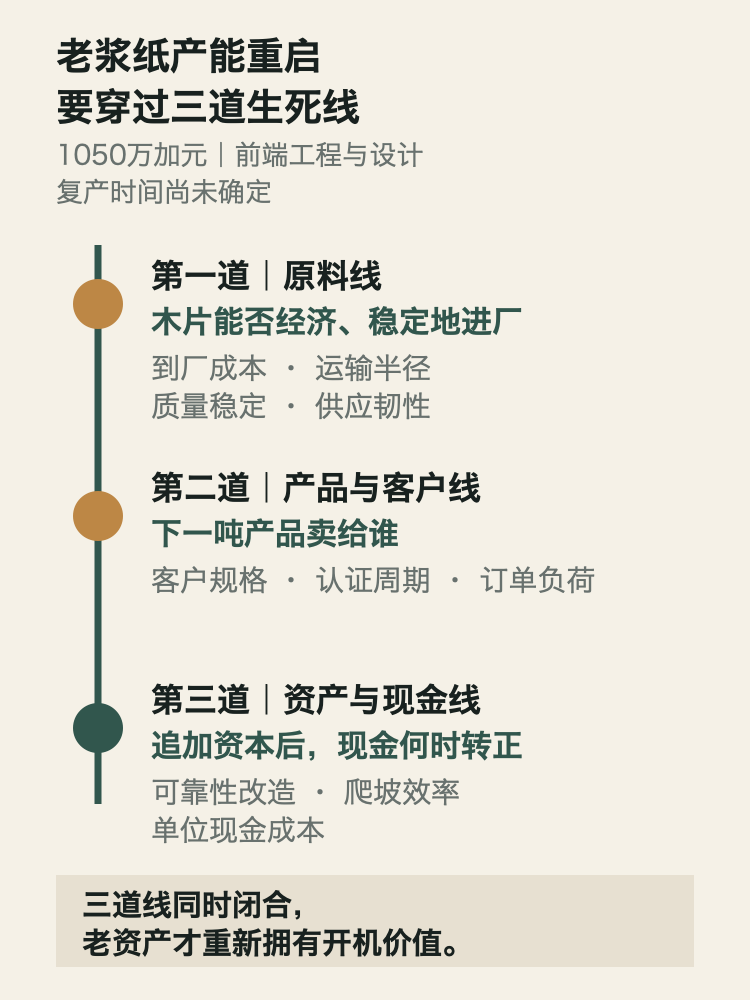
第三道生死线:旧资产能否产生新现金
老厂已有土地、厂房、能源和部分设备,可以缩短建设周期;多年停机也可能留下可靠性、环保、能耗和备件问题。前端工程的价值,就是把这些问题变成具体改造项目和资本数字。
近期,Domtar也因需求、浆价和当地纤维成本压力,决定无限期停产另一座加拿大浆厂。这条旁证说明,历史投入和名义产能都不能替代未来竞争力。
重启决策最终要回答三件事:追加资本后能否稳定运行,爬坡期利用率和单位现金成本能否收敛,经营现金流何时转正。
纸上谈兵 数说本质
对中国造纸企业,这个案例的价值不在加拿大获得了多少资金,而在重启顺序:先算到厂原料,再看客户订单,随后确定可靠性改造与资本缺口,最后用利用率、单位现金成本和经营现金流验收。
三道生死线能够同时闭合,老资产才重新拥有开机价值。
研究说明
本文由博碳包装依据政府公告、企业披露及证券监管存档独立研究整理,核验截至2026年9月6日。本文供产业研究学习,不构成投资、采购或经营保证;如需修改、说明或删除,可通过本公众号联系,我们将在收到后24小时内核查处理。
博碳观察数据与核验来源
安大略省政府|Espanola工程支持
Bioveld North|Espanola重启计划
美国证券交易委员会|Domtar 2023年Espanola停机公告
Domtar|近期另一座加拿大浆厂停产公告
Whether an old pulp mill is worth restarting is not determined by whether its machines can still turn, but by whether the next tonne of product can be made at a controllable cost and sold repeatedly to customers.
On 3 September, the Government of Ontario, Canada, announced a CAD 5.1 million investment in Bioveld North to support the assessment and engineering work required for a potential restart of the Espanola pulp and paper mill, which has been idle for nearly three years. The company will contribute a further CAD 5.4 million, creating a CAD 10.5 million front-end loading engineering and design programme.
The money does not buy production; it buys the opportunity to establish what a restart would actually require.
Espanola operated for more than 120 years. When the mill was idled in 2023, approximately 280,000 air-dried metric tonnes of northern bleached softwood kraft (NBSK) pulp and 69,000 short tons of specialty-paper capacity were removed from annual production. Domtar, the former operator, cited years of operating losses and high maintenance and operating costs.
The new owner must now first define the modernisation design, efficiency and reliability plan, and the capital actually required. It has set no restart date and has made clear that a successful restart will still require additional private capital and customer commitments.
Research sources:Government of Ontario | Espanola engineering support; Bioveld North | Espanola restart plan.
First make-or-break test: can wood chips reach the mill economically?
The Government of Ontario estimates that a successful restart could restore demand for up to 1.8 million cubic metres of sustainably sourced wood a year. The project sponsor says the mill was historically connected to 19 regional sawmills, six of which once sold approximately 75% of their wood chips to Espanola.
This historical network has value, but a restart must convert former relationships into current contracts. What the mill needs to know is the delivered cost of wood chips, haul distance, quality consistency and supply concentration. The presence of forests in the region proves only that a resource exists; whether suitable fibre can reach the wood yard on schedule and at the required cost determines the starting point of pulp economics.
Second make-or-break test: who will buy the output?
Bioveld North's study targets a restart at approximately 800 air-dried metric tonnes per day of premium talc-free northern bleached softwood kraft (NBSK) pulp, together with about 180 short tons per day of medical- and food-grade paper.
A different product mix could allow the legacy mill to rebuild its customer base, operating load and profit model. But labels such as "premium" and "specialty" translate into machine load only when the products enter customer specifications, qualifications, contracts and repeat purchases. The project's viability therefore depends on how much demand initial customers will commit, how long qualification will take, and what saleable yield can be achieved during ramp-up.
This is especially true for food-contact paper. The earlier the paper mill, functional-coating suppliers, printers and converters, and finished-product manufacturers collaborate around defined food-contact and processing conditions, the easier it becomes to determine whether a new grade can turn into real orders.
Third make-or-break test: can legacy assets generate new cash?
An old mill already has land, buildings, energy infrastructure and some equipment, which can shorten the construction schedule; years of idling may also leave reliability, environmental-compliance, energy-efficiency and spare-parts issues. The value of front-end engineering is to convert those uncertainties into defined upgrade scopes and capital requirements.
Domtar recently decided to idle another Canadian pulp mill indefinitely, citing weaker demand, poor pulp pricing and pressure from local fibre costs. That comparison shows why sunk investment and nameplate capacity cannot substitute for future competitiveness.
Ultimately, a restart decision must answer three questions: can the mill operate reliably after the additional investment; can utilisation and unit cash cost converge to sustainable levels during ramp-up; and when will operating cash flow turn positive?
Paper economics: let the numbers reveal the fundamentals
For Chinese paper producers, the value of this case lies not in the amount of Canadian funding secured, but in the sequence of a restart: calculate delivered raw-material costs first; validate customer orders next; then define reliability upgrades and the capital gap; and finally evaluate the result through utilisation, unit cash cost and operating cash flow.
Only when all three make-or-break tests are satisfied at the same time do legacy assets regain economic value as operating capacity.
Research note
This article was independently researched and compiled by BIOTEN Packaging from government announcements, company disclosures and securities-regulatory filings. Information was verified through 6 September 2026. It is provided for industry research and learning only and does not constitute investment, procurement or operating assurance. To request a correction, clarification or removal, please contact this official account; we will review the request within 24 hours of receipt.
BIOTEN Observer data and verification sources
Government of Ontario | Support for Espanola engineering work
Bioveld North | Espanola restart plan
U.S. Securities and Exchange Commission | Domtar's 2023 notice of the Espanola mill idling
Domtar | Recent announcement of the idling of another Canadian pulp mill