

包装下一轮增长,不是谁替代谁,而是材料各归其位、价值持续升级
纸基包装博碳观察 / PAPER PACKAGING STUDY

材料各归其位,增长最终由利润、现金流与复购兑现
制造能力 → 合格包装 → 客户价值 → 经营兑现
EDITORIAL QUESTION
研究问题|这不是材料替代题,而是价值兑现题
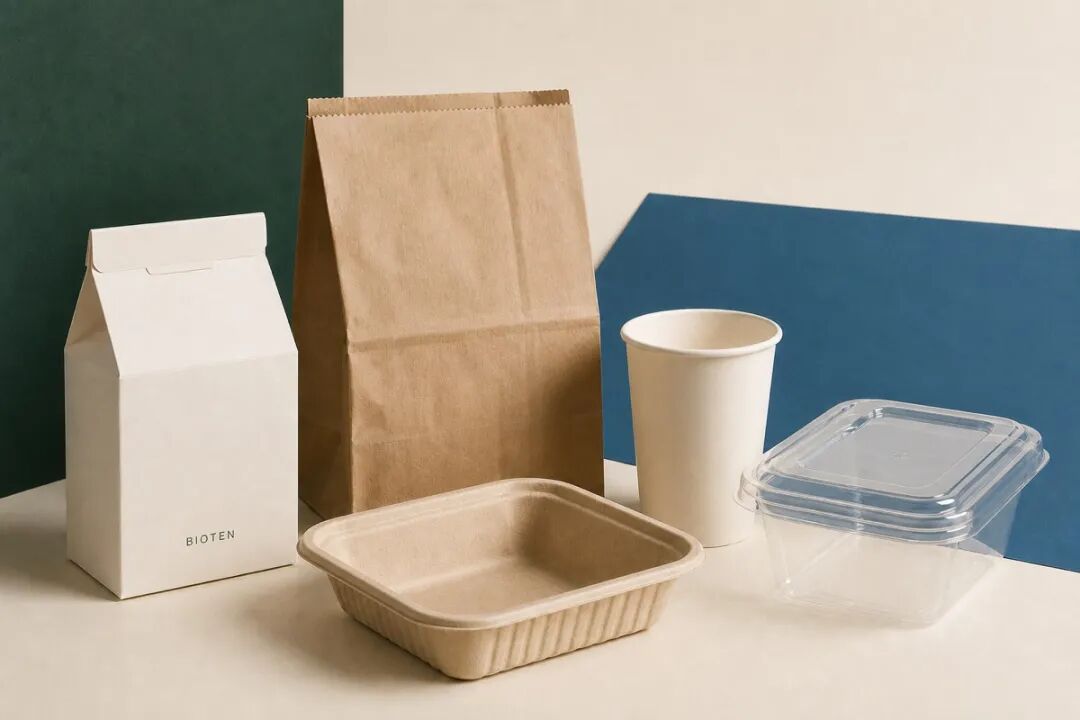
包装行业谈增长,最容易被简化成“纸能替代多少塑料”。但客户真正购买的不是材料立场,而是一个能在真实场景中保护内容物、稳定生产、按期交付、完成合规并控制总成本的包装结果。
塑料在高阻隔、韧性、轻量化、透明展示和复杂密封等场景仍有明确适用性;纸基则通过纤维结构、功能层、结构设计和成型工艺,在合适的场景中承担更多功能。下一轮机会,不是让一种材料占据所有位置,而是让材料各归其位,让每一项功能创造更清晰的客户价值。
更值得研究的问题是:企业怎样把已有制造能力变成客户愿意持续购买的结果?本文用一条主轴观察10家目的性样本:
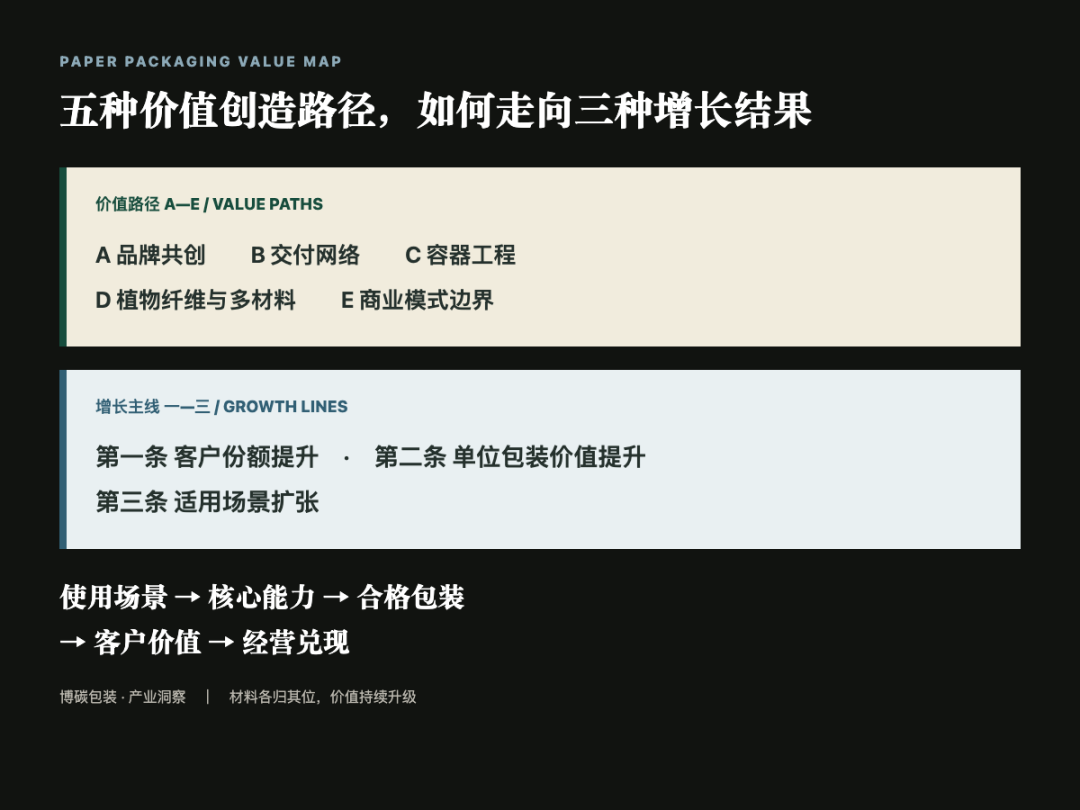
使用场景 → 核心能力 → 合格包装 → 客户价值 → 经营兑现
五种价值创造路径不是排名,也不是五个互不相交的盒子。它们回答的是同一个问题:一家企业最具辨识度的能力,究竟通过哪个主要接口进入客户现场;最终又由哪些经营结果证明。
CORE JUDGEMENT
核心判断
纸基包装的下一轮增长,不取决于某一种材料占据所有位置,而取决于企业能否把设计、材料、制造、交付与合规组织成客户愿意持续购买的结果。路径可以不同,评价标准始终相同:客户合作是否更深,单位价值是否提高,适用场景是否扩张,并最终形成利润、经营现金流和复购。
材料各归其位之后,真正拉开差距的,是企业把合格包装持续变成客户价值的能力。
SCOPE & METHOD
研究边界
这10家企业是核心观察样本,不是排名,不是“十强”,也不代表完整行业。本文另选6家企业,分别放入三条增长主线作“同行印证”;它们不重新编号,也不构成第二份名单,只用于说明相似的客户价值还在行业更多接口发生。不同规模、产品与市场口径不作简单横向比较。本篇聚焦包装转换、食品包装和消费包装企业,不把上游造纸企业与包装制造企业放在同一层级比较。
项目规划、展会展示、标准参与、生产许可和认证记录,只能证明明示的阶段与范围,不能自动等同于量产订单、市场地位或持续盈利。“增长”最终要由合作深度、单位价值、适用场景,以及毛利、利润、经营现金流和重复订单检验。
FIVE VALUE PATHS
五种价值创造路径|先看能力怎样进入客户现场
价值路径 / CAPABILITY PATH
A
BRAND CO-CREATION
高价值品牌包装与客户共创
品牌包装的含金量,不只在印刷和外观,更在供应商能否进入新品流程,把创意、结构、色彩与工艺稳定复制到量产,并将单个订单变成长期配套。可迁移的学习是:设计只有被制造体系稳定复现,才会成为客户价值。
企业案例 / CASE 01
GLOBAL BRAND DELIVERY
裕同科技:把品牌方案复制到全球量产
品牌共创|工程转换|跨区域复制
核心能力|裕同把创意设计、结构工程、研发打样、色彩管理、精益制造以及采购、仓储和物流组织成一条量产链,让不同能力围绕同一个客户结果协同工作。
客户价值|品牌新品不只要被“设计出来”,还要在不同市场按一致的品质、节奏和交付标准落地。裕同的跨区域网络为这种复制提供组织基础,减少方案转量产的协同成本。
经营兑现|2025年公司营业收入172.38亿元,同比增长0.47%;归母净利润15.92亿元,同比增长13.05%;经营活动现金流净额27.37亿元,同比增长38.23%。国外收入61.31亿元,占营业收入35.57%,同比增长20.27%。研发投入7.37亿元,占营收4.28%,同比微降0.91%。这组数据呈现的是收入总体稳定、盈利和现金回报改善、国外业务继续扩展的经营组合。
博碳观察|2026年interpack期间,公司展示了FluoZero®防油技术和Ecocoon™干法植物纤维缓冲材料。现阶段更适合把它们理解为应用储备;量产导入、同一客户新增品类、毛利与复购,才是下一步商业兑现指标。
资料:裕同科技2025年年度报告;裕同interpack 2026展示资料
企业案例 / CASE 02
FLEXIBLE MANUFACTURING
中荣股份:把品牌迭代做成柔性制造响应
结构研发|色彩管理|柔性响应
核心能力|中荣最有辨识度的,是“柔性”:让结构研发、色彩管理、工艺开发、数字印刷接口和跨基地制造共同服务品牌的高频迭代。
客户价值|当多批次、小批量、个性化和快速补单成为常态,客户需要的不只是更快,而是在速度提升的同时守住色彩一致、结构可靠和量产稳定。中荣把品牌变化翻译成制造秩序,为新品迭代提供了更灵活的承接方式。
经营兑现|2025年公司营业收入31.67亿元,同比增长13.85%;归母净利润1.53亿元,同比增长6.82%;经营活动现金流净额3.39亿元,同比增长27.18%;研发投入1.28亿元,同比增长18.21%。规模、盈利、现金流与研发投入同向增长,为柔性制造继续深化提供了积极基础。
博碳观察|公司披露的数字印刷合作增加了单张起印、个性化和快速补单等接口,但合作本身不等于新增订单。真正值得跟踪的是打样周期、跨基地色彩一次合格率、同一客户新增SKU以及研发成果进入稳定量产后的毛利和复购。
资料:中荣股份2025年年度报告;中荣数字印刷合作资料
价值路径 / CAPABILITY PATH
B
DELIVERY NETWORK
规模制造网络与供应链交付
瓦楞纸箱、纸袋和连锁门店包装有一个共同点:客户买的不只是制品,更是确定性。网络的价值不在工厂数量本身,而在订单能否被调度、稳定交付并形成合理的综合成本。可迁移的学习是:分散产能只有被组织成协同网络,才会产生交付价值。
企业案例 / CASE 03
DELIVERY NETWORK
合兴包装:用短半径网络兑现交付确定性
多基地|短半径|订单调度
核心能力|合兴把贴近客户的多基地网络,与原纸采购、订单调度、VMI、CPS及包装物流服务连接起来,组织瓦楞包装的短半径、高时效交付。
客户价值|这套网络能在旺季、促销、多工厂供应和临时切单时减少不确定性。合兴的优势不只是“有产能”,更在于把分散节点组织成可协同、可响应的交付系统。
经营兑现|2025年公司营业收入101.94亿元,同比下降11.13%;归母净利润1.03亿元,同比增长10.61%;综合毛利率13.02%,同比提高1.00个百分点;经营活动现金流净额2.58亿元,同比下降53.07%。在收入收缩中实现盈利指标改善,体现了经营韧性;现金流变化也说明网络效率仍要继续转化为回款质量。
博碳观察|年报把泰国、越南和印度尼西亚基地列入2026年加快产能释放和效能提升的计划。计划不是既成贡献;其价值要由基地利用率、订单来源、准时交付、海外子公司盈亏和经营现金流共同证明。
资料:合兴包装2025年年度报告
企业案例 / CASE 04
MULTI-SKU DELIVERY
南王科技:让多SKU制造跟上门店节奏
多品类|门店节奏|区域响应
核心能力|南王围绕纸袋、食品包装、无纺布袋及标签票据等产品组织多SKU制造与区域交付。它抓住的是连锁门店“多、快、变”的节奏:上新、促销和补货都需要制造端同步响应。
客户价值|多材料、多节点布局增加了门店包装组合的选择空间;评价时仍须区分不同材料业务,不用某一品类的增长代替另一品类的表现。
经营兑现|2025年食品包装收入6.04亿元,同比增长13.01%,毛利率14.94%,同比提高1.36个百分点;纸袋收入5.76亿元,同比下降11.91%,毛利率同比下降8.33个百分点;无纺布袋收入4.79亿元,同比增长185.59%,构成集团收入增量的主要来源。集团营业收入17.59亿元,同比增长25.60%,归母净亏损2643.15万元;经营活动现金流净额1.57亿元,同比增长257.36%,公司披露其增加同时受销售回款和政府补助影响。
博碳观察|纸袋收入与毛利率修复、食品包装盈利延续、纸制品项目和无纺布节点各自的投产利用率、区域订单密度以及恢复持续盈利的进程,将更完整地呈现南王多品类网络的经营质量。
资料:南王科技2025年年度报告
价值路径 / CAPABILITY PATH
C
CONTAINER ENGINEERING
食品餐饮场景与容器工程
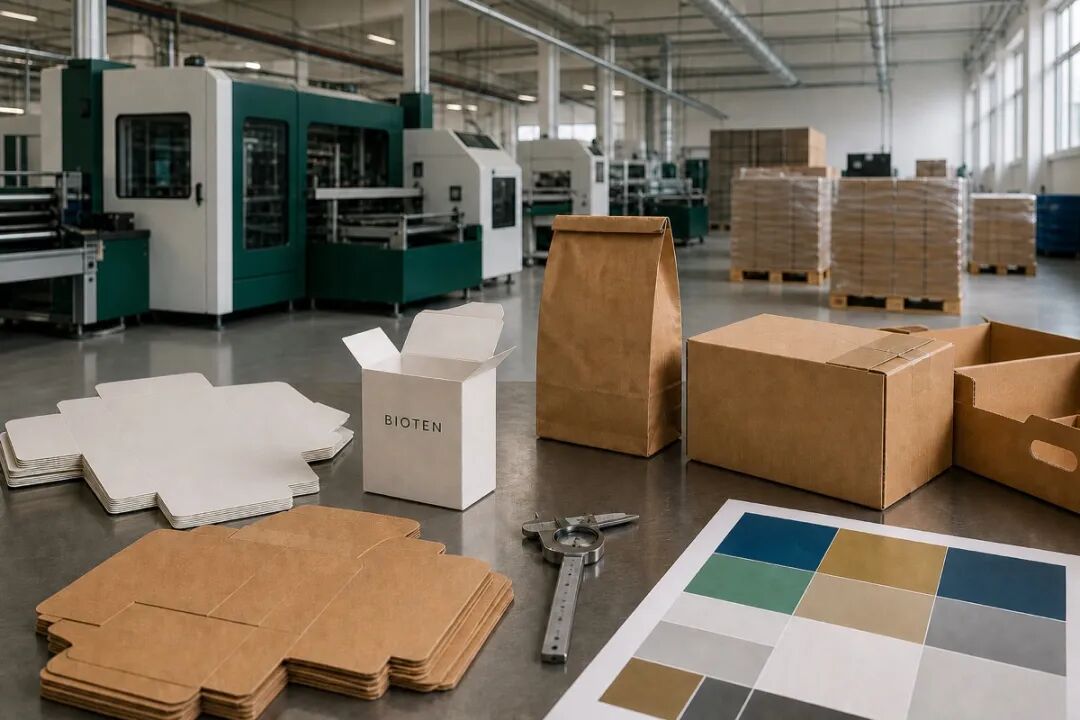
食品容器不是简单的材料成型。密封、防漏、阻隔、保鲜、印刷、热封、堆叠和机器线速,需要在同一制品上协同成立;食品接触与终端处置结论,也必须对应具体结构和目标市场。可迁移的学习是:材料创新只有穿过最终制品和商业线,才会成为可靠方案。
企业案例 / CASE 05
VERTICAL MANUFACTURING
恒鑫生活:把材料理解接到终端成型
材料改性|淋膜片材|终端成型
核心能力|恒鑫值得肯定的,不是单一“PLA可降解”标签,而是把粒子改性、淋膜、片材、印刷和成型与物流管理接进同一制造体系。它把餐饮具的订单语言翻译成可量化的规模语言,让服务、渠道、平台和使用体验能够在终端制品上反复校准。
客户价值|对餐饮具客户而言,纵向协同可以缩短材料与工艺之间的反复磨合,帮助纸杯、纸碗等制品形成更稳定的供应。真正的价值不在材料名称本身,而在合格率、使用结果和批量交付。
经营兑现|2025年公司营业收入18.45亿元,同比增长15.73%;归母净利润2.24亿元,同比增长1.80%;扣非归母净利润1.81亿元,同比下降15.44%;经营活动现金流净额3.40亿元,同比下降9.17%。可降解产品收入9.15亿元,占营业收入49.62%,同比增长4.95%,其毛利率26.25%,同比下降4.81个百分点。规模增长已经显现,下一步重点是把品类扩展更充分地转化为扣非利润与单位价值。
博碳观察|公司年报披露其连续6年入选中国轻工业塑料行业“降解塑料”类别十强,并披露特定PHA淋膜纸制品于2026年1月取得BPI家庭堆肥认证;前者只限于所述专业类别,后者的材料身份和时间来自公司披露,具体SKU与Home Certified状态须以BPI数据库为准。荣誉和认证不是订单证据,稳定订单、单位成本、合格率和复购才是商业深度。
资料:恒鑫生活2025年年度报告;BPI恒鑫产品数据库
企业案例 / CASE 06
FOOD CONTAINER ENGINEERING
新天力:让材料选择服从食品场景
密封防漏|阻隔保鲜|多材料选择
核心能力|新天力以热成型食品容器为底盘,围绕密封、防漏、阻隔、保鲜、外观和近客户交付组织方案,并保留纸制容器接口。它的专业之处,不是押注某一种材料,而是按内容物、生产方式与使用结果选材。
客户价值|食品工业、餐食和街饮场景需要不同的容器答案。新天力让材料服从场景,使客户能够在当前性能、成本和制造条件下选择更合适的结构;这种坦率而清晰的能力边界,比材料标签更有长期价值。
经营兑现|2025年公司营业收入10.57亿元,同比下降3.95%;归母净利润7616万元,同比增长11.35%;综合毛利率19.45%,同比提高1.15个百分点;经营活动现金流净额1.40亿元,同比下降39.48%。塑料食品容器占主营收入96.24%,纸制食品容器占2.63%;两类产能利用率分别为79.77%和13.66%,纸制食品容器毛利率17.57%,同比下降4.81个百分点。在收入回落中盈利能力改善,说明容器工程具有经营韧性;纸制容器仍处于能力利用和商业验证阶段。
博碳观察|塑料仍是绝对主业,纸制容器是特定场景接口,这并非“全面纸化转型”。防漏与密封升级、不同材料方案的客户采用、纸制容器利用率和毛利率,以及利润向现金的转化,将决定多材料能力的深度。
资料:新天力招股说明书(2026年5月19日签署)
企业案例 / CASE 07
CUP CONVERSION
湖南立乐(Lido):让水性涂层走进真实制杯工序
功能层|完整杯型|真实工序
核心能力|湖南立乐最有辨识度的,是制杯转换接口:把一次性纸杯和水性阻隔涂层带入一个新的广度,模切、侧封、杯底密封、卷边、堆叠与分杯等真实工序。持续多年与巴斯夫、APP金光、都佰城联合推广环保水性丙烯酸阻隔涂层,获得欧洲与澳新等多地高端市场信赖。立乐多年来专注于一次性纸杯水性涂层的易回收系统创新,在中国市场也赢得了咖啡连锁品牌及知名商超的长期订单。
客户价值|立乐把讨论从“材料样片是否可行”推进到“完整杯型能否稳定制造”。对于材料方和品牌方,这个接口能够更早暴露打杯线速、热封、杯底密封、套叠与分杯等问题,使水性涂布纸结构更接近真实商业线。
经营兑现|立乐未公开统一口径的审计经营数据,因此其收入规模、市场排名和客户份额不作判断。公开证据显示:国家标准平台将其列为GB/T 44834—2024和GB/T 27591—2025起草单位;湖南省许可清单列示其食品用纸包装、容器等制品生产许可;flustix数据库PF3R0016列示纸杯、纸盖、纸碗和纸盘,并给出98%可回收性评价。
博碳观察|立乐坚持纸杯的食品接触文件证据链客户可见,这点是高端客户及品牌用户极为重视的安全底线,客户复购与实际产销量持续增长。公开活动体现了立乐把材料方案推向完整制品的实践价值,由于还未上市,目前没有找到公开营收数据。本次研究不构成任何行业位次判断。
资料:湖南立乐官网;GB/T 44834—2024;GB/T 27591—2025;湖南省生产许可资料;flustix认证数据库以及市场与产业链信息反馈。
价值路径 / CAPABILITY PATH
D
FIBRE + MULTI-MATERIAL
植物纤维与多材料平台
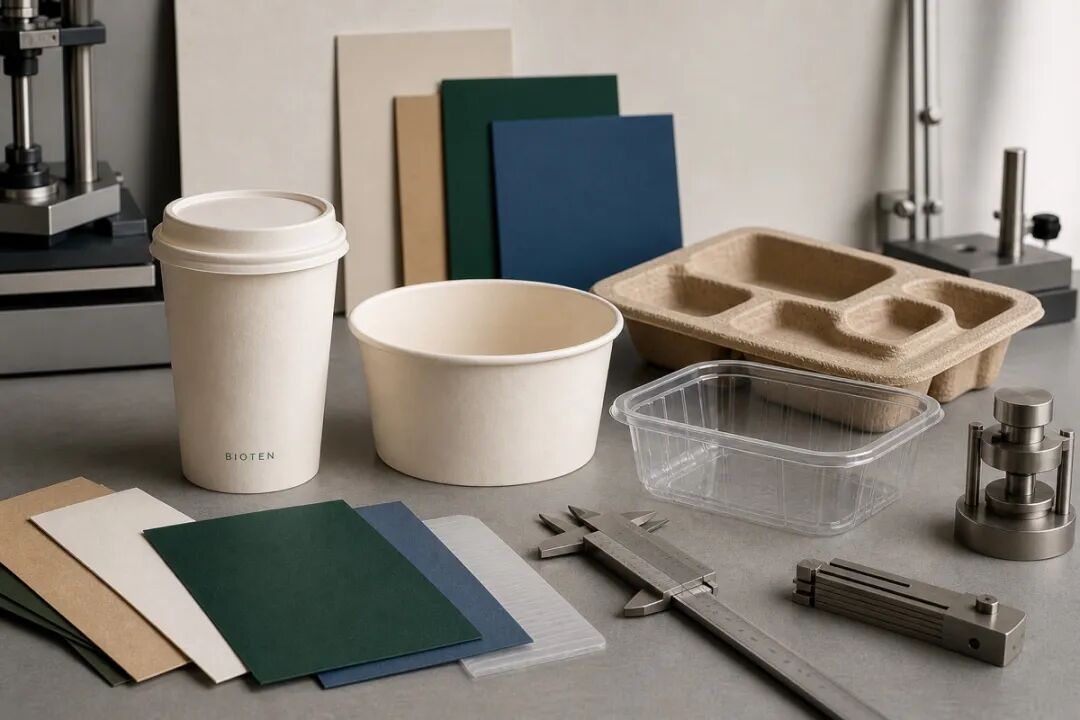
植物纤维进入更多应用,需要浆料、模具、结构、表面功能、自动化、良率和单位成本共同成立;多材料平台则要帮助客户在性能、法规、成本和市场需求之间做出更合适的选择。可迁移的学习是:产品线更宽并不自动等于价值更高,必须由分品类盈利、利用率与复购证明。
企业案例 / CASE 08
MOULDED FIBRE SCALE
众鑫股份:以专业化体系承接植物纤维规模制造
专业聚焦|规模制造|跨市场复制
核心能力|众鑫长期聚焦植物纤维模塑餐饮具,把研发、设备、认证、制造和客户服务沉淀在同一专业化体系。长期聚焦的价值,是让相近订单不断积累良率、效率和跨市场复制经验。
客户价值|对客户而言,专业化不只是产品更集中,也意味着设备、模具、材料与质量控制围绕同一类场景持续优化。众鑫已经把植物纤维从材料方向推进到可观察的规模制造体系,这是其最值得肯定的产业底盘。
经营兑现|2025年公司营业收入15.06亿元,同比下降2.62%;餐饮具收入14.42亿元,同比下降4.97%;归母净利润2.66亿元,同比下降17.79%;经营活动现金流净额4.17亿元,同比增长30.36%。其中泰国众鑫实现收入4.32亿元、净利润1.63亿元,说明海外制造已经形成实际经营贡献。收入和利润回落也必须如实看见,增长恢复不能只看产能布局。
博碳观察|公司2026年半年度业绩预告预计归母净利润1.75亿至2.20亿元,同比增长50.22%至88.85%,并将泰国产能布局对恢复美国市场供货的支持列为重要因素;该预告未经审计,最终以正式报告为准。餐具销量与单吨盈利、泰国基地利用率和现金贡献、客户关系延续,以及美国项目的实际投产节点,是跨市场复制的关键指标。
资料:众鑫股份2025年年度报告;众鑫股份2026年半年度业绩预告
企业案例 / CASE 09
MULTI-MATERIAL PLATFORM
家联科技:用多材料平台拓宽客户选择
材料组合|场景选择|品类协同
核心能力|家联把传统塑料、生物全降解、植物纤维和纸制品放在同一产品平台上,为客户比较性能、法规、成本和市场需求。它把材料选择从单选题变成组合题。
客户价值|不同国家、渠道和内容物并不需要同一种答案。多材料平台让客户不必预设路线,而能按场景配置产品结构;其真正价值,是缩短选择和试错路径,并提供跨品类的一站式供应接口。
经营兑现|2025年公司营业收入26.87亿元,同比增长15.53%;植物纤维制品收入1.95亿元,同比增长53.90%,占集团营收7.26%。集团归母净亏损7571万元,扣非归母净亏损1.92亿元;经营活动现金流净额1.13亿元,同比下降66.53%,公司解释主要与泰国工厂投运增加流动资金有关。新路线已有可观察需求,平台宽度仍需转化为分品类盈利和现金质量。
博碳观察|植物纤维品类未单独披露利润,不能由收入增幅直接推导盈利。植物纤维产能负荷、海外基地单位成本、客户复购、分品类毛利、扣非利润与经营现金流改善,将决定多材料平台能否从“产品更宽”走向“解决方案更深”。
资料:家联科技2025年年度报告
价值路径 / CAPABILITY PATH
E
BUSINESS MODEL BOUNDARY
制造底盘与数字商业的边界扩展
前四种路径主要回答包装能力如何进入客户现场;吉宏提供的是一类商业模式边界样本:当包装制造与数字商业并行,企业能否先让两套业务各自创造价值,再用可量化的连接证明协同。可迁移的学习是:多元业务的价值不靠故事拼接,而靠分部表现和真实协同分别验证。
企业案例 / CASE 10
MANUFACTURING + DIGITAL
吉宏股份:让两套业务各自创造价值
快消包装|数字商业|并行验证
核心能力|吉宏同时经营快消纸包装与跨境社交电商。包装板块以设计、纸盒、纸袋、食品包装和多基地制造服务快消客户;数字业务则形成独立的跨市场运营能力。两套业务并行,是它区别于多数包装企业的结构特征。
客户价值|包装客户获得稳定制造和品类扩展,数字业务则让集团更贴近不同市场的消费与经营节奏。不预设“天然协同”,分别看清两项业务,再等待可量化连接出现,是对这类商业模式更专业也更积极的理解。
经营兑现|2025年包装业务收入23.45亿元,同比增长11.71%,毛利率20.69%,同比提高2.84个百分点;纸袋收入增长21.15%,食品包装收入增长23.17%。集团营业收入67.22亿元,同比增长21.56%,归母净利润2.77亿元,同比增长52.16%,但经营活动现金流净额2.61亿元,同比下降32.45%。包装板块产品结构与盈利指标改善已经清晰,集团仍需把利润增长更充分地沉淀为现金回报。
博碳观察|食品包装和纸袋的新增客户与复购、包装分部现金贡献,以及数字业务能否形成可核验的客户导入、需求洞察或交付效率改善,是判断“并行”能否走向“协同”的关键。
资料:吉宏股份2025年年度报告
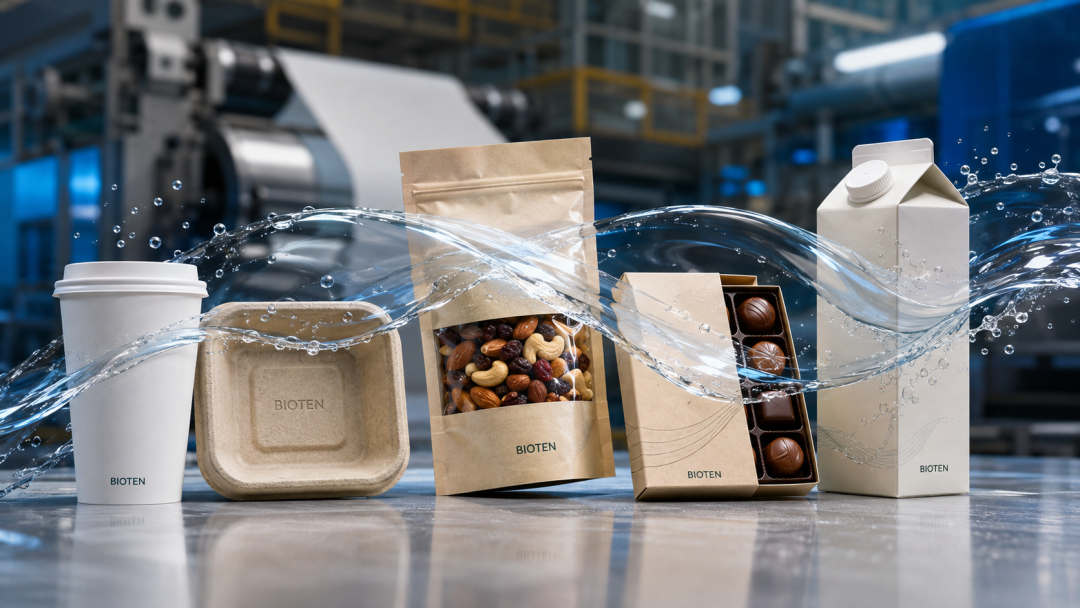
THREE GROWTH LINES
三条增长主线|把不同路径收束到同一组经营结果
十家核心样本提供分析骨架,六家同行印证直接放进最能解释其价值的增长线上,不另建名单、不重新编号。这样观察的重点不是“还有哪些企业”,而是同一种增长机制如何在行业不同位置重复发生。
增长主线 / GROWTH LINE 01
客户份额提升:从单品供给走向深度配套
裕同、中荣把设计、结构和工艺前移到客户新品流程;合兴、南王用区域制造和多SKU交付进入客户日常供应链;吉宏则提供制造与数字业务并行的边界样本、立乐的水性涂层纸杯单品让用户有了更多配套需求。共同方向,是从“接到一个订单”走向“参与更多产品与更多环节”。这条主线不能只看客户数量,还要看同一客户的合作品类、订单份额、续单率、应收效率和经营现金流。
同行印证 / INDUSTRY ECHO
美盈森:把分散的包装接口,组织成客户可调用的协同链。从设计与测试到第三方采购、库存、物流和现场辅助包装,它把原本由客户协调的多个接口接成一条服务链,让包装供应商从制品交付走向流程协同。
资料:美盈森2025年年度报告;美盈森官方能力介绍
浙江庞度:把复杂性留在工厂,把确定性交给客户。它把材料选择、结构设计、印刷制杯、质量标准与多基地交付组织成同一套客户系统,让品牌的新杯型、新场景与新材料,更有条件从想法走向稳定量产。
资料:浙江庞度官网;庞度发展历程与制造体系;GB/T 44834—2024
增长主线 / GROWTH LINE 02
单位包装价值提升:从卖制品走向交付结果
包装价值不只来自材料用量,还来自品牌上市效率、内容物保护、设备线速、良率、库存与物流成本。恒鑫的纵向制造、新天力的食品容器工程、立乐引领的水性涂层纸杯激发了产业想象空间,也把材料和工艺推进到终端使用结果。单位价值是否真正提高,应由毛利或单位贡献、合格率、客户总成本、稳定量产和复购共同证明,不能由技术展示或认证数量代替。
同行印证 / INDUSTRY ECHO
大胜达:不断拓宽瓦楞制造的价值半径。多基地、以销定产和柔性排产守住效率,设计、精品印刷及酒包等场景增加价值密度。它不是离开瓦楞底盘,而是在扩大这块底盘能够承接的客户结果。
资料:大胜达2025年年度报告;大胜达数智化实践
上海艾录:把一只工业纸袋,做成粉体生产线的风险控制接口。它把纸袋结构、防潮阻隔与智能灌装系统放进同一问题,让包装参与管理灌装、密封、搬运和储存中的内容物与生产衔接风险。
资料:上海艾录2025年年度报告
增长主线 / GROWTH LINE 03
适用场景扩张:让材料边界由工程回答
众鑫以专业化体系推进植物纤维规模制造,家联以多材料平台拓宽客户选择;新天力则提醒行业,材料方案必须服从内容物、生产方式与现实成本。场景扩张不是把一种材料推向所有用途,而是增加经得起功能、制造、合规和终端路径验证的合格方案,最终落实为新增合格SKU、商业线效率、产能利用率、分品类盈利和新场景复购。
同行印证 / INDUSTRY ECHO
柏星龙:把品牌故事,翻译成能够稳定生产的商业产品。它连接品牌策略、文化提炼、结构材料、工艺验证和产品交付,让有感染力的概念既能被消费者看见,也能被工厂持续、准确地还原。
资料:柏星龙2025年年度报告;柏星龙官方介绍
佳合科技:让瓦楞包装在运输与货架之间完成角色切换。从纸箱、彩盒到纸质展示架、展示盒,它把运输保护与零售陈列放进同一产品体系,让包装在商品到店后继续承担展示、识别与现场沟通。
资料:佳合科技2025年年度报告;佳合科技官网
证据边界|六家同行印证只用于识别能力及其客户价值机制,不据此推导当期订单、利润、市场份额或项目已全面兑现;经营与产品结论仍以年度报告、最终制品和适用范围为准。
VALUE VALIDATION
从能力到复购|一项方案如何真正兑现
一项新方案走向客户订单,需要连续回答:真实场景的功能是否成立;商业线能否稳定量产;最终制品能否完成目标市场的合规评价;使用后的终端路径是否可执行;每只合格包装的总成本是否可接受。
材料样片回答“是否可行”的起点;最终制品、商业线和重复订单,则回答“能否制造、能否使用、能否规模化”。一项方案越接近客户现场、量产数据和复购证据,其价值越扎实。
CONCLUSION
客户真正买的不是材料立场,而是可持续包装
沿着五种价值创造路径观察十家核心样本,再看六家同行印证,可以看到纸基包装竞争的基本单位正在改变:客户需要的已不只是单独一张纸、一粒树脂或一台成型机,而是一套能够把材料、设计、制造、合规与交付连接起来的能力系统。
这些企业没有同一种答案:有人把品牌创意带进量产,有人把网络与多SKU制造组织成交付确定性,有人把材料推进到真实容器工程,有人用专业化或多材料平台拓宽客户选择,也有人探索制造底盘与数字商业之间可量化的连接。路径不同,评价标准却相同:客户合作是否更深,单位价值是否更高,适用场景是否更广,并最终形成利润、经营现金流和复购。
积极评价企业,不意味着回避收入下降、利润承压、现金流变化或基地爬坡。能够同时看见已经形成的底盘、正在释放的能力和尚待兑现的结果,才是更有分寸、也更有价值的肯定。
因此,下一轮增长不是纸替代塑料,也不是塑料替代纸。材料各归其位之后,真正重要的是把合适的材料做成合格的包装,再把合格的包装变成可持续的客户价值。
博碳包装关注的,正是这段从材料到制品、从制造到客户、从能力到经营结果的转化:让每一项性能对应制造条件,让每一个环境声明对应证据边界,让真正可持续的创新更稳地走进客户现场。
RESEARCH NOTE
博碳包装·产业洞察·研究说明
本文以10家企业作为目的性核心观察样本,并以6家企业作为三条增长主线的同行印证;两者均不构成排名、入选认定、投资建议、法律意见或产品合规结论。五种价值创造路径与三条增长主线为编辑分析框架,允许交叉;吉宏属于商业模式边界样本,不与前四种制造与交付路径作同质比较。集团收入、分部收入、规划产能、实际产量、认证标示值和非上市企业披露不跨口径比较。
事实、公司年报或招股书披露、企业官网声明、认证数据库记录与本文分析分别处理。项目投产、合作、展会展示、技术交流、标准参与、生产许可和认证记录,不当然等同于满产、稳定订单、市场排名或企业全部产品合规。涉及食品接触、可回收、堆肥、PHA、水性阻隔等结论,必须回到目标市场、最终制品、具体SKU、测试方法和证书有效范围。
DATA & VERIFICATION
数据与核验来源
核心经营数据主要来自各公司2025年年度报告、招股说明书及交易所公告;企业官网。信息来源截止日期为2026年8月16日。
博碳包装 · 产业洞察
从材料到制品,从制造到客户,从能力到经营结果。
客户真正买的不是材料立场,而是可持续包装
The next phase of packaging growth will not be driven by one material replacing another, but by putting each material in the right application and continuing to increase customer value.
BIOTEN Packaging Industry Insights / PAPER PACKAGING STUDY
Once materials are used where they fit best, growth must ultimately be validated by profit, cash flow and repeat orders.
Manufacturing capability → Qualified packaging → Customer value → Business results
EDITORIAL QUESTION
Research question | This is not a question of material substitution, but of value realization.
Discussions of growth in the packaging industry are easily reduced to a single question: “How much plastic can paper replace?” Yet customers do not actually buy a position on materials. They buy packaging that protects its contents in real-world applications, runs reliably in production, is delivered on time, meets compliance requirements and controls total cost.
Plastics remain clearly suited to applications requiring high barrier performance, toughness, low weight, transparent presentation or complex sealing. Fiber-based packaging can assume more functions in suitable applications through fiber structures, functional layers, structural design and forming processes. The next opportunity is not to make one material occupy every position, but to put each material where it performs best so that every function creates clearer customer value.
The more useful question is this: how can companies turn their existing manufacturing capabilities into outcomes that customers are willing to purchase repeatedly? This article examines 10 purposively selected companies through one analytical sequence:
Use scenario → Core capability → Qualified packaging → Customer value → Business results
The five value-creation pathways are neither a ranking nor five mutually exclusive boxes. They address the same question: through which primary interface does a company’s most distinctive capability enter the customer’s operation, and which business outcomes ultimately validate it?
CORE JUDGEMENT
Core judgement
The next phase of growth in fiber-based packaging does not depend on one material occupying every position. It depends on whether a company can organize design, materials, manufacturing, delivery and compliance into outcomes that customers are willing to purchase repeatedly. The pathways may differ, but the criteria remain the same: deeper customer relationships, higher value per unit, broader application scope, and ultimately profit, operating cash flow and repeat orders.
Once materials are put in their proper place, the real differentiator is a company’s ability to keep turning qualified packaging into customer value.
SCOPE & METHOD
Scope of the study
These 10 companies are core observation samples selected for a specific purpose. They are not a ranking, not a “top 10” and not a complete representation of the industry. Six additional companies are used as peer evidence under three growth themes. They are not renumbered and do not form a second list; they merely show that similar customer-value mechanisms also occur at other points in the industry. Companies with different scales, product portfolios and market definitions are not compared mechanically. This article focuses on packaging converting, food packaging and consumer packaging companies; it does not compare upstream papermakers and packaging manufacturers at the same analytical level.
Project plans, exhibition displays, participation in standards, production licences and certification records prove only the stated stage and scope. They do not automatically demonstrate volume orders, market position or sustained profitability. “Growth” must ultimately be tested through the depth of customer relationships, value per unit, application scope, gross profit, profit, operating cash flow and repeat orders.
FIVE VALUE PATHS
Five value-creation pathways | First, examine how capabilities enter the customer’s operation.
Value path / CAPABILITY PATH
A
BRAND CO-CREATION
High-value brand packaging and customer co-creation
The value of brand packaging lies not only in printing and appearance, but also in whether a supplier can participate in the new-product process, reproduce creative, structural, color and process requirements reliably at scale, and turn a single order into a long-term supply relationship. The transferable lesson is that design becomes customer value only when a manufacturing system can reproduce it consistently.
Company case / CASE 01
GLOBAL BRAND DELIVERY
YUTO TECH.: Replicating brand solutions in global mass production
Brand co-creation | Engineering conversion | Cross-regional replication
Core capability | YUTO organizes creative design, structural engineering, R&D sampling, color management, lean manufacturing, procurement, warehousing and logistics into an integrated mass-production chain, enabling different capabilities to work together toward the same customer outcome.
Customer value | A new brand product must not only be designed; it must also reach different markets with consistent quality, timing and delivery standards. YUTO’s cross-regional network provides the organizational foundation for this replication and reduces the coordination cost of converting a concept into mass production.
Business results | In 2025, the company recorded revenue of RMB 17.238 billion, up 0.47% year on year; net profit attributable to shareholders of RMB 1.592 billion, up 13.05%; and net cash generated from operating activities of RMB 2.737 billion, up 38.23%. Overseas revenue reached RMB 6.131 billion, accounting for 35.57% of total revenue and increasing 20.27% year on year. R&D investment was RMB 737 million, or 4.28% of revenue, down slightly by 0.91% year on year. Taken together, these figures show broadly stable revenue, improved profitability and cash returns, and continued overseas expansion.
BIOTEN observation | At interpack 2026, the company presented FluoZero® grease-resistant technology and Ecocoon™ dry-formed plant-fiber cushioning material. At this stage, they are best understood as application reserves. Commercial realization should next be assessed through mass-production adoption, additional product categories from existing customers, gross margin and repeat orders.
Sources: YUTO TECH. 2025 Annual Report; YUTO TECH. interpack 2026 presentation materials
Company case / CASE 02
FLEXIBLE MANUFACTURING
ZRP: Turning brand iteration into a flexible manufacturing response
Structural R&D | Color management | Flexible response
Core capability | ZRP’s most distinctive capability is flexibility: structural R&D, color management, process development, digital-printing interfaces and cross-site manufacturing all support the frequent iteration required by brand customers.
Customer value | When multiple batches, short runs, personalization and rapid replenishment become routine, customers need more than speed. They also need color consistency, structural reliability and stable mass production. ZRP translates brand changes into an orderly manufacturing response, providing a more flexible route for new-product iteration.
Business results | In 2025, the company recorded revenue of RMB 3.167 billion, up 13.85% year on year; net profit attributable to shareholders of RMB 153 million, up 6.82%; net cash generated from operating activities of RMB 339 million, up 27.18%; and R&D investment of RMB 128 million, up 18.21%. Growth in scale, profitability, cash flow and R&D investment provides a positive foundation for further development of flexible manufacturing.
BIOTEN observation | The digital-printing partnership disclosed by the company adds capabilities such as single-sheet minimum runs, personalization and rapid replenishment, but the partnership itself does not prove incremental orders. The more meaningful indicators are sample lead time, first-pass color consistency across sites, additional SKUs from the same customer, and the gross margin and repeat orders achieved after R&D outcomes enter stable mass production.
Sources: ZRP 2025 Annual Report; ZRP digital-printing partnership materials
Value path / CAPABILITY PATH
B
DELIVERY NETWORK
Scaled manufacturing networks and supply-chain delivery
Corrugated boxes, paper bags and packaging for chain stores share one feature: customers buy certainty as well as products. The value of a network does not lie in the number of factories alone, but in whether orders can be scheduled, delivered reliably and fulfilled at a reasonable total cost. The transferable lesson is that distributed capacity creates delivery value only when it is organized as a coordinated network.
Company case / CASE 03
DELIVERY NETWORK
Hexing Packaging: Delivering certainty through a short-radius network
Multiple sites | Short radius | Order scheduling
Core capability | Hexing connects a multi-site network located close to customers with paper procurement, order scheduling, VMI, CPS and packaging logistics services, enabling short-radius, time-sensitive delivery of corrugated packaging.
Customer value | This network can reduce uncertainty during peak seasons, promotions, multi-plant supply arrangements and temporary order transfers. Hexing’s advantage is not simply that it has capacity, but that it organizes distributed nodes into a coordinated and responsive delivery system.
Business results | In 2025, the company recorded revenue of RMB 10.194 billion, down 11.13% year on year; net profit attributable to shareholders of RMB 103 million, up 10.61%; a consolidated gross margin of 13.02%, up 1.00 percentage point; and net cash generated from operating activities of RMB 258 million, down 53.07%. Improved profitability despite lower revenue demonstrates operating resilience, while the change in cash flow shows that network efficiency must still be converted into higher-quality collections.
BIOTEN observation | The annual report includes the company’s Thailand, Vietnam and Indonesia sites in its 2026 plan to accelerate capacity ramp-up and efficiency improvement. A plan is not a realized contribution. Its value must be demonstrated jointly by capacity utilization, order sources, on-time delivery, the profitability of overseas subsidiaries and operating cash flow.
Sources: Hexing Packaging 2025 Annual Report
Company case / CASE 04
MULTI-SKU DELIVERY
Nanwang: Keeping multi-SKU manufacturing aligned with store rhythms
Multiple categories | Store rhythm | Regional response
Core capability | Nanwang organizes multi-SKU manufacturing and regional delivery around paper bags, food packaging, nonwoven bags, labels and receipts. It addresses the “many, fast and changing” rhythm of chain stores, where product launches, promotions and replenishment all require a synchronized manufacturing response.
Customer value | A multi-material, multi-node footprint gives customers more choice in their store-packaging mix. Evaluation must nevertheless distinguish between material categories rather than using growth in one category as a proxy for another category’s performance.
Business results | In 2025, food-packaging revenue was RMB 604 million, up 13.01% year on year, with a gross margin of 14.94%, up 1.36 percentage points. Paper-bag revenue was RMB 576 million, down 11.91%, with gross margin down 8.33 percentage points. Nonwoven-bag revenue reached RMB 479 million, up 185.59%, making it the group’s main source of incremental revenue. Group revenue was RMB 1.759 billion, up 25.60%, while the net loss attributable to shareholders was RMB 26.4315 million. Net cash generated from operating activities was RMB 157 million, up 257.36%; the company stated that the increase was influenced by both sales collections and government grants.
BIOTEN observation | A more complete view of the operating quality of Nanwang’s multi-category network will come from the recovery of paper-bag revenue and gross margin, continued profitability in food packaging, capacity utilization at its paper-products projects and nonwoven nodes, regional order density, and progress toward sustained profitability.
Sources: Nanwang 2025 Annual Report
Value path / CAPABILITY PATH
C
CONTAINER ENGINEERING
Food-service applications and container engineering
A food container is not simply a formed material. Sealing, leak resistance, barrier performance, freshness preservation, printing, heat sealing, stacking and line speed must all work together in one product. Food-contact and end-of-life claims must also correspond to the specific structure and target market. The transferable lesson is that material innovation becomes a dependable solution only after it has passed through the finished product and the commercial production line.
Company case / CASE 05
VERTICAL MANUFACTURING
Hengxin Life: Connecting material expertise with finished-product forming
Material modification | Coating and sheet extrusion | Finished-product forming
Core capability | Hengxin deserves recognition not for a single “PLA biodegradable” label, but for integrating resin modification, coating, sheet extrusion, printing, forming and logistics management into one manufacturing system. It translates the order language of food-service ware into quantifiable production at scale, allowing service, channel, platform and user-experience requirements to be calibrated repeatedly in the finished product.
Customer value | For food-service ware customers, vertical coordination can shorten repeated adjustment between materials and processes and support a more stable supply of products such as paper cups and bowls. The real value lies not in the material name itself, but in yield, performance in use and reliable volume delivery.
Business results | In 2025, the company recorded revenue of RMB 1.845 billion, up 15.73% year on year; net profit attributable to shareholders of RMB 224 million, up 1.80%; net profit attributable to shareholders excluding non-recurring items of RMB 181 million, down 15.44%; and net cash generated from operating activities of RMB 340 million, down 9.17%. Revenue from biodegradable products was RMB 915 million, accounting for 49.62% of total revenue and increasing 4.95% year on year. The category’s gross margin was 26.25%, down 4.81 percentage points. Growth in scale is already visible; the next priority is to convert category expansion more fully into recurring profit and higher value per unit.
BIOTEN observation | The annual report states that Hengxin has ranked among the top 10 companies in the “biodegradable plastics” category of China’s light-industry plastics sector for six consecutive years. It also states that a specified PHA-coated paper product obtained BPI home-compostability certification in January 2026. The former applies only to the stated specialist category; the material identity and date of the latter come from the company’s disclosure, while the exact SKU and Home Certified status must be verified in the BPI database. Awards and certifications are not evidence of orders. Stable orders, unit cost, yield and repeat purchases provide the evidence of commercial depth.
Sources: Hengxin Life 2025 Annual Report; BPI database entry for Hengxin products
Company case / CASE 06
FOOD CONTAINER ENGINEERING
Otor Technology: Making material selection serve the food application
Leakproof sealing | Barrier and freshness preservation | Multi-material choice
Core capability | Otor Technology uses thermoformed food containers as its platform and organizes solutions around sealing, leak resistance, barrier performance, freshness preservation, appearance and delivery close to customers, while retaining a paper-container interface. Its expertise lies not in betting on one material, but in selecting materials according to the contents, production method and required use outcome.
Customer value | Food manufacturing, prepared meals and on-the-go beverages require different container solutions. Otor Technology makes the material serve the application, enabling customers to choose the most appropriate structure for current performance, cost and manufacturing conditions. Such a candid and clearly defined capability boundary has more lasting value than a material label.
Business results | In 2025, the company recorded revenue of RMB 1.057 billion, down 3.95% year on year; net profit attributable to shareholders of RMB 76.16 million, up 11.35%; a consolidated gross margin of 19.45%, up 1.15 percentage points; and net cash generated from operating activities of RMB 140 million, down 39.48%. Plastic food containers accounted for 96.24% of revenue from principal operations and paper food containers for 2.63%. Capacity utilization for the two categories was 79.77% and 13.66%, respectively. Paper food containers had a gross margin of 17.57%, down 4.81 percentage points. Improved profitability despite lower revenue demonstrates resilience in container engineering; paper containers remain at the capability-utilization and commercial-validation stage.
BIOTEN observation | Plastic remains the company’s clear core business, while paper containers provide an interface for specific applications; this is not a “complete transition to paper.” The depth of its multi-material capability will be determined by improvements in sealing and leak resistance, customer adoption of different material solutions, capacity utilization and gross margin for paper containers, and the conversion of profit into cash.
Sources: Otor Technology prospectus, signed 19 May 2026
Company case / CASE 07
CUP CONVERSION
Lido: Bringing water-based coatings into real cup-converting processes
Functional layer | Complete cup format | Real production process
Core capability | Lido’s most distinctive capability is its cup-converting interface. It brings disposable paper cups and water-based barrier coatings into the full production process, including die-cutting, side sealing, bottom sealing, rim rolling, stacking and cup separation. For many years, it has worked with BASF, APP Sinar Mas and DBC to promote environmentally preferable water-based acrylic barrier coatings, earning the trust of premium markets in Europe, Australia and New Zealand. Lido has long focused on easy-to-recycle systems for water-based coated disposable paper cups and has also won long-term orders from coffee chains and well-known retailers in China.
Customer value | Lido advances the discussion from “Can the material sample work?” to “Can the complete cup be manufactured reliably?” For material suppliers and brands, this interface exposes issues involving cup-line speed, heat sealing, bottom sealing, nesting and cup separation earlier, bringing water-based coated-paper structures closer to real commercial lines.
Business results | Lido does not publish audited operating data on a consistent basis, so this article makes no judgement on its revenue scale, market ranking or customer share. Public evidence shows that the national standards platform lists it as a drafting organization for GB/T 44834—2024 and GB/T 27591—2025; Hunan’s licensing register lists a production licence for food-contact paper packaging, containers and related products; and the flustix database entry PF3R0016 covers paper cups, lids, bowls and plates and reports a recyclability assessment of 98%.
BIOTEN observation | Lido keeps the food-contact documentation chain for its paper cups visible to customers, an important safety baseline for premium and brand customers. Customer repeat orders and actual production and sales volumes continue to grow. Public activities demonstrate the practical value of moving material solutions into complete products. Because Lido is not listed, no public revenue figures were found. This study makes no claim about its industry ranking.
Sources: Lido website; GB/T 44834—2024; GB/T 27591—2025; Hunan production-licence materials; flustix certification database; and market and value-chain feedback
Value path / CAPABILITY PATH
D
FIBER + MULTI-MATERIAL
Plant fiber and multi-material platforms
Extending plant fiber into more applications requires pulp formulation, tooling, structural design, surface functionality, automation, yield and unit cost to work together. A multi-material platform must help customers make better choices among performance, regulation, cost and market demand. The transferable lesson is that a broader product line does not automatically create more value; it must be demonstrated by category-level profitability, utilization and repeat orders.
Company case / CASE 08
MOLDED FIBER SCALE
ZX Packing Group: Scaling plant-fiber manufacturing through a specialized system
Specialist focus | Scaled manufacturing | Cross-market replication
Core capability | ZX Packing Group has long focused on molded plant-fiber food-service ware, consolidating R&D, equipment, certification, manufacturing and customer service in one specialized system. Sustained focus allows similar orders to build cumulative experience in yield, efficiency and replication across markets.
Customer value | For customers, specialization means more than a concentrated product portfolio. It also means that equipment, tooling, materials and quality control are continually optimized around the same application family. ZX Packing Group has advanced plant fiber from a material direction to an observable scaled-manufacturing system; this industrial platform is its most valuable strength.
Business results | In 2025, the company recorded revenue of RMB 1.506 billion, down 2.62% year on year; food-service ware revenue of RMB 1.442 billion, down 4.97%; net profit attributable to shareholders of RMB 266 million, down 17.79%; and net cash generated from operating activities of RMB 417 million, up 30.36%. Its Thailand operation generated revenue of RMB 432 million and net profit of RMB 163 million, demonstrating an actual operating contribution from overseas manufacturing. The decline in revenue and profit must also be acknowledged: recovery in growth cannot be assessed from capacity expansion alone.
BIOTEN observation | The company’s 2026 interim earnings forecast estimates net profit attributable to shareholders of RMB 175 million to RMB 220 million, an increase of 50.22% to 88.85% year on year, and identifies the Thailand capacity footprint as an important factor supporting resumed supply to the US market. The forecast is unaudited and remains subject to the formal report. Key indicators for cross-market replication include sales volume and profit per tonne for food-service ware, utilization and cash contribution at the Thailand site, continuity of customer relationships, and the actual commissioning milestones of US projects.
Sources: ZX Packing Group 2025 Annual Report; ZX Packing Group 2026 interim earnings forecast
Company case / CASE 09
MULTI-MATERIAL PLATFORM
Homelink: Broadening customer choice through a multi-material platform
Material portfolio | Application selection | Category coordination
Core capability | Homelink brings conventional plastics, fully biodegradable materials, plant fiber and paper products together on one product platform, enabling customers to compare performance, regulation, cost and market demand. It turns material selection from a single-choice question into a portfolio decision.
Customer value | Different countries, channels and contents do not require the same solution. A multi-material platform lets customers configure product structures by application without committing to a predetermined route. Its real value is to shorten the selection and trial-and-error process while providing a one-stop, cross-category supply interface.
Business results | In 2025, the company recorded revenue of RMB 2.687 billion, up 15.53% year on year. Revenue from plant-fiber products was RMB 195 million, up 53.90% and accounting for 7.26% of group revenue. The group reported a net loss attributable to shareholders of RMB 75.71 million and a net loss attributable to shareholders excluding non-recurring items of RMB 192 million. Net cash generated from operating activities was RMB 113 million, down 66.53%; the company attributed the change mainly to increased working-capital requirements following the start-up of its Thailand factory. Observable demand for the new route is emerging, but the breadth of the platform must still be converted into category-level profitability and cash quality.
BIOTEN observation | Profit from the plant-fiber category is not disclosed separately, so profitability cannot be inferred directly from revenue growth. Plant-fiber capacity loading, unit cost at overseas sites, customer repeat orders, category-level gross margin, profit excluding non-recurring items and improvement in operating cash flow will determine whether the multi-material platform moves from “a broader product range” to “deeper solutions.”
Sources: Homelink 2025 Annual Report
Value path / CAPABILITY PATH
E
BUSINESS MODEL BOUNDARY
Extending the boundary between a manufacturing platform and digital commerce
The first four pathways primarily explain how packaging capabilities enter the customer’s operation. JIHONG CO provides a boundary case in business models: when packaging manufacturing and digital commerce operate in parallel, can each business first create value independently and then demonstrate synergy through measurable connections? The transferable lesson is that the value of diversified businesses is not created by stitching together a narrative, but by validating segment performance and genuine synergy separately.
Company case / CASE 10
MANUFACTURING + DIGITAL
JIHONG CO: Enabling two businesses to create value in their own right
FMCG packaging | Digital commerce | Parallel validation
Core capability | JIHONG CO operates both FMCG paper packaging and cross-border social e-commerce. Its packaging segment serves FMCG customers through design, cartons, paper bags, food packaging and multi-site manufacturing, while its digital business has built an independent cross-market operating capability. The parallel operation of these two businesses distinguishes it structurally from most packaging companies.
Customer value | Packaging customers receive stable manufacturing and category expansion, while the digital business brings the group closer to consumer and operating rhythms in different markets. A more professional and constructive interpretation of this model is to avoid assuming “natural synergy,” evaluate the two businesses separately and wait for measurable connections to emerge.
Business results | In 2025, the packaging business recorded revenue of RMB 2.345 billion, up 11.71% year on year, with a gross margin of 20.69%, up 2.84 percentage points. Paper-bag revenue increased 21.15% and food-packaging revenue increased 23.17%. Group revenue was RMB 6.722 billion, up 21.56%, and net profit attributable to shareholders was RMB 277 million, up 52.16%; however, net cash generated from operating activities was RMB 261 million, down 32.45%. Improvements in the packaging segment’s product mix and profitability are clear, while the group still needs to convert profit growth more fully into cash returns.
BIOTEN observation | Key indicators for judging whether “parallel” operations develop into “synergy” include new customers and repeat orders in food packaging and paper bags, cash contribution from the packaging segment, and whether the digital business produces verifiable customer referrals, demand insights or improvements in delivery efficiency.
Sources: JIHONG CO 2025 Annual Report
THREE GROWTH LINES
Three growth lines | Bringing different pathways back to the same set of business outcomes
The 10 core samples provide the analytical framework. Six peer companies are placed directly under the growth line that best explains their value, without creating another list or renumbering them. The point is not to ask “Which other companies are included?” but to observe how the same growth mechanism recurs at different positions in the industry.
Growth line / GROWTH LINE 01
Increasing share of customer spend: From supplying one product to providing deeper support
YUTO and ZRP move design, structural engineering and process development forward into customers’ new-product workflows. Hexing Packaging and Nanwang use regional manufacturing and multi-SKU delivery to enter customers’ day-to-day supply chains. JIHONG CO provides a boundary case in which manufacturing and digital commerce operate in parallel, while Lido’s water-based coated paper cups create demand for a broader range of supporting solutions. The shared direction is a move from “winning one order” to “participating in more products and more stages.” This growth line should be assessed not only by customer count, but also by the number of categories supplied to the same customer, share of orders, renewal rate, receivables efficiency and operating cash flow.
Peer evidence / INDUSTRY ECHO
MYS Group: Organizing dispersed packaging interfaces into a coordinated chain that customers can call upon. From design and testing to third-party procurement, inventory, logistics and on-site packaging support, MYS Group connects multiple interfaces that customers would otherwise coordinate themselves. This moves the packaging supplier from product delivery toward process coordination.
Sources: MYS Group 2025 Annual Report; official description of MYS Group capabilities
Pando: Keeping complexity inside the factory and giving customers certainty. Pando organizes material selection, structural design, printing and cup forming, quality standards and multi-site delivery as one customer system, giving a brand’s new cup formats, applications and materials a better path from concept to stable mass production.
Sources: Pando website; Pando development history and manufacturing system; GB/T 44834—2024
Growth line / GROWTH LINE 02
Increasing value per package: From selling products to delivering outcomes
Packaging value comes not only from the amount of material used, but also from the speed of a brand launch, protection of the contents, production-line speed, yield, inventory and logistics cost. Hengxin’s vertical manufacturing, Otor Technology’s food-container engineering and the industry possibilities opened up by Lido’s water-based coated paper cups all advance materials and processes toward finished-product performance. Genuine increases in value per unit must be demonstrated jointly by gross margin or unit contribution, yield, total customer cost, stable mass production and repeat orders; they cannot be inferred from technology displays or the number of certifications.
Peer evidence / INDUSTRY ECHO
Great Shengda: Continuously extending the value radius of corrugated manufacturing. Multiple sites, make-to-order production and flexible scheduling protect efficiency, while design, premium printing and applications such as liquor packaging increase value density. Great Shengda is not leaving its corrugated platform; it is expanding the range of customer outcomes that the platform can support.
Sources: Great Shengda 2025 Annual Report; Great Shengda digital-intelligence practices
Shanghai Ailu: Turning an industrial paper sack into a risk-control interface for a powder-production line. Shanghai Ailu brings paper-sack structure, moisture and barrier protection, and intelligent filling systems into the same problem, allowing packaging to help manage risks at the interfaces between contents and production during filling, sealing, handling and storage.
Sources: Shanghai Ailu 2025 Annual Report
Growth line / GROWTH LINE 03
Expanding application scope: Letting engineering determine material boundaries
ZX Packing Group advances scaled plant-fiber manufacturing through a specialized system, while Homelink broadens customer choice through a multi-material platform. Otor Technology reminds the industry that material solutions must serve the contents, production method and real cost. Application expansion does not mean pushing one material into every use. It means adding qualified solutions that withstand validation of function, manufacturing, compliance and end-of-life pathways, and ultimately deliver new qualified SKUs, commercial-line efficiency, capacity utilization, category-level profitability and repeat orders in new applications.
Peer evidence / INDUSTRY ECHO
BXL Creative Design: Translating a brand story into a commercial product that can be manufactured reliably. It connects brand strategy, cultural interpretation, structural materials, process validation and product delivery, enabling an engaging concept both to be seen by consumers and to be reproduced continuously and accurately by a factory.
Sources: BXL Creative Design 2025 Annual Report; official BXL Creative Design profile
SuperMix: Enabling corrugated packaging to change roles between transport and the retail shelf. From shipping cartons and printed boxes to paper display stands and display boxes, SuperMix places transport protection and retail presentation in one product system, allowing packaging to continue supporting display, recognition and in-store communication after the product reaches the store.
Sources: SuperMix 2025 Annual Report; SuperMix website
Evidence boundary | The six peer companies are used only to identify capabilities and their mechanisms for creating customer value. They do not provide a basis for inferring current orders, profit, market share or the complete realization of a project. Business and product conclusions remain subject to annual reports, finished products and the stated scope of application.
VALUE VALIDATION
From capability to repeat orders | How a solution is truly realized
For a new solution to become a customer order, it must answer a sequence of questions: Does it perform in the real application? Can it be mass-produced reliably on a commercial line? Can the finished product complete the required compliance assessment in the target market? Is the end-of-life pathway workable after use? Is the total cost per qualified package acceptable?
A material sample answers the initial question, “Is it feasible?” The finished product, commercial line and repeat orders answer the further questions, “Can it be manufactured, can it be used and can it be scaled?” The closer a solution is to the customer’s operation, mass-production data and evidence of repeat orders, the more robust its value becomes.
CONCLUSION
Customers do not buy a position on materials; they buy sustainable packaging.
Examining 10 core samples through five value-creation pathways, then considering evidence from six peers, shows that the basic unit of competition in fiber-based packaging is changing. Customers no longer need only an individual sheet of paper, a resin pellet or a forming machine. They need a capability system that connects materials, design, manufacturing, compliance and delivery.
These companies do not share a single answer. Some bring brand creativity into mass production; some organize networks and multi-SKU manufacturing into delivery certainty; some advance materials into real container engineering; some broaden customer choice through specialization or multi-material platforms; and some explore measurable connections between a manufacturing platform and digital commerce. The pathways differ, but the criteria are the same: deeper customer relationships, higher value per unit, broader application scope, and ultimately profit, operating cash flow and repeat orders.
A constructive assessment of a company does not mean ignoring lower revenue, pressure on profit, changes in cash flow or the ramp-up of a production site. A more measured and valuable judgement recognizes the operating platform already in place, the capabilities being released and the outcomes that remain to be realized.
The next phase of growth, therefore, is neither paper replacing plastic nor plastic replacing paper. Once each material is put where it performs best, what matters is turning the right material into qualified packaging and then turning qualified packaging into sustainable customer value.
This conversion—from materials to products, from manufacturing to customers, and from capabilities to business outcomes—is precisely what BIOTEN Packaging follows. Every performance claim should correspond to its manufacturing conditions, every environmental claim to its evidence boundary, and genuinely sustainable innovation should enter the customer’s operation more reliably.
RESEARCH NOTE
BIOTEN Packaging · Industry Insights · Research note
This article uses 10 companies as purposively selected core observation samples and six companies as peer evidence under three growth lines. Neither group constitutes a ranking, an inclusion designation, investment advice, a legal opinion or a conclusion on product compliance. The five value-creation pathways and three growth lines are editorial analytical frameworks and may overlap. JIHONG CO is treated as a boundary case in business models and is not compared on a like-for-like basis with the first four manufacturing and delivery pathways. Group revenue, segment revenue, planned capacity, actual output, certified values and disclosures by unlisted companies are not compared across inconsistent reporting scopes.
Facts, disclosures in annual reports or prospectuses, statements on corporate websites, certification-database records and this article’s analysis are treated separately. Project commissioning, partnerships, exhibition displays, technical exchanges, participation in standards, production licences and certification records do not automatically demonstrate full capacity utilization, stable orders, market ranking or compliance of all company products. Claims involving food contact, recyclability, compostability, PHA or water-based barriers must be assessed against the target market, finished product, specific SKU, test method and valid scope of the certificate.
DATA & VERIFICATION
Data and verification sources
Core operating data are drawn primarily from company 2025 annual reports, prospectuses and exchange announcements, together with corporate websites. Information cut-off date: 16 August 2026.
BIOTEN Packaging · Industry Insights
From materials to products, from manufacturing to customers, and from capabilities to business outcomes.
Customers do not buy a position on materials; they buy sustainable packaging.