
规模写在产量表里,金桂的底牌是桉木化机浆与高档白卡的协同。
中国造纸二十强 · 第11位 / INDUSTRIAL PAPER STUDY
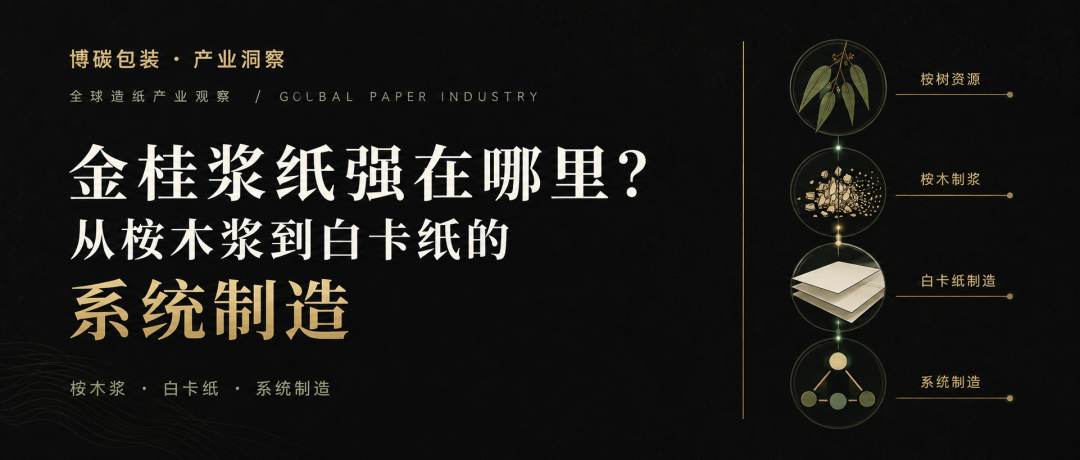
协会重点企业表第11位、2025年纸及纸板产量281.69万吨给出规模坐标。金桂更值得研究的,是化机浆线、高档白卡线、公用工程与港口交付如何协同,并最终进入产品质量、订单和经营现金流。
核心判断
金桂的强项,是把桉木化机浆的原料能力、高档白卡的规模制造和钦州港的出口交付组织在同一基地协同起来。281.69万吨和协会重点企业表第11位说明规模;松厚—强度平衡、成品率、加工良率、出口履约、利润与经营现金流,才决定这种规模能否沉淀为长期竞争力。
规模写在产量表里,价值落在纸页、订单和经营现金流里。
本系列从中国造纸协会2025年重点企业产量表前20家依次研究。按该表,广西金桂浆纸业有限公司2025年纸及纸板产量281.69万吨、同比增长5.91%,列第11位;协会同时注明,表格“按已收集到的数据排列”。
这个数字回答了金桂有多大,却没有回答它靠什么稳定制造和交付。向上游看,是APP广西林业体系提供的部分木材资源、多元原料采购和3条化机浆生产线;向中间看,是2条高档白卡纸生产线,以及热电、清污水、碱回收和自动化仓库;向下游看,则是消费品白卡、食品卡、杯碗餐盒原纸等产品布局和钦州港出口组织。
设备商资料把“化机浆—纸板”关系说得更直接。安德里茨披露,金桂两条P-RC APMP线升级,是为了满足新增纸板线带来的机械浆需求;维美德资料则显示,金桂BCTMP线以桉木片为原料,生产集团内部使用的化机浆。
这条制造链已经形成规模,但产量、利润和现金流并没有天然同步。2024年,白卡纸贡献合并收入的57.89%;营业收入和归母净利润分别同比下降16.83%和28.52%,经营活动现金流净额为-6.02亿元。2025年产量同比增加,经营质量是否同步改善,仍要等待同口径财务数据验证。
研究边界
口径说明:281.69万吨为协会2025年纸及纸板产量;广西日报2026年3月报道的100万吨化机浆、190万吨高档白卡纸为年产能,化机浆与纸及纸板不是同一产品范围,本文不将这些数字相加或计算利用率。APP广西林业资源属于集团体系,并不等于金桂单体资产或全部原料自给。300万吨升级方案已经推进至征求意见稿及报告书公开环节,但本轮未取得环评批复、开工、试产或投产文件。产品目录也不等于最终包装的食品接触、阻隔或回收证明。
01 · SCALE & REVENUE
第11位只是入口:白卡纸贡献近六成收入
协会数据表明,金桂2025年纸及纸板产出比上年增加。另一个必须分开的数字,是年产能。广西日报2026年3月报道披露,金桂当时已形成100万吨/年化机浆、190万吨/年高档白卡纸产能;协会281.69万吨则是2025年纸及纸板产量。
• 281.69万吨:协会2025年纸及纸板产量,同比+5.91%,列第11位;
• 100万吨/年:广西日报报道的化机浆产能;
• 190万吨/年:广西日报报道的高档白卡纸产能;
• 3条化机浆线、2条高档白卡线:金桂官网当前生产线数量披露。
产能、产量、产品范围和来源口径并不完全一致。本文不把100与190相加后同281.69比较,也不使用281.69÷190计算利用率。两组数字并置后,更适合观察纸机运行、产品结构和后续扩建的实际进展。
金元证券2024年度受托管理报告给出了经营结构。金桂当年白卡纸收入65.92亿元,占合并收入57.89%;来料加工收入28.99亿元,占25.46%;浆收入约6.00亿元,占5.27%。
这些数据确认了白卡纸的核心位置,也说明金桂收入并非只来自自产白卡销售。财务分类本身不能证明来料加工、浆、贸易与白卡纸之间已经形成协同;更值得跟踪的,是自制化机浆能否稳定匹配纸板需求,来料加工如何影响产品结构,以及订单能否顺利转为回款和经营现金流。
资料来源:中国造纸协会《中国造纸工业2025年度报告》;广西日报:春天里,工业竞速起势;金元证券《广西金桂浆纸业有限公司公司债券受托管理事务报告(2024年度)》。
02 · FIBER TO BOARD
桉木化机浆,如何进入高档白卡产品平台
真正把制浆线与纸板线连接起来的,是明确的设备改造关系。安德里茨2022年披露,金桂两条P-RC APMP纤维线升级,目的之一是满足新增纸板生产线带来的机械浆需求;改造覆盖木片预处理、高浓磨浆和纤维—蒸汽分离等环节。维美德资料则显示,金桂另一条BCTMP生产线以桉木片为原料,生产集团内部使用的化机浆。
化机浆可以为高档白卡提供松厚度和不透明度等配浆潜力,但不能单独决定成纸表现。白卡纸的挺度、层间结合、表面强度、印刷适性和模切折叠,还取决于化学浆与化机浆的配比、纸页分层、成形与压榨、干燥、施胶涂布、压光和水分控制。高松厚也不是越高越好,技术难点在于把松厚、强度、表面质量和纸机稳定性控制在同一质量窗口内。
集团林业资源只是原料组织的一部分。公司RCEP报道同时提到进口木浆、木片和淀粉等原料,因此这里的“林浆纸一体化”,应理解为集团林业资源、多元采购与基地制造之间的协同,而不是金桂全部原料自给。
官网列出的食品级白卡、纸杯原纸、面碗原纸和餐盒原纸,只能证明产品目录和应用方向。原纸进入饮料、热汤或含油食品场景时,往往还要经过淋膜或涂布、印刷、模切、成型和封合。食品接触、阻隔、热封与末端回收结论,必须按原纸、涂层或膜层、油墨胶黏剂、最终结构和真实使用条件分别核验。
对材料与设备供应商而言,合作指标因此更加具体:浆端看白度、游离度、纤维束以及松厚—强度平衡;纸机看断纸率、成品率、横幅定量和水分稳定;加工端看印刷适性、压痕爆线、模切、粘合、翘曲和成型良率。
资料来源:安德里茨:金桂两条P-RC APMP线升级验收;维美德:BCTMP生产线在广西金桂取得成功;金桂官网产品信息。
03 · PROFIT & CASH
产量增长以后,还要看利润与现金流
2024年,金桂合并口径营业收入113.87亿元,同比下降16.83%;归属于母公司所有者的净利润8.15亿元,同比下降28.52%;经营活动产生的现金流量净额为-6.02亿元,上年同期为13.79亿元。期末资产负债率45.76%,流动比率2.09、速动比率2.00。
• 营业收入113.87亿元,同比-16.83%;
• 归母净利润8.15亿元,同比-28.52%;
• 经营活动现金流净额-6.02亿元;
• 资产负债率45.76%,流动比率2.09、速动比率2.00。
这组财务结果说明,制造规模已经成形,但产量不会自动转为利润和现金。价格、订单、原料、库存和回款节奏,需要在同一周期内共同改善。
产出端出现了积极信号。公司专题报道披露,2025年产值102亿元,连续四年突破百亿元;钦州日报2026年6月报道援引公司总监介绍,2026年1—4月白卡纸产量84.8万吨,实现浆纸产值28.97亿元。上述数字属于企业报道和媒体采访口径,产值不等于营业收入,“满负荷稳定运行”也不替代产能利用率、停机记录、产销率或盈利证明。
因此,两组事实需要同时看:2025年纸及纸板产量较上年增加,2026年前四个月仍保持较高产出;利润和经营现金流是否同步改善,仍需等待同口径的2025年度财务数据。下一阶段更值得观察的,是高附加值产品占比、库存与应收周转、出口订单质量和经营现金流能否逐步同向。
资料来源:金元证券《广西金桂浆纸业有限公司公司债券受托管理事务报告(2024年度)》;中国工业新闻网转引钦州日报:绿色引擎驱动百亿产业。
04 · OPERATIONS & PROJECTS
环保运行与扩建项目,按阶段判断
自备热电、供水与污水处理,以及企业所称的碱回收系统,首先解决的是连续供能、用水和污染物管理。公开资料尚不足以证明单位能耗、单位水耗、碱回收效率或碳强度优势;后续应观察吨浆电耗、蒸汽回收、吨纸水耗、许可排放和非计划停机等指标。
金桂2025年度自行监测公示称,公司共有3个废水排放口、24个废气排放口,其中6个安装自动监控设施;企业披露的第三方手工监测结果均达标,数据上传发布完成率为100%。这些信息说明企业建立了自监和公开机制,但不替代监管抽查、排污许可执行报告或产品环境属性证明。
高档纸板车间绿色升级改造项目的阶段也需要更新。该项目由2025年11月首次信息公示,推进到2026年2月征求意见稿公众参与;行业媒体转引信息称,环境影响报告书于2026年3月27日公开。本轮尚未取得可核验的环评批复、开工、试生产或投产文件,因此“190万吨拟提升至300万吨”仍是项目方案,不是已经形成的新增产能或经营成果。
项目判断应按顺序记录:首次公示、征求意见稿、报告书公开、正式批复、开工、试生产、稳定运行、满产和盈利。每跨过一个节点,都需要新的文件或经营数据。
资料来源:广西金桂浆纸业有限公司2025年度自行监测开展情况公示;广西日报2026年2月项目公众参与公示;纸业观察网转引项目报告书公开信息。
05 · INDUSTRY VALUE
产业链机会,落在四个可验证环节
金桂的产业链价值,不在抽象的“规模大”,而在几个能够用工艺和经营数据核验的合作环节。
原料与化学品:把松厚—强度平衡稳定下来。 浆料白度、游离度、纤维束、松厚与抗张之间的平衡,会影响纸页分层、涂布和后续加工;合作效果要看批次波动、断纸率和成品率。
装备与数字化:把高车速变成稳定成品率。 纸机、复卷、分切、自动化仓库和质量数据系统,应当落实到横幅定量、水分、涂布量、表面强度、品种切换时间和非计划停机。
包装加工:让原纸性能通过印刷、模切和成型验证。 对食品卡、纸杯和餐盒原纸,加工端应关注印刷适性、压痕爆线、模切精度、粘合、翘曲、热封和成型良率;最终合规仍要按完整包装结构验证。
港口与贸易:让交付效率进入库存和现金周转。 出口配送型监管仓为报关后的储存、集拼和配送提供了组织节点,但设施启用不等于新增订单或利润。其价值要看通关周期、库存天数、准时足量交付率、货损索赔率和回款周期。
这些指标把合作方向说得更具体:好浆料要进入稳定纸页,稳定纸页要通过加工验证,交付效率最终要进入订单质量和经营现金流。
资料来源:金桂出口配送型监管仓正式启用;“钦品智造”出海提速。
CONCLUSION
从制造规模到经营质量
金桂在协会重点企业产量表中的第11位,说明它已经站在一个可观的规模坐标上。更值得研究的,是集团林业资源支持、多元原料采购、桉木化机浆、高档白卡产品平台、公用工程和港口交付共同构成的能力组合。
这套组合已经具备系统协同的制造基础,但经营结果仍在接受周期检验。2024年收入、利润和经营现金流的变化说明,规模不会自然沉淀为经营质量;2025年产量增长和2026年前四个月的产出数据,则表明制造能力仍在发挥。下一步应持续观察产品结构、纸页质量、出口订单、盈利能力和经营现金流能否逐步同向。
对产业链企业而言,合作方向因此变得具体:材料要改善纸页与加工表现,设备要提升稳定运行和品种切换效率,包装加工要把原纸性能转成终端价值,物流要缩短交付与回款周期。
博碳包装持续关注的,正是这些能够被客户、数据和现金流验证的环节。好材料进入适合的纸种,好原纸进入擅长的包装场景,制造能力才能沉淀为长期价值。
下一篇 · 协会重点企业产量表第12位
武汉金凤凰纸业有限公司
2025年纸及纸板产量248.10万吨 · 同比+12.43%
下一篇将继续核实其产品结构、原料组织与客户交付能力。数据来源:中国造纸协会《中国造纸工业2025年度报告》
博碳包装·产业洞察·研究说明
本文采用“中国造纸协会确定系列顺序、法定披露核对财务、广西日报与企业官网核对生产线和产能、设备商资料核对化机浆—纸板关系、环境信息公示核对项目阶段”的方法,信息核验截至2026年8月。
产量、产能、收入、利润、现金流、产品目录、设备商案例、自行监测、环评阶段和客户采用属于不同证据层级。企业官网、供应商资料和媒体采访均以披露主体口径使用,不替代审计财务、独立检测、环评批复或最终包装合规证明。
本文基于公开资料开展独立研究,不构成合作背书、产品认证、投资建议或交易依据。
博碳观察数据与核验来源
1. 中国造纸协会《中国造纸工业2025年度报告》
2. 金元证券《广西金桂浆纸业有限公司公司债券受托管理事务报告(2024年度)》
3. 广西日报:春天里,工业竞速起势
4. 金桂官网公司简介
5. 金桂官网产品信息
6. 安德里茨:金桂两条P-RC APMP线升级验收
7. 维美德:BCTMP生产线在广西金桂取得成功
8. 中国工业新闻网转引钦州日报:绿色引擎驱动百亿产业
9. “钦品智造”出海提速
10. 金桂出口配送型监管仓正式启用
11. 广西金桂浆纸业有限公司2025年度自行监测开展情况公示
12. 广西日报2026年2月项目公众参与公示
13. 纸业观察网转引项目报告书公开信息
14. 金光集团APP关于中国业务与林浆纸布局
Scale is visible in the production table; Jingui's real strength lies in integrating eucalyptus chemi-mechanical pulp with premium folding boxboard.
China's Top 20 Paper Producers · No. 11 / INDUSTRIAL PAPER STUDY
Its No. 11 position in the association's table of key producers and its 2025 paper and paperboard output of 2.8169 million tonnes establish the scale benchmark. The more important question is how Jingui coordinates its chemi-mechanical pulp lines, premium folding boxboard lines, utilities and port logistics—and how that coordination translates into product quality, orders and operating cash flow.
CORE JUDGMENT
Jingui's strength lies in coordinating eucalyptus chemi-mechanical pulp production, large-scale premium folding boxboard manufacturing and export delivery through the Port of Qinzhou at a single integrated site. Output of 2.8169 million tonnes and the No. 11 ranking demonstrate scale; the bulk–strength balance, saleable yield, converting yield, export execution, profitability and operating cash flow determine whether that scale becomes a durable competitive advantage.
Scale appears in the production table; value is realized in the sheet, the order book and operating cash flow.
This series examines, in order, the 20 largest producers in the China Paper Association's 2025 output table for key enterprises. According to that table, Guangxi Jingui Pulp & Paper Co., Ltd. produced 2.8169 million tonnes of paper and paperboard in 2025, up 5.91% year on year, ranking 11th. The association also notes that the table is ranked on the basis of data collected.
That figure shows how large Jingui is, but not how it achieves stable production and delivery. Upstream, the system combines part of its wood supply from APP China's Guangxi forestry operations, diversified raw-material procurement and three chemi-mechanical pulp lines. At the mill, it includes two premium folding boxboard lines, captive heat and power, water supply and wastewater treatment, chemical recovery and automated warehousing. Downstream, it spans consumer-packaging board, food-service board, cupstock, bowlstock and food-container board, supported by export logistics through the Port of Qinzhou.
Equipment suppliers describe the pulp-to-board relationship more directly. ANDRITZ states that two P-RC APMP fiberlines at Jingui were upgraded to meet the increased mechanical-pulp demand created by a new board production line. Valmet reports that Jingui's BCTMP line uses eucalyptus chips to produce chemi-mechanical pulp for integrated board production within the group.
This manufacturing chain has reached substantial scale, but output, profit and cash flow do not move in lockstep. In 2024, folding boxboard accounted for 57.89% of consolidated revenue; operating revenue and net profit attributable to the parent fell by 16.83% and 28.52%, respectively, while net cash flow from operating activities was negative RMB 602 million. Output increased in 2025, but comparable financial data are still needed to determine whether operating quality improved at the same time.
RESEARCH BOUNDARIES
Basis of comparison:The 2.8169 million tonnes figure is the association's 2025 output for paper and paperboard. The 1.0 million tonnes per year of chemi-mechanical pulp and 1.9 million tonnes per year of premium folding boxboard reported by Guangxi Daily in March 2026 are annual capacities. Chemi-mechanical pulp and paper and paperboard are different product scopes, so this article neither adds the figures together nor derives a utilization rate from them. APP China's Guangxi forestry resources belong to the group system; they are not necessarily assets of Jingui itself and do not imply complete raw-material self-sufficiency. The proposed 3.0-million-tonne upgrade has reached the draft-for-public-comment and report-disclosure stages, but no verifiable EIA approval, construction, trial-production or commissioning document was identified in this review. A product catalogue likewise does not constitute evidence of food-contact compliance, barrier performance or recyclability for the finished package.
01 · SCALE & REVENUE
No. 11 Is Only the Starting Point: Folding Boxboard Generates Nearly 60% of Revenue
Association data show that Jingui's paper and paperboard output increased in 2025. Annual capacity is a separate measure. Guangxi Daily reported in March 2026 that Jingui then had annual capacity of 1.0 million tonnes of chemi-mechanical pulp and 1.9 million tonnes of premium folding boxboard, whereas the association's 2.8169 million tonnes figure is 2025 paper and paperboard output.
•2.8169 million tonnes: 2025 paper and paperboard output reported by the association, up 5.91% year on year and ranked No. 11;
•1.0 million tonnes per year: chemi-mechanical pulp capacity reported by Guangxi Daily;
•1.9 million tonnes per year: premium folding boxboard capacity reported by Guangxi Daily;
•Three chemi-mechanical pulp lines and two premium folding boxboard lines: the current line count disclosed on Jingui's website.
Capacity, output, product scope and source methodology are not fully comparable. This article does not add 1.0 million and 1.9 million tonnes and compare the result with 2.8169 million tonnes, nor does it use 2.8169 ÷ 1.9 to estimate utilization. Read together, the figures are more useful for tracking paper-machine operation, product mix and the actual progress of subsequent expansion.
Jinyuan Securities' 2024 bond trustee report details Jingui's revenue mix. Folding boxboard generated RMB 6.592 billion, or 57.89% of consolidated revenue; toll-processing revenue was RMB 2.899 billion, or 25.46%; and pulp revenue was approximately RMB 600 million, or 5.27%.
These figures confirm the central role of folding boxboard while showing that Jingui's revenue is not derived solely from sales of self-produced board. The accounting categories alone do not prove synergies among toll processing, pulp, trading and folding boxboard. More important questions are whether internally produced chemi-mechanical pulp can consistently match board demand, how toll processing affects the product mix, and whether orders convert efficiently into collections and operating cash flow.
Sources: China Paper Association, 2025 Annual Report of China's Paper Industry; Guangxi Daily, “Industry Accelerates as Spring Arrives”; Jinyuan Securities, 2024 Bond Trustee Report of Guangxi Jingui Pulp & Paper Co., Ltd.
02 · FIBER TO BOARD
How Eucalyptus Chemi-Mechanical Pulp Enters the Premium Folding Boxboard Platform
The clearest link between the pulp lines and the board lines is the documented equipment upgrade. ANDRITZ reported in 2022 that one purpose of upgrading Jingui's two P-RC APMP fiberlines was to meet the increased mechanical-pulp demand from a new board production line. The work covered chip pretreatment, high-consistency refining and fiber–steam separation. Valmet reports that another BCTMP line at Jingui uses eucalyptus chips to make chemi-mechanical pulp for integrated board production within the group.
Chemi-mechanical pulp can contribute bulk and opacity to premium folding boxboard furnish, but it does not determine finished-sheet performance on its own. Board stiffness, internal bond strength, surface strength, printability and die-cutting and folding performance also depend on the ratio of chemical to chemi-mechanical pulp, ply design, forming and pressing, drying, sizing and coating, calendering and moisture control. Higher bulk is not inherently better; the technical challenge is to keep bulk, strength, surface quality and machine stability within the same operating window.
The group's forestry resources are only one part of the raw-material system. A company report on RCEP also refers to imported market pulp, wood chips and starch. “Integrated plantation–pulp–paper” should therefore be understood as coordination among group forestry resources, diversified procurement and mill operations—not as complete raw-material self-sufficiency at Jingui.
The food-grade board, cupstock, bowlstock and food-container board listed on the company's website establish only the product range and intended applications. Before base paper enters beverage, hot-soup or oily-food applications, it often undergoes extrusion coating or other coating, printing, die-cutting, forming and sealing. Claims concerning food contact, barrier performance, heat sealing and end-of-life recyclability must be verified separately for the base paper, coating or film, inks and adhesives, finished structure and actual conditions of use.
For material and equipment suppliers, the collaboration metrics are correspondingly specific. At the pulp stage, they include brightness, freeness, shive content and the bulk–strength balance. On the paper machine, they include sheet-break frequency, saleable yield, cross-direction basis-weight profile and moisture stability. In converting, they include printability, crease cracking, die-cutting, bonding, warp and forming yield.
Sources: ANDRITZ, final acceptance of the upgrade to two P-RC APMP lines at Jingui; Valmet, “BCTMP Line Proves Success at Guangxi Jingui Pulp & Paper”; Jingui product information.
03 · PROFIT & CASH
After Output Growth, Profit and Cash Flow Still Matter
In 2024, Jingui reported consolidated operating revenue of RMB 11.387 billion, down 16.83% year on year; net profit attributable to owners of the parent of RMB 815 million, down 28.52%; and net cash flow from operating activities of negative RMB 602 million, versus positive RMB 1.379 billion a year earlier. At year-end, the debt-to-asset ratio was 45.76%, the current ratio 2.09 and the quick ratio 2.00.
•Operating revenue of RMB 11.387 billion, down 16.83% year on year;
•Net profit attributable to owners of the parent of RMB 815 million, down 28.52% year on year;
•Net cash flow from operating activities of negative RMB 602 million;
•Debt-to-asset ratio of 45.76%, current ratio of 2.09 and quick ratio of 2.00.
These financial results show that manufacturing scale is established, but output does not automatically become profit and cash. Prices, order quality, raw materials, inventory and the pace of collections must improve within the same cycle.
There are positive signals on the production side. A company feature reported gross output value of RMB 10.2 billion in 2025, above RMB 10 billion for a fourth consecutive year. A June 2026 Qinzhou Daily report quoted a company director as saying that Jingui produced 848,000 tonnes of folding boxboard and generated RMB 2.897 billion in pulp-and-paper output value from January through April 2026. These figures come from company reporting and a media interview. Gross output value is not operating revenue, and “stable operation at full load” is not a substitute for evidence on capacity utilization, downtime, the production-to-sales ratio or profitability.
Both sets of facts therefore matter: paper and paperboard output increased in 2025, and production remained high during the first four months of 2026. Comparable 2025 financial data are still needed to determine whether profit and operating cash flow improved in parallel. The next issues to watch are the share of higher-value products, inventory and receivables turnover, the quality of export orders and whether operating cash flow moves in the same direction.
Sources: Jinyuan Securities, 2024 Bond Trustee Report of Guangxi Jingui Pulp & Paper Co., Ltd.; China Industry News, citing Qinzhou Daily, “A Green Engine Powers a Hundred-Billion-Yuan Industry.”
04 · OPERATIONS & PROJECTS
Assess Environmental Operations and Expansion Projects by Stage
Captive heat and power, water supply and wastewater treatment, and what the company describes as a chemical-recovery system first support continuous energy supply, water management and pollutant control. Public information is not yet sufficient to establish advantages in unit energy consumption, unit water use, chemical-recovery efficiency or carbon intensity. Future assessment should track electricity use per tonne of pulp, steam recovery, water use per tonne of paper, permitted emissions and unplanned downtime.
Jingui's 2025 self-monitoring disclosure states that the company has three wastewater discharge outlets and 24 air-emission outlets, six of which are equipped with automatic monitoring systems. The company reported that all third-party manual-monitoring results met applicable limits and that its data-upload and publication completion rate was 100%. This shows that a self-monitoring and disclosure mechanism is in place, but it does not replace regulatory inspections, pollutant-discharge permit implementation reports or evidence of product environmental attributes.
The stage of the premium paperboard workshop's green upgrade project must also be described precisely. The project progressed from an initial information disclosure in November 2025 to public consultation on the draft environmental impact report in February 2026. Industry media reported that the environmental impact report was released on 27 March 2026. This review did not identify verifiable documents confirming EIA approval, construction, trial production or commissioning. The proposed increase from 1.9 million to 3.0 million tonnes per year therefore remains a project plan, not realized capacity or an operating result.
Project status should be recorded in sequence: initial disclosure, draft for public consultation, report publication, formal approval, construction, trial production, stable operation, full production and profitability. Each transition requires a new document or new operating data.
Sources: Guangxi Jingui Pulp & Paper Co., Ltd., 2025 self-monitoring disclosure; Guangxi Daily, February 2026 public-participation notice; Paper Industry Observer, citing the publication of the project report.
05 · INDUSTRY VALUE
Value-Chain Opportunities Lie in Four Verifiable Areas
Jingui's value to the industry chain does not lie in the abstract idea of being “large,” but in several areas of collaboration that can be tested with process and operating data.
Raw Materials and Chemicals: Stabilize the Bulk–Strength Balance. The balance among pulp brightness, freeness, shive content, bulk and tensile strength affects ply structure, coating and downstream converting. Collaboration should be evaluated through batch-to-batch variation, sheet-break frequency and saleable yield.
Equipment and Digitalization: Turn High Speed into Consistent Saleable Yield. Paper machines, rewinders, slitters, automated warehouses and quality-data systems should be measured through cross-direction basis-weight, moisture and coat-weight profiles, surface strength, grade-changeover time and unplanned downtime.
Packaging Conversion: Validate Base-Paper Performance through Printing, Die-Cutting and Forming. For food-service board, cupstock and food-container board, converters should evaluate printability, crease cracking, die-cut accuracy, bonding, warp, heat sealing and forming yield. Final compliance must still be verified for the complete packaging structure.
Port and Trade: Translate Delivery Efficiency into Inventory and Cash Conversion. The customs-supervised export distribution warehouse provides an operating node for post-clearance storage, consolidation and distribution, but opening the facility does not itself create additional orders or profit. Its value should be assessed through customs-clearance time, inventory days, the on-time-in-full delivery rate, cargo-damage claim rate and collection cycle.
These metrics make the direction of collaboration concrete: good pulp must become a stable sheet; a stable sheet must pass converting validation; and delivery efficiency must ultimately improve order quality and operating cash flow.
Sources: the launch of Jingui's customs-supervised export distribution warehouse; “Qinzhou Smart Manufacturing Accelerates Its Global Reach.”
CONCLUSION
From Manufacturing Scale to Operating Quality
Jingui's No. 11 position in the association's output table for key producers places it at a meaningful scale benchmark. More important is the combination of capabilities created by support from group forestry resources, diversified raw-material procurement, eucalyptus chemi-mechanical pulp, a premium folding boxboard platform, utilities and port logistics.
This combination provides a foundation for coordinated manufacturing, but operating results remain exposed to the industry cycle. Changes in revenue, profit and operating cash flow in 2024 show that scale does not automatically become operating quality. Output growth in 2025 and production data for the first four months of 2026 show that the manufacturing base remains active. The next question is whether product mix, sheet quality, export orders, profitability and operating cash flow can increasingly move in the same direction.
For value-chain partners, the opportunities are therefore specific: materials should improve sheet and converting performance; equipment should raise operating stability and grade-change efficiency; packaging converters should translate base-paper performance into end-use value; and logistics should shorten delivery and collection cycles.
These are precisely the areas that BIOTEN Packaging continues to monitor—areas that can be validated by customers, data and cash flow. Only when the right material enters the right paper grade, and the right base paper enters the right packaging application, can manufacturing capability become durable value.
Next Article · No. 12 in the Association's Output Table for Key Producers
Wuhan Golden Phoenix Paper Co., Ltd.
2025 paper and paperboard output: 2.4810 million tonnes · Up 12.43% year on year
The next article will continue by verifying its product mix, raw-material system and customer-delivery capabilities. Source: China Paper Association, 2025 Annual Report of China's Paper Industry.
BIOTEN Packaging · Industry Insights · Research Note
This article uses the China Paper Association to establish the series order; statutory disclosures to verify financial data; Guangxi Daily and the company website to verify production lines and capacity; equipment-supplier materials to verify the chemi-mechanical-pulp-to-board relationship; and environmental disclosures to verify project stage. Information was checked through August 2026.
Output, capacity, revenue, profit, cash flow, product catalogues, supplier case studies, self-monitoring, EIA stage and customer adoption represent different levels of evidence. Company websites, supplier materials and media interviews are used according to the scope of the disclosing party and do not replace audited financial statements, independent testing, EIA approval or compliance evidence for the finished package.
This is independent research based on public information. It does not constitute a partnership endorsement, product certification, investment advice or a basis for any transaction.
BIOTEN Observer Data and Verification Sources
1. China Paper Association, 2025 Annual Report of China's Paper Industry
2. Jinyuan Securities, 2024 Bond Trustee Report of Guangxi Jingui Pulp & Paper Co., Ltd.
3. Guangxi Daily, “Industry Accelerates as Spring Arrives”
4. Jingui company profile
5. Jingui product information
6. ANDRITZ, final acceptance of the upgrade to Jingui's two P-RC APMP lines
7. Valmet, “BCTMP Line Proves Success at Guangxi Jingui Pulp & Paper”
8. China Industry News, citing Qinzhou Daily, “A Green Engine Powers a Hundred-Billion-Yuan Industry”
9. “Qinzhou Smart Manufacturing Accelerates Its Global Reach”
10. Launch of Jingui's customs-supervised export distribution warehouse
11. Guangxi Jingui Pulp & Paper Co., Ltd., 2025 self-monitoring disclosure
12. Guangxi Daily, February 2026 public-participation notice
13. Paper Industry Observer, citing the publication of the project report
14. APP China, overview of its China operations and integrated plantation–pulp–paper model