
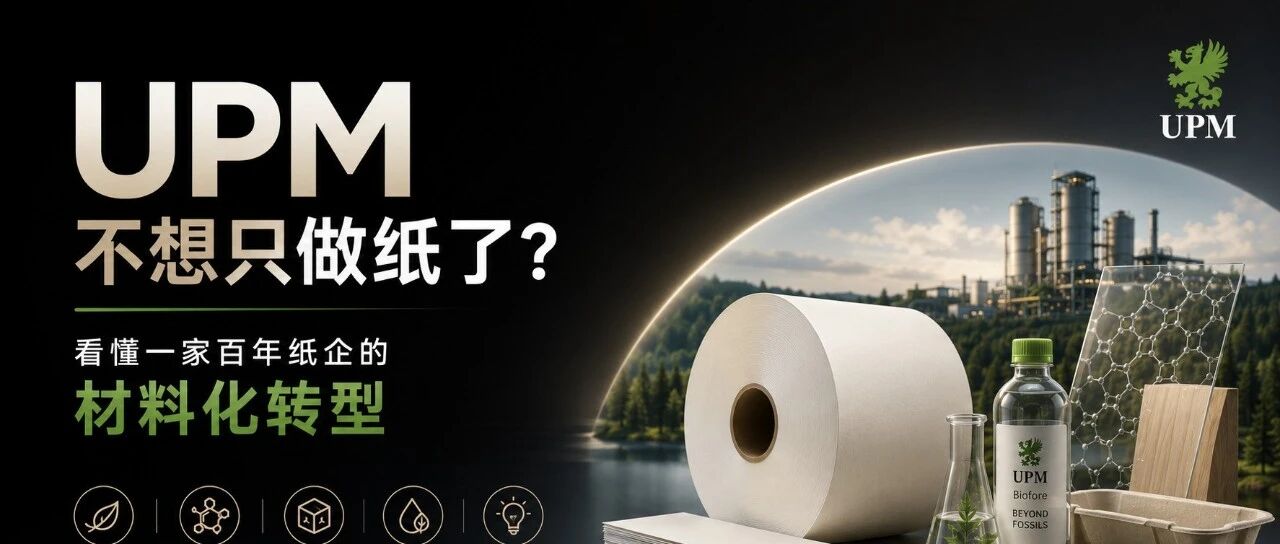
UPM真正想摆脱的不是纸,而是所有业务共用一套资本规则。
全球造纸产业观察 / GLOBAL PAPER INDUSTRY
图文纸合资、胶合板分拆、功能材料高回报、Leuna继续爬坡:UPM没有告别纸,而是在给不同资产重写资本规则。UPM中文名称;芬欧汇川
CURRENT CONTEXT · 中国造纸业2026上半年
机制纸及纸板产量|8313.2万吨 · 同比+6.0%
规上行业收入|6897.9亿元 · 同比+5.5%
规上行业利润|196.1亿元 · 同比+27.5%
行业PPI|累计同比-1.6%
产量、规上财务和PPI属于不同统计边界,不能相除计算吨利润。它们共同说明的是“量增、价弱、利修”,不是全面提价。
核心判断 · CORE JUDGEMENT
UPM正在同时重写价值单位和资本规则:在吨位尺度管理纤维成本,在平方米尺度经营标签、离型与包装功能,在分子尺度验证木质化学品;不同业务最终都要穿过客户资格、资本回报与经营现金流。
当更多吨位不再自然形成价格权,纸企还应该继续用同一套扩产逻辑管理全部业务吗?芬兰UPM提供了一个有冲突的海外样本。
2025年,它的图文纸业务仍实现1.81亿欧元可比息税前利润和17.8%的可比资本回报率,2026年却准备把它与Sappi欧洲图文纸合并;胶合板业务资本回报率达到24.3%,UPM仍计划将其分拆上市;投资估算已达13.70亿欧元的Leuna木质生物化学品工厂,则仍在爬坡。
UPM正在让成熟纸种、纸浆、标签与特种纸、新生物化学品接受不同规则,并由资本回报和现金流判断每条路线是否成立。
研究边界
UPM产业根系可追溯至1871—1872年,现UPM-Kymmene于1996年开始运营。“百年纸企”描述产业根系。
图文纸合资已签最终协议且Sappi股东已批准,但交易未交割;欧盟Phase II及美中等许可仍待。WISA分拆仍待8月31日股东大会等条件。
UPM半年报未经审计;Plywood列为终止经营。分部ROCE、CEPI成员区、中国统计和技术性能均不相互替代。
真正的材料化,是让成熟资产、增长资产和技术储备接受不同的资本纪律。
01 · WHY CHINA SHOULD READ UPM
中国为什么现在需要看UPM
UPM今天首先把自己定义为材料解决方案公司,但纸浆仍是最大的资本底盘,Specialty Materials依然生产标签基纸、离型纸、柔性包装纸、办公纸和部分图文纸。材料化没有让纸消失。
2026年上半年,UPM持续经营业务销售47.81亿欧元,同比约-3%;可比息税前利润4.71亿欧元,同比+17%,利润率9.8%。经营现金流却从4.68亿降至2.25亿欧元,营运资本增加3.39亿欧元,净债务升至33.13亿欧元。
持续经营资本开支由1.98亿降至1.09亿欧元,占销售额2.3%,全年预计约3亿欧元。资本开支收缩并未自动换来更强现金流,营运资本和项目爬坡同样占用现金。
中国行业处在量增、价格仍弱、利润先修复的阶段。下一笔资本投向新纸机、存量改造、浆线、功能材料或降债,需要一张比“未来市场很大”更严谨的业务账。
资料:国家统计局与UPM半年报;统计和企业数据不作横向比值。
02 · FIVE CAPITAL ACCOUNTS
一家公司,五张不同的资本账
如果只看产品名称,很容易把UPM理解成从传统纸业迁往高附加值材料。平均投入资本与可比资本回报率给出的答案更复杂。
2026 H1 · 平均投入资本 / 可比ROCE
Fibres|82.48亿欧元 / 4.9%
Adhesive Materials|8.55亿欧元 / 17.9%
Specialty Materials|6.73亿欧元 / 23.7%
Communication Papers|8.90亿欧元 / 10.1%
Other Operations|14.32亿欧元 / -6.3%
分部职责不同,不能机械排名;Other还包含生物燃料、生物化学品和集团服务。但数据足以说明:最大的资本底盘不一定拥有最高回报,功能材料已形成可观察的资本效率,新生物材料也不会因为“新”就天然高回报。
纸浆内部差异更大。Fibres South上半年可比息税前利润率22.5%,Fibres North仅2.6%,二季度单季亏损1000万欧元。同样叫自制浆,林木生产率、木片、物流、能源、汇率、检修和装置效率会给出完全不同的结果。
对中国浆纸一体化企业,一体化只能说明资产结构,不能替代到厂木材成本、单位现金成本、能源、物流和资本回报。
03 · MATURE BUSINESS GOVERNANCE
图文纸合资与WISA分拆:成熟业务先解决治理问题
CEPI成员区 · 2025供需坐标
图文纸|产量-7.3% · 表观消费-7.1%
包装纸及纸板|产量-0.1%
特种纸及纸板|产量+1.2%
2020—2025|产能-5.1% · 实际产量-9.8% · 开工率84.9%→80.7%
产能退出慢于产量下降,欧洲成熟纸种首先成为供需治理问题。CEPI成员区包含英国和挪威,不等同于EU27。
UPM图文纸业务2025年仍有7.3%可比利润率和17.8%资本回报率;到2026上半年,平均售价下降4%,利润率降至3.7%,但资本回报率仍有10.1%。业务仍有价值,需求、价格和产能治理却越来越困难。
UPM与Sappi拟议JV将双方图文纸放进50/50独立平台,企业价值14.20亿欧元,预计年协同约1亿欧元。Sappi股东已经批准,但欧盟Phase II和美中等许可仍待。
欧委会分别审查CM杂志纸、WFC涂布无木浆纸、C1S纸基标签面材和PSL压敏标签材料。前两项涉及横向产能与价格,后两项涉及面材竞争、股东协调和投入品限制。产业边界不是企业自己画完就算完成。
风险也没有凭空消失。UPM拟取得现金、股东贷款应收和50%权益,部分养老金与其他负债转入JV;直接经营敞口被改造成权益、贷款和未来分红风险。
WISA分拆同样要支付真实成本。H1销售2.40亿欧元、可比EBITDA率13.8%,经营现金流却由正转为小幅负值;分拆与上市成本预计3100万—3300万欧元。独立经营需要重建报告、系统、法律、融资与治理。截至8月18日,股东大会尚未召开。
Stora Enso选择进一步聚焦包装,Mondi继续把无涂布纸与瓦楞包装放进协同体系。欧洲纸企的共同趋势不是都不做纸,而是停止用同一套资本逻辑管理所有纤维资产。
04 · FUNCTION AND MOLECULE
材料化有两条路:表面功能与木质分子
UPM材料业务包含三种成熟度:已经盈利的自粘材料,仍以纸为主体的功能基材,以及仍在工业放大的木质化学品。三者不能压成一条高端化曲线。
界面材料|Adhesive Materials上半年销售8.61亿欧元,基本持平;可比息税前利润7600万欧元,利润率8.9%。它经营的是面材、胶黏剂、离型底材、涂布、分切和应用技术组成的自粘系统。标签选择应服从主包装的回收流程,而不是纸和塑料谁绝对胜出。
功能基材|Specialty Materials交付量+3.4%、销售额-4.1%、可比息税前利润+9.6%。半年报说明,利润增量主要来自折旧下降,销量和可变成本改善只是大体抵消价格下降。材料名称不能代替功能溢价。
常熟是中国最具体的接口。官网披露年产能约140万吨,并设亚洲研发能力;产品安全资料显示常熟PM3生产Solide Lucent阻隔基纸。基纸的食品接触管理与性能不覆盖涂层、油墨、胶黏剂和最终包装,也不能推导单厂利润或订单。
完整结构,而不是单张纸
阻隔方案|UPM Asendo基纸+Michelman涂层+BOBST工艺;OTR 140 cc/m²·day,条件23℃、50%RH。
再浆方案|oneBARRIER特定结构材料得率94.6%;技术得率不等于市场实际回收率。
这两个案例说明,可回收纸基包装不必追求绝对无铝、无涂层或无聚合物。关键是完整结构能否在目标工艺中解离、筛分,并保留足够质量的纤维。
木质分子|Leuna最新投资估算13.70亿欧元,是2020年初始5.50亿欧元的约2.49倍。年份、范围与价格条件不同,这组变化用于说明新型工业装置的放大风险,而非情绪化判断。
工业糖已经商业交付;可再生功能填料和其他木质素衍生物仍预计Q3交付;BioMEG、BioMPG尚无商业交付确认;2027满产和正利润仍是管理层目标。
可再生功能填料也不是碳黑或白炭黑的一比一替代。它密度约1.3g/cm³,偏极性并有吸湿倾向,主要处于低到中等增强范围,需要重新配方、混炼、成型和终件认证;“负碳”只适用于公司披露的摇篮到工厂大门边界。
Lappeenranta利用粗塔罗油生产可再生柴油与石脑油,已商业运行十年。它证明副产物可以形成独立商品,也说明成熟商业线和首台套分子路线必须使用不同回报时钟。
05 · CHINA ACTION COORDINATES
中国造纸产业链的行动坐标
中国造纸协会数据显示,2025年特种纸及纸板产量增长5.15%,消费量却下降2.18%,出口增长14.29%。转向特种纸不等于国内功能需求、售价和利润已经同步增长。
纸浆企业|跟踪到厂木材成本、单位现金成本、能源、物流、检修损失、实现浆价和汇率;不让“自制浆”替代成本证明。
综合纸厂|跟踪利用率、产销率、实现价格、库存天数、资本回报率,以及维护性与扩张性资本开支;成熟纸种、增长纸种和技术储备不能共享一个回报时钟。
特种纸与功能纸|跟踪认证周期、稳定良率、复购率、每平方米实现价格、出口集中度和加工投诉;高端名称不等于功能溢价。
化学品与涂层企业|同时记录原纸、涂布量、线速、温湿度、阻隔、热封、离型、食品接触、再浆和单位应用成本;桶装材料性能不能替代最终包装。
设备企业|跟踪能耗、水耗、蒸汽、停机、爬坡、多基材切换、在线检测和投资回收期;机会不仅是新纸机,也包括低涂布量、多层水性涂布、干燥、分切和再浆评价设备。
包装加工与品牌采购|跟踪成型速度、废品率、材料减量、货架期、客诉、回收适配和复购;材料单价降低,如果带来更多废品或产品损耗,并不等于包装成本下降。
未来两三年观察:图文纸JV能否获批并治理供需;功能材料能否在补库存消退后保持销量与资本回报;Leuna能否扩大交付并降低分部损失;资本开支和营运资本能否回到现金流;常熟等中国资产能否把基纸、涂层、设备和客户验证连接起来。
CONCLUSION · THREE VALUE SCALES
UPM没有告别纸它在同时重写价值单位和资本规则
纸浆仍是纤维底盘,功能纸仍是先进材料的重要组成,常熟仍承载亚洲纸张与研发,拟议JV也意味着UPM计划继续持有图文纸业务50%权益。
真正发生的变化,是每吨纤维要证明资源成本,每平方米材料要证明加工功能,木质分子要证明客户资格与工业放大,每一笔资本最终要证明回报和现金。
这套重构方向清楚,但尚未完成:合资和分拆仍待,功能材料利润改善不全来自售价,Leuna仍在爬坡,集团现金流也没有与利润同步增强。
未来的竞争单位,将同时包括每吨纤维的资源成本、每平方米材料的功能价值,以及每一笔资本能否形成可重复的客户现金流。
博碳包装·产业洞察·研究说明
本文采用“监管和行业统计确定市场现状、正式财报拆解资本回报、企业技术资料限定材料状态、本文分析连接中国决策”的方法,核验截至2026年8月18日。事实、企业披露、计算值、本文判断和管理层预测分别表述。
中国产量、规上财务、PPI与纸种统计范围不同,未计算行业吨利润。CEPI成员区不等于EU27。UPM分部投入资本和ROCE用途不同,不作为简单业务排行榜。
UPM半年报未经审计,Plywood列为终止经营;持续经营销售利润、集团现金流债务没有混写。交易企业价值、预计协同、分拆成本和项目目标未写成已实现结果。
功能纸、胶黏材料、阻隔包装、木质化学品和功能填料的性能均限定具体基材、结构、条件、回收流程与生命周期边界。基纸不覆盖最终包装,技术可回收不等于规模回收,首次交付不等于稳定利用率、复购或正现金流。
文中产业协同为研究建议,不构成合作背书、产品认证、投资建议或交易依据。
博碳观察数据与核验来源
01|UPM《2026年半年度报告》
02|UPM《2025年年度报告》
03|UPM与Sappi图文纸合资最终协议
04|欧盟委员会M.12270第二阶段审查
05|欧盟官方公报M.12270
06|CEPI《Key Statistics 2025》
07|Sappi 2026财年第三季度报告
08|UPM WISA分拆专题
09|WISA 8月17日补充招股书
10|UPM公司历史
11|UPM战略与业务组合
12|UPM Adhesive Materials
13|UPM Specialty Materials
14|UPM常熟纸厂
15|常熟Solide Lucent产品安全资料
16|UPM—Michelman—BOBST共同方案
17|UPM oneBARRIER结构说明
18|UPM ProCycle标签组合
19|UPM Leuna初始投资公告
20|UPM BioMotion RFF技术特征
21|UPM RFF生命周期边界
22|UPM Lappeenranta生物精炼厂
23|Stora Enso 2026年半年报
24|Mondi 2026年半年报
25|国家统计局:规上工业企业利润
26|国家统计局:2026年6月PPI
27|国家统计局:机制纸及纸板产量
28|中国造纸协会《中国造纸工业2025年度报告》
What UPM is really seeking to move beyond is not paper itself, but the practice of applying one set of capital rules across every business.
Global Paper Industry Review / GLOBAL PAPER INDUSTRY
Graphic-paper joint venture, plywood demerger, strong returns from functional materials and the continued Leuna ramp-up: UPM is not leaving paper behind; it is rewriting the capital rules for different assets. UPM's established Chinese-language name is Fen'ou Huichuan.
CURRENT CONTEXT · CHINA'S PAPER INDUSTRY IN H1 2026
Paper and paperboard output | 83.132 million tonnes · +6.0% year on year
Revenue of enterprises above designated size | RMB 689.79 billion · +5.5% year on year
Profit of enterprises above designated size | RMB 19.61 billion · +27.5% year on year
Producer Price Index (PPI) | -1.6% year on year, cumulative
Output, financial data for enterprises above designated size and the PPI have different statistical scopes and cannot be divided to calculate profit per tonne. Together they indicate higher volumes, weak prices and recovering profits—not across-the-board price increases.
Core Assessment
UPM is simultaneously rewriting its units of value and its capital rules: it manages fiber costs on a per-tonne basis, builds value in labels, release materials and packaging functionality per square metre, and validates wood-based chemicals at the molecular level. Every business must ultimately pass the tests of customer qualification, return on capital and operating cash flow.
When additional tonnage no longer translates naturally into pricing power, should a paper company continue managing every business with the same capacity-expansion logic? Finland's UPM provides a revealing and internally conflicted international case.
In 2025, its communication-papers business still generated €181 million in comparable EBIT and a 17.8% comparable return on capital employed. Yet in 2026, UPM is preparing to combine that business with Sappi's European graphic-paper operations. UPM Plywood achieved a 24.3% return on capital, but UPM still plans to demerge and list it separately. Meanwhile, the estimated investment in the Leuna wood-based biochemicals refinery has reached €1.37 billion and the facility remains in ramp-up.
UPM is subjecting mature paper grades, pulp, labels and specialty papers, and emerging biochemicals to different rules—and using return on capital and cash flow to determine whether each path is viable.
Research Boundaries
UPM's industrial roots date to 1871–1872, while the present UPM-Kymmene began operations in 1996. The description “century-old paper company” refers to those industrial roots.
The definitive agreement for the graphic-paper joint venture has been signed and Sappi's shareholders have approved the transaction, but it has not closed. Phase II review in the EU and approvals in the United States, China and other jurisdictions remain pending. The WISA demerger is still subject to the Extraordinary General Meeting on 31 August and other conditions.
UPM's half-year report is unaudited, and UPM Plywood is presented as discontinued operations. Segment ROCE, CEPI member-country data, Chinese statistics and technical-performance data are not interchangeable.
A genuine transformation into materials means subjecting mature assets, growth assets and technology options to different forms of capital discipline.
01 · WHY CHINA SHOULD READ UPM
Why China Should Study UPM Now
UPM today defines itself first as a material solutions company, yet pulp remains its largest capital base. UPM Specialty Materials continues to produce label papers, release papers, flexible-packaging papers, office papers and certain graphic papers. The shift toward materials has not made paper disappear.
In the first half of 2026, sales from continuing operations were €4.781 billion, down approximately 3% year on year. Comparable EBIT rose 17% to €471 million, or 9.8% of sales. Operating cash flow, however, fell from €468 million to €225 million; working capital increased by €339 million; and net debt rose to €3.313 billion.
Capital expenditure in continuing operations fell from €198 million to €109 million, equivalent to 2.3% of sales, with full-year spending expected to be approximately €300 million. Lower capital expenditure did not automatically produce stronger cash flow: working capital and project ramp-up also absorbed cash.
China's paper industry is experiencing volume growth, continued pricing weakness and an early recovery in profits. The next capital allocation—to a new paper machine, an upgrade of existing assets, a pulp line, functional materials or debt reduction—requires a business case more rigorous than “the future market is large.”
Sources: National Bureau of Statistics of China and UPM Half Year Financial Report 2026; statistical and company data are not used to derive cross-source ratios.
02 · FIVE CAPITAL ACCOUNTS
One Company, Five Different Capital Accounts
Looking only at product names makes it easy to interpret UPM as moving from traditional paper into higher-value materials. Average capital employed and comparable ROCE tell a more complex story.
H1 2026 · Average Capital Employed / Comparable ROCE
Fibres | €8.248 billion / 4.9%
Adhesive Materials | €855 million / 17.9%
Specialty Materials | €673 million / 23.7%
Communication Papers | €890 million / 10.1%
Other Operations | €1.432 billion / -6.3%
The segments perform different roles and should not be ranked mechanically; Other Operations also includes biofuels, biochemicals and group services. The figures nevertheless show that the largest capital base does not necessarily generate the highest return, that functional materials already demonstrate observable capital efficiency, and that new biomaterials do not earn high returns merely because they are new.
The divergence within pulp is even greater. Fibres South recorded a comparable EBIT margin of 22.5% in the first half, while Fibres North achieved only 2.6% and posted a €10 million loss in the second quarter alone. Even within captive pulp, forest productivity, wood chips, logistics, energy, exchange rates, maintenance and mill efficiency can produce entirely different outcomes.
For integrated pulp-and-paper companies in China, integration describes the asset structure; it does not replace evidence on delivered wood cost, cash cost per unit, energy, logistics and return on capital.
03 · MATURE BUSINESS GOVERNANCE
Graphic-Paper Joint Venture and WISA Demerger: Mature Businesses First Need Governance Solutions
CEPI Member Countries · 2025 Supply-and-Demand Reference
Graphic papers | Output -7.3% · apparent consumption -7.1%
Packaging paper and board | Output -0.1%
Specialty papers and board | Output +1.2%
2020–2025 | Capacity -5.1% · actual output -9.8% · operating rate 84.9% → 80.7%
Capacity has exited more slowly than output has declined, turning mature European paper grades first and foremost into a supply-and-demand governance problem. CEPI's member countries include the United Kingdom and Norway and are not equivalent to the EU27.
UPM Communication Papers still achieved a 7.3% comparable EBIT margin and a 17.8% comparable ROCE in 2025. By the first half of 2026, its average sales price had declined by 4% and its margin had fallen to 3.7%, although comparable ROCE remained 10.1%. The business still has value, but demand, pricing and capacity have become increasingly difficult to govern.
The proposed joint venture between UPM and Sappi would place their graphic-paper businesses in a 50/50 independent platform with a combined enterprise value of €1.42 billion and estimated annual synergies of approximately €100 million. Sappi's shareholders have approved the transaction, but the EU Phase II review and approvals in the United States, China and other jurisdictions remain pending.
The European Commission is examining coated mechanical magazine paper, woodfree coated paper, one-side-coated paper label face materials and pressure-sensitive label materials. The first two concern horizontal capacity and pricing; the latter two raise questions about competition in face materials, shareholder coordination and restrictions on inputs. A market boundary is not settled simply because the companies have defined it.
Nor have the risks disappeared. UPM would receive cash, shareholder-loan receivables and a 50% equity interest, while certain pension and other liabilities would transfer to the joint venture. Direct operating exposure would be transformed into equity, loan and future-dividend risk.
The WISA demerger also carries real costs. First-half sales were €240 million and the comparable EBITDA margin was 13.8%, yet operating cash flow moved from positive to slightly negative. Demerger and listing costs are expected to total €31–33 million. Operating independently requires rebuilding reporting, systems, legal structures, financing and governance. As of 18 August, the Extraordinary General Meeting had not yet taken place.
Stora Enso has chosen to focus further on packaging, while Mondi continues to manage uncoated paper and corrugated packaging within a coordinated system. The common trend among European paper companies is not that they are all leaving paper, but that they are ceasing to manage every fiber asset under the same capital logic.
04 · FUNCTION AND MOLECULE
Two Paths to Materials: Surface Functionality and Wood-Based Molecules
UPM's materials businesses span three levels of maturity: profitable self-adhesive materials, functional substrates that remain predominantly paper-based, and wood-based chemicals still being scaled industrially. They should not be compressed into a single “premiumization” curve.
Interface materials | UPM Adhesive Materials recorded first-half sales of €861 million, broadly unchanged, and comparable EBIT of €76 million, representing an 8.9% margin. It manages a self-adhesive system comprising face materials, adhesives, release liners, coating, slitting and application technology. Label selection should follow the recycling process of the primary packaging—not an assumption that either paper or plastic is always superior.
Functional substrates | UPM Specialty Materials reported a 3.4% increase in deliveries, a 4.1% decline in sales and a 9.6% increase in comparable EBIT. The half-year report states that the profit increase came mainly from lower depreciation, while higher volumes and improved variable costs broadly offset lower prices. A materials label is not a substitute for a functional premium.
Changshu is UPM's most tangible interface in China. The company website reports annual capacity of approximately 1.4 million tonnes and an Asian research-and-development capability; the product safety profile states that PM3 at Changshu produces UPM Solide™ Lucent barrier base paper. Food-contact controls and performance claims for the base paper do not cover coatings, inks, adhesives or the final package, and they cannot be used to infer the profitability or order book of a single mill.
The Complete Structure, Not a Single Sheet
Barrier solution | UPM Asendo™ base paper + Michelman coating + BOBST process; oxygen transmission rate of 140 cm³/(m²·day) at 23 °C and 50% relative humidity.
Repulping solution | A specific oneBARRIER structure achieved a material yield of 94.6%; a technical yield is not the same as the actual recycling rate in the market.
These examples show that recyclable paper-based packaging does not have to pursue the absolute elimination of aluminum, coatings or polymers. What matters is whether the complete structure can be disintegrated and screened in the target process while retaining fibers of sufficient quality.
Wood-based molecules | The latest estimated investment in Leuna is €1.37 billion, approximately 2.49 times the initial €550 million estimate announced in 2020. Because the dates, scopes and price assumptions differ, the change is used to illustrate scale-up risk in a new industrial facility—not as an emotive judgment.
Industrial sugars have already been delivered commercially. Renewable functional fillers and other lignin derivatives are still expected to begin deliveries in the third quarter; no commercial deliveries of BioMEG or BioMPG have yet been confirmed. Full production and positive earnings in 2027 remain management targets.
Renewable functional fillers are not one-for-one substitutes for carbon black or silica. With a density of approximately 1.3 g/cm³, a polar character and a tendency to absorb moisture, they operate mainly in the low-to-medium reinforcement range and require reformulation, compounding, molding and final-part qualification. “Carbon negative” applies only within the company's disclosed cradle-to-gate boundary.
The Lappeenranta biorefinery has used crude tall oil to produce renewable diesel and naphtha commercially for ten years. It demonstrates that a by-product can become a standalone product—and that a mature commercial line and a first-of-a-kind molecular pathway require different return clocks.
05 · CHINA ACTION COORDINATES
Action Coordinates for China's Paper Value Chain
China Paper Association data show that in 2025, output of specialty paper and paperboard increased by 5.15%, while consumption declined by 2.18% and exports rose by 14.29%. Moving into specialty paper does not mean domestic functional demand, pricing and profit have risen in step.
Pulp producers | Track delivered wood cost, cash cost per unit, energy, logistics, maintenance losses, realized pulp prices and exchange rates; do not let “captive pulp” substitute for cost evidence.
Integrated paper mills | Track capacity utilization, the sales-to-output ratio, realized prices, inventory days, return on capital, and maintenance versus expansion capital expenditure; mature grades, growth grades and technology options cannot share a single return clock.
Specialty and functional papers | Track qualification cycles, stable production yield, repeat-purchase rates, realized price per square metre, export concentration and converting complaints; a premium-sounding name does not establish a functional premium.
Chemical and coating suppliers | Record the base paper, coat weight, line speed, temperature and humidity, barrier performance, heat sealing, release performance, food contact, repulpability and applied cost per unit; performance measured in a drum cannot substitute for the final package.
Equipment suppliers | Track energy, water and steam consumption, downtime, ramp-up, multi-substrate changeovers, online inspection and investment payback. Opportunities extend beyond new paper machines to low coat weights, multilayer water-based coating, drying, slitting and repulpability-assessment equipment.
Packaging converters and brand procurement teams | Track forming speed, scrap rates, material downgauging, shelf life, customer complaints, recycling compatibility and repeat purchases. A lower material price does not reduce total packaging cost if it creates more scrap or product loss.
What to Watch Over the Next Two to Three Years: Whether the graphic-paper joint venture secures approval and can govern supply and demand; whether functional materials can sustain volumes and returns after restocking fades; whether Leuna can expand deliveries and reduce segment losses; whether lower capital expenditure and working capital translate into cash flow; and whether Chinese assets such as Changshu can connect base paper, coatings, equipment and customer qualification.
CONCLUSION · THREE VALUE SCALES
UPM Has Not Left Paper Behind—It Is Rewriting Units of Value and Capital Rules
Pulp remains the fiber platform; functional papers remain an important part of advanced materials; Changshu continues to provide paper production and R&D capacity for Asia; and the proposed joint venture means UPM plans to retain a 50% interest in the graphic-paper business.
The real change is that every tonne of fiber must prove its resource cost, every square metre of material must prove its converting functionality, wood-based molecules must pass customer qualification and industrial scale-up, and every euro of capital must ultimately demonstrate returns and cash generation.
The direction of the restructuring is clear, but it is not complete: the joint venture and demerger remain pending; improvement in functional-material earnings does not come entirely from pricing; Leuna remains in ramp-up; and group cash flow has not strengthened in step with profit.
The future unit of competition will encompass the resource cost of each tonne of fiber, the functional value of each square metre of material, and whether every capital commitment can generate repeatable customer cash flows.
BIOTEN Packaging · Industry Insights · Research Notes
This article uses regulatory and industry statistics to establish market conditions, official financial reports to analyze capital returns, corporate technical materials to define the status of material solutions, and the author's analysis to connect these findings to decisions in China. Information was verified through 18 August 2026. Facts, company disclosures, calculated figures, the author's judgments and management forecasts are identified separately.
China's output data, financial data for enterprises above designated size, PPI and paper-grade statistics have different scopes; no industry profit per tonne is calculated. CEPI member countries are not equivalent to the EU27. UPM segment capital employed and ROCE serve different purposes and are not used as a simple business ranking.
UPM's half-year report is unaudited, and UPM Plywood is presented as discontinued operations. Sales and earnings from continuing operations are not mixed with group cash flow and debt. Transaction enterprise values, estimated synergies, demerger costs and project targets are not presented as realized results.
Performance claims for functional papers, adhesive materials, barrier packaging, wood-based chemicals and renewable functional fillers are limited to the specified substrates, structures, test conditions, recycling processes and life-cycle boundaries. Base paper does not represent the final package; technical recyclability is not the same as recycling at scale; and first delivery does not establish stable utilization, repeat orders or positive cash flow.
The value-chain collaboration opportunities discussed in this article are research recommendations and do not constitute an endorsement of a partnership, product certification, investment advice or a basis for any transaction.
BIOTEN Observer · Data and Verification Sources
01|UPM Half Year Financial Report 2026
02|UPM Annual Report 2025
03|Definitive Agreement for the UPM–Sappi Graphic-Paper Joint Venture
04|European Commission Phase II Review of Case M.12270
05|Official Journal of the European Union, Case M.12270
06|CEPI Key Statistics 2025
07|Sappi Third Quarter Results, Financial Year 2026
08|UPM WISA Demerger Materials
09|WISA Supplemented Prospectus, 17 August
10|UPM Company History
11|UPM Strategy and Business Portfolio
12|UPM Adhesive Materials
13|UPM Specialty Materials
14|UPM Changshu Mill
15|UPM Solide™ Lucent Product Safety Profile, Changshu
16|UPM–Michelman–BOBST Joint Solution
17|UPM oneBARRIER Structure Description
18|UPM ProCycle™ Label Portfolio
19|UPM Leuna Initial Investment Announcement
20|UPM BioMotion™ RFF Technical Characteristics
21|UPM RFF Life-Cycle Boundary
22|UPM Lappeenranta Biorefinery
23|Stora Enso Half-Year Report 2026
24|Mondi Half-Year Results 2026
25|National Bureau of Statistics of China: Profits of Industrial Enterprises Above Designated Size
26|National Bureau of Statistics of China: PPI, June 2026
27|National Bureau of Statistics of China: Paper and Paperboard Output
28|China Paper Association, 2025 Annual Report on China's Paper Industry