
纸上谈兵·数说本质:纸机给出产量上限,热系统守住利润下限。
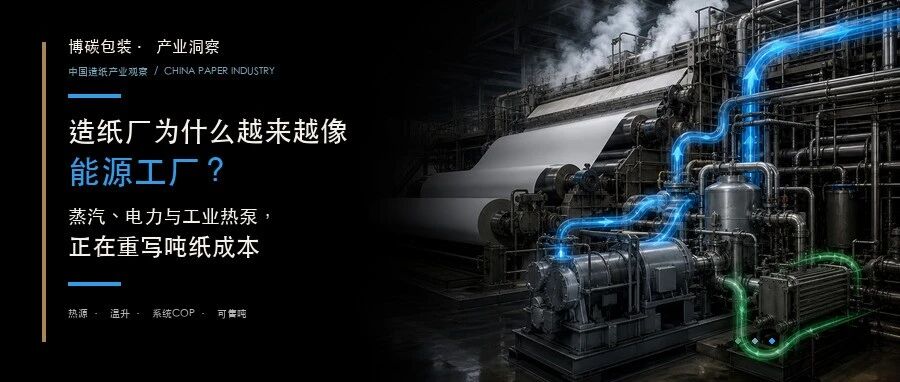
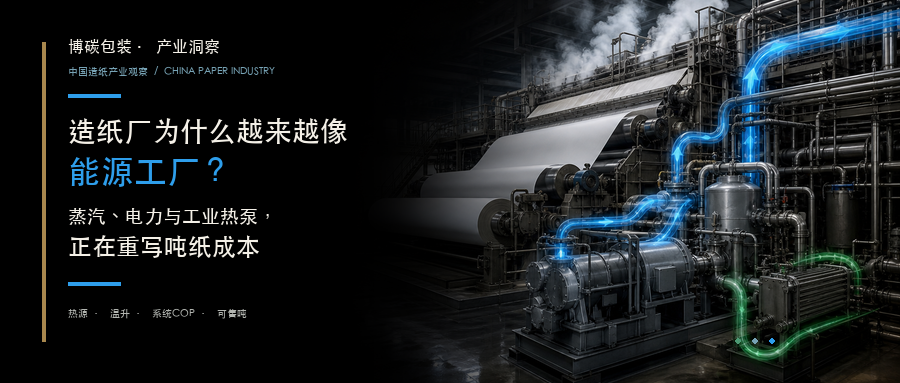
造纸厂为什么越来越像能源工厂?蒸汽、电力与工业热泵,正在重写吨纸成本
一项热泵改造要同时算热源、温升、蒸汽参数、全年COP、单位合格可售吨能耗和现金回收。
ENERGY COORDINATES / 能源坐标
约70% EHPA/Cepi对欧洲纸业干燥能耗的技术估计
8吨/小时 UPM Augsburg拟建新蒸汽能力
1500万kWh/年 Hydro-Québec披露的Domtar节电结果
口径:协会估计、在建项目目标和已运行案例不能横向相加。
RESEARCH QUESTION / 研究问题
一吨合格可售纸,究竟需要多少不可回收的热?
纸厂常把锅炉、蒸汽、冷凝水和排风放在公用工程里,但热系统会同时影响纸机速度、质量、断纸和成本。判断项目,只需看余热能否稳定提升到纸机需要的温度,并转化为单位合格可售吨成本的下降。
本文主轴:湿纸幅脱水 → 余热识别 → 温度提升 → 蒸汽替代 → 吨纸能耗 → 现金回收。
热泵能否进入经营账,只看三项结果:生产是否更稳,单位能源成本是否下降,自由现金流是否改善。
01 DRYING / HEAT BALANCE
烘干部,牵动产量与成本
EHPA与Cepi联合技术文件估计,干燥约占欧洲纸业能源使用的70%,并称欧洲纸业约70%的蒸汽使用压力低于5 bar。它是区域性技术口径,不能直接套用全部中国纸种,却说明低压蒸汽、排风和冷凝水为什么值得系统研究。
压榨后干度、气罩漏风、排风露点、冷凝水回收和白水温度,都会影响蒸汽负荷与纸机运行。项目应先画出热平衡,再决定哪里直接换热、哪里提升温度。
研究资料:EHPA/Cepi纸业热泵技术文件
02 COP / TEMPERATURE LIFT
COP不是成本下降百分比
COP是有用热输出与电力输入之比。COP为3,不等于吨纸成本下降67%;电价、锅炉效率、辅机、蒸汽损失、维护和资本开支都还没有进入这道算式。
SYSTEM COP / 系统COP
热源温度越高、目标温度越低、温升越小,通常越容易获得更高效率。采购时要看全年性能图、负荷范围和可利用小时,不只看单一设计点。
Cepi建议让热泵承担稳定基荷,以锅炉、电锅炉或储热应对启动和波动。IEA 2026进一步区分了成熟度:120°C以下已进入商业运行,160°C以下正在开始商业运行,更高温区仍更多处于示范或原型阶段。
研究资料:Cepi技术说明;IEA Heat Pump Monitor 2026
03 MILL CASES
同是热泵,项目路径各异
UPM AUGSBURG / 在建目标
40—50°C余热 → 8吨/小时新蒸汽 → 3.7 bar、150°C → 计划覆盖PM3约16%蒸汽需求。连续运行目标在2027年上半年,尚不是已兑现结果。
DOMTAR CLERMONT / 运行案例
两台水—水热泵把冷却回路余热送回热水系统。披露结果包括冬季需量下降4—5MW、年节电1500万kWh、冬季新鲜水下降约12%。
Domtar“少于15个月回收”依赖约300万加元、覆盖75%成本的支持条件;它不能作为无补贴项目的通用回收期。
Ranheim案例显示,热回收还可能改善白水温度、产品质量和产量。项目顺序应当是:先直接利用低温热,再提升温度,最后挑战高压力蒸汽。
研究资料:UPM Augsburg;Hydro-Québec Domtar;Valmet Ranheim
04 ECONOMIC STRESS TEST
减碳,不一定等于当期降本
2024年纸巾工厂模拟的代表性COP约1.9。在其2019年欧洲能源价格下,热泵蒸汽成本比燃气基准高55%;加入100欧元/吨二氧化碳价格后,才比基准低约12%。
2026年包装纸研究的最优组合把系统COP提高到2.8,模型供热成本接近燃气基准,并估算年能源成本下降约18%。这是优化模型,不是设备报价或工厂审计业绩。
差异来自边界条件:温升、循环设计、纸种蒸汽参数、电汽价差、碳成本和运行小时,会把同一类设备推向完全不同的经济结果。
研究资料:Energies 2024;Energy Conversion and Management X 2026
05 CHINA DECISION
先算五张账,再选设备
GB 31825—2024已于2025年5月1日实施并替代2015版。行业约束在升级,但单项技改能否赚钱,仍要回到企业自己的五张账。
01|热源账 温度、流量、污染物、稳定性和可利用小时。
02|热汇账 热水、烘缸、涂布干燥和不同压力蒸汽。
03|运行账 全年加权COP、负荷范围、启动和停机。
04|吨纸账 按合格可售吨统计蒸汽、电力和损失。
05|现金账 设备、管网、配电、停机、维护、补贴和融资。
纸机、换热器、压缩机、热泵、自动化和造纸化学品的价值,最终都要落到生产稳定、蒸汽替代、单位能源成本与自由现金流。
研究资料:GB 31825—2024标准状态
纸上谈兵·数说本质
热泵不是答案,热量路径才是。先算清一吨合格可售纸需要多少热、能回收多少、还要购买多少,再谈设备和回收期。
博碳包装·产业洞察·研究说明
本文基于IEA、Cepi、EHPA、国家标准平台、企业正式披露、公共事业机构案例及同行评议论文,由博碳包装独立研究整理,核验日期为2026年8月22日。本文仅供造纸及相关产业链研究学习,不构成设备选型、工程设计、投资、经营或其他决策依据。如对内容、数据或权益有意见,可留言提出修改、说明或删除要求,我们将在收到后24小时内核查处理。
博碳观察数据与核验来源
1. EHPA/Cepi纸业热泵文件;Cepi 2024说明
2. IEA Heat Pump Monitor 2026
3. UPM Augsburg;Hydro-Québec Domtar
4. Energies 2024;ECM X 2026
5. GB 31825—2024
PAPER INDUSTRY ANALYSIS, GROUNDED IN DATA: The paper machine sets the production ceiling; the thermal system protects the profit floor.
Why Paper Mills Increasingly ResembleEnergy PlantsSteam, power and industrial heat pumps are reshaping cost per tonne of paper
A heat-pump retrofit must account simultaneously for the heat source, temperature lift, steam parameters, annual COP, energy use per saleable tonne and cash payback.
ENERGY COORDINATES
Approximately 70% EHPA/Cepi technical estimate of drying’s share of energy use in the European paper industry
8 tonnes per hour Planned new steam capacity at UPM Augsburg
15 million kWh per year Electricity savings reported by Hydro-Québec for the Domtar project
Scope: Association estimates, targets for projects under construction and results from operating cases are not directly comparable or additive.
RESEARCH QUESTION
How Much Heat Cannot Be Recovered per Saleable Tonne of Paper?
Paper mills often treat boilers, steam, condensate and exhaust air as utilities, yet the thermal system simultaneously affects machine speed, quality, web breaks and cost. A project should be judged by whether waste heat can be lifted reliably to the temperature required by the paper machine and converted into a lower cost per saleable tonne.
Analytical sequence: Wet-web dewatering → waste-heat identification → temperature lift → steam displacement → energy use per tonne → cash payback.
Whether a heat pump belongs in the operating model comes down to three outcomes: more stable production, lower unit energy cost and improved free cash flow.
01 DRYING / HEAT BALANCE
The Dryer Section Drives Both Output and Cost
A joint technical paper from EHPA and Cepi estimates that drying accounts for approximately 70% of energy use in the European paper industry, and that around 70% of steam used by the sector is below 5 bar. These are regional technical estimates and cannot be applied directly to every Chinese paper grade, but they show why low-pressure steam, exhaust air and condensate merit systematic study.
Dryness after pressing, hood air leakage, exhaust-air dew point, condensate recovery and white-water temperature all affect steam load and paper-machine operation. A project should begin with a heat balance, then determine where direct heat exchange is sufficient and where temperature lift is required.
Research sources: EHPA/Cepi technical paper on heat pumps in the paper industry
02 COP / TEMPERATURE LIFT
COP Is Not the Percentage Reduction in Cost
COP is the ratio of useful heat output to electricity input. A COP of 3 does not mean that cost per tonne falls by 67%; electricity prices, boiler efficiency, auxiliary equipment, steam losses, maintenance and capital expenditure have not yet entered the calculation.
SYSTEM COP
Higher source temperature, lower target temperature and a smaller temperature lift generally make higher efficiency easier to achieve. Procurement decisions should be based on annual performance maps, load ranges and usable operating hours—not a single design point.
Cepi recommends using heat pumps for stable baseload, with boilers, electric boilers or thermal storage handling start-up and fluctuations. The IEA’s 2026 monitor further distinguishes maturity by temperature: systems below 120°C are already in commercial operation; those below 160°C are beginning commercial deployment; and higher-temperature applications remain largely at the demonstration or prototype stage.
Research sources: Cepi technical note; IEA Heat Pump Monitor 2026
03 MILL CASES
Similar Heat Pumps, Different Project Pathways
UPM AUGSBURG / PROJECT UNDER CONSTRUCTION
40–50°C waste heat → 8 tonnes per hour of new steam → 3.7 bar at 150°C → planned coverage of approximately 16% of PM3’s steam demand. Continuous operation is targeted for the first half of 2027; these results have not yet been realised.
DOMTAR CLERMONT / OPERATING CASE
Two water-to-water heat pumps return waste heat from the cooling circuit to the hot-water system. Reported results include a 4–5 MW reduction in winter demand, annual electricity savings of 15 million kWh and an approximately 12% reduction in winter freshwater use.
Domtar’s reported payback of “less than 15 months” depended on approximately C$3 million of support covering 75% of project costs; it should not be treated as a general payback period for unsubsidised projects.
The Ranheim case shows that heat recovery can also improve white-water temperature, product quality and output. The project sequence should be: use low-temperature heat directly first, lift its temperature second, and pursue high-pressure steam only last.
Research sources: UPM Augsburg; Hydro-Québec/Domtar; Valmet Ranheim
04 ECONOMIC STRESS TEST
Lower Carbon Does Not Necessarily Mean Lower Near-Term Cost
A 2024 tissue-mill simulation used a representative COP of approximately 1.9. At the study’s 2019 European energy prices, heat-pump steam cost 55% more than the gas benchmark; only after adding a carbon price of €100 per tonne of CO₂ did it fall approximately 12% below the benchmark.
A 2026 packaging-paper study raised system COP to 2.8 in its optimised configuration. Modelled heat-supply cost approached the gas benchmark, with estimated annual energy-cost savings of approximately 18%. This is an optimisation model, not an equipment quotation or audited mill performance.
The difference lies in boundary conditions: Temperature lift, cycle design, steam parameters for the paper grade, the electricity-to-steam price spread, carbon costs and operating hours can push the same class of equipment towards entirely different economic outcomes.
Research sources: Energies 2024; Energy Conversion and Management: X 2026
05 CHINA DECISION
Calculate Five Accounts Before Choosing Equipment
GB 31825—2024 took effect on 1 May 2025, replacing the 2015 edition. Industry constraints are tightening, but whether an individual retrofit creates value still depends on five company-specific accounts.
01 | Heat-source account Temperature, flow rate, contaminants, stability and available operating hours.
02 | Heat-sink account Hot water, dryer cylinders, coating drying and steam at different pressures.
03 | Operating account Annual weighted COP, load range, start-up and shutdown.
04 | Cost-per-tonne account Steam, electricity and losses measured per saleable tonne.
05 | Cash account Equipment, piping, power distribution, downtime, maintenance, subsidies and financing.
The value of paper machines, heat exchangers, compressors, heat pumps, automation and papermaking chemicals must ultimately be measured in production stability, steam displacement, unit energy cost and free cash flow.
Research sources: Status of GB 31825—2024
PAPER INDUSTRY ANALYSIS, GROUNDED IN DATA
The heat pump is not the answer; the heat pathway is. First determine how much heat is required per saleable tonne, how much can be recovered and how much must still be purchased—then discuss equipment and payback.
BIOTEN Packaging · Industry Insight · Research Note
This article was independently researched and compiled by BIOTEN Packaging from material published by the IEA, Cepi, EHPA, China’s national standards platform, formal corporate disclosures, utility case studies and peer-reviewed papers. Information was verified as of 22 August 2026. It is intended solely for research and learning within the paper industry and related value chains, and does not constitute a basis for equipment selection, engineering design, investment, operations or any other decision. If you have concerns regarding content, data or rights, please leave a message requesting correction, clarification or removal; we will review it within 24 hours.
BIOTEN Observer Data and Verification Sources
1. EHPA/Cepi paper-industry heat-pump paper; Cepi 2024 note
2. IEA Heat Pump Monitor 2026
3. UPM Augsburg; Hydro-Québec/Domtar
4. Energies 2024; Energy Conversion and Management: X 2026
5. GB 31825—2024