
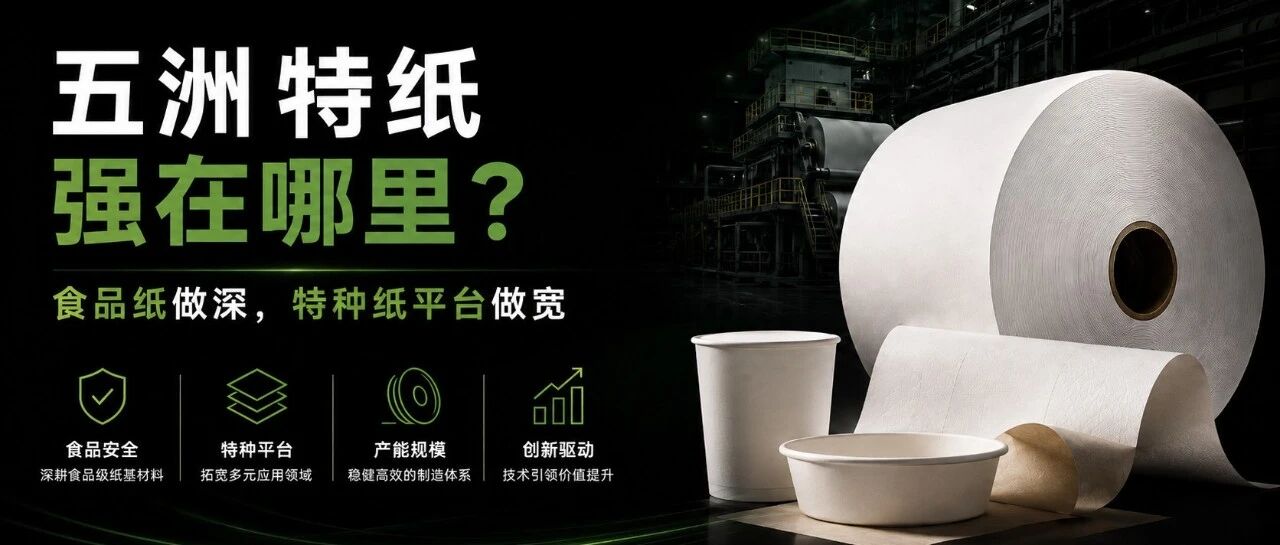
中国造纸二十强 · 第15位
食品纸做深,特种纸平台做宽。五洲特纸强在哪里?
五洲特纸的规模已有坐标:2025年产量220.34万吨,位列协会重点企业第15位。2026年上半年经营现金流转正,食品纸的专业积累正在向更多特种纸场景延伸。
企业坐标
2025 重点企业产量 220.34万吨第15位·协会调查口径
2026年上半年 营业收入 48.95亿元同比+18.76%
2026年上半年 归母净利润 2.30亿元同比+88.95%
研究资料:中国造纸协会;五洲特纸半年度报告
核心判断
五洲特纸的优势正在从“一种纸卖得多”,走向“多种纸在不同场景里稳定兑现”:食品包装纸提供专业起点,格拉辛、描图、转印与工业配套纸拉开产品谱系,工业包装纸承接新增规模,化机浆、沿江基地和物流工程再把原料与交付连接起来。2026年上半年利润、产销和经营现金流同步改善,说明这条链条已经出现积极的阶段性验证;但高附加值产品占比、资本开支回报和浆纸一体化仍要用更长时间兑现。
规模让五洲特纸走得更快,产品结构与现金流决定它能走多稳。
研究边界
本文研究对象为五洲特种纸业集团股份有限公司(股票代码605007),数据以公司合并口径为主;“重点企业产量”采用中国造纸协会调查表口径,“设计产能”采用公司定期报告披露口径,两者不混用。公司年报、半年报属于企业正式披露,标准平台资料用于确认标准状态和起草单位,本文判断不等同于独立审计结论。
文中所说的“平台”,是对产品、基地、原料和客户接口的分析性概括,不是工商分类;“产线投产、达产、项目建设、标准起草、客户合作”分别对应不同阶段,不能直接推导全部产品已经高毛利、全部SKU都具备同一认证或在建项目已经形成收入。
01 规模坐标
第15位是规模坐标,下一步看每吨价值
2025年,五洲特纸在中国造纸协会“重点造纸企业产量前30名”中位列第15位,产量220.34万吨,较2024年的149.90万吨增加46.99%。这组数字先把它在行业供给端的位置标了出来,也反映湖北基地新增产线正在改变集团的产销体量。
但产量排名只回答“做了多少”,没有回答“每吨留下了多少价值”。公司2025年实现营业收入88.84亿元,同比增长16.05%;归属于上市公司股东的净利润为2.45亿元,同比下降32.36%;主营业务毛利率为7.86%,下降1.90个百分点;经营活动现金流净额为负0.57亿元。收入和产量扩张与利润、现金流之间出现错位,说明新基地投产、期间费用和产品价格竞争仍在消化期。
规模扩张本身不是答案。纸机数量和总吨位建立之后,经营者更应看产品结构、产能利用、吨毛利、库存和现金回款是否同步变好。五洲特纸2026年上半年的数据,提供了下一阶段的观察窗口。
研究资料:中国造纸协会重点企业产量表;五洲特纸2025年年度报告
02 产品平台
产品矩阵,决定抗周期能力
五洲特纸在半年报中把业务分为食品包装、日用消费、出版印刷、工业配套、工业包装五个机制纸系列,并配套化机浆。食品包装纸覆盖纸杯、面碗、餐盒等容器用纸;格拉辛纸、硅油纸、防油纸、数码转印纸和描图纸连接标签、餐饮烘焙、印刷与消费场景;工业配套纸进入不锈钢衬纸、CTP版衬纸、电子玻璃间隔纸和电解电容器纸等功能性领域;工业包装纸则包括牛皮箱板纸、瓦楞原纸和纱管纸。
品类多并不自动带来优势。优势来自不同纸种面对的需求、原料和周期并不完全同步:食品包装纸是公司的专业起点,工业包装纸承接湖北基地的规模增量,日用消费与工业配套纸提供更细分的客户接口;产品谱系越完整,生产调度、研发试制和客户协同就越有机会形成内部复用。
截至2026年半年度报告披露日,公司列示的在产设计产能包括:食品包装材料78万吨、日用消费材料65.20万吨、出版印刷材料35万吨、工业配套材料5.10万吨、工业包装材料105万吨,以及化机浆30万吨,合计设计总产能288.30万吨。设计产能是设备和项目口径,不等于当期实际产量,更不等于全部产能都处于同一盈利水平。
2026年上半年各系列销量为:食品包装23.12万吨、日用消费23.30万吨、出版印刷12.54万吨、工业配套0.98万吨、工业包装61.61万吨。工业包装已经成为新增量的重要承接者,但食品包装纸仍是公司长期积累的专业接口。下一步的关键,是把高附加值食品纸、离型纸和工业配套纸的研发与客户订单,转化为更稳定的单位价值。
研究资料:五洲特纸2026年半年度报告;五洲特纸产品中心
03 制造底盘
三基地沿江协同,把纸机、能源与交付连成制造底盘
五洲特纸的三大基地分别位于浙江衢州、江西湖口和湖北汉川。公司半年报将其价值概括为:浙江基地依托特种纸产业配套,江西和湖北基地沿长江干线布局,便于原料和成品的水路运输,并与能源设施、区域客户形成互补。对重资产造纸企业来说,这种布局的价值不是地图上的“多几个工厂”,而是把原料采购、浆纸生产、能源消耗和交付半径放进同一套成本模型。
2026年上半年,公司披露已建成21条造纸生产线,整体设计总产能288.30万吨;湖北基地5条产线已全部达产。报告期内机制纸产量120.42万吨、销量121.55万吨,产销分别同比增长17.63%和23.13%。这表明产线释放已经传导到销量,但还需要继续观察旺季利用率、库存周转和单吨贡献。
原料端仍在补强。江西基地已经有30万吨化机浆产能,为食品包装纸和文化纸提供内部配套;年产60万吨化学浆项目已于2026年上半年开始土建施工和部分设备安装,九江物流码头同步建设。公司披露,PM19文化纸和PM25工业包装纸已完成投产,PM22工业包装纸、60万吨化学浆和物流码头预计于2027年上半年完工投产。项目尚未全面运营,价值要等到原料自给、运输效率、产品成本和现金回报被实际数据验证。
把“纸机投产”推进到“浆纸、能源、物流协同”,是五洲特纸下一段竞争力的核心。纸机解决的是产出,浆纸协同解决的是成本弹性,沿江物流解决的是交付半径;三者只有在同一订单和现金流中同时出现,平台优势才会落到经营结果上。
研究资料:五洲特纸2026年半年度报告
04 标准与创新
从产品创新到标准共识,专业能力开始沉淀为行业语言
食品包装纸的竞争,不能只看纸张白度、克重或价格。交付结果还包括耐水、耐脂、热封、印刷适配、成型稳定性,以及原纸、涂层、油墨、胶黏剂和终端容器之间的组合关系。五洲特纸在年报中披露,2025年参与制定的国家标准《食品包装用淋膜纸和纸板》和行业标准《食品包装纸》正式发布;国家标准平台也将五洲特种纸业集团股份有限公司列为GB/T 36392—2025的起草单位之一。
参与标准制定的价值,不是给企业自动加上一张“全部产品合规”的标签,而是把生产端积累的指标、检测和应用经验,放到行业共同使用的技术框架中。GB/T 36392—2025已于2025年6月30日发布、2026年1月1日实施;QB/T 1014—2025已于2025年7月2日发布、2026年2月1日实施。标准建立了共同的质量语言,具体产品仍要按用途、结构、涂层和检测结果逐项确认。
研发投入也在跟随产线扩张。2025年公司研发投入9353.26万元,占营业收入1.05%,研发人员由286人增至545人;2026年上半年研发费用8908.53万元,同比增长92.87%。这些数字说明公司正在为新产线和新纸种增加工程化资源。下一项检验,是研发投入能否落到高附加值纸种销量、客户复购与吨毛利上。
研究资料:五洲特纸2025年年度报告;全国标准信息公共服务平台GB/T 36392—2025;全国标准信息公共服务平台QB/T 1014—2025
05 经营兑现
2026年上半年,量、价、利润与现金流开始同向
2025年扩产先进入报表;2026年上半年,经营信号开始更完整:营业收入48.95亿元,同比增长18.76%;归属于上市公司股东的净利润2.30亿元,同比增长88.95%;扣除非经常性损益后的净利润2.26亿元,同比增长96.87%;经营活动现金流净额1.06亿元,上年同期为负0.74亿元。
公司将增长原因归结为湖北工业包装纸产线全面投产、除个别纸种外基本全系纸种盈利能力同比改善,以及成本精细化管控持续发力。销量与收入也保持同向:机制纸产量120.42万吨、销量121.55万吨,收入增幅与销量增幅共同构成阶段性修复信号。
按原料体系拆分,可以看到两条不同的经营路径:上半年木浆系产品收入32.66亿元,同比增长7.79%;废纸系产品收入16.13亿元,同比增长49.48%。木浆系产品销售均价5449元/吨,同比下降3.60%;废纸系产品销售均价2618元/吨,同比上升9.46%。公司一边利用化机浆和长协采购缓冲木浆波动,一边通过工业包装纸的产能释放承接废纸系需求;两条原料路线同时运转,构成了平台的经营弹性。
这一组数据值得肯定,但仍应保持专业的时间边界:上半年是一个阶段性窗口,不代表全年或完整周期已经完成反转。接下来要看下半年旺季订单、低毛利纸种压降、高附加值产品占比以及现金流能否持续。
研究资料:五洲特纸2026年半年度报告
06 经营边界
资本、产能与客户,决定平台能走多远
资本效率先要过关。2026年6月末,公司总资产144.16亿元,资产负债率73.33%,流动比率0.54;上半年投资活动现金流净额为负13.59亿元,在建工程25.47亿元。重资产扩张为未来产品结构和浆纸协同留下了空间,也把资金成本、项目进度和现金回收放到了经营者面前。
产能消化同样关键。公司半年报提示,食品包装纸、格拉辛纸和工业包装纸仍面临行业竞争,若需求不及预期,新增产能可能出现闲置或价格竞争。设计总产能288.30万吨是能力边界,不是已实现的销售和利润;产能利用率、库存、单位产品毛利和经营现金流需要一起看。
客户与产品结构决定订单质量。公司披露客户涵盖康师傅、统一、Avery Dennison等食品餐饮、标签和工业配套领域企业;客户名单能够说明合作基础,不能单独证明当期订单规模或全部SKU持续复购。需要追踪的是长期订单占比、客户复购、出口结构和高端纸种在收入与利润中的贡献。
所以,五洲特纸下一阶段的“强”,不是继续堆叠更多纸机,而是用更高附加值的纸种、更稳定的客户订单、更好的现金回收和更低的单位成本,证明多基地扩张已经进入质量兑现阶段。
研究资料:五洲特纸2026年半年度报告
博碳观察:纸上谈兵·数说本质
五洲特纸的能力已经形成三层结构:第一层,是从食品包装纸起步、延伸到五大纸种系列的产品平台;第二层,是浙江、江西、湖北三基地与化机浆、能源、沿江物流共同构成的制造底盘;第三层,是2026年上半年产销、利润和经营现金流同步改善所显示的阶段性经营兑现。
正在释放的,是湖北工业包装纸产能和木浆系、废纸系双线协同;尚待兑现的,是60万吨化学浆与物流码头投产后的成本回报、高附加值纸种占比提升,以及平台能力能否穿越下一轮价格波动。
对中国造纸产业链从业者来说,五洲特纸提供的启示并不只属于一家企业:特种纸的竞争正在从单一纸种、单台纸机和一次交易,走向场景化产品、浆纸协同、标准语言和可验证现金流。把每一项技术、每一条产线和每一个客户需求放进同一条兑现链,规模才会沉淀为可持续的产业能力。
下一篇
下一篇|山东世纪阳光纸业集团有限公司
中国造纸二十强第16位。下一篇将沿着文化纸、特种纸与浆纸协同的产品结构,继续观察企业如何把规模底盘转化为质量增长。
研究资料:中国造纸协会《2025年中国造纸工业年度报告》
博碳包装·产业洞察·研究说明
本文由博碳包装基于中国造纸协会、上海证券交易所/巨潮资讯及国家标准信息平台公开资料独立研究整理,仅供造纸、特种纸、包装与材料产业链研究学习,不构成投资、采购、合规或经营决策依据。若发现数据、来源或表述需要补充,请联系博碳包装提出修改、说明或删除;我们将在24小时内完成核查并处理。
博碳观察数据与核验来源
01|中国造纸协会|《2025年中国造纸工业年度报告》
02|五洲特纸|2025年年度报告
03|五洲特纸|2026年半年度报告
04|国家市场监督管理总局|GB/T 36392—2025《食品包装用淋膜纸和纸板》
05|国家市场监督管理总局|QB/T 1014—2025《食品包装纸》
06|五洲特纸|产品中心公开资料
CHINA’S TOP 20 PAPER COMPANIES · NO. 15
Deep Expertise in Food Packaging Paper, a Broad Specialty-Paper Platform.What Makes Wuzhou Special Paper Strong?
Wuzhou Special Paper’s scale has a clear benchmark: output reached 2.2034 million tonnes in 2025, ranking No. 15 among the association’s key enterprises. In H1 2026, operating cash flow turned positive, while the company’s expertise in food packaging paper continued to extend into a wider range of specialty-paper applications.
COMPANY SNAPSHOT
2025 Output of key enterprises 2.2034 million tonnes No. 15 · Association survey basis
H1 2026 Operating revenue RMB 4.895 billion YoY +18.76%
H1 2026 Net profit attributable to shareholders RMB 230 million YoY +88.95%
Sources: China Paper Association; Wuzhou Special Paper’s 2026 interim report
CORE ASSESSMENT
Wuzhou Special Paper’s advantage is evolving from “selling a large volume of one paper grade” to “reliably delivering multiple grades across different applications.” Food packaging paper provides the company’s specialist foundation; glassine, tracing, transfer, and industrial-support papers broaden the product spectrum; industrial packaging paper absorbs new scale; and chemi-mechanical pulp, river-linked production bases, and logistics projects connect raw materials with delivery. The simultaneous improvement in profit, production and sales, and operating cash flow in H1 2026 provides positive early validation of this chain. However, a higher share of value-added products, returns on capital expenditure, and pulp-and-paper integration will take longer to materialize.
Scale enables Wuzhou Special Paper to move faster; product mix and cash flow determine how steadily it can advance.
SCOPE OF ANALYSIS
This analysis covers Wuzhou Special Paper Group Co., Ltd. (stock code: 605007), using primarily the company’s consolidated figures. “Output of key enterprises” follows the China Paper Association survey basis, while “designed capacity” follows the basis disclosed in the company’s periodic reports; the two are not used interchangeably. Annual and interim reports are formal corporate disclosures, while standards-platform materials are used to confirm the status of standards and participating drafters. The analysis in this article is not an independent audit opinion.
The “platform” described in this article is an analytical summary of products, production bases, raw materials, and customer interfaces, not a legal or industrial registration category. Production-line commissioning, ramp-up to designed output, project construction, standards drafting, and customer cooperation represent different stages; none directly proves that every product already earns a high margin, that every SKU holds the same certification, or that projects under construction have begun generating revenue.
01 SCALE BENCHMARK
No. 15 Establishes the Scale Benchmark; the Next Question Is Value per Tonne
In 2025, Wuzhou Special Paper ranked No. 15 among the China Paper Association’s top 30 key paper enterprises by output. Production reached 2.2034 million tonnes, up 46.99% from 1.4990 million tonnes in 2024. These figures establish the company’s position on the industry’s supply side and show that new production lines at the Hubei base are changing the group’s production and sales scale.
Output rankings answer only “how much was produced,” not “how much value was retained per tonne.” In 2025, the company reported operating revenue of RMB 8.884 billion, up 16.05% year on year; net profit attributable to shareholders of the listed company was RMB 245 million, down 32.36%; gross margin for the principal business was 7.86%, down 1.90 percentage points; and net operating cash flow was negative RMB 57 million. The divergence between expanding revenue and output, on the one hand, and profit and cash flow, on the other, indicates that the commissioning of new bases, period expenses, and product-price competition were still being absorbed.
Scale expansion is not an answer in itself. Once the number of paper machines and total tonnage are established, management must determine whether product mix, capacity utilization, gross profit per tonne, inventory, and cash collection improve together. Wuzhou Special Paper’s H1 2026 results provide the next window for assessment.
Sources: China Paper Association’s output ranking for key enterprises; Wuzhou Special Paper’s 2025 annual report
02 PRODUCT PLATFORM
The Product Matrix Determines Resilience Across the Cycle
In its interim report, Wuzhou Special Paper divides its machine-made paper business into five series—food packaging, daily consumer, publishing and printing, industrial-support, and industrial packaging papers—supported by chemi-mechanical pulp. Food packaging papers include base paper for paper cups, noodle bowls, food containers, and other vessels. Glassine, silicone-coated release paper, greaseproof paper, digital transfer paper, and tracing paper serve labeling, food service and baking, printing, and consumer applications. Industrial-support papers serve functional applications such as stainless-steel interleaving paper, CTP plate interleaving paper, electronic-glass separator paper, and electrolytic-capacitor paper. Industrial packaging papers include kraft linerboard, corrugating medium, and paper core board.
A broad product range does not automatically create an advantage. The advantage arises because demand, raw materials, and cycles do not move in perfect synchronization across paper grades. Food packaging paper is the company’s specialist foundation; industrial packaging paper absorbs the Hubei base’s incremental scale; and daily consumer and industrial-support papers provide more specialized customer interfaces. The more complete the product spectrum, the greater the opportunity to reuse capabilities internally across production scheduling, R&D trials, and customer collaboration.
As of the disclosure date of the 2026 interim report, the company listed designed capacity in operation of 780,000 tonnes for food packaging materials, 652,000 tonnes for daily consumer materials, 350,000 tonnes for publishing and printing materials, 51,000 tonnes for industrial-support materials, 1.05 million tonnes for industrial packaging materials, and 300,000 tonnes for chemi-mechanical pulp, for total designed capacity of 2.883 million tonnes. Designed capacity is an equipment-and-project measure; it is not the same as current-period output and does not mean that every unit of capacity operates at the same level of profitability.
In H1 2026, sales by series were 231,200 tonnes of food packaging paper, 233,000 tonnes of daily consumer paper, 125,400 tonnes of publishing and printing paper, 9,800 tonnes of industrial-support paper, and 616,100 tonnes of industrial packaging paper. Industrial packaging has become a major destination for incremental volume, while food packaging paper remains the company’s long-established specialist interface. The next step is to convert R&D and customer orders for value-added food paper, release paper, and industrial-support paper into more stable unit value.
Sources: Wuzhou Special Paper’s 2026 interim report; Wuzhou Special Paper Product Center
03 MANUFACTURING PLATFORM
Three River-Linked Bases Connect Paper Machines, Energy, and Delivery into One Manufacturing Platform
Wuzhou Special Paper’s three principal bases are located in Quzhou, Zhejiang; Hukou, Jiangxi; and Hanchuan, Hubei. The interim report summarizes their roles as follows: the Zhejiang base benefits from the local specialty-paper cluster, while the Jiangxi and Hubei bases are positioned along the main Yangtze River corridor, facilitating waterborne transport of raw materials and finished goods and complementing energy infrastructure and regional customer coverage. For a capital-intensive paper producer, the value of this layout is not simply “more factories on the map,” but the integration of raw-material procurement, pulp and paper production, energy consumption, and delivery radius into a single cost model.
In H1 2026, the company reported 21 completed paper production lines with total designed capacity of 2.883 million tonnes; all five lines at the Hubei base had reached designed output. During the reporting period, machine-made paper output was 1.2042 million tonnes and sales were 1.2155 million tonnes, increasing 17.63% and 23.13% year on year, respectively. This indicates that released capacity has translated into sales, although peak-season utilization, inventory turnover, and contribution per tonne still require continued monitoring.
The raw-material side is also being strengthened. The Jiangxi base already has 300,000 tonnes of chemi-mechanical pulp capacity, providing internal supply for food packaging and printing and writing papers. Civil construction and partial equipment installation for the 600,000-tonne-per-year chemical pulp project began in H1 2026, alongside construction of the Jiujiang logistics terminal. The company disclosed that PM19 printing and writing paper and PM25 industrial packaging paper had been commissioned, while PM22 industrial packaging paper, the 600,000-tonne chemical pulp project, and the logistics terminal are expected to be completed and commissioned in H1 2027. These projects are not yet fully operational; their value must be validated by actual data on raw-material self-sufficiency, transport efficiency, product cost, and cash returns.
Advancing from “paper-machine commissioning” to coordination across pulp and paper, energy, and logistics is central to Wuzhou Special Paper’s next stage of competitiveness. Paper machines provide output; pulp-and-paper integration provides cost flexibility; and river-linked logistics improve the delivery radius. The platform advantage reaches operating results only when all three are reflected in the same orders and cash flows.
Sources: Wuzhou Special Paper’s 2026 interim report
04 STANDARDS & INNOVATION
From Product Innovation to Industry Standards: Expertise Is Becoming a Shared Technical Language
Competition in food packaging paper cannot be assessed only by brightness, basis weight, or price. Delivery performance also includes water and grease resistance, heat sealability, printability, forming stability, and the interaction among base paper, coatings, inks, adhesives, and finished containers. Wuzhou Special Paper disclosed in its annual report that the national standard Coated Paper and Board for Food Packaging and the industry standard Food Packaging Paper, both of which it helped draft, were formally issued in 2025. The national standards platform also lists Wuzhou Special Paper Group Co., Ltd. as one of the drafting organizations for GB/T 36392—2025.
The value of participating in standards development is not an automatic “all products comply” label. It is the ability to place production metrics, testing practices, and application experience into a technical framework shared across the industry. GB/T 36392—2025 was issued on June 30, 2025 and took effect on January 1, 2026; QB/T 1014—2025 was issued on July 2, 2025 and took effect on February 1, 2026. The standards establish a common language for quality, but each product must still be assessed individually according to its intended use, structure, coating, and test results.
R&D investment is also expanding with the production footprint. In 2025, the company invested RMB 93.5326 million in R&D, equivalent to 1.05% of operating revenue, and increased its R&D workforce from 286 to 545 people. In H1 2026, R&D expenses reached RMB 89.0853 million, up 92.87% year on year. These figures indicate that the company is adding engineering resources for new production lines and paper grades. The next test is whether this investment translates into sales of value-added grades, repeat customer orders, and higher gross profit per tonne.
Sources: Wuzhou Special Paper’s 2025 annual report; National Public Service Platform for Standards Information, GB/T 36392—2025 and QB/T 1014—2025
05 OPERATING PERFORMANCE
In H1 2026, Volume, Price, Profit, and Cash Flow Began Moving in the Same Direction
The financial statements first reflected the costs of expansion in 2025. By H1 2026, operating signals had become more complete: operating revenue was RMB 4.895 billion, up 18.76% year on year; net profit attributable to shareholders of the listed company was RMB 230 million, up 88.95%; net profit excluding non-recurring gains and losses was RMB 226 million, up 96.87%; and net operating cash flow was RMB 106 million, compared with negative RMB 74 million in the prior-year period.
The company attributed the improvement to the full commissioning of industrial packaging paper lines at the Hubei base, year-on-year profitability gains across nearly all paper grades, and continued refinement of cost controls. Sales and revenue also moved in the same direction: machine-made paper output was 1.2042 million tonnes and sales were 1.2155 million tonnes. The simultaneous growth in revenue and sales provides evidence of a phased operating recovery.
Viewed by raw-material system, two distinct operating paths emerge. In H1 2026, revenue from wood-pulp-based products was RMB 3.266 billion, up 7.79% year on year, while revenue from recovered-paper-based products was RMB 1.613 billion, up 49.48%. The average selling price of wood-pulp-based products was RMB 5,449 per tonne, down 3.60%, whereas the average selling price of recovered-paper-based products was RMB 2,618 per tonne, up 9.46%. The company uses chemi-mechanical pulp and long-term procurement agreements to buffer wood-pulp volatility, while the release of industrial packaging paper capacity captures recovered-paper-based demand. Running both raw-material routes in parallel contributes to the platform’s operating flexibility.
These results are encouraging, but the time horizon must remain explicit: H1 is a phased observation window, not proof that the full year or the entire cycle has reversed. The next questions are whether peak-season orders in H2 hold, whether low-margin grades are reduced, whether value-added products gain share, and whether positive cash flow can be sustained.
Sources: Wuzhou Special Paper’s 2026 interim report
06 OPERATING BOUNDARIES
Capital, Capacity, and Customers Determine How Far the Platform Can Go
Capital efficiency must pass the first test. At the end of June 2026, the company had total assets of RMB 14.416 billion, an asset-liability ratio of 73.33%, and a current ratio of 0.54. Net cash flow from investing activities in H1 was negative RMB 1.359 billion, while construction in progress stood at RMB 2.547 billion. Capital-intensive expansion creates room for a stronger product mix and pulp-and-paper coordination, but it also places funding costs, project schedules, and cash recovery squarely before management.
Capacity absorption is equally important. The interim report notes that food packaging paper, glassine paper, and industrial packaging paper continue to face industry competition; if demand underperforms, incremental capacity may remain idle or intensify price competition. Total designed capacity of 2.883 million tonnes is a capability boundary, not realized sales or profit. Capacity utilization, inventory, gross profit per unit, and operating cash flow must be evaluated together.
Customer mix and product mix determine order quality. The company disclosed customers across food service, labeling, and industrial-support applications, including Master Kong, Uni-President, and Avery Dennison. A customer list demonstrates a basis for cooperation but does not, by itself, prove current order volumes or sustained repeat purchases across all SKUs. The indicators that require tracking are the share of long-term orders, customer repurchase, export mix, and the contribution of premium grades to revenue and profit.
Wuzhou Special Paper’s next stage of “strength” therefore is not about adding more paper machines. It is about proving that multi-base expansion has entered a phase of quality realization through higher-value paper grades, more stable customer orders, stronger cash collection, and lower unit costs.
Sources: Wuzhou Special Paper’s 2026 interim report
BIOTEN OBSERVER · PAPER TALK · THE NUMBERS REVEAL THE ESSENCE
Wuzhou Special Paper has built a three-layer capability structure. The first layer is a product platform that began with food packaging paper and has expanded into five paper-grade series. The second is a manufacturing platform comprising the Zhejiang, Jiangxi, and Hubei bases together with chemi-mechanical pulp, energy infrastructure, and river-linked logistics. The third is the phased operating validation reflected in the simultaneous improvement of production and sales, profit, and operating cash flow in H1 2026.
What is already materializing is the release of industrial packaging paper capacity in Hubei and the parallel operation of wood-pulp-based and recovered-paper-based product lines. What remains to be proven is the cost return after the 600,000-tonne chemical pulp project and logistics terminal enter operation, a higher share of value-added paper grades, and the platform’s ability to withstand the next round of price volatility.
For participants across China’s paper value chain, the lesson from Wuzhou Special Paper extends beyond a single company. Specialty-paper competition is moving from one paper grade, one paper machine, and one transaction toward application-specific products, pulp-and-paper coordination, shared standards language, and verifiable cash flow. Only when every technology, production line, and customer need is integrated into the same delivery chain can scale mature into sustainable industrial capability.
NEXT ISSUE
Next: Shandong Century Sunshine Paper Group Co., Ltd.
Ranked No. 16 among China’s top 20 paper companies. The next article will examine how the company converts a scale-based manufacturing platform into quality growth through a product mix spanning printing and writing paper and specialty paper, supported by pulp-and-paper integration.
Sources: China Paper Association, 2025 Annual Report on China’s Paper Industry
BIOTEN Packaging · Industry Insights · Research Note
This article was independently researched and compiled by BIOTEN Packaging using public information from the China Paper Association, the Shanghai Stock Exchange and CNINFO, and the National Public Service Platform for Standards Information. It is provided solely for research and learning on the paper, specialty-paper, packaging, and materials value chains and does not constitute investment, procurement, compliance, or operating advice. If any data, source, or wording requires correction or supplementation, please contact BIOTEN Packaging to request revision, clarification, or removal; we will verify and process the request within 24 hours.
Data and Verification Sources for BIOTEN Observer
01|China Paper Association|2025 Annual Report on China’s Paper Industry
02|Wuzhou Special Paper|2025 Annual Report
03|Wuzhou Special Paper|2026 Interim Report
04|State Administration for Market Regulation|GB/T 36392—2025, Coated Paper and Board for Food Packaging
05|State Administration for Market Regulation|QB/T 1014—2025, Food Packaging Paper
06|Wuzhou Special Paper|Public Materials from the Product Center