
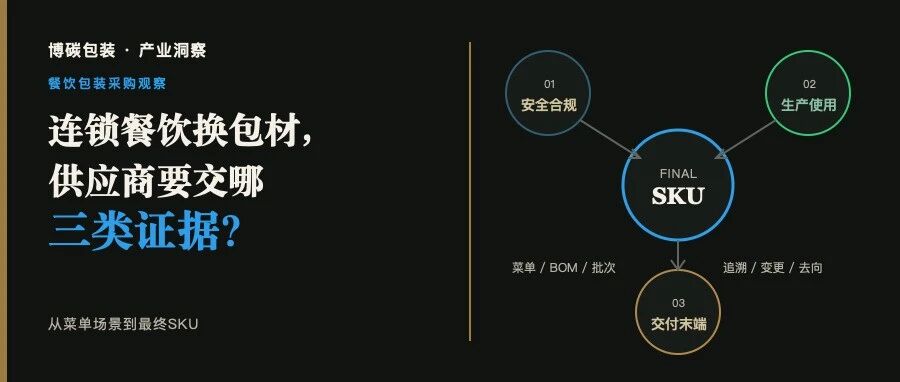
连锁餐饮换包材,采购的不是一个更绿色的材料名,而是一套能在菜单、门店、配送和目标城市中持续成立的最终SKU证据。
先看一个采购断点
116 / 9 2025年国家监督抽查116批食品接触用纸容器,9批不合格。
问题同时涉及荧光性物质、感官、抗压与杯身挺度。材料合格,不能自动替代最终杯、盒、盖组合的验证。
研究资料:市场监管总局国家监督抽查
01 · ACTION FIRST
换材前,采购先做四步
01|锁菜单场景。写清食品类型、温度、盛装和配送时间、堆叠、晃动、冷凝、微波或冷冻复热。汤面、炸物、冰饮和披萨不能共用一套条件。
02|锁最终SKU。建立版本化BOM,写明杯、盒、盖、涂层、油墨、黏合剂、封签和食品接触面;把每份报告映射到准确结构、工厂和批次。
03|先试高风险门店。优先测试高温、高油、长时配送或高投诉场景,记录泄漏、软化、变形、串味、开裂和门店操作时间。
04|固化复制规则。明确放行记录、追溯链、交期、备用工厂和变更通知。配方、克重、涂布量、工厂或关键参数变化,应触发风险评估和必要复验。
02 · TIMING
四个时点,责任进采购链
8月12日|欧盟PPWR一般适用,PFAS食品接触包装限制同步适用;更多义务设有更晚节点。
8月15日|生态环境法典施行,涉及一次性塑料制品减量、使用报告、绿色采购与供应链。
9月1日|北京餐饮外卖商户绿色包装指南实施;它是推荐性地方标准。
9月2日|GB 4806.10—2025食品接触材料及制品用涂料及涂层标准实施。
研究资料:生态环境法典;北京指南;国家卫生健康委公告;欧盟委员会PPWR适用说明
重要边界:这些规则没有替餐饮企业指定一种通用材料。北京指南只适用于北京并属于推荐性标准;PPWR只约束欧盟市场中的相关主体和包装。
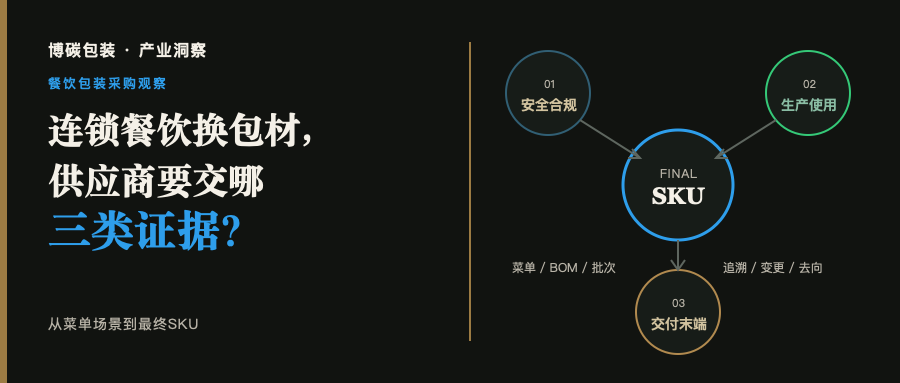
03 · THREE EVIDENCE PACKS
三类证据,三个答案
安全合规:最终SKU能不能接触这类食品?
生产使用:供应商能不能稳定做,门店能不能稳定用?
交付与末端:能不能跨门店持续供货,并兑现环境声明?
EVIDENCE 01 · SAFETY & COMPLIANCE
安全合规:最终SKU可用吗
安全包先交结构。供应商应提供版本化BOM和法规适用表:原纸或树脂、涂层、塑料层、油墨、黏合剂、色母、封签和杯盖分别是什么,食品接触面在哪里,谁对最终制品负责。
再把用途变成测试条件:食品类型、温度、时间、热灌装、微波、冷冻复热和面积体积比。GB 4806.8—2022适用于食品接触用纸和纸板材料及制品;涂层、塑料、油墨、黏合剂和复合结构还要按实际BOM判断标准组合。
最后验证最终SKU。迁移、感官、风险物质和其他安全项目要绑定准确样品、批次、方法和预期用途。材料证书只能证明其明示对象,不能替代杯、碗、盒、盖组合后的责任。
欧盟出口附加包
PPWR要求制造商完成适用要求的符合性评估、技术文件和欧盟符合性声明;一次性包装文件保存5年,可重复使用包装保存10年。食品接触包装PFAS有25 ppb、250 ppb和50 ppm三组不同口径。欧委会同时说明欧盟尚无统一测试方法,并给出阶段性执法路径;“无氟”声明因此要附检测对象、方法、检出限和样品结构。
研究资料:食品安全国家标准目录;欧盟PPWR;欧委会实施指南
EVIDENCE 02 · PRODUCTION & USE
生产使用:证明能稳定做、稳定用
供应商先证明制造窗口。连续试产记录机速、涂布量、干燥或固化、封口温度、成型稳定性、废品率和换卷换批影响。样品室能手工调好的结构,如果必须降速或增加人工检验,规模导入成本会完全不同。
餐饮企业再证明门店窗口。把代表性餐品、门店设备和配送路线放进测试,记录边、角、壁、接缝和盖口的失效,并比较同批、跨批和不同生产基地的波动。
平台企业披露的场景坐标
美团披露,其绿色包装解决方案按16类菜品推进;截至2025年底累计孵化投放43款、超过415万件绿色包装制品。这不能代表行业采用率,但说明餐饮包装性能必须服务具体餐品和配送失效。
研究资料:美团2025年年度报告;Wiley中试涂布研究
EVIDENCE 03 · DELIVERY & END-OF-LIFE
交付与末端:证明能持续供货、兑现声明
规模交付首先是质量和供应系统。供应商应按批提供放行记录,建立原料批次—生产批次—最终SKU—交付门店的追溯链,并明确产能、交期、最小订单、备用工厂和异常响应时间。
环境声明还要绑定地区。Cepi实验室方法可以模拟碎解、筛分和成纸,用于评估纸基包装的技术可回收性;4evergreen进一步区分常规、脱墨和专门回收工艺。测试通过,仍不等于目标城市会收集、分选并送入匹配纸厂。
复用方案要记录回收率、周转次数、清洗消毒、损耗和逆向物流;堆肥方案要核对认证对象、最终SKU、厚度,以及当地是否有单独收集和接收设施。没有真实路径时,只能写“技术上具备条件”。
2023年欧盟产生7970万吨包装废弃物,人均177.8千克,其中纸和纸板占40.4%。这个分母覆盖全部包装废弃物,不是餐饮包装统计;它提醒采购,环境声明不能停在包装设计端。
研究资料:Cepi测试方法;4evergreen评价协议;Eurostat包装废弃物统计
三类证据会不会挡住中小供应商?
会增加成本和周期。九毛九披露,2025年环保包装采购额约335万元,占全年包装采购总额5.21%。这是单一企业数据,不代表行业水平,却说明绿色包装需要预算和分阶段导入。
干燥、低温、短时、结构简单且不作高风险环境声明的SKU,可采用基础证据包;热汤、高油、长时配送、微波、多层复合或跨区域供应,进入增强验证;多基地、欧盟出口或公开回收/堆肥主张,使用完整包。食品安全底线不因企业规模降低。
供应商竞争力不等于证书数量。更有价值的是把现有报告映射到准确SKU,明确缺口,并在配方、工厂或场景变化时及时更新。
研究资料:九毛九2025年环境、社会及管治报告
连锁餐饮换包材,应从菜单和门店开始,而不是从材料名称开始。三类证据闭合后,试样才有资格进入多店复制。
博碳包装·产业洞察·研究说明
本文基于中国、北京和欧盟官方法规与标准信息,以及监管通报、Eurostat、上市公司、行业组织和同行评议研究,由博碳包装独立研究整理并核验至2026年8月29日;仅供餐饮包装产业链研究学习,不构成法律、认证、采购或投资决策依据。如对内容、数据或权益存在异议,可提出修改、说明或删除要求,我们将在收到后24小时内核查处理。
博碳观察数据与核验来源
01|生态环境部|中华人民共和国生态环境法典
02|北京市市场监督管理局|餐饮外卖商户绿色包装使用指南
03|市场监管总局|2025年食品相关产品国家监督抽查
04|国家卫生健康委|食品安全国家标准目录
05|欧盟委员会|PPWR开始适用
06|EUR-Lex|包装和包装废弃物法规
07|欧盟委员会|PPWR实施指南
08|美团|2025年年度报告
09|Cepi|纸和纸板可回收实验室测试方法
10|4evergreen|可回收性评价协议
11|Eurostat|2023年欧盟包装废弃物统计
12|九毛九|2025年环境、社会及管治报告
13|Wiley|串联分散与挤出涂布中试研究
When restaurant chains switch packaging, procurement is not buying a greener material label, but an evidence package for the final SKU that remains valid across menu items, stores, delivery conditions and target municipalities.
Start with a Break in the Procurement Logic
116 / 9 In China's 2025 national supervision sampling inspection, 9 of 116 batches of paper containers for food contact were non-compliant.
Findings covered fluorescent substances, sensory characteristics, compression strength and cup-body stiffness. Compliance at the material level cannot substitute for validation of the final cup, box and lid combination.
Research source: State Administration for Market Regulation: National Supervision Sampling Inspection
01 · ACTION FIRST
Four Steps for Procurement Before Switching Materials
01|Define the menu scenario. Specify the food type, temperature, filling and delivery time, stacking, shaking, condensation, microwave use, and frozen storage and reheating. Soup noodles, fried foods, iced drinks and pizza cannot share one set of conditions.
02|Define the final SKU. Create a version-controlled BOM covering the cup, box, lid, coating, inks, adhesives, tamper seal and food-contact surface; map every report to the exact structure, plant and batch.
03|Pilot in high-risk stores first. Prioritise high-temperature, high-grease, long-delivery or high-complaint scenarios. Record leakage, softening, deformation, odour or flavour transfer, cracking and store handling time.
04|Codify the replication rules. Define release records, traceability, lead time, backup plants and change-notification requirements. Changes in formulation, grammage, coat weight, plant or critical parameters should trigger a risk assessment and, where necessary, retesting.
02 · TIMING
Four Milestones Bring Responsibility into the Procurement Chain
12 August| The EU PPWR becomes generally applicable, including the PFAS restrictions for food-contact packaging; additional obligations take effect at later dates.
15 August| China's Ecological and Environmental Code takes effect, covering reduction in single-use plastic products, usage reporting, green procurement and supply chains.
1 September| Beijing's Guidelines for the Use of Green Packaging by Food Delivery Merchants take effect; they are a recommendatory local standard.
2 September| GB 4806.10—2025, the national food-safety standard for coatings and coating layers used in food-contact materials and articles, takes effect.
Research sources: China's Ecological and Environmental Code; Beijing Guidelines; National Health Commission announcement; European Commission PPWR application guidance
Important boundary: These rules do not prescribe one universal material for foodservice operators. The Beijing Guidelines apply only in Beijing and are recommendatory; the PPWR applies only to relevant economic operators and packaging placed on the EU market.
03 · THREE EVIDENCE PACKAGES
Three Evidence Packages, Three Questions Answered
Safety and compliance: Can the final SKU safely contact this type of food?
Production and use: Can the supplier manufacture it consistently, and can stores use it reliably?
Delivery and end-of-life: Can it be supplied consistently across stores, and can its environmental claims be substantiated?
EVIDENCE 01 · SAFETY & COMPLIANCE
Safety and Compliance: Is the Final SKU Fit for Use?
The safety package starts with the structure. Suppliers should provide a version-controlled BOM and a regulatory applicability matrix identifying the base paper or resin, coating, plastic layer, inks, adhesives, masterbatch, tamper seal and lid; the location of the food-contact surface; and who is responsible for the finished article.
Next, translate intended use into test conditions: food type, temperature, duration, hot filling, microwave use, frozen storage and reheating, and surface-area-to-volume ratio. GB 4806.8—2022 applies to paper and paperboard materials and articles intended for food contact; the applicable combination of standards for coatings, plastics, printing inks, adhesives and composite structures must be determined from the actual BOM.
Finally, validate the final SKU. Migration, sensory, substances of concern and other safety tests must be tied to the exact sample, batch, method and intended use. A material certificate proves only the object it expressly covers; it does not replace responsibility for the assembled cup, bowl, box and lid.
Additional Package for EU Exports
Under the PPWR, manufacturers must conduct the applicable conformity assessment and prepare technical documentation and an EU declaration of conformity. Records must be retained for five years for single-use packaging and ten years for reusable packaging. Food-contact packaging is subject to three PFAS thresholds—25 ppb, 250 ppb and 50 ppm—measured on different bases. The European Commission has also stated that there is not yet a harmonised EU test method and has outlined a phased enforcement approach. Any “fluorine-free” claim should therefore identify the analyte or scope tested, method, limit of detection and sample structure.
Research sources: National Food Safety Standards Catalogue; EU PPWR; European Commission implementation guidance
EVIDENCE 02 · PRODUCTION & USE
Production and Use: Prove Consistent Manufacturing and Reliable Use
First, suppliers must prove the manufacturing window. Continuous trial-production records should cover line speed, coat weight, drying or curing, sealing temperature, forming stability, reject rate, and the effects of roll and batch changeovers. A structure that can be tuned by hand in a sample room may have a very different cost at scale if it requires slower line speeds or additional manual inspection.
Foodservice operators must then prove the store-use window. Test representative menu items, store equipment and delivery routes; record failures at edges, corners, walls, seams and lid interfaces; and compare variation within a batch, across batches and among production sites.
Scenario Reference Disclosed by a Platform Company
Meituan disclosed that its green-packaging solutions are being developed for 16 food categories; by the end of 2025, it had incubated and deployed 43 solutions, totalling more than 4.15 million green-packaging items. These figures do not represent industry adoption, but they show that foodservice-packaging performance must address specific dishes and delivery failure modes.
Research sources: Meituan 2025 Annual Report; Wiley pilot-scale coating study
EVIDENCE 03 · DELIVERY & END-OF-LIFE
Delivery and End-of-Life: Prove Continuity of Supply and Substantiate Claims
Scaled delivery starts with a quality and supply system. Suppliers should provide a batch-release record for every batch, establish traceability from raw-material lot to production batch, final SKU and destination store, and define capacity, lead time, minimum order quantity, backup plants and response times for exceptions.
Environmental claims must also be tied to geography. The Cepi laboratory method simulates pulping, screening and handsheet formation to assess the technical recyclability of paper-based packaging; 4evergreen further distinguishes standard-mill, deinking-mill and specialised-mill processes. Passing a test still does not prove that the target municipality will collect, sort and send the package to a compatible paper mill.
Reuse programmes should track return rate, number of rotations, cleaning and sanitisation, losses and reverse logistics. Composting programmes should verify the certified object, final SKU, thickness, and whether separate collection and accepting facilities exist locally. Without a real pathway, the claim can state only that the product is “technically capable under specified conditions.”
The EU generated 79.7 million tonnes of packaging waste in 2023, or 177.8 kg per person, of which paper and cardboard accounted for 40.4%. That denominator covers all packaging waste, not foodservice packaging alone; it reminds procurement teams that environmental claims cannot stop at package design.
Research sources: Cepi test method; 4evergreen Recyclability Evaluation Protocol; Eurostat packaging-waste statistics
Will Three Evidence Packages Shut Out Smaller Suppliers?
They will increase cost and lead time. Jiumaojiu disclosed that it spent approximately RMB 3.35 million on environmentally friendly packaging in 2025, representing 5.21% of its total packaging procurement expenditure for the year. This is a single-company figure and does not represent the industry, but it shows that green packaging requires a budget and phased adoption.
A basic evidence package may be used for SKUs involving dry, cool, short-duration foods, simple structures and no high-risk environmental claims; hot soup, high-grease foods, long delivery times, microwave use, multilayer structures or cross-region supply require enhanced validation; multi-site supply, EU exports or public recycling or composting claims require the full package. Food-safety requirements do not weaken for smaller companies.
Supplier competitiveness is not measured by certificate count. More valuable is the ability to map existing reports to the exact SKU, identify gaps, and update evidence promptly when formulations, plants or use scenarios change.
Research source: Jiumaojiu 2025 Environmental, Social and Governance Report
For restaurant chains, a packaging switch should begin with the menu and the store, not with a material name. Only after all three evidence packages close the loop should a sample qualify for multi-store rollout.
BIOTEN Packaging · Industry Insight · Research Note
This article is based on official regulations and standards from China, Beijing and the European Union, together with regulatory notices, Eurostat data, listed-company disclosures, industry organisations and peer-reviewed research. It was independently researched, compiled and verified by BIOTEN Packaging through 29 August 2026. It is intended solely for research and educational use within the foodservice-packaging value chain and does not constitute legal, certification, procurement or investment advice. Requests for correction, clarification or removal will be reviewed within 24 hours of receipt.
BIOTEN Observer Data and Verification Sources
01 | Ministry of Ecology and Environment | Ecological and Environmental Code of the People's Republic of China
02 | Beijing Municipal Administration for Market Regulation | Guidelines for the Use of Green Packaging by Food Delivery Merchants
03 | State Administration for Market Regulation | 2025 National Supervision Sampling Inspection of Food-Related Products
04 | National Health Commission | National Food Safety Standards Catalogue
05 | European Commission | PPWR Begins to Apply
06 | EUR-Lex | Packaging and Packaging Waste Regulation
07 | European Commission | PPWR Implementation Guidance
08 | Meituan | 2025 Annual Report
09 | Cepi | Laboratory Test Method for the Recyclability of Paper and Board
10 | 4evergreen | Recyclability Evaluation Protocol
11 | Eurostat | EU Packaging Waste Statistics, 2023
12 | Jiumaojiu | 2025 Environmental, Social and Governance Report
13 | Wiley | Pilot-Scale Tandem Dispersion and Extrusion-Coating Study