
餐饮包装采购观察
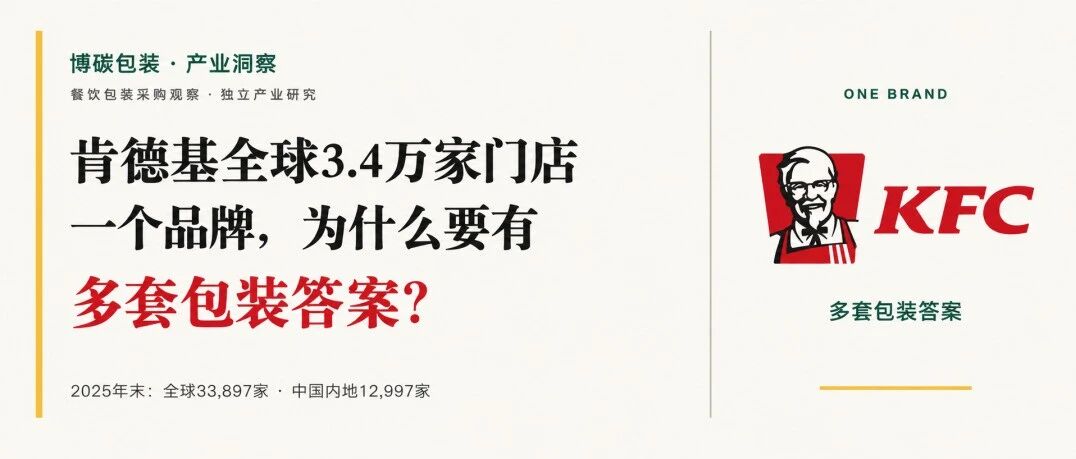
2025年末全球33,897家、中国内地12,997家;从品牌视觉到桶盒、杯盖、配送与末端,拆解连锁包装为何必须逐市场回答。
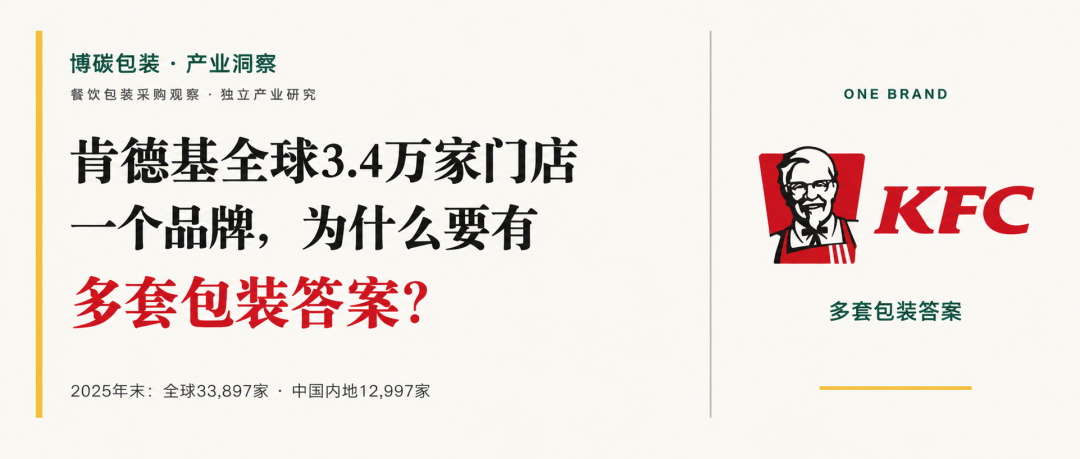
全球品牌可以共享同一套视觉和体验语言,包装却必须服从每个市场的产品、运营、法规与末端条件;多套答案不是失去一致性,而是规模化成立的条件。
KFC Global在2026年把新视觉延伸到包装、数字平台和餐厅环境;但全球99%的加盟/许可结构、中国内地公司店与加盟店并存,以及SKU、食品接触、配送和末端差异,决定包装不能只靠一套材料答案。
全球33,897家和中国内地12,997家均为2025年末口径;百胜中国约35,000吨为公司级包装减量,不拆为KFC单品牌、单SKU或单店结果。
33,897 全球KFC餐厅 · 12,997 中国内地KFC · 149 个市场
01 · GLOBAL NETWORK
品牌是一套,经营网络不是一套
截至2025年末,KFC全球33,897家餐厅,可合理写作“全球3.4万家”;网络覆盖149个国家和地区,99%为加盟或被许可经营,系统销售额364.34亿美元。中国内地同日为12,997家,即“近1.3万家”,其中公司经营11,032家、加盟商经营1,965家。
2026年8月更新的中国内地主特许协议进一步说明:品牌权利、运营责任、采购执行与门店落地需要分层。全球门店总数不能替代本地包装准入。
研究资料:Yum! Brands 2025 Form 10-K;百胜中国2026年第一季度业绩公告、2026年8月主特许协议更新。
02 · PACKAGE FUNCTIONS
包装答案从构件和工况开始分叉
桶、盒和内衬要处理油脂、热湿、挺度、堆码与开启;杯体、杯盖和直饮口要处理封合、防漏与耐温;酱料和小食容器需要独立的食品接触验证;外卖袋、封签和餐具受配送与门店操作影响;用后端还要面对当地收集、分选与再生设施。
同一视觉可以印在不同市场的包装上,纸张、克重、阻隔、油墨、胶黏剂、盖材、成型设备和法规文件却可能随SKU改变。材料名称不是量产答案。
03 · CHINA EVIDENCE
中国内地已经给出三类真实答案
重复使用|2019年可重复使用服务篮替代十多种一次性纸包装,在超过6,000家餐厅导入;公司当时预计每年节省逾2,000吨纸包装。
构件减量|2021年公告涉及塑料吸管、木质餐具和袋类替换;这是历史行动,不代表2026年所有门店、所有SKU的当前状态。
公司级管理|百胜中国披露2025年包装减量约35,000吨,其中纸约17,000吨、塑料约18,000吨;不可降解塑料包装重量相对2019年减少30%的目标已达成。
重要边界:35,000吨不是KFC单品牌包装量,也不能替代单SKU用量、供应商份额或实际回收率。
研究资料:百胜中国2019年可持续发展行动公告、2021年减塑公告与2025年可持续发展报告。
04 · BRAND UPDATE
2026新视觉统一了表达,没有统一BOM
KFC Global在2026年6月宣布新视觉进入包装、数字平台、广告和餐厅环境,并从英国、爱尔兰等市场开始推进。全球可以统一的是颜色、图形、桶形资产、信息层级与消费者识别。
公告没有说明中国内地何时采用,也没有披露桶盒、杯盖、袋类的材料结构、BOM、供应商、覆盖率或末端结果。包装上的视觉统一,是供应链工作的起点。
研究资料:KFC Global 2026全球品牌更新。
05 · INDUSTRY GATES
五类参与者,各自要盯什么
造纸企业|跟踪具体桶、盒、袋、杯的纸种、克重、纤维认证、挺度、耐油与区域供货半径。
包装加工|观察模切、折叠、成型、套印、胶黏、封合窗口和连续生产良率。
功能材料|把阻隔、涂层和胶黏体系绑定接触面、温度、油脂、迁移、感官、成型与真实末端。
设备检测|建立跨SKU的成型稳定性、热封、防漏、抗压、运输模拟、迁移与感官数据。
品牌采购|维护品牌—市场—运营主体—SKU—供应商—门店—末端地图,把库存切换和加盟执行纳入改版计划。
纸上谈兵·数说本质
全球统一的是消费者认识谁;逐市场回答的是用什么纸、什么阻隔、怎样成型、由谁采购、在哪些门店执行,以及使用后能否进入真实末端。
博碳包装·产业洞察·研究说明
本文基于Yum! Brands、百胜中国与KFC Global的公开年报、业绩公告、品牌更新与可持续发展资料,由博碳包装独立研究整理,核验截至2026年8月30日;仅供产业链研究学习,不构成采购、性能、合规或投资决策依据。若对内容、数据或权益有修改、说明或删除需求,请联系博碳包装;收到后24小时内核查处理。
博碳观察数据与核验来源
01|Yum! Brands|2025 Form 10-K02|百胜中国|2026年第一季度业绩公告03|百胜中国|2025年可持续发展报告04|百胜中国|2021年KFC与必胜客减塑公告05|百胜中国|2026年8月主特许协议更新06|KFC Global|2026全球品牌更新
Foodservice Packaging Procurement Review
At year-end 2025, KFC had 33,897 restaurants worldwide, including 12,997 in mainland China. From brand identity to buckets and boxes, cup lids, delivery and end-of-life systems, this analysis explains why chain restaurants need market-specific packaging solutions.
A global brand can share one visual and experiential language, but its packaging must be designed around each market's product mix, operating model, regulatory requirements and end-of-life infrastructure. Multiple solutions do not undermine consistency; they are what make scale possible.
In 2026, KFC Global extended its refreshed visual identity across packaging, digital platforms and restaurant environments. Yet a global network that is 99% franchised, a mainland China system comprising both company-operated and franchised restaurants, and differences in SKUs, food-contact requirements, delivery and end-of-life infrastructure mean packaging cannot rely on a single material solution.
The figures of 33,897 worldwide and 12,997 in mainland China both refer to year-end 2025. Yum China's approximately 35,000 tonnes of packaging savings are company-wide, not KFC brand-specific, SKU-specific or per-store results.
33,897 KFC Restaurants Worldwide · 12,997 KFC Restaurants in Mainland China · 149 Markets
01 · GLOBAL NETWORK
One brand, many operating networks
As of year-end 2025, KFC operated 33,897 restaurants worldwide (reasonably summarized as about 34,000). Its network spanned 149 countries and territories; 99% of the restaurants were franchised, and system sales totaled US$36.434 billion. In mainland China, KFC had 12,997 restaurants on the same date (nearly 13,000), including 11,032 company-operated restaurants and 1,965 franchise-operated restaurants.
The August 2026 update to the master license agreement for mainland China further demonstrates that brand rights, operating responsibilities, procurement execution and in-store implementation are layered. A global restaurant count cannot substitute for local packaging qualification and implementation.
Source documents:Yum! Brands 2025 Form 10-K; Yum China first-quarter 2026 earnings release; and the August 2026 update to the master license agreement.
02 · PACKAGE FUNCTIONS
Packaging solutions diverge by component and operating condition
Buckets, boxes and liners must meet requirements for grease resistance, heat and humidity exposure, structural stiffness, stacking and opening performance; cups, lids and sip openings must deliver seal integrity, leak resistance and heat resistance; sauce and side-item containers require separate food-contact validation; takeaway bags, tamper-evident seals and cutlery are affected by delivery and restaurant operations; and end-of-life solutions must align with local collection, sorting and recycling infrastructure.
The same visual identity can appear on packaging in different markets, yet paper grade, basis weight, barrier systems, inks, adhesives, lid materials, forming equipment and regulatory documentation may vary by SKU. A material name is not a mass-production solution.
03 · CHINA EVIDENCE
Mainland China has already produced three real-world solutions
Reuse |In 2019, reusable serving baskets replaced more than ten types of single-use paper packaging and were introduced in more than 6,000 restaurants. At the time, Yum China expected them to save more than 2,000 tonnes of paper per year.
Component reduction |A 2021 announcement covered the replacement of plastic straws, wooden cutlery and certain bags. These were historical initiatives and do not represent the current status of every restaurant and every SKU in 2026.
Company-wide management |Yum China reported approximately 35,000 tonnes of packaging savings in 2025, comprising about 17,000 tonnes of paper packaging and 18,000 tonnes of plastic packaging. It also met its target of reducing the weight of non-degradable plastic packaging by 30% from a 2019 baseline.
Important boundary:The 35,000-tonne figure is not KFC-specific packaging volume and cannot be used as a proxy for usage by individual SKU, supplier share or actual recycling rates.
Source documents:Yum China's 2019 sustainability initiative announcement, its 2021 plastic-reduction announcement, and its 2025 Sustainability Report.
04 · BRAND UPDATE
The 2026 brand refresh standardized the look, not the bill of materials
In June 2026, KFC Global announced that its refreshed visual identity would extend across packaging, digital platforms, advertising and restaurant environments, with the rollout beginning in markets including the UK and Ireland. What can be standardized globally is the use of brand colors, graphics, bucket iconography, information hierarchy and consumer recognition cues.
The announcement did not state when the identity would be adopted in mainland China, nor did it disclose the material structures, bills of materials, suppliers, coverage or end-of-life outcomes for buckets and boxes, cup lids or bags. Visual consistency on packaging is the starting point for supply-chain execution.
Source document:KFC Global's 2026 global brand refresh announcement.
05 · INDUSTRY GATES
What five stakeholder groups should track
Papermakers |Track the paper grade, basis weight, fiber certification, stiffness, grease resistance and regional supply radius for each specific bucket, box, bag and cup.
Packaging converters |Evaluate die-cutting, folding, forming, print registration, adhesive application, sealing windows and continuous-production yield.
Functional materials suppliers |Tie barrier, coating and adhesive systems to the food-contact surface, temperature, grease exposure, migration, sensory performance, forming process and actual end-of-life route.
Equipment and testing providers |Build cross-SKU data on forming stability, heat sealing, leak resistance, compression strength, transport simulation, migration and sensory performance.
Brand procurement teams |Maintain a map that connects the brand, market, operator, SKU, supplier, restaurant and end-of-life route, and incorporate inventory transitions and franchisee implementation into packaging-revision plans.
Paper Industry Roundtable · Numbers reveal the fundamentals
Globally, the brand can standardize whom consumers recognize. Market by market, it must answer which paper to use, what barrier system to specify, how the pack is formed, who procures it, in which restaurants it is implemented and whether it can enter a functioning end-of-life system after use.
BIOTEN Packaging · Industry Insight · Research Notes
This article is based on public annual reports, earnings releases, brand updates and sustainability disclosures from Yum! Brands, Yum China and KFC Global. It was independently researched and compiled by BIOTEN Packaging and verified through 30 August 2026. It is intended solely for value-chain research and learning and does not constitute procurement, performance, compliance or investment advice. For requests to amend, clarify or remove content, data or rights-related material, please contact BIOTEN Packaging; we will review the request within 24 hours of receipt.
BIOTEN Observer: Data and Verification Sources
01 | Yum! Brands | 2025 Form 10-K; 02 | Yum China | First-Quarter 2026 Earnings Release; 03 | Yum China | 2025 Sustainability Report; 04 | Yum China | 2021 KFC and Pizza Hut Plastic-Reduction Announcement; 05 | Yum China | August 2026 Master License Agreement Update; 06 | KFC Global | 2026 Global Brand Refresh