
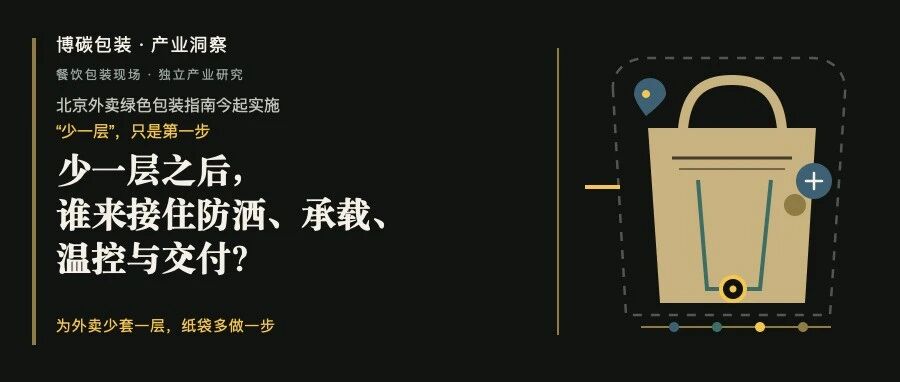
外卖包装绿色化真正难的,不是把一种材料换成另一种,而是删掉冗余之后,让剩下的每一层继续接住防洒、承载、温控与交付体验。
一场雨,一杯冷饮,几盒刚出锅的热餐。店员把餐盒和杯托放进纸袋,折好袋口,临出门前又套上一层塑料袋或厚无纺布袋。怕淋、怕漏、怕串温,也怕送到顾客手里时袋口已经敞开——每一层都有理由,总用量却未必真的下降。
今天,北京地方标准DB11/T 2510—2026《餐饮外卖商户绿色包装使用指南》正式实施。官方解读给出的关键不是“统一换成什么”,而是按餐品、温度、汤汁和包装任务做选择:尺寸要适配,功能不重复,能少一层的地方少一层,需要密封与保温的地方继续守住。
指南把安全性、减量化、易回收或可降解、重复使用放在一套坐标中。它不替商户选一只通用袋,而是让每一层包装回答两个问题:它有没有必要;如果删掉,谁来接住原来的功能。
研究资料:北京市地方标准公告;北京市市场监管局官方解读

01 · FOUR ACTIONS
减层前,先做四个动作
行动01|判断场景。写清餐品、温度、汤汁、凝露、重量、配送时长和天气。汤面、炸物、冰饮与烘焙不能共用一套判断,结果是一张订单工况表。
行动02|删除冗余。逐层问清容器、封口和外袋分别负责什么。没有保温需求,就不再用厚袋重复保险,结果是一份按层标注的减量清单。
行动03|补回功能。把防洒交给杯盖、餐盒或封膜,把组合承载交给纸袋,把局部油湿与凝露交给准确位置的材料和结构,结果是一套默认功能分工。
行动04|整单验证。用真实餐品、重量和配送时间测试袋底、侧褶、胶缝、提手、折痕与封口,并记录二次加袋、漏损、投诉和重送,结果是一份可追溯的试样记录。
四步之后留下的,不该只是一句“更环保”,而是一张门店、采购、质量和供应商都能看懂的订单包装卡。
02 · THREE CONDITIONS
少一层后,三个缺口
雨天配送|外部保护。雨水会沿折痕、胶缝、袋底和提手路径进入。方案要照顾外表面与整袋结构,核心观察是带载之后哪里先软、哪里先破。
冷热组合|局部油湿。冷饮凝露、热餐蒸汽和少量油污集中在特定位置。容器与封口守住自由液体,纸袋只在实际接触位置增加功能。
订单交付|连续承载。杯托和餐盒把重量传到袋底、侧褶、袋壁和纸提手;折口减少顶部暴露,纸质封签帮助识别开启状态。
功能不能跟着被删掉。为外卖少套一层,纸袋多做一步。
03 · BIOTEN ROUTE
外修、内修、一芯增强
博碳包装把三种工况组织成一套外卖纸袋场景化整体解决方案,技术主张是:内外兼修,一芯增强。
外修,接住雨天。外层PHA水性上光油作为候选表面保护路线,按雨量、暴露时间、纸种和整袋结构决定是否采用。
内修,接住冷热。内层PHA水性阻隔只在凝露、少量油污等需要的位置配置,避免整袋无差别叠加。
一芯增强,接住交付。纤维增效共聚物,减量还能增强包装纸与纸提手、袋壁、侧褶和袋底形成连续承载路径;宽底适配餐盒与杯托,折口和封签管理顶部交付。
三条路线先解决“怎样设计和验证”,最终配置随订单工况、完整材料结构和整袋测试确定。
04 · PRODUCT FAMILY
纸袋也要按任务分型
组合外带需要外卖承载纸袋;咖啡店、便利店、小件零售和预包装食品更适合便利抓口纸袋;包子、玉米、烤肠等热干、微湿或带油单品,可进入即食功能纸袋路线。
同一家门店也可能同时需要三种袋:承载袋接住完整订单,抓口袋服务快速带走,即食袋处理短时盛装。袋型跟着任务走,材料才有机会真正减下来。
05 · PRESSURE TEST
少一层,如何能科学计算出减量增强
减层如果带来漏损、冷凝软化、二次加袋或订单重送,总资源消耗可能反而上升。纸、PHA、水性涂层和“少一层”都只是方向。
最直接的复盘,是看包装层数和克重有没有下降、二次加袋有没有减少、漏损和重送有没有上升,以及用后的结构是否进入当地真实收集路径。
06 · ONE ORDER DIAGNOSIS
用一笔订单开始诊断
如果你正在改外卖袋,可以提交:现用袋或装袋照片、餐盒与杯托尺寸、典型单袋重量、配送时长,以及雨天或保温要求。
博碳返回:袋型尺寸建议、纸张与局部涂层配置思路、打样验证清单。
按项目匹配:包装纸、定制涂布或阻隔纸、成品外卖纸袋资源。
这五项输入足以启动第一轮讨论,也能快速识别问题出在尺寸、表面、局部阻隔,还是提手与袋底的承载路径。先把这一单做对,再讨论怎样复制到更多门店。
真正有价值的减量,是让每一层有明确任务、每一个功能有准确承接、每一笔订单都能被验证。
博碳包装·产业洞察·研究说明
本文基于北京市市场监管、政府门户、发展改革和国家标准化公开资料,并结合博碳包装现有产品边界资料独立研究整理,核验截至2026年9月1日;DB11/T 2510—2026为推荐性北京市地方标准,标准参与单位不构成对BIOTEN产品的推荐或背书,产品配置与性能以最终材料结构和整袋验证为准。本文仅供餐饮包装产业链研究学习,不构成法律、食品接触、认证、采购、供应或投资决策依据。如对内容、数据或权益存在异议,可提出修改、说明或删除要求,我们将在收到后24小时内核查处理。
博碳观察数据与核验来源
01|北京市市场监督管理局|北京市地方标准公告2026年标字第6号
02|北京市市场监督管理局|餐饮外卖商户绿色包装使用指南官方解读
03|北京市人民政府门户网站|餐饮外卖包装要适配不宜过度
04|国家市场监督管理总局|中华人民共和国标准化法
The real challenge in greening food-delivery packaging is not replacing one material with another. It is removing redundant layers while ensuring that every remaining layer still provides spill protection, load-bearing strength, thermal control and reliable delivery performance.
Rain is falling, an iced drink is sweating, and several hot meals have just left the kitchen. A staff member places the meal containers and cup tray in a paper bag, folds the top, and then adds a plastic bag or a heavy nonwoven bag just before dispatch. The extra layer is meant to prevent rain exposure, leakage and temperature interference—and to keep the bag closed until it reaches the customer. Every layer appears to have a reason, yet total material use may not fall at all.
Today, Beijing local standard DB11/T 2510—2026, Guidelines for the Use of Green Packaging by Food Delivery Merchants, takes effect. The official interpretation does not prescribe one universal replacement. Instead, packaging should be selected according to the food, temperature, liquid content and task: dimensions should fit, functions should not be duplicated, unnecessary layers should be removed, and sealing or insulation should be retained where required.
The Guide places safety, material reduction, recyclability or degradability, and reuse within one framework. Rather than selecting one generic bag for every merchant, it asks two questions of each packaging layer: Is it necessary? If it is removed, which component will take over its function?
Research sources: Beijing Local Standards Announcement; official interpretation by the Beijing Municipal Administration for Market Regulation
01 · FOUR ACTIONS
Four Actions Before Removing a Layer
Action 01 | Define the Use Case. Record the food type, temperature, liquid content, condensation, weight, delivery time and weather conditions. Soup noodles, fried foods, iced drinks and baked goods cannot share one assessment standard. The result should be an order-specific operating-condition sheet.
Action 02 | Eliminate Redundancy. Clarify the role of the container, closure and outer bag, layer by layer. Where insulation is unnecessary, do not use a heavy bag as redundant protection. The result should be a layer-by-layer material-reduction checklist.
Action 03 | Restore Required Functions. Assign spill protection to the cup lid, meal container or sealing film; combined load carrying to the paper bag; and localized oil, moisture and condensation management to materials and structures at the points where they are needed. The result should be a default functional architecture.
Action 04 | Validate the Complete Order. Use actual food, load and delivery time to test the bag base, side gussets, adhesive seams, handles, folds and closure. Record secondary bagging, leakage, complaints and redeliveries to create a traceable sample-validation record.
After these four steps, the result should be more than a claim that the packaging is “greener.” It should be an order-specific packaging specification that stores, procurement teams, quality teams and suppliers can all understand.
02 · THREE CONDITIONS
Three Gaps Created by Removing a Layer
Rainy-Day Delivery | External Protection. Rainwater can enter along folds, adhesive seams, the bag base and handle paths. The solution must address both the outer surface and the complete bag structure. The key question is where a loaded bag first softens and where it first fails.
Hot-and-Cold Orders | Localized Oil and Moisture. Condensation from cold drinks, steam from hot meals and small amounts of oil concentrate in specific locations. Containers and closures should retain free liquids; the paper bag should receive added functionality only at the points of actual contact.
Order Fulfilment | A Continuous Load Path. Cup trays and meal containers transfer weight through the bag base, side gussets, bag walls and paper handles. A fold-over top reduces exposure, while a paper seal helps indicate whether the bag has been opened.
Functions cannot disappear with the removed layer. If one outer layer is eliminated, the paper bag must take on more of the work.
03 · BIOTEN ROUTE
Protect the Outside, Protect the Inside, Reinforce the Fiber Core
BIOTEN Packaging integrates the three operating conditions into one scenario-based, end-to-end solution for food-delivery paper bags, built around one technical proposition: Protect the outside, protect the inside and reinforce the fiber core.
External Protection: Manage Rain Exposure. A PHA waterborne overprint varnish on the outer layer is a candidate surface-protection route. Its use should be determined by rainfall, exposure duration, paper grade and the complete bag structure.
Internal Protection: Manage Heat and Cold. Apply a PHA waterborne barrier coating only where condensation or light oil exposure occurs, avoiding undifferentiated full-bag coating.
Fiber-Core Reinforcement: Support Delivery Loads. A fiber-enhancing copolymer can support lightweighting while helping the packaging paper, paper handles, bag walls, side gussets and base form a continuous load path. A wide base accommodates meal containers and cup trays, while the fold-over top and paper seal manage the top of the package during delivery.
These three routes first address how the package should be designed and validated. The final configuration must be determined by the order conditions, the complete material structure and whole-bag testing.
04 · PRODUCT FAMILY
Paper Bags Should Be Specified by Task
Combined takeaway orders require a food-delivery carrier paper bag. Coffee shops, convenience stores, small-item retailers and prepackaged foods are better suited to an easy-grip paper bag. Hot, dry, slightly moist or oily single items—such as steamed buns, corn and grilled sausages—can use a ready-to-eat functional paper-bag route.
One store may need all three bag types: a carrier bag for the complete order, an easy-grip bag for rapid takeaway, and a ready-to-eat bag for short-duration holding. When the bag format follows the task, material use has a real opportunity to fall.
05 · PRESSURE TEST
With One Less Layer, How Can “Less Material, More Performance” Be Quantified?
If removing a layer causes leakage, condensation-related softening, secondary bagging or order redelivery, total resource consumption may rise instead. Paper, PHA, waterborne coatings and “one less layer” are all directions—not proof of performance.
The most direct review is to determine whether the number of packaging layers and material grammage have fallen, whether secondary bagging has decreased, whether leakage and redelivery have increased, and whether the used structure can enter a real local collection pathway.
06 · ONE-ORDER DIAGNOSIS
Start the Diagnosis with One Order
If you are redesigning a food-delivery bag, submit: Photographs of the current bag or packed order; dimensions of the meal containers and cup trays; typical weight per bag; delivery time; and rainy-day or insulation requirements.
BIOTEN provides: Recommendations on bag format and dimensions, an approach to paper-grade and localized-coating configuration, and a sample-validation checklist.
Project-specific matching: Resources for packaging paper, custom-coated or barrier paper, and finished food-delivery paper bags.
These five inputs are enough to start the first discussion and quickly identify whether the issue lies in dimensions, surface protection, localized barriers, or the load path through the handles and bag base. First make this order work; then discuss how to replicate the solution across more stores.
Valuable material reduction gives every layer a defined task, assigns every function to the right component and makes every order verifiable.
BIOTEN Packaging | Industry Insight | Research Note
This article was independently researched and prepared using public information from Beijing market-regulation authorities, government portals, development and reform authorities, and national standardization sources, together with information on the current product boundaries of BIOTEN Packaging. Information was verified through 1 September 2026. DB11/T 2510—2026 is a recommended Beijing local standard. Participation in drafting the standard does not constitute a recommendation or endorsement of BIOTEN products. Product configuration and performance remain subject to the final material structure and whole-bag validation. This article is provided solely for research and learning by the food-service packaging value chain and does not constitute legal, food-contact, certification, procurement, supply or investment advice. Requests for correction, clarification or removal will be reviewed within 24 hours of receipt.
BIOTEN Observer Data and Verification Sources
01 | Beijing Municipal Administration for Market Regulation | Beijing Local Standards Announcement No. 6 of 2026
02 | Beijing Municipal Administration for Market Regulation | Official Interpretation of the Guidelines for the Use of Green Packaging by Food Delivery Merchants
03 | Beijing Municipal People’s Government Portal | Food-Delivery Packaging Should Be Fit for Purpose and Not Excessive
04 | State Administration for Market Regulation | Standardization Law of the People’s Republic of China