
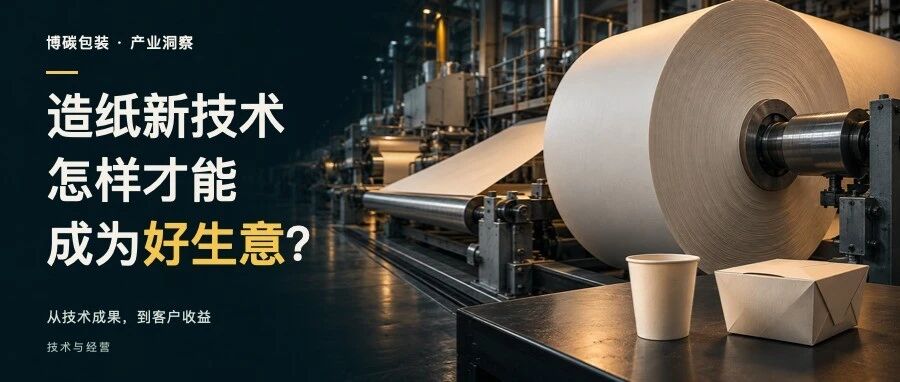
From customer benefits to reliable delivery, this article examines what turns a new technology into a viable business and how paper mills, coaters and converters can validate solutions together and build lasting partnerships.
R&D improves performance, production keeps the paper machine running steadily, sales wins customers, and finance monitors collections. Each function brings its own professional judgment.
When a new technology enters a paper mill, the challenge is to translate those judgments into shared objectives, trials and decisions.
A sample passing laboratory tests does not mean customers are ready to switch. A successful machine trial does not establish that continuous production is cost-effective. Winning an order does not mean development costs have been recovered.
For a new papermaking technology to become a viable business, technical progress must connect with customer benefits and returns for the enterprise.
Fundamental research needs time and room to explore. Here, the focus is on technologies entering commercialization: how fiber treatment, additives, forming control, dryer upgrades and functional coatings can become capabilities that support a sustainable business.
Start with who will adopt the technology and who will benefit
For internal strength-control and energy-saving projects, first assess improvements in existing product quality, resource consumption and conforming output. For new paper grades and functional coatings, also consider whether downstream customers will adopt them and continue buying. The two types of project create benefits differently and need distinct acceptance criteria.
Two questions should be separated when evaluating a new technology: is it technically mature, and are customers and their supply chains ready to adopt it?
The US Department of Energy’s Adoption Readiness Level framework goes beyond technical maturity to assess willingness to pay, market acceptance and the availability of supporting resources. It reminds developers that the ability to make something and the market’s ability to use it require separate evidence.
In papermaking, can higher strength help a customer reduce grammage while meeting requirements? Can a better barrier prevent leakage or failure after folding? Can improved converting compatibility reduce downtime, waste and delivery risk? These are concrete reasons to switch.
Food packaging illustrates the opportunity. In a 2020 report, the Organisation for Economic Co-operation and Development (OECD) used historical European data and market-share assumptions to provide a historical reference estimate of approximately 27.6 million tonnes for annual global production of food-contact paper and board, principally for applications such as folding cartons, corrugated boxes and paper bags. Each company still needs to identify the segments it can serve reliably, based on end use, performance and processing conditions.
A mill sells by the tonne, while downstream customers may compare costs per 10,000 paper bags, cups or cartons. Paper with a slightly higher price per tonne can still lower a customer’s total cost if it reduces material consumption and scrap. New functionality may also generate revenue by opening applications the customer could not previously serve.
Customers also face switching costs: new machine trials, validation, training and inventory management, and sometimes renewed approval from the end user.
When a paper machine stops, fixed costs and delivery pressures continue. Production teams have real cost reasons for approaching new technologies cautiously. Quantifying adoption risks and planning trials properly are also part of the value a technology provider should deliver.
To encourage customers to change, show both the benefits and a credible path to achieving them.
Move from the best result to consistent performance
Papermaking is continuous manufacturing. A technology’s value depends not only on its best sample, but on whether results remain within specification when raw-material batches or operating shifts change.
To accommodate variation, production sometimes needs extra additives or coat weight, or a lower operating speed. Greater stability creates room to optimize these safety margins.
Voith’s 2022 case study of PM 10 at Laakirchen in Austria offers a concrete example. The mill used strength prediction and process control to optimize starch application and forming parameters. According to Voith, starch savings were approximately 4% in the first year and up to 10% in the second, while key strength measures remained within target ranges. These percentages refer to starch consumption, not total production cost.
The system connects quality prediction, process adjustment and cost optimization. The useful principle is to reduce resource consumption within the required quality range, achieving stability and savings together.
When Koehler Paper launched its 36 g/m² NexPlus Seal Pure heat-sealable packaging paper in 2024, it highlighted a development challenge: the paper had to run reliably on both Koehler’s paper and coating machines and customers’ packaging machines.
Paper may be manufacturable at the mill, but unstable feeding, cracking at folds or sealing difficulties at the customer’s plant can offset upstream material savings with downstream losses.
Validation therefore needs to establish a stable operating window and record the effects of raw materials, speed, temperature and converting conditions. Assess average performance alongside variation and the points at which failures occur.
Customers need dependable everyday performance, not just occasional record results.
Account for improvements across the entire process
Savings in one operation and benefits to the overall process must be calculated separately.
For water-based coatings, the same dry coat weight can introduce different amounts of water into the dryer depending on solids content at application. Changes in drying, film formation, winding and downstream converting can then affect line speed and yield. Valmet’s technical guidance also emphasizes that changing one drying method affects the drying process as a whole.
When comparing solutions, first identify material differences on the same base paper under comparable conditions. Then optimize each process and compare conforming output and cost for the same end-use objective.
Before-and-after comparisons should also record changes in raw-material and energy prices, grammage, product mix and line utilization. Improvements caused by falling input prices or a different order mix should not all be attributed to the technology.
Cost per conforming unit = total relevant costs for the period ÷ conforming output.
Calculate materials from actual consumption and use consistent definitions for energy, labor, maintenance and fixed-cost allocation. Avoid counting waste twice, and list adoption costs such as installation, trials and training separately.
This full-cost approach helps evaluate long-term product economics. An upgrade decision also requires comparing incremental benefits, investment and capital tied up with and without adoption. Fixed expenses that do not fall after an upgrade are not project savings. Alternative uses of the same funds and downtime should also be compared.
Identify the actual production bottleneck. A faster coater may not increase conforming output if drying capacity cannot keep up. Even when equipment capacity is freed, orders and downstream delivery capacity are needed before it can generate additional revenue.
Theoretical extra production must therefore not be treated as actual sales.
Cash flow also depends on equipment payments, the ramp-up period, inventory and collection timing. A project’s profit potential and the company’s ability to finance it until returns materialize are separate questions.
A technology’s economics depend on the benefits it delivers across the whole process, not just savings reported by one operation.
Align contributions with returns
Some solutions have technical value but struggle to progress because those funding the work are not the same parties receiving the benefits.
The mill pays for trials and upgrades while downstream users gain material savings; the technology provider continues development while procurement compares only material unit prices. Innovation is difficult to sustain if the additional value never supports a reasonable return.
Partners should agree in advance on trial contributions, acceptance criteria, procurement arrangements, technical services and permitted uses of development results. Sharing the validation results needed for decisions can coexist with respect for proprietary technology and R&D contributions.
If similar solutions are easily copied, repeated price comparisons can erode the additional returns. Accumulated process know-how, application data, efficient service and reliable delivery offer stronger reasons for customers to stay.
The paper-based outer-packaging solution announced by UPM, Siegwerk and Uteco on October 20, 2026, illustrates coordinated roles. Different partners provide the base paper, functional coating and application technology, while joint production trials integrate coating, printing and heat sealing. The solution is for secondary packaging; the primary packaging that provides the main product protection remains in place.
The lesson for companies across the value chain is to contribute their expertise to a complete solution customers can adopt. Each partner’s investment, responsibilities and returns must also be aligned with that solution.
Cooperation can move from a single trial to sustained innovation only when those creating value can continue earning a reasonable return.
Make professional judgment count in decisions
Management sets investment limits, technical leaders are responsible for trial methods and conclusions, and production teams and customers confirm real-world results. Professional advice becomes part of decision-making when it influences plans, budgets and the next investment.
At project launch, R&D, production and commercial teams should jointly confirm the target customer, current benchmark, validation line and pass criteria. This avoids pursuing laboratory targets that later have to be redefined for production or customers.
As work progresses, distinguish sample validation, production-line validation and small-batch delivery. Record results, costs and unresolved issues at each stage before deciding on the next investment.
If an improvement in one property creates new converting losses, calculate whether the added benefits cover them. If the customer’s application changes, redefine the specification. If essential conditions remain unmet, discontinuing the current route is also an option.
A clear record of what was tested, why work stopped and which conditions remain unresolved means even a discontinued route can reduce repeated trial and error later.
The larger the investment, the more important accurate information becomes. When professional judgment informs budgets and stage decisions, team expertise becomes an organizational capability.
Turn one successful delivery into a repeatable capability
What a business retains after a delivery determines whether the next development project must start from scratch.
If every order depends on improvised coordination and repeated firefighting, growth can increase the management burden just as quickly. Capturing experience in product specifications, operating windows, batch controls and procedures for handling deviations provides a foundation for more consistent delivery.
The aim is not simply to accumulate samples. It is to identify suitable applications faster, assess risks more accurately and rely less on last-minute fixes. The more reusable these capabilities become, the stronger the foundation for adopting the next technology.
China’s 15th Five-Year Plan promotes innovation in bio-based materials, biomanufacturing and application demonstrations. Its Ecological and Environmental Code sets requirements concerning reduction, resource recovery and green procurement. For paper companies, the opportunity is to bring material innovation into real applications and create products whose performance can be verified and whose manufacture can remain stable.
For the EU market, the Packaging and Packaging Waste Regulation (PPWR) includes requirements for packaging minimization and recyclability. From 2030, packaging weight and volume must be reduced to the minimum needed to perform its function, subject to the regulation’s applicable provisions. The European Commission has also launched a public consultation on bio-based plastic packaging to assess environmental performance and possible measures to expand its use.
The long-term value of BIOTEN PHA water-based barrier emulsions lies in translating these directions into specific products. Bio-based PHA provides a material option for reducing reliance on fossil feedstocks. Coordinating base paper, coating and forming helps optimize functional-layer use while meeting water-barrier, grease-barrier and heat-sealing requirements. Compatibility with paper-fiber recovery is considered during structural design, while designated coatings listed in BPI’s commercial and home compostability certification directories provide options for suitable composting applications. Food-contact suitability, actual use and the intended end-of-life pathway must then be validated against the target market’s applicable standards, turning the technology into paper cups and food packaging that can be supplied reliably.
A joint development project can divide responsibilities as follows: mills provide base paper and papermaking expertise; coaters establish coating, drying and winding conditions; converters validate folding, heat sealing and actual use; and BIOTEN supports material selection, problem analysis and validation planning. Working toward the same product target, partners jointly calculate the cost of conforming output and build reusable specifications and process evidence.
If you are dealing with paper-cup leakage, loss of barrier performance after folding, or difficulty balancing grease resistance and moisture-vapor transmission in bakery bags, contact BIOTEN with a specific application. Current paper samples, equipment conditions, target improvements and existing test records are useful starting points. The first discussion aligns the intended use, current problems and comparison objectives, before partners identify critical conditions to validate, trial responsibilities and the next investment.
New papermaking technologies become viable businesses when technical achievements deliver consistent performance, consistent performance creates customer benefits, and those benefits support reasonable returns and continued innovation.
Research note
This article was independently researched and prepared by BIOTEN Packaging using publicly available research frameworks, company case studies and technical materials, with information checked as of October 25, 2026. Historical cases are cited in their original time frame and context. The comparisons and business considerations do not constitute investment advice, procurement commitments or performance guarantees. This article is intended for industry research and learning. For corrections, clarification or removal requests, please contact this WeChat official account; we will review and address requests within 24 hours of receipt.
BIOTEN Insights: data and verification sources
US Department of Energy | Technology Readiness Level and Adoption Readiness Level frameworks
Voith | Laakirchen PM 10 starch consumption and strength-control case study
Koehler Paper | Development and application of 36 g/m² heat-sealable packaging paper
Valmet | Energy consumption and system assessment in coating drying
UPM | Joint development combining base paper, coatings and equipment
DBC | BIOTEN PHA paper-based barrier engineering and application collaboration
BPI | BIOTEN PHA barrier coating certification directory
European Union | Packaging and Packaging Waste Regulation (PPWR)
European Commission | Public consultation on bio-based plastic packaging
NDRC | 15th Five-Year Plan: bio-based materials and application demonstrations
Ministry of Ecology and Environment | Ecological and Environmental Code: circular economy, substitute products and green procurement
OECD | Reference estimate for the food-contact paper and board market