
2018年,在党中央、国务院坚强领导下,教育系统以习近平新时代中国特色社会主义思想为指导,全面贯彻党的十九大精神和全国教育大会精神,坚持稳中求进总基调,按照高质量发展根本要求,贯彻党的教育方针,推进教育优先发展,落实立德树人根本任务,启动实施“写好教育奋进之笔行动”,推动教育改革发展各项工作取得突破性进展,各级各类教育取得显著成就,在加快推进教育现代化、建设教育强国、办好人民满意教育的征程中迈出了新的步伐。
一、综合
全国共有各级各类学校51.88万所,比上年增加5017所,增长0.98%;各级各类学历教育在校生2.76亿人,比上年增加539.40万人,增长2.00%;专任教师1672.85万人,比上年增加45.96万人,增长2.83%。
二、学前教育
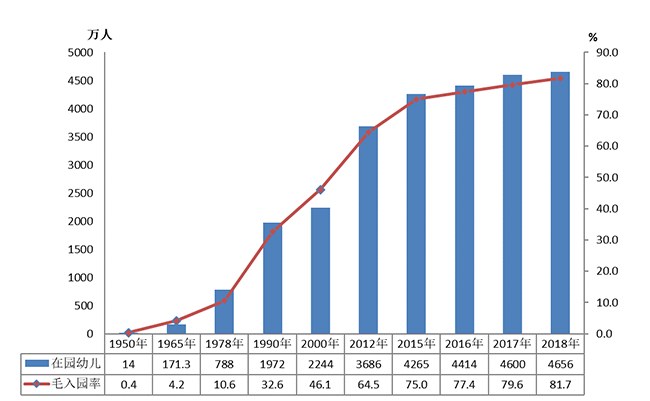
全国共有幼儿园26.67万所,比上年增加1.17万所,增长4.60%。学前教育入园幼儿[2]1863.91万人,比上年减少74.04万人,下降3.82%;在园幼儿[3]4656.42万人,比上年增加56.28万人,增长1.22%。幼儿园教职工453.15万人,比上年增加33.86万人,增长8.08%;专任教师258.14万人,比上年增加14.92万人,增长6.14%。学前教育毛入园率[4]达到81.7%,比上年提高2.1个百分点。
图1 学前教育在园幼儿和毛入园率
三、义务教育
全国共有义务教育阶段学校21.38万所,招生3469.89万人,在校生1.50亿人,专任教师973.09万人,九年义务教育巩固率[5]94.2%。
1.小学
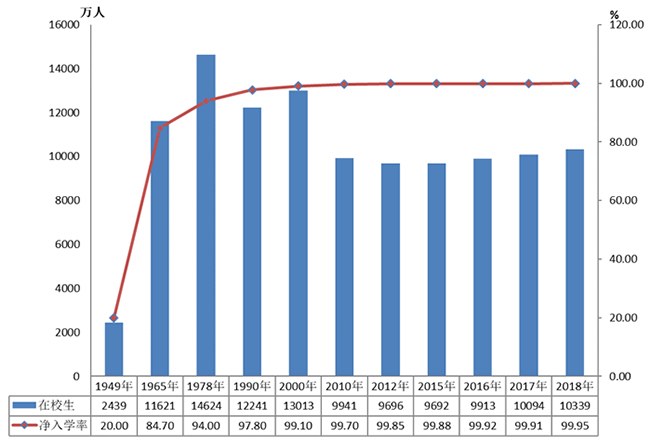
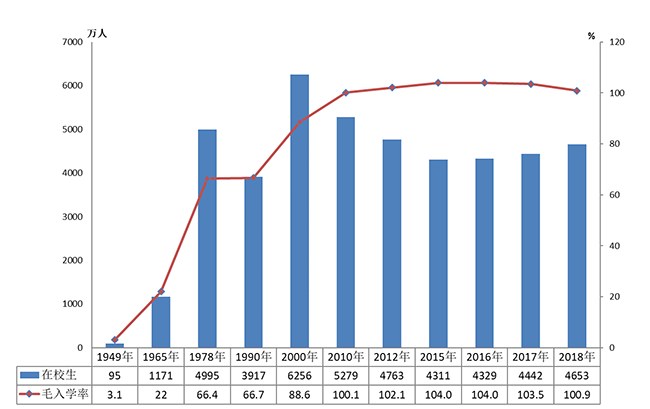
全国共有普通小学16.18万所,比上年减少0.52万所,下降3.11%。另有小学教学点10.14万个,比上年减少0.16万个。招生1867.30万人,比上年增加100.74万人,增长5.70%;在校生10339.25万人,比上年增加245.56万人,增长2.43%;毕业生1616.49万人,比上年增加50.59万人,增长3.23%。小学学龄儿童净入学率[6]达到99.95%。
图2 小学在校生和净入学率
小学教职工[7]573.25万人,比上年增加8.72万人,增长1.54%;专任教师[8]609.19万人,比上年增加14.70万人,增长2.47%。专任教师学历合格率[9]99.97%,比上年提高0.01个百分点。生师比16.97:1。
表1 小学学校数、教职工、专任教师情况
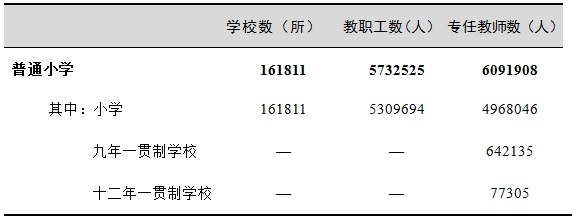
普通小学(含教学点)校舍建筑面积78619.53万平方米,比上年增加3531.07万平方米。设施设备配备达标[10]的学校比例情况分别为:体育运动场(馆)面积达标学校88.47%,体育器械配备达标学校94.23%,音乐器材配备达标学校93.89%,美术器材配备达标学校93.70%,数学自然实验仪器达标学校93.72%,各项比例比上年均有提高。
2.初中
全国共有初中学校5.20万所(含职业初中11所),比上年增加88所,增长0.17%。招生1602.59万人,比上年增加55.37万人,增长3.58%;在校生4652.59万人,比上年增加210.52万人,增长4.74%;毕业生1367.77万人,比上年减少29.70万人,下降2.13%。初中阶段毛入学率[4]100.9%。
图3 初中阶段在校生和毛入学率
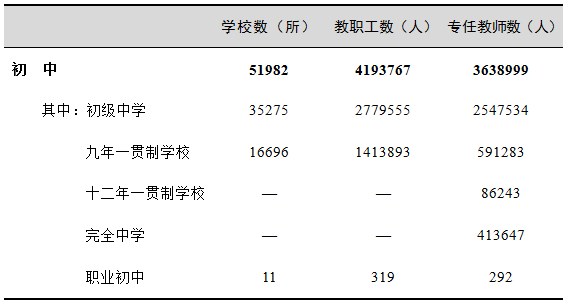
初中教职工419.38万人,比上年增加11.57万人,增长2.84%;专任教师[11] 363.90万人,比上年增加9.03万人,增长2.54%。初中专任教师学历合格率99.86%,比上年提高0.03个百分点。生师比12.79:1。
表2 初中学校数、教职工、专任教师情况
初中校舍建筑面积64368.13万平方米,比上年增加3361.39万平方米。设施设备配备达标的学校比例情况分别为:体育运动场(馆)面积达标学校92.58%,体育器械配备达标学校95.91%,音乐器材配备达标学校95.45%,美术器材配备达标学校95.21%,理科实验仪器达标学校95.64%,各项比例较上年均有提高。
3.进城务工人员随迁子女
全国义务教育阶段在校生中进城务工人员随迁子女[12]共1424.04万人。其中,在小学就读1048.39万人,在初中就读375.65万人。
四、特殊教育
全国共有特殊教育学校2152所,比上年增加45所,增长2.14%;特殊教育学校共有专任教师5.87万人,比上年增加0.27万人,增长4.78%。
全国共招收各种形式[13]的特殊教育学生12.35万人,比上年增加1.27万人,增长11.43%;在校生66.59万人,比上年增加8.71万人,增长15.05%。其中,附设特教班在校生3316人,占特殊教育在校生0.50%;随班就读在校生32.91万人,占特殊教育在校生49.41%;送教上门[14]在校生11.64万人,占特殊教育在校生17.48%。
五、高中阶段教育
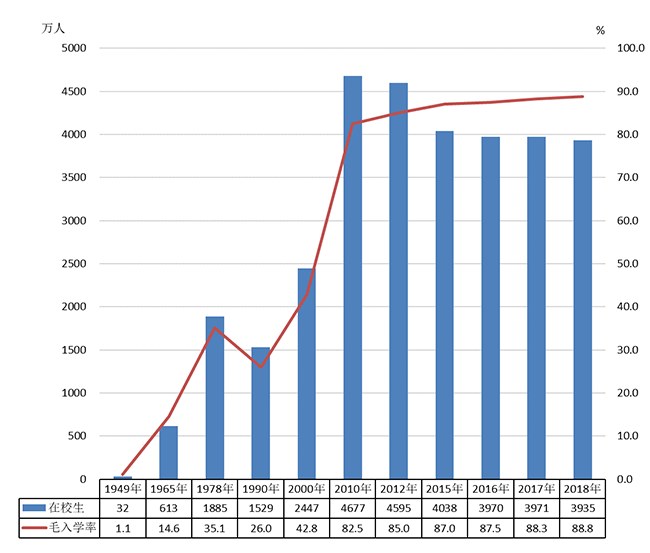
全国高中阶段教育[15]共有学校2.43万所,比上年减少298所,下降1.21%;招生1349.76万人,比上年减少32.73万人,下降2.37%;在校学生3934.67万人,比上年减少36.32万人,下降0.91%。高中阶段毛入学率88.8%,比上年提高0.5个百分点。
图4 高中阶段在校生和毛入学率
1.普通高中
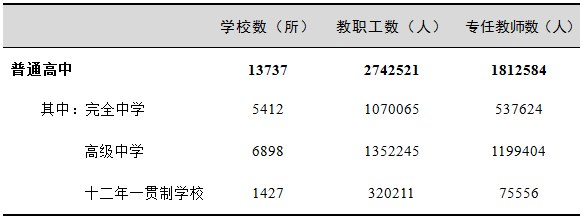
全国普通高中1.37万所,比上年增加182所,增长1.34%;招生792.71万人,比上年减少7.35万人,下降0.92%;在校生2375.37万人,比上年增加0.82万人,增长0.03%;毕业生779.24万人,比上年增加3.52万人,增长0.45%。
普通高中教职工274.25万人,比上年增加7.74万人,增长2.91%;专任教师181.26万人,比上年增加3.86万人,增长2.18%。生师比13.10:1;专任教师学历合格率98.41%,比上年提高0.26个百分点。
表3 普通高中学校数、教职工、专任教师情况
普通高中共有校舍建筑面积54206.05万平方米,比上年增加2694.31万平方米。普通高中设施设备配备达标的学校比例情况分别为:体育运动场(馆)面积达标学校91.77%,体育器械配备达标学校93.84%,音乐器材配备达标学校92.71%,美术器材配备达标学校92.91%,理科实验仪器达标学校93.70%。
2.成人高中
全国成人高中354所,比上年减少38所;在校生4.03万人,毕业生3.60万人。成人高中教职工2633人,专任教师2129人。
3.中等职业教育
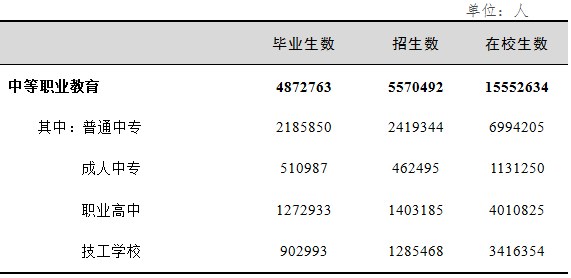
全国中等职业教育[16]共有学校1.02万所,比上年减少442所,下降4.14%。其中,普通中等专业学校3322所,比上年减少24所;成人中等专业学校1097所,比上年减少121所;职业高中3431所,比上年减少186所;技工学校2379所,比上年减少111所。
中等职业教育招生557.05万人,比上年减少25.38万人,下降4.36%,占高中阶段教育招生总数的41.27%。其中,普通中专招生241.93万人,比上年减少4.31万人;成人中专招生46.25万人,比上年减少10.63万人;职业高中招生140.32万人,比上年减少8.08万人;技工学校招生128.55万人,比上年减少2.36万人。
中等职业教育在校生1555.26万人,比上年减少37.23万人,下降2.34%,占高中阶段教育在校生总数的39.53%。其中,普通中专在校生699.42万人,比上年减少13.57万人;成人中专在校生113.13万人,比上年减少14.12万人;职业高中在校生401.08万人,比上年减少12.97万人;技工学校在校生341.64万人,比上年增加3.43万人。
中等职业教育毕业生487.28万人,比上年减少9.60万人,下降1.93%。其中,普通中专毕业生218.59万人,比上年增加1.59万人;成人中专毕业生51.10万人,比上年减少9.31万人;职业高中毕业生127.29万人,比上年减少1.70万人;技工学校毕业生90.30万人,比上年减少0.18万人。
表4 中等职业教育学生情况
中等职业教育学校共有教职工106.63万人,比上年减少1.34万人,下降1.24%。其中,普通中等专业学校教职工39.75万人,比上年增加693人;成人中等专业学校教职工5.19万人,比上年减少7799人;职业高中教职工33.95万人,比上年减少4311人;技工学校教职工26.67万人,比上年减少1854人。
中等职业教育学校共有专任教师83.35万人,比上年减少5677人,下降0.68%,生师比[17]19.10:1。其中,普通中等专业学校专任教师30.50万人,比上年增加3382人;成人中等专业学校专任教师3.95万人,比上年减少5263人;职业高中专任教师28.30万人,比上年减少3057人;技工学校专任教师19.81万人,比上年减少740人。
六、高等教育
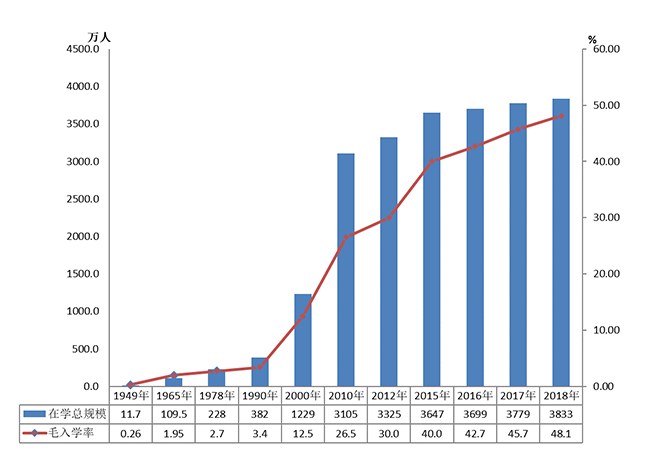
全国各类高等教育在学总规模[18]达到3833万人,高等教育毛入学率达到48.1%。全国共有普通高等学校2663所(含独立学院265所),比上年增加32所,增长1.22%。其中,本科院校1245所,比上年增加2所;高职(专科)院校1418所,比上年增加30所。全国共有成人高等学校277所,比上年减少5所;研究生培养机构815个,其中,普通高校580个,科研机构235个。普通高等学校校均规模[19]10605人,其中,本科院校14896人,高职(专科)院校6837人。
图5 高等教育在学规模和毛入学率
研究生招生85.80万人,其中,全日制73.93万人。招收博士生9.55万人,招收硕士生76.25万人。在学研究生273.13万人,其中,在学博士生38.95万人,在学硕士生234.17万人。毕业研究生60.44万人,其中,毕业博士生6.07万人,毕业硕士生54.36万人。
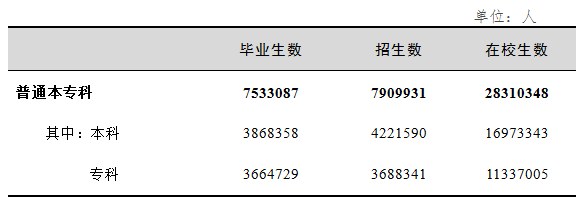
普通本专科招生790.99万人,比上年增加29.50万人,增长3.87%;在校生2831.03万人,比上年增加77.45万人,增长2.81%;毕业生753.31万人,比上年增加17.48万人,增长2.38%。
表5 普通本专科学生情况
成人本专科招生273.31万人,比上年增加55.78万人,增长25.64%;在校生590.99万人,比上年增加46.84万人,增长8.61%;毕业生217.74万人,比上年减少29.30万人,下降11.86%。
全国高等教育自学考试学历教育报考544.69万人次,取得毕业证书48.72万人。
普通高等学校教职工248.75万人,比上年增加4.45万人,增长1.82%;专任教师167.28万人,比上年增加3.95万人,增长2.42%。普通高校生师比[20]为17.56:1,其中,本科院校17.42:1,高职(专科)院校17.89:1。成人高等学校教职工3.80万人,比上年减少3381人;专任教师2.19万人,比上年减少2082人。
普通高等学校校舍总建筑面积[21]97713.56万平方米,比上年增加2313.23万平方米;教学科研仪器设备总值[22]5533.06亿元,比上年增加537.77亿元。
七、民办教育
全国共有各级各类民办学校18.35万所,比上年增加5815所,占全国比重35.36%;招生1779.75万人,比上年增加57.89万人,增长3.36%;各类教育在校生达5378.21万人,比上年增加257.74万人,增长5.03%。其中:
图6 民办教育在校生规模结构
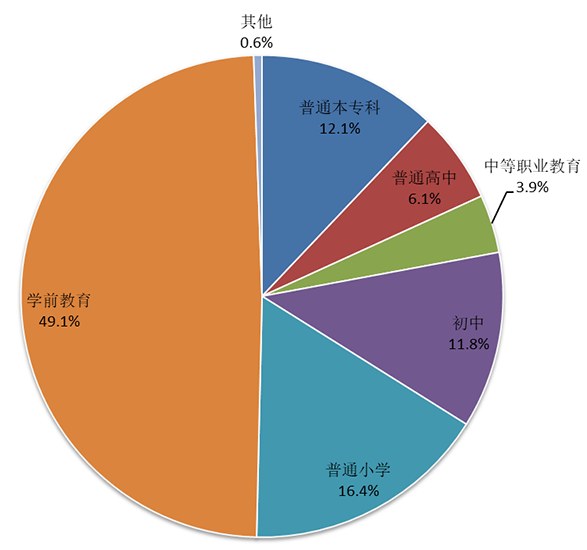
民办幼儿园16.58万所,比上年增加5407所,增长3.37%;入园儿童997.26万人,比上年减少2.06万人,下降0.21%;在园幼儿2639.78万人,比上年增加67.44万人,增长2.62%。
民办普通小学6179所,比上年增加72所,增长1.18%;招生155.31万人,比上年增加17.61万人,增长12.79%;在校生884.57万人,比上年增加70.40万人,增长8.65%。
民办初中5462所,比上年增加185所,增长3.51%;招生230.47万人,比上年增加21.38万人,增长10.22%;在校生636.30万人,比上年增加58.62万人,增长10.15%。
民办普通高中3216所,比上年增加214所,增长7.13%;招生116.95万人,比上年增加5.54万人,增长4.97%;在校生328.27万人,比上年增加22.01万人,增长7.19%。
民办中等职业学校1993所,比上年减少76所,下降3.67%;招生81.23万人,比上年增加2.55万人,增长3.24%;在校生209.70万人,比上年增加12.37万人,增长6.27%。
民办高校750所(含独立学院265所,成人高校1所),比上年增加3所。普通本专科招生183.94万人,比上年增加8.57万人,增长4.89%;在校生649.60万人,比上年增加21.14万人,增长3.36%。硕士研究生招生735人,在学1490人。
注释:
[1]各项统计数据均未包括香港特别行政区、澳门特别行政区和台湾省。部分数据因四舍五入的原因,存在着与分项合计不等的情况。
[2][3]含独立设置的幼儿园和附设幼儿班幼儿。
[4]毛入学率,是指某一级教育不分年龄的在校学生总数占该级教育国家规定年龄组人口数的百分比。由于包含非正规年龄组(低龄或超龄)学生,毛入学率可能会超过100%。
[5]九年义务教育巩固率,是指初中毕业班学生数占该年级入小学一年级时学生数的百分比。
[6]小学学龄儿童净入学率,是指小学教育在校学龄人口数占小学教育国家规定年龄组人口总数的百分比,是按各地不同入学年龄和学制分别计算的。
[7]因九年一贯制学校的教职工数计入初中阶段教育,完全中学、十二年一贯制学校的教职工数计入高中阶段教育,而专任教师是按照教育层次进行归类,存在小学教职工数据小于专任教师数据的情况。
[8]含九年一贯制学校和十二年一贯制学校小学段专任教师。
[9]专任教师学历合格率,是指某一级教育具有国家规定的最低学历要求的专任教师数占该级教育专任教师总数的百分比。各级教育教师的最低学历要求,参照《中华人民共和国教师法》中的相关规定:取得小学教师资格,应当具备中等师范学校毕业及其以上学历;取得初级中学教师、初级职业学校文化、专业课教师资格,应当具备高等师范专科学校或者其他大学专科毕业及其以上学历;取得高级中学教师资格和中等专业学校、技工学校、职业高中文化课、专业课教师资格,应当具备高等师范院校本科或者其他大学本科毕业及其以上学历。
[10]设施设备配备达标的学校,是指体育运动场(馆)面积、体育器械配备达到《教育部卫生部财政部关于印发国家学校体育卫生条件试行基本标准的通知》(教体艺﹝2008﹞5号)的相关标准;音乐器材配备、美术器材配备、数学自然实验仪器、理科实验仪器等达到各省、自治区、直辖市规定的仪器配备相关标准。含普通小学、初中和普通高中。
[11]含九年一贯制学校、十二年一贯制学校和完全中学初中段专任教师。
[12]进城务工人员随迁子女,是指户籍登记在外省(区、市)、本省外县(区)的乡村,随务工父母到输入地的城区、镇区(同住)并接受义务教育的适龄儿童少年。
[13]含特殊教育学校、附设特教班、随班就读和送教上门学生。
[14]含特殊教育学校、普通小学、初中送教上门学生。
[15]高中阶段包括普通高中、成人高中、中等职业学校。
[16]中等职业教育包括普通中等专业学校、职业高中、技工学校和成人中等专业学校。
[17]中等职业教育生师比不含技工学校数据。
[18]包括研究生、普通本专科、成人本专科、网络本专科、高等教育自学考试本专科等各种形式的高等教育在学人数。
[19]普通高等学校校均规模,仅含普通本专科在校生,不含分校点数据。
[20]普通高校生师比,不含分校点数据,学生总数为折合学生数。
[21][22]包括学校产权和非产权独立使用。
In 2018, under the strong leadership of the CPC Central Committee and the State Council, the education system guided by Xi Jinping's Thought on Socialism with Chinese Characteristics for a New Era, fully implemented the spirit of the 19th National Congress of the Communist Party of China and the National Education Conference, adhered to the general tone of steady progress, and pursued high-quality development. The system promoted educational priority development and fulfilled the fundamental task of fostering virtue and nurturing talent by launching the 'Writing the Chapter of Educational Progress' action. Significant breakthroughs were made in various aspects of educational reform and development, achieving notable accomplishments at all levels of education. These achievements propelled the country closer to its goals of accelerating modernization in education, building an education powerhouse, and providing satisfactory education for the people.
I. Overview
There were a total of 518,800 schools at all levels across the country, an increase of 5,017 from the previous year, representing a growth of 0.98%; the total number of students enrolled in all levels of education was 276 million, an increase of 5.394 million from the previous year, or 2.00%; and the number of full-time teachers was 16.7285 million, an increase of 459,600 from the previous year, or 2.83%.
II. Preschool Education
There were a total of 266,700 kindergartens across the country, an increase of 11,700 from the previous year, representing a growth of 4.60%. The number of children enrolled in preschool education decreased by 740,400 to 18.6391 million, a decline of 3.82%; while the number of children currently attending kindergarten increased by 562,800 to 46.5642 million, a growth of 1.22%. The number of staff in kindergartens was 4.5315 million, an increase of 338,600 from the previous year, or 8.08%; and the number of full-time teachers was 2.5814 million, an increase of 149,200 from the previous year, or 6.14%. The gross enrollment rate in preschool education reached 81.7%, an increase of 2.1 percentage points from the previous year.
III. Compulsory Education
There were a total of 213,800 schools at the compulsory education stage in China, enrolling 34,698,900 students and having 150 million students enrolled, with 97.309 million full-time teachers. The gross enrollment ratio for nine years of compulsory education was 94.2%.
1. Primary School
There were a total of 161,800 ordinary primary schools in China, a decrease of 52,000 from the previous year, representing a decline of 3.11%. Additionally, there were 101,400 teaching points for primary schools, a decrease of 16,000 from the previous year. A total of 18,673,000 students were enrolled, an increase of 1,007,400 from the previous year, representing a growth of 5.70%; there were 103,392,500 students enrolled, an increase of 2,455,600 from the previous year, representing a growth of 2.43%; and 16,164,900 graduates, an increase of 505,900 from the previous year, representing a growth of 3.23%. The net enrollment rate for primary school-aged children reached 99.95%.
There were 57.325 million staff members in primary schools, an increase of 87,200 from the previous year, representing a growth of 1.54%; among them, 6.0919 million full-time teachers, an increase of 147,000 from the previous year, representing a growth of 2.47%. The qualification rate for full-time teachers' academic credentials was 99.97%, an increase of 0.01 percentage points from the previous year. The student-to-teacher ratio was 16.97:1.
The gross floor area of school buildings in ordinary primary schools (including teaching points) was 78,619.53 million square meters, an increase of 3,531.07 million square meters from the previous year. The proportion of schools meeting standards for facilities and equipment was as follows: 88.47% for sports fields (gyms), 94.23% for sports equipment, 93.89% for music equipment, 93.70% for art equipment, and 93.72% for science and mathematics laboratory equipment. All these proportions increased from the previous year.
2. Junior High School
There were a total of 52,000 junior high schools across the country (including 11 vocational junior high schools), an increase of 88 from the previous year, representing a growth of 0.17%. The number of students enrolled was 16,025,900, an increase of 553,700 from the previous year, or 3.58%; the number of students in school was 46,525,900, an increase of 2,105,200 from the previous year, or 4.74%; and the number of graduates was 13,677,700, a decrease of 297,000 from the previous year, or 2.13%. The gross enrollment ratio for junior high school was 100.9%.
There were 4,193,800 staff members in junior high schools, an increase of 115,700 from the previous year, or 2.84%. Among them, there were 3,639,000 full-time teachers, an increase of 90,300 from the previous year, or 2.54%. The qualification rate for full-time teachers in terms of academic credentials was 99.86%, an increase of 0.03 percentage points from the previous year. The student-to-teacher ratio was 12.79:1.
The total floor area of school buildings in junior high schools was 64,368.13 million square meters, an increase of 3,361.39 million square meters from the previous year. The proportion of schools meeting standards for facility and equipment included: 92.58% for sports fields (gyms), 95.91% for sports equipment, 95.45% for music equipment, 95.21% for art equipment, and 95.64% for science laboratory equipment. All proportions increased from the previous year.
3. Migrant Workers' Children
There were a total of 14,240,400 migrant workers' children enrolled in compulsory education across the country. Among them, 10,483,900 were enrolled in primary school and 3,756,500 were enrolled in junior high school.
IV. Special Education
There were a total of 2,152 special education schools nationwide, an increase of 45 from the previous year, representing a growth of 2.14%. These schools employed 58,700 full-time teachers, an increase of 2,700 from the previous year, marking a growth of 4.78%.
A total of 123,500 students with various forms of special education were enrolled nationwide, an increase of 12,700 from the previous year, representing a growth of 11.43%. The number of students in special education programs was 665,900, an increase of 87,100 from the previous year, marking a growth of 15.05%. Among them, there were 3,316 students in attached special education classes, accounting for 0.50% of the total number of special education students; 329,100 students received special education in regular classrooms, accounting for 49.41% of the total number of special education students; and 116,400 students received home-based instruction, accounting for 17.48% of the total number of special education students.
Five, Secondary Education
There were a total of 24,300 secondary schools nationwide, a decrease of 298 from the previous year, representing a decline of 1.21%. The number of students enrolled was 13,497,600, a decrease of 327,300 from the previous year, marking a decline of 2.37%. The total number of students in secondary education was 39,346,700, a decrease of 363,200 from the previous year, representing a decline of 0.91%. The gross enrollment ratio for secondary education was 88.8%, an increase of 0.5 percentage points from the previous year.
1. General High Schools
There were a total of 13,700 general high schools nationwide, an increase of 182 from the previous year, representing a growth of 1.34%. The number of students enrolled was 7,927,100, a decrease of 73,500 from the previous year, marking a decline of 0.92%. The total number of students in general high schools was 23,753,700, an increase of 8,200 from the previous year, representing a growth of 0.03%. The number of graduates was 7,792,400, an increase of 35,200 from the previous year, marking a growth of 0.45%.
There were 2,742,500 staff members in general high schools, an increase of 77,400 from the previous year, representing a growth of 2.91%. The number of full-time teachers was 1,812,600, an increase of 38,600 from the previous year, marking a growth of 2.18%. The student-to-teacher ratio was 13.10:1; the percentage of full-time teachers with qualified academic qualifications was 98.41%, an increase of 0.26 percentage points from the previous year.
The total floor area of school buildings in ordinary high schools was 54,206.05 million square meters, an increase of 2,694.31 million square meters from the previous year. The proportion of schools meeting standards for various facilities and equipment were as follows: 91.77% for sports fields (gyms), 93.84% for sports equipment, 92.71% for music equipment, 92.91% for art equipment, and 93.70% for science laboratory equipment.
2. Adult High School
There were 354 adult high schools nationwide, a decrease of 38 from the previous year; with 40,300 students enrolled and 36,000 graduates. The number of staff was 2,633, including 2,129 full-time teachers.
3. Secondary Vocational Education
There were a total of 10,200 secondary vocational schools nationwide, a decrease of 442 from the previous year, representing a 4.14% decline. Among these, there were 3,322 ordinary secondary specialized schools, a decrease of 24; 1,097 adult secondary specialized schools, a decrease of 121; 3,431 vocational high schools, a decrease of 186; and 2,379 technical schools, a decrease of 111.
Enrollment in secondary vocational education was 5,570,500 students, a decrease of 253,800 from the previous year, or a 4.36% decline, accounting for 41.27% of total enrollment in secondary education. This included 2,419,300 students in ordinary secondary specialized schools, a decrease of 43,100; 462,500 students in adult secondary specialized schools, a decrease of 106,300; 1,403,200 students in vocational high schools, a decrease of 80,800; and 1,285,500 students in technical schools, a decrease of 23,600.
The total number of students enrolled in secondary vocational education was 15,552,600, a decrease of 372,300 from the previous year, or a 2.34% decline, accounting for 39.53% of total enrollment in secondary education. This included 6,994,200 students in ordinary secondary specialized schools, a decrease of 135,700; 1,131,300 students in adult secondary specialized schools, a decrease of 141,200; 4,010,800 students in vocational high schools, a decrease of 129,700; and 3,416,400 students in technical schools, an increase of 34,300.
The number of graduates from secondary vocational education was 4,872,800, a decrease of 96,000 from the previous year, or a 1.93% decline. This included 2,185,900 graduates from ordinary secondary specialized schools, an increase of 15,900; 511,000 graduates from adult secondary specialized schools, a decrease of 93,100; 1,272,900 graduates from vocational high schools, a decrease of 17,000; and 903,000 graduates from technical schools, a decrease of 18,000.
Secondary vocational education institutions had a total of 1.0663 million staff members, a decrease of 13,400 from the previous year, representing a decline of 1.24%. Among them, secondary specialized schools had 397,500 staff members, an increase of 693 from the previous year; adult secondary specialized schools had 51,900 staff members, a decrease of 7,799 from the previous year; vocational high schools had 339,500 staff members, a decrease of 4,311 from the previous year; and technical schools had 266,700 staff members, a decrease of 1,854 from the previous year.
Secondary vocational education institutions had a total of 833,500 full-time teachers, a decrease of 5,677 from the previous year, representing a decline of 0.68%, with a student-to-teacher ratio[17] of 19.10:1. Among them, secondary specialized schools had 305,000 full-time teachers, an increase of 3,382 from the previous year; adult secondary specialized schools had 39,500 full-time teachers, a decrease of 5,263 from the previous year; vocational high schools had 283,000 full-time teachers, a decrease of 3,057 from the previous year; and technical schools had 198,100 full-time teachers, a decrease of 740 from the previous year.
Higher Education
The total scale of higher education enrollment in China reached 38.33 million students, with a gross enrollment ratio of 48.1%. There were a total of 2,663 institutions of higher learning (including 265 independent colleges), an increase of 32 from the previous year, representing a growth of 1.22%. Among them, there were 1,245 undergraduate institutions, an increase of 2 from the previous year; and 1,418 vocational colleges and technical schools, an increase of 30 from the previous year. There were 277 adult higher education institutions, a decrease of 5 from the previous year; and 815 graduate training institutions, including 580 ordinary universities and 235 research institutes. The average scale of ordinary higher education institutions was 10,605 students, with undergraduate institutions averaging 14,896 students and vocational colleges and technical schools averaging 6,837 students.
A total of 858,000 graduate students were enrolled, including 739,300 full-time students. Among them, 95,500 doctoral students and 762,500 master's students were enrolled. There were 2.7313 million graduate students in total, with 389,500 doctoral students and 2.3417 million master's students. A total of 604,400 graduates were produced, including 60,700 doctoral graduates and 543,600 master's graduates.
A total of 7.9099 million students enrolled in ordinary higher education institutions, an increase of 295,000 from the previous year, representing a growth of 3.87%; the number of students was 28.3103 million, an increase of 774,500 from the previous year, representing a growth of 2.81%; and the number of graduates was 7.5331 million, an increase of 174,800 from the previous year, representing a growth of 2.38%.
Enrollment in adult undergraduate and vocational programs increased to 273.31 million students, up by 55.78 million from the previous year, a growth of 25.64%; the number of on-campus students reached 590.99 million, an increase of 46.84 million from the previous year, representing an 8.61% rise; graduates numbered 217.74 million, a decrease of 29.30 million from the previous year, or 11.86%.
The national higher education self-study examination for academic qualifications had 544.69 million examinees, with 48.72 million obtaining graduation certificates.
There were 248.75 million staff members in ordinary higher education institutions, an increase of 4.45 million from the previous year, or a growth of 1.82%; among them, there were 167.28 million full-time teachers, an increase of 3.95 million from the previous year, representing a 2.42% rise. The student-to-teacher ratio in ordinary higher education institutions was 17.56:1, with 17.42:1 for undergraduate institutions and 17.89:1 for vocational (undergraduate) institutions. In adult higher education institutions, the number of staff members decreased to 38,000, a reduction of 3,381 from the previous year; among them, there were 21,900 full-time teachers, a decrease of 2,082 from the previous year.
The total floor area of buildings in ordinary higher education institutions was 97,713.56 million square meters, an increase of 2,313.23 million square meters from the previous year; the total value of teaching and research instruments and equipment was 553.306 billion yuan, up by 53.77 billion yuan from the previous year.
Seven: Private Education
There were a total of 183,500 private schools and institutions at all levels, an increase of 5,815 from the previous year, accounting for 35.36% of the national total; enrollment increased to 177,975,000 students, up by 578,900 from the previous year, a growth of 3.36%; the number of students in all types of education reached 53,782,100, an increase of 2,577,400 from the previous year, or 5.03%. Among them:
There were 165,800 private kindergartens, an increase of 5,407 from the previous year, or a growth of 3.37%; the number of children enrolled decreased to 9,972,600, a reduction of 20,600 from the previous year, or 0.21%; the number of children in attendance increased to 26,397,800, an increase of 674,400 from the previous year, or 2.62%.
There were 6,179 privately-run primary schools, an increase of 72 from the previous year, representing a growth of 1.18%; admissions reached 15.531 million students, up by 1.761 million, or 12.79% compared to the previous year; and there were 884.57 million students enrolled, an increase of 70.4 million, or 8.65% from the previous year.
There were 5,462 privately-run junior high schools, an increase of 185 from the previous year, representing a growth of 3.51%; admissions reached 23.047 million students, up by 2.138 million, or 10.22% compared to the previous year; and there were 636.3 million students enrolled, an increase of 58.62 million, or 10.15% from the previous year.
There were 3,216 privately-run general high schools, an increase of 214 from the previous year, representing a growth of 7.13%; admissions reached 11.695 million students, up by 0.554 million, or 4.97% compared to the previous year; and there were 328.27 million students enrolled, an increase of 22.01 million, or 7.19% from the previous year.
There were 1,993 privately-run secondary vocational schools (including 265 independent colleges and 1 adult college), a decrease of 76 from the previous year. Admissions reached 8.123 million students, an increase of 0.255 million, or 3.24% compared to the previous year; and there were 209.7 million students enrolled, an increase of 12.37 million, or 6.27% from the previous year. There were 735 postgraduate students and 1,490 postgraduates in training.
There were 750 private higher-education institutions, including 265 independent colleges and one adult higher-education institution, an increase of three from the previous year. General undergraduate and junior-college enrollment reached 1.8394 million, up by 85,700 or 4.89%; total enrollment reached 6.4960 million, up by 211,400 or 3.36%. Master's-program admissions numbered 735, with 1,490 students enrolled.
Notes:
[1] All statistical data exclude the Hong Kong Special Administrative Region, Macao Special Administrative Region, and Taiwan Province. Some discrepancies may arise due to rounding.
[2][3] Includes children in independently established kindergartens and attached kindergarten classes.
[4] Gross enrollment ratio refers to the percentage of students enrolled in a level of education, regardless of age, out of the population of the corresponding age group. Due to the inclusion of non-standard age group students (underage or overage), the gross enrollment ratio may exceed 100%.
[5] Compulsory education consolidation rate refers to the percentage of junior high school graduates in a grade relative to the number of students who entered primary school in that grade.
Net enrollment rate for school-age children in primary education refers to the percentage of the school-age population enrolled in primary education out of the total population in the age group prescribed by the state for primary education, calculated separately according to different enrollment ages and school systems in various regions.
Because the number of faculty and staff in nine-year integrated schools is counted under junior secondary education, and that in complete secondary schools and twelve-year integrated schools is counted under senior secondary education, while full-time teachers are classified by educational level, there are cases where the data on primary school faculty and staff is smaller than that on full-time teachers.
Includes full-time teachers in the primary education stage of nine-year integrated schools and twelve-year integrated schools.
The qualification rate of full-time teachers' educational background refers to the percentage of full-time teachers meeting the minimum educational requirements prescribed by the state at a certain educational level out of the total number of full-time teachers at that level. The minimum educational requirements for teachers at each level refer to the relevant provisions of the Teachers Law of the People's Republic of China: to obtain a primary school teacher qualification, one should have a diploma from a secondary normal school or above; to obtain a junior secondary school teacher or a cultural or professional course teacher qualification in a junior vocational school, one should have a diploma from a higher normal junior college or other junior college or above; to obtain a senior secondary school teacher qualification or a cultural or professional course teacher qualification in a secondary specialized school, technical school, or vocational high school, one should have a bachelor's degree from a higher normal institution or other university or above.
Schools with qualified facilities and equipment refer to those where the area of sports fields (halls) and the provision of sports equipment meet the relevant standards of the 'Notice on Printing and Distributing the Trial Basic Standards for National School Sports and Health Conditions' (Jiao Ti Yi [2008] No. 5) issued by the Ministry of Education, Ministry of Health, and Ministry of Finance; and where the provision of music equipment, art equipment, mathematics and natural science experimental instruments, and science experimental instruments, etc., meet the relevant standards for instrument provision prescribed by each province, autonomous region, and municipality directly under the Central Government. Includes ordinary primary schools, junior secondary schools, and ordinary senior secondary schools.
Includes full-time teachers in the junior secondary education stage of nine-year integrated schools, twelve-year integrated schools, and complete secondary schools.
[12] Children of migrant workers who move with their parents refer to school-age children and adolescents whose household registration is in rural areas of other provinces (regions, municipalities) or other counties (districts) within the same province, who move with their working parents to urban or town areas (living together) in the destination location and receive compulsory education.
[13] Includes students in special education schools, attached special education classes, regular classes, and those receiving home-delivered education.
[14] Includes students in special education schools, regular primary schools, and junior high schools receiving home-delivered education.
[15] The high school stage includes regular high schools, adult high schools, and secondary vocational schools.
[16] Secondary vocational education includes general secondary specialized schools, vocational high schools, technical schools, and adult secondary specialized schools.
[17] The student-to-teacher ratio for secondary vocational education does not include data from technical schools.
[18] This includes the total number of students enrolled in various forms of higher education such as graduate studies, general undergraduate and vocational bachelor's and associate degree programs, adult undergraduate and associate degree programs, online undergraduate and associate degree programs, and higher education self-study exams.
[19] The average size of general higher education institutions only includes the number of full-time undergraduate and vocational students, excluding data from branch campuses.
[20] The student-to-teacher ratio for general higher education institutions does not include data from branch campuses, with the total student population being the equivalent student count.
[21][22] This includes school-owned and non-school-owned independent use.