依托巴斯夫在中国30万吨级水性粘合剂产能供应能力,双方持续深化新能源电池材料市场协同
“巴斯夫与中科联化电池材料高性能水性粘合剂技术与规模化应用合作推进会”在上海举行。巴斯夫亚太区分散体业务高级副总裁傅安之(Andreas Fechtenkötter)、巴斯夫大中华区分散体业务总经理黄奕、巴斯夫亚太区胶黏剂与纤维粘合业务总监周圣中、巴斯夫电池粘结剂全球业务管理严小伟等相关负责人到访中科联化,与中科联化总裁林凡秋及团队围绕电池负极水性粘合剂在中国新能源电池市场的客户导入、应用验证、供应保障和规模化推广进行了深入交流。
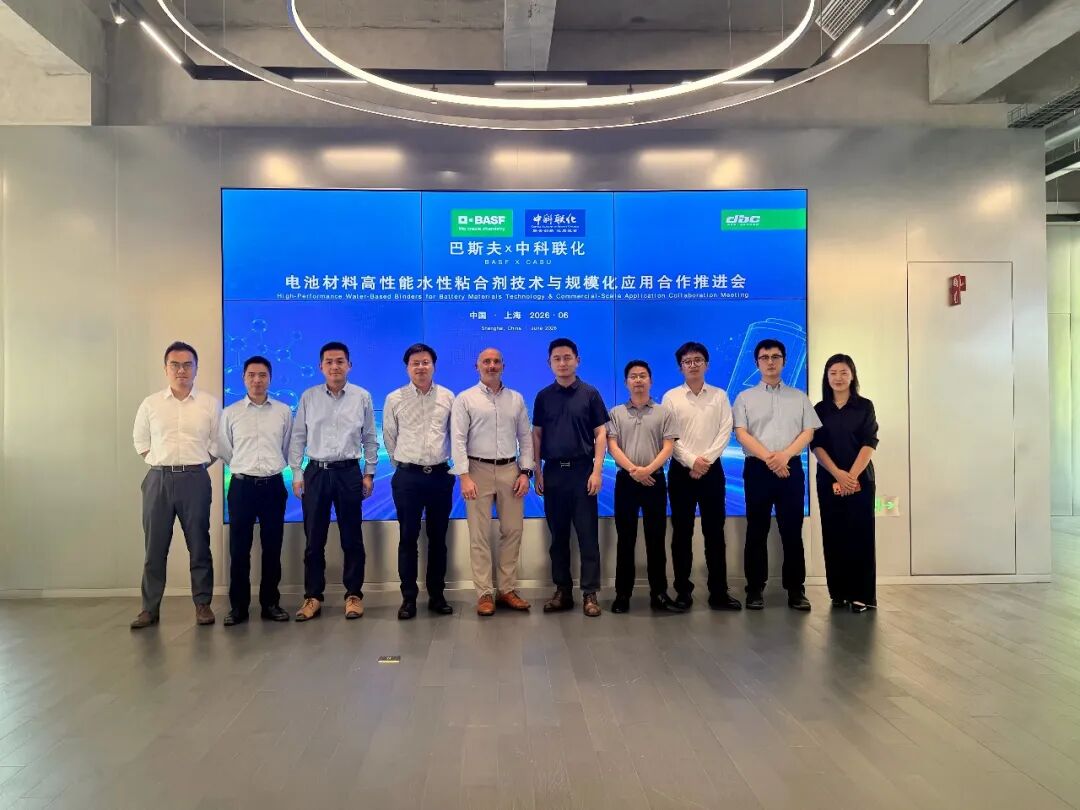
此次交流不仅是中科联化与巴斯夫长期合作的一次阶段性推进,也是都佰城集团新能源材料业务板块持续深化产业协同的重要合作动态。作为都佰城集团新能源材料业务的重要协同平台,中科联化长期关注高性能材料在动力电池、储能电池及先进电池技术方向的应用价值,持续推动国际领先材料体系与中国新能源电池产业需求的高效衔接。
本次推进会的核心,是依托巴斯夫在中国30万吨级水性粘合剂产能供应能力,以及中科联化在新能源电池客户开发、应用推进、技术反馈和本地化服务方面的长期积累,进一步推动电池用水性粘合剂从产品供应走向更具综合竞争力的规模化应用方案。
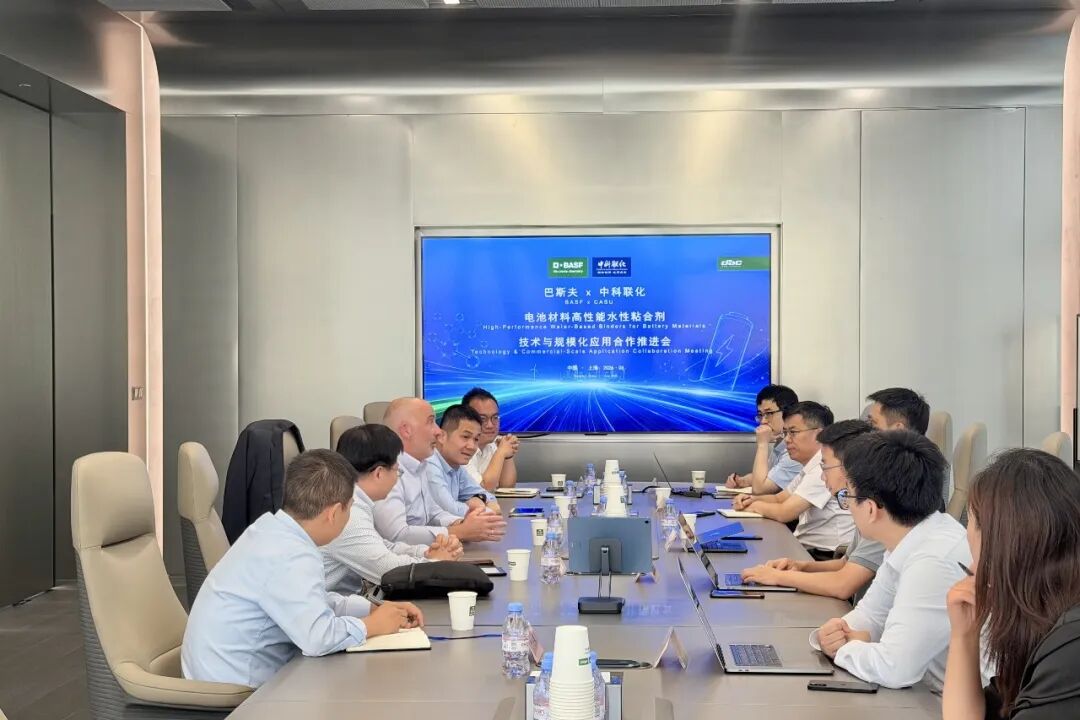
当前,中国新能源电池产业正从高速扩张阶段进入更加成熟的规模化竞争阶段。电池企业对关键材料的选择,已经不再只看单一性能指标,而是更加关注材料性能稳定性、批量供应确定性、应用适配效率、技术响应速度和综合使用成本。
这一变化在负极材料体系中尤为明显。随着动力电池向高能量密度、快充性能和长循环寿命持续升级,储能电池向高安全性、长寿命和系统成本优化持续发展,高硅负极、硅碳负极以及半固态/固态电池等技术趋势,也在不断推动电极材料体系迭代。新的技术趋势,对负极粘合体系、极片加工稳定性、界面适配能力和规模化制造一致性提出了更高要求。
负极水性粘合剂虽然在电芯材料成本中占比较小,却直接影响极片加工稳定性、粘结强度、循环表现、低温性能和电池一致性。对于电池企业而言,一款真正具备市场竞争力的粘合剂产品,不仅要性能可靠,更要能够稳定供应、快速导入、持续优化,并在规模化应用中体现综合价值。
围绕电池粘合剂业务,中科联化与巴斯夫已持续合作超过五年。双方在市场开拓、客户应用、技术反馈和产业链协同方面形成了良好的合作基础。本次推进会中,双方重点聚焦巴斯夫 Basonal Power®、Licity® 等电池材料高性能水性粘合剂产品在中国市场的规模化应用机会,进一步探讨如何以更稳定的本土化供应能力、更高效的客户导入机制和更具综合竞争力的应用方案,服务中国新能源电池客户。
巴斯夫大中华区分散体业务总经理黄奕介绍,巴斯夫已在中国形成30万吨级水性粘合剂产能供应能力。今年4月,巴斯夫湛江一体化基地的顺利投产,也为电池水性粘合剂产品提供了更加稳定可靠的上游原材料来源,进一步增强了巴斯夫在中国市场的一体化供应能力和综合成本竞争力。依托这一规模化、本土化和一体化的产业基础,巴斯夫能够在产品质量稳定性、批量交付能力、供应保障效率和客户应用支持方面,为中国新能源电池材料客户提供更具确定性的服务支撑。
在此基础上,中科联化将进一步发挥对中国新能源电池客户需求的理解,以及在客户开发、应用推进、技术反馈、本地化服务和项目落地方面的协同能力。双方优势互补,有助于推动高性能电池负极水性粘合剂从单一产品供应,进一步走向系统化、规模化和本地化的应用解决方案。
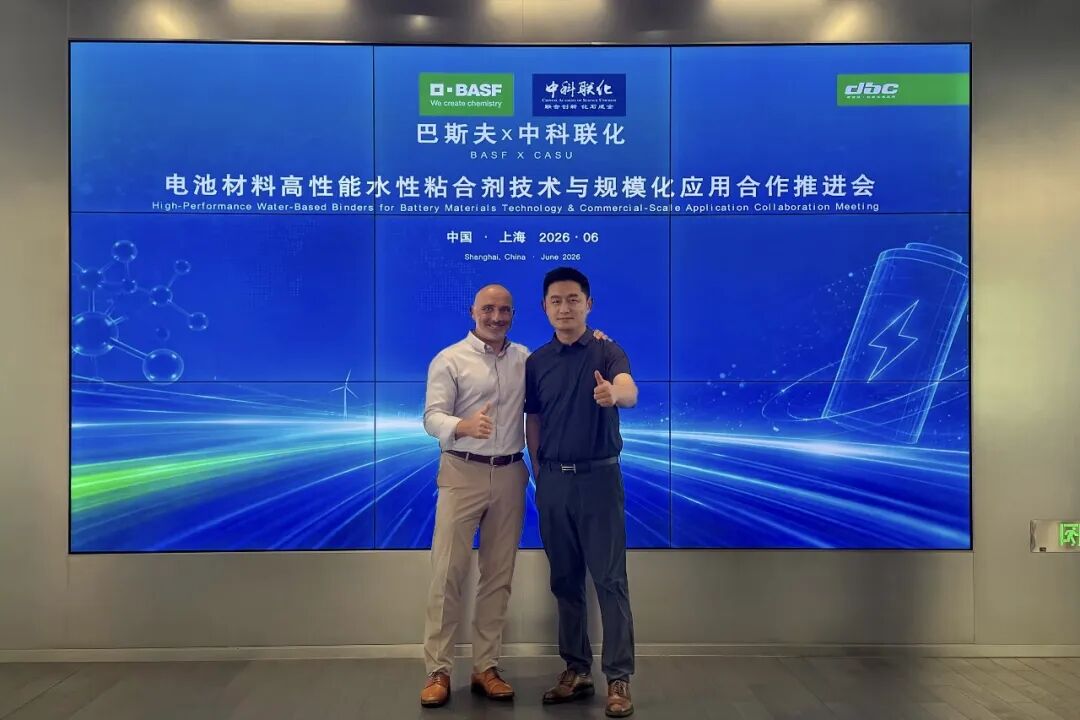
巴斯夫高级副总裁傅安之表示,中国新能源电池产业正在持续推动材料技术升级,对高性能水性粘合剂的稳定供应、应用适配和综合价值提出了更高要求。巴斯夫将继续发挥在分散体技术、产品创新、本土供应和应用支持方面的优势,为客户提供更具竞争力的材料解决方案,支持中国电池产业高质量发展。
中科联化总裁林凡秋表示,五年多来的合作让双方对中国电池材料市场和客户应用需求有了更加深入的理解。未来,中科联化将继续发挥本地客户协同、项目推进和产业链服务能力,与巴斯夫共同推动高性能电池负极水性粘合剂在动力电池、储能电池、高硅负极及半固态/固态电池等技术趋势下的规模化应用。
面向未来,都佰城集团将持续关注新能源材料、绿色制造和高性能应用材料领域的发展机会,支持中科联化与国际领先材料企业深化协同,围绕电池材料、绿色材料和功能材料等方向,持续构建更具产业价值的材料应用平台,为中国新能源电池产业提供更稳定、更高效、更具综合竞争力的关键材料解决方案。
中科联化简介:中科联化有限公司( CASU )是一家聚焦新材料与电池有机环保材料产业应用的创新型企业,由都佰城集团与中国科学院于 2017 年在上海合资设立。公司围绕高端化学品及原材料工业投资、应用研发与技术创新持续布局,锂电有机材料、胶黏剂、生物基涂料等领域具备较强的技术研发与产业化能力。业务合作:电话 400 096 2017,邮箱 casu@cas.cc
Leveraging BASF's 300,000-ton water-based binder production capacity in China, both parties continue to deepen collaboration in the new energy battery materials market.
Collaboration Promotion Meeting and Background
The "BASF and CASU High-Performance Water-Based Battery Binder Technology and Scale-Up Application Collaboration Promotion Meeting" was held in Shanghai. Andreas Fechtenkötter, Senior Vice President of BASF's Dispersions Business in Asia Pacific; Huang Yi, General Manager of BASF's Dispersions Business in Greater China; Zhou Shengzhong, Director of BASF's Adhesives and Fiber Bonding Business in Asia Pacific; Yan Xiaowei, Global Business Manager of BASF's Battery Binders; and other relevant executives visited CASU. They held in-depth discussions with CASU President Lin Fanqiu and his team regarding customer onboarding, application validation, supply assurance, and scale-up promotion of water-based anode binders in China's new energy battery market.
This exchange represents not only a milestone in the long-term collaboration between CASU and BASF, but also a significant development in DBC Group's continuous deepening of industrial synergy within its new energy materials business segment. As a key synergy platform for DBC Group's new energy materials business, CASU has long focused on the application value of high-performance materials in power batteries, energy storage batteries, and advanced battery technologies, continuously driving the efficient alignment of internationally leading material systems with the demands of China's new energy battery industry.
The core of this promotion meeting is to leverage BASF's 300,000-ton water-based binder production capacity in China, alongside CASU's long-standing expertise in new energy battery customer development, application promotion, technical feedback, and localized services, to further advance water-based battery binders from product supply to scale-up application solutions with greater comprehensive competitiveness.
Application Requirements for New Energy Battery Materials
Currently, China's new energy battery industry is transitioning from a phase of rapid expansion to a more mature stage of scale-up competition. Battery manufacturers' selection of key materials no longer focuses solely on single performance metrics; instead, greater emphasis is placed on material performance stability, certainty of bulk supply, application adaptation efficiency, technical response speed, and comprehensive cost of use.
This shift is particularly evident in anode material systems. As power batteries continue to upgrade toward higher energy density, fast-charging capabilities, and longer cycle life, and energy storage batteries develop toward higher safety, longer lifespan, and optimized system costs, technological trends such as high-silicon anodes, silicon-carbon anodes, and semi-solid/solid-state batteries are continuously driving the iteration of electrode material systems. These new technological trends impose higher demands on anode binder systems, electrode processing stability, interface adaptation capabilities, and consistency in scale-up manufacturing.
Although water-based anode binders account for a small proportion of cell material costs, they directly impact electrode processing stability, bonding strength, cycle performance, low-temperature performance, and battery consistency. For battery manufacturers, a binder product with true market competitiveness must not only be reliable in performance but also capable of stable supply, rapid onboarding, continuous optimization, and demonstrating comprehensive value in scale-up applications.
Synergy in Localized Supply and Customer Onboarding
Regarding battery binder business, CASU and BASF have collaborated for over five years. Both parties have established a solid foundation for cooperation in market development, customer applications, technical feedback, and supply chain synergy. During this promotion meeting, both parties focused primarily on the scale-up application opportunities for BASF's high-performance water-based battery binder products, such as Basonal Power® and Licity®, in the Chinese market. They further explored how to serve China's new energy battery customers with more stable localized supply capabilities, more efficient customer onboarding mechanisms, and application solutions with greater comprehensive competitiveness.
Huang Yi, General Manager of BASF's Dispersions Business in Greater China, introduced that BASF has established a 300,000-ton water-based binder production capacity in China. The successful commissioning of BASF's Zhanjiang integrated base in April this year has also provided a more stable and reliable source of upstream raw materials for water-based battery binder products, further enhancing BASF's integrated supply capabilities and comprehensive cost competitiveness in the Chinese market. Relying on this scale-up, localized, and integrated industrial foundation, BASF can provide more deterministic service support for China's new energy battery material customers in terms of product quality stability, bulk delivery capability, supply assurance efficiency, and customer application support.
On this basis, CASU will further leverage its understanding of the needs of China's new energy battery customers, as well as its synergy capabilities in customer development, application promotion, technical feedback, localized services, and project implementation. The complementary advantages of both parties will help advance high-performance water-based anode binders from single product supply to systematic, scale-up, and localized application solutions.
Fu Anzhi, Senior Vice President of BASF, stated that China's new energy battery industry is continuously driving upgrades in material technology, placing higher demands on the stable supply, application adaptability, and comprehensive value of high-performance water-based binders. BASF will continue to leverage its strengths in dispersion technology, product innovation, local supply, and application support to provide customers with more competitive material solutions, supporting the high-quality development of China's battery industry.
Lin Fanqiu, President of CASU, stated that over five years of collaboration has deepened both parties' understanding of the Chinese battery material market and customer application needs. In the future, CASU will continue to leverage its capabilities in local customer collaboration, project advancement, and industrial chain services, working with BASF to jointly promote the scaled application of high-performance water-based anode binders for batteries under technological trends such as power batteries, energy storage batteries, high-silicon anodes, and semi-solid/solid-state batteries.
Looking ahead, DBC Group will continue to focus on development opportunities in new energy materials, green manufacturing, and high-performance application materials. It will support CASU in deepening collaboration with leading international material companies, continuously building a more industrially valuable material application platform centered on battery materials, green materials, and functional materials, providing more stable, efficient, and competitively comprehensive key material solutions for China's new energy battery industry.
About CASU: CASU Co., Ltd. (CASU) is an innovative enterprise focused on the industrial application of new materials and organic eco-friendly battery materials. It was established as a joint venture in Shanghai in 2017 by DBC Group and the Chinese Academy of Sciences. The company continuously invests in high-end chemicals and raw material industries, application R&D, and technological innovation, possessing strong technical R&D and industrialization capabilities in fields such as lithium-ion organic materials, adhesives, and bio-based coatings. Business Cooperation: Tel 400 096 2017, Email casu@cas.cc