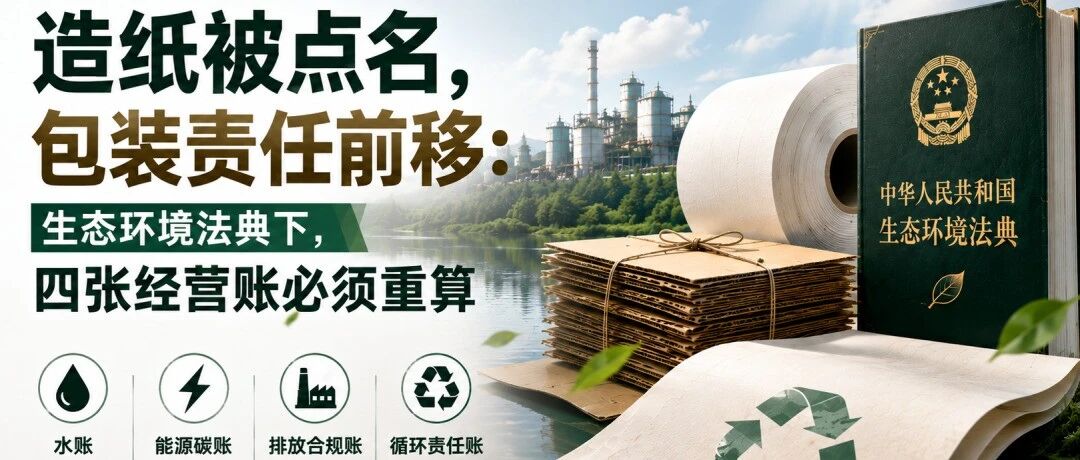
生态环境法典 8 月 15 日施行,真正改变造纸包装行业的,不是多一项检测,而是污染、资源、包装、回收与碳数据开始进入同一张经营账。哪些是现实义务,哪些仍待细则?成本、订单和技术路线将如何变化?
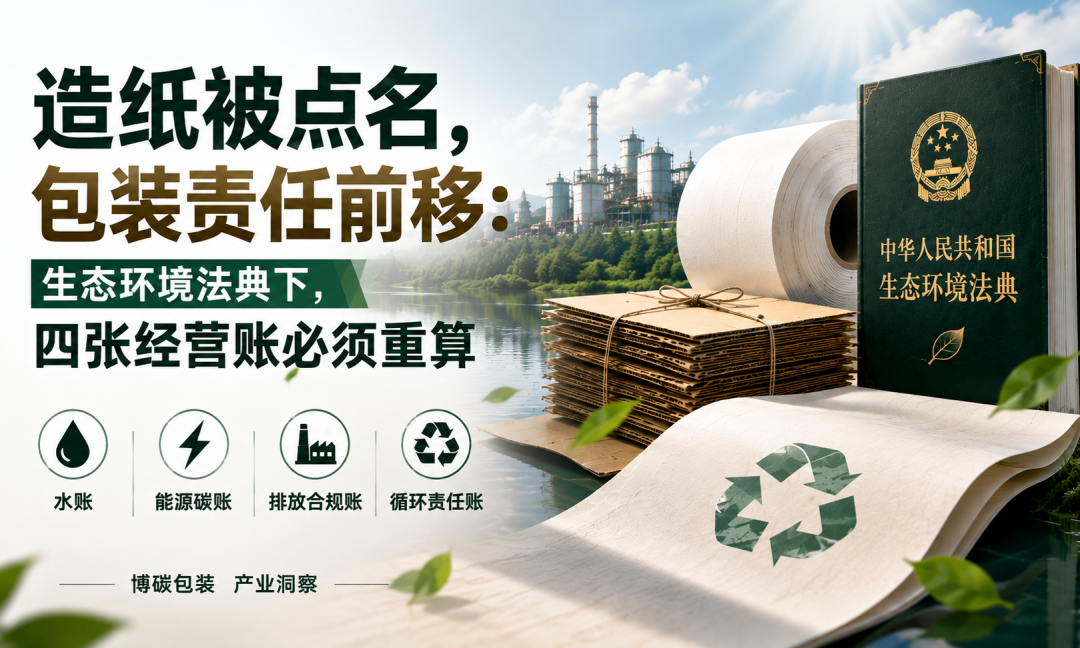
从水与纤维效率、包装减量、VOC成本到循环与碳数据,拆解生态环境法典对造纸包装产业链的真实影响。
生态环境法典 8 月 15 日施行,真正改变造纸包装行业的,不是多一项检测,而是污染、资源、包装、回收与碳数据开始进入同一张经营账。哪些是现实义务,哪些仍待细则?成本、订单和技术路线将如何变化?
FOUR OPERATING ACCOUNTS|四张经营账
01纸厂资源效率账
02包装设计与订单账
03VOC原料与税负账
04循环、碳与客户准入账
EFFECTIVE · 2026 / 08 / 15
生态环境法典施行倒计时 6 天
很多造纸和包装企业最先想到的,可能是三个问题:
是不是又要增加一项检测?环保设备是不是还要继续投入?包装材料会不会增加新的限值?
这些问题都没有错,但还没有触及本质。
法典对造纸包装产业链最深的影响,不是给企业增加一张孤立的“绿色证书”,而是把过去分散在污染防治、清洁生产、循环经济、绿色包装、生产者责任延伸和碳管理中的要求,连接成一套更完整的治理框架。
污染数据开始成为成本数据,材料数据开始成为订单数据,回收数据开始成为产品数据。
而行业恰好处在一个对成本极其敏感的阶段。
中国造纸协会数据显示,2025 年我国纸及纸板产量达到 1.4135 亿吨,同比增长 3.74%;消费量达到 1.3879 亿吨,同比增长 1.80%。与此同时,国家统计口径下,规模以上造纸和纸制品业营业收入同比下降 2.6%,利润总额下降 13.6%。用公开的 443 亿元利润总额除以 14186.7 亿元营业收入,简单比值只有约 3.1%——这不是毛利率或净利率,但足以说明利润空间的紧张。
两组数据统计口径不同,不能直接混算;但它们指向同一个现实:
行业还在增长,利润却没有同步增长。企业必须在利润承压时,完成资源效率、产品结构和环境数据能力的升级。
所以,8 月 15 日以后,造纸包装行业真正需要重算的,是四张经营账。
但在算账之前,必须先把“8 月 15 日到底改变什么”讲清楚。
一先拆开四个时间层:不是所有要求都在8月15日突然出现
这一步非常重要。
如果把所有绿色低碳政策都解释成“法典生效当天新增的强制义务”,企业容易恐慌投入,文章也容易误导;如果把法典理解成只是把旧法装订在一起,又会低估它把全产业链责任连接起来的影响。
准确的理解,应当分为四层。
LAYER 01
8月15日发生的是法律体系切换
法典第 1242 条明确,自 2026 年 8 月 15 日起施行;《环境保护法》《大气污染防治法》《水污染防治法》《固体废物污染环境防治法》《清洁生产促进法》等十部法律同时废止。
这意味着,生态环境治理进入法典化的新框架。
但“同时废止”不等于原有义务消失,也不等于所有条款都是当天新创造出来的。工业废水收集处理、VOCs 控制、限制商品过度包装等大量要求,本来已有法律和标准基础,法典对其进行了系统整合、衔接和提升。
LAYER 02
8月15日有一项企业能直接感知的行政衔接——新版排污许可证
生态环境部已明确,自 8 月 15 日起分行业、分批次启动新版排污许可证更新,2026 年底前全面应用。新版许可证覆盖大气、水、工业固废、工业噪声和土壤等环境要素,并采用“一口一表一码”的结构。
现有排污许可管理企业不需要重新填报,也不需要重新申请,可直接登录全国排污许可证管理信息平台下载新版许可证。
企业真正要做的,不是重复提交一次材料,而是核对:
许可证中的产线、产能、原辅材料和排放口,是否与实际生产一致;
生产、监测、污染治理、固废和环境税数据,能否相互验证;
改扩建、工艺变化或材料变化,是否已经按规定完成相应手续。
新版许可证的价值,不只是版式变化。它更像企业环境数据的总索引。
LAYER 03
已经明确的义务,需要持续执行,而不是等8月15日再开始
包括工业废水完整收集和处理、适用的 VOCs 含量及使用要求、排污许可与实际生产一致、遵守限制商品过度包装强制性标准等。
这些事项不能被包装成“未来趋势”,也不能因为法典尚未生效就暂缓管理。
LAYER 04
方向已确定,但仍需目录、标准或细则落地
这里包括:普通包装是否以及何时进入强制回收名录、不同产品的 EPR 履责方式、包装碳足迹的具体强制披露范围、低 VOC 产品标识的实施细节,以及造纸行业正式纳入全国碳市场的时间和配额办法。
此外,2027 年 1 月 1 日起实施的 VOCs 环境保护税试点,是与法典相互衔接的平行政策,不应写成法典第 213—215 条本身直接征税。
先把这四层拆开,企业才知道什么要立即整改,什么要建立数据底座,什么要等待正式规则。
二第一张账:纸厂资源效率账——水、纤维、能源不能再分开算
法典第 944 条直接将造纸与钢铁、有色金属、石化、化工、建材、印染等行业并列,提出推动绿色低碳转型、推广清洁生产技术装备、推进工艺流程更新升级,并完善能源效率、碳排放等约束性标准。
“造纸被点名”是真的。
但第 944 条首先是一条产业转型和制度建设条款,并不是说纸厂只要没有完成某项模糊的“绿色转型”,就会直接依据这一条受到处罚。
它发出的真正信号是:未来对纸厂的评价,不会停留在末端排放是否达标,而会越来越关注单位产品消耗了多少水、纤维、蒸汽、电力和碳排放。
ACCOUNT 01
水账的背后,其实是纤维账
法典第 297—300 条要求造成水污染的企业进行技术改造,提高水的重复利用率,减少废水和污染物排放;工业废水应全部收集处理,有毒有害废水应分类收集,不得稀释排放;进入集中处理设施前还应满足预处理要求。
对纸厂而言,少排一吨废水的价值,远不只是少付一吨污水处理费。
白水和废水往往同时携带细小纤维、填料、施胶剂、助留助滤剂、湿强剂和热量。纤维跟着水流失,既增加原料成本,也增加污水处理负荷和污泥量。
真正有价值的水管理,必须先固定企业或产线边界,再同时做两套平衡。以下是年度工厂边界下的最简示意式:
水量平衡
新鲜水及其他外部带入水 = 产品带出 + 蒸发损失 + 污泥及固废带出 + 外排水 + 库存变化 + 其他可解释损失
纤维平衡
进入造纸系统的绝干纤维 = 成品中的绝干纤维 + 外排副产物中的纤维 + 污泥、筛渣及废水中的纤维 + 库存变化 + 其他可解释损失
白水回收量和损纸回用量属于系统内部循环,应单列为过程指标,不能与外部投入、最终产出重复相加。不同纸厂还需按浆纸一体化边界、外购浆含水、填料和化学品带水等实际情况扩展公式。
如果这两套账不能闭合,企业就很难判断,一项“节水工程”到底降低了总成本,还是把问题转移到了断纸、纸病、化学品消耗和污泥处置。
需要特别避免一个误区:
提高水重复利用率,不等于盲目追求完全闭路循环。
水系统封闭度过高,盐分、阴离子垃圾、胶黏物和微生物可能累积,带来滤水变差、施胶失效、沉积、腐蚀、异味和断纸率上升。行业要找的不是“零排放口号”,而是保证纸机稳定和纸张质量前提下的新鲜水、纤维损失、化学品损失与处理成本的综合最优点。
ACCOUNT 02
能源账正在变成碳账,但不能把未来写成已经发生
GB 31825-2024《制浆造纸单位产品能源消耗限额》已于 2025 年 5 月 1 日实施。它是现行强制性国家标准,不是法典生效后才出现的新要求。
另一方面,碳数据要求并不只是远期信号。生态环境部《关于做好 2026 年全国碳排放权交易市场有关工作的通知》已经明确:造纸等行业中,年度温室气体排放量达到 2.6 万吨二氧化碳当量、约合综合能源消费量 1 万吨标准煤的单位,纳入年度温室气体排放报告管理;通知要求相关企业在 2026 年 3 月 31 日前报送 2025 年度排放报告及补充数据,省级生态环境主管部门在 2026 年底前完成核实。对达到门槛的纸厂来说,现在要做的不是等待扩围,而是复核已经报送的数据、凭证和计算边界能否经得起核实。
但必须区分两件事:排放报告管理已经发生,配额管理尚未发生。 2026 年现行通知中的配额分配与清缴行业仍是发电、钢铁、水泥和铝冶炼。生态环境部已启动造纸等行业扩围准备,但正式纳入时间和配额办法仍待正式方案,不能替主管部门提前下结论。
纸厂现在最有价值的准备,是把每个纸种、每条产线的四个指标做实:
新鲜水耗,单位:立方米/吨纸;
纤维损失,单位:千克/吨纸;
电、蒸汽和燃料消耗,按纸种和工序分配;
污染物负荷,既看浓度,也看单位产品产生量和排放量。
因为多数有效的减碳项目,最先表现为蒸汽、电力、断纸、废品和停机成本的下降。对利润率紧张的纸厂而言,能先改善经营现金流的减碳,才最有落地价值。
三第二张账:包装设计与订单账——“纸”不会自动等于“绿色”
法典第 972 条鼓励绿色设计;第 973 条鼓励绿色包装、减量包装,同时明确生产经营者的包装应当合理,遵守限制商品过度包装的强制性标准,不得过度包装,包装材质、结构和成本应与内装产品相适应;第 974 条进一步要求电商、快递、外卖等行业减少包装物使用,优先采用可重复使用、易回收利用的包装物,并积极回收利用。
这里最值得包装企业关注的,不是“纸替塑”三个字,而是评价对象已经从一种材料前移到完整包装系统。
一个纸包装方案,可能同时包含:
原纸、底涂、阻隔层、油墨、光油、胶黏剂、热封层、湿强体系、窗口材料和最终成型结构。
如果为了替代一层塑料,显著提高原纸定量、涂层用量和干燥能耗;如果包装在线速度下降、废品率上升;如果食品污染后没有现实收集路径;如果最终进入再浆系统时产生大量筛渣和黏着物,那么“纸含量更高”并不能自动证明系统环境表现更好。
真正专业的绿色包装设计,至少要过四道门:
GATE 01
功能门
包装必须先满足阻水、阻油、阻氧、热封、耐磨、印刷、迁移安全、货架期和运输保护等基本功能。不能用环境概念替代产品安全和使用性能。
GATE 02
材料效率门
比较的不是“纸还是塑料”这一单项,而是在同一包装功能下,总材料重量是否下降,无效层数和空隙是否减少,是否存在过度包装。
GATE 03
制造效率门
要把线速、干燥能耗、换线时间、清洗剂用量、废品率和质量波动纳入计算。一种材料只有能在客户真实设备上稳定生产,才可能形成订单。
GATE 04
现实循环门
要说明包装在哪个地区、通过什么收集体系、进入什么分选和再浆条件。实验室中“能够分离”,不等于现实中一定被收集、分选和利用。
因此,“可回收”的证据不应只是一张基材检测报告,而应至少绑定:
最终包装完整 BOM;
各层材料及单位面积用量;
最不利涂布量、印刷面积和复合结构;
适用的回收场景和测试方法;
纤维回收或得率、筛渣及干扰物;
回收浆或成纸质量。
法典不会因为包装是纸,就自动认定它绿色;真正接受评价的是完整包装系统。
对包装企业而言,这会直接改变订单逻辑:过去客户购买的是一只盒、一只杯或一张袋;未来头部客户更可能购买一套“功能合格、材料减量、制造稳定、回收路径清楚、数据能够核验”的解决方案。
四第三张账:VOCs原料与税负账——最先形成订单的,可能不是碳,而是物料衡算
法典第 213—215 条规定了含 VOCs 原辅材料和产品的含量限值、低 VOCs 材料使用、生产使用过程的减排措施,以及低 VOCs 产品标识制度。
对包装印刷、涂布和复合企业,这些要求会落到非常具体的物料上:
油墨;
光油;
胶黏剂;
清洗剂和稀释剂;
润版液;
涂层剂和整理剂。
但必须先纠正两个常见误解。
水性不等于零 VOC,低气味也不等于低 VOC。
产品的 VOC 判断,需要绑定产品类别、待用状态、稀释方式、测试方法和适用标准。不能仅凭“水性”两个字作合规结论。
更直接的经营信号来自 2027 年 1 月 1 日起实施的 VOCs 环境保护税试点。首批行业明确包括印刷业和化学原料及化学制品制造业。税额幅度为每污染当量 8—12 元,VOCs 污染当量值为 0.95 千克;含 VOCs 原辅材料使用排放源项采用物料衡算法计算。
做一个只用于理解量级的简化算例:
如果 1 吨全部属于应税 VOCs 排放量,在不考虑 18 种单项物质扣除、绩效等级优惠和地方适用税额差异时:
1000 千克 ÷ 0.95 千克/污染当量 × 8—12 元/污染当量
对应约 8421—12632 元。
这里的关键词是应税排放量。
它不是 1 吨采购材料,不是 1 吨油墨,也不是产品检测出的 VOC 含量直接乘税率。企业是否纳税、应税排放量多少,还要看行业分类、排污许可标识、实际排放源项、物料衡算、收集治理、18 种单项物质扣除和地方税额。
试点办法中“VOCs 质量占比大于或者等于 10%”,是含 VOCs 原辅材料排放源项的识别口径之一,不是判断产品是否属于“低 VOC”的合格线。
因此,材料供应商真正能为客户创造的价值,不是笼统宣称“更环保”,而是帮助客户算清一张综合成本表:
材料采购成本
实际单位用量
稀释与清洗成本
干燥能耗
废气收集治理成本
废品与停机损失
潜在应税排放成本。
一款低 VOC 材料如果导致线速明显下降、能耗和废品上升,综合收益可能并不成立;反过来,如果它在低干涂量下仍能维持附着、阻隔、热封、耐磨、抗粘连和储存稳定性,就可能同时降低原料、治理、税负和产线损失。
VOCs不是一个宣传词,而是一条从采购台账、物料衡算、排污许可到税务申报的经营数据链。
这很可能是未来一年包装功能材料最快形成真实订单的入口之一。
五第四张账:循环、碳与客户准入账——环境数据正在成为产品的一部分
法典第 959 条建立生产者责任延伸制度;第 977 条进一步规定,生产、进口、销售依法列入强制回收名录的产品和包装物的企业,应按规定履行回收、利用或无害化处置责任。
但这不能被解释为:
“从8月15日起,所有纸杯、纸盒和纸袋都必须缴纳统一EPR费用。”
第 977 条的触发条件是“依法列入强制回收名录”,具体名录和管理办法仍由国家发展改革部门会同有关部门制定。
不过,产业准备已经开始。
国家发展改革委对《循环经济发展“十五五”规划》的官方解读明确提出,支持行业开展饮料纸基复合包装、一次性饮品外带杯等自律回收工作。这两类包装的共同难点十分典型:价值低、分布散、易受食品残留污染,而且通常含有非纤维功能层。
真正的产业问题不是一句“可回收”,而是:
谁设置回收点,谁承担收运成本;
污染后的包装是否仍有经济价值;
纤维和非纤维组分分别进入哪里;
品牌、平台、包装厂、材料商和纸厂如何分担责任;
回收结果如何记录、核验并防止只回收不利用。
与此同时,法典第 1000 条提出企业按照国家规定实施绿色采购、建立绿色供应链;第 1036 条建立产品碳足迹核算、分级管理、标识认证和信息披露制度。
截至 2025 年底,我国已发布 15 项产品碳足迹核算国家标准和 200 多项细分领域团体标准;国家温室气体排放因子数据库第二版因子总数增至 576 个。
这不意味着所有纸包装在 8 月 15 日当天都必须披露碳足迹。
但一个更现实的变化可能更早出现:品牌客户、出口客户、政府采购和头部供应链,会先把可追溯环境数据变成供应商准入条件。
未来一款纸张、涂层或包装的交付文件,不应只有报价单和 TDS,还应逐步形成一份企业内部的“产品环境属性文件包”:
产品身份、配方或结构版本;
最终包装 BOM 与单位包装重量;
VOC 数据、测试方法和适用边界;
主要能源、原料和制造损耗数据;
最终包装的回收兼容性及适用场景;
碳足迹所需的一手活动数据与数据质量说明;
可以使用、限制使用和不得使用的环境声明。
这不是国家已经规定的统一“产品护照”名称,而是一套企业应主动建立的数据资产。
包装下一轮竞争的重要分水岭,不是谁更会讲绿色,而是谁能把绿色转成可核验的成本、性能和数据。
六哪些订单会先来?不是所有绿色机会都在同一个时间点
从造纸包装产业链看,可以把机会分为“已经可成交的近端订单”和“需要共同建设的中期能力”。
NOW 01
纸厂节水、纤维回收和能效改造
付款逻辑最清楚:每吨纸节省多少新鲜水、蒸汽、电力、纤维和污水处理费用;是否降低断纸、废品和停机。只要测量边界清楚,价值就能进入财务模型。
NOW 02
低VOCs油墨、光油、胶黏剂、清洗剂和功能涂层
客户不会只比较每公斤价格,而会逐步比较单位成品的实际用量、线速、干燥、治理、清洗、废品和潜在应税排放。能提供物料衡算和真实产线数据的供应商,更容易进入采购决策。
NOW 03
减量化与结构优化
减少无效层、降低单位包装重量、缩小空隙、优化箱型和模切排版、提高运输装载效率,这些方案同时响应过度包装、成本和物流效率,通常比单纯更换材料更容易建立商业闭环。
NEXT 01
可回收阻隔与完整包装验证
机会不只是“把 PE 换掉”,而是在满足食品接触、阻隔、热封和货架期的同时,减少非纤维层、降低筛渣和黏着物风险,并在最终包装上完成验证。
NEXT 02
饮料纸基复合包装和外带杯的回收体系
这是系统工程,需要品牌、平台、门店、收运、再生纸厂和材料商协同。单个材料的实验室结果,不能替代真实收集率和最终利用率。
NEXT 03
产品碳足迹与绿色供应链数据
短期看是客户问卷和审厂资料,长期看会进入产品设计、采购、定价和供应商分级。越早建立原始活动数据,未来的核算成本和解释风险越低。
由此可以看出,法典带来的产业机会并不是一个泛化的“环保市场”,而是三类可被购买的价值:
可量化的成本下降、可验证的产品升级、可进入客户系统的数据能力。
七企业现在怎么做:一条30/90/180天路线图
NEXT 30天
先分清义务,再补齐底账
建立一张政策矩阵,把事项分成:
已经在执行的现实义务;
8 月 15 日发生的法律或行政衔接;
已发布、将在未来生效的政策;
方向明确但仍待目录、标准和细则的制度。
同时核对环评、排污许可证、实际产线和排放口;盘点重点产品 BOM;建立水、纤维、能源、VOCs 和废弃物流的基础台账;清理“零 VOC、完全可回收、100%可降解、零碳、法典合规”等缺乏边界的宣传用语。
NEXT 90天
只选一个SKU,做三种方案比较
不要一开始就做全产品线改造。选择一个销量大、客户关注高、结构有改进空间的包装,用同一功能单位比较三种方案:
现有基准结构;
最小改动方案;
结构性升级方案。
统一比较:包装总重量、材料层数、功能性能、单位用量、线速、干燥能耗、废品率、VOC 投入、治理负荷、回收表现和全成本。
只有同口径比较,才能避免“某个单项指标更绿,系统成本和环境负荷反而更高”。
NEXT 180天
形成一个可以交给客户审核的证据包
至少选一个产品,形成从原料、制造、使用到回收边界的完整文件:
技术规格和版本;
性能与测试方法;
食品接触或产品安全资料;
VOC 与实际使用数据;
完整包装回收兼容性;
碳足迹活动数据;
环境声明及其证据等级。
这份文件的价值,在于把研发、生产、环保、采购、销售和客户审核使用的口径统一起来。
八博碳观察:功能材料的价值标准正在改变
生态环境法典没有点名 PHA,也没有规定纸、水性或生物基材料自动属于绿色材料。
因此,PHA 水性功能材料的机会不能建立在材料名称上,而要建立在一条可验证的客户价值链上:
能否以更低的单位用量提供所需阻水、阻油、热封或耐磨功能;
能否在客户真实设备上保持线速、附着和稳定性;
能否减少 VOCs 投入与治理负荷;
能否尽量保留最终纸包装的现实回收路径;
能否提供化学合规、材料来源和碳足迹所需的数据。
“生物基”只有在同一功能单位和清晰系统边界下进行碳足迹比较,才可能转化为低碳优势;“可降解”只有在明确环境条件、时间和终端处置路径时,才可能转化为真实价值;“可再浆”也只有在最终印刷、涂布、复合和成型包装上得到验证,才能成为可信声明。
对功能材料供应商而言,未来真正需要交付的,不只是一吨材料,而是:
材料性能 + 制造窗口 + 综合成本 + 回收兼容性 + 环境数据。
这也是博碳包装更值得建立的专业位置:不抢先替客户宣布“合规”,而是帮助客户把一个绿色方向做成可生产、可验证、可成交的包装方案。
结结语
生态环境法典对造纸包装行业的影响,可以浓缩成三句话。
对纸厂:
上游不只要证明排放达标,还要证明怎样用更少的水、纤维和能源稳定造出同样的纸。
对包装企业:
下游不只要证明用了纸,还要证明完整包装怎样减量、稳定制造并保留现实循环路径。
对材料供应商:
不只要证明材料有性能,还要证明它怎样降低客户的综合成本和环境负荷。
8 月 15 日不是所有绿色规则同时完成落地的终点,而是造纸包装行业把环境责任重新写入经营模型的起点。
未来真正有竞争力的企业,不是绿色名词最多的企业,而是能用工艺和数据证明:
在完成同样包装功能的前提下,消耗更少资源,产生更少污染,保留更好的循环路径,并为客户创造可计算的经营价值。
这才是生态环境法典对造纸与包装产业链最本质的影响。
据资料来源与口径说明
《中华人民共和国生态环境法典》全文|生态环境部
《关于优化排污许可证(副本)格式的通知》|生态环境部
《征收挥发性有机物环境保护税试点实施办法》|财政部、税务总局、生态环境部
《循环经济发展“十五五”规划》专家解读之二|国家发展改革委
产品碳足迹管理体系建设进展|生态环境部 2026 年 6 月新闻发布会
关于做好 2026 年全国碳排放权交易市场有关工作的通知|生态环境部
全国碳市场造纸等行业扩围准备答记者问|生态环境部
GB 31825-2024《制浆造纸单位产品能源消耗限额》|国家标准全文公开系统
2025 年全国规模以上造纸和纸制品业收入与利润|国家林业和草原局
《中国造纸工业 2025 年度报告》|中国造纸协会
说明:本文为产业研究与经营分析,不构成针对特定企业的法律、税务、认证或合规意见。企业应结合产品类别、生产工艺、排污许可证、所在地政策及正式配套规则进行判断。文中简化算例只用于解释数量级,不替代企业实际申报计算。
研究:2026年8月9日|博碳包装 产业洞察
The Ecological and Environmental Code takes effect on August 15. What will truly change the papermaking and packaging industry is not the addition of another test, but the fact that pollution, resources, packaging, recycling, and carbon data are beginning to enter the same operating ledger. Which obligations are already real, and which still await implementing rules? How will costs, orders, and technology pathways change?
From water and fiber efficiency, packaging reduction, and VOC costs to circularity and carbon data, this article examines the real impact of the Ecological and Environmental Code on the papermaking and packaging value chain.
The Ecological and Environmental Code takes effect on August 15. What will truly change the papermaking and packaging industry is not the addition of another test, but the fact that pollution, resources, packaging, recycling, and carbon data are beginning to enter the same operating ledger. Which obligations are already real, and which still await implementing rules? How will costs, orders, and technology pathways change?
FOUR OPERATING ACCOUNTS | Four Operating Accounts
01 Paper Mill Resource-Efficiency Account
02 Packaging Design and Order Account
03 VOC Raw-Material and Tax Account
04 Circularity, Carbon, and Customer-Access Account
EFFECTIVE · 2026 / 08 / 15
6 Days Until the Ecological and Environmental Code Takes Effect
Many papermaking and packaging companies may first think of three questions:
Will another test be required? Will further investment in environmental equipment be necessary? Will new limits be imposed on packaging materials?
These are all valid questions, but they do not yet reach the core issue.
The Code’s deepest impact on the papermaking and packaging value chain is not to add an isolated “green certificate,” but to connect requirements previously dispersed across pollution prevention and control, cleaner production, the circular economy, green packaging, extended producer responsibility, and carbon management into a more complete governance framework.
Pollution data are beginning to become cost data, material data are beginning to become order data, and recycling data are beginning to become product data.
And the industry happens to be at a stage of extreme cost sensitivity.
According to the China Paper Association, China’s paper and paperboard production reached 141.35 million metric tons in 2025, up 3.74% year over year, while consumption reached 138.79 million metric tons, up 1.80%. Meanwhile, under national statistical reporting, operating revenue of paper and paper products enterprises above designated size declined 2.6% year over year, and total profit fell 13.6%. Dividing the publicly reported RMB 44.3 billion in total profit by RMB 1,418.67 billion in operating revenue gives a simple ratio of only approximately 3.1%—this is neither gross margin nor net margin, but it is sufficient to illustrate how tight profit headroom has become.
The two sets of data use different statistical scopes and cannot be directly combined; however, they point to the same reality:
The industry is still growing, but profits are not growing in step. Companies must upgrade resource efficiency, product mix, and environmental-data capabilities while margins remain under pressure.
Therefore, after August 15, what the papermaking and packaging industry truly needs to recalculate are four operating accounts.
But before doing the calculations, it is essential to clarify exactly what changes on August 15.
I. First Separate Four Timing Layers: Not Every Requirement Suddenly Appears on August 15
This step is critical.
If every green and low-carbon policy is interpreted as a “new mandatory obligation created on the day the Code takes effect,” companies may make panic-driven investments and articles may mislead readers; if the Code is understood as merely binding old laws together, its impact in connecting responsibilities across the entire value chain will be underestimated.
An accurate understanding should distinguish four layers.
LAYER 01
August 15 Marks a Transition in the Legal System
Article 1242 of the Code expressly provides that it takes effect on August 15, 2026; at the same time, ten laws, including the Environmental Protection Law, the Atmospheric Pollution Prevention and Control Law, the Water Pollution Prevention and Control Law, the Law on the Prevention and Control of Environmental Pollution by Solid Waste, and the Cleaner Production Promotion Law, are repealed.
This means ecological and environmental governance is entering a new codified framework.
However, “repealed at the same time” does not mean that existing obligations disappear, nor does it mean that every provision was newly created on that date. Many requirements—including complete collection and treatment of industrial wastewater, VOCs controls, and restrictions on excessive commodity packaging—already had legal and standards-based foundations; the Code systematically integrates, coordinates, and strengthens them.
LAYER 02
August 15 Brings One Administrative Transition Companies Can Directly See—the New Version of the Pollutant Discharge Permit
The Ministry of Ecology and Environment has made clear that, beginning August 15, updates to the new version of pollutant discharge permits will be launched by industry and in batches, with full application by the end of 2026. The new permit covers environmental elements including air, water, industrial solid waste, industrial noise, and soil, and adopts a “one outlet, one table, one code” structure.
Companies already subject to pollutant discharge permit management do not need to resubmit information or reapply; they may directly log in to the National Pollutant Discharge Permit Management Information Platform to download the new permit.
What companies actually need to do is not resubmit the same materials, but verify:
Whether the production lines, capacity, raw and auxiliary materials, and discharge outlets listed in the permit are consistent with actual production;
Whether production, monitoring, pollution-control, solid-waste, and environmental-tax data can corroborate one another;
Whether the required procedures have been completed for expansions, modifications, process changes, or material changes.
The value of the new permit is not merely a change in format. It is more like the master index for a company’s environmental data.
LAYER 03
Obligations That Are Already Clear Must Continue to Be Implemented Rather Than Waiting Until August 15
These include complete collection and treatment of industrial wastewater, applicable VOCs content and use requirements, consistency between pollutant discharge permits and actual production, and compliance with mandatory standards restricting excessive commodity packaging.
These matters cannot be packaged as “future trends,” nor can management of them be deferred simply because the Code has not yet taken effect.
LAYER 04
The Direction Is Set, but Catalogs, Standards, or Detailed Rules Are Still Needed
These include whether and when ordinary packaging will enter mandatory recycling catalogs, how EPR obligations will be fulfilled for different products, the specific scope of mandatory carbon-footprint disclosure for packaging, implementation details for low-VOC product labeling, and the timing and allowance methodology for formally including the papermaking industry in the national carbon market.
In addition, the VOCs environmental protection tax pilot taking effect on January 1, 2027 is a parallel policy coordinated with the Code and should not be described as a tax directly imposed by Articles 213–215 of the Code themselves.
Only by separating these four layers can companies know what requires immediate correction, what requires a data foundation, and what should await formal rules.
II. The First Account: Paper Mill Resource Efficiency—Water, Fiber, and Energy Can No Longer Be Calculated Separately
Article 944 of the Code expressly lists papermaking alongside steel, nonferrous metals, petrochemicals, chemicals, building materials, printing and dyeing, and other industries, calling for green and low-carbon transformation, promotion of cleaner-production technologies and equipment, process renewal and upgrading, and improved mandatory standards for energy efficiency, carbon emissions, and other indicators.
It is true that “papermaking is specifically named.”
But Article 944 is first and foremost an industrial-transformation and institutional-development provision; it does not mean that a paper mill can be penalized directly under this article simply because it has not completed some vaguely defined “green transformation.”
Its real signal is that future evaluation of paper mills will not stop at whether end-of-pipe emissions meet standards, but will increasingly focus on how much water, fiber, steam, electricity, and carbon emissions are consumed per unit of product.
ACCOUNT 01
Behind the Water Account Is Actually a Fiber Account
Articles 297–300 of the Code require enterprises causing water pollution to carry out technical modifications, increase water reuse rates, and reduce wastewater and pollutant discharges; industrial wastewater must be fully collected and treated, toxic and hazardous wastewater must be collected separately and may not be diluted for discharge; and pretreatment requirements must be met before wastewater enters centralized treatment facilities.
For a paper mill, the value of discharging one metric ton less wastewater goes far beyond saving the treatment cost for one metric ton of wastewater.
White water and wastewater often carry fines, fillers, sizing agents, retention and drainage aids, wet-strength agents, and heat. Fiber lost with water increases both raw-material costs and wastewater-treatment loads and sludge volumes.
Truly valuable water management must first define the company or production-line boundary and then establish two balances simultaneously. The following are the simplest illustrative equations for an annual plant boundary:
Water Balance
Fresh water and other externally introduced water = water leaving with products + evaporation losses + water leaving with sludge and solid waste + discharged water + inventory changes + other explainable losses
Fiber Balance
Oven-dry fiber entering the papermaking system = oven-dry fiber in finished products + fiber in externally discharged by-products + fiber in sludge, screen rejects, and wastewater + inventory changes + other explainable losses
White-water recovery and broke reuse are internal system recirculation and should be reported separately as process indicators; they must not be added repeatedly to external inputs or final outputs. Different mills must also expand the equations according to actual conditions such as integrated pulp-and-paper boundaries, moisture in purchased pulp, and water introduced by fillers and chemicals.
If these two balances cannot be closed, a company will struggle to determine whether a “water-saving project” actually reduces total cost or merely shifts the problem into web breaks, paper defects, chemical consumption, and sludge disposal.
One misconception must be avoided in particular:
Increasing the water reuse rate does not mean blindly pursuing a completely closed-loop water system.
If the water system is excessively closed, salts, anionic trash, stickies, and microorganisms may accumulate, causing poorer drainage, sizing failure, deposits, corrosion, odor, and increased web-break rates. The industry should not pursue a “zero-discharge slogan,” but the overall optimum among fresh-water use, fiber loss, chemical loss, and treatment cost while maintaining paper-machine stability and paper quality.
ACCOUNT 02
The Energy Account Is Becoming a Carbon Account, but the Future Must Not Be Written as Though It Has Already Happened
GB 31825-2024, The Norm of Energy Consumption per Unit Product of Pulp and Paper, took effect on May 1, 2025. It is a currently effective mandatory national standard, not a new requirement created only after the Code takes effect.
Meanwhile, carbon-data requirements are not merely a long-term signal. The Ministry of Ecology and Environment’s Notice on Relevant Work for the National Carbon Emissions Trading Market in 2026 has already made clear that entities in papermaking and other industries with annual greenhouse gas emissions of 26,000 metric tons of CO₂ equivalent, approximately equivalent to comprehensive energy consumption of 10,000 metric tons of standard coal, are included in annual greenhouse gas emissions reporting management; the notice requires relevant companies to submit their 2025 emissions reports and supplementary data by March 31, 2026, and provincial ecology and environment authorities to complete verification by the end of 2026. For paper mills meeting the threshold, the task now is not to wait for market expansion, but to review whether the submitted data, supporting documentation, and calculation boundaries can withstand verification.
But two matters must be distinguished: emissions-reporting management has already begun, while allowance management has not. Under the current 2026 notice, the industries subject to allowance allocation and surrender remain power generation, steel, cement, and aluminum smelting. The Ministry of Ecology and Environment has begun preparations to expand coverage to papermaking and other industries, but the formal inclusion date and allowance methodology still await an official plan; conclusions should not be drawn in advance of the competent authority.
The most valuable preparation for paper mills now is to establish four robust metrics for every paper grade and production line:
Fresh-water consumption, unit: m³/metric ton of paper;
Fiber loss, unit: kg/metric ton of paper;
Electricity, steam, and fuel consumption, allocated by paper grade and process;
Pollutant load, considering both concentration and generation and discharge per unit of product.
This is because most effective decarbonization projects first appear as reductions in steam, electricity, web breaks, rejects, and downtime costs. For paper mills under margin pressure, decarbonization that first improves operating cash flow has the greatest implementation value.
III. The Second Account: Packaging Design and Orders—“Paper” Does Not Automatically Mean “Green”
Article 972 of the Code encourages green design; Article 973 encourages green packaging and packaging reduction, while expressly requiring business operators to use reasonable packaging, comply with mandatory standards restricting excessive commodity packaging, refrain from excessive packaging, and ensure that packaging materials, structures, and costs are appropriate for the contained product; Article 974 further requires e-commerce, express delivery, food delivery, and other industries to reduce packaging use, prioritize reusable and readily recyclable packaging, and actively recover and utilize packaging.
What packaging companies should focus on most is not the phrase “paper replacing plastic,” but the fact that the object of evaluation has shifted upstream from a single material to the complete packaging system.
A paper-packaging solution may simultaneously include:
Base paper, primer, barrier layer, ink, overprint varnish, adhesive, heat-seal layer, wet-strength system, window material, and final forming structure.
If replacing one plastic layer significantly increases base-paper basis weight, coating usage, and drying energy; if packaging-line speed falls and reject rates rise; if food-contaminated packaging has no practical collection pathway; or if the final package generates large amounts of screen rejects and stickies in the repulping system, then “higher paper content” does not automatically demonstrate better system-level environmental performance.
Professional green-packaging design must pass at least four gates:
GATE 01
Function Gate
Packaging must first satisfy basic functions including water resistance, grease resistance, oxygen barrier, heat sealing, abrasion resistance, printing, migration safety, shelf life, and transport protection. Environmental concepts cannot substitute for product safety and use performance.
GATE 02
Material-Efficiency Gate
The comparison is not the single question of “paper or plastic,” but whether total material weight declines for the same packaging function, whether unnecessary layers and void space are reduced, and whether excessive packaging exists.
GATE 03
Manufacturing-Efficiency Gate
Line speed, drying energy consumption, changeover time, cleaning-agent usage, reject rate, and quality variability must be included in the calculation. A material can generate orders only if it can be produced reliably on the customer’s actual equipment.
GATE 04
Real-World Circularity Gate
The packaging must specify in which region, through what collection system, and under what sorting and repulping conditions it will be handled. Being “separable” in a laboratory does not mean it will necessarily be collected, sorted, and utilized in the real world.
Therefore, evidence for “recyclability” should not consist only of a substrate test report, but should at minimum be tied to:
The complete BOM of the final package;
Materials in each layer and their usage per unit area;
Worst-case coating weight, printed area, and laminated structure;
Applicable recycling scenarios and test methods;
Fiber recovery or yield, screen rejects, and interfering substances;
Quality of recovered pulp or paper made from it.
The Code will not automatically deem packaging green simply because it is made of paper; what is actually evaluated is the complete packaging system.
For packaging companies, this will directly change the logic of orders: in the past, customers bought a box, a cup, or a bag; in the future, leading customers are more likely to buy a solution that is “functionally compliant, material-efficient, stable in manufacturing, clear in its recycling pathway, and supported by verifiable data.”
IV. The Third Account: VOCs Raw Materials and Tax Burden—The Fastest Route to Orders May Be Material Balance, Not Carbon
Articles 213–215 of the Code provide for content limits on raw and auxiliary materials and products containing VOCs, the use of low-VOCs materials, emission-reduction measures during production and use, and a low-VOCs product labeling system.
For packaging printing, coating, and laminating companies, these requirements translate into very specific materials:
Inks;
Overprint varnishes;
Adhesives;
Cleaning agents and thinners;
Fountain solutions;
Coating agents and finishing agents.
But two common misconceptions must first be corrected.
Water-based does not mean zero VOC, and low odor does not mean low VOC.
VOC determinations for a product must be tied to the product category, ready-for-use state, dilution method, test method, and applicable standard. Compliance conclusions cannot be drawn solely from the words “water-based.”
A more direct operating signal comes from the VOCs environmental protection tax pilot taking effect on January 1, 2027. The first group of industries expressly includes printing and the manufacture of chemical raw materials and chemical products. The tax rate ranges from RMB 8–12 per pollution equivalent, and the VOCs pollution-equivalent value is 0.95 kg; emission-source items involving the use of raw and auxiliary materials containing VOCs are calculated using a material-balance method.
Consider a simplified example solely to understand the order of magnitude:
If 1 metric ton consists entirely of taxable VOCs emissions, without considering deductions for 18 individual substances, performance-level incentives, or differences in locally applicable tax rates:
1,000 kg ÷ 0.95 kg/pollution equivalent × RMB 8–12/pollution equivalent
This corresponds to approximately RMB 8,421–12,632.
The key term here is taxable emissions.
It is not 1 metric ton of purchased material, not 1 metric ton of ink, and not simply the VOC content measured in a product multiplied by the tax rate. Whether a company is taxable and the amount of taxable emissions depend on industry classification, pollutant-discharge-permit identification, actual emission-source items, material balance, collection and treatment, deductions for 18 individual substances, and local tax rates.
Under the pilot measures, “VOCs mass fraction greater than or equal to 10%” is one of the identification criteria for emission-source items involving raw and auxiliary materials containing VOCs; it is not a qualification threshold for determining whether a product is “low VOC.”
Therefore, the real value a material supplier can create for customers is not a broad claim that a product is “more environmentally friendly,” but helping customers calculate a comprehensive cost sheet:
Material procurement cost
Actual unit consumption
Dilution and cleaning costs
Drying energy consumption
Waste-gas collection and treatment costs
Reject and downtime losses
Potential taxable-emissions cost.
If a low-VOC material causes line speed to decline significantly while energy consumption and rejects increase, the overall benefit may not hold; conversely, if it can maintain adhesion, barrier performance, heat sealing, abrasion resistance, blocking resistance, and storage stability at a low dry coat weight, it may simultaneously reduce raw-material, treatment, tax, and production-line losses.
VOCs are not a marketing term, but an operating-data chain running from procurement records and material balance to pollutant discharge permits and tax filings.
This is likely to become one of the fastest routes to real orders for functional packaging materials over the next year.
V. The Fourth Account: Circularity, Carbon, and Customer Access—Environmental Data Are Becoming Part of the Product
Article 959 of the Code establishes an extended producer responsibility system; Article 977 further provides that enterprises producing, importing, or selling products and packaging legally included in mandatory recycling catalogs must fulfill responsibilities for recovery, utilization, or harmless disposal as required.
But this cannot be interpreted to mean:
“Beginning August 15, all paper cups, paper boxes, and paper bags must pay a uniform EPR fee.”
The trigger under Article 977 is being “legally included in a mandatory recycling catalog,” and the specific catalogs and administrative measures are still to be formulated by the national development and reform authority together with relevant departments.
However, industry preparations have already begun.
The National Development and Reform Commission’s official interpretation of the “15th Five-Year Plan” for Circular Economy Development expressly proposes supporting industry-led voluntary recycling initiatives for beverage cartons and disposable takeaway beverage cups. The shared challenges of these two packaging categories are highly representative: low value, dispersed distribution, susceptibility to food-residue contamination, and the typical presence of non-fiber functional layers.
The real industry question is not simply whether something is “recyclable,” but:
Who establishes collection points, and who bears collection and transportation costs;
Whether contaminated packaging still has economic value;
Where the fiber and non-fiber components respectively go;
How brands, platforms, packaging converters, material suppliers, and paper mills share responsibility;
How recycling outcomes are recorded and verified, and how recovery without actual utilization is prevented.
At the same time, Article 1000 of the Code calls for companies to implement green procurement and establish green supply chains in accordance with national requirements; Article 1036 establishes systems for product carbon-footprint accounting, tiered management, labeling and certification, and information disclosure.
By the end of 2025, China had issued 15 national standards for product carbon-footprint accounting and more than 200 group standards for specific sectors; the second edition of the national greenhouse gas emission factor database increased the total number of factors to 576.
This does not mean that every paper package must disclose its carbon footprint on August 15.
But a more practical change may arrive sooner: brand customers, export customers, government procurement, and leading supply chains may first turn traceable environmental data into supplier-access requirements.
In the future, delivery documentation for a paper, coating, or package should not consist only of a quotation and TDS, but should progressively include an internal “product environmental attributes dossier”:
Product identity and formulation or structural version;
Final packaging BOM and weight per package;
VOC data, test methods, and applicable boundaries;
Key energy, raw-material, and manufacturing-loss data;
Recycling compatibility of the final package and applicable scenarios;
Primary activity data required for carbon-footprint accounting and a description of data quality;
Environmental claims that may be used, may be used with limitations, and must not be used.
This is not a nationally prescribed uniform name for a “product passport,” but a data asset that companies should proactively establish.
An important dividing line in the next round of packaging competition will not be who talks about green concepts more effectively, but who can convert green performance into verifiable costs, performance, and data.
VI. Which Orders Will Come First? Not Every Green Opportunity Arrives at the Same Time
From the perspective of the papermaking and packaging value chain, opportunities can be divided into “near-term orders that can already be transacted” and “medium-term capabilities that require joint development.”
NOW 01
Paper Mill Water Saving, Fiber Recovery, and Energy-Efficiency Upgrades
The payment logic is clearest here: how much fresh water, steam, electricity, fiber, and wastewater-treatment cost is saved per metric ton of paper; and whether web breaks, rejects, and downtime are reduced. As long as the measurement boundary is clear, the value can enter the financial model.
NOW 02
Low-VOCs Inks, Overprint Varnishes, Adhesives, Cleaning Agents, and Functional Coatings
Customers will not compare only price per kilogram; they will increasingly compare actual consumption per finished product, line speed, drying, treatment, cleaning, rejects, and potential taxable emissions. Suppliers able to provide material-balance data and real production-line data are more likely to enter procurement decisions.
NOW 03
Material Reduction and Structural Optimization
Reducing unnecessary layers, lowering packaging weight per unit, minimizing void space, optimizing box design and die-cut layouts, and improving transportation loading efficiency simultaneously address excessive packaging, cost, and logistics efficiency and generally make it easier to establish a commercial closed loop than simply replacing one material with another.
NEXT 01
Recyclable Barriers and Complete-Packaging Validation
The opportunity is not simply to “replace PE,” but to reduce non-fiber layers and lower the risks of screen rejects and stickies while meeting food-contact, barrier, heat-sealing, and shelf-life requirements and completing validation on the final package.
NEXT 02
Recycling Systems for Beverage Cartons and Takeaway Cups
This is a systems-engineering challenge requiring coordination among brands, platforms, stores, collection and transportation operators, recycled-paper mills, and material suppliers. Laboratory results for an individual material cannot substitute for real-world collection rates and final utilization rates.
NEXT 03
Product Carbon Footprints and Green Supply-Chain Data
In the short term, these appear in customer questionnaires and audit materials; in the long term, they will enter product design, procurement, pricing, and supplier segmentation. The earlier original activity data are established, the lower the future accounting cost and interpretation risk.
This shows that the industrial opportunities created by the Code are not a generalized “environmental market,” but three types of value that can be purchased:
Quantifiable cost reductions, verifiable product upgrades, and data capabilities that can enter customer systems.
VII. What Companies Should Do Now: A 30/90/180-Day Roadmap
NEXT 30 DAYS
First Distinguish Obligations, Then Complete the Baseline Records
Establish a policy matrix and divide matters into:
Existing obligations already in force;
Legal or administrative transitions occurring on August 15;
Policies already issued that will take effect in the future;
Systems whose direction is clear but that still await catalogs, standards, and detailed rules.
At the same time, reconcile environmental impact assessments, pollutant discharge permits, actual production lines, and discharge outlets; inventory the BOMs of key products; establish baseline records for water, fiber, energy, VOCs, and waste streams; and remove promotional claims such as “zero VOC,” “fully recyclable,” “100% biodegradable,” “zero carbon,” and “compliant with the Code” when they lack defined boundaries.
NEXT 90 DAYS
Select Only One SKU and Compare Three Options
Do not begin by transforming the entire product line. Select one high-volume package with strong customer attention and room for structural improvement, and compare three options using the same functional unit:
Existing baseline structure;
Minimum-change option;
Structural-upgrade option.
Compare on a consistent basis: total packaging weight, number of material layers, functional performance, unit consumption, line speed, drying energy consumption, reject rate, VOC input, treatment load, recycling performance, and total cost.
Only a like-for-like comparison can avoid a situation in which “one individual indicator is greener while total system cost and environmental burden are actually higher.”
NEXT 180 DAYS
Build an Evidence Package That Can Be Submitted for Customer Audit
Select at least one product and create complete documentation covering the boundaries from raw materials and manufacturing through use and recycling:
Technical specifications and version;
Performance and test methods;
Food-contact or product-safety documentation;
VOC and actual-use data;
Recycling compatibility of the complete package;
Carbon-footprint activity data;
Environmental claims and their levels of evidence.
The value of this documentation is to unify the basis used by R&D, production, environmental management, procurement, sales, and customer audits.
VIII. BIOTEN View: The Value Standard for Functional Materials Is Changing
The Ecological and Environmental Code does not specifically name PHA, nor does it provide that paper, water-based, or bio-based materials automatically qualify as green materials.
Therefore, the opportunity for water-based PHA functional materials cannot be built on the material name itself, but must be built on a verifiable customer value chain:
Can the required water resistance, grease resistance, heat sealing, or abrasion resistance be delivered at a lower unit consumption;
Can line speed, adhesion, and stability be maintained on the customer’s actual equipment;
Can VOCs input and treatment load be reduced;
Can the real-world recycling pathway of the final paper package be preserved as much as possible;
Can the data required for chemical compliance, material sourcing, and carbon-footprint accounting be provided.
“Bio-based” can translate into a low-carbon advantage only when carbon footprints are compared using the same functional unit and clearly defined system boundaries; “biodegradable” can translate into real value only when environmental conditions, time, and end-of-life pathways are specified; and “repulpable” can become a credible claim only when validated on the final printed, coated, laminated, and converted package.
For functional-material suppliers, what truly needs to be delivered in the future is not merely one metric ton of material, but:
Material Performance + Manufacturing Window + Total Cost + Recycling Compatibility + Environmental Data.
This is also the professional position BIOTEN Packaging should build: not declaring “compliance” on behalf of customers in advance, but helping customers turn a green direction into a packaging solution that is manufacturable, verifiable, and commercially viable.
Conclusion
The impact of the Ecological and Environmental Code on the papermaking and packaging industry can be condensed into three statements.
For paper mills:
Upstream operations must not only demonstrate compliant emissions, but also demonstrate how to produce the same paper consistently using less water, fiber, and energy.
For packaging companies:
Downstream operations must not only demonstrate the use of paper, but also demonstrate how the complete package reduces material use, can be manufactured consistently, and preserves a realistic circularity pathway.
For material suppliers:
They must not only demonstrate material performance, but also show how the material reduces customers’ total costs and environmental burden.
August 15 is not the endpoint at which all green rules simultaneously become fully implemented, but the starting point for the papermaking and packaging industry to rewrite environmental responsibility into its operating model.
The companies that will truly be competitive in the future are not those with the most green terminology, but those able to demonstrate through processes and data that:
For the same packaging function, they consume fewer resources, generate less pollution, preserve better circularity pathways, and create quantifiable operating value for customers.
This is the most fundamental impact of the Ecological and Environmental Code on the papermaking and packaging value chain.
Sources and Scope Notes
Full Text of the Ecological and Environmental Code of the People’s Republic of China | Ministry of Ecology and Environment
Notice on Optimizing the Format of Pollutant Discharge Permits (Duplicate Copy) | Ministry of Ecology and Environment
Pilot Implementation Measures for Levying Environmental Protection Tax on Volatile Organic Compounds | Ministry of Finance, State Taxation Administration, Ministry of Ecology and Environment
Expert Interpretation II of the “15th Five-Year Plan” for Circular Economy Development | National Development and Reform Commission
Progress in Building the Product Carbon-Footprint Management System | Ministry of Ecology and Environment, June 2026 Press Conference
Notice on Relevant Work for the National Carbon Emissions Trading Market in 2026 | Ministry of Ecology and Environment
Q&A on Preparations to Expand the National Carbon Market to Papermaking and Other Industries | Ministry of Ecology and Environment
GB 31825-2024, The Norm of Energy Consumption per Unit Product of Pulp and Paper | National Standards Full-Text Disclosure System
2025 Revenue and Profit of Paper and Paper Products Enterprises Above Designated Size Nationwide | National Forestry and Grassland Administration
“2025 Annual Report on China’s Paper Industry” | China Paper Association
Note: This article is industry research and operating analysis and does not constitute legal, tax, certification, or compliance advice for any specific company. Companies should make determinations based on product category, production process, pollutant discharge permit, local policies, and formally issued supporting rules. The simplified examples in this article are solely intended to explain orders of magnitude and do not replace actual company filing calculations.
Research: August 9, 2026 | BIOTEN Packaging Industry Insights