

PAPER LEADERS · 06
晨鸣纸业强在哪里?
看懂一艘浆纸巨轮的系统重启
博碳包装 · 造纸强企产业观察
五大基地复产,只是重新点火。真正的重启,是让浆、纸、能源、产品、渠道与资金重新咬合,并持续产生正毛利、经营现金流和降杠杆能力。
一台纸机重新运转,需要原料、能源、人员和订单同时到位。
重启晨鸣纸业这样的重资产企业,难度还要高得多:五大生产基地、化学浆线、不同纸种、覆盖国内外市场的销售体系和庞大的资金系统,任何一环没有跟上,都可能让“开起来”与“赚到钱”之间隔着很远。
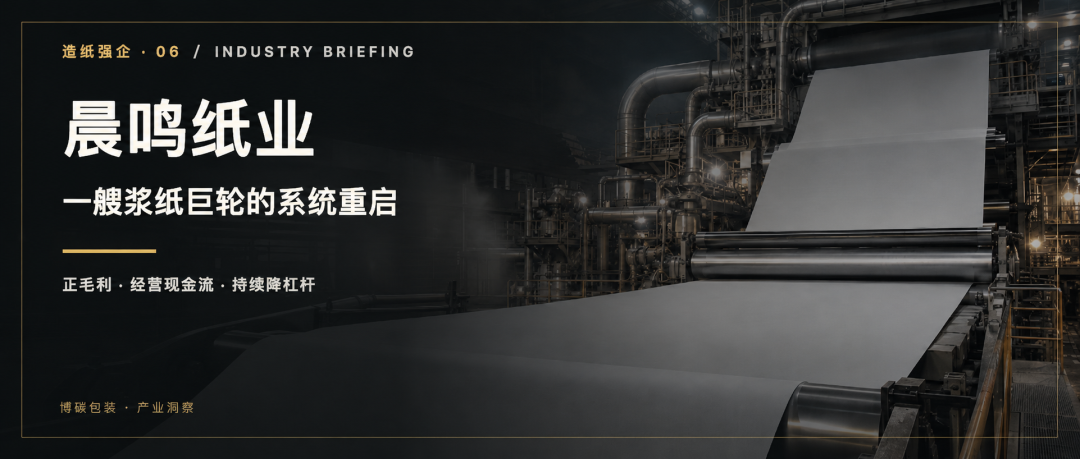
所以,2026年观察晨鸣,最重要的问题不是“产能回来了没有”,而是:系统效率回来了没有?
82.96亿元
2025年归母净亏损
29.81亿元
2026年一季度营业收入
7—8亿元
2026年上半年预计归母净亏损|未经审计
01 · SYSTEM UNDER PRESSURE
82.96亿元亏损,是一套系统失速的结果
2025年的造纸行业并不轻松。国家统计局数据显示,造纸和纸制品业利润总额443.0亿元,同比下降13.6%。但行业承压,仍不足以解释晨鸣的全部亏损。
根据公司2025年年度报告,当年营业收入61.87亿元,同比下降72.78%;归母净亏损82.96亿元。机制纸销量由2024年的447万吨降至100万吨,机制纸收入42.09亿元、成本64.76亿元,毛利率降至-53.85%,其中停工损失约20.58亿元。
第一层|生产中断
寿光、江西、吉林基地在2025年前三季度基本停产,湛江基地全年停产。销量骤降后,折旧、检修、人员和能源等重资产成本无法同步消失。
第二层|资金成本
2025年财务费用仍达16.36亿元。复产需要流动资金,而高负债又持续消耗现金,两者相互牵制。
第三层|风险显性化
信用减值、资产减值和投资损失进一步放大账面亏损。年末资产负债率94.44%,部分借款和供应商货款逾期;审计机构出具带强调事项段的无保留意见。
数字边界:停工损失已经进入机制纸成本,不能与毛亏机械相加。它们共同说明的是生产、资金与资产质量同时承压。
02 · THE INDUSTRIAL SYSTEM
真正的底牌,不是一台纸机,而是一套产业系统
晨鸣的强,首先是系统的完整度。公司在山东、广东、湖北、江西、吉林布局生产基地,并在寿光、湛江、黄冈等基地配套化学浆生产线。
浆|430万吨木浆产能 · 87%自给率
公司2025年度业绩说明会披露口径
基|五个省级生产基地
产能组织、区域交付与协同基础
纸|7个系列 · 200多个品种
文化纸、白卡、工业纸、特种纸等产品切换空间
网|采购、物流与国内外销售网络
把生产能力连接到订单、交付与回款
这套底盘可以服务文化出版、礼盒与烟包、食品卡、纸杯与面碗、防粘原纸、格拉辛纸和标签底纸等不同市场。
真正有价值的,不是名义产能本身,而是浆源、纸机、能源、产品切换、质量控制、客户结构和交付半径能否重新形成协同。
03 · EARLY RESTART
积极信号已经出现,但仍在第一阶段
截至2026年3月13日,公司披露五大基地已全面复工复产。随后的一季报显示:营业收入29.81亿元,同比增长273.97%;归母净亏损5.12亿元,上年同期亏损14.52亿元。
这是明确的改善:产销量回升、停工损失减少,亏损明显收窄。但一季度营业成本32.38亿元,仍高于营业收入;经营活动现金流量净额约0.26亿元。
半年度业绩预告预计,上半年归母净亏损7亿至8亿元,较上年同期的38.58亿元大幅收窄。趋势值得肯定,但预告未经审计,亏损仍然存在。
资金缓冲|公司披露
109家相关机构中,90家已达成降息、展期协议
公司预计年化降低财务费用6亿元以上。降息展期是在为经营修复争取时间,不等于债务已经下降。
更准确的状态是:生产系统已经重新启动,经营结果正在修复,盈利与现金流仍待穿越。
04 · FIVE GATES
真正的系统重启,要穿过五道门
01
重新开机
02
稳定运行
03
形成正毛利
04
产生经营现金流
05
持续降杠杆
前一步没有站稳,后一步就很难持续。判断巨轮是否真正回到航道,可以看四个刻度:
一看稳定运行
全面复产解决“能不能开”,设备运行率、产能利用率和连续生产解决“能不能稳定开”。
二看单吨效益
售价能否覆盖浆、化学品、能源、折旧和物流成本,决定规模是在创造利润,还是放大亏损。
三看经营现金流
持续回款才是真正的造血能力。复产期原料占款增加可以理解,但现金流必须随后改善。
四看债务下降
展期和降息能争取时间,最终仍要把正毛利、现金流和资产盘活转化为降杠杆。
05 · PRODUCT MIX
31个新产品,关键不是数量,而是利润组合
晨鸣披露,计划2026年度开发31个新产品,部分已经陆续推向市场;同时提出提高高档铜版纸、高白双胶纸、高档黄色防粘原纸、高档静电纸等高效益产品占比,减少低效益产品投放。
公司管理层同时表示,短期内没有扩张产能的计划,当前核心是改善现金流、优化债务结构。
方向很清楚:不是继续做大名义产能,而是把已有系统变成更高效的产出。新产品要改善毛利结构,也要带来更稳定的订单与回款。
06 · VALUE FOR THE CHAIN
对产业链来说,机会来自“验证”,不是想象
晨鸣的系统重启,也给上下游提出了更具体的问题:
原料与化学品企业
能否稳定供货、降低单耗并保持批次一致性?
设备与服务企业
能否通过检修、提速、能耗优化和在线检测,提升连续运行质量?
包装加工企业
能否围绕食品卡、白卡、防粘原纸等具体纸种,验证加工适配性、交付与质量稳定性?
功能材料企业
能否在真实纸种和最终包装上,完成涂布、阻隔、热封、印刷、食品接触与回收兼容性验证?
对包括博碳包装在内的功能材料企业,这些只能视为潜在协同场景。在真实纸种、涂布工艺和最终包装完成验证之前,不能推导晨鸣已经采用相关材料,也不能暗示双方已经形成合作。
CONCLUSION
系统的价值,要由结果重新证明
晨鸣纸业真正的强,不在于它曾经有多大,而在于它仍保有一套可以被重新组织的产业系统。
五大基地全面复产,是这艘浆纸巨轮重新点火;产品结构调整、降本增效和亏损收窄,说明它正在恢复航速。
真正的“系统重启”,要等到每一吨浆、每一台纸机、每一个产品和每一笔回款重新咬合,并连续转化为正毛利、强现金流和可持续降杠杆。
这条路不会一蹴而就,但方向已经比一年前清晰。
博碳包装·产业洞察——数据与核验来源说明
晨鸣纸业2025年年度报告
晨鸣纸业2025年度业绩说明会记录
晨鸣纸业2026年第一季度报告
晨鸣纸业2026年半年度业绩预告
国家统计局:2025年规模以上工业企业利润数据
信息核验截至2026年8月13日。半年度数据为公司预测数据,未经审计;产能、自给率、融资安排、产品计划及未来经营措施均按公司披露口径表述,不代表已经实现相应经营结果。
本文为造纸与包装产业研究,不构成投资建议、交易依据或对任何企业产品性能、合作关系及认证状态的背书。
PAPER LEADERS · 06
What Makes Chenming Paper Strong?
Understanding the System Restart of a Pulp-and-Paper Giant
BIOTEN Packaging · Industry Review of Leading Paper Companies
Bringing five production bases back online is only a relaunch. A true restart means reconnecting pulp, paper, energy, products, channels and capital—and consistently generating positive gross profit, operating cash flow and sustainable deleveraging capacity.
Restarting a paper machine requires raw materials, energy, people and orders to be in place at the same time.
Restarting a capital-intensive company such as Chenming Paper is far more difficult. It must coordinate five production bases, chemical-pulp lines, multiple paper grades, a sales system serving domestic and overseas markets, and a vast financing structure. If any one link falls behind, a wide gap can remain between getting the machines running and making money.
That is why the most important question when assessing Chenming in 2026 is not, “Has capacity returned?” but:Has system efficiency returned?
RMB 8.296 billion
2025 net loss attributable to shareholders
RMB 2.981 billion
Revenue in the first quarter of 2026
RMB 700–800 million
Estimated net loss attributable to shareholders for H1 2026 | Unaudited
01 · SYSTEM UNDER PRESSURE
The RMB 8.296 Billion Loss Was the Result of an Entire System Losing Momentum
The paper industry had a difficult 2025. According to China’s National Bureau of Statistics, total profit in the paper and paper-products industry fell 13.6% year on year to RMB 44.30 billion. Yet industry pressure alone does not explain the full extent of Chenming’s loss.
According to the company’s 2025 annual report, revenue fell 72.78% year on year to RMB 6.187 billion, while net loss attributable to shareholders reached RMB 8.296 billion. Sales of machine-made paper declined from 4.47 million tonnes in 2024 to 1.00 million tonnes. The segment recorded revenue of RMB 4.209 billion against costs of RMB 6.476 billion, resulting in a gross margin of –53.85%; shutdown losses accounted for approximately RMB 2.058 billion of those costs.
Layer 1 | Production Disruptions
The Shouguang, Jiangxi and Jilin bases were largely shut down during the first three quarters of 2025, while the Zhanjiang base remained offline throughout the year. When sales volumes collapsed, the fixed costs of depreciation, maintenance, staffing and energy could not disappear at the same pace.
Layer 2 | Financing Costs
Finance costs still reached RMB 1.636 billion in 2025. Restarting operations requires working capital, while high leverage continues to consume cash—the two constraints reinforce each other.
Layer 3 | Risks Becoming Visible
Credit-impairment losses, asset impairments and investment losses further enlarged the reported loss. The debt-to-assets ratio reached 94.44% at year-end, with certain borrowings and supplier payables overdue. The auditor issued an unmodified opinion with an emphasis-of-matter paragraph.
Data boundary: shutdown losses were already included in the cost of machine-made paper and therefore cannot be mechanically added to the gross loss. Together, the figures show simultaneous pressure on production, funding and asset quality.
02 · THE INDUSTRIAL SYSTEM
The Real Foundation Is Not One Paper Machine, but an Industrial System
Chenming’s core strength begins with the completeness of its system. The company operates production bases in Shandong, Guangdong, Hubei, Jiangxi and Jilin, with supporting chemical-pulp lines at sites including Shouguang, Zhanjiang and Huanggang.
Pulp | 4.3 million tonnes of wood-pulp capacity · 87% self-sufficiency
Based on disclosures at the company’s 2025 annual results briefing
Bases | Five provincial production bases
A foundation for capacity coordination, regional delivery and operational collaboration
Paper | Seven product series · More than 200 grades
Flexibility across printing and writing paper, coated ivory board, industrial paper and specialty grades
Network | Procurement, logistics, and domestic and international sales
Connecting manufacturing capacity with orders, delivery and cash collection
This industrial platform can serve a wide range of markets, including publishing, gift boxes and cigarette packaging, food-grade board, paper cups and bowls, release base paper, glassine paper and labelstock.
The real value lies not in nominal capacity itself, but in whether pulp supply, paper machines, energy, grade switching, quality control, customer mix and delivery radius can once again work as an integrated system.
03 · EARLY RESTART
Positive Signals Have Emerged, but the Restart Is Still in Its First Stage
The company disclosed that all five bases had fully resumed operations by March 13, 2026. Its subsequent first-quarter report showed revenue of RMB 2.981 billion, up 273.97% year on year, and a net loss attributable to shareholders of RMB 512 million, compared with a loss of RMB 1.452 billion a year earlier.
This is a clear improvement: production and sales volumes recovered, shutdown losses decreased, and the loss narrowed materially. However, first-quarter operating costs of RMB 3.238 billion still exceeded revenue, while net cash generated from operating activities was only about RMB 26 million.
The half-year results forecast estimates a net loss attributable to shareholders of RMB 700–800 million, sharply narrower than RMB 3.858 billion in the same period a year earlier. The direction is encouraging, but the forecast is unaudited and the company remains loss-making.
Funding Buffer | Company Disclosure
Of 109 relevant financial institutions, 90 have reached agreements on interest-rate reductions or maturity extensions
The company expects these arrangements to reduce annualized finance costs by more than RMB 600 million. Lower rates and extended maturities are buying time for an operating recovery;they do not mean that debt has already fallen.
A more accurate description of the current position is:The production system has restarted and operating results are recovering, but profitability and cash flow have yet to complete the transition.
04 · FIVE GATES
A True System Restart Must Pass Through Five Gates
01
Restart the machines
02
Stabilize operations
03
Generate positive gross profit
04
Generate operating cash flow
05
Sustain deleveraging
If one stage is not secure, the next is difficult to sustain. Four gauges can show whether this industrial giant has truly returned to course:
1. Operating Stability
A full production restart answers whether the machines can run. Equipment uptime, capacity utilization and continuous production answer whether they can run reliably.
2. Unit Economics
Whether selling prices cover pulp, chemicals, energy, depreciation and logistics determines whether scale creates profit or magnifies losses.
3. Operating Cash Flow
Sustained cash collection is the real measure of self-generated funding. Higher working-capital requirements for raw materials are understandable during a restart, but cash flow must subsequently improve.
4. Debt Reduction
Maturity extensions and lower interest rates can buy time, but positive gross profit, cash flow and asset revitalization must ultimately translate into deleveraging.
05 · PRODUCT MIX
For 31 New Products, the Key Is Not the Number but the Profit Mix
Chenming has disclosed plans to develop 31 new products in 2026, some of which have already been introduced. It also intends to increase the share of higher-return grades—including premium coated paper, high-brightness offset paper, premium yellow release base paper and premium electrostatic-copy paper—while reducing lower-return output.
Management has also said that it has no near-term plan to expand capacity; the current priorities are improving cash flow and optimizing the debt structure.
The direction is clear: instead of increasing nominal capacity, Chenming must make its existing system more productive. New products need to improve the gross-profit mix while also bringing more stable orders and collections.
06 · VALUE FOR THE CHAIN
For the Value Chain, Opportunity Comes from Validation—not Assumption
Chenming’s system restart also raises more specific questions for upstream and downstream participants:
Raw-material and chemical suppliers
Can they ensure stable supply, reduce unit consumption and maintain batch-to-batch consistency?
Equipment and service providers
Can maintenance, speed optimization, energy-efficiency improvements and online inspection raise the quality of continuous operations?
Packaging converters
Can they validate converting compatibility, delivery performance and quality consistency for specific grades such as food-grade board, coated ivory board and release base paper?
Functional-material suppliers
Can they validate coating, barrier performance, heat sealing, printing, food-contact compliance and recyclability compatibility on actual paper grades and finished packaging?
For functional-material suppliers, including BIOTEN Packaging, these should be treated only as potential areas for collaboration. Until validation has been completed on actual paper grades, coating processes and finished packaging, it would be inappropriate to infer that Chenming has adopted the relevant materials or to imply that the two parties have established a partnership.
CONCLUSION
The System’s Value Must Be Proven Again Through Results
Chenming Paper’s real strength lies not in how large it once was, but in the fact that it still retains an industrial system that can be reorganized.
The full resumption of its five bases has restarted the engines of this pulp-and-paper giant. Product-mix adjustments, cost and efficiency measures, and narrowing losses show that it is beginning to regain speed.
A true system restart will come only when every tonne of pulp, every paper machine, every product and every cash collection reconnects—and consistently converts into positive gross profit, strong cash flow and sustainable deleveraging.
The process will not be completed overnight, but the direction is clearer than it was a year ago.
BIOTEN Packaging · Industry Insights — Data Sources and Verification Notes
Chenming Paper 2025 Annual Report
Chenming Paper 2025 Annual Results Briefing Record
Chenming Paper First Quarter 2026 Report
Chenming Paper 2026 Half-Year Results Forecast
National Bureau of Statistics of China: 2025 Profits of Industrial Enterprises Above Designated Size
Information was verified through August 13, 2026. Half-year figures are company forecasts and are unaudited. Capacity, self-sufficiency, financing arrangements, product plans and future operating measures are presented on the basis of company disclosures and do not indicate that the corresponding operating results have already been achieved.
This article is an industry study of paper and packaging. It does not constitute investment advice or a basis for trading, nor does it endorse any company’s product performance, partnership status or certifications.