江苏荣成的核心能力,是把再生纤维、工业纸和区域纸箱交付连成一套系统。
中国造纸二十强 / INDUSTRIAL PAPER STUDY
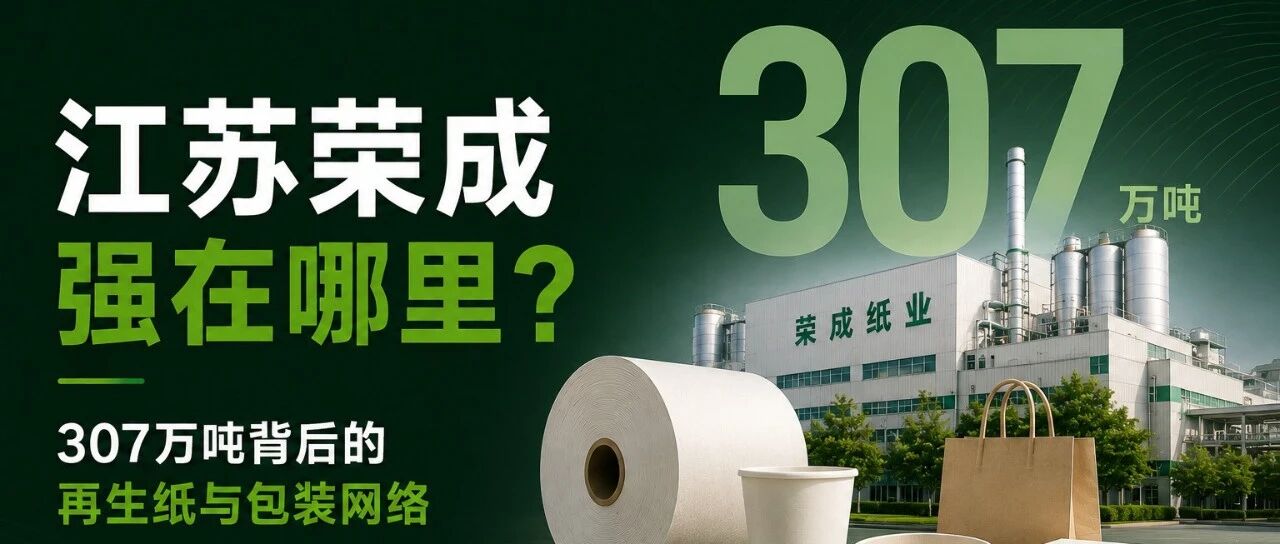
荣成纸业强在哪里?307万吨背后的再生纸与包装网络
307万吨只是规模坐标。更值得研究的是,江苏荣成如何把再生纤维、三座大陆工业纸基地、覆盖华东与华中的纸箱网络以及能源水循环,组织成一套真实运行的制造与交付系统。
核心判断
江苏荣成的产业底牌,是一张由再生纤维回收、三座大陆工业纸基地、覆盖华东与华中的纸箱网络、热电与水循环系统组成的区域网络。2026年上半年,荣成集团工业纸和纸器分部同时改善,为纸与箱的一体化价值提供了经营证据。
纸厂决定供给,纸箱网络决定交付;回收、能源与水系统决定这张网络能否持续。
01 · MANUFACTURING NETWORK
307万吨背后是一张大陆制造网络
中国造纸协会《中国造纸工业2025年度报告》列示,江苏荣成环保科技股份有限公司2025年纸及纸板产量为307.00万吨,同比下降0.97%,在报告列示的重点企业中位列第九。协会同时注明,排名“按已收集到的数据排列”。
这个规模坐标没有直接说明江苏荣成的组织形态。荣成纸业2026年第二季合并财报显示,集团通过荣成纸业(中国)控股、昆山荣中投资与苏州满果包装,合计控制江苏荣成100%股权。江苏荣成又连接无锡、平湖、湖北等工业纸基地,以及昆山、苏州、上海、杭州和华中地区的包装主体。
荣成纸业官网当前列出的大陆低碳造纸基地包括无锡荣成、平湖荣成和湖北荣成;绿色包装纸箱基地覆盖昆山、苏州、上海、杭州及华中多个城市。2026年第二季财报的合并结构还包括嘉兴荣成智能环保包装有限公司。
三个观察坐标
307.00万吨:协会列示的2025年纸及纸板产量,只作为系列规模坐标。
三座工业纸基地:无锡、平湖与湖北,构成大陆原纸供给底盘。
区域纸箱网络:贴近华东、华中客户,把原纸能力转化为纸板、纸箱和交付服务。
口径边界:协会没有披露307万吨是江苏荣成单一法人自产量,还是包含相关大陆纸厂的汇总口径。荣成纸业2024年永续报告披露大陆工业纸产能为330万吨;两项数字不能据此直接计算利用率。
资料来源:中国造纸协会《中国造纸工业2025年度报告》;荣成纸业2026年第二季合并财务报告。
02 · FROM FIBER TO DELIVERY
一张网络如何从再生纤维走到纸箱
荣成纸业官网将集团定位为使用回收废纸作为生产原料的低碳造纸与绿色包装垂直整合制造商,主要产品包括箱纸板、瓦楞原纸、瓦楞纸板和瓦楞纸箱。2024年永续报告也把废纸回收、低碳造纸、绿色包装和废旧产品回收放进同一价值链。
这条链的难点并不只在“有没有废纸”。再生纤维的含水率、杂质、胶黏物、灰分、纤维长度和批次稳定性,会依次影响制浆得率、纸机运行、强度指标、蒸汽与化学品单耗,最终进入箱纸板和瓦楞原纸的成本与质量。
能力路径 A · RECOVERY
回收与分选:控制水分、杂质、胶黏物与纤维损伤,为纸机稳定和吨纸成本建立起点。
能力路径 B · INDUSTRIAL PAPER
工业纸制造:把纤维质量转化为环压、耐破、克重稳定和连续生产效率。
能力路径 C · CORRUGATED PACKAGING
纸板与纸箱:通过楞型、箱型、印刷、结构设计和加工良率,把原纸性能转化为包装表现。
能力路径 D · REGIONAL DELIVERY
区域交付:用贴近客户的纸箱基地缩短运输与响应距离,让需求更快反馈到纸板结构和原纸制造。
2026年上半年财报列示,无锡、平湖、湖北等纸厂与江苏荣成、下沙、苏州、武汉和湖南等包装主体之间存在内部销售及应收关系。这些往来确认,纸厂和纸箱厂之间已经形成实际供货联系,而不只是组织结构图上的关联。
工业纸解决原纸供给,纸箱网络解决客户距离、交期、结构设计和服务响应。纸箱具有明显的运输半径和服务半径,区域基地能够缩短交付时间,也让客户反馈更快回到制造端。
资料来源:荣成纸业官网:公司概要;荣成纸业2024年永续报告书。
03 · OPERATING RESULTS
2026年上半年集团纸与箱同时恢复盈利
2025年,荣成纸业集团合并营业收入为新台币447.08亿元,同比下降约6.47%;综合毛利率9.85%,营业亏损约0.13亿元,归属于母公司业主的净亏损约5.17亿元,经营活动现金流量净额为11.41亿元。完整产业链仍然要面对纸价、需求、成本和产线爬坡的共同压力。
2026年上半年,经营结果出现更清晰的改善:集团合并营业收入242.48亿元,同比增长约13.23%;综合毛利率由上年同期9.33%提高至10.86%;营业利润2.32亿元,上年同期为亏损1.21亿元;归属于母公司业主的净利润2.43亿元,上年同期为亏损5.70亿元。
2026上半年经营账页 · 集团合并口径
242.48亿元 营业收入
同比增长约13.23%;中国市场收入197.05亿元,同比增长约20.06%。
10.86% 综合毛利率
上年同期为9.33%,提高约1.53个百分点。
13.38亿元 经营现金流净额
同比增长约99.68%,高于上年同期6.70亿元。
两个核心分部也同时转正。工业纸外部收入181.09亿元,同比增长约15.48%,分部利润3.14亿元,上年同期亏损3.05亿元;纸器,也就是纸板与纸箱业务,外部收入58.49亿元,同比增长约11.31%,分部利润1.22亿元,上年同期亏损1.92亿元。
收入、毛利率、分部利润和经营现金流同步改善,比单看集团净利润更能呈现系统的经营质量。公司自结数据显示,2026年1—7月累计合并营收285.35亿元,同比增长13.88%;累计合并营业利润3.50亿元、税前利润4.78亿元。
财务边界:上述金额均为新台币,属于台湾上市母公司荣成纸业集团合并、分部或地域口径,不能写成江苏荣成单体业绩;工业纸与纸器分部同时包含台湾及大陆业务。1—7月数据为企业内部自行结算,最终仍以会计师核阅或查核财报为准。
资料来源:荣成纸业2025年度合并财务报告;荣成纸业2026年第二季合并财务报告。
04 · CAPACITY REALISATION
湖北基地决定规模能力能否转化为利润
荣成纸业合并财报披露,湖北荣成规划建设年产150万吨纸板和10万千瓦热电联产项目。第一阶段115万吨纸板及热电联产项目已经完成;第二阶段35万吨生产线也已完成,但仍在办理并网供电手续,预计2026年办理验收。
项目阶段必须分开阅读
规划:150万吨纸板+10万千瓦热电联产。
已完成:第一阶段115万吨纸板及热电项目;第二阶段35万吨生产线。
尚待推进:第二阶段并网供电手续与验收。
经营兑现:稳定负荷、单位能耗、纸机效率、区域订单、内部消化和现金流。
2026年上半年大陆投资表显示,湖北荣成净亏损约新台币3.06亿元;同期平湖荣成盈利约0.29亿元,无锡荣成小幅亏损,江苏荣成本体亦小幅亏损。集团工业纸与纸器分部已经转正,但基地之间仍处在不同经营阶段。
湖北基地的价值,在于连接华中再生纤维、工业纸生产、热电与武汉、仙桃、荆州、湖南等纸箱基地。后续观察重点应是35万吨生产线验收与负荷、单位能耗、纸机稳定性、原纸内部消化、区域订单和经营现金流,而不只是150万吨规划规模。
项目边界:生产线完成不等于已经并网、验收、稳定运行、满产或盈利。湖北荣成的亏损也不能仅凭公开财报单一归因于新产线爬坡。
资料来源:荣成纸业2026年第二季合并财务报告。
05 · NEXT OPERATING SYSTEM
低碳、智能与组织重构打开下一阶段
荣成的循环能力不仅包括回收废纸,也包括汽电共生、余热利用、水循环、废弃物资源化和区域包装。公司2024年永续报告称,大陆拥有三座低碳造纸厂和八座绿色包装纸箱厂,并提出在大陆工业纸产能达到330万吨后,把经营重心转向减碳、纸箱扩张、设备升级和提高工业纸自用比例。
公司2026年公开资料称,过去八年已经完成上游工业纸厂与下游纸箱厂的软硬件升级,实现生产数据自动连接,并计划未来三年推进AI在制造环节的应用。JIT、排产、质量预测、预防性维护、库存与运输调度,是这些数字能力最直接的兑现位置。
2026年8月12日,荣成纸业董事会通过投资控股转型方案,拟将台湾工业纸与纸箱业务分割至全资子公司,母公司更名为荣成投资控股;大陆业务继续由L&C及旗下公司负责。方案尚待2026年10月1日股东临时会审议,暂定2027年1月4日为分割基准日。
这项重组说明,荣成正在尝试把台湾、大陆、日本及海外业务的区域责任进一步分开,让制造、资源配置和战略合作由更明确的组织承担。对江苏荣成而言,这可能强化其大陆产业平台身份,实际影响仍要等待股东决议和后续组织落地。
产业链的四个合作接口
再生纤维与回收:分选纯度、水分、胶黏物、灰分、纤维损伤与供应半径。
化学品、设备与能源:吨纸成本、断纸率、车速、环压、耐破、蒸汽与水资源效率。
纸板纸箱与品牌客户:克重、楞型、抗压、印刷、堆码、物流损耗与交期的系统优化。
数字化运营:把模型接入排产、质量、维护、库存和运输的真实生产指标。
兑现边界:公司披露的低碳指标、AI规划和组织转型分别属于企业数据、未来计划与待审议项目。它们都需要由能耗、良率、停机时间、库存周转、订单质量、利润和现金流继续验证。
资料来源:荣成纸业官网:环保科技;智能制造基础与AI应用;荣成纸业转型投资控股公司新闻稿。
CONCLUSION
循环制造的价值最终要在经营结果中兑现
江苏荣成的研究价值,集中在307万吨背后的一套循环包装系统:再生纤维进入无锡、平湖和湖北纸厂,原纸再进入华东、华中的纸板纸箱基地,能源、水和数字系统共同支撑制造与交付。
2026年上半年,工业纸和纸器分部同时转正,中国市场收入保持增长,经营现金流明显改善。荣成的垂直一体化能力由此获得了更清楚的经营结果,也给行业呈现了再生纸、区域纸箱网络和精益运营结合后的价值。
下一阶段的主线已经清楚:让湖北新产线稳定运行,提高工业纸内部消化和纸箱订单质量,继续降低能源与水资源成本,并让AI和组织重构实际进入效率、利润和现金流。
当再生纤维能够被稳定地转化为工业纸、纸板和纸箱,并在区域客户中完成快速交付,循环制造就成为一套可以持续兑现的经营能力。
NEXT COMPANY · NO.10
下一篇|联盛纸业
按中国造纸协会2025年重点企业产量表,联盛纸业以282.40万吨纸及纸板产量位列第十,同比增长0.57%。
排名只作为系列顺序。下一篇将在独立研究后形成企业判断,不从江苏荣成的模式预设结论。
博碳包装·产业洞察·研究说明
本文采用“协会统计确定规模坐标、荣成纸业合并财报核对主体与经营结果、永续报告和企业官网拆解循环制造、公司正式新闻稿更新组织与智能制造动态”的方法,信息核验截至2026年8月18日。
307.00万吨属于中国造纸协会列示的江苏荣成环保科技股份有限公司口径,协会未公开统计合并范围。新台币收入、利润、现金流、分部和大陆子公司数据来自台湾上市公司荣成纸业及子公司合并财报,不能写成江苏荣成单体业绩。
工业纸、纸器和中国市场收入属于集团分部或地域口径;同一分部可能同时包含台湾和大陆业务。公司永续与低碳数据属于企业披露,不能替代第三方产品碳足迹、具体客户包装或单一工厂证明。
2026年7月数据为公司内部自行结算;投资控股转型方案尚待股东临时会审议;湖北第二阶段35万吨生产线仍在办理并网与验收。项目完成、验收、稳定运行、满产和盈利分别记录。
数据与核验来源
01|中国造纸协会《中国造纸工业2025年度报告》
02|荣成纸业2025年度合并财务报告
03|荣成纸业2026年第二季合并财务报告
04|荣成纸业2024年永续报告书
05|荣成纸业官网:公司概要
06|荣成纸业官网:环保科技
07|荣成纸业转型投资控股公司新闻稿
08|荣成股东会:智能制造基础与AI应用
09|荣成纸业官网:瓦楞纸板
10|荣成纸业2026年低碳进展新闻稿
11|荣成纸业2026年月度自结合并损益
12|荣成纸业2026年月度自结营收
Jiangsu Longchen Greentech's core strength lies in integrating recovered fiber, industrial paper and regional corrugated-box delivery into a single operating system.
China's Top 20 Paper Producers / INDUSTRIAL PAPER STUDY
What Makes Longchen Paper & Packaging Strong? The Recovered-Paper and Packaging Network Behind 3.07 Million Tonnes
The 3.07-million-tonne figure is only a scale marker. The more important question is how Jiangsu Longchen Greentech integrates recovered fiber, three industrial-paper bases in mainland China, a corrugated-box network spanning East and Central China, and closed-loop energy and water systems into an operating manufacturing and delivery network.
Core Assessment
Jiangsu Longchen Greentech's industrial foundation is a regional network comprising recovered-fiber collection, three industrial-paper bases in mainland China, a corrugated-box network across East and Central China, and combined heat-and-power and water-recycling systems. In the first half of 2026, both the industrial-paper and corrugated-packaging segments of Longchen Paper & Packaging improved, providing operating evidence of the value created by integrating paper and box production.
Paper mills determine supply, while the corrugated-box network determines delivery; recovery, energy and water systems determine whether the network can endure.
01 · MANUFACTURING NETWORK
Behind 3.07 Million Tonnes Is a Mainland Manufacturing Network
According to the China Paper Association's 2025 Annual Report on China's Paper Industry, Jiangsu Longchen Greentech Co., Ltd. produced 3.07 million tonnes of paper and paperboard in 2025, down 0.97% year on year and ranking ninth among the key enterprises listed in the report. The association also notes that the ranking is based on the data it was able to collect.
This scale marker alone does not explain Jiangsu Longchen Greentech's organizational footprint. Longchen Paper & Packaging's consolidated financial statements for the second quarter of 2026 show that the group holds 100% of Jiangsu Longchen Greentech through Long Chen Paper (China) Holdings, Kunshan Rongzhong Investment and Suzhou Manguo Packaging. Jiangsu Longchen Greentech is, in turn, connected to industrial-paper bases in Wuxi, Pinghu and Hubei, as well as packaging operations in Kunshan, Suzhou, Shanghai, Hangzhou and Central China.
Longchen Paper & Packaging's website currently lists Wuxi Longchen, Pinghu Longchen and Hubei Longchen as its low-carbon papermaking bases in mainland China; its eco-packaging and corrugated-box network covers Kunshan, Suzhou, Shanghai, Hangzhou and several cities in Central China. The group's consolidated structure for the second quarter of 2026 also includes Jiaxing Longchen Intelligent Eco-Packaging Co., Ltd.
Three Reference Points
3.07 million tonnes: The 2025 paper and paperboard output reported by the association, used here only as a scale marker for this series.
Three industrial-paper bases: Wuxi, Pinghu and Hubei form the mainland base-paper supply platform.
Regional corrugated-box network: Located close to customers in East and Central China, the network converts base-paper capacity into corrugated board, boxes and delivery services.
Scope boundary: The association does not disclose whether the 3.07-million-tonne figure represents the output of Jiangsu Longchen Greentech as a single legal entity or an aggregate that includes related mainland paper mills. Longchen Paper & Packaging's 2024 Sustainability Report states that its mainland industrial-paper capacity was 3.3 million tonnes; the two figures cannot be used directly to calculate capacity utilization.
Sources: China Paper Association, 2025 Annual Report on China's Paper Industry; Longchen Paper & Packaging, consolidated financial statements for the second quarter of 2026.
02 · FROM FIBER TO DELIVERY
How the Network Runs from Recovered Fiber to Corrugated Boxes
Longchen Paper & Packaging describes itself as a vertically integrated manufacturer of low-carbon paper and eco-packaging that uses recovered paper as its primary raw material. Its main products include linerboard, corrugating medium, corrugated board and corrugated boxes. The 2024 Sustainability Report likewise places recovered-paper collection, low-carbon papermaking, eco-packaging and post-consumer product recovery within a single value chain.
The challenge in this chain is not simply whether recovered paper is available. Moisture, contaminants, stickies, ash content, fiber length and batch consistency affect pulp yield, paper-machine runnability, strength properties, and steam and chemical consumption per tonne—ultimately shaping the cost and quality of linerboard and corrugating medium.
Capability Path A · RECOVERY
Collection and sorting: Control moisture, contaminants, stickies and fiber damage to establish the basis for stable paper-machine operation and competitive cost per tonne.
Capability Path B · INDUSTRIAL PAPER
Industrial-paper production: Translate fiber quality into ring-crush strength, burst strength, basis-weight consistency and continuous-run efficiency.
Capability Path C · CORRUGATED PACKAGING
Corrugated board and boxes: Use flute profile, box design, printing, structural engineering and converting yield to translate base-paper performance into packaging performance.
Capability Path D · REGIONAL DELIVERY
Regional delivery: Use corrugated-box plants close to customers to shorten transport and response distances, enabling demand signals to flow back more quickly into board design and base-paper production.
The financial statements for the first half of 2026 report intercompany sales and receivables between paper mills in Wuxi, Pinghu and Hubei and packaging entities in Jiangsu, Xiasha, Suzhou, Wuhan and Hunan. These transactions confirm that actual supply relationships exist between the paper mills and corrugated-box plants, rather than merely links on an organizational chart.
Industrial paper secures base-paper supply; the corrugated-box network addresses customer proximity, lead times, structural design and service responsiveness. Because corrugated boxes have clear transport and service radii, regional plants can shorten delivery times and return customer feedback to manufacturing more quickly.
Sources: Longchen Paper & Packaging website, Company Profile; Longchen Paper & Packaging, 2024 Sustainability Report.
03 · OPERATING RESULTS
Both Paper and Packaging Returned to Profit in the First Half of 2026
In 2025, Longchen Paper & Packaging recorded consolidated revenue of NT$44.708 billion, down approximately 6.47% year on year; a consolidated gross margin of 9.85%; an operating loss of approximately NT$13 million; a net loss attributable to owners of the parent of approximately NT$517 million; and net cash inflows from operating activities of NT$1.141 billion. Even a fully integrated value chain remains exposed to the combined pressures of paper prices, demand, costs and production-line ramp-up.
Operating results improved more clearly in the first half of 2026: consolidated revenue reached NT$24.248 billion, up approximately 13.23% year on year; consolidated gross margin rose from 9.33% to 10.86%; operating profit was NT$232 million, compared with an operating loss of NT$121 million a year earlier; and net profit attributable to owners of the parent was NT$243 million, compared with a net loss of NT$570 million.
First-Half 2026 Operating Scorecard · Consolidated Group Basis
NT$24.248 billion Revenue
Up approximately 13.23% year on year; revenue from the China market was NT$19.705 billion, up approximately 20.06%.
10.86% Consolidated gross margin
Up approximately 1.53 percentage points from 9.33% in the prior-year period.
NT$1.338 billion Net cash flows from operating activities
Up approximately 99.68% from NT$670 million in the prior-year period.
Both core segments also returned to profit. External revenue from industrial paper was NT$18.109 billion, up approximately 15.48%, with segment profit of NT$314 million versus a loss of NT$305 million a year earlier. The corrugated-packaging segment—corrugated board and boxes—reported external revenue of NT$5.849 billion, up approximately 11.31%, and segment profit of NT$122 million versus a loss of NT$192 million.
The simultaneous improvement in revenue, gross margin, segment profit and operating cash flow says more about the system's operating quality than group net profit alone. Company-reported figures show cumulative consolidated revenue of NT$28.535 billion for January–July 2026, up 13.88%, with cumulative operating profit of NT$350 million and profit before tax of NT$478 million.
Financial scope: All amounts above are in New Taiwan dollars and are reported on the consolidated, segment or geographic basis of the Taiwan-listed parent, Longchen Paper & Packaging. They must not be presented as the standalone results of Jiangsu Longchen Greentech. The industrial-paper and corrugated-packaging segments include operations in both Taiwan and mainland China. The January–July figures are internally compiled, unaudited company data and remain subject to the financial statements reviewed or audited by the company's accountants.
Sources: Longchen Paper & Packaging, 2025 consolidated financial statements; Longchen Paper & Packaging, consolidated financial statements for the second quarter of 2026.
04 · CAPACITY REALISATION
The Hubei Base Will Determine Whether Scale Converts into Profit
Longchen Paper & Packaging's consolidated financial statements disclose that Hubei Longchen planned an annual paperboard capacity of 1.5 million tonnes together with a 100 MW combined heat-and-power project. The first-phase project, comprising 1.15 million tonnes of paperboard capacity and the CHP facility, has been completed. The second-phase 350,000-tonne production line has also been completed, but grid-connection procedures are still under way, with acceptance expected in 2026.
Each Project Stage Must Be Read Separately
Planned: 1.5 million tonnes of paperboard capacity plus 100 MW of combined heat and power.
Completed: The first-phase 1.15-million-tonne paperboard and CHP project; the second-phase 350,000-tonne production line.
Outstanding: Grid-connection procedures and acceptance for the second phase.
Operating delivery: Stable operating loads, energy consumption per unit, paper-machine efficiency, regional orders, internal offtake and cash flow.
The mainland investment schedule for the first half of 2026 shows that Hubei Longchen recorded a net loss of approximately NT$306 million. Over the same period, Pinghu Longchen earned approximately NT$29 million, while Wuxi Longchen and Jiangsu Longchen Greentech each recorded a small loss. The group's industrial-paper and corrugated-packaging segments returned to profit overall, but the individual bases remain at different operating stages.
The value of the Hubei base lies in linking recovered fiber in Central China with industrial-paper production, combined heat and power, and corrugated-box plants in Wuhan, Xiantao, Jingzhou and Hunan. The next indicators to watch are acceptance and operating load for the 350,000-tonne line, energy consumption per unit, paper-machine stability, internal offtake of base paper, regional orders and operating cash flow—not merely the planned capacity of 1.5 million tonnes.
Project boundary: Completion of a production line does not mean it has been connected to the grid, accepted, operated stably, run at full capacity or made profitable. Nor can Hubei Longchen's loss be attributed solely to the new line's ramp-up on the basis of public financial statements alone.
Source: Longchen Paper & Packaging, consolidated financial statements for the second quarter of 2026.
05 · NEXT OPERATING SYSTEM
Low Carbon, Intelligence and Organizational Restructuring Open the Next Phase
Longchen's circular capabilities extend beyond recovered-paper collection to combined heat and power, waste-heat recovery, water recycling, waste valorization and regional packaging. The company's 2024 Sustainability Report states that it operates three low-carbon paper mills and eight eco-packaging and corrugated-box plants in mainland China. It also says that, after mainland industrial-paper capacity reached 3.3 million tonnes, the operating focus shifted toward carbon reduction, expansion of corrugated-box operations, equipment upgrades and a higher internal-consumption ratio for industrial paper.
The company's 2026 public materials state that hardware and software upgrades at upstream industrial-paper mills and downstream corrugated-box plants over the past eight years have enabled production data to connect automatically, and that AI applications in manufacturing are planned for the next three years. Just-in-time operations, production scheduling, quality prediction, predictive maintenance, inventory management and transport dispatch are the most direct areas in which these digital capabilities can produce measurable results.
On 12 August 2026, Longchen Paper & Packaging's board approved a proposed transformation into an investment holding company. The plan would spin off the Taiwan industrial-paper and corrugated-packaging businesses into a wholly owned subsidiary and rename the parent Longchen Investment Holdings; the mainland business would continue to be managed by L&C and its subsidiaries. The proposal remains subject to approval at an extraordinary general meeting on 1 October 2026, with 4 January 2027 tentatively set as the effective date of the demerger.
The restructuring indicates that Longchen is seeking to separate regional accountability more clearly across Taiwan, mainland China, Japan and other overseas operations, assigning manufacturing, resource allocation and strategic partnerships to more clearly defined organizations. For Jiangsu Longchen Greentech, this may strengthen its role as the group's mainland industrial platform, but the actual impact will depend on shareholder approval and subsequent implementation.
Four Collaboration Interfaces Across the Value Chain
Recovered fiber and collection: Sorting purity, moisture, stickies, ash content, fiber damage and supply radius.
Chemicals, equipment and energy: Cost per tonne, paper-break frequency, machine speed, ring-crush strength, burst strength, and steam and water efficiency.
Corrugated board, boxes and brand owners: System-level optimization of basis weight, flute profile, compression strength, printing, stacking, logistics damage and lead times.
Digital operations: Connect models to real production metrics for scheduling, quality, maintenance, inventory and transport.
Evidence boundary: The company's disclosed low-carbon indicators, AI plans and organizational transformation represent corporate data, future plans and a proposal still awaiting approval, respectively. Each must be tested against energy consumption, yield, downtime, inventory turns, order quality, profit and cash flow.
Sources: Longchen Paper & Packaging website, Green Technology; Smart-Manufacturing Foundations and AI Applications; Longchen Paper & Packaging press release on its proposed transformation into an investment holding company.
CONCLUSION
Circular Manufacturing Must Ultimately Deliver Operating Results
The research value of Jiangsu Longchen Greentech lies in the circular-packaging system behind the 3.07-million-tonne scale marker: recovered fiber enters the Wuxi, Pinghu and Hubei paper mills; base paper then flows into corrugated-board and box plants across East and Central China; and energy, water and digital systems support both manufacturing and delivery.
In the first half of 2026, the industrial-paper and corrugated-packaging segments both returned to profit, revenue from the China market continued to grow, and operating cash flow improved materially. These results provide clearer operating evidence of Longchen's vertically integrated capabilities and illustrate the value that can emerge when recovered paper, a regional corrugated-box network and lean operations work together.
The next-phase agenda is clear: stabilize the new Hubei production line, increase internal offtake of industrial paper and the quality of corrugated-box orders, continue reducing energy and water costs, and translate AI deployment and organizational restructuring into measurable gains in efficiency, profit and cash flow.
When recovered fiber can be converted reliably into industrial paper, corrugated board and boxes—and delivered rapidly to regional customers—circular manufacturing becomes an operating capability capable of producing repeatable results.
NEXT COMPANY · NO.10
Next: Liansheng Paper
According to the China Paper Association's table of 2025 output by key enterprises, Liansheng Paper ranked tenth with paper and paperboard output of 2.824 million tonnes, up 0.57% year on year.
The ranking determines only the order of this series. The next article will develop an independent assessment after separate research, without presuming that Liansheng follows Jiangsu Longchen Greentech's model.
BIOTEN Packaging · Industry Insights · Research Notes
This article uses association statistics to establish the scale marker; Longchen Paper & Packaging's consolidated financial statements to verify entities and operating results; sustainability reports and the company website to analyze circular manufacturing; and official company releases to update organizational and smart-manufacturing developments. Information was verified through 18 August 2026.
The 3.07-million-tonne figure follows the reporting scope for Jiangsu Longchen Greentech Co., Ltd. in the China Paper Association's table; the association does not publicly disclose the scope of consolidation. Revenue, profit, cash flow, segment and mainland-subsidiary figures in New Taiwan dollars come from the consolidated financial statements of Taiwan-listed Longchen Paper & Packaging and its subsidiaries and must not be presented as the standalone results of Jiangsu Longchen Greentech.
Industrial-paper, corrugated-packaging and China-market revenue figures are reported on group segment or geographic bases; a single segment may include operations in both Taiwan and mainland China. Company sustainability and low-carbon data are corporate disclosures and are not substitutes for third-party product carbon footprints, evidence for a specific customer's packaging, or proof relating to an individual mill.
The July 2026 figures are internally compiled company data; the proposed investment-holding-company transformation remains subject to approval at an extraordinary general meeting; and grid connection and acceptance for the second-phase 350,000-tonne line in Hubei are still in progress. Project completion, acceptance, stable operation, full production and profitability are recorded as separate stages.
Data and Verification Sources
01|China Paper Association, 2025 Annual Report on China's Paper Industry
02|Longchen Paper & Packaging, 2025 Consolidated Financial Statements
03|Longchen Paper & Packaging, Consolidated Financial Statements for the Second Quarter of 2026
04|Longchen Paper & Packaging, 2024 Sustainability Report
05|Longchen Paper & Packaging Website: Company Profile
06|Longchen Paper & Packaging Website: Green Technology
07|Longchen Paper & Packaging Press Release on Its Proposed Transformation into an Investment Holding Company
08|Longchen Shareholders' Meeting: Smart-Manufacturing Foundations and AI Applications
09|Longchen Paper & Packaging Website: Corrugated Board
10|Longchen Paper & Packaging 2026 Low-Carbon Progress Release
11|Longchen Paper & Packaging 2026 Monthly Self-Reported Consolidated Profit and Loss
12|Longchen Paper & Packaging 2026 Monthly Self-Reported Revenue