

纸上谈兵·数说本质:禁废之后,进口再生纤维先要证明自己已经是浆。
废纸不能进口以后,再生纸浆为什么又要重新定规矩?
GB/T 43393—2026《再生纸浆》将于2026年10月1日实施。禁废之后,再生纤维拼的不是改个名称,而是原料、加工、产品和批次证据能否经得起同一条链路验证。

2025 · 再生纤维坐标
12,891万吨纸浆消费 · 6,948万吨再生纸浆 · 372万吨进口再生纸浆
研究资料:中国造纸协会《中国造纸工业2025年度报告》;单位:万吨;再生纸浆占纸浆消费54%。
01 · 旧通道
禁废切断旧通道,纤维需求没有消失
2020年第53号公告明确,自2021年1月1日起,禁止以任何方式进口固体废物。废纸不能再以固体废物身份进入中国,这条边界没有因为“再生”二字而放松。
再生纤维仍是中国造纸工业的重要原料。2025年,再生纸浆消费6,948万吨,占纸浆消费54%;其中进口再生纸浆372万吨。国内回收体系决定总盘子,进口再生纸浆则保留为一条规模较小、但仍具产业意义的补充通道。
变化不只是把一道工序搬到境外。如果货物要以再生纸浆进入中国,境外端就要先完成足以支撑产品身份的加工与质量责任。
研究资料:生态环境部等《全面禁止进口固体废物有关事项的公告》;中国造纸协会年度统计。
核心判断
新国标抬高的,不是“再生纸浆”这个名称的门槛,而是证明它已完成资源化加工的门槛。
02 · 申报与检验
加工过,也未必是再生纸浆
六部门2025年第200号公告明确,进口再生纸浆的境外生产原料须为分类回收的纸、纸板及纸制品,进口产品须符合GB/T 43393国家标准要求。仅经过简单分类、剪切、打包等处理的废纸碎片,仍属于禁止进口的固体废物。
海关总署2025年第195号公告要求,申报进口再生纸浆时,应在报关单备注栏按实际工艺注明“干法”或“湿法”。这是一项申报与监管识别要求,不是给某一种工艺贴上“天然合格”或“天然不合格”的标签。
第200号公告还规定,海关可对疑似固体废物的进口再生纸浆开展属性鉴别;经鉴别为固体废物的,依法退运。金属、塑料、玻璃等夹杂物超过公告0.50%限值的,官方解读明确可被退运或销毁。
研究资料:海关总署等公告2025年第200号;海关总署公告2025年第195号;政府公告解读。
关键边界
GB/T 43393—2026是推荐性产品标准,不单独决定一批货的通关结论;产品标准、海关检验与固废属性鉴别解决的是不同问题。
03 · 产品身份
新国标补的是产品技术底座,不是单独的通关许可证
GB/T 43393—2023于2023年11月27日发布并实施。国家标准平台显示,2026版于2026年3月31日发布、将于10月1日实施,并全部代替2023版;其修订项目于2025年10月31日下达,项目周期为6个月。
修订项目公开的文件范围包括术语和定义、产品分类、要求、检验规则、标志、包装、运输、贮存、质量文件及试验方法,并排除仅经简单剪切、打包得到的废纸碎片。重点不是“看起来像不像浆”,而是能否作为产品被定义、检验、交付和追责。
进口再生纸浆检验规程SN/T 5939—2025已实施。产品标准提供技术基准;海关对具体批次的感官、关键指标检验和必要属性鉴别,则构成进口监管的一部分。
研究资料:国家标准平台GB/T 43393—2026;再生纸浆修订项目;SN/T 5939—2025。
04 · 四道证据门
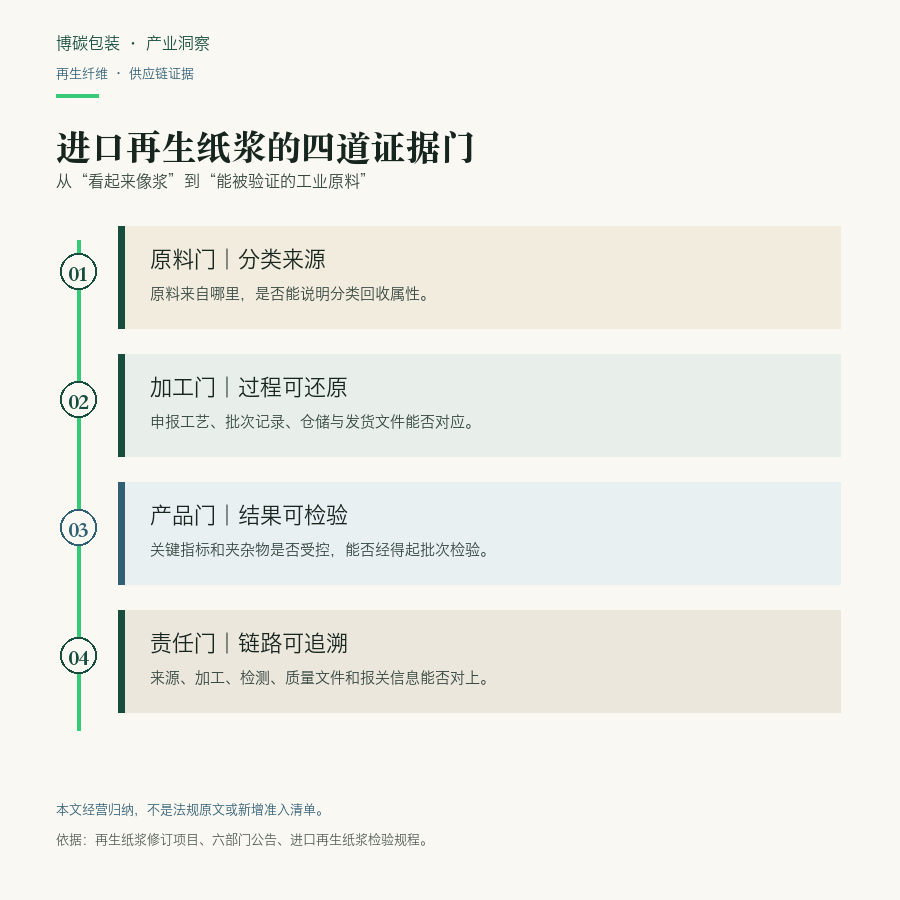
真正要过的,是四道证据门
原料门|原料来自哪里,是否能说明分类回收属性。
加工门|申报工艺、批次记录、仓储与发货文件能否对应。
产品门|关键指标和夹杂物是否受控,能否经得起批次检验。
责任门|来源、加工、检测、质量文件和报关信息能否对上。发生争议时,谁能还原这条链,谁才真正拥有供应链的控制力。
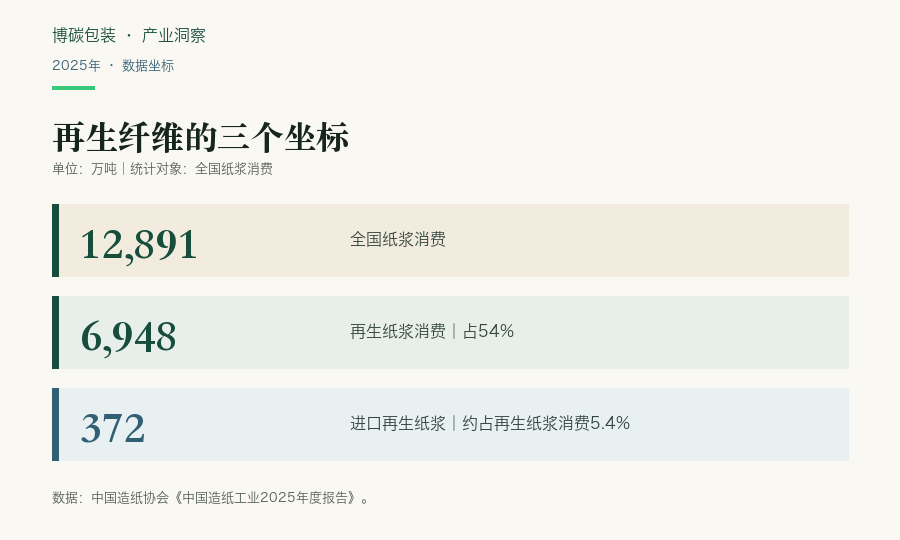
统计口径:三项均为2025年中国造纸协会年度统计;372万吨约占再生纸浆消费量5.4%,不是中国再生纤维供应的总量占比。
05 · 供应链价值
372万吨不是总量主角,却可能影响一条供应链
372万吨约占2025年再生纸浆消费量的5.4%。它不是中国再生纤维供应的主体;国内回收体系仍然决定总盘子。
但采购竞争并不只由全国总量决定。对于特定纸种、区域和配浆结构,一条稳定、可验证的海外来源,可能影响采购选择、原料波动、纸机配浆和供应安全。它不能替代国内回收体系,却可能成为边际供给的一项变量。
国家发展改革委等部门提出规范进口再生纸浆监督监管,也鼓励国内再生资源回收利用企业走出去,构建国际国内一体化的资源循环利用体系。它不是“废纸进口重开”,而是把跨境再生资源放在零固废进口与可验证利用两条边界之内。
研究资料:国家发展改革委等《再生材料应用推广行动方案》;中国造纸协会年度统计。
给采购与制浆团队的四项盘点
第一,盘原料。供应商能否说明分类回收来源,并排除不适用原料?
第二,盘过程。干法或湿法申报是否与实际生产、仓储、装运和批次记录一致?
第三,盘产品。关键检验、夹杂物控制和质量文件能否形成闭环,并经得起异常追溯?
第四,盘纸机端。这批纤维究竟改善了什么:配浆结构、成纸性能、损纸、原料成本,还是库存与现金占用?前三级对应监管关注点;最后一项是纸厂自己的经营判断。
两张账要分开。进口合规账回答“能不能进”;纸机应用账回答“值不值得进、进了能贡献什么”。通过海关检验,不自动等于适合某一纸种的配浆,仍要看运行稳定、成纸结果和吨纸成本。
纸上谈兵·数说本质
禁废划出的是“什么不能进”;标准与监管要回答的是“什么才配作为工业资源进来”。
下一场竞争,不只在纸机上
GB/T 43393—2026不是把废纸换一个名称就能跨境流动的许可证,也不应被理解为合格再生纸浆的“关门令”。它与海关申报、检验和属性鉴别共同提高了产品身份可验证的要求。
谁能把来源、加工、产品和证据接成稳定的供应链,谁才更有机会把再生纤维变成长期的成本、交付与循环价值。
博碳包装·产业洞察·研究说明
本文基于国家标准平台、海关监管公告及政府解读、国家发展改革委政策文件和中国造纸协会年度统计,由博碳包装独立研究整理。本文仅供造纸及包装产业链研究学习,不构成通关、合规、采购、投资或交易依据。如对内容、数据或权益有意见,可留言提出修改、说明或删除要求,我们将在收到后24小时内核查处理。
博碳观察数据与核验来源
01|生态环境部等|关于全面禁止进口固体废物有关事项的公告
02|国家标准平台|GB/T 43393—2026《再生纸浆》
03|国家标准平台|《再生纸浆》修订项目
04|海关总署|公告2025年第195号(进口再生纸浆申报要求)
05|海关总署等|公告2025年第200号(规范进口再生纸浆监督监管)
06|国家标准平台|SN/T 5939—2025《进口再生纸浆检验规程》
07|国家发展改革委等|再生材料应用推广行动方案
08|中国造纸协会|中国造纸工业2025年度报告
09|国家标准平台|GB/T 43393—2023《再生纸浆》
PAPER INDUSTRY ANALYSIS, GROUNDED IN DATA: After the ban on solid-waste imports, imported recovered fibre must first prove that it has genuinely become pulp.
After China Banned Waste-Paper Imports, Why Does Recycled Pulp Need New Rules?
GB/T 43393—2026, Recycled Pulp, will take effect on 1 October 2026. In the post-ban market, competitiveness is no longer about renaming recovered fibre; it is about whether the raw material, processing, product identity and batch evidence can withstand verification across one consistent chain.
2025 · RECOVERED-FIBRE SNAPSHOT
12,891 × 10,000 tonnes of total pulp consumption · 6,948 × 10,000 tonnes of recycled-pulp consumption · 372 × 10,000 tonnes of imported recycled pulp
Sources: China Paper Association, 2025 Annual Report on China's Paper Industry; unit: 10,000 tonnes; recycled pulp accounted for 54% of total pulp consumption.
01 · THE OLD ROUTE
The Import Ban Closed the Old Route, but Fibre Demand Did Not Disappear
Announcement No. 53 of 2020 makes clear that, from 1 January 2021, China prohibits the import of solid waste in any form. Recovered paper can no longer enter China under the identity of solid waste; the word “recycled” does not relax that boundary.
Recovered fibre remains an important feedstock for China's paper industry. In 2025, recycled-pulp consumption reached 6,948 × 10,000 tonnes (69.48 million tonnes), or 54% of total pulp consumption; imported recycled pulp accounted for 372 × 10,000 tonnes (3.72 million tonnes). China's domestic collection and recycling system determines the overall supply base, while imported recycled pulp remains a smaller but still industrially meaningful supplementary channel.
The change is not simply a matter of moving one processing step offshore. If a shipment is to enter China as recycled pulp, the overseas producer must first perform sufficient processing—and assume sufficient quality responsibility—to support that product identity.
Sources: Announcement on Matters Concerning the Comprehensive Ban on the Import of Solid Waste, issued by the Ministry of Ecology and Environment and other authorities; annual statistics from the China Paper Association.
CORE FINDING
The new national standard raises the threshold not for using the name “recycled pulp,” but for proving that the material has undergone genuine resource-recovery processing.
02 · DECLARATION AND INSPECTION
Processing Alone Does Not Make It Recycled Pulp
The six-agency Announcement No. 200 of 2025 specifies that overseas feedstock used to produce recycled pulp for import must consist of separately collected recovered paper, paperboard and paper products, and that the imported product must comply with GB/T 43393. Recovered-paper fragments that have undergone only simple sorting, cutting or baling remain solid waste prohibited from import.
GACC Announcement No. 195 of 2025 requires importers declaring recycled pulp to state “dry process” or “wet process” in the remarks field of the customs declaration, according to the actual production process. This is a declaration and regulatory-identification requirement; it does not make either process inherently compliant or non-compliant.
Announcement No. 200 also authorises Customs to conduct solid-waste identification on imported recycled pulp suspected of being solid waste. Material identified as solid waste must be returned in accordance with the law. Where metal, plastic, glass or other impurities exceed the announcement's 0.50% limit, official interpretations state that the shipment may be returned or destroyed.
Sources: GACC and other agencies, Announcement No. 200 of 2025; GACC Announcement No. 195 of 2025; official government interpretations.
KEY DISTINCTION
GB/T 43393—2026 is a voluntary product standard. It does not, on its own, determine whether a shipment will clear customs; product standards, customs inspection and solid-waste identification address different questions.
03 · PRODUCT IDENTITY
The New Standard Provides a Technical Foundation for the Product, Not a Standalone Customs-Clearance Licence
GB/T 43393—2023 was issued and implemented on 27 November 2023. The national standards platform shows that the 2026 edition was issued on 31 March 2026, will take effect on 1 October, and will replace the 2023 edition in full. The revision project was assigned on 31 October 2025 with a six-month project cycle.
The published scope of the revision covers terms and definitions, product classification, requirements, inspection rules, marking, packaging, transport, storage, quality documentation and test methods, while excluding recovered-paper fragments obtained only through simple cutting and baling. The central question is not whether the material “looks like pulp,” but whether it can be defined, tested, delivered and held accountable as a product.
SN/T 5939—2025, Rules for Inspection of Imported Recycled Pulp, is already in force. The product standard supplies the technical benchmark; Customs' sensory checks, key-indicator testing and any necessary solid-waste identification for a specific batch form part of import supervision.
Sources: National standards platform: GB/T 43393—2026; Recycled Pulp revision project; SN/T 5939—2025.
04 · FOUR EVIDENTIARY GATES
What Really Matters Is Passing Four Evidentiary Gates
Raw-material gate| Where did the feedstock come from, and can its separately collected and recovered status be demonstrated?
Processing gate| Do the declared process, batch records, warehousing records and shipping documents correspond?
Product gate| Are key indicators and non-fibrous impurities controlled, and can the material withstand batch inspection?
Accountability gate| Do the source, processing, testing, quality documents and customs-declaration information align? When a dispute arises, the party able to reconstruct this chain is the party with genuine control over the supply chain.
Statistical note: All three figures are from the China Paper Association's 2025 annual statistics. The 3.72 million tonnes account for about 5.4% of recycled-pulp consumption—not 5.4% of China's total recovered-fibre supply.
05 · SUPPLY-CHAIN VALUE
3.72 Million Tonnes Is Not the Main Volume Driver, but It Can Still Shape a Supply Chain
The 3.72 million tonnes represented approximately 5.4% of recycled-pulp consumption in 2025. It is not the mainstay of China's recovered-fibre supply; the domestic collection and recycling system still determines the overall supply base.
Procurement competition, however, is not determined by national totals alone. For a specific paper grade, region and furnish design, a stable and verifiable overseas source can influence sourcing options, raw-material volatility, mill furnish strategy and supply security. It cannot replace the domestic recovery system, but it can be an important variable at the margin.
The National Development and Reform Commission and other authorities have called for stronger supervision of imported recycled pulp, while encouraging Chinese recycling enterprises to expand overseas and build an integrated domestic-and-international resource-circulation system. This is not a “reopening” of recovered-paper imports; it places cross-border secondary resources within two boundaries: zero solid-waste imports and verifiable resource use.
Sources: National Development and Reform Commission and other authorities, Action Plan for Promoting the Application of Recycled Materials; annual statistics from the China Paper Association.
Four Checks for Procurement and Pulping Teams
1. Audit the raw material. Can the supplier document the separately collected feedstock source and exclude unsuitable materials?
2. Audit the process. Does the dry- or wet-process declaration match actual production, warehousing, shipment and batch records?
3. Audit the product. Do key tests, impurity controls and quality documents form a closed evidentiary loop that can withstand exception tracing?
4. Audit the paper-machine application. What, exactly, does the fibre improve: furnish design, finished-paper performance, broke rate, fibre cost, or inventory and working-capital requirements? The first three checks correspond to regulatory concerns; the last is the mill's own operating decision.
Keep the two ledgers separate. The import-compliance ledger answers “Can it enter China?”; the paper-machine application ledger answers “Is it worth importing, and what will it contribute?” Passing customs inspection does not automatically mean that the pulp is suitable for a particular grade's furnish. Mills must still assess runnability, paper performance and cost per tonne.
PAPER INDUSTRY ANALYSIS, GROUNDED IN DATA
The import ban defines what may not enter; standards and regulation must define what qualifies to enter as an industrial resource.
The Next Contest Will Not Be Fought on the Paper Machine Alone
GB/T 43393—2026 is not a licence that allows recovered paper to cross borders under a different name, nor should it be understood as a “closed-door order” against compliant recycled pulp. Together with customs declarations, inspection and solid-waste identification, it raises the evidentiary standard for product identity.
The companies that can connect source, processing, product and evidence into a stable supply chain will be better positioned to convert recovered fibre into lasting cost, delivery and circular-value advantages.
BIOTEN Packaging · Industry Insight · Research Note
This article was independently researched and compiled by BIOTEN Packaging using the national standards platform, customs-regulatory announcements and official interpretations, policy documents from the National Development and Reform Commission, and annual statistics from the China Paper Association. It is intended solely for research and learning across the paper and packaging value chain and does not constitute a basis for customs clearance, compliance, procurement, investment or transactions. If you have concerns regarding the content, data or rights, please leave a message requesting correction, clarification or removal; we will review the matter within 24 hours of receipt.
BIOTEN Observer Data and Verification Sources
01|Ministry of Ecology and Environment and other authorities|Announcement on Matters Concerning the Comprehensive Ban on the Import of Solid Waste
02|National standards platform|GB/T 43393—2026, Recycled Pulp
03|National standards platform|Recycled Pulp revision project
04|General Administration of Customs of China|Announcement No. 195 of 2025 (declaration requirements for imported recycled pulp)
05|General Administration of Customs of China and other agencies|Announcement No. 200 of 2025 (supervision of imported recycled pulp)
06|National standards platform|SN/T 5939—2025, Rules for Inspection of Imported Recycled Pulp
07|National Development and Reform Commission and other authorities|Action Plan for Promoting the Application of Recycled Materials
08|China Paper Association|2025 Annual Report on China's Paper Industry
09|National standards platform|GB/T 43393—2023, Recycled Pulp