拆开产品结构、现金流与资本约束,看清这份半年报证明了什么,也还没有证明什么。
太阳纸业上半年的表现更接近盈利韧性,而非高弹性反转:现金回收改善,但综合毛利率承压,资本开支仍高于经营现金流。
利润增长来自不同纸种此消彼长、经营现金回收增强,以及财务费用下降的共同作用。把这些变量拆开,才能判断一体化究竟贡献了什么。
本文以公司2026年半年度报告合并口径为主。公司对林浆纸一体化、成本控制和基地协同的解释均标为企业披露,不替代分产品、分基地和现金流验证。
2026年上半年|合并口径
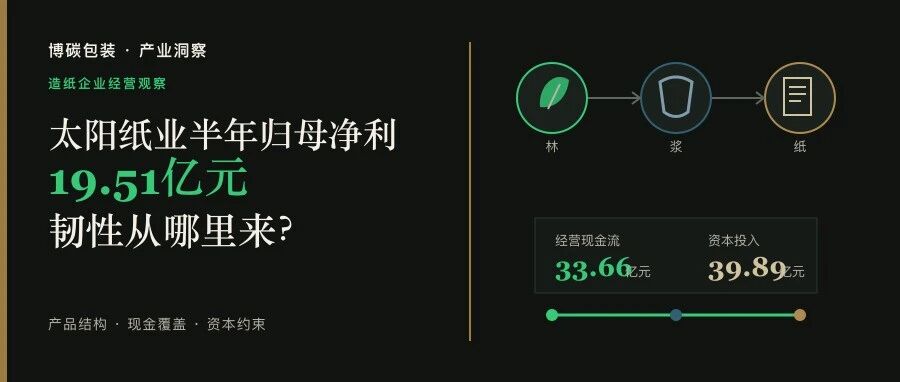
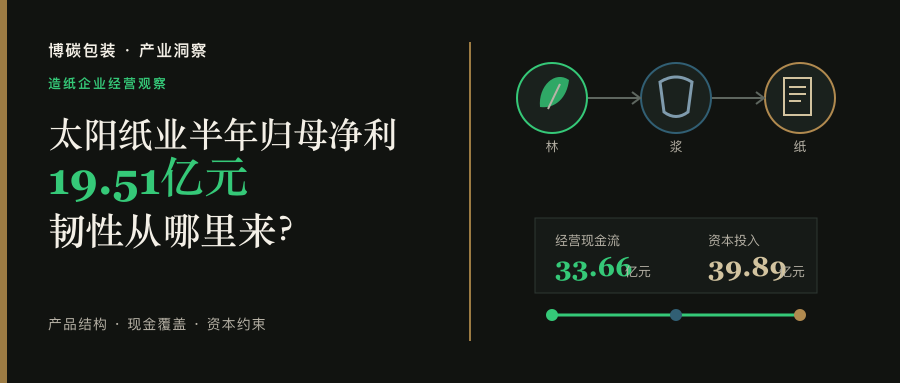
208.62 亿元收入 · 19.51 亿元归母净利润 · 33.66 亿元经营现金流
章节01 · 财报事实
官方口径:归母净利润同比增长9.60%
上半年营业总收入208.62亿元,同比增长9.15%;归母净利润19.51亿元,同比增长9.60%;扣非净利润19.35亿元,同比增长9.70%。归母与扣非增速接近,说明利润增长并非主要依靠大额非经常性损益。
按营业收入与营业成本计算,综合毛利率约15.66%,上年同期约16.50%,下降约0.83个百分点。营业利润仍增加,除业务规模增长外,财务费用从2.65亿元降至1.55亿元也提供了帮助。公司将财务费用下降主要归因于汇兑收益增加,这一阶段性变量不能直接归入一体化贡献。
研究资料:太阳纸业2026年半年度报告
章节02 · 利润机制
产品结构呈现对冲,而非所有纸种同步改善
牛皮箱板纸收入70.76亿元,同比增长35.54%,毛利率提高2.84个百分点;生活用纸收入增长13.74%,毛利率提高7.08个百分点。包装相关纸种承担了主要增量。
双胶纸、铜版纸和溶解浆收入下降,毛利率分别下降3.58、7.96和13.88个百分点;浆及纸制品整体毛利率14.88%,同比下降1.17个百分点。多产品组合与集团盈利表现相互一致,但半年报还不能证明精确因果,更不等于每条产品线都具备更强定价权。
章节03 · 现金约束
经营现金流改善,但尚未完全覆盖扩张
经营活动现金流净额33.66亿元,同比增长77.74%,约为归母净利润的1.73倍。同期购建固定资产、无形资产和其他长期资产支付39.89亿元。两者相减作简化观察,仍为净流出约6.23亿元;上年同期约为净流出28.33亿元,缺口明显收窄但尚未转正。
期末存货较年末增加约8.67%,在建工程增加约77.93%,资产负债率47.85%,较年末上升0.10个百分点。盈利韧性成立,并不代表库存和资本约束已经消失。
重要边界:经营现金流减购建长期资产支出只是现金覆盖观察,不是会计准则定义的自由现金流。
章节04 · 基地与项目
多个基地贡献利润,新项目提高未来门槛
半年报列示的南宁太阳、广西太阳、太阳老挝、兖州天章和太阳宏河均实现净利润。由于集团内部存在浆、能源、化工和贸易往来,子公司利润不能简单相加,也不能直接比较基地效率。
颜店60万吨漂白化学浆项目在8月下旬进入试产;南宁项目计划建设50万吨本色化学木浆和60万吨特种纸生产线,总投资不超过50亿元,预计2027年四季度完成投资并进入试产。试产不等于达产,达产不等于盈利。后续要看爬坡、良率、现金成本和新增折旧。
研究资料:太阳纸业南宁林浆纸一体化技改项目公告
章节05 · 同业边界
一体化不是统一答案,规模也不保证利润
同一报告期,山鹰国际披露营业收入142.59亿元、归母净亏损6.82亿元、经营现金流16.44亿元。两家公司产品结构、原料路线、海外资产和资本结构不同,不能做简单盈利排名。
对照只能提示:在纸价承压和原料波动并存时,规模本身不能保证利润。要把太阳纸业披露的成本护城河变成可验证结论,还需要吨毛利、自产浆内部成本、外购浆替代比例和基地利用率。
研究资料:山鹰国际2026年半年度报告
章节06 · 兑现指标
五个指标决定韧性能否升级为弹性
01|纸种毛利:箱板纸、生活用纸的改善能否延续,文化纸和溶解浆的下行能否收窄。
02|现金覆盖:经营现金流能否持续覆盖颜店与南宁项目的主要资本投入。
03|营运效率:存货和应收账款能否与收入同步改善,而不是靠备货或信用扩张。
04|债务成本:资产负债率、有息负债和财务费用在汇率变化后是否仍然稳定。
05|项目爬坡:吨浆现金成本、产品良率、新增折旧和外购浆替代量是否兑现。
纸上谈兵·数说本质
19.51亿元更适合定义为扩张期的盈利韧性,而不是高弹性反转;真正的分水岭,是新增浆纸项目投产后,吨毛利、现金覆盖、库存周转和负债约束能否同时改善。
博碳包装·产业洞察·研究说明
本文基于太阳纸业、山鹰国际公开披露,由博碳包装独立研究整理,核验截至2026年8月27日,仅供造纸与包装产业链研究学习,不构成证券、采购或投资决策依据。博碳包装与文中企业未披露投资、供应或项目关联;如对内容、数据或权益存在异议,可提出修改、说明或删除要求,我们将在收到后24小时内核查处理。
博碳观察数据与核验来源
01|太阳纸业|2026年半年度报告
02|太阳纸业|广西南宁林浆纸一体化提质增效技改项目公告
03|山鹰国际|2026年半年度报告
A closer look at product mix, cash flow, and capital constraints reveals what the interim results demonstrate—and what remains unproven.
Sun Paper’s first-half performance is better described as earnings resilience than as a high-upside turnaround: cash conversion improved, but the overall gross margin remained under pressure and capital expenditure still exceeded operating cash flow.
Profit growth reflected a combination of offsetting movements across paper grades, stronger operating cash generation, and lower finance costs. Only by separating these variables can we assess what integration actually contributed.
This article primarily uses the consolidated figures in the company’s H1 2026 interim report. The company’s explanations of forest–pulp–paper integration, cost control, and production-base synergies are identified as company disclosures and do not replace product-level, base-level, and cash-flow validation.
H1 2026 | CONSOLIDATED BASIS
RMB 20.862 billion in revenue · RMB 1.951 billion in net profit attributable to shareholders of the parent · RMB 3.366 billion in net cash generated from operating activities
SECTION 01 · REPORTED RESULTS
Official figures: Net profit attributable to shareholders of the parent rose 9.60% year on year
In the first half of 2026, total operating revenue was RMB 20.862 billion, up 9.15% year on year; net profit attributable to shareholders of the parent was RMB 1.951 billion, up 9.60%; and net profit attributable to shareholders of the parent excluding non-recurring gains and losses was RMB 1.935 billion, up 9.70%. The similar growth rates of attributable net profit and adjusted attributable net profit indicate that earnings growth was not driven primarily by large non-recurring gains.
Based on operating revenue and operating costs, the overall gross margin was approximately 15.66%, compared with approximately 16.50% in the prior-year period—a decline of about 0.83 percentage points. Operating profit still increased. In addition to business growth, the reduction in finance costs from RMB 265 million to RMB 155 million also contributed. The company attributed the decline in finance costs mainly to higher foreign-exchange gains, a period-specific factor that should not be counted directly as a contribution from integration.
Sources: Sun Paper H1 2026 Interim Report
SECTION 02 · EARNINGS DRIVERS
Product mix provided an offset; not every grade improved
Revenue from kraft linerboard reached RMB 7.076 billion, up 35.54% year on year, while gross margin increased by 2.84 percentage points. Tissue-paper revenue grew 13.74%, and gross margin increased by 7.08 percentage points. Packaging-related paper grades accounted for most of the incremental growth.
Revenue from uncoated woodfree paper, coated art paper, and dissolving pulp declined, while their gross margins fell by 3.58, 7.96, and 13.88 percentage points, respectively. Gross margin for pulp and paper products overall was 14.88%, down 1.17 percentage points year on year. The multi-product portfolio is consistent with the group’s earnings performance, but the interim report does not establish precise causality—still less does it prove stronger pricing power in every product line.
SECTION 03 · CASH CONSTRAINTS
Operating cash flow improved but still did not fully cover expansion
Net cash generated from operating activities was RMB 3.366 billion, up 77.74% year on year and equivalent to approximately 1.73 times net profit attributable to shareholders of the parent. During the same period, cash paid to acquire or construct fixed assets, intangible assets, and other long-term assets totaled RMB 3.989 billion. As a simplified comparison, subtracting the latter from operating cash flow leaves a net outflow of approximately RMB 623 million, versus approximately RMB 2.833 billion in the prior-year period. The gap narrowed substantially but did not turn positive.
Inventories at period-end were approximately 8.67% higher than at year-end, while construction in progress increased by approximately 77.93%. The debt-to-asset ratio was 47.85%, up 0.10 percentage points from year-end. Earnings resilience is evident, but inventory and capital constraints have not disappeared.
KEY LIMITATION:Operating cash flow less cash paid to acquire or construct long-term assets is only a cash-coverage observation; it is not free cash flow as defined by accounting standards.
SECTION 04 · PRODUCTION BASES AND PROJECTS
Multiple bases generated profits; new projects raise the future performance bar
The interim report shows that Nanning Sun Paper, Guangxi Sun Paper, Sun Paper’s Laos subsidiary, Yanzhou Tianzhang, and Sun Honghe each recorded a net profit. Because the group has internal transactions involving pulp, energy, chemicals, and trading, subsidiary profits cannot simply be added together or used directly to compare the efficiency of different production bases.
The 600,000-tonne-per-year bleached chemical pulp project at Yandian entered trial production in late August. The Nanning project plans to build a 500,000-tonne-per-year unbleached chemical wood-pulp line and a 600,000-tonne-per-year specialty-paper line, with total investment capped at RMB 5 billion. Investment completion and trial production are expected in Q4 2027. Trial production does not mean full capacity, and full capacity does not guarantee profit. The next tests are ramp-up, yield, cash cost, and incremental depreciation.
Sources: Sun Paper Announcement on the Guangxi Nanning Forest–Pulp–Paper Integration Quality-and-Efficiency Upgrade Project
SECTION 05 · PEER-COMPARISON BOUNDARIES
Integration is not a universal answer, and scale does not guarantee profit
For the same reporting period, Shanying International disclosed operating revenue of RMB 14.259 billion, a net loss attributable to shareholders of the parent of RMB 682 million, and net cash generated from operating activities of RMB 1.644 billion. The two companies have different product mixes, raw-material strategies, overseas assets, and capital structures, so a simple profitability ranking would be misleading.
The comparison shows only that scale by itself does not guarantee profit when paper prices are under pressure and raw-material costs are volatile. Verifying Sun Paper’s disclosed cost moat would still require data on gross profit per tonne, the internal cost of in-house pulp, the replacement ratio for purchased pulp, and production-base utilization rates.
Sources: Shanying International H1 2026 Interim Report
SECTION 06 · WHAT TO WATCH
Five indicators will show whether resilience can translate into greater earnings upside
01 | Gross margin by grade:Whether the gains in kraft linerboard and tissue paper can be sustained, and whether the declines in printing and writing paper and dissolving pulp can narrow.
02 | Cash coverage:Whether operating cash flow can consistently cover the principal capital commitments for the Yandian and Nanning projects.
03 | Working-capital efficiency:Whether inventories and accounts receivable can improve in step with revenue, rather than through inventory build-up or credit expansion.
04 | Debt and financing costs:Whether the debt-to-asset ratio, interest-bearing debt, and finance costs remain stable after exchange-rate effects normalize.
05 | Project ramp-up:Whether pulp cash cost per tonne, product yield, incremental depreciation, and the displacement of purchased pulp materialize as planned.
PAPER STRATEGY · THE FUNDAMENTALS IN THE DATA
RMB 1.951 billion is better interpreted as earnings resilience during expansion than as a high-upside turnaround. The real inflection point will be whether gross profit per tonne, cash coverage, inventory turnover, and balance-sheet constraints improve together after the new pulp and paper projects start production.
BIOTEN PACKAGING · INDUSTRY INSIGHT · RESEARCH NOTE
This article was independently researched and prepared by BIOTEN Packaging using public disclosures from Sun Paper and Shanying International. Information was verified through 27 August 2026. It is intended solely for research and learning across the paper and packaging value chain and does not constitute a basis for securities, procurement, or investment decisions. BIOTEN Packaging has not disclosed any investment, supply, or project relationship with the companies discussed. To request a correction, clarification, or deletion concerning the content, data, or rights involved, please contact us; we will review the request within 24 hours of receipt.
BIOTEN OBSERVER · DATA AND VERIFICATION SOURCES
01 | Sun Paper | H1 2026 Interim Report
02 | Sun Paper | Announcement on the Guangxi Nanning Forest–Pulp–Paper Integration Quality-and-Efficiency Upgrade Project
03 | Shanying International | H1 2026 Interim Report