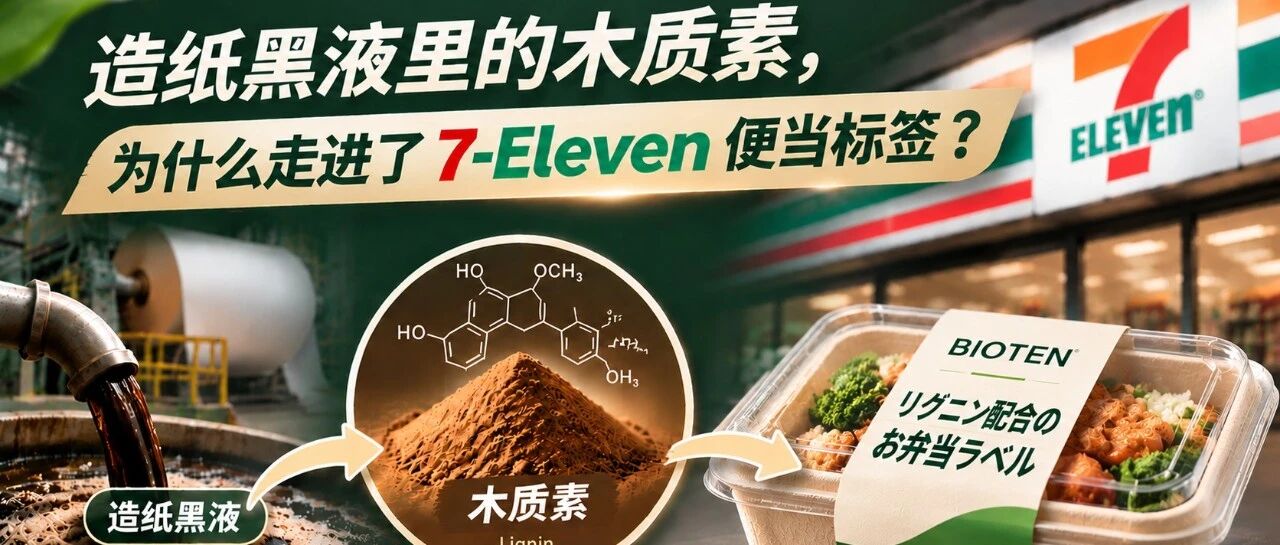
Seven-Eleven Japan and Osaka Sealing Printing (OSP) recently announced a pilot using a new thermal label. Under the announced plan, the trial runs from November 3 to December 7, 2026, at approximately 300 stores in selected areas of Chiba Prefecture, covering around 15 boxed-meal products.
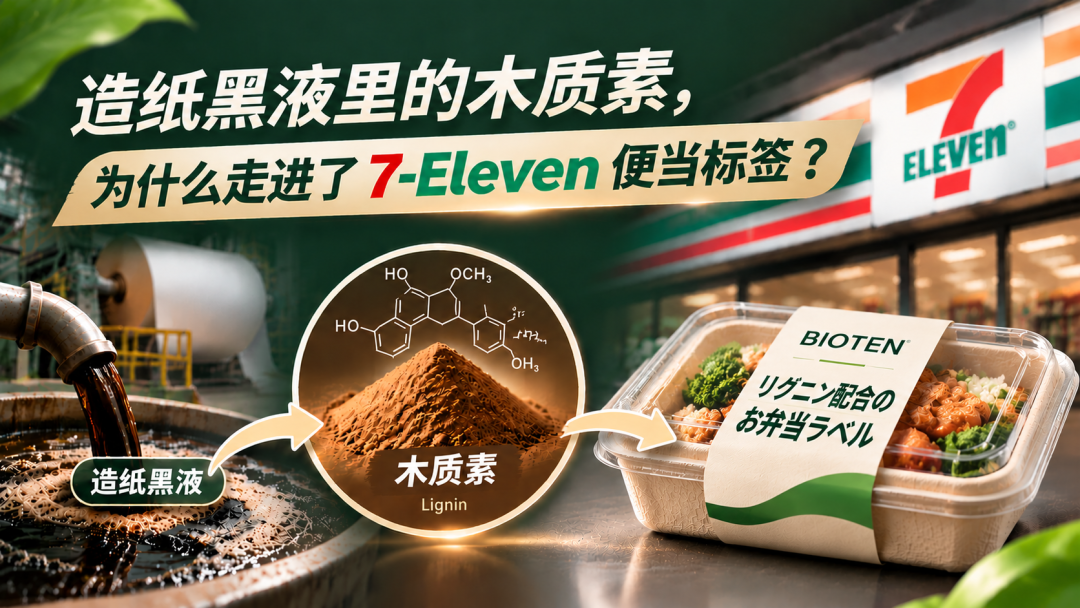
One of the key materials is lignin recovered from kraft pulping black liquor.
This development deserves attention across the pulp and paper value chain: a material from the pulping process can, through further development, perform a functional role in a finished label.
What does lignin do in a thermal label?
A thermal label is more than paper with printing on it.
Its surface carries a heat-sensitive layer. Heat from the printer causes a dye and a color developer to interact, producing text and barcodes. The performance of this layer affects print clarity and barcode readability, and the label must work with both printing and scanning equipment.
The label being trialed is called Treeloop Thermal. According to information published by the participating companies, the product uses lignin to replace part of the conventional color developer. The announcement states that naturally derived materials replace 10–20% of the thermal materials, excluding the paper substrate.
This percentage refers to the non-paper portion of the thermal material. It is neither the lignin content of the whole label nor a percentage reduction in carbon emissions.
Lignin must first be separated and processed before it can be incorporated into a color-developer formulation. Its performance then depends on its interaction with the paper substrate, coating and printing conditions.
OSP also reports that the product joined its range in May 2026. Its lignin-based color-developing material gives it a natural, light-brown appearance. The Seven-Eleven pilot provides an opportunity to assess this material under everyday convenience-store conditions.
Black liquor already has value
Pulp and paper professionals know that black liquor is not simply a waste liquid to be discarded.
During kraft pulping, some of the lignin in wood enters the black liquor. Many pulp mills concentrate this liquor and feed it into the chemical recovery system, recovering pulping chemicals while producing steam and electricity to support mill operations.
The economics of extracting lignin therefore involve more than selling an additional material.
On one side is the potential revenue from lignin as a functional raw material. On the other are the costs of separation, washing, drying, equipment and transport, together with changes in steam and electricity generation, chemical recovery and the mill’s sulfur balance.
Where recovery capacity limits pulp production, extracting an appropriate proportion of the lignin may help relieve the bottleneck. Where the mill already faces an energy shortfall, the cost of replacement energy requires careful assessment.
The key question is whether additional lignin revenue, after separation and processing costs, can offset changes in the value of existing energy generation and chemical recovery while leaving the mill a reasonable return.
The steps from material to product
The fact that lignin can be used in a thermal formulation does not mean lignin from every source can be used directly in the same label.
Feedstocks and pulping conditions affect lignin composition and properties. To support continued use by downstream customers, the first requirements are reliable supply and batch-to-batch consistency.
Label producers must then assess whether the printed image is clear and barcodes can be scanned reliably; whether information remains legible during storage, refrigeration or exposure to water and oil; and whether the material works with existing coating, slitting and printing equipment.
Finally, the economics must work for the customer. An alternative material source must be evaluated alongside label unit cost, converting efficiency, waste and actual purchasing volumes to determine whether customers will continue to adopt it.
Nippon Paper Industries and NICCA Chemical publicly introduced thermal paper using a lignin-based color developer in 2024. The convenience-store pilot brings this material approach into a more specific retail application.
A material’s potential must become product reliability in the applications customers use every day.
Where are the opportunities for paper companies?
For businesses with kraft pulping and chemical recovery systems, the opportunity is to investigate lignin extraction and suitable downstream uses in light of their own energy balance. The aim is to identify the proportion and applications that make economic sense for the mill as a whole, rather than diverting all of the material into new products.
Opportunities also exist for paper companies without pulping black liquor. Functional label papers require suitable base paper, surface properties and coating conditions. Companies with specialty-paper and converting capabilities can work with material suppliers and label manufacturers to develop application-specific papers.
For coating, printing and label businesses, the opportunity is to turn new materials into products that can be manufactured consistently, printed clearly and run on customers’ equipment. Retailers and food businesses need to assess how well the labels perform through storage, transport, display and sale.
Beyond labels, the industry is also investigating lignin for adhesives and other materials. Each application has its own performance, cost and customer requirements and needs separate development.
Connecting the value chain through function
This boxed-meal label offers a lesson in starting with a specific need: end users require reliable printing, material suppliers develop the color-developing function, and paper producers and converters turn it into a product that can be supplied.
For a boxed meal, the label must keep information clear. Where the container is paper-based, the packaging also needs to withstand refrigeration, storage, transport and heating. Inside, it encounters moisture and grease from food; outside, condensation may form after removal from refrigerated storage. Moisture uptake can also affect the container’s stiffness and appearance.
BIOTEN PHA water-based barrier technology offers a basis for working with paper mills and converting partners on paper-based meal containers with complementary inner and outer protection. The inner surface addresses food moisture and grease, while a suitable PHA water-based coating can be selected for the outer surface where water resistance to condensation is needed.
For refrigerated meals intended for microwave reheating, BIOTEN PHA water-based barrier coatings provide a material option for paper-based containers. Barrier performance, structural integrity and food-contact safety must be validated for the specific food and heating conditions, supporting reliable packaging from storage through consumption.
Turning this opportunity into a product requires coordination across the value chain: mills supply base paper suitable for converting; coaters develop the functional layers and production process; container manufacturers validate forming and sealing; and BIOTEN supports material selection and application development.
Starting with a target meal container, partners can compare it with the current structure and examine container condition under condensation, crease and seal performance, forming yield and cost per 1,000 conforming finished units. This work can progressively establish product specifications that customers can procure against.
Lignin provides a color-developing function in labels, while BIOTEN PHA supports functional development in paper-based packaging. Both approaches start with a specific application and connect materials, paper, processes and use requirements.
For China’s paper-packaging value chain, new growth need not begin with another production line. It can also begin with understanding an unmet need and combining existing expertise to address it.
Starting with a sheet of paper, turning materials into products and bringing those products into real applications can create opportunities for lasting value.
Research note
This article was independently prepared by BIOTEN Packaging using publicly available company information, pulping technical resources and industry research, with information checked as of November 5, 2026. It is intended for industry research and learning and does not constitute procurement or investment advice. Product suitability must be assessed for the specific material and conditions of use. For corrections, clarification or removal requests, please contact this WeChat official account; we will review and address requests within 24 hours of receipt.
BIOTEN Insights: data and verification sources
Seven-Eleven Japan | Boxed-meal label pilot announcement
Osaka Sealing Printing | Lignin-based thermal label pilot and product introduction
Osaka Sealing Printing | Treeloop Thermal product launch
Nippon Paper Industries | Thermal paper using a lignin-based color developer
Valmet | Lignin extraction from pulping black liquor
Chalmers University of Technology | Economic comparison of lignin extraction and electricity generation
Stora Enso | Lignin-based adhesive materials
DBC | Applications of PHA water-based barrier materials
DBC | Low-temperature and condensation considerations for PHA water-based materials
DBC | Functional solutions for the inner and outer surfaces of paper-based products
DBC | Application research on paper trays for reheating refrigerated ready meals