
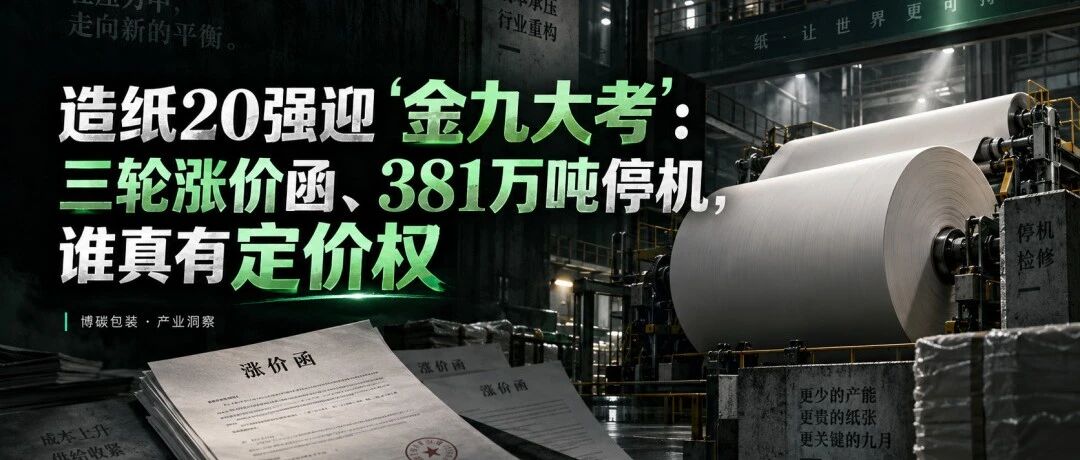
9月10日,也就是明天,玖龙东莞、太仓基地的瓦楞纸涨价函就将正式执行,每吨上调50元。短短一周左右,这已经是头部纸企9月里的第三轮动作:先是五大基地瓦楞纸,再是五大基地再生牛卡,紧接着又预告了节后10月9日的新一轮调涨。与之配套的,是一份覆盖几乎所有头部企业、合计约381万吨的金九银十停机计划。
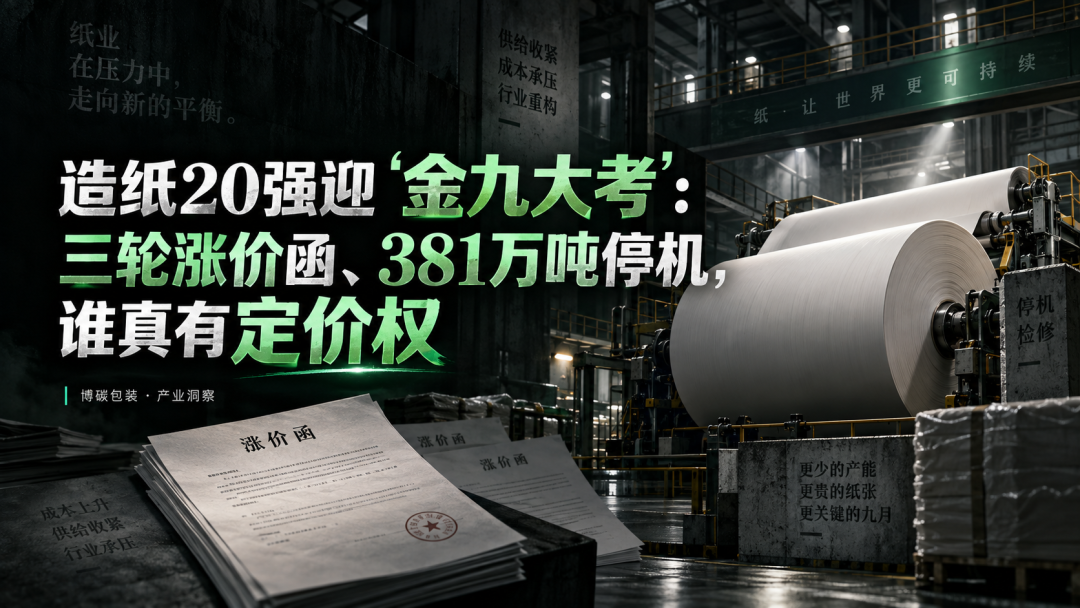
一边是密集的涨价函,一边是大规模的停机控产,中国造纸产量20强由此集体进入一场"金九"大考。但对产业链上下游来说,真正的问题从来不是"谁发了涨价函",而是:函上的价格能不能变成成交价,停机换来的供给收缩能不能变成利润表上的吨毛利。这篇文章把明牌、底牌和历史规律拆开,看一看20强里,谁是真有定价权。
01 明牌:三轮涨价函的节奏与话术
先把这轮涨价的时间线摆清楚。第一轮打的是瓦楞纸,9月4日前后发函,玖龙东莞、太仓自9月10日、泉州自9月12日、天津和河北自9月14日起,地龙瓦楞纸统一上调50元/吨(出口口径约7美元/吨)。第二轮打的是再生牛卡,9月7日至8日发函,东莞、太仓自9月16日,泉州、重庆自9月18日,湖北自9月19日起,再生牛卡同样上调50元/吨,江苏金田纸业随即跟涨环保牛卡和高强瓦楞。第三轮是节后预告,太仓、沈阳、天津、河北基地计划自10月9日起上调牛卡、瓦楞部分纸种30元/吨。
三份函给出的理由高度一致,都是废纸、煤炭、化工辅料等综合成本持续上行,需要以此保障产品质量与服务的稳定可持续。这是龙头企业典型的预期管理打法:分纸种、分基地、分批次推进,给下游留出消化时间,也给同行留出跟涨窗口。海外市场同期同向,美国国际纸业、PCA等也在9月上调箱板纸价格,全球包装纸处在同一个成本与旺季叙事里。
这轮操作也有两个值得注意的细节。其一,第三轮节后涨幅从此前的50元调整为30元,节奏更趋稳健;其二,涨价函发布的同时,部分基地、部分纸种在国庆期间配套了阶段性返利政策。涨价函锚定报价、返利兼顾渠道提货与旺季走量,是行业旺季常见的组合安排,也说明在需求尚未完全释放的阶段,龙头更倾向于用挺价与价保相结合的方式稳住市场,而不是一次性把价格拉满。
02 底牌:381万吨停机是怎么来的
如果说涨价函是摆在台面上的明牌,停机控产就是握在手里的底牌。据国泰海通证券造纸行业9月专题(数据来自隆众资讯、卓创资讯),截至2026年8月底,已公布的金九银十停机计划共52台纸机,测算停机损失产量约381万吨,其中9月22条、约219万吨,10月30条、约162万吨,10月的停机高度集中在国庆假期。分企业看,整个金九银十窗口玖龙涉及16条、山鹰涉及14条,荣成、理文等头部企业悉数在列;其中仅国庆检修时段,山鹰六大基地就安排12条线在9月29日至10月6日停机4至8天、影响箱板瓦楞产能约9.7万吨,玖龙旗下20多台纸机国庆期间停机3至7天。
把时间拉长,这种协同控产不是第一次,而是在逐年加码。同一研报统计,金九银十的停机台数从2024年的32台、2025年的44台,增加到2026年的52台,对应损失产量从225万吨、307万吨增至381万吨;如果把春节、五六月淡季、金九银十三个时段加总,全年协同停机台数从2024年的163台增至2026年的246台,损失产量从约2126万吨增至约2981万吨,三年增长约四成。在新增产能投放放缓、行业仍处过剩格局的背景下,头部企业已经把"旺季前提检修、主动收缩供给"变成了一套常态化的价格管理工具。
需要说明口径:381万吨是券商依据企业公开发布的停机函测算的结果,算法是年产能乘以停机天数再除以330个生产日,未公开产能的纸机用同类纸种平均产能插补,属于公开资料的不完全统计,实际损失会随开机安排浮动。但方向是确定的:这是近三年力度最大的一次金九停机,龙头的协同意愿强于往年。
03 历史复盘:为什么9月喊涨,10月才见真章
停机力度最大,价格就一定涨吗?研报对过去三年的复盘给出了一个反直觉的结论:停机只是必要条件,需求才是充分条件,9月往往是博弈期,真正的量价弹性历史上多出现在10月。
2024年就是最典型的例子。当年9月行业停了137万吨,但需求旺季不旺,纸厂只能稳价走量,箱板纸价格环比反而微跌0.5%、瓦楞纸跌0.7%;进入10月,废纸供应转紧,叠加内需回升和外需抢出口,价格才真正转正,瓦楞纸累计上涨约1.1%,箱板纸吨毛利从9月的494元修复到10月的523元,瓦楞纸吨毛利从85元升到128元。2025年节奏类似但更强,9月在原料收缩和行业自律下箱板、瓦楞先涨2.2%和5.4%,10月再借国庆检修与双11前置备货加速,单月上涨3.8%和7.0%,瓦楞纸吨毛利单月修复约70元。两年共同的规律是,9月靠停机和涨价函稳住预期,10月靠真实订单完成定价。
回到当下,需求端的考卷并不轻松。价格监测显示,8月下旬以来国废黄板纸到厂价整体走弱,区域分化明显,9月8日珠三角龙头纸厂上调A级废黄纸20元至1960元/吨,而河南部分纸厂同期下调约40元至1930元/吨;成品端,瓦楞纸企业库存天数约11.6天,环比还在增加,9月3日瓦楞原纸140克出厂均价约3085元/吨,较8月底小跌1.15%,中秋备货被业内称为"旺季不旺",50元/吨的涨价函在终端不少是以返利形式兑现,并没有直接抬升成交价,也有机构提示9月瓦楞纸仍有下行压力。当然也有另一面,AA级120克瓦楞纸均价同比仍高约13.6%,"反内卷"下行业自律增强、新增产能放缓,成本支撑并未消失。多空交织,恰恰说明现在处于"函上涨价、成交待验"的窗口期。
04 20强分层应考:四档定价权
判断一家纸企有没有真定价权,不看涨价函发得早不早、频次高不高,而看四个变量:成本端能否自给(自制浆比例、废纸渠道、自备能源)、纸种结构对箱瓦景气的暴露度、供给纪律的协同执行力,以及资产负债表能否支撑它不靠返利走货。用这四把尺子量2025年产量20强(合计约9053.55万吨、占全国约64.1%,依据中国造纸协会2025年度产量排序),能清楚分出四个层级。
第一档是成本加结构型,涨价落地能力最强,代表是太阳纸业和理文造纸。太阳纸业2026年上半年营收208.62亿元、归母净利润19.51亿元,暂时位居行业第一,二季度归母净利润同比增长约16.8%,箱板纸涨价超预期是重要拉动,背后是林浆纸一体化带来的成本缓冲和广西箱板新产能释放,公司还拟投不超过50亿元在南宁扩建木浆与特种纸,进一步提高自制浆比例。理文造纸上半年营收148.42亿港元、净利润13.73亿港元,较去年同期的8.11亿港元增长近七成,靠的是一贯的成本纪律和贵港275亿元林浆纸一体化项目的纵深。这一档企业即便在弱市里,也更有能力把报价落成真实出厂价。
第二档是规则发起型,掌握行业协调权,代表是玖龙纸业。玖龙2025年产量2266万吨、稳居第一,16条停机计划、三轮涨价函都由它率先发起,全国多基地协同调度,截至2025年末纤维原料年设计产能约820万吨,北海415亿元、规划615万吨的林浆纸一体化项目也在推进。它定的是全行业的节奏,这是龙头才有的协调力。同时也要看到,在需求偏弱的阶段,即便是龙头也需要通过阶段性返利平衡走量、第三轮涨幅也更克制,这说明它拥有的是引领行业节奏的相对定价权,价格能走多高,最终仍要由全行业需求共同决定。
第三档是主动控量、周期修复型,代表是山鹰国际和景兴纸业。山鹰2025年产量754.53万吨、位列第四,这次安排14条线停机,是停机力度最大的企业之一;上半年受箱板瓦楞价格周期低位影响,营收142.59亿元、归母净利润亏损6.82亿元,随着价格企稳,二季度环比减亏约63%、6月实现单月扭亏,已经进入修复通道。山鹰布局"原纸到包装到客户"的一体化链条,又以较大规模的停机自律主动控量,随着旺季价格回暖,业绩修复的弹性也会更明显。景兴纸业产量169.26万吨、排在第18位,上半年净利润1.39亿元、同比增长约153%,在低基数上展现出较高弹性,并通过生活用纸技改延伸消费纸品类。
第四档是区域跟涨和成本曲线型。江苏荣成307万吨、联盛龙海282.40万吨、武汉金凤凰248.10万吨、世纪阳光216.41万吨、河南龙源168.65万吨等区域龙头,依托沿海或中部区位、再生纤维组织和运输半径参与这轮行情,能不能跟上涨价、跟多少,取决于各自在成本曲线上的位置,而大量中小厂在库存压力下仍以让利走货为主。
还要看到,20强并不都在同一张考卷上。博汇纸业、亚太森博、中国纸业、广西金桂、金东、宁波亚洲浆纸偏白卡和高档纸板,五洲特纸、仙鹤股份偏特种纸,这轮箱瓦涨价与它们关联较弱;值得一提的是华泰集团,靠箱板纸转型见效,上半年牛皮箱板纸收入70.76亿元、同比增长35.54%,毛利率提升到18.48%,是传统大厂向景气纸种切换的样本。所谓20强迎金九大考,本质上是包装纸阵营的一次定价权分化,规模大不等于定价强,盈利质量才是分水岭。
05 从业者怎么用:锁价还是等降,盯三个信号
对纸板厂、纸箱厂和品牌方采购,历史复盘给出的策略很清晰:9月是龙头喊话与供给收缩的博弈期,价格易反复,不宜赌单边,刚需可分批锁定,把希望全部押在"节后必降"或"一路涨上去"都不现实,真正的方向要等10月需求验证。具体盯三个先行信号,比追涨价函更有用。
第一,盯三轮涨价函的到价执行率和返利力度。9月10日至19日是第一、二轮的集中执行窗口,函上的50元有多少真正进到出厂价、多少被返利和账期稀释,直接反映龙头挺价的成色,返利越大,说明实涨越弱。第二,盯国庆停机之后的库存变化。当前瓦楞纸厂库存天数约11.6天且环比上行,是压制价格的关键,如果52台纸机如期停机、双11前置备货启动后,纸厂库存和社会库存能明显回落,价格才有持续基础。第三,盯国废到厂价与箱瓦纸的价差,也就是吨毛利拐点。成本端废纸供应偏紧的中长期格局未改,研报判断10月箱瓦量价表现环比9月大概率改善,原料与成品的价差一旦重新走阔,就是这轮挺价真正落地的确认信号。
金九的涨价函是态度,381万吨停机是动作,但定价权从来不是喊出来的,它是成本自给、产品结构、供给纪律和现金流在旺季的一次集中体检。对20强而言,9月只是开卷,10月才判分;对产业链上的每一个从业者而言,看清各家企业成本与现金流的真实底气,比记住几张涨价函重要得多。博碳包装会持续跟踪三轮涨价的实际落地与库存、成本变化,在关键节点给出判断。
本文由博碳包装依据公开资料、政府及标准平台公开信息、企业案例研究整理,核验截至2026年9月9日。本文供产业研究学习,不构成采购或性能保证;如需修改、说明或删除,可通过本公众号联系,我们将在收到后24小时内核查处理。

Tomorrow, 10 September, Nine Dragons Paper's announced price increase for corrugating medium at its Dongguan and Taicang mills takes effect, adding RMB 50 per tonne. In roughly a week, leading paper producers have already announced three rounds of action for September: first corrugating medium at five mills, then recycled kraftliner at five mills, followed by notice of another increase from 9 October, after the holiday. These moves are accompanied by shutdown plans covering almost all leading producers during the traditional September–October peak season, with estimated production losses totalling about 3.81 million tonnes.
A wave of price increase notices and large-scale production curtailments has put China's top 20 paper producers by output to the test this September. For businesses across the value chain, however, the real issue is not who has issued a notice. It is whether announced prices become actual transaction prices, and whether reduced supply translates into higher gross profit per tonne. This article examines the announced measures, the supply discipline behind them and historical patterns to assess which of the top 20 producers truly have pricing power.
01 The announced moves: three rounds of price increases
The timeline begins with corrugating medium. Notices issued around 4 September announced a uniform RMB 50 per tonne increase for Nine Dragons' Dilong-brand corrugating medium, equivalent to about USD 7 per tonne for exports. Effective dates are 10 September for Dongguan and Taicang, 12 September for Quanzhou, and 14 September for Tianjin and Hebei. The second round targets recycled kraftliner: notices issued on 7–8 September announce the same RMB 50 per tonne increase from 16 September at Dongguan and Taicang, 18 September at Quanzhou and Chongqing, and 19 September at Hubei. Jiangsu Jintian Paper then followed with increases for its eco-friendly kraftliner and high-strength corrugating medium. The third round looks beyond the holiday: Taicang, Shenyang, Tianjin and Hebei plan to raise prices for selected kraftliner and corrugating medium grades by RMB 30 per tonne from 9 October.
All three rounds cite much the same rationale: rising combined costs for recovered paper, coal and chemical additives require price adjustments to sustain product quality and service. This is a familiar approach to managing expectations among leading producers. Staging increases by grade, mill and effective date gives downstream customers time to adjust and competitors a window to follow. Overseas markets are moving in the same direction, with International Paper and Packaging Corporation of America (PCA) also raising containerboard prices in September. Cost pressures and seasonal demand expectations are shaping packaging paper markets globally.
Two details deserve attention. First, the third increase, scheduled after the holiday, is a more measured RMB 30 per tonne, compared with RMB 50 in the earlier rounds. Second, alongside the notices, some mills are offering temporary rebates on selected grades during China's National Day holiday. Using notices to anchor quotations while rebates support distributor purchases and seasonal sales volumes is common in the peak season. It also suggests that, before demand fully recovers, leading producers prefer to combine price support with customer price protection rather than push through the largest possible increase at once.
02 The supply response: how the 3.81 million tonne shutdown estimate was calculated
If price increase notices are the visible move, production curtailments provide the backing. According to Guotai Haitong Securities' September paper industry report, drawing on OilChem and SCI data, shutdown plans announced by the end of August 2026 cover 52 paper machines for the September–October peak season, with estimated production losses of about 3.81 million tonnes. The reported breakdown is 22 machines and about 2.19 million tonnes in September, and 30 machines and about 1.62 million tonnes in October, with October shutdowns concentrated around the National Day holiday. Across the full peak-season window, the report lists 16 lines at Nine Dragons and 14 at Shanying, alongside other leading producers including Longchen and Lee & Man Paper. For National Day maintenance alone, Shanying's six mills have scheduled 12 lines to shut for 4–8 days between 29 September and 6 October, affecting about 97,000 tonnes of linerboard and corrugating medium capacity. More than 20 Nine Dragons paper machines are scheduled to shut for 3–7 days during the holiday.
Such coordinated curtailments are not new, but their scale has increased each year. The same report counts 32 machines scheduled for peak-season shutdowns in 2024, 44 in 2025 and 52 in 2026, with corresponding estimated production losses of 2.25 million, 3.07 million and 3.81 million tonnes. Across the three shutdown periods—the Spring Festival, the May–June low season and the September–October peak season—the reported annual total rises from 163 machines in 2024 to 246 in 2026, while estimated production losses increase from about 21.26 million to 29.81 million tonnes, or roughly 40% over the three-year period. As new capacity additions slow but industry overcapacity persists, leading producers have made maintenance ahead of peak demand and deliberate supply reductions a recurring part of price management.
The methodology matters. The 3.81 million tonne figure is the broker's estimate based on publicly announced shutdown notices: annual capacity multiplied by shutdown days, divided by 330 production days. Where machine capacity is undisclosed, average capacity for comparable paper grades is used. This is an incomplete tally of public information, and actual production losses will vary with operating schedules. Nevertheless, the report's assessment is clear: these are the most extensive September peak-season curtailments of the past three years, reflecting a stronger willingness among leading producers to coordinate supply.
03 The historical pattern: September announcements, October results
Do the largest shutdowns necessarily bring higher prices? The report's review of the past three years suggests otherwise: shutdowns alone are insufficient without demand. September is often a period of negotiation and adjustment, while meaningful gains in volumes and prices have historically appeared more often in October.
The clearest example is 2024. September shutdowns reportedly removed 1.37 million tonnes of output, yet weak seasonal demand left mills focused on holding prices and maintaining sales volumes. Linerboard prices actually fell 0.5% month on month, while corrugating medium fell 0.7%. In October, tighter recovered paper supply, recovering domestic demand and a rush to fulfil export orders finally supported price gains, with corrugating medium rising about 1.1% in total. Gross profit per tonne of linerboard recovered from RMB 494 in September to RMB 523 in October; for corrugating medium, it rose from RMB 85 to RMB 128. The pattern was similar but stronger in 2025. Tighter raw material supply and industry supply discipline lifted September linerboard and corrugating medium prices by 2.2% and 5.4%, respectively. National Day maintenance and advance stocking for the Singles' Day shopping festival on 11 November then accelerated the gains: October prices rose 3.8% and 7.0%, respectively, and gross profit per tonne of corrugating medium improved by about RMB 70 within the month. In both years, September shutdowns and notices supported expectations; October orders determined realised prices.
This year's demand test is challenging. Price monitoring indicates that delivered prices for domestic recovered corrugated board have generally weakened since late August, with marked regional differences. On 8 September, a leading Pearl River Delta mill raised its Grade A recovered corrugated board purchase price by RMB 20 to RMB 1,960 per tonne, while some Henan mills cut theirs by about RMB 40 to RMB 1,930 per tonne. On the finished paper side, corrugating medium producers hold about 11.6 days of inventory, still rising from the previous period. On 3 September, the average ex-mill price of 140 gsm corrugating medium was about RMB 3,085 per tonne, down 1.15% from late August. Industry participants describe Mid-Autumn Festival stocking as a disappointing peak season. In many cases, rebates offset announced RMB 50 per tonne increases, leaving actual transaction prices little changed; some market observers also warn of further downside pressure in September. There is another side to the picture: average prices for AA-grade 120 gsm corrugating medium remain about 13.6% higher year on year. Stronger industry discipline under efforts to curb destructive competition, slower capacity additions and continued cost support provide counterweights. These mixed signals show why announced increases still need to be tested against actual transactions.
04 Four tiers of pricing power among the top 20
Real pricing power is not measured by how early or how often a producer issues increase notices. Four factors matter: input self-sufficiency, including in-house pulp, recovered paper sourcing and captive energy; the product mix's exposure to the linerboard and corrugating medium cycle; the ability to implement supply discipline; and a balance sheet strong enough to support sales without relying on rebates. Applying these measures to the top 20 producers in the China Paper Association's 2025 output ranking—together producing about 90.5355 million tonnes, or roughly 64.1% of national output—reveals four tiers.
Tier one combines cost advantages with product mix, giving companies such as Sun Paper and Lee & Man Paper the strongest ability to realise announced increases. Sun Paper reported first-half 2026 revenue of RMB 20.862 billion and net profit attributable to shareholders of RMB 1.951 billion, provisionally leading the industry on the latter measure. Second-quarter attributable net profit rose about 16.8% year on year, with stronger-than-expected linerboard price increases providing a significant boost. Integrated forestry, pulp and paper operations offer a cost cushion, while new linerboard capacity in Guangxi is coming on stream. The company also plans to invest up to RMB 5 billion in wood pulp and specialty paper expansion in Nanning, further increasing its in-house pulp share. Lee & Man Paper reported first-half revenue of HKD 14.842 billion and net profit of HKD 1.373 billion, nearly 70% above the HKD 811 million recorded a year earlier. Its strengths include consistent cost discipline and the depth of its RMB 27.5 billion integrated forestry, pulp and paper project in Guigang. Even in a weak market, producers in this tier are better placed to turn quotations into actual ex-mill prices.
Tier two sets the pace for the industry, with Nine Dragons Paper as the leading example. Nine Dragons ranked first in 2025 with output of 22.66 million tonnes. It has taken the lead with shutdown plans covering 16 lines and three rounds of increase notices, coordinating operations across its nationwide mill network. At the end of 2025, its annual design capacity for fibre raw materials was about 8.2 million tonnes. Its RMB 41.5 billion integrated forestry, pulp and paper project in Beihai, with planned capacity of 6.15 million tonnes, is also advancing. This ability to set the industry's pace is a distinctive strength of a market leader. Yet weak demand still requires temporary rebates to sustain sales volumes, and the smaller third-round increase is more restrained. Its pricing power is therefore relative: it can lead the market, but overall demand ultimately determines how far prices can rise.
Tier three actively restrains output and offers exposure to a cyclical recovery, with Shanying International and Jingxing Paper as examples. Shanying ranked fourth in 2025 with output of 7.5453 million tonnes. Its planned shutdowns cover 14 lines, among the most extensive curtailments announced. Low-cycle linerboard and corrugating medium prices weighed on its first-half results: revenue was RMB 14.259 billion and the net loss attributable to shareholders was RMB 682 million. As prices stabilised, the second-quarter loss narrowed by about 63% from the first quarter, and June returned to a monthly profit, indicating a recovery was under way. Shanying is building an integrated chain from base paper to packaging and customers, while actively limiting output through substantial shutdowns. A seasonal price recovery could therefore have a pronounced effect on earnings. Jingxing Paper ranked 18th with output of 1.6926 million tonnes. First-half net profit reached RMB 139 million, up about 153% year on year from a low base, while tissue production upgrades are extending its consumer paper offering.
Tier four consists of regional producers whose ability to follow increases depends on their cost position. Regional leaders include Jiangsu Longchen, with output of 3.07 million tonnes; Liansheng Paper (Longhai), 2.8240 million tonnes; Wuhan Jin Feng Huang Paper, 2.4810 million tonnes; Century Sunshine Paper, 2.1641 million tonnes; and Henan Longyuan Paper, 1.6865 million tonnes. They participate through coastal or central-China locations, recovered fibre sourcing networks and advantageous delivery distances. Whether they can follow price increases, and by how much, depends on their position on the cost curve. Many small and midsized mills, meanwhile, continue to prioritise sales through discounts under inventory pressure.
The top 20 do not all face the same test. The article groups Bohui Paper, Asia Symbol, China Paper, Guangxi Jingui, Gold East Paper and Ningbo Asia Pulp & Paper mainly with folding boxboard and premium paperboard, and Wuzhou Special Paper and Xianhe with specialty paper, making this linerboard and corrugating medium price cycle less directly relevant to them. Huatai Group is a notable example of a traditional producer benefiting from a shift toward linerboard: first-half kraftliner revenue reached RMB 7.076 billion, up 35.54% year on year, while its gross margin rose to 18.48%. Its experience illustrates the potential of moving into paper grades with improving market conditions. The September test is essentially a differentiation of pricing power within packaging paper: scale alone does not guarantee pricing strength; earnings quality is the dividing line.
05 For buyers: three signals to watch before locking in prices or waiting
For corrugated board mills, box makers and brand procurement teams, the historical pattern suggests a practical approach. September combines producers' price signals with supply curtailments, so prices can fluctuate and a one-way bet is unwise. Essential requirements can be secured in stages. Assuming either an inevitable post-holiday decline or uninterrupted increases is unrealistic; October demand will provide the clearer direction. Three leading indicators are more useful than simply following each new notice.
First, track how much of the three announced increases reaches actual selling prices, and how large the rebates are. The main implementation window for the first two rounds is 10–19 September. How much of the announced RMB 50 per tonne enters ex-mill prices, and how much is diluted by rebates or payment terms, directly indicates the strength of producers' price support. Larger rebates mean a smaller effective increase. Second, track inventories after the National Day shutdowns. Corrugating medium mills currently hold about 11.6 days of inventory, still rising from the previous period and putting pressure on prices. Sustained gains require a clear decline in both mill and downstream inventories as the 52 machines shut as scheduled and advance stocking for Singles' Day begins. Third, watch the spread between delivered domestic recovered paper costs and linerboard or corrugating medium prices—the turning point in gross profit per tonne. The medium- to long-term picture of relatively tight recovered paper supply remains unchanged. The report expects October volumes and prices for these grades to improve from September. A renewed widening of the raw material-to-finished paper spread would confirm that this round of price support is taking hold.
September's notices signal intent, and the estimated 3.81 million tonnes of shutdown-related production losses represent action. But pricing power is not created by announcements. The peak season tests input self-sufficiency, product mix, supply discipline and cash flow together. For the top 20, September opens the examination; October delivers the results. For everyone across the value chain, understanding each producer's underlying costs and cash flow matters far more than remembering a few increase notices. BIOTEN Packaging will continue to track actual price implementation, inventories and costs, offering assessments at key points.
This article was compiled by BIOTEN Packaging from public materials, information published by government and standards platforms, and corporate case studies, with the source article's verification cutoff of 9 September 2026. It is intended for industry research and learning and does not constitute a procurement or performance guarantee. For corrections, clarification or removal requests, please contact us through this WeChat official account. We will review and respond within 24 hours of receipt.