
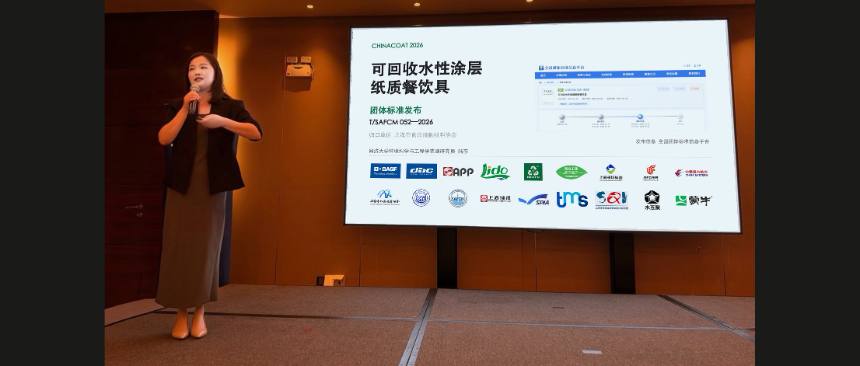
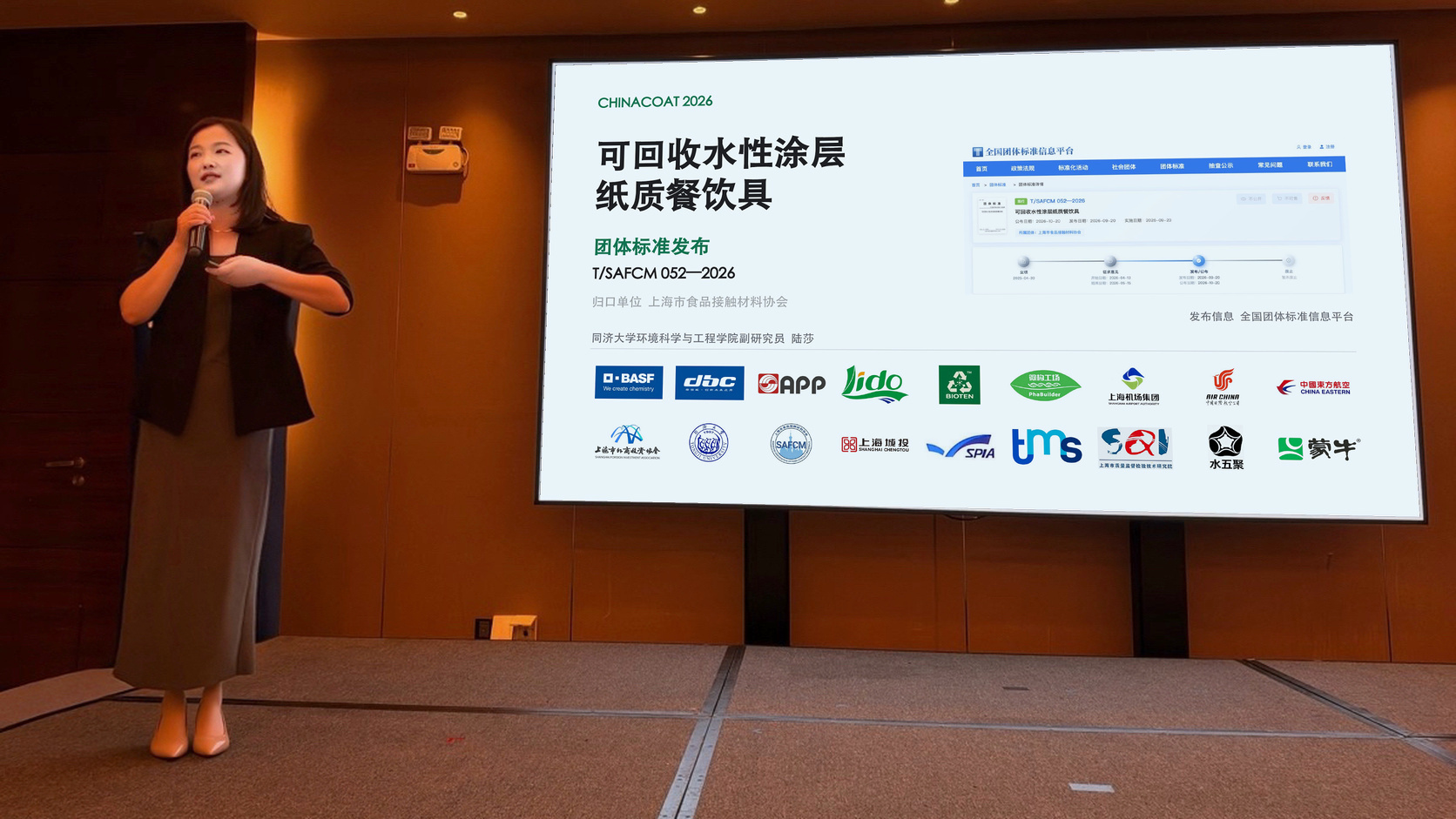
At CHINACOAT 2026 in Guangzhou, Sha Lu, an associate research fellow at Tongji University’s College of Environmental Science and Engineering and one of the standard’s principal drafters, presented its technical requirements and pathways to international application. The standard was listed on China’s National Association Standards Information Platform on 20 October 2026. It was jointly proposed by BASF (China) Co., Ltd. and DBC New Materials Technology (Shanghai) Co., Ltd., with 18 organisations participating in its development.
China’s 15th Five-Year Plan Outline identifies biomanufacturing as one of the country’s future industries. The Ministry of Industry and Information Technology’s Industrial Green and Low-Carbon Development Plan for the 15th Five-Year Period further calls for the development and application of high-performance, biodegradable bio-based materials, and wider use of biomanufacturing in sectors including papermaking. China’s Ecological and Environmental Code contains provisions on raw materials and products with low volatile organic compound (VOC) content, green packaging, and recovery and recycling. In the European Union, the Packaging and Packaging Waste Regulation (PPWR) phases in requirements for design for recycling and circularity. For paper tableware with water-based coatings, translating these policy goals into materials innovation and product applications requires clear, workable assessment criteria.
The Shanghai standard addresses this need through a technical framework linking materials, finished products and recyclability assessment. With food-contact safety and functional performance as its foundation, it defines assessment requirements for water-based coating formulations, coated paper and finished tableware, and incorporates indicators such as bio-based carbon content, VOC content and recyclability. Companies can use it to check raw-material information and test reports against the specific product, and to define technical conditions for material selection and procurement.
For materials, the standard covers film-forming systems including environmentally friendly water-based acrylic emulsions and PHA water-based composite emulsions, translating environmental requirements into controls on the materials actually used and the test methods applied. For the ready-for-use water-based coating, VOC content, calculated excluding water, must not exceed 2 g/L. Where a polyhydroxyalkanoate (PHA) water-based composite emulsion is used as the principal film-forming system, that emulsion must have a bio-based carbon content of at least 25%, expressed as a share of total organic carbon. Carbon-14 analysis is used to verify bio-based carbon content, supporting international technical exchange and comparison of results.
For finished products, food-contact safety is fundamental, while resistance to water and grease and structural strength must meet the requirements of the intended use. For markets including China, the European Union, the United States, Japan, South Korea, Australia and New Zealand, companies should assess material composition, food types and conditions of use to verify compliance with the applicable food-contact safety requirements. The standard also uses total fluorine content in finished products to screen for risks associated with per- and polyfluoroalkyl substances (PFAS). Suppliers and customers agree on acceptance criteria for microplastic migration, with supporting information provided through a self-declaration; disclosure of a product carbon footprint through a self-declaration is encouraged.
For recycling, the standard specifies recyclability assessment requirements for paper and paperboard with water-based coatings. In developing alternatives to conventional “paper + PE” structures, the “paper + water-based coating” route focuses on paper-fibre repulping and recycling. The “paper + PHA” route offers an additional compostable product option through separate validation of finished-product compostability, alongside compliance with the recyclability requirements. Companies can develop products for different recovery and treatment scenarios by matching the intended use with actual collection and processing conditions.
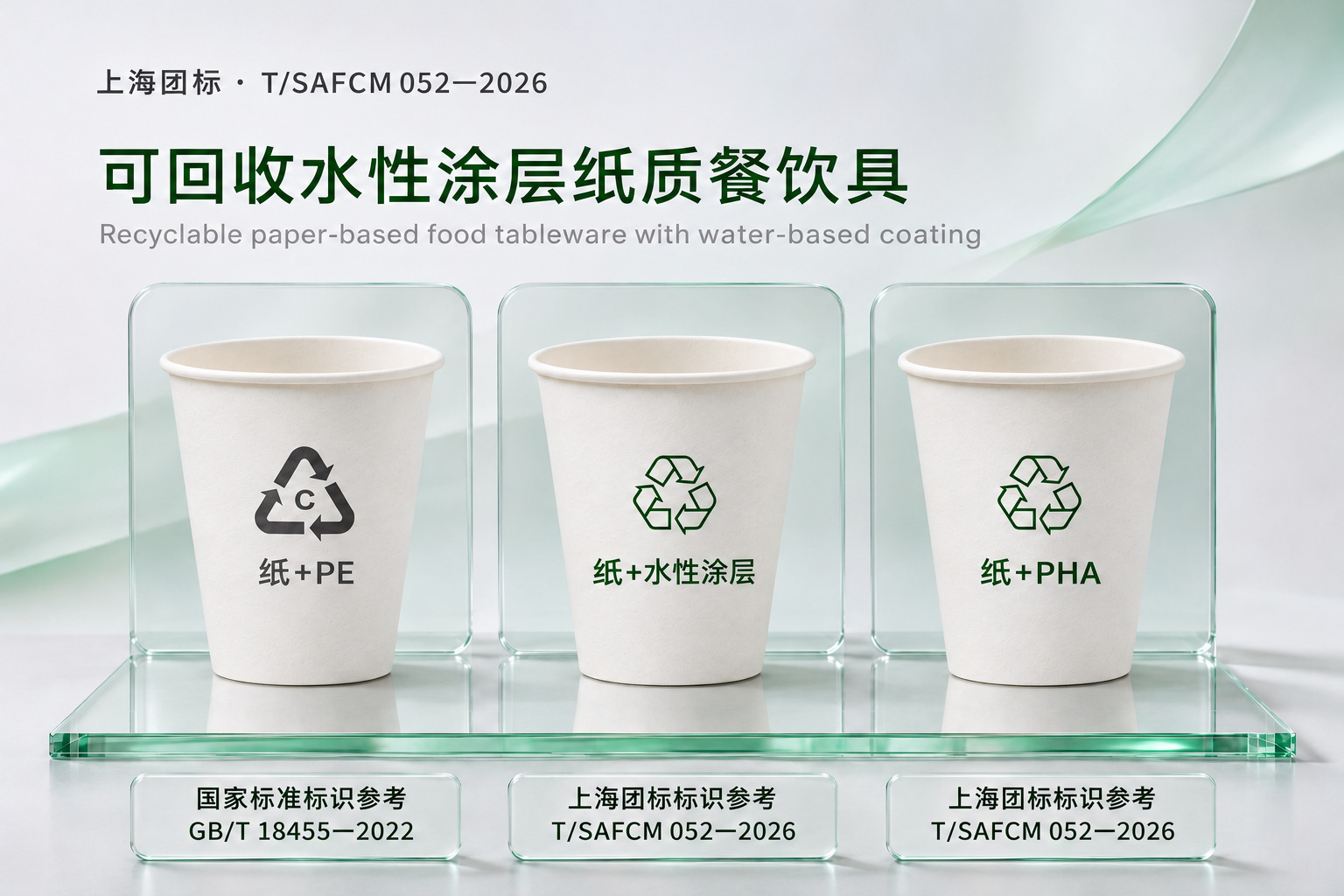
Clear technical requirements also need to be applied in day-to-day production. Material suppliers can use the standard to define development and testing requirements; paper mills and product manufacturers can validate the actual material combinations, specifications and intended uses; and brand procurement teams can review the corresponding product documentation. Routine release inspections and type testing help companies maintain those requirements through to delivery and reduce repeated discussions caused by inconsistent assessment criteria.
The 18 drafting organisations bring together expertise in materials, manufacturing, supply, end use and professional services. Contributors in materials and technology include BASF, DBC, Beijing PhaBuilder Biotechnology Co., Ltd. and BIOTEN (Shanghai) Biomaterials Co., Ltd. Participants in base paper and finished-product manufacturing include Shandong Bohui Paper Co., Ltd., Ningbo Asia Pulp & Paper Co., Ltd., Hunan Lile Environmental Protection Technology Co., Ltd. and Air China Shantou Industrial Development Company.
Trading and supply-chain participants include Shanghai Shuiwuju Trading Co., Ltd., HAVI Global Solutions (Guangzhou) Company Ltd. and Shanghai Eastern Aviation International Trade Co., Ltd. Aviation-service and food-industry participants include Shanghai Hongqiao International Airport Co., Ltd., Shanghai China Aviation Catering Co., Ltd. and Inner Mongolia Mengniu Dairy (Group) Co., Ltd. Participation from both suppliers and users helps the standard reflect procurement needs and real-world applications.
Participants in research, testing, recycling and industry services include Tongji University’s College of Environmental Science and Engineering, the Shanghai Institute of Quality Inspection and Technical Research, Shanghai Chengtou Environmental Resources Utilization Co., Ltd. and the Shanghai Foreign Investment Association. Their participation across disciplines provides a foundation for validation across the value chain and subsequent application partnerships.
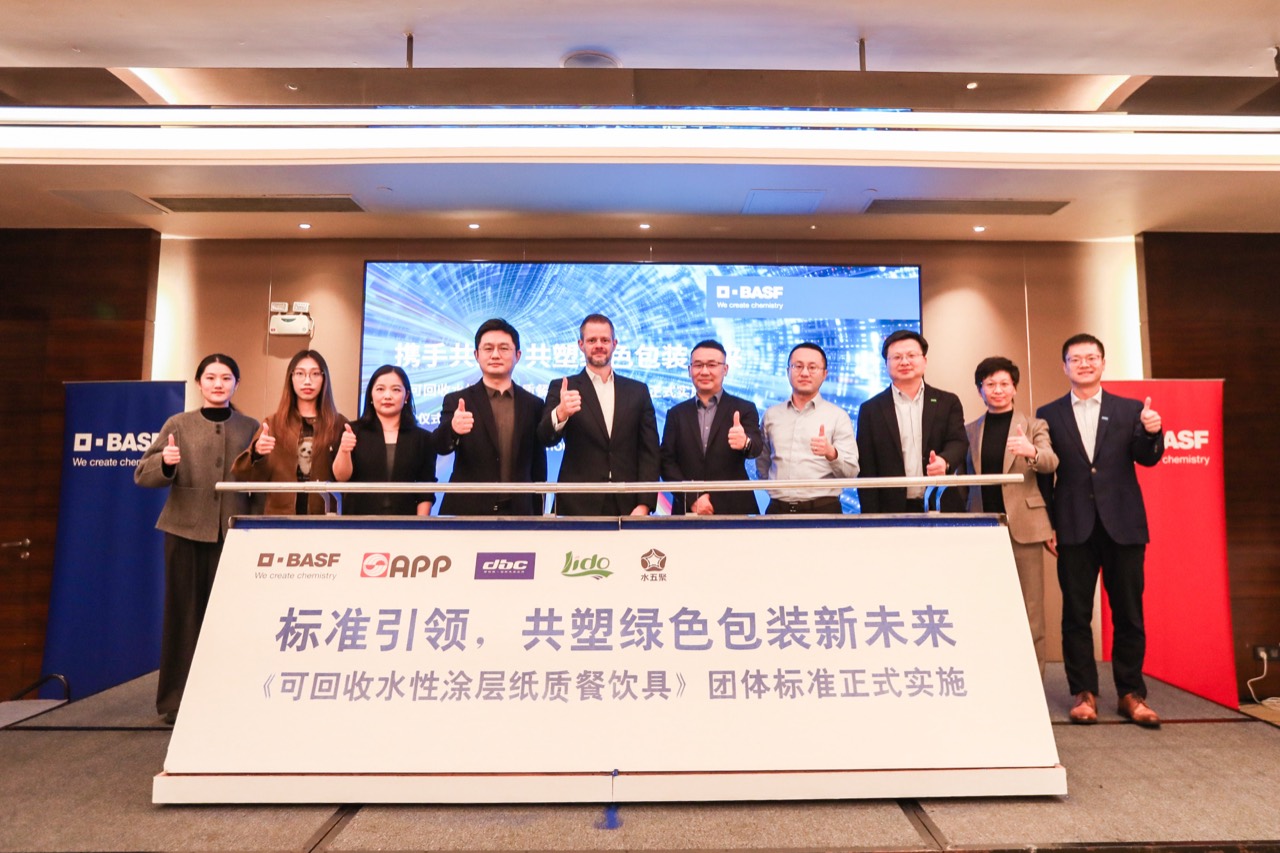
In her presentation, Sha Lu proposed joint validation, collaborative development of real-world applications, and traceable delivery. By linking VOC control at source, quantification of bio-based carbon and recyclability assessment, the standard defines verifiable product requirements to support international procurement. Companies can begin with a specific product and target market, coordinating validation of the materials, finished product and post-use treatment. Turning materials innovation into reliable products and consistent supply is the foundation for broader international collaboration in paper tableware with water-based coatings.