

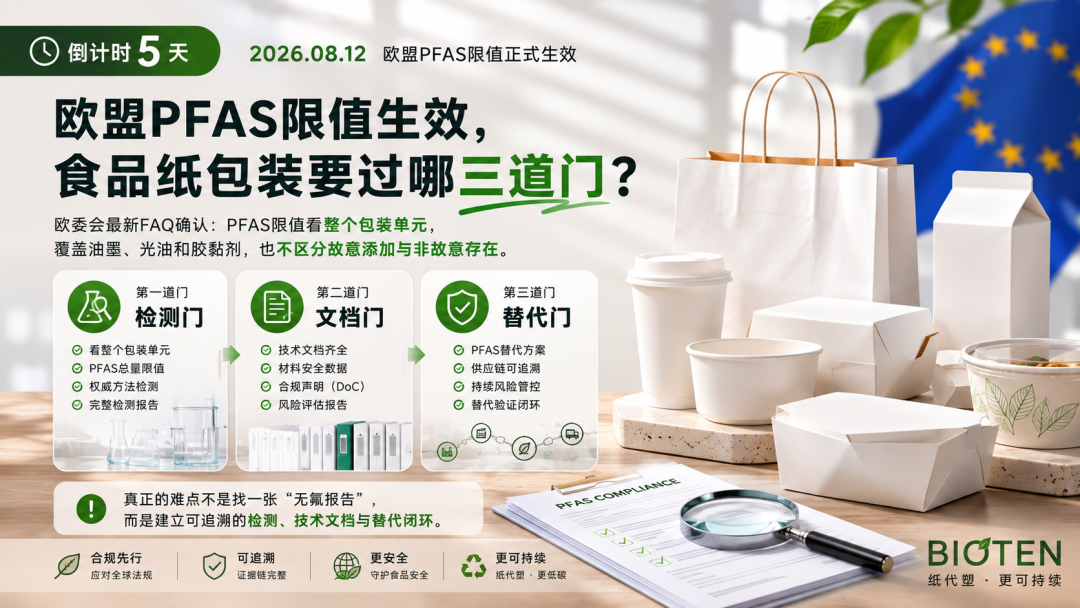
欧委会最新FAQ确认:PFAS限值看整个包装单元,覆盖油墨、光油和胶黏剂,也不区分故意添加与非故意存在。真正的难点不是找一张“无氟报告”,而是建立可追溯的检测、技术文档与替代闭环。
博碳包装|PPWR合规观察
从25 ppb、250 ppb到50 ppm,拆清纸杯、餐盒、防油纸与模塑纤维的检测、证据和替代闭环
欧委会最新FAQ确认:PFAS限值看整个包装单元,覆盖油墨、光油和胶黏剂,也不区分故意添加与非故意存在。真正的难点不是找一张“无氟报告”,而是建立可追溯的检测、技术文档与替代闭环。
三组限值|先看对象,再看数字
25 ppb
任何单项靶向PFAS|聚合物PFAS不计入该项定量
250 ppb
靶向PFAS总和|适用时考虑前体降解
50 ppm
包括聚合物PFAS|与前两项不是同一分析对象
三组限值不能按数字大小绘制比例图,任何一道触发都不能由另外两道抵消。
2026 / 08 / 12
距离欧盟食品接触包装PFAS限值生效,5 天
从这一天起,一件食品接触包装,只要在欧盟PPWR规定的任何一道PFAS限值上达到或超过门槛,就不得投放欧盟市场。
很多企业首先想到的是:
“我们的产品是纸做的。”
“我们的涂层是水性的。”
“供应商说没有故意添加PFAS。”
“原纸已经做过检测。”
但这些信息,单独拿出任何一条,都不足以证明最终包装合规。
欧委会在2026年8月3日发布的PPWR官方FAQ,把产业端最容易忽略的四件事说得非常清楚(见文末来源2):
01这不是一句笼统的“PFAS全面禁令”,而是三组最高浓度限值。
02限值看的是整个包装单元,包括油墨、光油、胶水和胶黏剂。
03故意添加和非故意存在的PFAS,都没有被区别对待。
04欧盟目前还没有形成统一的PFAS检测协议。
这意味着,8月12日真正改变的,不只是某一种防油剂能不能继续使用,而是食品纸包装的合规逻辑:
从“我用了什么材料”,转向“我能否证明整个包装在限值以内”。
一先把边界说清:PPWR管的不是“纸”,而是最终食品接触包装
PPWR第5条第5款规定,自2026年8月12日起,食品接触包装如果PFAS浓度达到或超过任一规定限值,不得投放市场(见文末来源1)。
这里有三个关键词。
1. 食品接触包装
三组PFAS限值针对的是拟与食品接触的包装。不能把这三组数字直接套到所有非食品纸箱、运输纸盒或工业包装上。
同日起,其他包装仍可能受到PPWR中“关注物质最小化”、重金属等一般要求约束,但那是另一套合规问题,不能与食品接触包装的PFAS浓度限值混为一谈。
2. 达到或超过
法规使用的是“达到或超过限值”。因此,25 ppb、250 ppb和50 ppm不是留给企业踩线的目标值,而是市场准入边界。
实验室检出限、测量不确定度、样品均匀性和批次波动,都应当进入企业的内部风险余量,而不是等检测结果贴着限值才开始行动。
3. 整个包装单元
欧委会最新FAQ进一步明确,限值适用于整个包装单元,包括(见文末来源2):
原纸或纸板;
防油、防水、热封等功能涂层;
内外表面的油墨与光油;
胶水和胶黏剂;
与包装一体化的其他组件。
所以,一只纸餐盒的原纸合格,不等于餐盒合格;一层水性阻隔涂层没有故意添加PFAS,也不等于印刷、上光、粘合后的最终包装已经合格。
法规看最终对象,企业却常常只拿到单一材料的证明。这个错位,就是当前最大的证据缺口。
二三道限值门,分别在查什么?
PPWR设置的三道门,不能只看数字大小,还要看每道门覆盖的分析对象。
LIMIT 01
25 ppb
第一道门——任何单项靶向PFAS
如果通过靶向分析测得任何一种PFAS达到或超过25 ppb,包装不得投放市场。
在这道门的定量中,聚合物PFAS被排除。
它关注的是“有没有某一个已被靶向测定的PFAS单项超限”。因此,一份报告的专业价值,取决于它到底检测了哪些目标物、采用什么前处理、检出限是多少,而不只取决于报告首页写了“未检出”。
LIMIT 02
250 ppb
第二道门——靶向PFAS总和
如果靶向分析测得的PFAS总和达到或超过250 ppb,包装同样不得投放市场。
在适用情况下,还要考虑对前体物进行降解后的结果;聚合物PFAS同样不计入这道门的定量。
这道门防止的是:多个单项都低于25 ppb,但累积总量仍然偏高。
LIMIT 03
50 ppm
第三道门——包括聚合物PFAS在内的PFAS
第三道门的限值是50 ppm,并明确包括聚合物PFAS。
50 ppm在数值上等于50,000 ppb,看起来远高于前两道门;但不能因此认为第三道门更宽松。原因是三道门覆盖的PFAS范围并不相同,第三道门把聚合物PFAS纳入了判定对象。
可以把它们理解为三种不同的风险视角:
25 ppb:盯住单个靶向物;
250 ppb:盯住靶向物的累积;
50 ppm:把包括聚合物PFAS在内的更宽对象纳入边界。
任何一道门触发,都不能靠另外两道没有触发来抵消。
三最容易被误读的“第四个数字”:总氟50 mg/kg
法规还提到另一个很容易与第三道门混淆的数字:总氟超过50 mg/kg。
对固体样品而言,50 mg/kg在数值上等于50 ppm。但这两个“50”测量的不是同一个对象:
50 ppm限值看的是包括聚合物PFAS在内的PFAS质量;
50 mg/kg看的是样品中的总氟元素。
氟可能来自PFAS,也可能来自非PFAS含氟物质。总氟结果不能直接换算成“PFAS总量”。
按照PPWR,如果总氟超过50 mg/kg,相关制造商、进口商或下游用户在被要求时,需要提供证据,说明所测氟来自PFAS还是非PFAS,以支持技术文档的建立。
因此,正确理解是:
总氟超过50 mg/kg,是进一步解释和举证的触发信号,不是自动判定产品不合格。
反过来,总氟低于50 mg/kg,也不能单独证明三道PFAS限值全部通过。一个样品完全可能在总氟筛查信号不高的情况下,仍触发25 ppb的单项门槛或250 ppb的总和门槛。
所以,企业不应该问“做总氟还是做靶向PFAS,选一个就行吗”,而应当问:
不同方法分别覆盖哪一层风险,它们怎样组合成可解释的证据链?
四没有CAS清单,也没有统一检测协议,企业怎么做?
欧委会最新FAQ给出了两个很关键、也很现实的答案(见文末来源2)。
第一,不会发布一个有限的PFAS CAS清单
PPWR采用的是结构性定义。只要符合定义并可能存在于包装中,就可能进入范围。
这意味着,“我们测了某个固定清单”只能说明已覆盖该清单,不能自动等于“覆盖全部PFAS”。目标物选择必须与配方、杂质、历史用途、供应链信息和生产过程风险相匹配。
第二,目前还没有统一的欧盟检测协议
欧委会表示,正在与利益相关方、主管机构以及欧盟食品接触材料参考实验室推进统一方案。
在统一方案形成之前,企业面对的不是“无法检测”,而是检测结果必须带着方法边界被理解:
样品是原纸、涂层、单个组件,还是最终包装?
靶向清单包含哪些PFAS?
是否覆盖相关前体物或采用了适当处理?
聚合物PFAS如何评估?
总氟或总有机氟采用什么前处理和报告方式?
检出限、定量限和测量不确定度是多少?
样品对应哪个SKU、配方版本、批次和生产日期?
如果这些问题没有答案,一张“PFAS未检出”报告很难支撑最终包装的长期放行。
五不是所有纸包装风险相同:先查谁,要看四个变量
法律没有发布“纸杯、餐盒、防油纸、模塑纤维谁风险最高”的官方排名,也不会因为某个品类名称而自动判定其含有PFAS。
但企业可以用四个变量建立排查优先级:
变量一:功能强度
包装是否需要同时承受油脂、水分、热食、长时间接触或高温加工?功能要求越高,历史配方和替代路线越值得核查。
变量二:历史化学品
供应商是否曾使用含氟防油剂、含氟加工助剂或无法解释的“高等级防油”体系?旧配方是否已经明确停用,还是只有口头承诺?
变量三:结构复杂度
一张未印刷防油纸,与一个经过涂布、印刷、上光、模切和粘合的餐盒,证据复杂度完全不同。组件越多,未知来源和交叉污染路径越多。
变量四:证据完整度
能否追溯到准确SKU、批次、配方版本和供应商变更?有没有最终包装层面的检测?声明是否覆盖非故意存在,而不只是“未故意添加”?
结合历史用途线索和功能要求,以下产品应优先进入企业风险盘点:
快餐包装纸、汉堡纸和高防油纸;
微波爆米花袋、宠物食品袋等高阻隔纸袋;
外卖纸板餐盒、纸碗和热油食品容器;
烘焙纸、垫纸和其他耐油耐热纸;
纸浆模塑餐盘、餐盒和食品托盘;
带有印刷、光油、粘合或复合结构的纸杯与食品纸容器。
美国FDA的历史资料确认,含PFAS防油物质曾被用于快餐包装纸、微波爆米花袋、外卖纸板容器和宠物食品袋(见文末来源4)。这个资料能告诉我们“从哪里优先找风险”,但不能证明今天某一具体产品一定含有PFAS。
正确做法不是给品类贴标签,而是给每一个最终结构建立风险档案。
六一套可执行的五层证据闭环
由于欧盟统一检测协议尚未形成,下面不是所谓“欧盟官方五步法”,而是一套面向企业的风险控制框架。
第一层:BOM与供应链声明
先把最终包装拆开:原纸、涂层、油墨、光油、胶黏剂、助剂、复合层和一体化组件,一个都不能漏。
供应商文件至少要回答:
对应的准确产品名称、SKU和配方版本;
是否故意使用符合PPWR结构定义的PFAS;
已知杂质、交叉污染和生产助剂风险;
文件覆盖的工厂、批次和有效期;
配方、原料或工艺变化时如何通知。
“未故意添加”可以用于风险识别,但不能独立完成最终合规证明。
第二层:总氟或总有机氟筛查
筛查的价值,是快速发现供应链声明与实际样品之间可能存在的偏差,并帮助确定进一步检测优先级。
但筛查不是万能裁判:它不能自动识别具体PFAS,也不能单独替代25 ppb和250 ppb的靶向判定。
第三层:靶向PFAS与必要的前体评估
靶向分析要覆盖与配方、用途和历史风险相关的物质,并把目标物清单、方法、检出限和定量限写进报告。
当存在前体物转化风险时,应与实验室、欧盟客户或进口商共同确认是否需要相应处理和结果表达。
第四层:最终包装与关键组件交叉验证
最终包装单元的检测回答“这个市场对象总体是否落在限值以内”;组件检测回答“风险来自哪里、应该改哪一层”。两者不是互相替代,而是诊断与放行的不同工具。
对于印刷餐盒、复合纸袋、模塑纤维餐具等结构,建议至少把以下对象说清:
未加工基材;
功能涂层或内衬;
印刷、上光、粘合后的最终包装;
最不利的颜色、覆盖率、涂布量或胶黏剂用量;
正常批次与配方变更后的代表性批次。
第五层:技术文档、符合性声明与变更控制
PPWR附件VII的技术文档并不是一叠零散检测报告。它应形成一条可复核的逻辑链,包括(见文末来源1):
包装的一般说明和预期用途;
设计、组件和材料信息;
不符合风险分析与评估;
采用的标准、技术规范或替代解决方案;
定性评估和测试报告;
与批量生产一致性的控制;
EU符合性声明及后续更新。
对一次性包装,相关技术文档和符合性声明通常需要保留5年;可重复使用包装为10年。
真正能经受客户或监管追问的,不是某一张报告,而是“声明—测试—结构—批次—变更”五者能够互相对应。
七供应商、制造商、进口商,谁来承担这条证据链?
首先必须确认自己在具体交易中的法律角色。品牌归属、以谁的名称或商标投放、谁设计和下单,都会影响角色判断,不能只按日常称呼认定。
从PPWR的责任逻辑看:
供应商
应向制造商提供证明包装及包装材料符合要求所必需的信息和文件。对原纸、涂层、油墨、光油和胶黏剂企业而言,客户追问精确SKU、配方声明、测试方法和变更记录,并不只是“额外填表”。
制造商
在投放市场前,需要完成符合性评估,建立技术文档,并签发EU符合性声明;同时还要确保批量生产持续与文档一致。
进口商
只能把符合要求的包装投放欧盟市场,并需要核验符合性评估、技术文件和声明是否齐备,在有理由怀疑不合规时不能继续投放。
这对中国造纸、涂布、印刷和包装企业意味着:
欧盟客户索要的证据会继续向上游传导。谁最早建立结构化数据,谁就更容易进入客户的合格供应链;谁只能提供一句“我们不含PFAS”,谁就可能成为整条证据链的断点。
八替代PFAS,不是把一种化学品换成另一句营销语言
如果企业正在评估水性阻隔、生物基涂层或PHA等非含氟候选路线,至少要同时关闭四条验证线。
1. 化学与合规
确认配方及全部组件的PFAS风险、杂质和交叉污染;在最终包装结构上验证三组浓度边界;建立食品接触材料所需的迁移与安全证据。
2. 功能性能
防油等级只是起点。还要结合真实食品和使用条件评估:
热油、常温油脂和长时间接触;
吸水、渗漏和水蒸气阻隔;
折痕、压线、模切边和针孔后的屏障连续性;
热封起封温度、封口强度和封口窗口;
微波、烘焙、冷藏或冷冻等目标场景。
3. 加工稳定性
实验室涂布成功,不等于能够在造纸机、涂布机、印刷机或成型线上稳定运行。固含、黏度、干燥负荷、起泡、粘辊、套印、摩擦系数、模切掉粉和线速度,都要在代表性设备上验证。
4. 回收与系统结果
纸基不自动等于可回收。涂层用量、纤维解离、筛渣、胶黏物和当地回收系统适配,需要与阻隔性能一起考虑。
因此,一条成熟的替代路线必须同时回答:
是否过法规限值?是否扛得住真实食品?是否跑得动工业产线?是否进入目标回收系统?
少一个答案,都只是材料概念,不是可规模化的包装方案。
九距离生效只剩5天,企业现在还能做什么?
五天不一定足够完成所有实验室检测和配方切换,但足够把风险从“未知”变成“可控”。
0—8 HOURS
建清单,不再凭品类名称判断
列出所有拟投放欧盟的食品接触包装SKU;
标出最终结构、用途、食品类型、温度和接触时间;
明确供应商、制造商、品牌方和进口商角色;
盘点已生产、在途、库存和8月12日后的投放计划。
8—24 HOURS
收文件,锁住配方版本
向原纸、涂层、油墨、光油和胶黏剂供应商索取准确SKU声明;
核对“未故意添加”的定义与覆盖范围;
收集现有检测报告的样品、方法、目标物和检出限;
暂停未记录的配方、原料和工艺变更。
24—48 HOURS
分风险,确定样品与方法
把SKU分为三类:
红色
:历史化学品不明、供应商文件缺失、检测边界不足或最终结构未经核验;
黄色
:已有部分声明和测试,但组件、批次或方法仍有缺口;
绿色
:BOM完整、证据可追溯、最终结构与批次控制能够闭环。
与实验室、客户或进口商共同确认样品对象、靶向清单、筛查方法、前体评估、检出限和报告表达,避免各做各的、结果却无法互认。
48—72 HOURS
做放行决策,不让未知风险继续流动
对红色SKU设置HOLD,不要用“暂时没有发现”代替证据;
对黄色SKU列明缺口、责任人和关闭日期;
对绿色SKU建立技术文档索引和客户交付包;
对必须替代的结构启动小试、产线验证和最终包装复测;
把供应商变更通知与重新评估触发条件写入质量体系。
最重要的不是在五天内制造一份看似完整的文件,而是确保8月12日之后,每一个被放行的SKU都有足够依据。
十一张表判断:你的产品真的准备好了吗?
在放行一件欧盟食品纸包装之前,请连续回答十个问题:
01我们确认它属于哪个法律角色、由谁投放市场了吗?
02最终包装的BOM是否覆盖原纸、涂层、油墨、光油、胶黏剂和全部组件?
03每份声明是否对应准确SKU、工厂、配方版本和批次?
04“未故意添加”之外,是否评估了杂质、加工助剂和交叉污染?
05检测样品是单一材料,还是最终包装单元?
06靶向PFAS报告列明了目标物、方法、检出限和定量限吗?
07总氟筛查是否被正确解释,而没有被写成“PFAS-free证明”?
08是否考虑了聚合物PFAS和必要的前体风险?
09技术文档能否把风险评估、测试报告、批量生产和EU符合性声明串起来?
10任何配方、原料、工艺或供应商变化,是否会触发重新评估?
只要其中一个关键问题答不上来,企业面对的就不是“文档不够漂亮”,而是产品能否继续投放市场的不确定性。
结结语:8月12日终结的,是“用材料形容词代替合规证据”
纸基、水性、生物基、无氟、环保——这些词可以描述技术方向,却不能替最终包装完成符合性评估。
PPWR把企业拉回一个更严格、也更务实的起点:
你用了什么,只是第一问;它在最终包装中表现如何、检测如何覆盖、证据能否追溯,才决定它能不能进入市场。
对造纸企业,这是化学品与批次管理能力;
对涂层、油墨和胶黏剂企业,这是精确SKU与配方证据能力;
对印刷包装企业,这是整包BOM与最终结构验证能力;
对食品品牌和进口商,这是供应链放行与持续合规能力。
8月12日不是“所有含氟化学品故事的终点”。
它更像一条分界线:从此以后,食品纸包装不能再靠一句“应该没问题”进入欧盟市场。
真正稀缺的,也不再是一句“PFAS-free”,而是一条经得起追问、能够持续更新的证据链。
据本文依据与口径说明
本文截至2026年8月7日,优先采用欧盟法规原文和欧委会最新实施FAQ。文中的“五层证据闭环”“四变量优先级”和“72小时行动表”是博碳包装基于法规要求提出的企业风险管理框架,不是欧委会发布的统一检测协议,也不替代企业针对具体产品取得的法律、实验室或合规意见。
Regulation (EU) 2025/40 — EUR-Lex官方文本:第5条第5—6款、第15—16条、第38—39条及附件VII。
European Commission — PPWR Frequently Asked Questions,2026-08-03发布:重点参见PFAS与供应链文件相关问答。
European Commission — Packaging and Packaging Waste:PPWR一般适用日期与实施资料入口。
U.S. FDA — PFAS Used in Grease-Proofing Agents for Food Packaging:纸和纸板食品包装中PFAS防油剂的历史用途与退出背景。
留言讨论
你的产品现在卡在哪一步:供应商声明、检测方法、最终包装验证,还是替代材料的产线性能?欢迎留言,我们将继续拆解食品纸包装PFAS证据链中的具体技术问题。
The latest CoE FAQ confirms:PFASThe limit values are for the whole packaging unit, covering ink, light oil and glue, without distinguishing between intentional additions and unintentional presence. The real difficulty is not to find a single "fluorine-freeReported) instead, they create retrospective detections, technical files and substitute closed rings.
BIOTENPackaging PPWR compliance observation
From25 ppbI'm not sure.250 ppbPresent.50 ppm, testing, proof and replacement of closed rings for paper-free cups, dining boxes, oilproof paper and plastic fibre
The latest CoE FAQ confirms:PFASThe limit values are for the whole packaging unit, covering ink, light oil and glue, without distinguishing between intentional additions and unintentional presence. The real difficulty is not to find a single "fluorine-freeReported) instead, they create retrospective detections, technical files and substitute closed rings.
Three-string limit values, look at objects first and then numbers.
25 ppb
Any single targetPFASPolymerium diazolePFASNot included in this amount
250 ppb
TargetPFASConsider precursor degradation when total and platinum apply
50 ppm
Including polymers.PFASThe | is not the same as the first two.
Three sets of limit values cannot be drawn in proportion to the size of a number, and any triggers cannot be offset by two other paths.
2026 I'm not sure. 08 I'm not sure. 12
Distance from the European Unionfood contactPackagingPFASThe limit value is in effect.5 Jesus.
One from this day on.food contactPackaging, provided that in any of the EU PPWR provisionsPFASThe threshold is not allowed to be placed in the EU market if it has been met or exceeded.
Many companies first thought:
"Our products are paper-based."
"Our coatings are watery."
“Supplier states that no intentional additionsPFAS"and it's a very good thing to do."
"The original paper has been tested."
However, any single item of this information is insufficient to demonstrate compliance with the final packaging.
The EC is...2026Year8Month3The official PPWR FAQ released on the day made it clear that the four things most easily overlooked by industry.2:
01This is not a general phrase."PFASTotal ban”, instead of three sets of maximum concentration limits.
02The limit values are for the entire packaging unit, including ink, light oil, glue and glue.
03Added intentionally and unintentionally presentPFASNo distinction has been made.
04The EU is not yet unified.PFASTest protocol.
It means,8Month12What really changed is not just whether a single anti-oil agent can continue to be used, but rather the logic of compliance in food paper packaging:
From “What materials did I use” to “Can I prove that the entire package is within limit”.
First, we'll make clear the boundaries: PPWR is not a paper tube but an end.food contactPackaging
PPWR No.5Article5Under the terms of2026Year8Month12The government has been trying to protect the country.food contactPackaging ifPFASConcentrations of any specified value or greater shall not be placed on the market (see sources at end of text).1I'm not sure.
There are three keywords here.
1. food contactPackaging
Group IIIPFASThe limit value is for the proposed and the intendedfood contact. The three sets of numbers cannot be directly placed on all non-food paper boxes, transport boxes or industrial packagings.
From the same date, other packagings may still be subject to general requirements in PPWR for “minimization of concern”, heavy metals etc. but that is another set of compliance issues which cannot be matchedfood contactPackaging.PFASConcentration limit values are mixed.
2. Accomplishment or exceeding
The regulations use the term “reach or exceed limits”.25 ppbI'm not sure.250 ppband50 ppmThe target value is not left to firms, but the market access boundary.
Laboratory detection limits, measuring uncertainty, homogeneity of samples and batch fluctuations should be introduced into the enterprise ' s internal risk balance rather than waiting for test results to be tied to a limit.
3. Whole packaging unit
The latest CoE FAQ is further clarified that the limit values apply to the entire packaging unit, including (see sources at end of text)2:
(a) Original paper or cardboard;
(a) Oil, water and heatproof coatings;
Ink and light oil on the internal and external surfaces;
(a) glue and glue;
(c) other components integrated with packaging.
Therefore, a paper box is not qualified for the original;waterborne barrier coatingNo intentional additionPFASand does not equal to the final packaging that is printed, lighted, glued and completed.
The regulations are the ultimate target, and businesses often get evidence of a single material. This is the biggest evidentiary gap at present.
Two or three lines of restricted service. What are we looking for?
The three gates set up by the PPWR are not just numerical in size, but also the analytical objects covered by each.
Limit 01
25 ppb
First door -- any single target.PFAS
If you can see any of these from the target-direction analysis,PFASAccomplishment or exceeding25 ppbPackagings shall not be placed on the market.
In the quantum of this door, polymers.PFASExcluded.
It's about, "Is there any one that has been identified as a target?PFASIndividually, the limit is exceeded.” The professional value of a report therefore depends on what it detects, what pre-treatment is used and how much checkout limits are applied, not just “undetected” in the front page.
Limit 02
250 ppb
Second door. Targeting.PFASTotal
If the target is analyzed,PFASTotal amount reached or exceeded250 ppbPackaging is likewise not allowed to be placed on the market.
Where applicable, the results of degradation of precursors are also considered; polymersPFASThe quantitative value of the door is likewise excluded.
This door is prevented from being below the level of each of these.25 ppbHowever, the cumulative total is still high.
Limit 03
50 ppm
Third door -- including polymersPFASIncludingPFAS
The third door limit is...50 ppmand explicitly includes polymersPFASI'm sorry.
50 ppmequals50,000 ppbIt looks much higher than the first two doors; but it doesn't make the third door more relaxed.PFASThe range is different.PFASTarget audience included.
They can be understood as three different risk perspectives:
25 ppb: Keep an eye on the individual target;
250 ppb: Keep an eye on the accumulation of target objects;
50 ppm: Include polymersPFASMore broadly, including the other subjects, are included in the border.
No door trigger can be counterbalanced by two other tracks that have not.
Three of the most misread “fourth number”: total fluorine50 mg/kg
The regulation also mentions another figure that can easily be confused with the third door: total fluorine exceeds50 mg/kgI'm sorry.
For solid samples,50 mg/kgequals50 ppmBut these two.50"The measure is not the same object:
50 ppmThe limit is for polymers.PFASIncludingPFASQuality;
50 mg/kgLook at the total fluorinated elements in the samples.
Fluorine may come fromPFASOr maybe it's from the wrong side.PFASFluorinated substances. Total fluorinated results cannot be converted directly to "PFASTotal”.
According to PPWR if total fluorine exceeds50 mg/kg, the manufacturer, importer or downstream user will be required to provide evidence that the fluorinated product is derived fromPFASOr is it not?PFASto support the creation of technical documents.
It is therefore correctly understood that:
Total fluorinated greater than50 mg/kg, the trigger signal for further explanation and proof, not automatic determination of product non-conformity.
In turn, total fluorine is below50 mg/kgAnd there's no way to prove it alone.PFASThe limit value is passed. A sample may well be triggered by a low total fluorine screening signal25 ppbindividual threshold or250 ppbThe sum threshold.
So, the company shouldn't ask, "To make a total or to target."PFASOne is fine with that”, but one should ask:
Which levels of risk are covered separately by different methods, and how do they combine into an explanatory evidence chain?
Four without CAS, no uniform testing protocols. What do enterprises do?
The latest EC FAQ gives two critical and realistic answers.2I'm not sure.
First, there's no limited release.PFAS CAS List
PPWR uses a structural definition. It may be included as long as it meets the definition and is likely to exist in packaging.
This means that “we measured a fixed list” can only mean that it is covered and not automatically equal to “covering all”.PFAS”The selection of the target must be matched with formulation, impurity, historical use, supply chain information and production process risks.
Second, there is no uniform EU test protocol.
CoE indicated that it was working with stakeholders, competent bodies and the EUfood-contact materialsReference Laboratory Promotion of Harmonization Programme.
Before a unified programme is formed, enterprises are not confronted with “undetectable” but the results must be understood along methodological boundaries:
Are samples original paper, coatings, individual components or final packaging?
What's the target list?PFAS♪ And I'm gonna be here ♪
Are the precursors covered or are they being appropriately addressed?
PolymerPFASHow do you assess it?
What is the pre-treatment and reporting approach for total or total organic fluoride?
What are the check-out limits, quantitative limitations and measurement uncertainties?
Which SKU, formulation version, batch and date of production are the samples?
If there are no answers to these questions, one.PFASThe “undetected” report makes it difficult to support the long-term release of final packaging.
Five is not all paper wrapping at the same risk: to find out who first depends on four variables
The law does not publish an official ranking of "the most risky of the cups, the lunchboxes, the oilproof paper, the plastic fibre" and it does not automatically determine its content because of a name for a class.PFASI'm sorry.
However, enterprises can establish a ranking priority with four variables:
Variable I: Function strength
Is packaging required to absorb both fat, moisture, hot food, prolonged exposure or high temperature processing? The higher the functional requirements, the more verifiable historical formulas and alternative routes are.
Variable II: Historical chemicals
Has the supplier ever used a fluoro-based oil protection agent, a fluorine processant or an unexplained “high-level oilproof” system? Was the old formulation explicitly discontinued or was it verbally committed?
Variable III: Structural complexity
A unprinted tarproof paper is completely different from a painted, printed, luminous, slicing and glued meal box. The more components there are, the more unknown sources and cross-pollution pathways.
Variable four: evidence integrity
Can you trace to the exact SKU, batches, formulation versions and supplier changes? Are there any final packaging-level tests? Does the declaration cover unintentional presence rather than simply “not intentionally added”?
In conjunction with historical usage leads and functional requirements, the following products should be prioritized for entry into enterprise risk inventories:
Fast-food wrapping paper, hamburger paper and high oilproof paper;
(b) High-blocking paper bags such as microwave popcorn and pet food bags;
(a) The take-out of cardboard food boxes, paper bowls and hot oil food containers;
(a) bake paper, mats and other oil-resistant papers;
Pulp plastics plates, dining boxes and food trays;
Paper cups and food paper containers with printing, light oil, glued or composite structures.
US FDA historical information confirms, includingPFASOil-resistant substances were used in fast food wrapping paper, microwave popcorn bags, cardboard containers and pet food bags (see sources at the end of the document).4This information tells us where to prioritize risk, but it doesn't prove that a specific product today containsPFASI'm sorry.
The right approach is not to label the product but to create risk profiles for each final structure.
Six sets of enforceable five-level evidence closed.
Since the EU uniform testing agreement has not yet been concluded, the following is not a so-called “EU official five-step approach”, but rather an enterprise-oriented framework for risk control.
First tier: BOM and Supply Chain Statement
The final packaging is first unbundled: original paper, coatings, ink, light oil, glue, aides, composite layers and integrated components, none of which shall be leaked.
The vendor document should at least answer:
(b) The exact product name, SKU and formulation versions corresponding to them;
Whether to use intentionally the PPWR structure definitionPFAS(a) The following:
Known impurities, cross-pollution and production of assistive agents;
Plants, batches and validity periods covered by the document;
How to notify changes in formulations, feedstocks or processes.
“Not intentionally added” may be used for risk identification but cannot independently complete the final certification of compliance.
Second layer: screening of total or total organic fluoride
The value of screening is to quickly identify possible deviations between supply chain statements and actual samples, and help to establish further testing priorities.
But screening is not a universal decision: it cannot automatically identify the specifics.PFASAnd no one can replace it.25 ppband250 ppbTargeting.
Level 3: TargetingPFASAssessment of precursors as necessary
Target analysis covers substances associated with formulation, use and historical risks and includes target lists, methods, check-out limits and quantitative limitations in the report.
Where there is a risk of diversion of precursors, the need for corresponding treatment and results should be identified with laboratories, EU clients or importers.
Layer 4: Final packaging and critical components cross-check
The final packaging unit test answered, “Is this market object generally falling within the limit value?”; the component tested, “Where risk comes from and which layer should be changed”. They were not substitutes but different tools for diagnosis and release.
For structures such as printed food boxes, composite paper bags and plastic fibreware, it is recommended that at least the following objects be identified:
(a) unprocessed base materials;
Functional coating or liner;
(a) Final packaging after printing, top light and glued;
(a) The most unfavourable use of colour, cover, coating or glue;
Representative batch after normal batch and formula change.
Level 5: Technical documentation, conformity statements and change control
The technical documentation for PPWR Annex VII is not a random test report. It should form a re-readable logical chain, including (see sources at the end of the text).1:
(a) A general description of the packaging and its intended use;
(a) Design, components and material information;
(a) Risk analysis and assessment is not consistent;
Standards, technical specifications or alternative solutions used;
(a) Qualitative assessment and test reports;
Controls consistent with bulk production;
EU conformity statement and subsequent updates.
For one-time packagings, the relevant technical documents and conformity statements are normally required to be retained5years; packing may be repeated as10Year.
What is truly subject to client or supervisory scrutiny is not a report, but a “declaration-test-structure-batch-change” that corresponds to each other.
Who will bear the chain of evidence?
First, you must identify your legal role in a particular transaction. Branding, who's name or brand is placed, who designs and puts the bill will affect character judgement and cannot be determined by just everyday designations.
From the logic of responsibility in PPWR:
Vendors
The manufacturer shall be provided with the information and documentation necessary to demonstrate that packaging and packaging materials meet the requirements. For original paper, coatings, ink, photo oil, and glue enterprises, customer follow-up on accurate SKU, formulation statements, test methods and change records is not merely an “additional filling form”.
Manufacturers
Before placing the market, conformity assessments are to be completed, technical documentation established and a declaration of EU compliance issued; it is also necessary to ensure that bulk production continues to be consistent with the document.
Importers
Only eligible packagings can be placed on the EU market and will require verification of conformity assessments, technical documents and declarations to be ready, and cannot continue to be delivered if there is reason to suspect non-compliance.
This means to the paper, cloth, printing and packaging enterprises in China:
The evidence requested by EU clients will continue to be transmitted upstream. Whoever first builds structured data has easier access to the customer's qualifying supply chain; whoever can only provide a phrase, “We don't have it.”PFAS“The only way to get a complete chain of evidence is if you have to.
Eight insteadPFASNot to replace a chemical with another marketing language.
If an enterprise is assessing aquatic barriers, bio-based coatings orPHAAt least four verification lines are to be closed simultaneously, as opposed to fluorinated candidate routes.
1. Chemical and compliance
Confirm formula and all componentsPFASRisks, impurities and cross-contamination; verification of three sets of concentration boundaries on the final packaging structure; establishment offood-contact materialsThe required evidence of relocation and security.
2. Function Performance
The level of oil protection is only the starting point.
(b) Hot oils, regular hot fats and long-term exposure;
(b) Water insulation, leakage and water vapour barriers;
(a) The continuity of the barrier following the creases, pressure lines, modifiers and needle holes;
(b) The heat of sealing the temperature, seal strength and shut-off windows;
Target scenes such as microwave, baking, refrigeration or freezing.
3. Process Stability
The laboratory fabric is successfully painted and does not amount to a steady operation on paper machines, rags, printers or plastic wires. Solid, sticky loads, bubbles, glues, twigs, friction coefficients, powder cut off and line speed are validated on representative equipment.
4. Recovery and system results
The base of the paper does not automatically equalrecyclable. The coatings, fibre disassembly, sifting, glue and local recovery systems are suitable for use and need to be considered together with barrier performance.
Therefore, a mature alternative route must be accompanied by an answer:
Are the regulatory limits exceeded? Can you carry real food? Can industrial lines run? Is target recovery system in place?
The one answer is a material concept, not a scalable package.
Nine miles to go.5Jesus, what else can the company do now?
Five days is not necessarily sufficient to complete all laboratory tests and formula switching, but enough to shift the risk from “unknown” to “managerable”.
0I'm not sure.8 HOURS
Listing, no longer based on class names
List all EU-related projectsfood contactPackaging SKU;
(a) Mark the final structure, use, type of food, temperature and time of exposure;
(c) Clarify the roles of suppliers, manufacturers, brand parties and importers;
Inventory of production, in-transit, inventory and8Month12The future release plan.
8I'm not sure.24 HOURS
Collect files, lock the formula version
(c) Request accurate SKU statements from suppliers of original paper, coatings, ink, photo oil and glue;
(b) Checking the definition and coverage of “not intentionally added”;
(b) Collection of samples, methods, targets and detection limits for existing testing reports;
Suspend unrecorded changes in formulations, feedstocks and processes.
24I'm not sure.48 HOURS
Risk classification, identification of samples and methods
SKU is divided into three categories:
Red
: Unknown historical chemicals, missing supplier documentation, inadequate detection boundaries or unverified final structure;
Yellow
: partial declarations and tests have been made, but there are gaps in components, batches or methods;
Green
BOM is complete, evidence retraceable and final structure and batch control can be closed.
Identify, together with laboratories, clients or importers, the objects of samples, target-to-target lists, screening methods, precursor assessments, check-out limits and reporting expressions to avoid individualizations but not mutual recognition of results.
48I'm not sure.72 HOURS
Release decision to keep unknown risks flowing
(b) Set up HOLD for Red SKU without replacing the evidence with “not found temporarily”;
(b) The identification of gaps, responsible persons and closing dates for yellow SKU;
(b) Development of a technical document index for green SKU and customer delivery packages;
(b) Start small tests, production line validation and final packaging re-examination of structures that must be replaced;
The trigger conditions for supplier change notification and reassessment are included in the quality system.
The most important thing is not to create a document that looks like it's complete within five days, but to make sure8Month12After that day, each of the SKUs released had a sufficient basis.
Eleven tables. Are you really ready for your product?
Before releasing a single EU food paper package, please answer 10 questions in succession:
01Have we identified which legal role it belongs to and who has placed it on the market?
02Do BOM, which is the final package, cover original paper, coatings, ink, light oil, glue and all components?
03Are the declarations correct with respect to SKU, plant, formulation version and batches?
04Are impurities, process agents and cross-pollutions assessed beyond “not intentionally added”?
05Are samples single material or final packaging units tested?
06TargetPFASAre the targets, methods, detection limits and quantitative limits identified in the report?
07Whether the total fluorine screening was correctly interpreted and not written as "PFAS-Free Prove?
08Whether polymers are consideredPFASAnd the necessary precursor risk?
09Can the technical documents be linked to risk assessment, test reports, bulk production and EU conformity statements?
10Will any changes in formulations, feedstocks, processes or suppliers trigger a reassessment?
As long as one of the key issues is not answered, firms are faced with uncertainty about whether or not products will continue to be placed on the market rather than “beautiful files”.
Concluding remarks:8Month12The end of the day is "substantiation of material to proof of compliance."
Paper, water, biological,fluorine-freeEnvironmental protection - these terms can describe the direction of technology but cannot complete conformity assessment for final packaging.
The PPWR brings the business back to a more rigorous and pragmatic starting point:
What you used was only the first question; it was how it behaved in the final packaging, how it was covered and whether evidence could be traced to determine whether it would enter the market.
For paper-based enterprises, this is chemical and batch management capacity;
For coating, ink and glue enterprises, this is the ability to prove the exact SKU and formulation;
For the printing packaging industry, this is a package BOM and final structure validation capability;
For food brands and importers, this is the ability to release and maintain compliance with supply chains.
8Month12Day is not the end of all fluorinated chemicals stories.
It is more like a dividing line: ever since, the food paper packaging cannot enter the EU market by a single phrase “should be fine”.
"The truly scarce one is no longer a word."PFAS-free”, but a chain of evidence that can be kept up to date and open.
According to the paper,
This document is available as of2026Year8Month7On the other hand, priority is given to the original EU legislation and the latest implementation of the FAQ by the EC.72"Ah, a schedule of hours."BIOTENPackaging is an enterprise risk management framework based on statutory requirements and does not constitute a uniform testing agreement issued by the EC, nor is it a substitute for the legal, laboratory or compliance advice obtained by enterprises on specific products.
Regulation 2025I'm not sure.40 — Official version of EUR-Lex: No.5Article5I'm not sure.6Section, section15I'm not sure.16Articles,38I'm not sure.39Article and annex VII.
The government has a lot of people to say about the situation.2026- I'm sorry.08- I'm sorry.03Publication: HighlightsPFASQuestions and answers related to supply chain documents.
Europapan Commission — Packaging and Packaging Waste: The General Application Date of the PPR and Implementation Information Entry.
U.S. FDA- PFAS Used in Great-Proofing Technologies for Food Packaging: Paper and cardboardfood packagingMediumPFASHistorical use of oilproof agents and exit background.
Leave a message for discussion.
What is the point of your product now: supplier statements, testing methods, final packaging certification, or alternative material production?PFASSpecific technical issues in the evidence chain.