

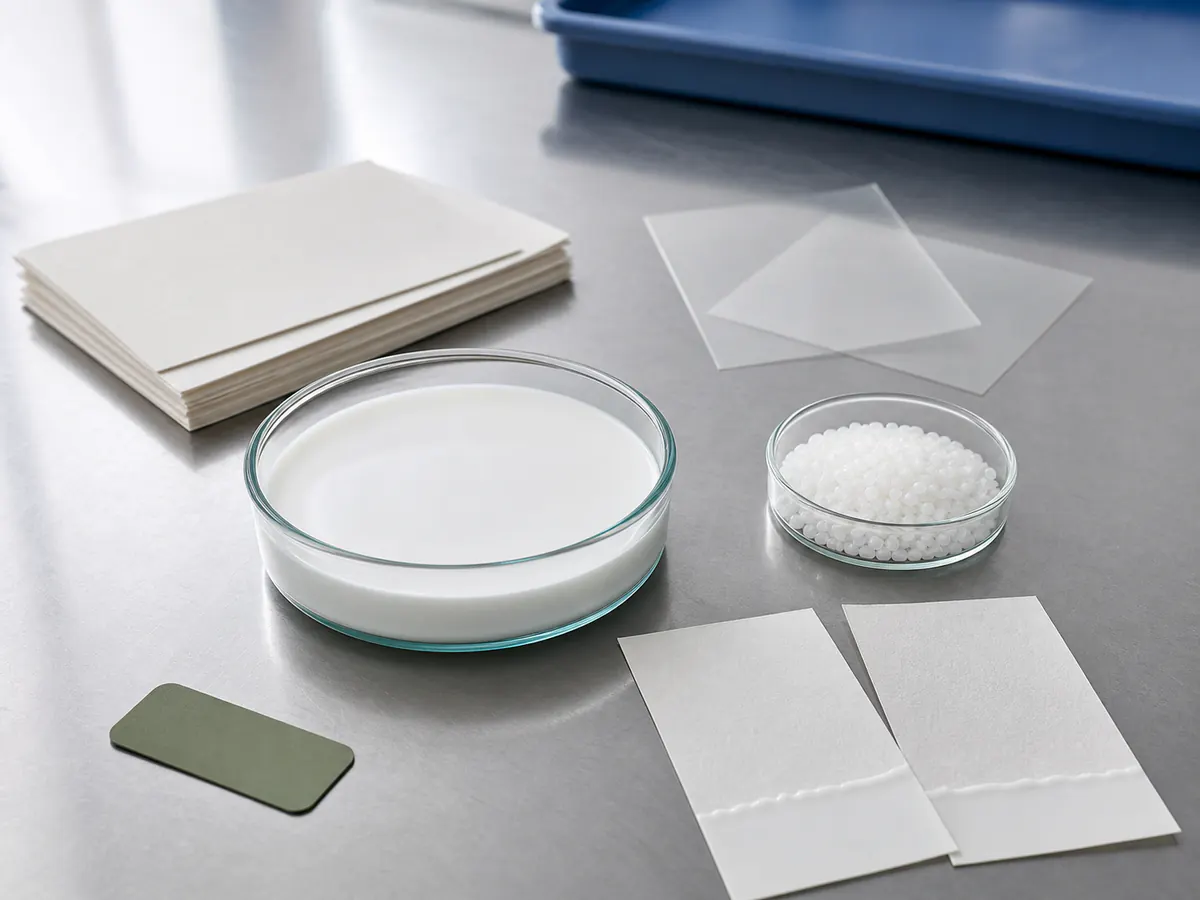












Anionic, amphoteric and nonionic systems can change dispersion, rheology and interfacial state.
BIOTEN | PERSONAL CARE
Bring functional materials into formulation, sensory profile and use experience.
Across bath, facial-cleansing, laundry and functional-care systems, BIOTEN evaluates PHA-based waterborne materials within complete formulations containing surfactants, pH modifiers, salts, fragrances, actives and packaging interfaces to define their film-forming, carrier and sensory value.

Application systemsBath · Facial cleansing · Laundry · Functional care
Material RoleFilm formation · Carrier · Sensory feel · Interface
Formulation variablesSurfactants · pH · Salt · Fragrance · Actives
Development routePersonal-care formulation development
Personal Care Applications
Material value becomes real only inside the complete formulation.
Emulsion particle size or appearance alone cannot stand in for formulation performance. The effects of surfactants, rheology modifiers, actives, fragrances and use mode on material state and experience must be observed together.
Film-formation rate, lubricity, residual feel and rinse-off behavior shape the use experience.
Hydrophilic–lipophilic balance, dispersion stability and release mode affect the formulation position of functional ingredients.
Temperature cycling, centrifugation, color, odor and viscosity change jointly form the stability evaluation.
A material logic that can be observed, decomposed and reviewed.
Place the material role, complete formulation, process conditions and application stage in one system—explain the phenomenon first, then design the experiment.
Complete formulationThe material must enter the actual surfactant, thickener, fragrance and active system
Interfacial behaviorWetting · Dispersion · Compatibility
Use processFoaming · Application · Rinse-off
Sensory outcomeFeel · Residue · Comfort
Observe continuously from material state through the use process.
The project must answer more than whether the material can be added. It must define the point and sequence of addition, shear conditions, pH window and target dosage, then connect experimental results to the final use experience.
Formulation baseSurfactants, thickeners, pH and electrolytes
Material positionFilm formation, carrier and interface regulation
Sensory evaluationSkin feel, spread, rinse-off and residue
Stability evaluationTemperature, centrifugation, color, odor and viscosity
Turn different application objects into distinct development tasks.
Each scenario has a different material role, formulation boundary and evaluation method. One generalized conclusion cannot cover every application.
Bath systems
Define the material window across foaming, spread, rinse-off and after-bath feel.
- Surfactant compatibility
- Rinse-off behavior
- Sensory design
Facial-cleansing systems
Focus on mild cleansing, refined sensory feel and the stability of actives within the complete formulation.
- Mild cleansing
- Film-forming feel
- Formulation Stability
Laundry systems
Evaluate functional materials through soil removal, dispersion, fabric contact and rinse conditions.
- Dispersion stability
- Process compatibility
- Rinse window
Functional-care carrier
Design waterborne carrier and film-forming routes for protective, soothing or other functional ingredients.
- Compatibility with actives
- Interfacial carrier
- Use evaluation
A continuous development pathway from problem brief to application conclusion.
Each step defines its input, test object and next decision so material R&D remains connected to real application conditions.
Surfactants, thickeners, actives and fragrance
Film formation, carrier or interfacial function
pH, salt, temperature and shear
Spread, foaming, rinse-off and sensory feel
Accelerated conditions and packaging compatibility
SCOPE & EVIDENCE
Material compatibility and use experience do not automatically establish efficacy or safety.
Film formation, sensory feel, rheology and formulation compatibility must be evaluated in the complete formulation, use mode, packaging and stability conditions. Human efficacy, safety, irritation, notification or target-market compliance requires the corresponding specialist validation.
- Material screening narrows the formulation route; it does not replace finished-product safety assessment.
- Public statements must be tied to the formulation object, test method, sample version and applicable scope.
Start development with the real formulation, process and problem.
Describe the application object, current system, target function, present failure and project stage. We will use them to define the minimum executable material and formulation task.