





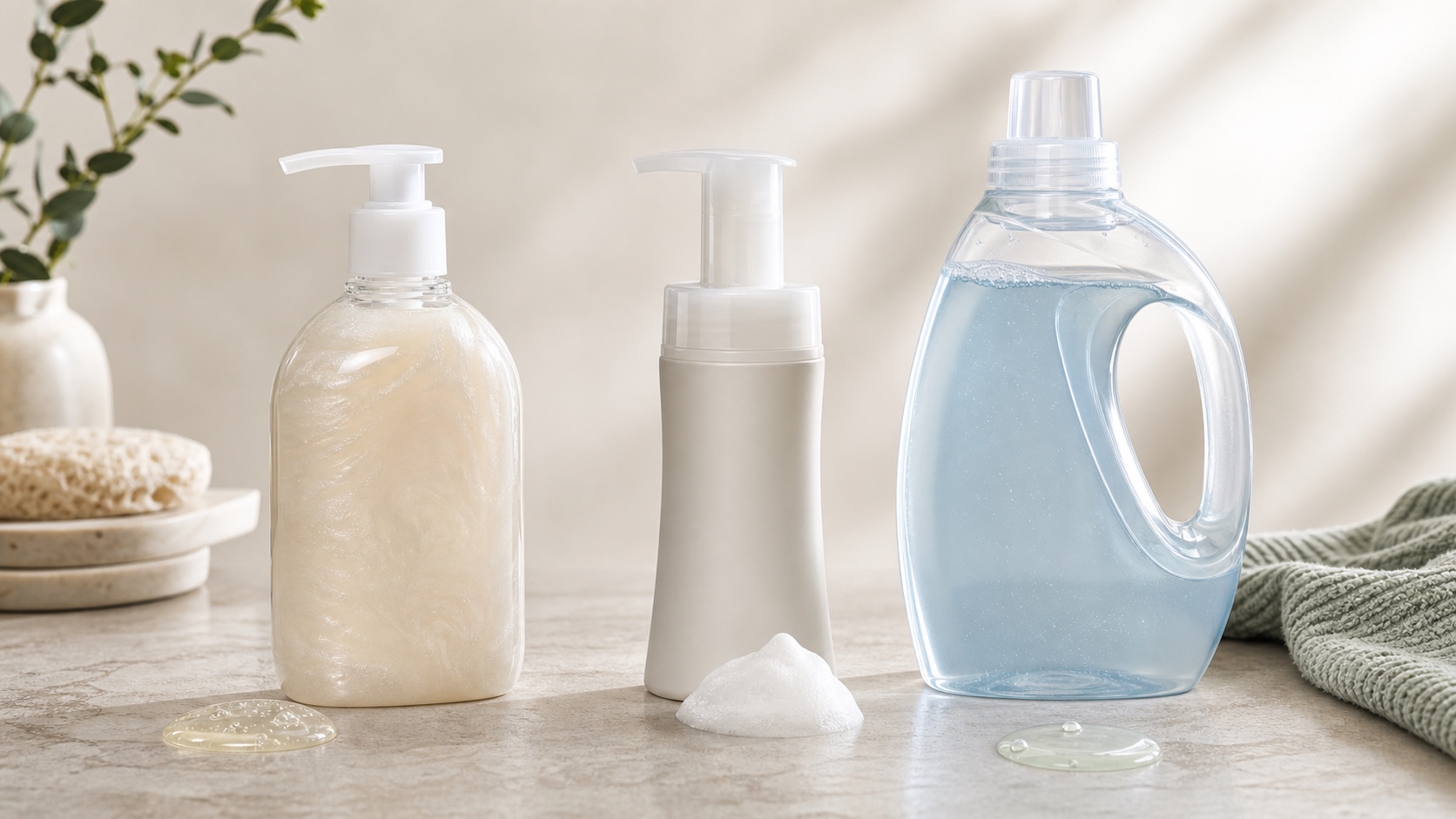

Complete recipes and techniques for bathing, cleansing, washing or functional care.
BIOTEN Developer | Cleaning and Care App
Start with the complete formula and find where the material really works.
For daily chemical formula, raw material and brand R&D teams, organize the surfactant system, pH, salt, flavor, actives, addition sequence, sensory targets and shelf stability requirements into a clear development brief.
Cleaning and care applications
First restore the complete formula environment, and then determine the actual location of the material.
The development brief needs to provide surface activity, electrolytes, pH, rheology, preservation, flavor and active ingredients, as well as the order of addition, shear temperature, current failure and sensory targets.
Anionic, amphoteric, nonionic proportions and thickening and electrolyte conditions.
The order of priority is spreading, slipperiness, rinse, residue, softness and refreshment.
Separation, flocculation, viscosity drift, color, odor or packaging compatibility changes.
Establish a minimum variable matrix around compatibility, rheology, film formation and usage experience.
Blank, existing and candidate formulations remain comparable, changing only material amounts, order of addition, or shear conditions, and simultaneously observing stability, washout, carryover, and packaging compatibility.
The addition of materials is not the end point, the recipe behavior and usage experience are.
First use the blank formula, current formula and target formula to establish a comparable baseline, and then adjust the material dosage, addition order and shearing conditions. Formula stability, usage evaluation and packaging compatibility need to be observed simultaneously.
System environmentSurface activity · pH · Salt · Thickening
Material locationFilm formation · carrier · interface
process conditionsSequence · Shear · Temperature · Time
Evaluation dimensionAppearance · Rheology · Skin feel · Stability
From formulation baseline to stability and sensory evaluation, proceed in the same version chain.
Physical and chemical stability, microscopic appearance, usage process, sensory observation and packaging compatibility are recorded separately, and no single observation is directly extrapolated into efficacy or safety claims.
Establish a true baseline
Identify sensitive variables
Dosage and adding method
Process and senses
Acceleration is compatible with packaging
Let every sensory judgment be returned to the formula version, process conditions and evaluation methods.
Project profiles also retain compatibility windows, stable trends, sensory records, packaging compatibility and unclosed safety evaluation boundaries.
Recipe Development Kit
Baseline, variant, sample, process, sensory and stability data remain version consistent.
Material positioning conclusion
Describe the material's valid positions, usage windows and limitations in the complete formula.
Evaluation plan
Connect physical and chemical stability, use process, sensory and packaging compatibility.
Start with complete formulations, sensory targets and interface failures.
Submit surfactant, electrolyte, rheology, preservative, and active ingredient conditions, as well as film formation, skin feel, rinse, or stability goals, and arrange compatibility, sensory, stability, and safety evaluation boundaries accordingly.