
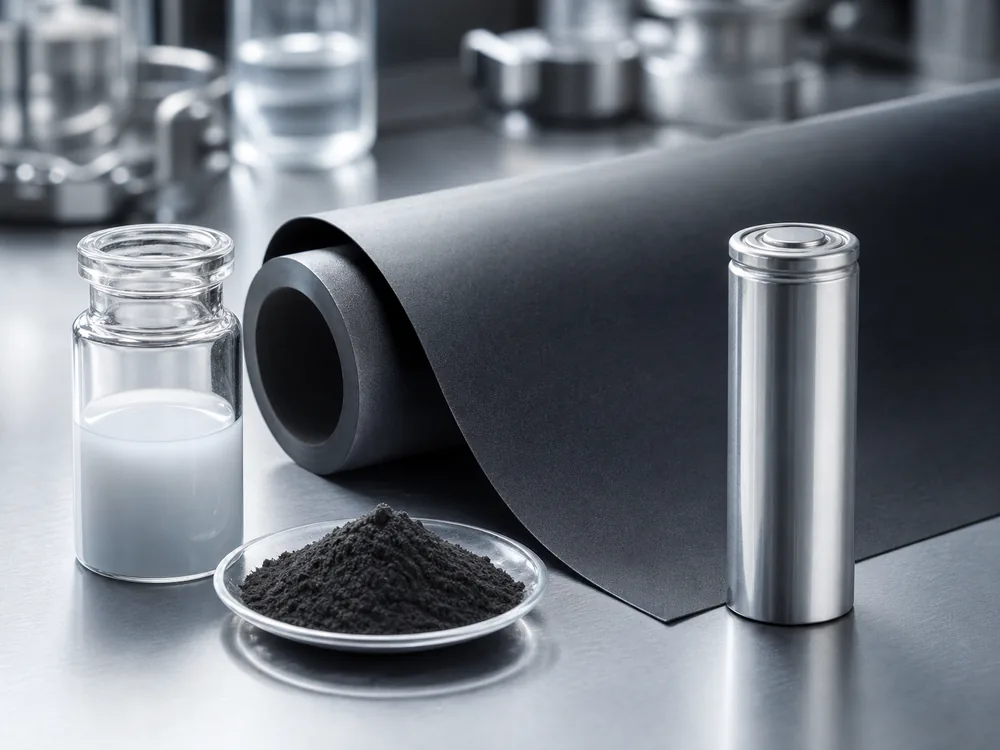













Polymer design
Build material hypotheses from functional groups, molecular weight, glass transition temperature, and dispersion state.


CASU China Science and Technology Alliance | Advanced Materials
Focusing on the water-based battery bonding system, the polymer structure, active materials, conductors, slurry dispersion, coating, drying, rolling, peeling and electrochemical evaluation are connected in series to establish a material language that can be used jointly by R&D and manufacturing.

Material structure, particle interface, slurry rheology, coating drying and electrochemical performance are coupled with each other; every judgment goes back to the same batch of materials, pole pieces and process conditions.
Build material hypotheses from functional groups, molecular weight, glass transition temperature, and dispersion state.
Observe the adsorption and bonding between the binder and active materials, conductors and current collectors.
Control dispersion, solids, viscosity, thixotropy, stability and equipment shear conditions.
Joint coating uniformity, dry migration, roll compaction and flexible peel performance.
Trace results such as rate, cycle, impedance, and expansion back to material and process objects.
Pay attention to equipment scale-up, batch stability, quality indicators and supply coordination.
Establish a research and development context based on battery material systems, functional material directions and industrial collaboration objects, allowing images to directly serve material identification and project judgment.



Submit the electrode system, active materials, slurry status, coating conditions, existing data and failure performance, and the materials and process team will establish the first round of evaluation path.
Clarify the positive and negative electrode materials, conductors and current collectors
Record solid content, viscosity, dispersion and storage stability
Create binder combinations, variables and controls
Complete coating, drying, rolling, peeling and electrical testing
Curing specifications, batch control and scale-up conditions
Starting from the existing formula, slurry data and pole piece failure, executable collaborative tasks of material screening, process verification and pilot testing are formed.