








PPWR harmonises the product baseline, while Member States turn common rules into five operating systems for responsibility, reuse, data, return and fees.
BIOTEN Observer on EU packaging governance / EU PACKAGING GOVERNANCE
PPWR now applies: how are EU Member Statesputting it into practice?
Germany puts responsible parties on a public register; France brings reuse into restaurants; Spain splits annual reporting by date; Austria uses a €0.25 deposit to bring bottles and cans back; and Denmark translates packaging design into a cost per kilogram.
1 EU product baseline · 5 national implementation perspectives · 4 business ledgers
Scope of analysis:The five countries are representative perspectives, not a complete account of all 27 Member States, a ranking or legal advice. Information was verified as of 13 August 2026.
01 · COMMON GROUND
The EU sets the baseline, but Member States still operate their own packaging systems
PPWR entered into force on 11 February 2025 and generally applies from 12 August 2026. These two dates must not be conflated. General application does not mean that labelling, recyclability grades, recycled-plastic content, packaging minimisation, reuse targets and restrictions on single-use packaging all become due on the same day.
From that date, PFAS limits apply to food-contact packaging. The first limit is25 ppb.The limit for the sum of targeted PFAS is250 ppb.The limit for total PFAS is50 ppm.This three-threshold framework applies to food-contact packaging.
Testing boundary |The EU has not yet established a harmonised PFAS test method for food-contact packaging. At this stage, the European Commission recommends a stepwise approach: screen for total fluorine, distinguish organic from inorganic fluorine, and then use methods such as Direct TOP to verify compliance with the targeted limits.
Evidence boundary |A “no intentionally added PFAS” statement, a raw-material report or a single total-fluorine screening result cannot automatically replace a complete assessment of the final food-contact packaging.
Also from 12 August, Article 6(1)—“all packaging placed on the market shall be recyclable”—begins to apply. However, harmonised design-for-recycling criteria and assessment methods still depend on subsequent delegated acts and will apply from 1 January 2030 or 24 months after those acts enter into force, whichever is later.Recyclability is now a legal principle, while the harmonised scoring framework is still being developed.
79.7 Mt
Total EU packaging waste in 2023; 177.8 kg per capita
40.4%
Share of paper and cardboard, the largest material category
67.5%
Recycling rate for all packaging waste, still below the 70% target for 2030
Europe is not starting from a perfect position. PPWR harmonises the product baseline for packaging while leaving national authorities, producer registration, EPR, collection systems, deposit return, reuse promotion and enforcement to Member States. The practical reality is therefore neither “27 product standards” nor “one EU certificate that clears all 27 countries”, but:one EU product platform combined with multiple national operating accounts.
Legislation and sources:Regulation (EU) 2025/40; European Commission PPWR implementation guidelines C/2026/3084; Eurostat 2023 packaging-waste data
02
DE / GERMANY · RESPONSIBILITY
Germany: put responsible parties on a public register first
Its first question: who is responsible?
Germany’s core action is not to dismantle the existing system, but to clarify roles on the established foundations of LUCID packaging registration, system participation and volume reporting. ZSVR states that PPWR and Germany’s new Packaging Law Implementation Act operate together from 12 August 2026 and replace the former Packaging Act. Existing basic registration and EPR obligations remain, while the responsible party changes in some own-brand, import and service-packaging scenarios.
Two roles are most easily confused:the manufacturer bears product-compliance responsibility for the complete packaging, while the producer bears the national EPR responsibility once that packaging becomes waste.The same company may hold both roles, or the roles may need to be assessed separately depending on the brand, commissioned design and route by which the packaging is first placed on the market.
For service packaging such as paper cups and food containers, “we are only the contract manufacturer” is no longer a sufficient answer. The relevant questions are who determines the structure, who influences materials and design, and who places the packaging on the market under its own name. From 12 August, a non-EU business with no German establishment that sells directly to end users in Germany must also appoint an authorised EPR representative; however, the producer must still complete its own LUCID registration.
What this means for companies |Product role, EPR role, authorised representative, LUCID status, system-participation contract and volume data must all reconcile within the same transaction chain.
Sources:ZSVR: changes from 12 August; guidance on service packaging; authorised representatives
03
FR / FRANCE · REUSE
France: bring reuse into restaurants—and put the shortfall on the table
Its first question: how can single use be reduced?
Since 1 January 2023, dine-in food-service establishments able to serve at least 20 customers at the same time have been required to use reusable cups, lids, plates, containers and cutlery. France has also set national packaging-reuse targets of 5% for 2023 and 10% for 2027.
1.82%
Overall reuse rate for all packaging in France in 2024
10%
National packaging-reuse target for 2027
2.75 billion units
Approximate number of reusable packaging units placed on the market in 2024
Moving from 1.82% to 10% is not achieved simply by replacing a single-use cup with a heavier cup. It requires simultaneous improvements in container standardisation, in-store take-back, washing capacity, transport radius, loss control and the actual number of reuse cycles.
The latest adjustment to France’s EPR scheme for professional packaging illustrates the same logic. The new scheme, originally scheduled to operate from 1 July 2026, was officially deferred to 1 January 2027 because the identification of responsible parties and the fee structure were not ready. This is neither a delay to PPWR nor a suspension of all French EPR. It is a specific national scheme completing its interfaces before formal charging begins.
Implementation watch |Reuse is first and foremost an infrastructure and operating challenge. The real indicators are return rate, number of rotations, loss rate, washing radius and cost per cycle.
Sources:French rules on reusable tableware for dine-in service; ADEME 2024 data; adjustment to professional-packaging EPR
04
ES / SPAIN · DATA
Spain: write the regulation’s dates into annual reporting
Its first question: who reports how much, and for which dates?
Producers in Spain must enter the national Product Producers Register (RPP) and report the volume of packaging first placed on the Spanish market in each calendar year. Because PPWR changes the status of some “producers” from 12 August, the authorities do not simply require every company to report the full year. Instead, they divide 2026 into three cases according to changes in the responsible party.
Producer throughout the year |Report the period from 1 January to 31 December 2026.
No longer a producer after 12 August |Report only the period from 1 January to 12 August.
Becomes a producer only after PPWR applies |Report the period from 13 August to 31 December.
The reporting window runs from 2 January to 31 March 2027. Companies therefore cannot ask only, “How much packaging did we sell in 2026?” They must also ask:For each batch of packaging, who was the producer under the rules in force when it was first placed on the market?
Spain also brings e-commerce platforms into advance verification. Before allowing a producer to use a marketplace, the platform must verify RPP registration information and the declaration of EPR compliance, and it may consult the government’s public list of producers. The list dated 31 July 2026 is already online; an automated query interface is still under development.
What this means for companies |Compliance data is becoming specific to the entity, date and quantity. Orders, first-placement dates, registration status and annual volume declarations must correspond with one another.
Sources:Spain’s MITECO: RPP registration, 2026 reporting and platform verification
05
AT / AUSTRIA · RETURN
Austria: €0.25 to bring bottles and cans back
Its first question: how can packaging actually be returned?
Since 1 January 2025, plastic beverage bottles and metal beverage cans from 0.1 to 3 litres within the scope of the scheme have been subject to a one-way packaging deposit of €0.25 per item. Consumers recover the deposit only when they return an empty container bearing the Austrian deposit mark to a reverse-vending machine or return point.
€0.25
Uniform deposit for each eligible bottle or can
81.5%
Actual first-year return rate reported by the system operator
1 billion+
Bottles and cans returned in the first ten months of operation
A €0.25 deposit may be small, but it simultaneously gives consumers a reason to retain the container, enables identification, encourages return, improves material purity and creates a stable feedstock stream.
Austria also assesses “whether it came back” separately from “whether it is easy to recycle”. In March 2026, the system operator reported an average recyclability rate of 99.5%, calculated by weight of recyclable components for packaging covered by the scheme, and an average recycled-plastic content of more than 60% in one-way plastic bottles placed on the market. Both figures are operator disclosures based on registration and assessment data and should not be extrapolated to all packaging in Austria.
Important boundary |The 99.5% figure describes structural recyclability; 81.5% describes the actual return rate. Being designed for easy recycling does not mean a package has actually been returned by the consumer.
Sources:Austrian government deposit rules; first-year return rate; disclosures on recyclability and recycled plastic
06
DK / DENMARK · COST
Denmark: translate packaging design into a cost per kilogram
Its first question: what will this packaging ultimately cost?
From 1 January 2025, all packaging-material categories were brought within the producer-responsibility registration scope after categories such as ceramics, cork, porcelain and textiles were added. The practical start date for extended packaging EPR was 1 October 2025. New entrants must in principle register nationally no later than 14 days before placing packaging on the market and subsequently report volumes annually.
Layer one |DPA charges a one-off registration fee and an annual administration fee calculated by volume to fund registration, allocation and system maintenance.
Layer two |Responsibility for collecting, sorting and treating packaging waste operates through collective schemes and the national allocation mechanism. Eco-modulated fees are linked to the design, material composition and recyclability difficulty of the specific packaging.
In the past, removing 1 g of material meant calculating mainly the savings in purchasing and transport. Companies must now continue asking: what material category does that 1 g belong to? How many kilograms are placed on the market annually? Which grade applies under the eco-modulation criteria? What registration, collection and treatment costs will result?
Packaging is therefore no longer merely a purchasing cost. It is an operating responsibility that design, supply-chain, finance and environmental teams must calculate together. The measure of success is not only whether the “material is greener”, but whether material classification, weight data, fee grades, collective-scheme invoices and actual waste costs form a closed loop.
Important boundary |January 2025 marks the expansion of material-category coverage; 1 October 2025 marks the practical start of extended EPR. DPA administration fees are not the same as the total cost of waste treatment.
Sources:Danish DPA registration; DPA fee guidance; eco-modulated fees; the 1 October 2025 operating milestone
07 · FIVE OPERATING MACHINES
Five countries, not five separate stories, but one operating chain
DEResponsibility system |Who is responsible?
FRReuse system |How can single use be reduced?
ESData system |Who reports how much, and for which dates?
ATReturn system |How can packaging actually be returned?
DKCost system |How does responsibility enter operating cost?
The five systems are not legal categories under EU law, but the comparative framework used in this article. Together they perform five basic functions: identify the responsible party, calculate packaging volumes, attach costs to responsibility, build collection or reuse infrastructure, and use data to demonstrate outcomes.
PPWR harmonises the baseline for packaging entering the market. Member States operate the national systems through which packaging is registered, measured, charged and taken back.
08 · BUSINESS RESPONSE
For Chinese companies: move from one test report to four auditable ledgers
Material composition, food-contact testing, heavy-metal reports, physical performance and evidence of recycling or compostability within a defined scope remain important, but they do not cover all product rules and national operating obligations. A more robust approach is to maintain one EU master technical file and four auditable ledgers for each destination country.
01 / PRODUCT
Complete packaging product ledger
Define the packaging hierarchy, components, materials and weight BOM at final-packaging-unit level. Record the paper, barrier layer, inks, adhesives, labels and sealing structure; retain evidence of product roles, technical documentation, declarations of conformity, PFAS and food-contact compliance, recycling pathways and version changes.
02 / RESPONSIBILITY
Member State responsibility ledger
Determine country by country who is the EPR producer, whether an authorised representative is required, the registration number, which scheme is joined, and who reports and pays. The EU technical file can be reused, but German LUCID, Spanish RPP and Danish registration evidence cannot substitute for one another.
03 / QUANTITY
Material quantity and cost ledger
Record each SKU’s component weights, material categories, annual volume placed on the market, reporting period, fee version, collective-scheme invoices and change dates. Volume data should link to the BOM, orders and first-placement records in the destination country.
04 / END-OF-LIFE
End-of-life pathway evidence ledger
Explain how the packaging is identified, collected, returned, sorted, reused or recycled in the destination country. Distinguish four states: “recyclable by design”, “actually collected”, “recycled at scale” and “incorporated into new products”.
Connect the four ledgers through a change-control system:Whenever paper grammage, barrier formulation, coat weight, ink, adhesive, factory, intended use, brand or sales route changes, the company should be able to determine which tests, declarations, roles, fees and country-specific actions must be repeated.
09 · PAPER PACKAGING
The opportunity for paper packaging is not that “paper automatically replaces plastic”
Paper-based, water-based, bio-based, biodegradable, compostable, repulpable, recyclable, food-contact safe and PPWR-compliant are distinct evidence pathways. None can be inferred automatically from a material name.
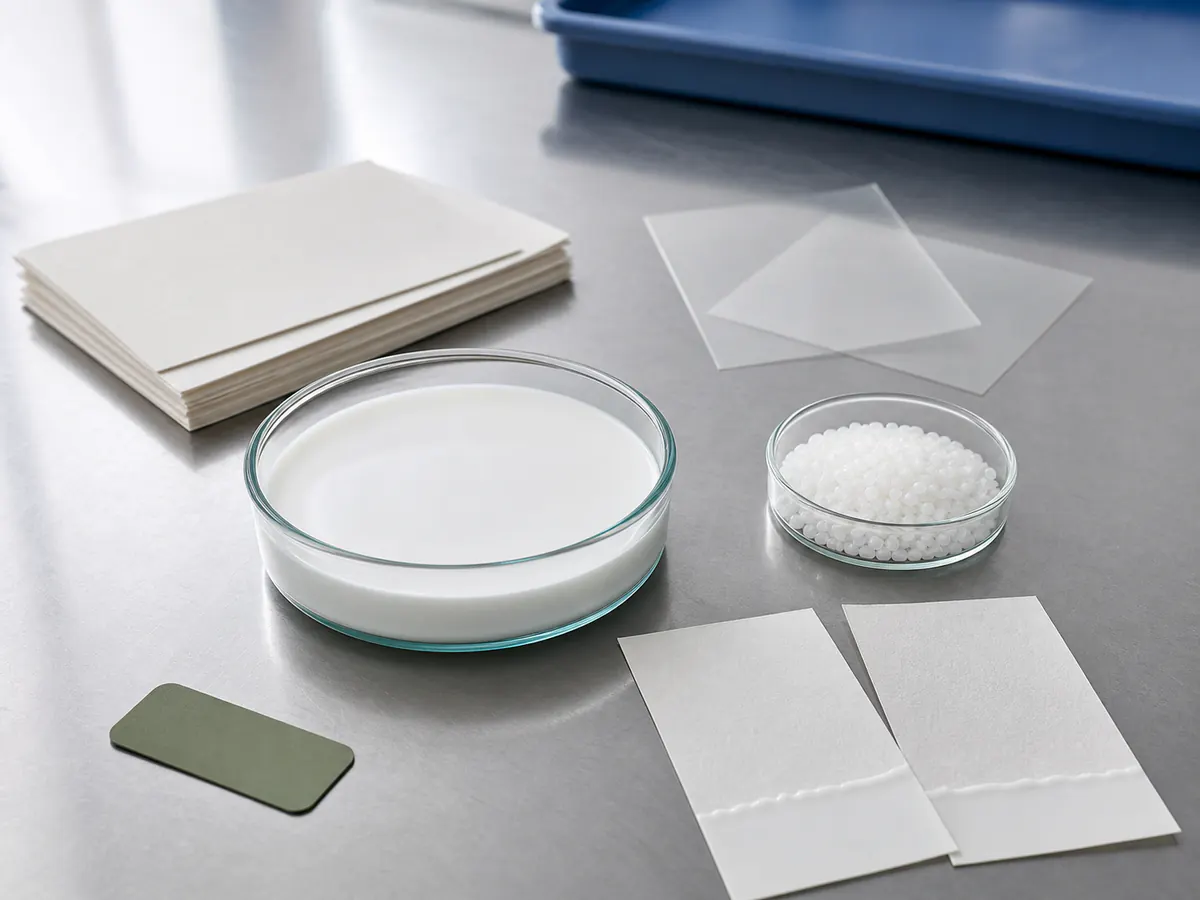
The real opportunity is to reduce unnecessary material and hard-to-separate structures while meeting barrier, sealing, mechanical-strength, food-contact and shelf-life requirements—and to ensure that the final packaging is recognised by the collection, sorting and recycling systems of the target market. Water-based barriers or bio-based functional systems containing PHA may enable downgauging, functional integration or material substitution in specific structures, but their value must be demonstrated step by step fromspecific formulation—coating—coated paper—final packagingmust be demonstrated at each stage.
Stress test one |Even if a structure reduces plastic, its system value is not established if it introduces additional hard-to-separate composite layers.
Stress test two |Laboratory repulpability does not prove recycling at scale if the destination country lacks the corresponding collection and sorting route.
Stress test three |Reusable packaging cannot deliver reuse value without take-back, washing and circulation networks.
The opportunity belongs to companies that can do three things at once: deliver the required function, provide the data, and return the packaging to the system.
CONCLUSION
PPWR is not a certificate; it is a European operating system
What is already in place is the common EU product baseline. What is now taking effect is the national implementation capacity represented by Germany’s public responsibility register, France’s reuse infrastructure, Spain’s date-based reporting, Austria’s deposit return and Denmark’s fee modulation. Still to be delivered are phased outcomes such as harmonised labelling, full recyclability assessment, reuse at scale, collection rates, data quality and subsequent enforcement.
The most positive and profound aspect of this change is that packaging competition is moving from “what is the material called?” to “can the system handle it?”. Packaging that can enter the European market reliably in future must be:identifiable, measurable, accountable, recyclable and verifiable.
Companies do not need an unrelated product design for each of the 27 Member States, but they do need one EU master technical file connected to each destination country’s responsibility, registration, fee and recycling interfaces. Those that first turn these interfaces into repeatable organisational capabilities are more likely to convert compliance cost into customer trust and long-term order capability.
BIOTEN Packaging will continue to examine the real interfaces between paper, functional materials, packaging design and Europe’s collection, reuse and recycling systems. Our criteria remain unchanged: has progress actually occurred, how is industrial value created, and which data and operating indicators demonstrate it?
BIOTEN Packaging · Industry insights · Research note
This article is based primarily on public information from EU legislation, European Commission implementation guidelines, Eurostat, Member State governments, regulators, statutory registries and deposit-system operators, verified as of 13 August 2026. EU legislation and government or regulatory sources are treated as primary evidence. Austria’s return-rate, recyclability and recycled-content figures are expressly identified as operator disclosures and are not extrapolated to all packaging.
The five-country sample is not a complete compliance checklist for all 27 Member States and does not constitute legal advice. Dynamic fee rates, producer status, authorised representatives, registration fields, labels, deposit scope and national penalty rules should be verified again before actual market placement and formal release. “Five operating systems” and “four ledgers” are analytical frameworks used in this article, not statutory EU terms or prescribed forms.
This article was prepared by BIOTEN Packaging from public information and does not treat any potential commercial relationship as factual evidence. Paper-based, water-based, bio-based, biodegradable, compostable, repulpable, recyclable, food-contact safety and PPWR compliance are separate evidence pathways; materials, coatings, coated paper and final packaging must also be substantiated separately.
Data and verification sources
Common EU rules |Regulation (EU) 2025/40; European Commission implementation guidelines C/2026/3084; Eurostat packaging-waste statistics.
Germany and France |Germany’s ZSVR transition arrangements; French dine-in rules; ADEME reuse data.
Spain |MITECO producer registration and 2026 reporting guidance.
Austria |Government deposit rules; operating data and assessment boundaries.
Denmark |DPA packaging registration; Danish Environmental Protection Agency producer-responsibility guidance; extended-EPR operating milestones.
Read Original