











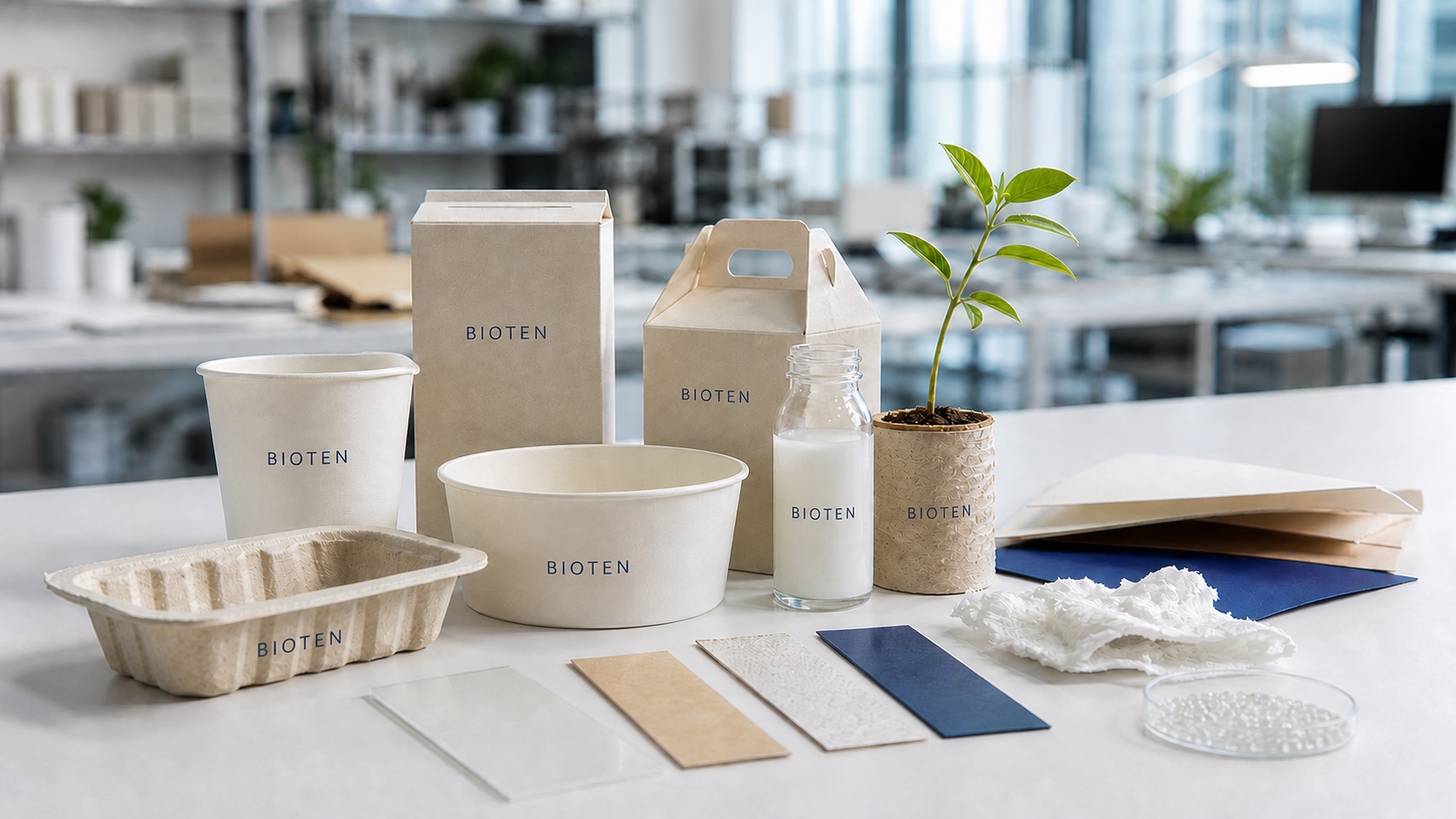


Paper & Packaging Weekly Roundup: Week 34 of 2026
This Week, Competition in Paper and Packaging Entered a New Phase
Starbucks is offering US$100,000 for a cold-cup solution, 380,000 tonnes of softwood pulp capacity has been idled, and one paper producer has issued an RMB 4 billion profit outlook. These seemingly separate developments are moving competition in paper and packaging from “who can produce” to “who can deliver proven outcomes.”
Materials and Sourcing
01 | Starbucks Offers US$100,000 for a Transparent, Plastic-Free Cold Cup: Why Is It So Difficult?
Starbucks has launched a global cold-cup innovation challenge through InnoCentive, with a US$100,000 award and a submission deadline of 14 September. It is not looking merely for a “more sustainable cup”, but for an integrated cup-and-lid solution that can enter a real-world supply chain.
According to the project criteria, a target solution must simultaneously provide high transparency—with haze of no more than 5%—meet the challenge’s definition of “plastic-free”, be compostable, comply with food-contact requirements in the target markets, have no odour, withstand short-term heat exposure, remain leak-free after holding liquid for 24 hours, survive a one-metre drop when filled with ice water, and demonstrate manufacturing potential at a scale of at least several hundred tonnes per year.
The difficulty is that these requirements are not naturally compatible. Transparency generally relies on a uniform, dense material structure; barrier performance, heat resistance and rigidity often require more complex formulations or structures; and compostability, compatibility with existing equipment and cost at scale further narrow the available options. A cold cup is therefore no longer an ordinary packaging item, but an integrated engineering challenge spanning materials, forming, food contact, consumer experience and end-of-life treatment.
“Plastic-free” also requires precise interpretation. Here it is a screening criterion defined specifically for this challenge and is narrower than common market claims such as “bio-based” or “compostable”. It should not be extrapolated into a blanket rejection of material routes such as PLA or PHA. Each material still needs to be evaluated against its intended use, applicable regulations and available end-of-life conditions.
For Chinese materials and packaging companies, brand procurement is shifting from “What material is it?” to “Can you provide a complete evidence package for the final SKU?” Food-contact compliance, stable barrier and heat-resistance performance, equipment compatibility, unit cost, and recycling or treatment pathways must all be addressed in one validation package. If any element is missing, a solution will often remain at the sample or pilot stage and struggle to enter a long-term procurement catalogue. The published criteria combine several requirements that constrain one another; whether a solution can enter an actual procurement system will therefore depend on materials, manufacturing, compliance, cost and end-of-life pathways forming a verifiable, integrated loop.
Key Qualification Requirement
Food contact, barrier performance, equipment compatibility, cost and end-of-life pathways must all work at the same time.
Research sources:InnoCentive | Starbucks Global Cold Cup Innovation Challenge; yet2 | Detailed challenge criteria.
Supply and Cost
02 | 380,000 Tonnes Idled: Not a Turning Point, but a Contraction at the Margin of the Cost Curve
On 20 August, Domtar announced the indefinite idling of its Howe Sound pulp mill in Canada and the associated chip facility. The company said the decision would remove approximately 380,000 tonnes per year of northern bleached softwood kraft (NBSK) pulp from market supply, citing weaker demand in Asia, persistently poor global pulp pricing and reduced availability of affordable fibre in the region.
The most useful interpretation is not that “380,000 tonnes have disappeared, so pulp prices will reverse immediately”. The indefinite idling of a mill first indicates that current prices are insufficient to justify continuing to exchange cash for output at that asset. It changes the margin of the cost curve rather than instantly rewriting the global supply-demand balance for market pulp.
For Chinese paper mills and traders, the next step should not be to watch only futures screens or regional averages. Four variables deserve continuous monitoring: arrivals of imported softwood pulp and port inventories; the spread between comparable import offers and domestic prices; whether other high-cost North American assets follow with downtime; and whether Howe Sound is ultimately restarted, sold or permanently closed. Whether furnish substitution is viable must still be assessed against the specific grade, quality requirements and end-use application.
What to Watch
Whether high-cost supply continues to contract—starting with inventories, price spreads and the status of comparable capacity.
Research sources:Domtar | Announcement of the indefinite idling of Howe Sound.
Profit and Cash
03 | RMB 4 Billion in Profit: Rising Paper Prices Do Not Mean Profits Have Fully Returned
Nine Dragons Paper issued a positive profit alert on 20 August. For the year ended 30 June 2026, the group expects profit of approximately RMB 3.9–4.1 billion, an increase of 77.1%–86.2% year on year. The company’s explanation is straightforward: sales volume increased, while product selling prices rose faster and by more than raw-material costs, improving gross profit.
That explanation is more informative than the headline profit increase. A recovery is sustainable only when comparable net selling prices outpace costs without sacrificing orders, extending payment terms or tying up more cash. Higher paper prices, improving industry quotations and company profit growth are related measures, but none can substitute for the others.
For board, carton and other packaging converters, the most useful discipline is a weekly review of four indicators: realised transaction prices after increases, changes in downstream orders, inventory turnover for both base paper and finished goods, and accounts receivable together with operating cash flow. The first two show whether customers have accepted the higher prices; the latter two show whether profit has actually returned to the balance sheet and cash account.
Research sources:Nine Dragons Paper | Positive profit alert.
System-Level Competition
04 | Fibre Trays and Recycled PET: System-Level Competition Has Begun
Cirkla has announced plans to build a moulded-fibre fresh-meat packaging plant in Georgia, United States, with production scheduled to begin in the first quarter of 2027. Its published concept does not pit an uncoated “bare fibre” tray against modified-atmosphere packaging for fresh meat. Instead, it combines a fibre tray, a high-barrier liner, heat sealing and a design that allows the components to be separated. The company’s claims regarding plastic reduction and shelf life still need to be validated for specific SKUs, test conditions and local recycling pathways, but the route itself makes one point clear: the further paper-based packaging moves into high-performance applications, the more it must be engineered as a barrier system.
In the same week, Suntory, Indorama Ventures and Iwatani announced a bottle-to-preform recycled-PET project in Thailand. The planned facility will have annual capacity equivalent to approximately 400 million recycled-PET preforms and is expected to supply Suntory PepsiCo Beverage Thailand from 2028. Plastic packaging is not standing still while it waits to be replaced; it is also using closed-loop recycling, shorter processing routes, brand procurement and scale manufacturing to reduce system costs.
This provides a more mature frame for the “paper replacing plastic” debate. Paper should not be forced into applications where it cannot reliably deliver safety, barrier performance or supply; plastics should not use mature performance as a reason to ignore circularity and compliance pressures. The competition is not between material camps, but between technology routes seeking to deliver the same packaging service at the lowest total system cost.
Research sources:Cirkla | U.S. moulded-fibre fresh-meat packaging project; Suntory | Thailand bottle-to-preform recycled-PET project.
Rules and Exports
05 | PPWR and Canada’s New Investigations: Evidence Must Follow the Final SKU
The EU Packaging and Packaging Waste Regulation (PPWR) has been generally applicable since 12 August and covers all packaging placed on the EU market, regardless of material or origin. Restrictions on PFAS above specified thresholds in food-contact packaging have also reached their application date; this does not mean that every requirement scheduled for 2030—covering recyclability, recycled content, minimisation and reuse—has taken effect at the same time.
For paper-based food packaging, customers will ask increasingly specific questions: Where does the barrier performance come from? What is present in the coating, inks and adhesives? Can the final packaging unit be supported by evidence on composition, testing, supply chain and structure? “Paper-based”, “biodegradable” and “plastic-free” are no longer stand-alone passports to market.
On 17 August, the Canada Border Services Agency initiated dumping and subsidy investigations into certain paperboard cups and containers from China, extending the same evidence logic to exports. Initiation does not mean that duties have been imposed, but exporters should first verify the product definition, coated-paperboard structure, formed blanks and documentation chain before modelling possible duty scenarios. Product scope and documentation quality often shape the quality of a response well before a final determination is announced.
Documentation Focus
Composition, coatings, inks, adhesives, testing and the documentation chain must all be tied to the final SKU.
Research sources:European Commission | PPWR packaging-waste rules; European Commission | PPWR frequently asked questions; CBSA | Notice of initiation for paperboard cups and containers; CBSA | Investigation schedule.
Paper Talk | Reading the Data: Four Ledgers the Value Chain Must Now Keep
An idling of 380,000 tonnes is not, by itself, proof of a pulp-price reversal, and RMB 4 billion is not the profit statement of an entire industry. Starbucks’ 5%-haze cold cup, the requirement to remain leak-free for 24 hours, and capacity for 400 million recycled-PET preforms all point to the same conclusion: the next round of competition will not be decided by a single material, but by who can deliver resources, pricing, performance and evidence together.
The most useful takeaway this week is not that “the industry is improving across the board”, but that the priority of four business ledgers has changed:
Resource ledger:Do not look only at today’s price; assess whether fibre will remain available, substitutable and reliably deliverable over time.
Price ledger:Do not look only at price-increase letters; assess net realised price, orders, collections and cash.
Performance ledger:Do not look only at material specifications; determine whether the final SKU can consistently satisfy safety, processing, user-experience and end-of-life requirements.
Evidence ledger:Do not rely on a single declaration; map composition, testing, structure, supply chain and market rules item by item.
The companies that first turn these four ledgers into a feedback loop from raw materials to end of life will be better positioned to win stable orders through the next cycle of price volatility, customer screening and tightening rules. Paper, plastics and bio-based materials each retain applications in which they perform best. Industrial progress is not about eliminating one material, but about using every material where it can deliver sustainable value.
BIOTEN Packaging | Industry Insights | Research Note
This article was independently researched and compiled by BIOTEN Packaging from company announcements, regulatory and trade-remedy materials, brand open-innovation pages and publicly available project information. It is intended solely for research and learning across the paper and packaging value chain and does not constitute investment, procurement, customs, trade-remedy or transaction advice. If you have comments concerning the content, data or rights involved, please leave a message requesting a correction, clarification or removal. We will review the request within 24 hours of receipt.
BIOTEN Observer Data and Verification Sources
Domtar | Announcement of the indefinite idling of Howe Sound
Nine Dragons Paper | Positive profit alert
InnoCentive | Starbucks Global Cold Cup Innovation Challenge
Yet2 | Detailed criteria for the Starbucks challenge
Cirkla | U.S. moulded-fibre fresh-meat packaging project
Suntory | Thailand bottle-to-preform recycled-PET project
European Commission | PPWR packaging-waste rules
European Commission | PPWR frequently asked questions
Canada Border Services Agency | Notice of initiation for paperboard cups and containers
Canada Border Services Agency | Investigation schedule for paperboard cups and containers