











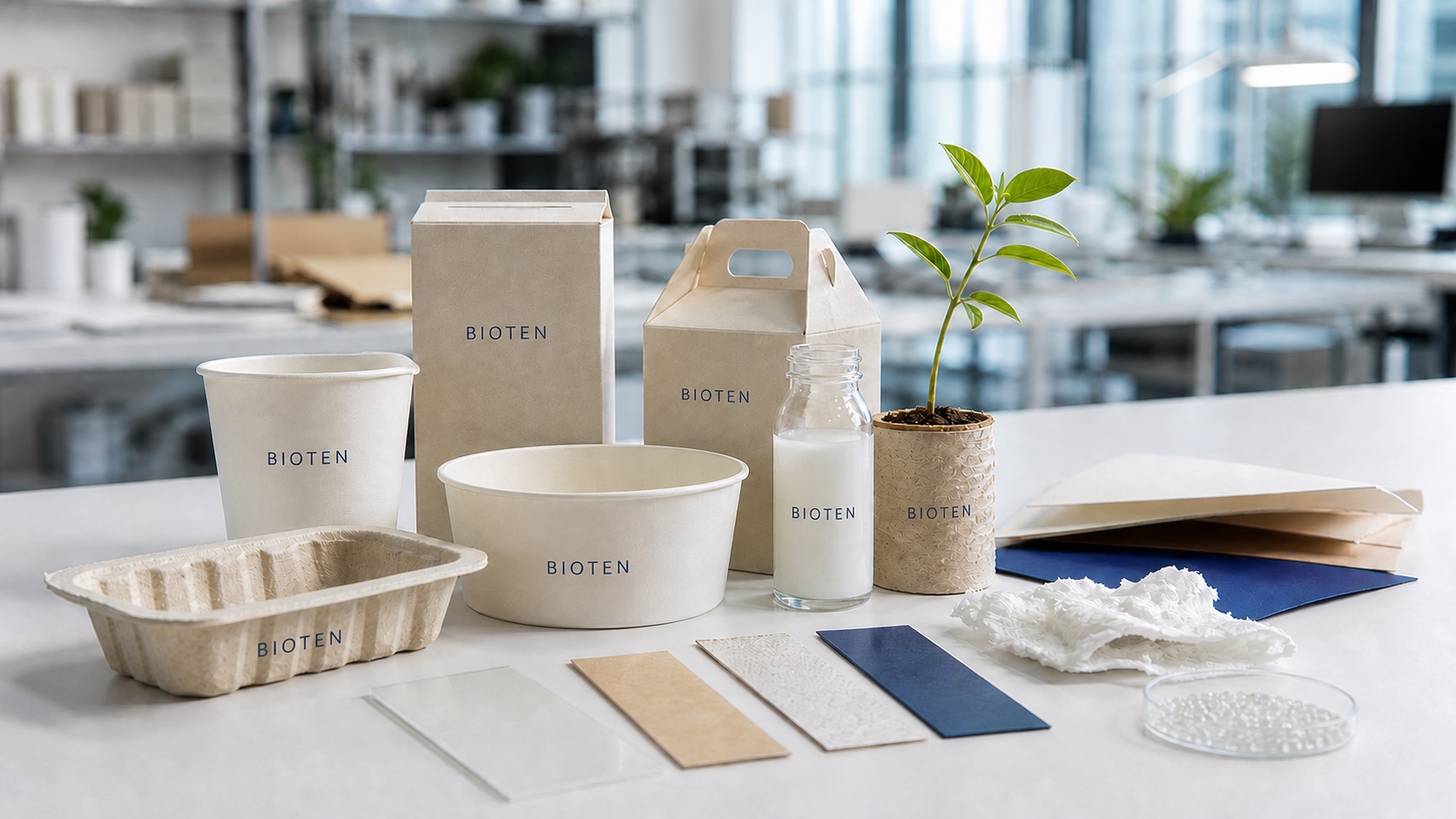

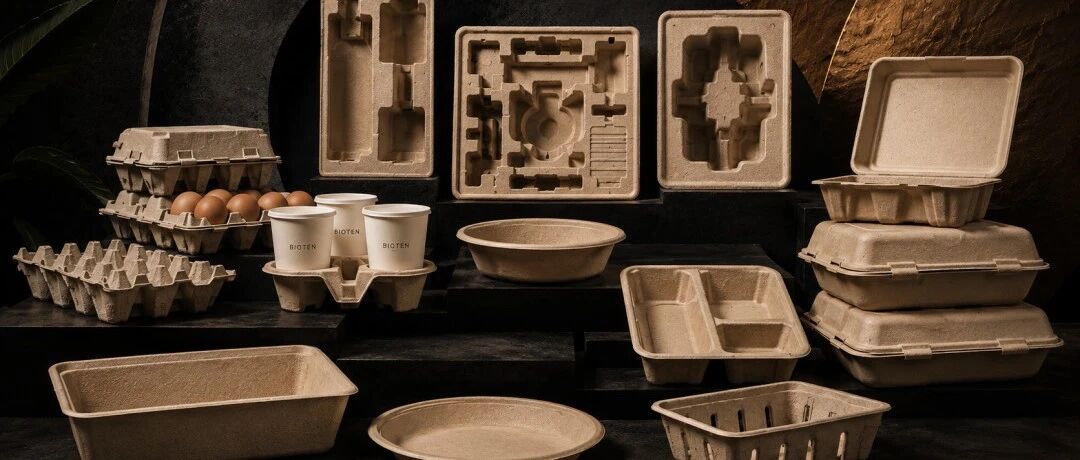
Molded fiber capacity is expanding, but higher output does not automatically create more value. Nearly 79% of manufacturers participating in IMFA’s global benchmarking survey expect production to increase in 2026. Yet more volume does not mean that profit and cash flow will rise in step. Moving from high-volume products such as egg and fruit trays into precision protective inserts, demanding food packaging, and foodservice items requires manufacturers to pass four gates at once: food-contact compliance, real-use performance, a complete bill of materials (BOM), and reliable delivery.
Higher output does not mean that profit and cash flow will rise in step. Moving from egg and fruit trays into high-performance food packaging requires manufacturers to pass four gates: food-contact compliance, real-use performance, a complete bill of materials, and reliable delivery.
2026 · THREE EVIDENCE COORDINATES
IMFA | Manufacturers participating in the inaugural benchmarking survey
Nearly 79% Expect production to increase in 2026
Huhtamaki Fiber Packaging | H1 2026 segment figures
+6% Comparable net sales growth +28% Adjusted EBIT
ZX Packing Group | H1 2026 company figures; report unaudited
+33.70% Operating revenue
+66.61% Net profit attributable to shareholders of the listed company
RMB 163 million Net cash generated from operating activitiesDown 34.44% year on year, but still positive
Although all three operate in molded fiber, high-volume supply, customer-certified industrial packaging, and high-performance food packaging do not share the same profit model. The closer an application comes to food contact, the more responsibility shifts to the coating and the finished article.
The IMFA figure reflects expectations among participating manufacturers; Huhtamaki reports segment data; and ZX Packing Group reports company-level financials. Concept validation, equipment orders, and commercial production are presented as separate stages and are not combined into an industry growth rate.
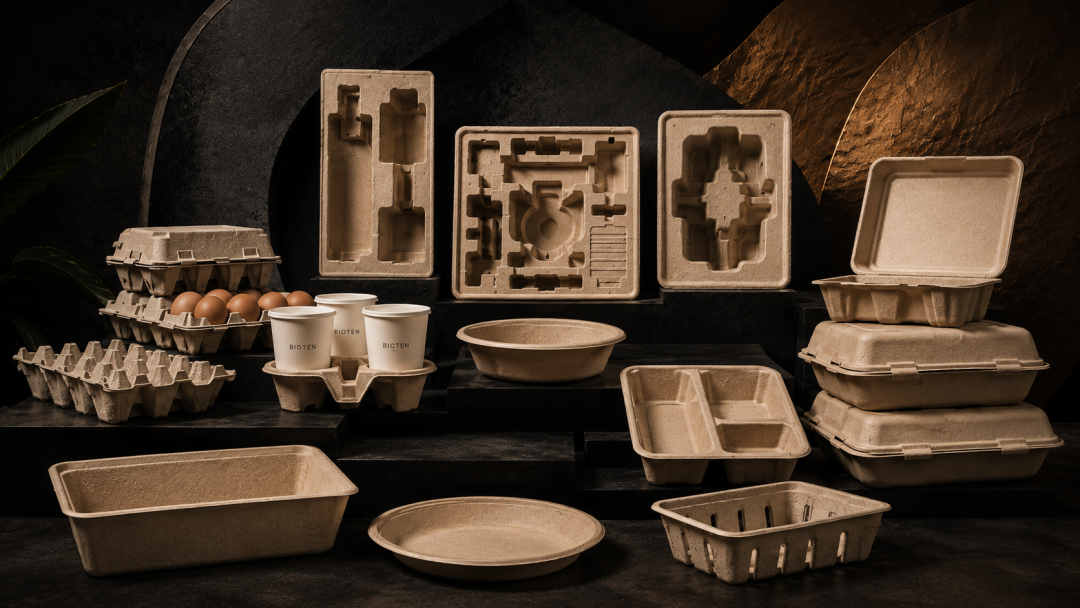
These three datasets cannot be added together to produce a single industry growth rate. Together, however, they show that manufacturers expect higher output, a global company’s segment performance is improving, and a Chinese producer’s sales are growing. Whether profit and cash flow improve at the same pace remains a separate question.
Applications are also on different tracks. Chinese foodservice items are already supplied at scale; dry-molded-fiber coffee lids are in commercial production in Malaysia; Sweden is investing in equipment for fiber-based snus cans; fiber bottle caps remain under development; and an Australian fresh-meat tray is still at the concept-validation stage.
The first growth phase broadened the range of applications. The second must answer how food packaging can convert performance, compliance, and reliable delivery into profit and cash flow.
Sources:IMFA global benchmarking report; Huhtamaki Half-yearly Report 2026; ZX Packing Group Half-year Report 2026; BIOTEN Developer.
01 · APPLICATION STAGES
The first growth phase: four application stages beyond egg trays
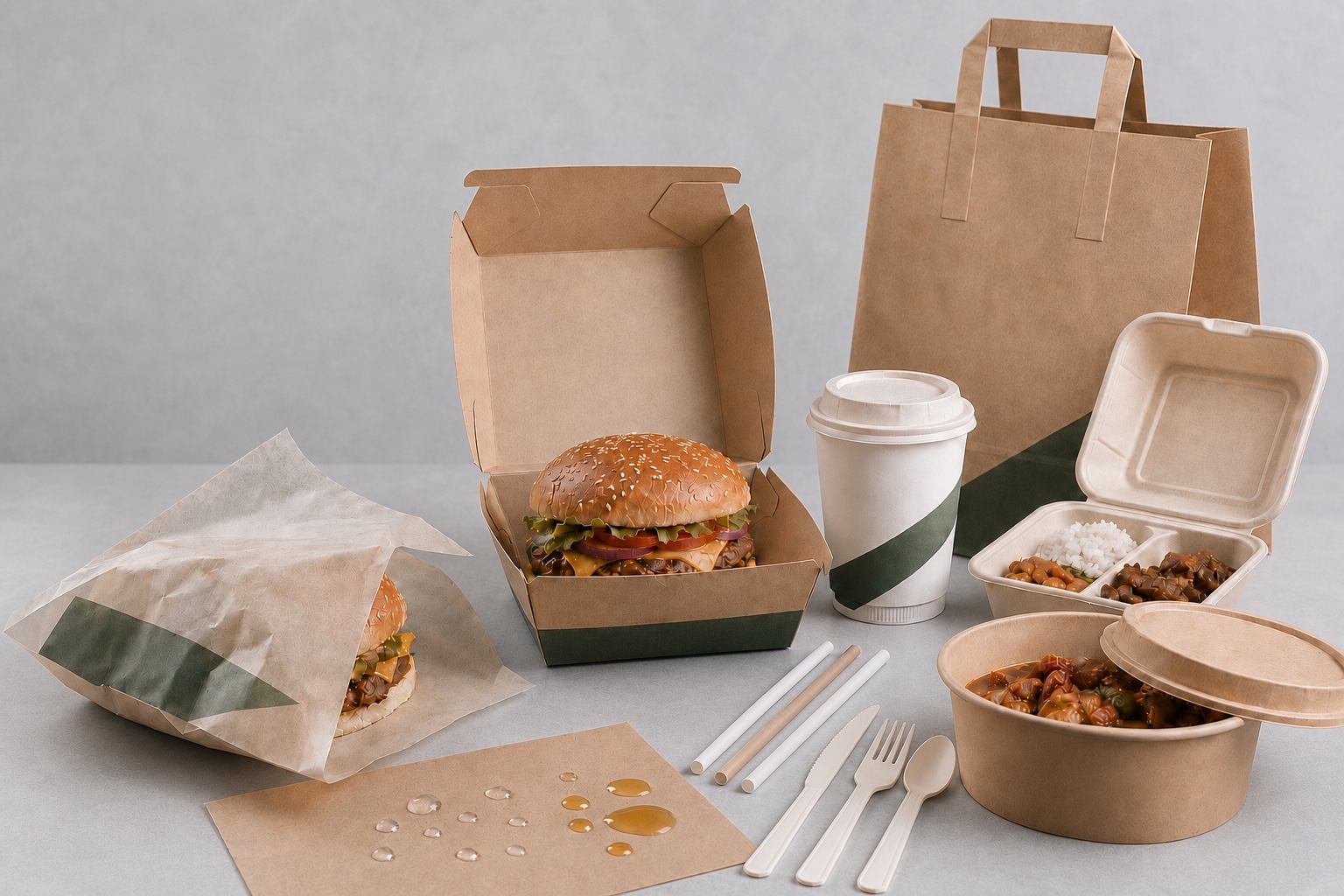
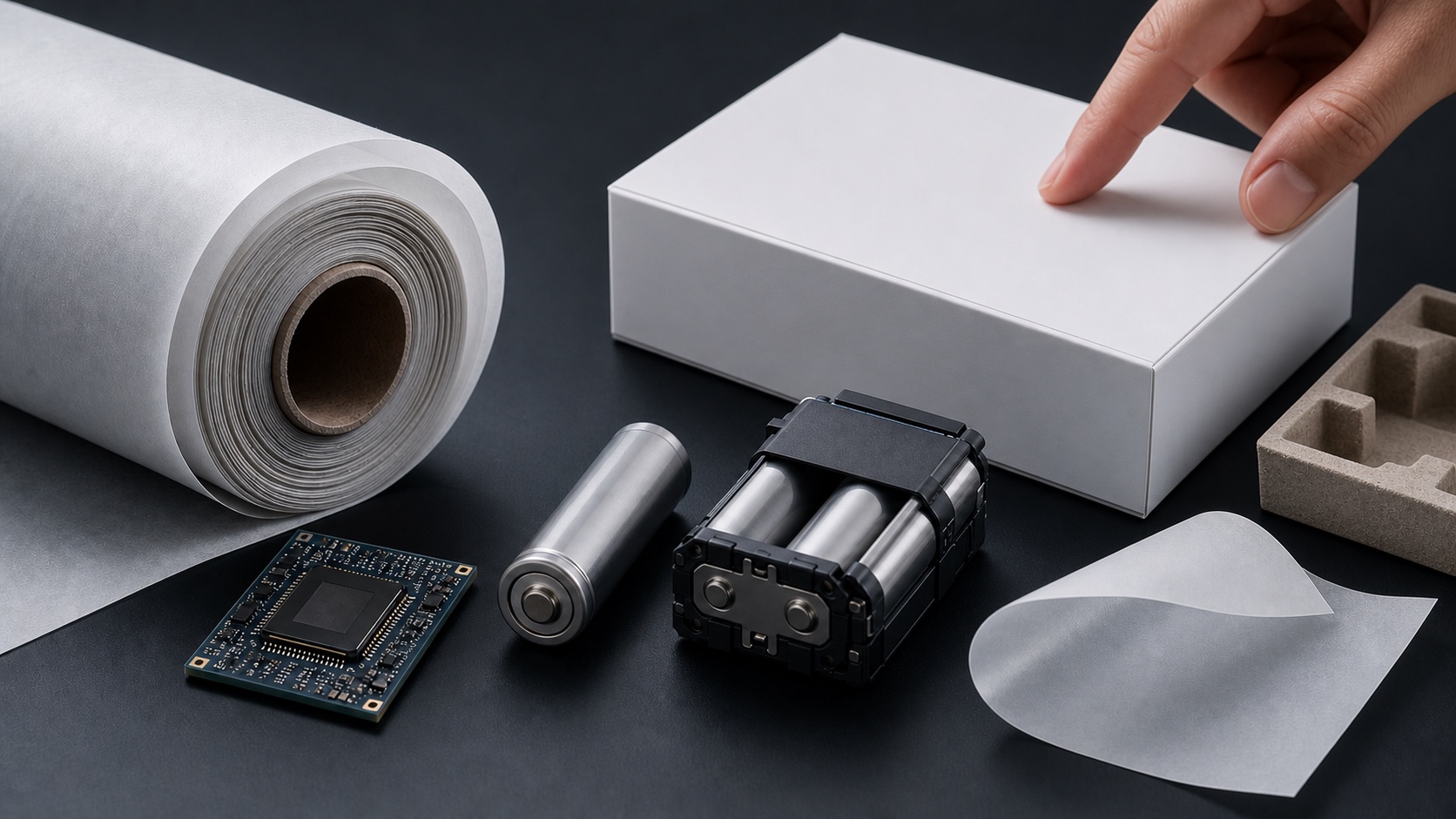
Egg trays, fruit trays, and beverage carriers remain the volume base. Industrial cushioning, electronics inserts, and premium cosmetic packaging move the industry toward tighter requirements for structure, dimensions, surface quality, and customer approval. Meal boxes, soup bowls, fresh-food trays, puffed-food inserts, and cold-chain packaging bring food contact and real-use conditions together in a single finished article.
Concept validation |Zipform’s fresh-meat tray in Australia has completed initial testing; broader market validation and industrialization are still required.
Development testing |PulPac’s fiber bottle cap has undergone early real-world testing but remains explicitly in development.
Industrial investment |Future Materials Sweden has ordered two production units, with its new facility initially focused on fiber-based snus cans.
Commercial production |HZ Green Pulp disclosed in 2025 that its Dry Molded Fiber coffee lids in Malaysia had entered full-scale commercial production.
The first growth phase has been enabled by several processes. Conventional thick-wall or transfer-molded wet fiber serves trays, foodservice items, and cost-sensitive protective packaging. Premium wet pressing and thermoforming target thinner walls, tighter tolerances, and better surfaces. Dry Molded Fiber seeks to shorten the dewatering and drying chain associated with wet preforms. Moisture content, tooling, cycle time, energy use, precision, and yield cannot be compared across these three routes without a consistent basis.
Sources:Fresh-meat tray project; BIOTEN Developer; fiber bottle-cap development; Swedish equipment order; commercial production of coffee lids.
02 · PROFIT MODELS
The post-growth reality: one industry, at least three profit models
ZX Packing Group’s audited 2025 annual report shows that revenue from foodservice items declined by 4.97%, while “other environmentally friendly packaging,” driven by sales of new premium industrial-packaging products, grew by 64.14%. The latter generated only RMB 16.799 million in annual revenue, compared with RMB 1.442 billion from foodservice items.
High-volume foodservice items |Continuous production, purchasing scale, and regional supply underpin this model, but margins are readily squeezed by unit prices, energy, trade measures, and logistics.
Customer-certified industrial and premium packaging |Structure, tooling, surface quality, and customer approval create project value, at the cost of development lead times, changeovers, and batch-to-batch consistency requirements.
High-performance food packaging |These products must simultaneously manage food contact, barrier performance, sealing, distribution, and end-of-life responsibilities. Any premium can still be absorbed by coating, drying, yield losses, and certification lead times.
In the same year, the company’s output of foodservice items and other products declined by 19.76%, while sales volume fell by 1.40%. Domestic sales rose by 8.21%, but export sales declined by 4.62%. The annual report primarily associates the production decline with U.S. trade measures and the ramp-up of capacity in Thailand.
Nominal capacity is not stable output, an equipment order is not a customer order, and an exhibition sample is not a repeat purchase. Application expansion answers whether there is work to be done; unit cost per conforming product and cash collection answer whether value is being created.
Sources:ZX Packing Group Annual Report 2025; final determination by the U.S. Department of Commerce; final determination by the Canada Border Services Agency.
03 · THE SECOND GROWTH PHASE
Why food packaging is harder—and more valuable—in the second growth phase
Precision electronics inserts and premium cosmetic packaging can also create high value. Food packaging warrants separate discussion because it combines high frequency, broad volume, and complex service conditions, testing materials, structures, regulation, manufacturing, and end-of-life performance at the same time.
Meal boxes, soup bowls, fresh-food trays, frozen and reheated foods, prepared foods, and supermarket ready-to-eat packaging are not purchased merely for “high plant-fiber content.” Customers buy defined outcomes: no leakage with hot soup, no migration of oils and fats, no loss of stiffness under condensation, no premature edge failure, and no lid disengagement.
Food-contact gate |Pulp, additives, coatings, inks, adhesives, migration, and organoleptic performance.
Real-use gate |Contents, temperature, time, hot aqueous and oily foods, freeze–reheat cycles, edges, sealing, and distribution.
Regulatory and customer gate |Target-market classification, testing documentation, customer audits, and final SKU approval.
End-of-life and economics gate |Material reduction, separability, repulpability or compostability, together with drying, yield, and unit cost per conforming product.
China’s Environmental Code, effective from 15 August 2026, requires packaging to be reasonable and reduced and incorporates green procurement and green supply chains into corporate responsibilities. Beijing’s Guidelines for the Use of Green Packaging by Food-Delivery Merchants, effective from 1 September 2026, translate food temperature, package dimensions, layer count, sealing, and readily separable structures into merchant actions.
Laws and recommended local standards have different legal force, and neither specifies molded fiber, waterborne coatings, PHA, or PLA. Instead, they change the procurement questions: Has the structure been reduced? Is the bill of materials traceable? Does the product pass its intended food-use conditions? Are the food-contact safety, repulpability, compostability, and claimed post-use pathway credible? Can the plastic content be calculated to determine whether the product falls within the scope of the Single-Use Plastics Directive (SUPD)?
Sources:Environmental Code of the People’s Republic of China; Beijing green food-delivery packaging guidelines; BIOTEN Developer; SUPD guidance.
04 · BILL OF MATERIALS AND COATING
The key to better quality: a complete bill of materials and the functional coating
Fiber determines whether molded pulp can be formed. The complete bill of materials and the coating determine which food-use conditions the article can enter, which regulatory responsibilities it assumes, and which post-use pathway it can credibly follow.
Wood pulp, recovered pulp, bamboo pulp, bagasse pulp, and straw pulp answer the question, “Where does the fiber come from?” Bamboo pulp is already within the raw-material boundary for molded fiber, but it does not automatically prove that the finished article is food-contact compliant, recyclable, compostable, or low carbon.
High-performance molded fiber necessarily involves formulations and additives as well as barrier coatings; bio-based materials are part of this higher-value market. Professional assessment must determine whether each component is necessary, traceable, suitable for the target food and temperature, stable across batches, and compatible with the declared end-of-life pathway.
“Waterborne” describes only the dispersion or application medium. After the water evaporates, the film-forming polymer, formulation, coat weight, and film continuity determine grease resistance, water resistance, resistance to hot liquids, heat sealability, regulatory classification, and end-of-life behavior.
PE lamination |Mature performance, heat sealing, and supply chains; paper–plastic separation, repulping, and non-compostable end-of-life routes still require management.
Waterborne or dispersion systems such as EAA, acrylics, and PU |Flexible formulations and relatively mature production experience; being “waterborne” does not change the identity of the film-forming polymer.
Natural polymers, wax/resin systems, and mineral combinations |Can provide part of the barrier function, but humidity, thermal stability, cracking on flexing, and the bonding phase remain constraints.
PHA waterborne barrier route |Places food-barrier development and a verified biological-treatment pathway on the same engineering route. Evidence must still be established for the specific material, thickness, formulation, and finished-article scope.
China |GB 4806.10—2025 takes effect on 2 September 2026.
United States |The U.S. Food and Drug Administration has confirmed that 35 food contact notifications involving grease-proofing PFAS for paper and paperboard are no longer effective because the relevant uses were abandoned.
European Union |The SUPD provides no minimum plastic-content exemption. The PPWR’s 95%/5% rule is not a general-purpose “plastic-free threshold.”
Certification |Certification of a material or component does not automatically certify every finished meal box.
Sources:Announcement of GB 4806.10—2025; U.S. FDA status of PFAS uses in paper food packaging; BIOTEN Developer; SUPD guidance; EU Packaging and Packaging Waste Regulation (PPWR).
05 · BIOTEN MATERIAL INTERFACES
BIOTEN Observer: three material interfaces, each addressing a different failure mode
The following observations concern material-development interfaces associated with BIOTEN Packaging; they are not three product cards.
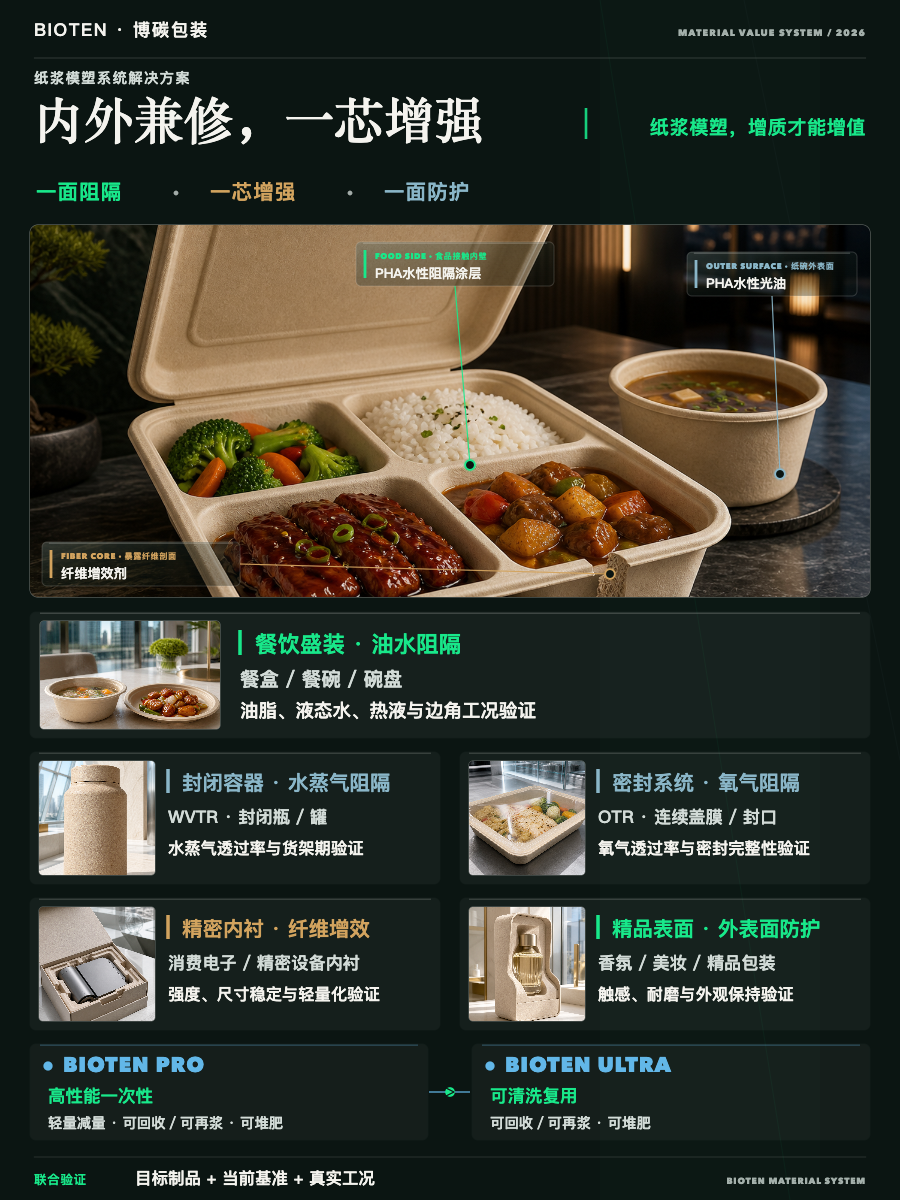
PHA waterborne barrier coating for the food-contact surface |Designed for hot soup, oils and fats, sauces, fresh-food condensation, and freeze–reheat conditions. DIN CERTCO and BPI list records for Bioten™ PHA Barrier Coating materials, components, or coatings. These records do not prescribe a coat weight and do not replace certification of the finished food container. Procurement must still establish the minimum effective dry coat weight, edge continuity, drying window, and target food conditions within the same SKU.
Fiber-performance copolymer |Acts within the pulp, wet preform, and fiber network to improve strength, forming stability, lightweighting, and fiber-use efficiency. It may also be applied by surface spraying; addition rates of only a few parts per thousand in the furnish can provide broad reinforcement or enable weight reduction.
PHA waterborne overprint varnish for the exterior surface |Intended for premium wet-pressed, cosmetic, electronics, or high-end foodservice applications requiring appearance, tactile quality, abrasion resistance, and surface protection. It is commercially meaningful only when the brand experience can support the added process cost. Washable reuse remains a development direction within the BIOTEN Developer molded-fiber system.
The three interfaces act respectively within the fiber network, on the food-contact inner surface, and on the brand-facing outer surface. Their common threshold is not the material name, but a precisely defined SKU, a complete finished article, repeatable data, and unit cost per conforming product.
Sources:DIN CERTCO records; BPI directory; Australasian Bioplastics Association certification information; BIOTEN Developer.
06 · RELIABLE DELIVERY
Converting profit potential into cash: from minimum effective coat weight to cash collection
Commercial validation only begins after the coating route is selected. A high-performance molded-fiber food container must, at minimum, lock down the fiber and additive formulation, coating SKU, application method, wet and dry coat weights, drying window, edge coverage, contents, temperature, sealing, stacking, and distribution conditions.
01 |Minimum effective wet and dry coat weights
02 |Drying load, line speed, changeovers, and downtime
03 |First-piece pass rate, cross-batch conformance rate, and stable saleable output
04 |Unit cost per conforming product—not material price per kilogram
05 |First-pass approval rate for food contact, the target market, and customer certification
06 |Repeat purchases, customer complaints, inventory, receivables, and cash collection
There is currently no publicly available minimum BIOTEN spray application or dry coat weight that applies across SKUs. It must be determined through design of experiments (DOE): under the same article, service conditions, and acceptance criteria, compare coat weight, drying, barrier performance, yield, and cost to identify the minimum effective operating window.
Pulp suppliers must deliver fiber consistency. Material suppliers must deliver formulation identity, application windows, and end-of-life evidence. Equipment and tooling suppliers must integrate coating, drying, and in-line inspection into the production line. Finished-article manufacturers must place yield, certification, customer complaints, cost, and cash collection on the same operating dashboard.
PAPER PERSPECTIVES · THE NUMBERS BEHIND THE STORY
The real breakthrough worth expecting is not more samples, but precisely defined SKUs that conform across batches, win repeat orders, and convert profit into cash.
The second growth phase is not another fiber story
The first growth phase has already taken molded fiber into industrial inserts, electronics, cosmetics, fresh foods, and complex components. The second must make food packaging withstand simultaneous tests of food contact, real-use performance, regulatory classification, end-of-life pathways, and mass-production economics.
Incremental volume comes from more applications. Better quality comes from a complete bill of materials, functional layers, and an evidence package. Value creation can be realized only through yield, unit cost per conforming product, customer approval, repeat purchases, complaint performance, and cash collection.
BIOTEN Packaging · Industry Insights · Research Notes
This article prioritizes benchmarking reports from industry associations, periodic reports of listed companies, regulatory and standards bodies, certification databases, and original company project disclosures. It was independently researched and compiled by BIOTEN Packaging, with information verified through 26 August 2026. BIOTEN materials are associated with BIOTEN Developer; related content is presented only on the basis of public evidence and development interfaces still requiring validation. This article is provided solely for value-chain research and learning and does not constitute procurement, compliance, investment, or other specific decision-making advice. If you have concerns regarding the content, data, or rights, please contact us to request correction, clarification, or removal; we will review the request within 24 hours of receipt.
BIOTEN Observer · Data and Verification Sources
01 | IMFA | Announcement of the inaugural global molded-fiber benchmarking reports
02 | Huhtamaki | Half-yearly Report 2026
03 | ZX Packing Group | Half-year Report 2026; Annual Report 2025
04 | PulPac | Fresh-meat tray concept validation; fiber bottle-cap development; Swedish equipment order
05 | Ministry of Ecology and Environment of the People’s Republic of China | Environmental Code of the People’s Republic of China
06 | Beijing Municipal Administration for Market Regulation | Guidelines for the Use of Green Packaging by Food-Delivery Merchants
07 | National Health Commission of the People’s Republic of China | Announcement of GB 4806.10—2025
08 | U.S. Food and Drug Administration | Status of PFAS uses in paper and paperboard food packaging
09 | European Commission | SUPD interpretive guidance; PPWR
10 | DIN CERTCO | DBC/BIOTEN certification records
11 | BPI | DBC/BIOTEN component and coating directory
12 | Australasian Bioplastics Association | Certification information and directory entry