




Papermaking Operations Review · H1 2026
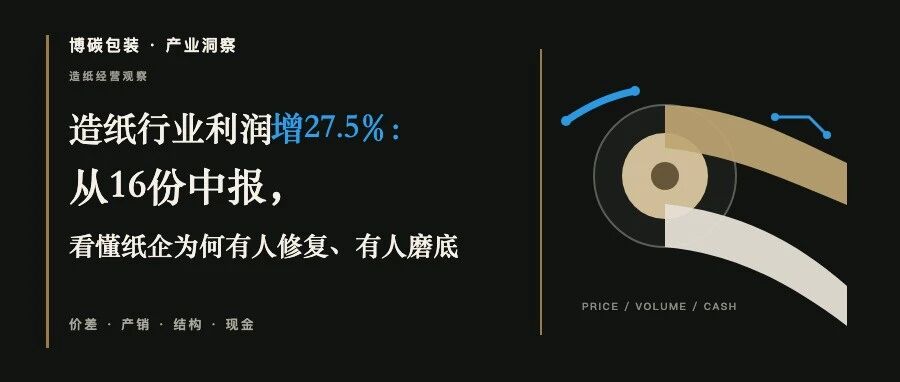
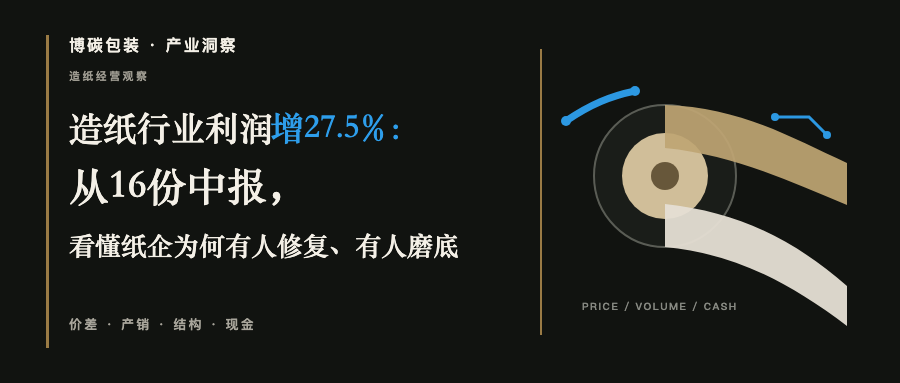
Industry profits are rising—why is recovery uneven?
Industry-wide statistics show an upswing, yet the 16-company interim-report sample follows sharply different trajectories. The key is not the direction of paper prices alone, but whether net realized prices, costs, operating rates, fixed-cost absorption, and cash generation can improve in sequence.
The industry’s 27.5% profit growth is primarily an aggregate recovery signal. For an individual company to complete the recovery, margins, production and sales, and cash generation must improve consecutively; if any link is missing, the profit may remain only on paper.
Sun Paper’s kraft linerboard revenue rose 35.54%, while coated art paper revenue fell 29.65%; Shanying International recorded an H1 loss of RMB 682 million but RMB 1.644 billion of operating cash flow, while Rongsheng Environmental Protection earned RMB 190 million yet reported negative operating cash flow. Paper grades, earnings, and cash are moving along different tracks.
The 16 interim reports form a fixed sample reconstructed from disclosures available as of the evening of 25 August 2026 and from the comparability of principal operations. National industry statistics, consolidated company statements, and product-level data are used on separate bases.
INDUSTRY OVERVIEW | H1 2026
RMB 689.79 billion | +5.5% Operating revenue of above-designated-size enterprises in the paper and paper products industry.
RMB 607.73 billion | +5.2% Operating costs, growing slightly more slowly than revenue.
RMB 19.61 billion | +27.5% Total profits, growing markedly faster than revenue.
Approx. 2.84% A supplementary ratio calculated in this article as cumulative total profits divided by operating revenue.
Latest update:For January–July, revenue was RMB 805.05 billion, costs were RMB 709.77 billion, and profits were RMB 22.75 billion; profits rose 27.6% year on year, giving a simple ratio of approximately 2.83%. Neither ratio is an official profit margin separately published by the National Bureau of Statistics for the paper industry.
Research sources:National Bureau of Statistics data on profits of above-designated-size industrial enterprises for H1 and January–July.
Within the 16-company interim-report sample, net profit attributable to shareholders of the parent improved or turned positive at 10 companies and deteriorated at six; adjusted attributable net profit was positive at 14 companies, and operating cash flow was positive at 13. The industry-wide upturn has gained some breadth, but it has not produced earnings and cash of comparable quality across companies.
The sample comprises Sun Paper, Jingxing Paper, Qifeng New Material, Hengda New Material, Qingshan Paper, Minfeng Special Paper, Huatai Paper, Hengfeng Paper, Guanhao High-Tech, Shanying International, Rongsheng Environmental Protection, Linping Paper, Wuzhou Special Paper, Forest Packaging, Huada Haitian, and Metastar. These companies span multiple paper grades and businesses and are not assessed under a single label.
SECTION 01 · WITHIN-COMPANY VALIDATION
Sun Paper: Two lines within one company
In H1, Sun Paper recorded operating revenue of RMB 20.862 billion, up 9.15% year on year; net profit attributable to shareholders of the parent of RMB 1.951 billion, up 9.60%; and net cash generated from operating activities of RMB 3.366 billion, up 77.74%. The consolidated figures were steady, but the product-level data diverged sharply.
One company, three transmission paths
Kraft linerboard Revenue of RMB 7.076 billion, up 35.54% year on year; gross margin of 18.48%, up 2.84 percentage points.
Uncoated woodfree paper Revenue down 4.86%; gross margin 10.80%, down 3.58 percentage points.
Coated art paper Revenue down 29.65%; gross margin 8.89%, down 7.96 percentage points.
Using one company and one reporting period removes most cross-company noise. Different paper grades face different demand, supply, and pricing cycles; raw-material and manufacturing capabilities must pass through product mix before reaching the income statement.
Multiple production bases, pulp–paper integration, and a diversified product portfolio provide room for internal hedging, but they do not imply a broad-based upcycle. Sun Paper’s overall gross margin for pulp and paper products still declined by 1.17 percentage points. An integrated producer can allocate more resources, but performance must ultimately be tested through gross margin by paper grade and operating cash generation.
Research sources:Sun Paper H1 2026 Interim Report.
SECTION 02 · PACKAGING PAPER
Packaging-paper recovery depends on margins, production, and sales
Jingxing Paper | Products, expenses, and working capital improve together
Operating revenue was RMB 3.161 billion, up 20.22% year on year; net profit attributable to shareholders of the parent was RMB 139 million, up 152.95%; and operating cash flow shifted from a net outflow of RMB 491 million to a net inflow of RMB 601 million. Revenue from industrial base paper and recycled-pulp board increased. Finance costs fell 85.34% after redemption of the convertible bonds, while higher sales and lower inventories also improved cash generation.
Wuzhou Special Paper | Capacity contribution and capital investment appear together
Operating revenue was RMB 4.895 billion, up 18.76% year on year, and net profit attributable to shareholders of the parent was RMB 230 million, up 88.95%. Revenue from recovered-paper-based products increased by 49.48%, with average selling prices up 9.46%; average prices for wood-pulp-based products fell 3.60%. The full commissioning of the industrial packaging paper line in Hubei was one source of incremental revenue.
At the same time, net cash used in investing activities was RMB 1.359 billion, while net cash generated from financing activities was RMB 1.341 billion. New capacity has already contributed volume and profit, but utilization, unit costs, order coverage, and cash returns still need to be validated.
Shanying International | Volume and price recovery must still absorb the fixed-cost burden
Paper sales volume increased 7.68%. The attributable net loss in Q2 narrowed by RMB 313 million from Q1, a sequential reduction of 62.95%, and June returned to profit on a monthly basis; nevertheless, the attributable net loss for H1 remained RMB 682 million. Operating costs grew 8.65%, faster than revenue. Finance costs fell 8.65% year on year but remained RMB 411 million.
When packaging paper is described as recovering first, it means that volume, pricing, operating rates, and quarterly gross margins have begun to improve at some companies. If costs continue to rise or new capacity outpaces the recovery in orders, higher sales volume may still fail to generate sufficient profit.
Research sources:Jingxing Paper H1 2026 Interim Report; Wuzhou Special Paper H1 2026 Interim Report; Shanying International H1 2026 Interim Report.
SECTION 03 · PRINTING AND WRITING PAPER
Printing and writing paper is bottoming; lower pulp prices are not the answer
Pressure in printing and writing paper is already visible in Sun Paper’s uncoated woodfree and coated art paper segments. Huatai Paper provides another company-level sample: operating revenue was RMB 6.211 billion, down 3.10% year on year; net profit attributable to shareholders of the parent was RMB 18.89 million, down 72.07%; adjusted attributable net profit was a loss of RMB 1.98 million; and operating cash flow was a net outflow of RMB 69.89 million.
Lower wood-pulp prices can reduce costs, but they cannot determine profit on their own. If finished-paper prices fall faster, the spread per tonne will still narrow. Demand recovery, homogeneous supply, new capacity, and inventories also affect how quickly prices stabilize. Huatai operates both papermaking and chemical businesses, so its consolidated figures cannot be interpreted as the profit or loss of printing and writing paper alone.
“Bottoming” is not a permanent label. If net realized paper prices stabilize, supply contracts, or companies create new spreads through in-house pulp, differentiated products, exports, and cost control, the two earnings trajectories may converge again. The evidence required is not a single price-increase notice, but simultaneous improvement in net transaction prices, orders, inventories, and cash.
Research sources:Sun Paper H1 2026 Interim Report; Huatai Paper H1 2026 Interim Report.
SECTION 04 · EARNINGS QUALITY
Profit and cash can move in opposite directions
Hengda New Material recorded operating revenue of RMB 548 million and net profit attributable to shareholders of the parent of RMB 53.85 million, up 5.16% and 57.29%, respectively. Base paper for medical and food packaging accounted for 88.10% of operating revenue. End-use segmentation and product mix supported the improvement.
Attributable net profit alone, however, does not establish the quality of core operations. Guanhao High-Tech reported attributable net profit of RMB 213 million and adjusted attributable net profit of RMB 32 million, a gap of approximately RMB 181 million. Forest Packaging’s revenue rose 74.51% to RMB 2.025 billion, yet attributable net profit fell 73.68% to RMB 8.19 million. The company said revenue growth mainly reflected added papermaking capacity; major reasons for the profit decline included a RMB 24.8184 million reduction in VAT refunds under the refund-upon-collection policy and the fact that its 600,000-tonne-per-year digital inkjet paper project had not yet reached profitability.
Profit and cash can also cross: Shanying International posted an attributable net loss of RMB 682 million but a net operating cash inflow of RMB 1.644 billion, which the company attributed mainly to increased collection of sales proceeds. Rongsheng Environmental Protection reported attributable net profit of RMB 190 million and adjusted attributable net profit of RMB 106 million, but a net operating cash outflow of RMB 57.52 million.
Attributable net profit measures the result at shareholder level; adjusted attributable net profit indicates the quality of recurring operations; and operating cash flow tests whether earnings have been collected in cash. Cash should also be decomposed into changes in receivables, inventories, payables, and notes. Positive cash flow does not automatically mean that core operations have fully recovered.
Research sources:Hengda New Material H1 2026 Interim Report; Guanhao High-Tech H1 2026 Interim Report; Forest Packaging H1 2026 Interim Report; Shanying International H1 2026 Interim Report; Rongsheng Environmental Protection H1 2026 Interim Report.
In the same round of industry recovery, no single paper grade is necessarily first to emerge; the leaders are the companies able to improve margins, production and sales, and cash at the same time.
SECTION 05 · VALUE-CHAIN ASSESSMENT
Four indicators to watch in H2
Margins |Whether actual net realized prices outperform costs for recovered paper, wood pulp, energy, chemicals, and logistics.
Production and sales |Whether orders, sales volumes, operating rates, inventories, and new capacity are aligned—and whether volume growth can dilute the fixed-cost burden.
Product mix |Whether profit comes from high-value products and sustained operating improvement, or from a low base, expense changes, tax effects, and one-off factors.
Cash |Whether receivables, inventories, payables, notes, interest, and capital expenditure absorb the profit.
For paper mills, these four indicators should be translated into profit bridges by paper grade and capacity ramp-up schedules. For corrugated board, carton, and printed-packaging companies, they should become actual purchase prices, end-market orders, inventories, and customers’ acceptance of price adjustments. For equipment, chemical, and fiber suppliers, they should become customer operating rates, returns on technical upgrades, yield, purchasing continuity, and project cash recovery.
PAPER STRATEGY · THE FUNDAMENTALS IN THE DATA
The industry’s 27.5% profit growth shows that the paper and paper products industry is emerging from its low point, but it does not prove that all 16 companies in the interim-report sample are recovering in sync. Packaging paper has delivered earlier improvement in margins, production, and sales at some companies; printing and writing paper is still waiting for more stable net realized prices and a better supply–demand balance; specialty paper continues to diverge by application barrier, capacity stage, and earnings quality.
What has emerged is an industry-wide profit recovery. What is being released is the benefit of product mix and operating efficiency at selected companies. What remains to be demonstrated is whether these improvements can pass through inventories, receivables, interest, and capital expenditure to become sustained cash generation and the next round of competitiveness.
BIOTEN Packaging focuses on whether value is genuinely transmitted among paper performance, converting efficiency, and end use. The value chain need not bet simply on one paper grade; it should identify which capabilities are already established, which profits are sustainable, and which cash conversion still requires time.
BIOTEN PACKAGING · INDUSTRY INSIGHT · RESEARCH NOTE
This article was independently researched and prepared by BIOTEN Packaging using data from the National Bureau of Statistics, the H1 2026 interim reports of 16 listed companies, and other public industry sources. National industry statistics, consolidated company data, and product-level data are used on separate bases. This article is intended solely for research and learning across the paper and packaging value chain and does not constitute a basis for investment, procurement, pricing, or trading decisions. Requests for corrections, clarifications, or deletion concerning the content, data, or rights will be reviewed by BIOTEN Packaging within 24 hours of receipt.
BIOTEN OBSERVER · DATA AND VERIFICATION SOURCES
01 | National Bureau of Statistics | Profits of Above-Designated-Size Industrial Enterprises Nationwide, January–June 2026
02 | National Bureau of Statistics | Profits of Above-Designated-Size Industrial Enterprises Nationwide, January–July 2026
03 | Securities Daily | Diverging Interim Results among A-share Listed Paper Companies
04 | Sun Paper | H1 2026 Interim Report
05 | Jingxing Paper | H1 2026 Interim Report
06 | Wuzhou Special Paper | H1 2026 Interim Report
07 | Shanying International | H1 2026 Interim Report
08 | Huatai Paper | H1 2026 Interim Report
09 | Hengda New Material | H1 2026 Interim Report
10 | Guanhao High-Tech | H1 2026 Interim Report
11 | Rongsheng Environmental Protection | H1 2026 Interim Report
12 | Forest Packaging | H1 2026 Interim Report