



A closer look at product mix, cash flow, and capital constraints reveals what the interim results demonstrate—and what remains unproven.
Sun Paper’s first-half performance is better described as earnings resilience than as a high-upside turnaround: cash conversion improved, but the overall gross margin remained under pressure and capital expenditure still exceeded operating cash flow.
Profit growth reflected a combination of offsetting movements across paper grades, stronger operating cash generation, and lower finance costs. Only by separating these variables can we assess what integration actually contributed.
This article primarily uses the consolidated figures in the company’s H1 2026 interim report. The company’s explanations of forest–pulp–paper integration, cost control, and production-base synergies are identified as company disclosures and do not replace product-level, base-level, and cash-flow validation.
H1 2026 | CONSOLIDATED BASIS
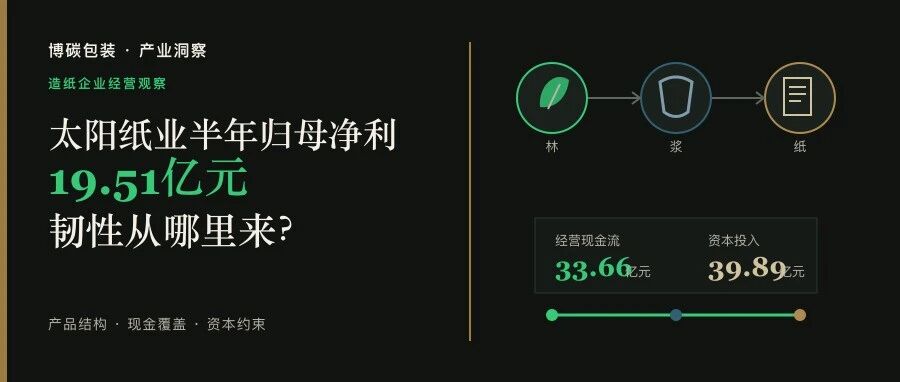
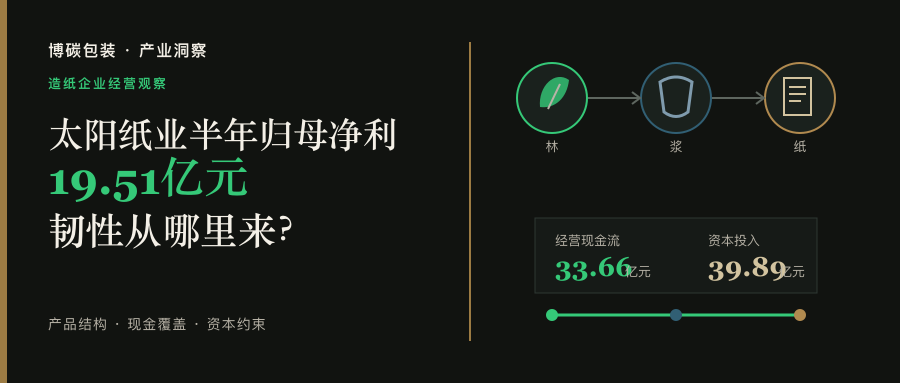
RMB 20.862 billion in revenue · RMB 1.951 billion in net profit attributable to shareholders of the parent · RMB 3.366 billion in net cash generated from operating activities
SECTION 01 · REPORTED RESULTS
Official figures: Net profit attributable to shareholders of the parent rose 9.60% year on year
In the first half of 2026, total operating revenue was RMB 20.862 billion, up 9.15% year on year; net profit attributable to shareholders of the parent was RMB 1.951 billion, up 9.60%; and net profit attributable to shareholders of the parent excluding non-recurring gains and losses was RMB 1.935 billion, up 9.70%. The similar growth rates of attributable net profit and adjusted attributable net profit indicate that earnings growth was not driven primarily by large non-recurring gains.
Based on operating revenue and operating costs, the overall gross margin was approximately 15.66%, compared with approximately 16.50% in the prior-year period—a decline of about 0.83 percentage points. Operating profit still increased. In addition to business growth, the reduction in finance costs from RMB 265 million to RMB 155 million also contributed. The company attributed the decline in finance costs mainly to higher foreign-exchange gains, a period-specific factor that should not be counted directly as a contribution from integration.
Sources: Sun Paper H1 2026 Interim Report
SECTION 02 · EARNINGS DRIVERS
Product mix provided an offset; not every grade improved
Revenue from kraft linerboard reached RMB 7.076 billion, up 35.54% year on year, while gross margin increased by 2.84 percentage points. Tissue-paper revenue grew 13.74%, and gross margin increased by 7.08 percentage points. Packaging-related paper grades accounted for most of the incremental growth.
Revenue from uncoated woodfree paper, coated art paper, and dissolving pulp declined, while their gross margins fell by 3.58, 7.96, and 13.88 percentage points, respectively. Gross margin for pulp and paper products overall was 14.88%, down 1.17 percentage points year on year. The multi-product portfolio is consistent with the group’s earnings performance, but the interim report does not establish precise causality—still less does it prove stronger pricing power in every product line.
SECTION 03 · CASH CONSTRAINTS
Operating cash flow improved but still did not fully cover expansion
Net cash generated from operating activities was RMB 3.366 billion, up 77.74% year on year and equivalent to approximately 1.73 times net profit attributable to shareholders of the parent. During the same period, cash paid to acquire or construct fixed assets, intangible assets, and other long-term assets totaled RMB 3.989 billion. As a simplified comparison, subtracting the latter from operating cash flow leaves a net outflow of approximately RMB 623 million, versus approximately RMB 2.833 billion in the prior-year period. The gap narrowed substantially but did not turn positive.
Inventories at period-end were approximately 8.67% higher than at year-end, while construction in progress increased by approximately 77.93%. The debt-to-asset ratio was 47.85%, up 0.10 percentage points from year-end. Earnings resilience is evident, but inventory and capital constraints have not disappeared.
KEY LIMITATION:Operating cash flow less cash paid to acquire or construct long-term assets is only a cash-coverage observation; it is not free cash flow as defined by accounting standards.
SECTION 04 · PRODUCTION BASES AND PROJECTS
Multiple bases generated profits; new projects raise the future performance bar
The interim report shows that Nanning Sun Paper, Guangxi Sun Paper, Sun Paper’s Laos subsidiary, Yanzhou Tianzhang, and Sun Honghe each recorded a net profit. Because the group has internal transactions involving pulp, energy, chemicals, and trading, subsidiary profits cannot simply be added together or used directly to compare the efficiency of different production bases.
The 600,000-tonne-per-year bleached chemical pulp project at Yandian entered trial production in late August. The Nanning project plans to build a 500,000-tonne-per-year unbleached chemical wood-pulp line and a 600,000-tonne-per-year specialty-paper line, with total investment capped at RMB 5 billion. Investment completion and trial production are expected in Q4 2027. Trial production does not mean full capacity, and full capacity does not guarantee profit. The next tests are ramp-up, yield, cash cost, and incremental depreciation.
Sources: Sun Paper Announcement on the Guangxi Nanning Forest–Pulp–Paper Integration Quality-and-Efficiency Upgrade Project
SECTION 05 · PEER-COMPARISON BOUNDARIES
Integration is not a universal answer, and scale does not guarantee profit
For the same reporting period, Shanying International disclosed operating revenue of RMB 14.259 billion, a net loss attributable to shareholders of the parent of RMB 682 million, and net cash generated from operating activities of RMB 1.644 billion. The two companies have different product mixes, raw-material strategies, overseas assets, and capital structures, so a simple profitability ranking would be misleading.
The comparison shows only that scale by itself does not guarantee profit when paper prices are under pressure and raw-material costs are volatile. Verifying Sun Paper’s disclosed cost moat would still require data on gross profit per tonne, the internal cost of in-house pulp, the replacement ratio for purchased pulp, and production-base utilization rates.
Sources: Shanying International H1 2026 Interim Report
SECTION 06 · WHAT TO WATCH
Five indicators will show whether resilience can translate into greater earnings upside
01 | Gross margin by grade:Whether the gains in kraft linerboard and tissue paper can be sustained, and whether the declines in printing and writing paper and dissolving pulp can narrow.
02 | Cash coverage:Whether operating cash flow can consistently cover the principal capital commitments for the Yandian and Nanning projects.
03 | Working-capital efficiency:Whether inventories and accounts receivable can improve in step with revenue, rather than through inventory build-up or credit expansion.
04 | Debt and financing costs:Whether the debt-to-asset ratio, interest-bearing debt, and finance costs remain stable after exchange-rate effects normalize.
05 | Project ramp-up:Whether pulp cash cost per tonne, product yield, incremental depreciation, and the displacement of purchased pulp materialize as planned.
PAPER STRATEGY · THE FUNDAMENTALS IN THE DATA
RMB 1.951 billion is better interpreted as earnings resilience during expansion than as a high-upside turnaround. The real inflection point will be whether gross profit per tonne, cash coverage, inventory turnover, and balance-sheet constraints improve together after the new pulp and paper projects start production.
BIOTEN PACKAGING · INDUSTRY INSIGHT · RESEARCH NOTE
This article was independently researched and prepared by BIOTEN Packaging using public disclosures from Sun Paper and Shanying International. Information was verified through 27 August 2026. It is intended solely for research and learning across the paper and packaging value chain and does not constitute a basis for securities, procurement, or investment decisions. BIOTEN Packaging has not disclosed any investment, supply, or project relationship with the companies discussed. To request a correction, clarification, or deletion concerning the content, data, or rights involved, please contact us; we will review the request within 24 hours of receipt.
BIOTEN OBSERVER · DATA AND VERIFICATION SOURCES
01 | Sun Paper | H1 2026 Interim Report
02 | Sun Paper | Announcement on the Guangxi Nanning Forest–Pulp–Paper Integration Quality-and-Efficiency Upgrade Project
03 | Shanying International | H1 2026 Interim Report