

















In August 2026, the World Packaging Organisation (WPO) announced that 6 September would be observed annually as World Packaging Day, with the inaugural celebration taking place on 6 September this year. The date also commemorates WPO's founding in Tokyo in 1968.
The initiative invites packaging associations, companies, academic institutions and professionals worldwide to organise exchanges, open houses and educational activities around four themes: Packaging for Progress, Packaging Against Food Waste, Packaging and Economic Growth, and Packaging and Sustainability.
From a sheet of base paper to a delivered takeaway order, packaging passes through a converter's production line and a restaurant's packing counter before reaching the consumer. Viewed as one system, three trends deserve the shared attention of papermakers, packaging converters and foodservice companies.
Trend 1 · Order value
Calculate cost through the moment of delivery
A takeaway order incurs packaging costs not only at procurement but also during bagging, delivery and after-sales service.
A box may cost a few cents less, but if it adds packing time or results in soup leakage or a tipped cup, the restaurant may spend those savings on replacement orders and redelivery. The benefits of a packaging upgrade should therefore be measured across the entire order.
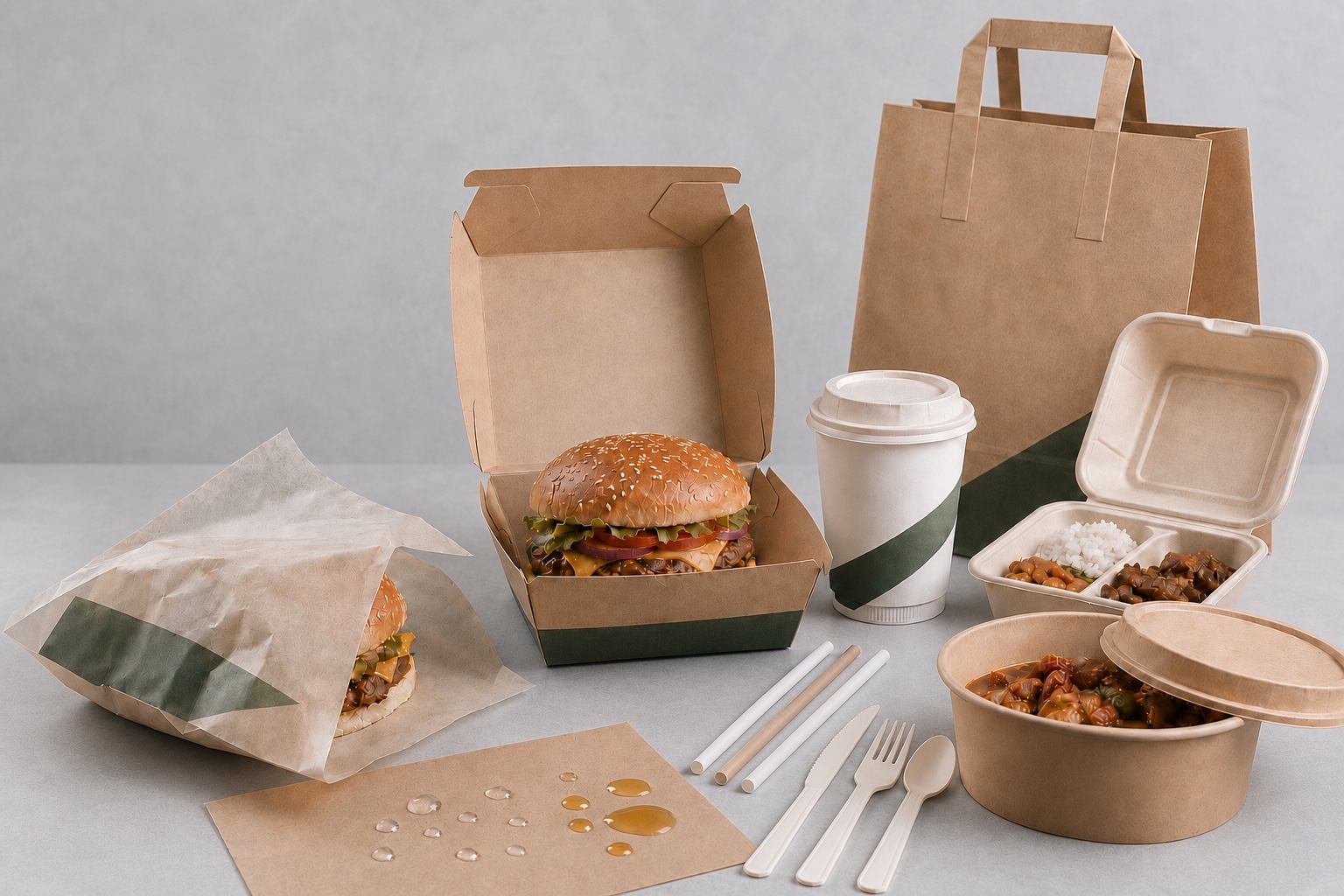
Beijing's Guidelines for the Use of Green Packaging by Food-delivery Merchants (DB11/T 2510—2026), effective 1 September 2026, call for pack sizes to be matched to food items, layers around products such as hamburgers and sandwiches to be reduced, and redundant functions to be avoided. This recommended local standard translates packaging selection into specific food and operating scenarios.
For converters, these requirements become direct development questions: How should a paper box perform with oily foods? How should cups, lids, trays and bags work together during carrying and delivery? How can sealing and bagging be made easier for staff? Paper, functional layers, structure and in-store operations should all be designed around the same food item.
Chain restaurant procurement teams can compare total packaging consumption, bagging labour and packaging-attributable after-sales costs across comparable orders over the same period.
One less handling step and one fewer leakage incident are both forms of value that a packaging supplier can demonstrate to its customer.
Research sources: Beijing Municipal Administration for Market Regulation | Guidelines for the Use of Green Packaging by Food-delivery Merchants; National Public Service Platform for Standards Information | DB11/T 2510—2026
Trend 2 · Materials and converting
Bring performance and convertibility together
In March 2026, Stora Enso reported that Swedish converter Aristo had initially achieved grease resistance for its takeaway boxes by applying an additional lacquer, but the material incurred high losses during converting. Aristo later adopted CKB Nude Aqua, a paperboard with a one-sided dispersion barrier, and now uses it in several foodservice formats, including sushi boxes and compartments for breakfast packs.
The collaboration considered grease resistance, stiffness, folding and gluing, and print performance together. The functional layer provides protection, the paperboard structure provides support, and converting compatibility enables stable production.
Papermakers need to understand earlier what type of box the customer plans to produce and which forming process it will use. Coating suppliers must consider coating placement, drying and film formation together with folding and gluing. Foodservice packaging converters, meanwhile, should evaluate line speed, scrap rate and batch-to-batch consistency alongside finished-pack performance.
The value of developing water-based barriers should likewise be realised through this kind of collaboration: define the base paper, food type and pack structure, then match the required functions to existing or compatible converting conditions.
Good paper must run smoothly at the converter and perform reliably at the restaurant.
Research sources: Stora Enso | Aristo foodservice packaging converting case study
Trend 3 · Standards and applications
Beijing focuses on selection; Shanghai advances evaluation
For green packaging to move from restaurant-level demand to volume procurement, suppliers and buyers need a shared technical language for products.
Beijing's guideline starts with merchant use, addressing which packaging suits which foods and which layers can be reduced. The Shanghai Association of Food Contact Materials' proposed association standard for recyclable paper foodservice ware with water-based coatings focuses on a specific product direction. The association announced approval of the project on 30 April 2025.
The association's public report also notes that BASF, DBC, APP China, and LIDO Environmental Technology were among the companies involved in drafting the standard. Bringing material and product experience into standardisation discussions helps upstream and downstream participants establish a shared language for evaluation.
From an application perspective, the value of this kind of standardisation lies in connecting food-contact safety, in-use performance, recyclability assessment and environmental information. Papermakers can work to a defined end product; coaters and converters can validate against the same requirements; foodservice buyers can compare like-for-like projects; and recyclers can identify materials and intended uses.
Beijing makes food-specific requirements concrete, while Shanghai advances product evaluation—giving suppliers and buyers a shared basis for discussing the same product.
Food-contact safety should be verified against applicable national standards; resource efficiency should be measured from actual material consumption and recovery records; and carbon performance should be compared using carbon-footprint data for the same functional unit and system boundary. Only when these data are connected can “safe, functional and circular” become a basis for procurement and improvement.
WPO frames the global agenda,
Beijing translates end-user needs into specific requirements,
and Shanghai advances product-side standardisation.
Together, these developments point to practical research directions for food protection, resource efficiency and low-carbon implementation.
Research sources: Shanghai Association of Food Contact Materials | Association standard project approval notice; the Association | Project review report
Start with one product
World Packaging Day gives the industry a shared point for discussion. Companies can make that discussion concrete around a single paper cup, food container or paper bag: define the food and period of use; compare the protective performance, converting yield, handling time and cost per order of the old and new solutions; and then specify the post-use handling pathway.
Only when product development, restaurant selection and performance records form a complete improvement loop can procurement, quality and operations evaluate packaging investment on the same basis.
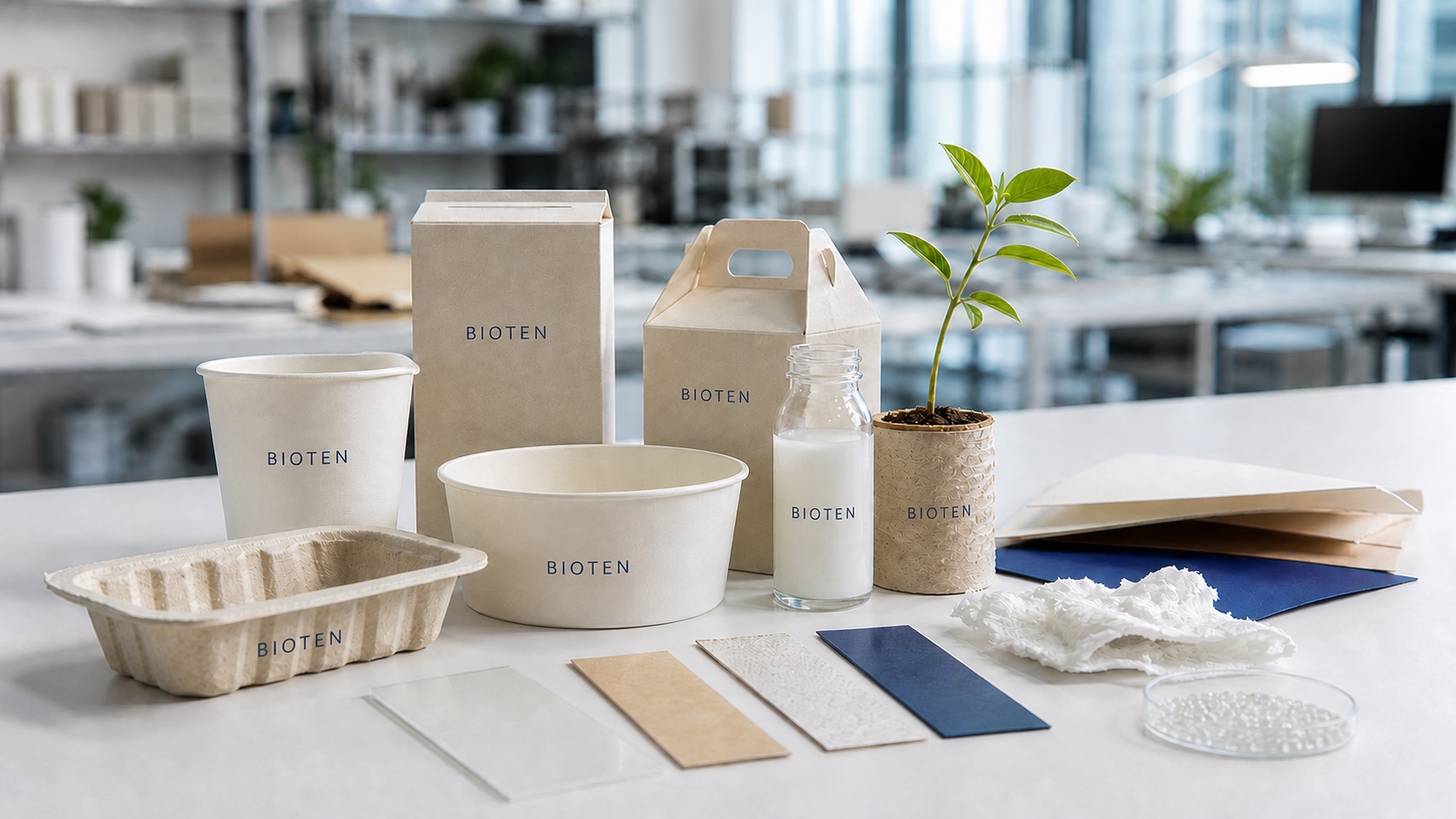
This is precisely the collaboration BIOTEN Packaging focuses on—from materials to products and from standards to applications—bringing base paper, functional layers, converting processes and end-use requirements together in one product.
Research note
This article was researched and compiled by BIOTEN Packaging from official WPO materials, public information from government and standards platforms, and corporate case studies. Information was verified through 6 September 2026. The three trends presented are industry analysis. This article is for industry research and learning and does not constitute a procurement recommendation or performance guarantee. For corrections, clarifications or removal requests, please contact us through this official account; we will review the request within 24 hours of receipt.
Data and verification sources for BIOTEN Observer
World Packaging Organisation | World Packaging Day announcement
World Packaging Organisation | Event overview and four pillars
World Packaging Organisation | About WPO
Beijing Municipal Administration for Market Regulation | Guidelines for the Use of Green Packaging by Food-delivery Merchants
National Public Service Platform for Standards Information | DB11/T 2510—2026
Stora Enso | Aristo foodservice packaging converting case study
Shanghai Association of Food Contact Materials | Association standard project approval notice
Shanghai Association of Food Contact Materials | Project review report