








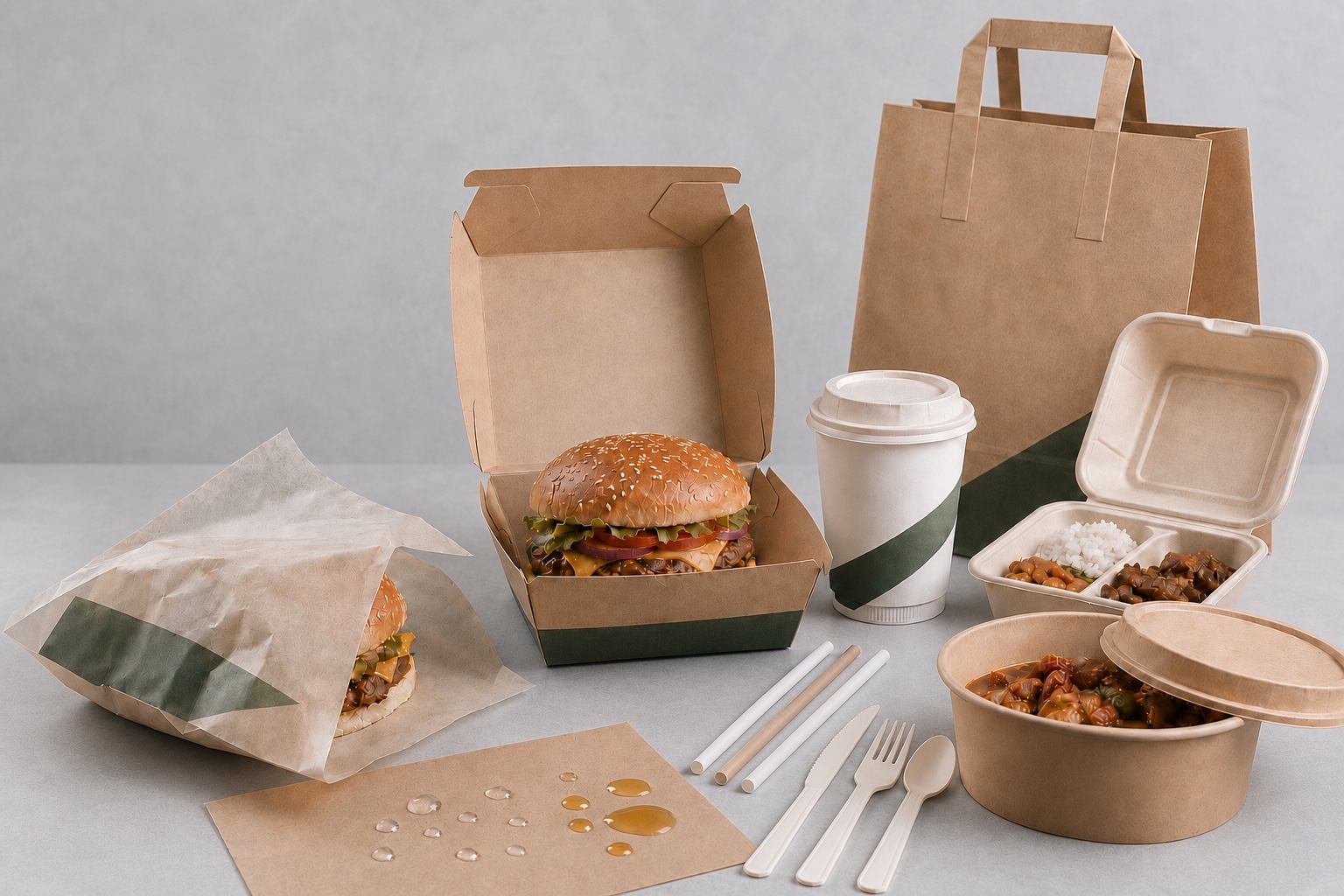





Hot and fatty foods
Assess mixed oil/water, hot steam, corner pooling, crease penetration, load bearing and closure.


FOODSERVICEWARE · FOOD CONTAINER
Folded cartons, formed trays and compartmented containers face mixed foods, oil/water migration, crease damage, corner sealing, stacking and delivery vibration and must be assessed as complete structures.
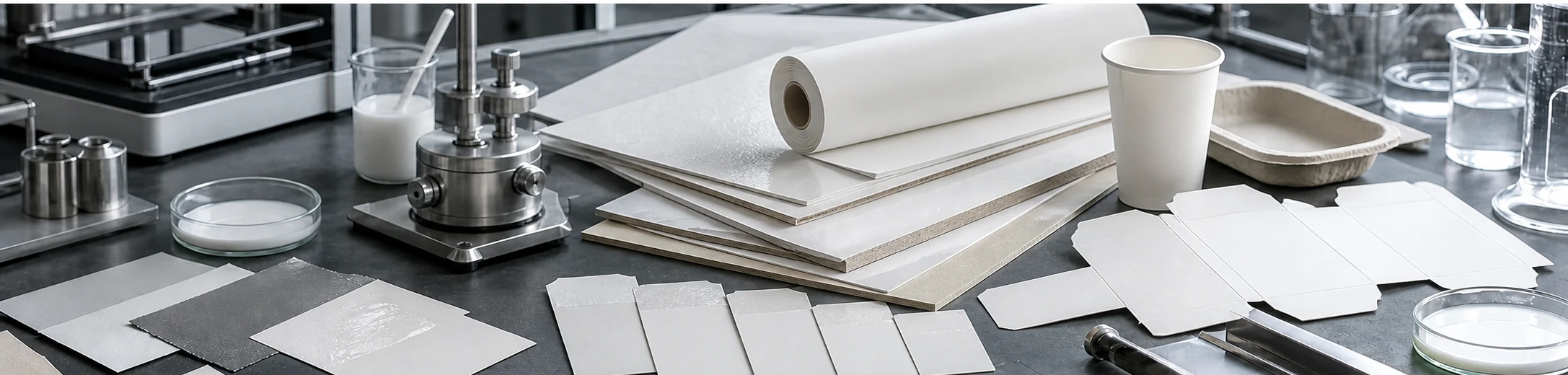
Engineering scope | paper, candidate coatings, converting, finished articles and responsibilities are governed together, with project results delivered by evidence version.
01 · SCENARIO
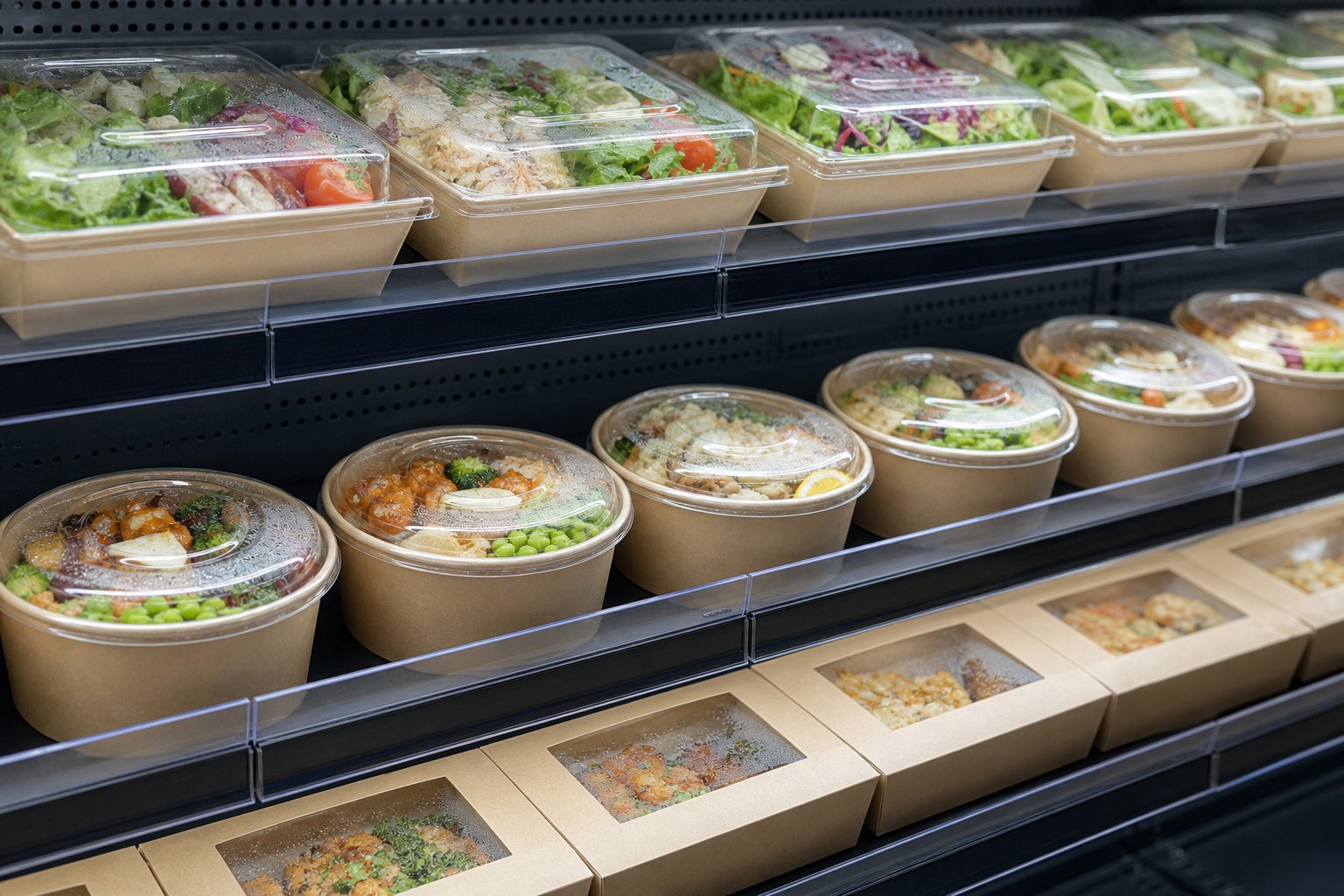
Container architecture must follow the food, delivery and eating mode.
Assess mixed oil/water, hot steam, corner pooling, crease penetration, load bearing and closure.
Assess moisture migration, acidic dressings, condensation, extended hold and transparent lid/window combinations.
Adjacent media, divider distortion, cross-flow, stacking and delivery amplify local risks.
02 · COMPONENTS / BOM
Every test, compliance or environmental conclusion must be tied to the complete structure, suppliers, batches and specimen version.
Panels, base, walls, creases, folded corners, locks, compartments and cut edges.
Paper, sizing, inner/outer coatings, printing, varnish and possible window/laminate areas.
Paper or transparent lid, adhesive, tamper seal, absorbent pad, separator and label.
03—05 · ENGINEERING AXIS
Each stage retains inputs, specimen version, decision method and fallback criteria. A laboratory flat sheet answers only its defined question.
Stiffness, compression, fold endurance, ply bond, wet-heat dimensional stability and forming direction must match the carton geometry.
Panels, creases, corners, cut edges and locks carry different stresses and require zoned sampling and criteria.
Advance from grease screening and short water contact into mixed-media, time/temperature, abrasion and corner-pooling validation.
After a flat coated sheet passes, cracking and penetration still require evaluation at creases, folds, formed corners and locks.
Confirm ink/varnish compatibility, cut-edge quality, crease geometry, fold direction and coating damage.
Adhesive, heat-sealed, mechanical-lock or formed architectures require validation on target equipment, rate and delivery loads.
06 · FAILURE MAP
Use location, medium, time, temperature, action, specimen version and failure progression to break water resistance into locatable, correctable engineering problems.
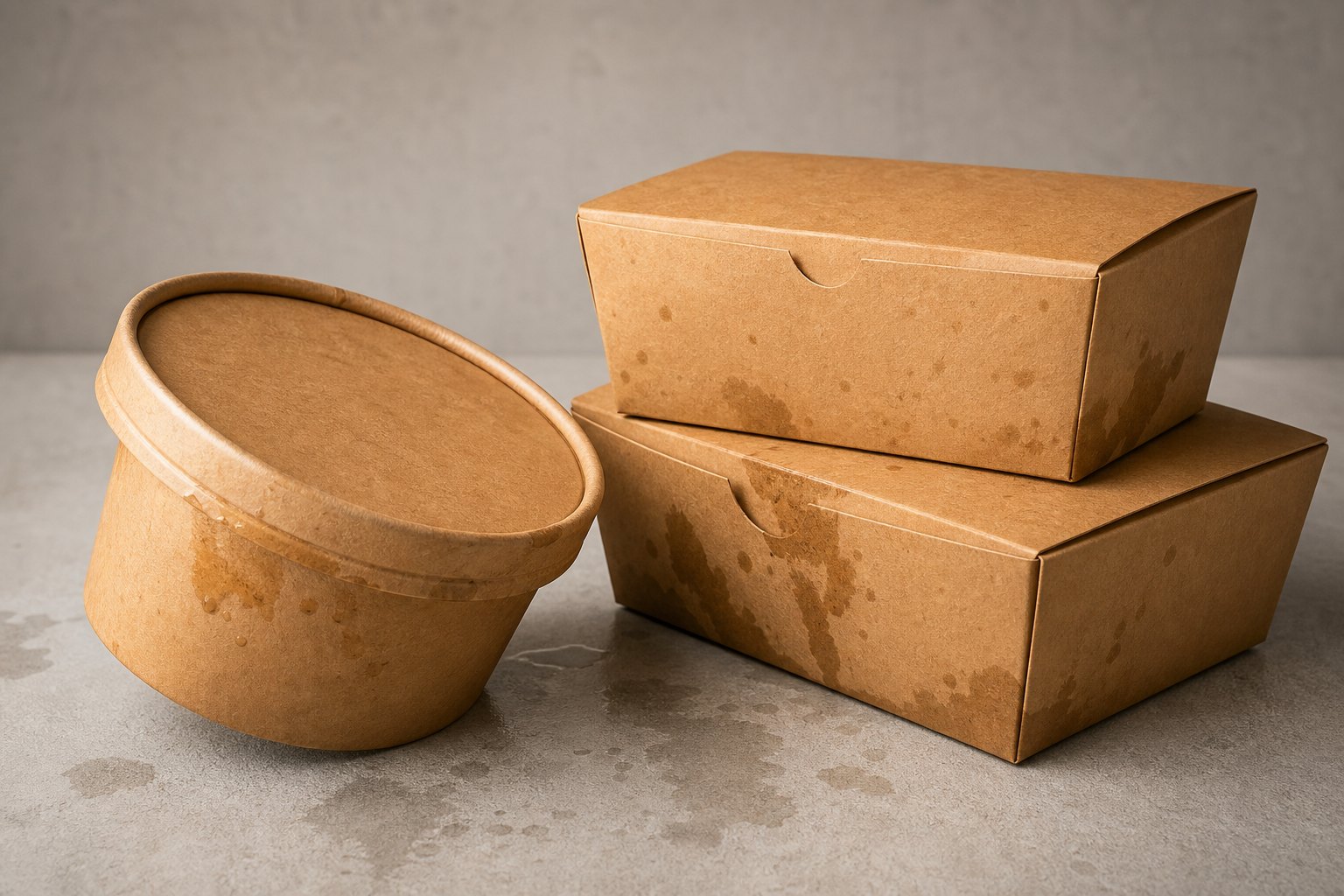
Coating cracks, exposed edges, pooled liquid and insufficient corner sealing often combine.
Wet heat, food load, stacking, handling and divider distortion may cause collapse or lid opening.
Vibration, tilt, impact, insulated-bag conditions and waiting time may change arrival performance.
07 · G0—G4
Sample, production, compliance, shelf-life and environmental claims advance by evidence stage; validation-pending status remains transparent and traceable.
Define contents, temperature, contact time, distribution, storage, use mode, target market and owners, using complete inputs to set the material-conclusion boundary.
Confirm the complete BOM, batches and specimen version for paper, sizing, coating, ink, adhesive and seams, archiving emulsion, flat-sheet and finished-article data by object level.
Validate coating, drying, winding, printing, cutting, creasing, sealing and forming windows, then recheck critical failures on complete articles.
Build food-contact and chemical evidence for the target market, food type, contact conditions and complete formulation. Each claim maps to valid documentation.
After justified use, distribution and evidence review, the project proceeds to decisions on production introduction, shelf-life conclusions, public claims and end-of-life pathways.
Each fixed value carries its specimen, method, conditions, units, sample size, batch and report status, forming a reproducible data passport.
Material and finished-article review and testing are organized by target market, use, food type, time/temperature and complete BOM to form complete-pack compliance evidence.
‘Not intentionally added’, ‘not detected’ and ‘PFAS-free’ are each bound to an analyte list, threshold, method, specimen and supply-chain declaration.
Define plastic, polymer, coating and complete-structure calculation boundaries, then compare material use per pack, functional equivalence and production losses between baseline and candidate structures.
Recyclability and compostability each map the complete article, methods, facility access, regional systems and valid certification or testing into a distinct end-of-life route.
Microwave, hot-food, chilled, frozen and shelf-life suitability build scenario-specific validation results around defined food, container, closure, equipment and time/temperature conditions.
Progress from lab film formation, hand samples and low-speed trials to target equipment, rate, quality system and sustained-run validation.
Submit food media, time/temperature, dieline or article, paper/coating, closure, equipment and delivery conditions to build a zoned failure map and validation plan.