








Scale shows how much can be produced; stability determines whether every tonne of fibre can keep creating value.
China’s Top 20 Paper Producers · 06/ CHINA PAPER LEADERS
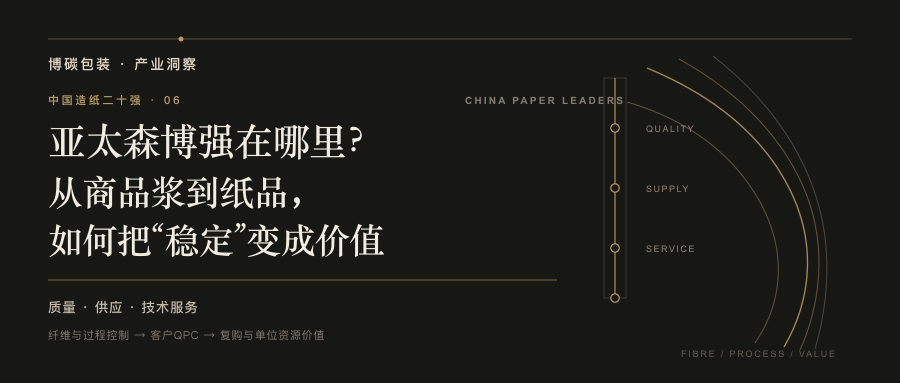
Starting from its ranking figure of 3.7781 million tonnes, this article explains how Asia Symbol turns fibre grading, continuous manufacturing, online control and coordination across multiple production bases into stable quality, supply and technical service—and how customers ultimately validate that stability through QPC results, repeat purchases and higher value per unit of resource.
CORE JUDGEMENT
Asia Symbol’s distinguishing capability is not merely the scale of its pulp and paper operations; it is the company’s effort to organise fibre, continuous manufacturing, online control, multi-site supply and customer technical service into a “stability system”.
This system has established a manufacturing and product foundation. The next stage of value creation must be demonstrated through commercialisation of new products, stable project ramp-up, improved customer QPC results, sustained repeat purchases and clearer product-level environmental data.
In the China Paper Association’s 2025 output ranking of major paper producers, Asia Symbol Group reported3.7781 million tonnesof paper and paperboard, ranking sixth, up 6.30% year on year.
But that ranking excludes one of Asia Symbol’s most important businesses—market wood pulp. The company’s 2025 Sustainability Report states that its Shandong, Guangdong and Jiangsu operations produced a combined total of5.9148 million tonnesof wood pulp, printing and writing paper, and white paperboard.
Both figures are valid, but they answer different questions: the first is a ranking figure for paper and paperboard; the second includes wood pulp and shows the breadth of the business system. They are not interchangeable and must not be subtracted, divided or used to infer capacity utilisation.
3.7781million tonnes
2025 paper and paperboard producer ranking · No. 6 nationwide
5.9148million tonnes
2025 company reporting scope · total output of wood pulp, printing and writing paper, and white paperboard
Scope note: do not combine the two figures mathematically. Sources: China Paper Association’s 2025 annual report and Asia Symbol’s 2025 Sustainability Report.
The real question is not “how many million tonnes does Asia Symbol have?” It is this: when market pulp, printing and writing paper, white paperboard and tissue are distributed across different production bases, equipment and customer conditions, how does the company keep quality variation, supply cadence and technical service within a window customers can anticipate?
In its 2025 report, Asia Symbol summarises its pulp-business principles as “stable quality, stable supply and stable technical service”. This is not a slogan to be accepted at face value, but a testable operating thesis: whether batch variation narrows; whether paper machines and converting equipment run steadily; whether delivery is predictable; whether complaints are closed out; and whether new products progress from trial runs to repeat orders.
RESEARCH QUESTION
Against an industry backdrop of rising output but pressure on revenue and profit, can Asia Symbol translate pulp and paper scale into repeatable quality, predictable supply and verifiable customer value?
Research boundary: this article examines the company’s pulp and paper operations in China. Because unified, consolidated group revenue, profit and operating cash-flow data were not available, output is not used as a proxy for profitability and no undisclosed financial results are inferred.
01 · SCALE IS NOT STABILITY
Two sets of figures describe scale, not “stability”
In 2025, China produced 141.35 million tonnes of paper and paperboard, up 3.74% year on year. Over the same period, operating revenue across the pulp, paper and paper-products industry fell 2.59%, while total profit fell 13.55%.
These data make the industry reality clear:Volume can grow without revenue and profit moving in step.When new supply, pricing pressure and product differentiation coexist, scale is only the entry ticket to competition; it does not, by itself, demonstrate operating quality.
141.35million tonnes +3.74%
National paper and paperboard output
−2.59%Operating revenue
Pulp, paper and paper-products industry as a whole
−13.55%Total profit
Industry aggregate from the same association report; not used to infer Asia Symbol’s profitability.
For downstream paper mills and converters, meeting an average specification is only the starting point. The harder task is to keep variation in brightness, cleanliness, fibre distribution, strength, wet expansion, stiffness and surface properties within an acceptable window.
Because one sample with attractive test results cannot support long-term production,only a controlled distribution can keep paper machines running continuously, reduce converting abnormalities and maintain batch-to-batch consistency in finished products.
The No. 6 ranking is therefore only a point of entry. The larger the scale and the broader the product range, the harder stability is to manage—and the more rigorously the company’s system capabilities are tested.
02 · FIBRE AS A FUNCTION
Stability begins by turning fibre into a defined function
The capacity map disclosed in Asia Symbol’s 2025 report includes: Shandong, annual capacity of 2.35 million tonnes of wood pulp, 600,000 tonnes of white paperboard and 500,000 tonnes of printing and writing paper; Guangdong, 1.5 million tonnes of high-grade printing and writing paper; and Jiangsu, 1 million tonnes of high-grade white paperboard.
SHANDONG · Rizhao
2.35 million tonnes wood pulp · 600,000 tonnes white paperboard · 500,000 tonnes printing and writing paper
Controls the fibre and pulping foundation, while extending into paperboard, printing and writing paper, and tissue.
GUANGDONG · Jiangmen
1.5 million tonnes of high-grade printing and writing paper
Supports large-scale production and market service for printing and writing paper.
JIANGSU · Rugao
1 million tonnes of high-grade white paperboard
Focuses on applications including food packaging, paper cups and liquid packaging.
The value of the three production bases is not a simple sum of their figures. It lies in their different product roles and in connecting upstream fibre, manufacturing processes and downstream applications.
Upstream, official information from Asia Symbol’s Shandong operation states that it can supply more than 2 million tonnes per year of bleached kraft hardwood pulp. It uses continuous cooking, kraft pulping and elemental chlorine-free (ECF) bleaching, and differentiates its grades by application: BPT for tissue, BPSP for specialty paper and BPW for printing and writing paper.
BPT | Tissue:Focuses on softness, formation and fibre bonding.
BPSP | Specialty paper:Focuses on cleanliness, dimensional stability and converting suitability.
BPW | Printing and writing paper:Focuses on opacity, smoothness, strength and printability.
Market pulp is therefore no longer merely a generic “hardwood pulp”; it becomes a portfolio of fibre functions designed for different paper machines and finished-paper targets.
In manufacturing, the company states that the 500,000-tonne high-grade printing and writing paper line in Rizhao has a design speed of 1,800 m/min and is equipped with distributed control systems (DCS) and quality control systems (QCS) for online quality monitoring. Downstream processes such as cutting, packaging, stacking and palletising are also automated.
Advanced equipment does not automatically produce advanced results. A genuine quality system must close the loop among online data, laboratory testing, customer feedback, paper-machine settings and formulation adjustments. The test is whether variation can be kept within the customer’s window over high-speed, long-duration and multi-batch production.
Fibre grading → continuous manufacturing → online control → customer feedback
This is the process chain through which “stability” is created. Equipment configuration only shows that control conditions exist; it does not automatically prove long-term operating results.
03 · FROM TONNES TO SQUARE METRES
From tonnes of pulp to stable performance per square metre: how stability becomes product value
Asia Symbol’s portfolio extends across market pulp, printing and writing paper, white paperboard and tissue. The four categories share a fibre foundation but face different tests of value: market pulp is judged by batch consistency and paper-machine compatibility; printing and writing paper by print performance and machine runnability; white paperboard by printing, die-cutting, creasing, carton forming and filling; and tissue by softness, strength, absorbency, converting and channel turnover.
China Paper Association data show that, in 2025, output of uncoated printing and writing paper grew 1.63% and consumption 1.25%; white paperboard output grew 2.62% and consumption 1.21%; and tissue output grew 4.37% and consumption 1.95%. Based on the association’s import and export tables, the three categories recorded net exports of approximately 920,000 tonnes, 2.51 million tonnes and 1.65 million tonnes, respectively.
2025 · INDUSTRY CONTEXT
Uncoated printing and writing paper:Output +1.63% · consumption +1.25% · net exports approx. 920,000 tonnes
White paperboard:Output +2.62% · consumption +1.21% · net exports approx. 2.51 million tonnes
Tissue:Output +4.37% · consumption +1.95% · net exports approx. 1.65 million tonnes
These industry figures describe the market environment for each category; they do not represent Asia Symbol’s sales, pricing, market share or profitability.
As products span more customers, equipment and regions, consistency of quality, predictability of delivery and speed of technical response only become more important.
In 2025, Asia Symbol disclosed R&D expenditure of RMB 1.1202945 billion, or approximatelyRMB 1.12 billion.The company employed 778 R&D staff, representing 15.98% of its workforce. The Jiangsu operation conducted 28 R&D projects and completed trial production of 8 new products; the Guangdong operation was granted 11 patents.
1.12billion yuan
2025 R&D expenditure
778people
R&D staff · 15.98% of the workforce
Jiangsu: 28 projects → 8 products completed trial production; Guangdong: 11 patents granted.
Investment and trial production show that the R&D system is operating; they do not prove that commercial value has already been realised. The true conversion chain should be:
Successful trial production → validation on customer equipment → batch consistency → sustained repeat purchases
High-bulk gable-top liquid-packaging paperboard is one typical stress test. The company reports that, while meeting the same finished-paper performance and customer requirements, paper weight for the same area can be reduced by approximately 10%. For lightweight kraft-back liquid-packaging paperboard, the company reports a reduction of 2%–5%.
Lightweighting does not simply mean making paper thinner. At a lower basis weight, thickness, stiffness, interlayer bonding, edge wicking, printability, lamination, carton forming, filling and transport performance must all be maintained. Only when these properties remain stable on specific customer structures and equipment can lower fibre and chemical inputs become genuine customer value.
The key to moving from “tonnes of pulp” to “performance per square metre” is therefore not a longer list of product names, but whether new products can perform repeatedly within more complex application windows.
04 · THREE CLOCKS
Expansion in 2026 must stand the test of three clocks
On 5 May 2026, a production snapshot published by Rizhao News showed all lines at Asia Symbol’s Shandong operation running at full load that day. Daily output was approximately 1,500 tonnes of printing and writing base paper, sheets and A3/A4 copy paper, and approximately 460 tonnes of tissue parent rolls, soft packs and toilet rolls.
This is a positive single-day operating data point, but it is not average output for the first half of the year and cannot substitute for sales, profit or cash flow.
The phase II tissue project began at the end of 2025. The current phase plans 6 tissue production lines plus slitting, converting and warehousing systems, adding 150,000 tonnes of capacity. The first line is planned to start production by the end of 2026, with the full project planned to be operational in the first half of 2027. These are planned dates, not realised results.
In March 2026, Asia Symbol’s Shandong operation also published a draft environmental impact assessment for public consultation on an optimisation and upgrade of its pulp lines. The proposal would raise PL11 from 315,000 tonnes per year to 390,000 tonnes per year, and PL12 from 1.92 million tonnes per year to 2.10 million tonnes per year. Publication only confirms entry into public participation; it does not mean the project has been approved, completed or reached design output.
01 · DELIVERY CLOCK
Whether civil works, equipment installation, commissioning and start-up are completed as planned.
02 · RAMP-UP CLOCK
Whether paper machines ramp up steadily, and whether yield, web-break rate, energy consumption, unit consumption and batch consistency enter their target windows.
03 · ADOPTION CLOCK
Whether new products pass customer validation and achieve a sound sales mix, sustained repeat purchases and healthy collections.
Starting a project on schedule is positive, but only when the three clocks gradually align will added tonnage become stable supply rather than additional depreciation, inventory and pricing pressure. Without unified consolidated group financial data, this article cannot conclude that overall profit, cash flow or investment returns have improved.
05 · QPC AS PROOF
The industrial chain must jointly validate QPC outcomes
Asia Symbol’s public materials repeatedly use the operating concept of QPC, meaningquality, production and cost.It turns “stability” from an abstract adjective into traceable outcomes: whether quality remains conforming, whether production lines deliver stable output and whether total cost stays under control amid volatility.
QQUALITY · Quality
Batch variation, customer acceptance rate, and closure of complaints and abnormalities
PPRODUCTION · Production
Continuous operation, conforming output and predictable delivery
CCOST · Cost
Energy consumption, unit consumption, processing abnormalities and total cost in use
Woodchip, pulp and chemical suppliers:The purchase price alone is not enough; refining energy, retention, strength, paper-machine abnormalities and batch variation must also be considered.
Equipment and digital-technology providers:Supplying equipment specifications alone is not enough; online monitoring, predictive maintenance, web-break rate, energy consumption and yield must be connected.
Printers and packaging converters:Laboratory paper samples alone are not enough; performance must be validated under real printing, die-cutting, creasing, carton-forming, laminating and filling speeds.
Brand owners and procurement teams:Writing “green” or “lightweight” is not enough; performance windows, batch rules, traceability documents and responsibility for abnormalities must be written into procurement specifications.
Functional-materials providers:Barrier, heat-seal or grease-resistance data cannot stop at a single material layer; they must be assessed against the specific base paper, coating structure, processing conditions and final package.
Environmental indicators are also hard constraints on continuous production. Asia Symbol’s full Chinese-language report states that, in 2025, greenhouse-gas emissions were 0.43 tCO₂e per tonne of product; renewable and clean energy accounted for 73.60%; water consumption was 9.12 m³ per tonne of product; and the industrial-water reuse rate was 96.26%. Of purchased woodchips and pulp, 43.35% fell within the company’s category of “FSC or PEFC/CFCC certified, or covered by due diligence”.
0.43tCO₂e / tonne of product
Greenhouse-gas emissions per tonne of product
73.60%Renewable and clean energy
Company reporting scope
9.12m³ / tonne of product
Water consumption per tonne of product · industrial-water reuse rate 96.26%
43.35%
Share of purchased woodchips and pulp included by the company within certification or due-diligence coverage
These are company-level indicators covering the Shandong, Guangdong and Jiangsu operations. They are not the product carbon footprint of any single paper grade, package or order, and they do not mean that all raw materials carry the same certification. What downstream customers need is further allocation of the company-level baseline to specific products, certificate holders, chain-of-custody scopes and order documentation.
For material and application researchers, including BIOTEN Packaging, studying Asia Symbol does not mean assuming that any one material must be used in all paper products, and it certainly does not imply that the two companies already cooperate. The purpose is to identify the functions genuinely missing from a specific grade and validate them jointly against customer QPC and final-packaging conditions.
Good collaboration does not force one material into every scenario. It allows fibre, chemicals, coatings, equipment and recycling systems to work together in the right application.
CONCLUSION · THE DIVIDING LINE
The dividing line is not how much larger capacity can become, but whether “stability” can be verified repeatedly
Asia Symbol has established scale: its paper and paperboard output ranks sixth; market wood pulp, printing and writing paper, and white paperboard form a multi-site manufacturing foundation; and tissue and lightweight paperboard are extending the product boundary.
More importantly, it is seeking to convert scale into three forms of stability: stable quality, stable supply and stable technical service. Fibre grading, continuous pulping, online monitoring, multi-site manufacturing and the R&D organisation provide the foundation for this path.
What remains to be demonstrated is equally clear: whether new capacity can ramp up steadily; whether new products can move from trial production to repeat volume orders; whether company-level environmental indicators can be allocated further to specific products and orders; and whether these capabilities ultimately generate sustainable profit and cash flow.
The dividing line for Asia Symbol’s future value is not how much larger capacity can become, but whether “stability” can be verified again and again across more products, more production bases and more customer conditions.
NEXT · CHINA’S TOP 20 PAPER PRODUCERS · 07
Next article | Huatai Group
According to the China Paper Association’s 2025 output ranking of major paper producers, Huatai Group Co., Ltd. ranked seventh with 3.1027 million tonnes of paper and paperboard.
The next article will continue the series through four dimensions: product structure, manufacturing coordination, project progress and value realisation. This note establishes only the sequence and research question; it does not prejudge the conclusion.
Ranking source: appendix to the China Paper Association’s China Paper Industry 2025 Annual Report.
BIOTEN Packaging · Industry Insights · Research note
This article uses the following method: association statistics establish the scale coordinate; the company’s full Chinese-language report is used to break down capabilities; official project information defines each project’s stage; and customer QPC tests industrial value. Information was verified through 16 August 2026. Facts, company disclosures, this article’s analysis and project plans are presented separately.
The China Paper Association figure of 3.7781 million tonnes refers to Asia Symbol’s 2025 paper and paperboard output within the association’s major-producer ranking. Asia Symbol’s figure of 5.9148 million tonnes is the total output of wood pulp, printing and writing paper, and white paperboard disclosed in its 2025 Sustainability Report, covering the Shandong, Guangdong and Jiangsu operations. The 2025 report no longer includes the Jiujiang tissue mill in Jiangxi, so the figure cannot be compared directly with the 2024 total of 6.085 million tonnes, which included that mill and tissue.
Asia Symbol’s English release note and the full Chinese-language report display different figures for three items: renewable and clean energy, the water reuse rate, and the procurement scope for woodchips and pulp. The 2025 report states that the Chinese version prevails in the event of inconsistency. This article therefore uses the 73.60%, 96.26% and 43.35% figures explicitly stated in the full Chinese edition, while retaining a record of the discrepancies in the internal source register.
This article did not obtain consolidated revenue, profit or operating cash-flow data for Asia Symbol comparable with listed-company annual-report disclosures. It therefore makes no inference about profitability, cash flow or capacity utilisation. The tissue start-up timetable, pulp-line upgrade and lightweighting figures are qualified according to public disclosures and do not represent full production or applicability to every customer structure.
Reference data and verification sources
01 | China Paper Association, China Paper Industry 2025 Annual Report
02 | Asia Symbol, 2025 Sustainability Report, full Chinese edition
03 | Asia Symbol, release note for the 2025 Sustainability Report
04 | Asia Symbol, pulp products and application-specific grades
05 | Asia Symbol, paperboard product information
06 | Asia Symbol, information on the 500,000-tonne high-grade printing and writing paper line
07 | Asia Symbol, 2023 Sustainability Report and QPC explanation
08 | Rizhao Daily, phase II tissue project and 2025 development review
09 | Rizhao News, May 2026 production snapshot
10 | Rizhao News, progress on key projects in the Rizhao Economic and Technological Development Zone
11 | Public consultation draft EIA for Asia Symbol’s pulp-line upgrade project
12 | Asia Symbol, 2024 Sustainability Report and reporting boundary